Some days, keeping your toddler busy feels like a full-time job.
You clean up one activity, and five minutes later, your little one is standing beside you saying, “What can I do?” You offer a toy. They lose interest. You suggest a book. They wander away. You finally sit down with your coffee, and suddenly the cushions are being turned into a mountain.
Sound familiar?
The good news is that you don’t need a house full of toys or a complicated activity schedule to make playtime enjoyable. Some of the best toddler activities use things you already have at home: a cardboard box, a few cups, some paper, clean socks, cushions, or even a pile of laundry.
At this age, your child learns through doing. They want to touch, move, pour, stack, scribble, imitate, investigate, and repeat. The CDC explains that the way toddlers play, learn, communicate, behave, and move provides useful clues about their development.
So instead of trying to entertain your toddler every minute, think of these Toddler Activities as a simple toolbox. When your child has extra energy, choose a movement game. When they need something quieter, try stickers or sorting. When you’re stuck indoors, bring out a cardboard box and let their imagination take over.
Here are 50 easy Toddler Activities you can use at home, indoors, outdoors, during busy afternoons, or whenever you hear those familiar words: “I’m bored.”
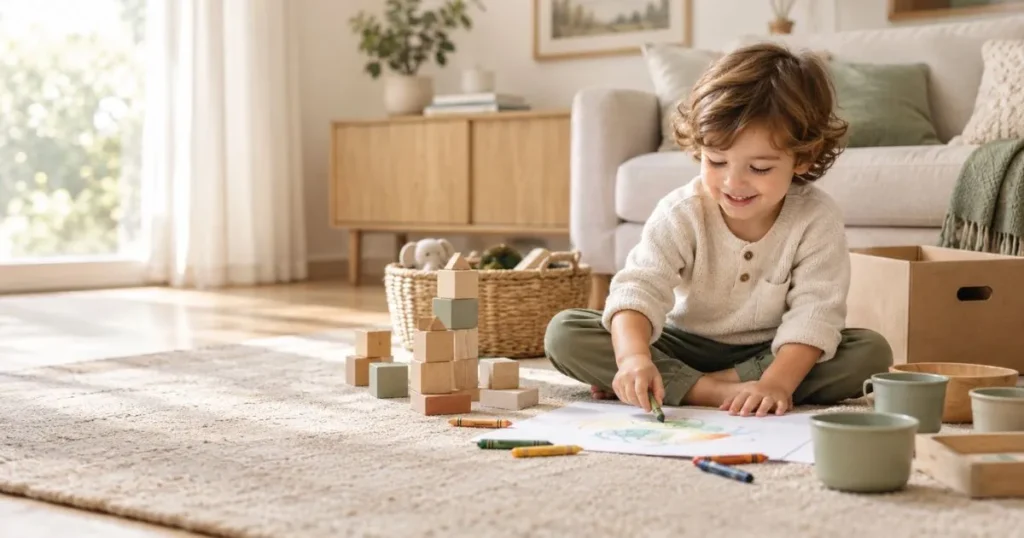
What Makes a Good Toddler Activity?
As you start working your way through the list, remember one thing: an activity doesn’t have to be impressive to be worthwhile.
Your toddler may spend twenty minutes building a tower one day and abandon it after two minutes the next. That doesn’t mean the activity failed. Young children often move quickly between ideas, return to familiar games, and turn one activity into something completely different.
A useful Toddler Activity usually has a few simple qualities:
- It is appropriate for your child’s abilities.
- It doesn’t require a long setup.
- Your child can participate rather than simply watch.
- It leaves room for exploration.
- You can adapt it when your toddler loses interest.
- It doesn’t require expensive materials.
- It gives your child an opportunity to move, create, communicate, or solve a simple problem.
You also don’t have to finish an activity exactly as you planned it.
If you set up a color-sorting game and your toddler decides the blocks are ingredients for an imaginary soup, follow their lead. That shift is part of the play.
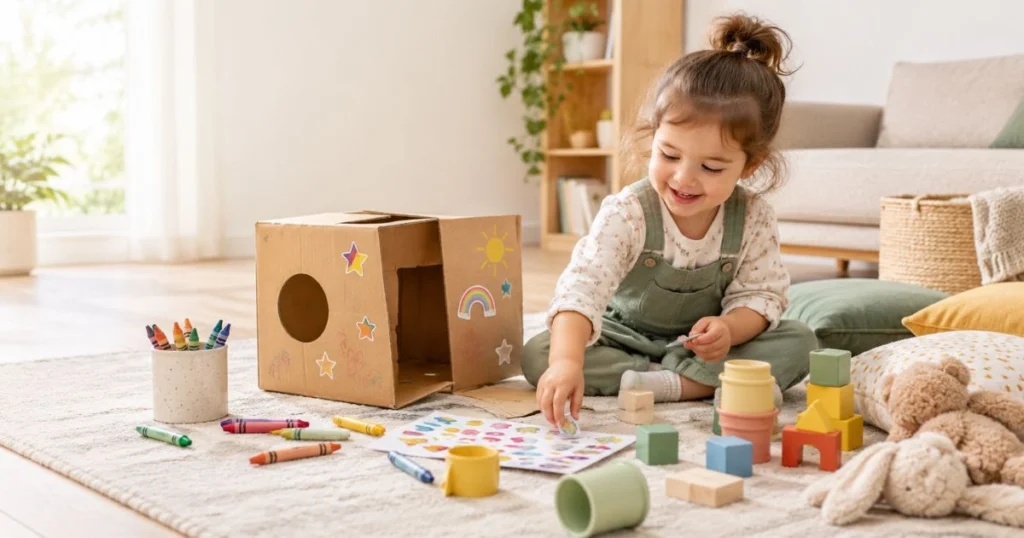
The CDC‘s guidance on child-led play similarly encourages parents to let children take the lead, while adults can support Toddler Activities through attention, imitation, description, and encouragement.
Many simple toddler activities also build fine motor skills through actions like squeezing, sorting, sticking, drawing, and manipulating objects.
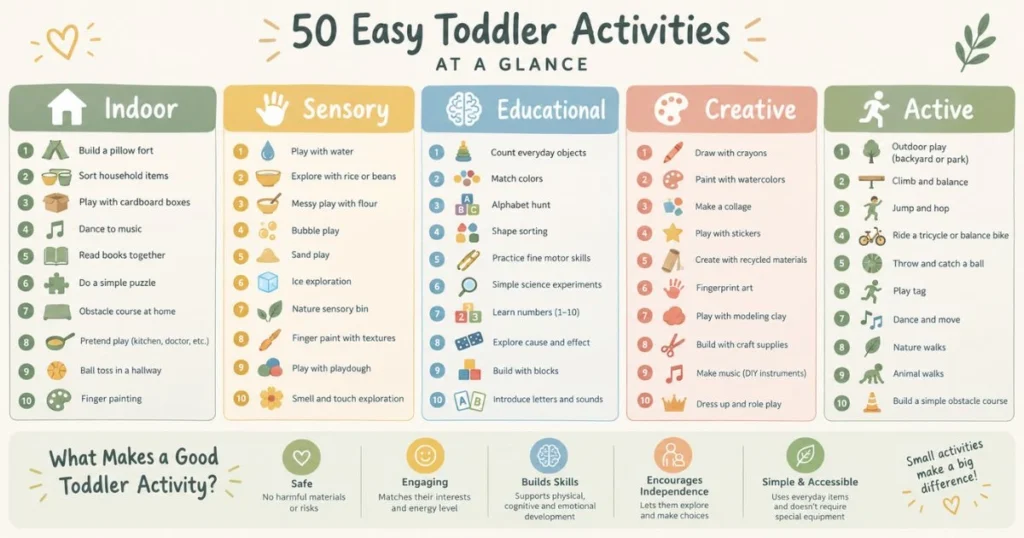
50 Easy Toddler Activities to Keep Little Kids Busy
Easy Indoor Toddler Activities
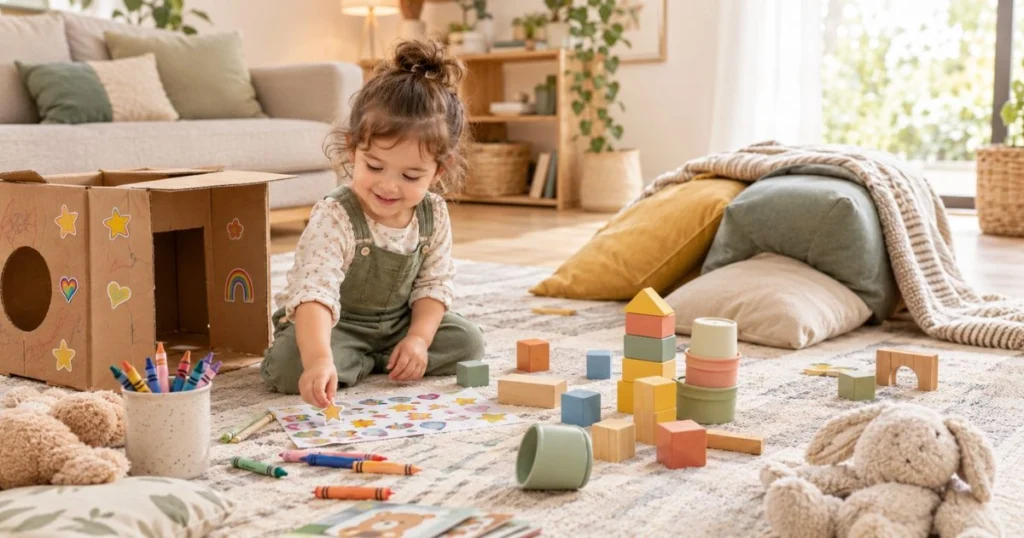
When the weather keeps you indoors or you simply need easy Toddler Activities for the living room, these ideas are a great place to start.
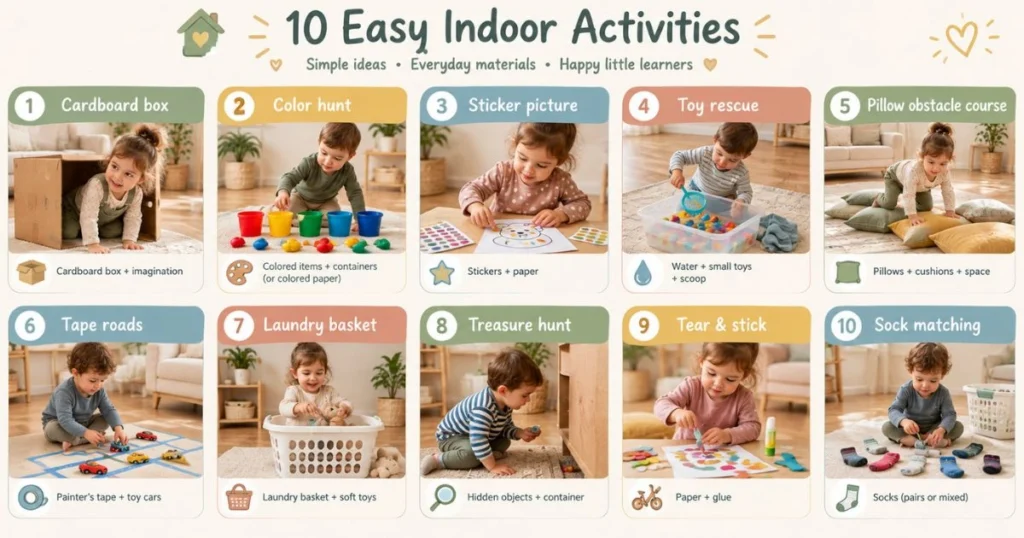
1. Turn a Cardboard Box Into Something New
Don’t throw that large delivery box away just yet.
Give your toddler a few washable crayons or markers and let them decide what the box becomes.
It could be:
- A house
- A car
- A train
- A shop
- A bed for stuffed animals
- A pretend animal shelter
You can cut or decorate the box if you want, but you don’t need to. Often, the plain box is enough.
Why it works: Your child gets to practice imagination, language, and pretend play without needing a special toy.
2. Go on a Color Hunt
Choose one color and challenge your toddler to find objects around the room that match it.
Say:
“Can you find something blue?”
Once they find one item, continue looking together.
For older toddlers, make it slightly harder by asking them to find three objects of the same color.
3. Create a Sticker Picture
Give your toddler a sheet of paper and large, age-appropriate stickers.
Don’t worry about creating a recognizable picture. Let your child place the stickers wherever they want.
You can talk about:
- Colors
- Shapes
- Animals
- Sizes
- Positions such as “above,” “under,” and “next to”
This turns a simple craft into a small language game.
4. Play Toy Rescue
Put several familiar toys into a safe, easy-to-open container.
Your toddler’s mission is to rescue them.
You can make the game more interesting by saying:
“Can you save the teddy?”
“Where is the car?”
“Can you find the ball?”
The activity encourages reaching, grasping, coordination, and simple problem-solving.
5. Build a Pillow Obstacle Course
Use cushions and pillows to create a simple path.
Your toddler can:
- Walk around a pillow.
- Step over a low cushion.
- Crawl through a safe space.
- Reach a stuffed animal at the end.
Keep everything low and stable, and remove anything that could cause a fall.
6. Make Roads With Painter’s Tape
Use removable painter’s tape to make roads on the floor.
Then add toy cars, blocks, or stuffed animals.
Your toddler can drive from one “building” to another.
You can introduce simple words such as:
- Stop
- Go
- Fast
- Slow
- Up
- Down
- Turn
7. Push a Laundry Basket
An empty laundry basket can become a surprisingly entertaining activity.
Let your toddler push it across a clear floor.
Put a few soft toys inside if your child enjoys transporting things from one place to another.
Make sure the basket is stable and your toddler has enough open space.
8. Have an Indoor Treasure Hunt
Hide a few familiar objects in easy-to-find locations.
Instead of giving complicated clues, keep them simple:
“Can you find your teddy?”
“Look near the chair.”
“Can you find something red?”
This activity combines movement with listening and language.
9. Tear and Stick Paper
Give your toddler pieces of paper and let them tear them into smaller pieces.
Then use child-safe glue to attach the pieces to another sheet.
You don’t need a particular final picture.
The process is the activity.
10. Match Clean Socks
Put several clean socks into a basket.
Ask your toddler to find pairs.
You can start with only two or three pairs and gradually add more.
This is especially useful when you want a quiet activity that doesn’t require a lot of preparation.
If you need even more ideas for days when you’re stuck inside, see our guide to [30 Easy Indoor Activities for Toddlers].
Sensory Toddler Activities
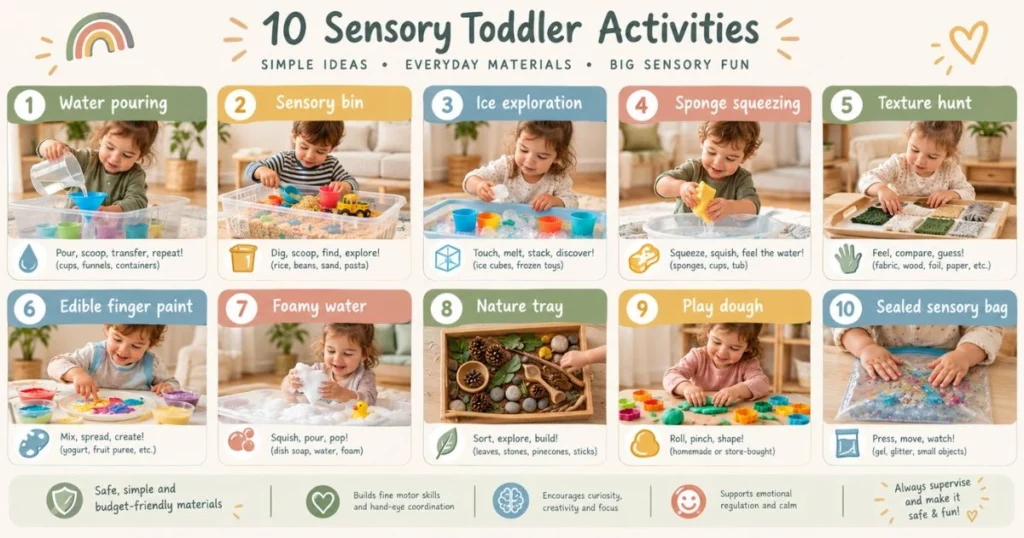
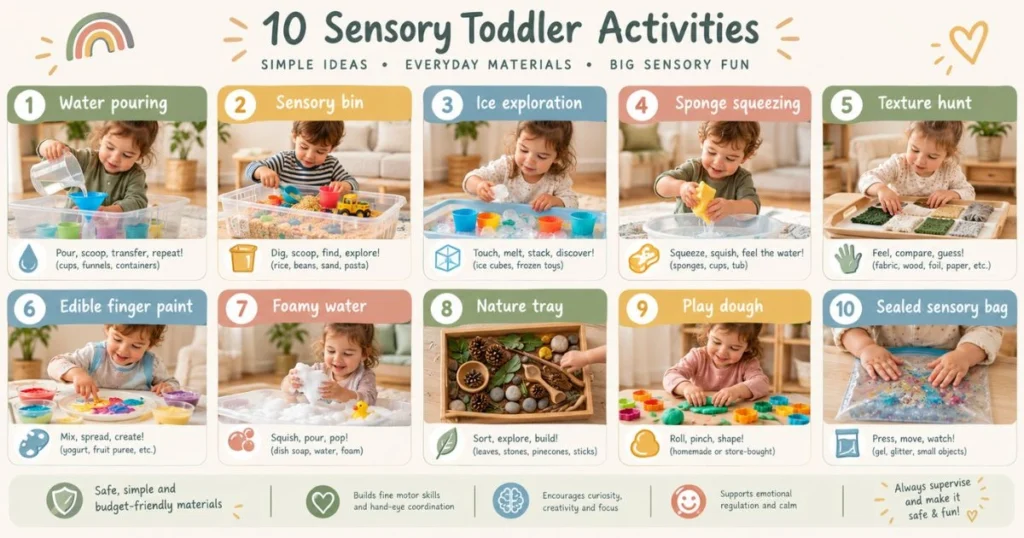
Sensory play can be wonderfully simple. Your toddler doesn’t need an elaborate sensory table. A shallow container and a few safe materials may be enough.
Always choose materials that are appropriate for your child’s age and supervise closely, particularly when water, food, small objects, or loose materials are involved.
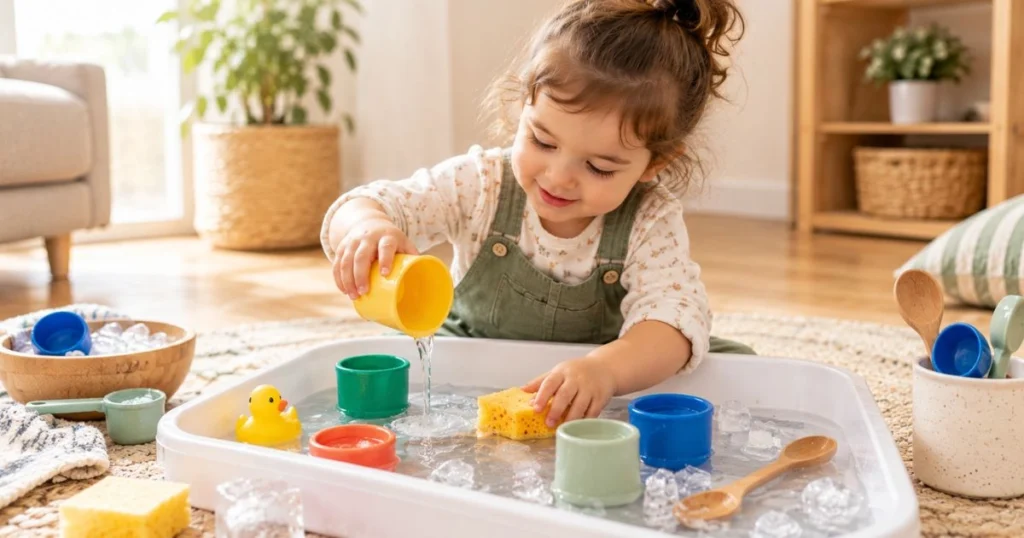
11. Set Up a Water Pouring Station
Place a small amount of water in a basin or suitable container.
Add:
- Plastic cups
- Small bowls
- Spoons
- Measuring cups
- Safe containers
Let your toddler pour water from one container into another.
This can become surprisingly absorbing.
Skills involved: hand-eye coordination, pouring, concentration, and early understanding of volume.
12. Make a Simple Sensory Bin
Choose an age-appropriate sensory material and put it into a shallow container.
Add larger objects that your toddler can safely handle.
Your child can scoop, transfer, touch, and explore.
Avoid small items if your toddler still mouths objects.
13. Explore Ice
Place a few ice cubes into a bowl.
Let your toddler touch and observe them.
Talk about what happens:
“The ice is cold.”
“Look, it’s getting smaller.”
“There’s water in the bowl.”
You are introducing simple science concepts without turning the activity into a lesson.
14. Try Sponge Squeezing
Give your toddler a sponge and two containers with a small amount of water.
Show them how to dip the sponge into the water and squeeze it into the other container.
It is simple, but the repetitive movement can be very satisfying.
15. Go on a Texture Hunt
Collect safe objects with different textures.
You might have:
- Something soft
- Something smooth
- Something rough
- Something hard
- Something bumpy
Let your toddler touch each one.
Use descriptive words as you play.
16. Make Edible Finger Paint
For toddlers who are likely to put their fingers in their mouths, you can make an edible painting mixture from simple food ingredients.
Use a large sheet of paper and let your toddler spread, tap, swirl, and make marks.
The purpose isn’t creating beautiful artwork. It’s letting your child explore texture and movement.
17. Make Foamy Water
Add bubbles to a small amount of water and give your toddler cups and safe utensils for scooping and transferring.
This can be especially appealing during bath time.
Never leave your toddler alone around water.
18. Create a Nature Sensory Tray
Bring some of the outdoors inside.
Depending on your surroundings, you might use:
- Large leaves
- A large pinecone
- Smooth, large stones
- Sticks
- Grass
Let your toddler look at and touch the different materials.
Check everything first and remove anything sharp, toxic, dirty, or small enough to become a choking hazard.
19. Squish and Roll Play Dough
Play dough is one of those materials that can be used in countless ways.
Your toddler can:
- Squish it
- Roll it
- Flatten it
- Pinch it
- Make balls
- Press objects into it
You can add simple pretend play too.
“Let’s make dinner.”
“Can you make a tiny pancake?”
20. Make a Sealed Sensory Bag
Place a suitable gel or liquid inside a strong, securely sealed sensory bag.
Let your toddler press and move the contents with their fingers.
Check the bag carefully before use and supervise throughout the activity. If it leaks or becomes damaged, remove it immediately.
If your toddler enjoys touching, pouring, scooping, and exploring different textures, you’ll find more simple ideas in our guide to [Sensory Play: 25 Easy Activities for Toddlers at Home].
Educational Toddler Activities That Feel Like Play
Learning doesn’t have to mean worksheets.
For toddlers, everyday Toddler Activities can naturally build skills through counting, matching, sorting, language, memory, movement, and simple problem-solving.
The CDC‘s current guidance for 2-year-olds includes activities such as simple puzzles, blocks, art, songs, outdoor exploration, playing with containers, and helping with household tasks.
21. Sort by Color
Gather several large, safe objects.
Ask your toddler to make groups.
For example:
“Put all the red ones here.”
“Where should the yellow block go?”
Don’t worry about correcting every mistake. Let your toddler experiment.
22. Go on a Shape Hunt
Look around your home for shapes.
You might find:
- A round plate
- A square book
- A rectangular box
- A circular lid
You can simply name what you see.
23. Count Toys Together
Choose a few toys and count them aloud.
“One, two, three…”
For a younger toddler, simply hearing the sequence is useful. Older toddlers may begin trying to count independently.
24. Sort Big and Small
Put several objects together.
Ask your toddler to make two groups:
Big and small.
This is a simple introduction to comparison.
25. Match Animals
Use toy animals and pictures.
Ask:
“Where is the dog?”
“Can you find the picture that matches?”
You can also make animal sounds together.
26. Try a Simple Puzzle
Choose a puzzle that matches your toddler’s abilities.
Start with a few large pieces.
The CDC specifically recommends simple puzzles involving shapes, colors, or animals as an activity for 2-year-olds.
27. Explore Letters
You don’t need to teach the alphabet formally.
Let your toddler play with:
- Large magnetic letters
- Alphabet books
- Homemade letter cards
Point out letters you see naturally.
“That’s the letter A.”
Keep it playful.
28. Go on a Number Hunt
Look for numbers around your home.
You might find them on:
- A clock
- A remote control
- A calendar
- Packaging
- A measuring cup
You can simply point them out.
29. Sort Safe Kitchen Utensils
Give your toddler a few safe kitchen items.
Ask them to sort by:
- Size
- Shape
- Type
For example, “Put the spoons here.”
Always remove anything sharp, breakable, or otherwise unsuitable.
30. Play “What’s Missing?”
Put three or four familiar objects on a tray.
Name them together.
Cover the tray, remove one item, then uncover it and see if your toddler can spot what’s missing.
Ask:
“What is missing?”
Your toddler may not get it right away. That’s perfectly fine. The game is about noticing and remembering.
Creative Toddler Activities
Creative play isn’t about making something perfect enough to display on the fridge. These Toddler Activities are about letting your child explore, experiment, and learn through the process.
31. Finger Paint Together
Put washable, child-appropriate paint on paper and let your toddler explore.
Try dots, swirls, handprints, and broad strokes.
The CDC includes crayons and finger painting among simple creative activities for 2-year-olds.
32. Paint With a Sponge
Instead of a paintbrush, use a sponge.
Your toddler can dip and stamp.
Try making circles, lines, or simple patterns.
33. Make a Nature Collage
Take a short walk and collect suitable large natural materials.
Back home, glue them onto paper.
Your toddler can decide where everything goes.
34. Create Scribble Art
Give your toddler crayons and paper.
Let them experiment with:
- Lines
- Dots
- Circles
- Swirls
- Zigzags
There is no wrong picture.
35. Make Paper Plate Animals
Turn a paper plate into a simple animal.
You can add ears, eyes, or a nose using child-safe craft materials.
Your toddler can help with decorating.
36. Make Cotton Ball Pictures
Cotton balls can become clouds, sheep, snow, or abstract art.
Use a simple picture as a starting point, but let your toddler take the idea in another direction.
37. Make Simple Music Shakers
Use a container that can be closed securely and cannot be opened by your toddler.
Let your child shake it while you sing.
Make fast sounds and slow sounds.
Never use loose materials that could escape and become choking hazards.
38. Create Sticker Art
Give your toddler a blank sheet and stickers.
You can turn it into a pretend garden, zoo, road, or simply let them create freely.
39. Experiment With Colors
Use two washable colors and let your toddler discover what happens when they mix.
Try:
- Blue + yellow
- Red + yellow
- Red + blue
Talk about what you see without expecting your toddler to memorize the results.
40. Make Something From a Cardboard Tube
A clean cardboard tube can become part of a simple craft.
Use it to create:
- A telescope
- A pretend microphone
- A stamp
- A simple animal craft
Supervise closely and discard anything that becomes damaged.
Active Toddler Activities to Burn Off Extra Energy
Sometimes your toddler doesn’t need another quiet activity—they simply need to move.
Physical Toddler Activities can be spread throughout the day rather than treated as one formal exercise session. WHO recommends that children ages 1–2 get at least 180 minutes of physical activity across the day, at any intensity, while children ages 3–4 should also get at least 180 minutes, including at least 60 minutes of moderate-to-vigorous activity.
That can include plenty of ordinary play.
41. Have a Dance Party
Put on music and dance.
Try:
- Jumping
- Spinning
- Clapping
- Moving slowly
- Moving quickly
Let your toddler copy you.
42. Walk Like an Animal
Pretend to be different animals.
“Can you walk like a bear?”
“Can you hop like a frog?”
“Can you waddle like a penguin?”
This turns movement into pretend play.
43. Play Balloon Tap
Try to keep a balloon from touching the floor.
Your toddler can tap it upward.
Keep close supervision and immediately remove broken balloon pieces.
44. Play Follow the Leader
Take turns being the leader.
The leader can:
- Clap
- Stomp
- Turn around
- Walk backward with care
- Touch their toes
- March
45. Set Up Indoor Bowling
Use lightweight, safe objects as bowling pins and a soft ball.
Let your toddler roll rather than throw.
46. Play Freeze Dance
Dance while the music plays.
Pause the music.
Everyone freezes.
Then start again.
Toddlers often love the surprise of stopping and starting.
47. Create a Jumping Game
If your toddler can jump safely, place a few simple markers on the floor.
Ask them to jump from one to another.
Adapt the activity to your child’s physical ability.
48. Make a Crawl-Through Tunnel
Use a toddler play tunnel or another safe setup that won’t collapse.
Let your child crawl through it.
You can place a stuffed animal at the other end for them to “rescue.”
49. Have a Scavenger Hunt
Give your toddler a simple mission.
“Find something soft.”
“Find a spoon.”
“Find something green.”
“Find your shoes.”
Now your child is walking, searching, listening, and thinking at the same time.
50. Turn Cleanup Into a Game
Instead of announcing that playtime is over, make cleanup part of the activity.
Try:
“Can we put all the blocks in the basket?”
“Let’s see how many cars we can park.”
The CDC also encourages toddlers to participate in simple household tasks, such as putting toys or laundry into a basket.
For more age-appropriate ways to strengthen little hands, see [Fine Motor Activities for Toddlers: Easy Activities by Age].
Toddler Activities by Age
Not every activity will suit every toddler. Your child’s abilities, interests, and attention span matter more than a strict age label.
Toddler Activities for 1-Year-Olds
Younger toddlers often enjoy Toddler Activities that involve exploring, moving, and copying what they see around them.
Try:
- Water pouring with close supervision
- Large stacking toys
- Simple containers
- Music and movement
- Texture exploration
- Large crayons
- Peekaboo
- Putting toys into baskets
- Simple household helping
During the second year, children become increasingly mobile, explore objects and their surroundings, and often imitate adults and older children.
Toddler Activities for 2-Year-Olds
Two-year-olds may be rThey’re ready for more interactive challenges.
Try these Toddler Activities:
- Simple puzzles
- Color sorting
- Pretend cooking
- Blocks
- Finger painting
- Ball games
- Scavenger hunts
- Counting games
- Helping with simple chores
The CDC’s 2-year-old guidance includes puzzles, blocks, art, songs, outdoor play, balls, containers, and simple helping tasks.
Toddler Activities for 3-Year-Olds
You can gradually make activAs your child grows, they may enjoy Toddler Activities that are a little more challenging and engaging.
Try:
- Longer scavenger hunts
- More detailed crafts
- Pretend-play stories
- Simple matching games
- Obstacle courses
- Counting games
- Memory games
- Simple turn-taking games
The goal isn’t to make the activity “hard.” You’re simply giving your child a little more room to think, explore, and participate.
10 Toddler Activities You Can Set Up in 5 Minutes
When you need something right now, use this quick list.
| Activity | What You Need | Approx. Setup | Main Focus |
| Color Hunt | Household objects | 1 minute | Observation |
| Sticker Art | Paper + stickers | 1 minute | Fine motor |
| Water Pouring | Cups + water | 3 minutes | Coordination |
| Toy Sorting | Large toys | 1 minute | Thinking |
| Dance Party | Music | 1 minute | Movement |
| Sock Matching | Clean socks | 1 minute | Matching |
| Scavenger Hunt | Household objects | 2 minutes | Language + movement |
| Cardboard Box Play | Box + crayons | 5 minutes | Imagination |
| Counting Toys | Toys | 1 minute | Early math |
| Pillow Course | Pillows | 3 minutes | Gross motor |
Save this section for those moments when your toddler is bored and you don’t have the energy to invent something from scratch.
Toddler Activities Using Things You Already Have at Home
You may already have everything you need for simple Toddler Activities at home.
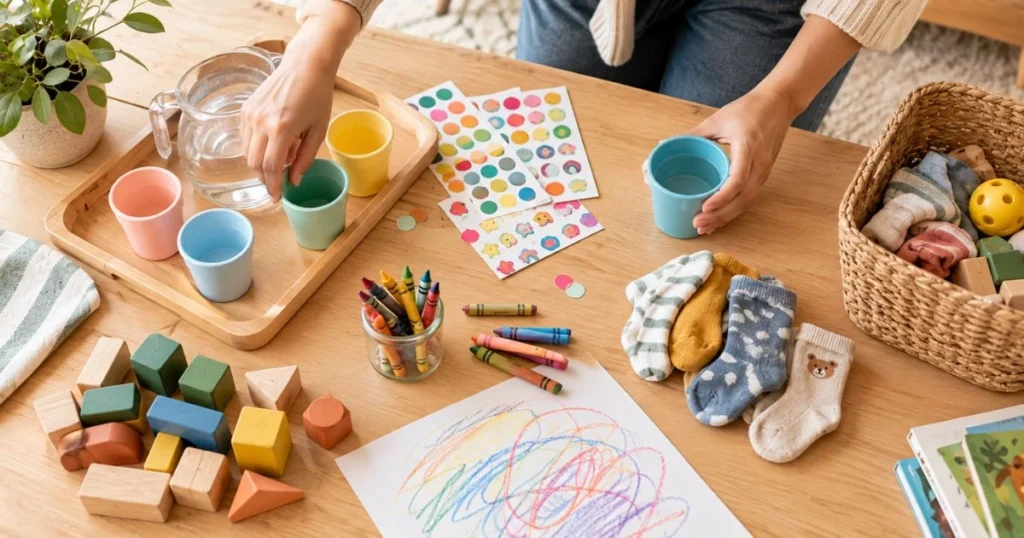
Kitchen Items
Try:
- Plastic cups
- Measuring cups
- Large bowls
- Wooden spoons
- Safe containers
These can become tools for pretend cooking, sorting, pouring, and transferring.
Laundry Items
Clean socks, towels, and laundry baskets can become part of:
- Matching games
- Sorting
- Pretend play
- Carrying games
- Cleanup races
Cardboard and Paper
Keep a few clean boxes and pieces of cardboard available.
They can become:
- Roads
- Houses
- Garages
- Signs
- Art canvases
Everyday Household Materials
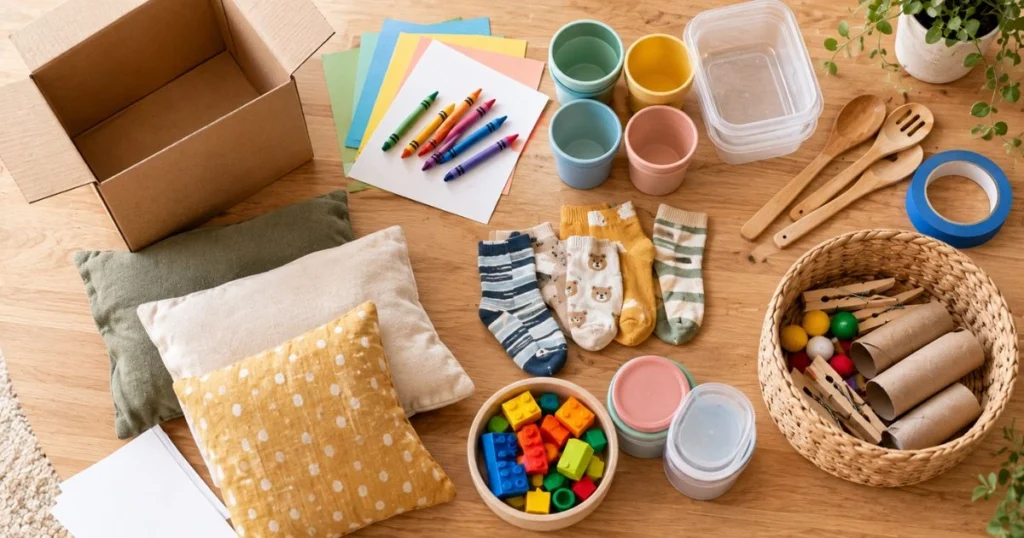
Painter’s tape, paper, crayons, pillows, blankets, and containers can create dozens of simple Toddler Activities.
You don’t need to buy a new toy every time your toddler says they’re bored.
How Toddler Activities Support Development
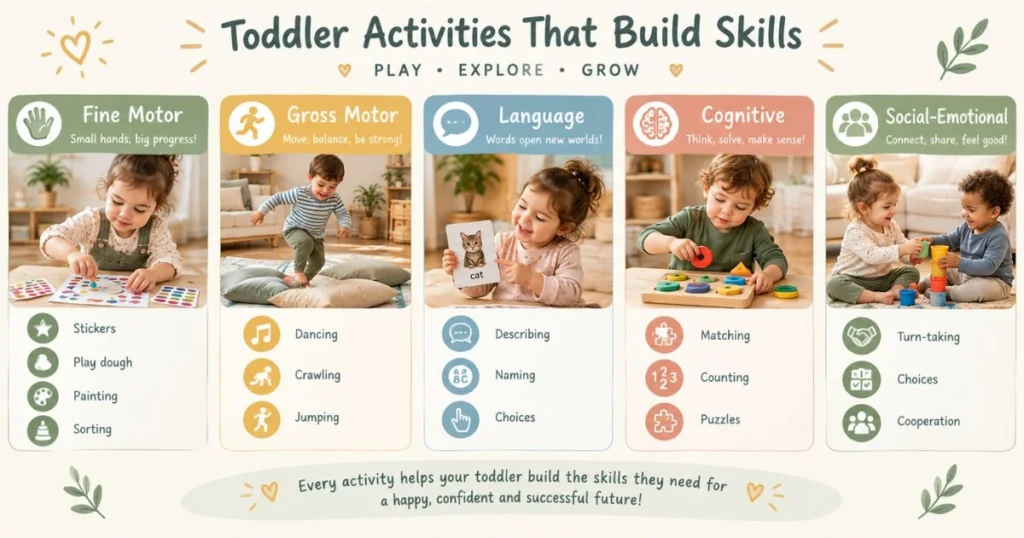
Good play doesn’t need a “learning objective” attached to it, but many ordinary activities naturally give your child opportunities to practice different skills.
Fine Motor Skills
Activities involving small hand movements can include:
- Stickers
- Play dough
- Painting
- Sorting
- Pouring
- Crayon drawing
Gross Motor Skills
Movement-based activities include:
- Dancing
- Crawling
- Jumping
- Animal walks
- Obstacle courses
- Ball games
Language Development
You can support language during almost any activity.
Talk about:
- What you’re doing
- What your toddler is doing
- Colors
- Shapes
- Sounds
- Actions
- Objects
- Choices
Instead of constantly asking questions, sometimes simply describe what you see:
“You put the blue block on top.”
“You found the big spoon.”
“You’re making a long road.”
This keeps language flowing without turning play into a quiz.
Cognitive Skills
Sorting, matching, counting, puzzles, and simple problem-solving give toddlers opportunities to think about how objects relate to one another.
The CDC notes that by age 2, many children are beginning to hold an object in one hand while using the other to manipulate it, try buttons or switches on toys, and combine different toys during play. These simple Toddler Activities can encourage those developing skills through everyday play.
Social and Emotional Skills
PlaIt also creates opportunities to practice:
- Taking turns
- Waiting
- Making choices
- Expressing preferences
- Asking for help
- Pretending
- Cooperating
You don’t need to force these skills. They often develop naturally during shared Toddler Activities, especially when your child has space to interact, make choices, and communicate with you.
How Long Should Toddler Activities Last?
There isn’t one perfect length for a toddler activity.
Your child might spend:
- Three minutes painting
- Ten minutes sorting
- Twenty minutes building
- Two minutes with a puzzle
- Five minutes dancing
- Then return to the painting
That’s normal.
Instead of asking, “How long should my toddler stay with this activity?” try asking:
“Is my toddler interested right now?”
If the answer is no, you can put the activity away and try something different later.
Sometimes the activity itself isn’t the problem. Your toddler may simply be hungry, tired, overstimulated, or ready to move.
If your toddler seems tired or loses interest quickly, their daily sleep routine may also be worth considering—see our [Toddler Nap Schedule] guide for age-by-age sleep guidance.
How to Keep Your Toddler Interested in Activities
Rotate Activities Instead of Offering Everything
If every toy is available at once, your toddler may quickly lose interest because there is nothing new to discover.
Instead, keep a smaller selection of toys and materials within reach, and rotate the rest every few days. You can also bring back older toys alongside new Toddler Activities to make familiar materials feel interesting again.
Follow Your Toddler’s Interests
If your toddler loves cars, build different Toddler Activities around that interest.
Count the cars.
Sort them by color or size.
Build a garage.
Make a road with painter’s tape.
Hide the cars for a simple scavenger hunt.
One strong interest can become ten different games. Following what your toddler already enjoys can make play feel more engaging while giving you plenty of ways to practice counting, sorting, movement, imagination, and problem-solving.
Repeat Favorite Activities
Don’t worry if your toddler wants to do the same activity again.
Repetition gives children another opportunity to explore something they already understand.
Let Your Toddler Lead
You don’t need to control every step.
CDC guidance on child-led play emphasizes allowing children to take the lead, while parents can support the interaction through attention, imitation, description, and reflection.
Don’t Rush to Fix Every Problem
If your toddler is trying to fit an object into a container, give them a moment to figure it out.
You can offer help when they need it, but don’t rush to solve the problem for them. Allowing your child to experiment during Toddler Activities gives them space to test ideas, make adjustments, and discover what works. This kind of child-led play can also support independence and confidence.
When boredom, frustration, or overstimulation turns into big feelings, these [toddler tantrum] strategies can help you respond calmly.
Toddler Activity Safety Tips
Fun comes second to safety.
Before starting an activity, quickly scan the setup from your toddler’s point of view.
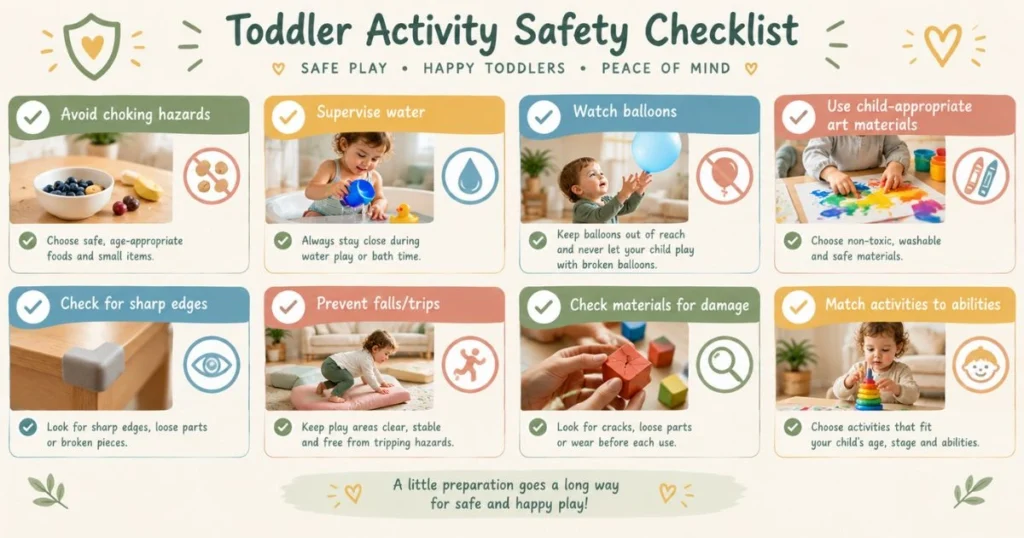
Watch for Choking Hazards
Avoid small objects if your child still puts things in their mouth.
Supervise Water Play
Even a small amount of water requires close supervision.
Be Careful With Balloons
Balloons and broken balloon pieces can be hazardous for young children.
Choose Appropriate Art Materials
Use child-appropriate, non-toxic materials and supervise their use.
Check Homemade Activities
Before handing your toddler something for a Toddler Activity, take a moment to check whether it is safe for their age and abilities.
Ask yourself:
- Can it break into small pieces?
- Could my child swallow or choke on part of it?
- Could my child fall while using it?
- Could anything become wrapped around or tangled around them?
- Are there any sharp edges, points, or pieces?
- Could the activity create a slipping or tripping hazard?
- Does my child need close supervision while using it?
When in doubt, choose a larger, sturdier, age-appropriate material and stay nearby during play. Even simple Toddler Activities can become unsafe if materials break, are used in an unexpected way, or create a hazard in the play area.
Adapt Activities to Your Child
Two toddlers of the same age can have very different abilities, interests, and comfort levels.
Choose Toddler Activities based on what fits your child rather than following an activity instruction blindly. You can make an activity easier, simplify the materials, or add a little more challenge depending on your toddler’s skills and confidence. The CDC also recommends choosing activities and toys that are safe and appropriate for your child’s skill level.
Should Toddler Activities Replace Screen Time?
You don’t need to turn screen time into a source of guilt.
Instead, think about balance.
Hands-on Toddler Activities give your child opportunities to move, communicate, manipulate objects, experiment, use their imagination, and interact with you. Screens can also have a place in family life, especially when you choose age-appropriate content and participate with your child.
For children ages 18–24 months, the American Academy of Pediatrics recommends that parents who choose to introduce digital media select high-quality programming and use it together with their child. For children ages 2–5, AAP guidance recommends limiting screen media to about one hour or less per day of high-quality content and encourages parents to watch or use it together with their child.
WHO also emphasizes the importance of active play and limiting sedentary screen time for young children. For 2-year-olds, its guidance recommends no more than one hour of sedentary screen time per day, with less being better.
So when your toddler reaches for the tablet, you don’t have to panic.
You can simply offer another option:
“Would you like to do stickers or play with the blocks?”
Sometimes the answer will be yes.
Sometimes it will be no.
That’s parenting. You don’t need to make every moment screen-free or fill every minute with Toddler Activities. The goal is simply to create a healthy balance between screens, active play, quiet time, and connection.
A predictable balance of active play, quiet activities, and bedtime routines can make the whole day feel more manageable; see our [Toddler Bedtime Routine] guide for more ideas.
Frequently Asked Questions About Toddler Activities
What are the best toddler activities to keep a child busy?
The best toddler activities are usually simple, hands-on, and flexible. Good choices include sensory play, sorting, stickers, puzzles, pretend play, scavenger hunts, cardboard-box play, dancing, and water pouring.
Choose according to your child’s mood. A restless toddler may need movement, while an overstimulated toddler may prefer something quiet.
What are easy toddler activities to do at home?
You can try these simple Toddler Activities at home: a color hunt, sticker art, sock matching, cardboard-box play, toy sorting, water pouring, counting toys, finger painting, or a simple scavenger hunt.
Most of these activities require very little preparation and use everyday materials you probably already have around the house. This makes it easy to offer your toddler something engaging without needing to buy special supplies.
What are good toddler activities when you’re stuck indoors?
Try:
- Pillow obstacle courses
- Dance parties
- Sensory bins
- Indoor treasure hunts
- Painting
- Puzzles
- Cardboard-box play
- Sticker activities
- Toy sorting
Keep a mixture of active and quiet options available.
What can I do with my toddler without buying toys?
Look around your home—you may already have everything you need for simple Toddler Activities.
A cardboard box can become a house. Clean socks can turn into a matching game. Plastic cups can become pouring tools. Pillows can create a simple obstacle course. Paper and crayons can become an art station.
You don’t need expensive toys or complicated supplies. Your toddler’s imagination can do much of the work, turning ordinary household items into opportunities for creative play.
What are educational toddler activities?
Educational toddler activities can include sorting, counting, matching, puzzles, pretend play, storytelling, art, sensory exploration, and simple problem-solving.
You don’t need worksheets for learning to happen.
What are good toddler activities for a 2-year-old?
Good choices for Toddler Activities include simple puzzles, blocks, balls, finger painting, pretend play, sorting, songs, outdoor exploration, playing with containers, and simple household tasks. These ideas are also consistent with activity suggestions from the CDC for 2-year-olds, which include puzzles, blocks, art, songs, outdoor play, containers, pretend play, and helping with simple chores.
How can I keep my toddler busy without using screens?
Create a siA simple Toddler Activities rotation can help you offer variety without feeling like you have to plan every minute of the day.
For example:
- Start with a movement game.
- Follow it with a creative activity.
- Offer some sensory play.
- End the day with a calm activity, such as reading books or doing a simple puzzle.
You don’t have to keep your toddler entertained every minute. Leave room for independent exploration too. Child-led play can support independence and confidence while giving your child the freedom to follow their own interests.
How long should a toddler activity last?
As long as your child remains interested and engaged.
Some toddler activities may last only a few minutes. Others may hold your child’s attention longer.
Don’t worry about reaching an arbitrary time goal.
Conclusion: Your Toddler Doesn’t Need More Entertainment
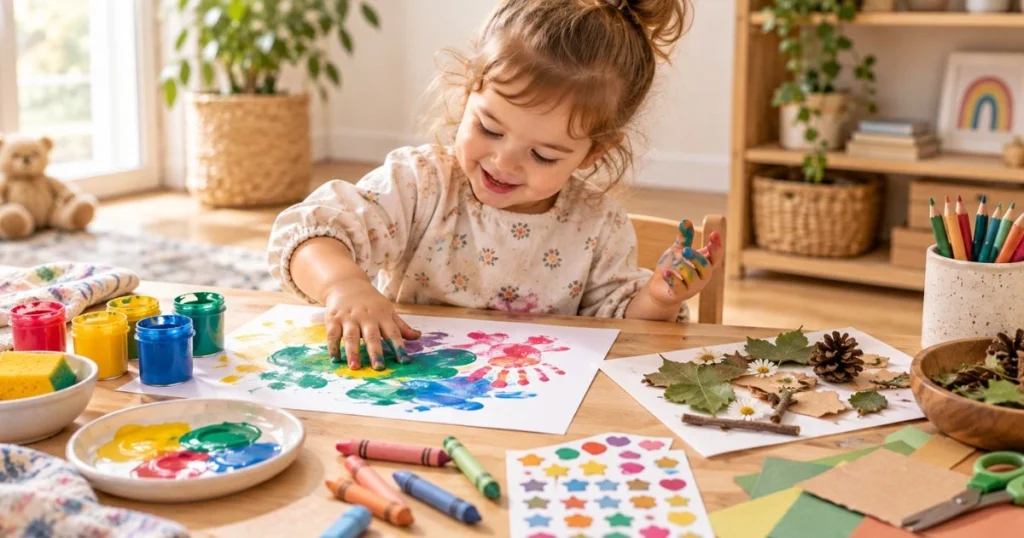
You don’t have to become your toddler’s personal entertainment director.
You don’t need a perfectly organized playroom, expensive educational toys, or a new activity every morning.
Sometimes your child needs nothing more than a cardboard box and a few crayons.
Sometimes they need to run.
Sometimes they want to pour water from one cup into another for what feels like an eternity.
And sometimes they simply want you to sit beside them while they figure something out.
The 50 toddler activities in this guide aren’t a checklist you have to complete. Think of them as ideas you can pull from when your child is restless, bored, curious, energetic, or simply ready to try something different.
Start with one.
If it works, repeat it.
If it doesn’t, move on.
And remember that play doesn’t have to look perfect to be meaningful.
Your toddler is learning every time they pour, stack, scribble, sort, crawl, pretend, dance, build, discover, and ask you to do it again.
Save this list for the next “I’m bored” moment, choose one activity that fits your toddler’s mood today, and let the play begin.