You know that moment when your toddler finds a bowl, a spoon, and a little water—and suddenly your perfectly quiet kitchen turns into a laboratory?
They scoop. They pour. They spill. They touch everything. Then they do it all again.
It may look like simple toddler mischief, but there is something valuable happening underneath all that exploring. Your child is learning about texture, temperature, movement, sound, cause and effect, and the physical world around them.
That is where sensory play comes in.
You don’t need a dedicated playroom or a collection of expensive educational toys. A tray of water, a few cups, some cooked pasta, ice cubes, homemade playdough, or even leaves collected outside can give your toddler plenty to investigate.
Play itself is an important part of early development. The American Academy of Pediatrics notes that play supports areas such as social-emotional development, cognition, language, and self-regulation, while simple household objects can give toddlers opportunities to explore and experiment.
In this guide, you’ll find 25 easy sensory play activities for toddlers at home, along with simple material lists, ways to make each activity educational, ideas for different ages, and safety tips to keep in mind.
The goal isn’t to create a picture-perfect activity.
It’s to give your toddler a safe opportunity to wonder, “What happens if I try this?”
What Is Sensory Play?
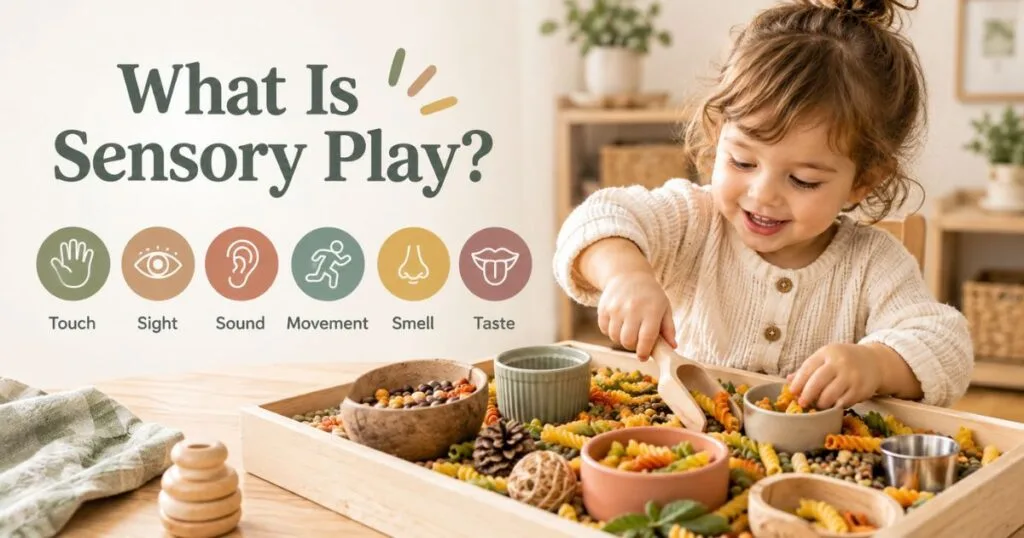
Sensory play is any type of play that gives your child opportunities to explore the world through their senses and movement.
Your toddler might:
- Touch something soft, rough, cold, sticky, or squishy.
- Watch colors mix.
- Listen to different sounds.
- Smell herbs or flowers.
- Taste appropriate foods.
- Pour, scoop, squeeze, stir, carry, or crawl.
- Notice what happens when they change something.
A single activity can involve several senses at once.
For example, water play allows your toddler to feel the temperature and movement of the water, watch it pour, hear the splash, and practice controlling a cup or spoon.
This type of exploration fits naturally with how young children learn. The American Academy of Pediatrics describes play as a way toddlers explore and learn about their world and recommends giving them time and safe, simple materials to investigate.
If you’re looking for more simple ways to keep your toddler busy at home, explore our guide to 30 Easy Indoor Activities for Toddlers That They’ll Love.
What Senses Are Involved in Sensory Play?
You usually think of five senses:
- Touch — soft, rough, smooth, wet, dry, sticky, cold.
- Sight — colors, shapes, movement, size.
- Hearing — shaking, splashing, tapping, pouring.
- Smell — herbs, flowers, fruit, natural materials.
- Taste — appropriate foods and taste-safe activities.
Movement and body awareness also matter during active play. Your toddler learns where their body is, how much force to use, and how to move through their surroundings.
Why Is Sensory Play Good for Toddlers?
Sensory play isn’t about turning every activity into a lesson. Your toddler is already learning simply by experimenting.
Sensory Play Supports Fine Motor Skills
Many activities involve movements such as:
- Scooping
- Pouring
- Squeezing
- Pinching
- Stirring
- Transferring
- Rolling
- Pressing
These actions give your toddler opportunities to practice using their hands and fingers.
A sponge-squeezing game, for example, may look like a simple water activity to you. Your toddler is also figuring out how much pressure is needed to squeeze the sponge and how to move water from one container to another.
Sensory Play Encourages Problem-Solving
Open-ended activities give your toddler little problems to solve.
They might wonder:
- How can I get the ice out?
- Why did the water disappear from the sponge?
- Which cup holds more?
- What happens when these colors mix?
- How can I peel this tape off?
- What happens if I pour faster?
You don’t need to give the answer right away.
Give your child time to experiment.
For more ways to help your toddler build coordination through active play, see our guide to 20 Easy Gross Motor Activities for Toddlers and Preschoolers.
Sensory Play Builds Language
You can naturally introduce new words while your toddler explores.
Try words such as:
- Cold
- Warm
- Wet
- Dry
- Soft
- Hard
- Rough
- Smooth
- Heavy
- Light
- Full
- Empty
- More
- Less
- Sticky
- Squishy
Instead of turning play into a vocabulary quiz, simply describe what your child is doing.
“Your sponge is soaking up the water.”
“That’s a cold ice cube.”
“You poured all the water into the big cup.”
The American Academy of Pediatrics also highlights the value of caregivers talking with children during play and drawing attention to what they see, hear, and feel.
Sensory Play Encourages Exploration and Attention
Your toddler doesn’t need to complete a predetermined craft to benefit from play.
Sometimes the learning is in the repetition.
They pour the same cup ten times.
They squeeze the sponge again and again.
They keep dropping an object into the bowl.
That repetition is part of exploration.
Play also provides opportunities to practice attention, flexible thinking, and self-regulation.
Many of these activities also support hand and finger control, so you can find more ideas in our guide to Fine Motor Activities for Toddlers.
What Do You Need for Sensory Play at Home?
Before you buy anything, look around your kitchen and home.
You probably already have many useful materials.
Simple Sensory Play Supplies
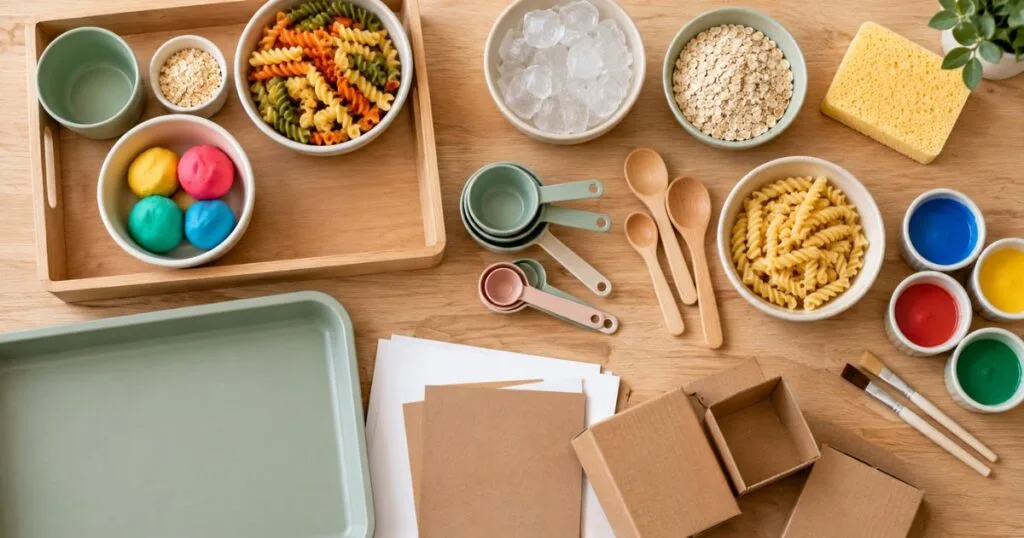
- Plastic cups
- Bowls
- Measuring cups
- Large spoons
- Sponges
- Ice
- Water
- Cooked pasta
- Oats
- Playdough
- Washable paint
- Large trays
- Towels
- Paper
- Cardboard boxes
- Large toddler-safe objects
- Leaves and other carefully selected natural materials
The American Academy of Pediatrics recommends simple, safe objects such as cups, plates, pots, pans, blocks, books, and crayons for toddler exploration.
Do You Need Special Sensory Toys?
No.
A commercial sensory table can be convenient, but it isn’t necessary.
A baking tray can become a sensory tray.
A plastic bowl can become a sensory bin.
Kitchen measuring cups can become pouring tools.
A sponge can become a fine motor activity.
You don’t need expensive materials—the experience matters most.
You can also find plenty of simple, low-preparation ideas in our guide to 30 Easy Indoor Activities for Toddlers.
25 Easy Sensory Play Activities for Toddlers at Home
1. Water Pouring Sensory Play
Water is one of the easiest places to start.
What You Need
- Shallow container
- Small amount of water
- Plastic cups
- Large spoon
- Small pitcher
How to Do It
Fill a shallow container with water and place a few cups and spoons nearby.
Let your toddler scoop, pour, transfer, and experiment.
You can introduce simple concepts such as:
- Full and empty
- More and less
- Fast and slow
- Big and small
Don’t worry if your toddler mostly pours water onto the tray. That’s part of the activity.
Best for: fine motor practice, coordination, early math language, cause and effect.
2. Ice Cube Exploration
Turn a few ice cubes into a tiny science experiment.
What You Need
- Ice cubes
- Bowl
- Spoon
- Warm water
- Optional large toddler-safe objects
Let your toddler touch the ice and observe how it changes.
Ask:
- “Is it cold?”
- “What happens when we add warm water?”
- “Where did the ice go?”
This activity introduces simple ideas about temperature and melting without requiring a formal science lesson.
3. Sponge Squeeze Water Play
What You Need
- Two shallow containers
- Water
- One or two large sponges
Place water in one container.
Your toddler soaks the sponge, carries it to the other container, and squeezes.
You can demonstrate once and then let your child experiment.
Skills practiced:
- Hand strength
- Coordination
- Concentration
- Cause and effect
4. Colored Water Mixing
This activity adds a little color to ordinary water play.
| Material | Amount | Purpose |
| Water | Small amounts | Base |
| Child-appropriate coloring | A few drops | Color exploration |
| Plastic cups | 2–4 | Mixing |
| Spoon | 1 | Stirring |
Place different colors into separate cups.
Let your toddler pour one color into another and watch what changes.
Use simple language:
“Blue and yellow are mixing.”
“Now the water looks different.”
Safety: Keep all materials appropriate for your child’s age and supervise closely.
5. Frozen Toy Rescue
Give your toddler a small problem to solve.
Freeze a large, toddler-safe object inside a container of water.
Once frozen, place it in a tray and offer warm water and a spoon.
Your child can investigate how to release the object.
This activity encourages:
- Persistence
- Observation
- Problem-solving
- Cause and effect
Avoid objects that are small enough to become choking hazards.
Food-Based Sensory Play
Food can provide wonderful textures, but you need to think about safety first.
A material being described as “edible” or “taste-safe” doesn’t automatically make it appropriate for every toddler.
Consider allergies, choking hazards, preparation, texture, and your child’s tendency to put materials in their mouth.
If you’re also exploring age-appropriate foods with your little one, our Toddler Meal Ideas guide has more simple, family-friendly ideas.
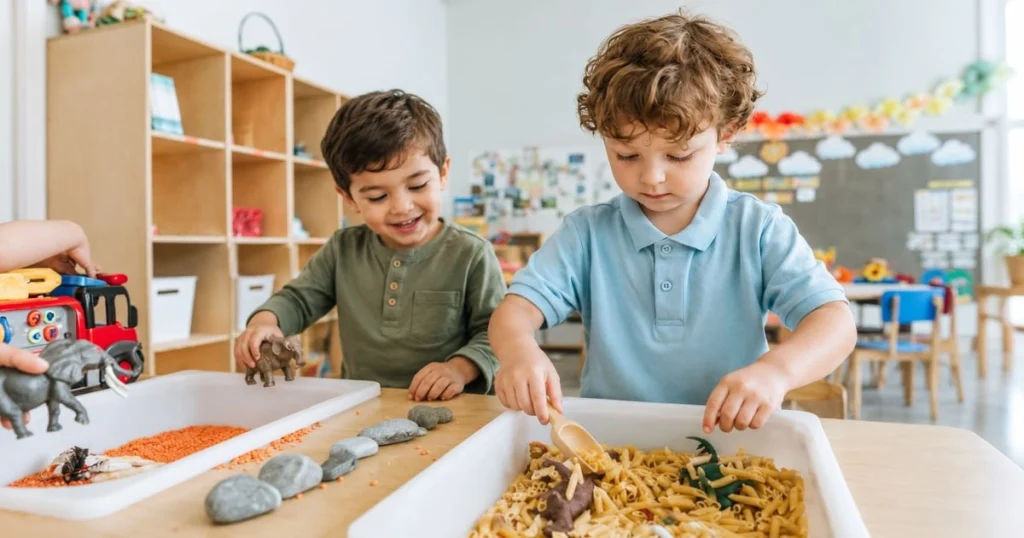
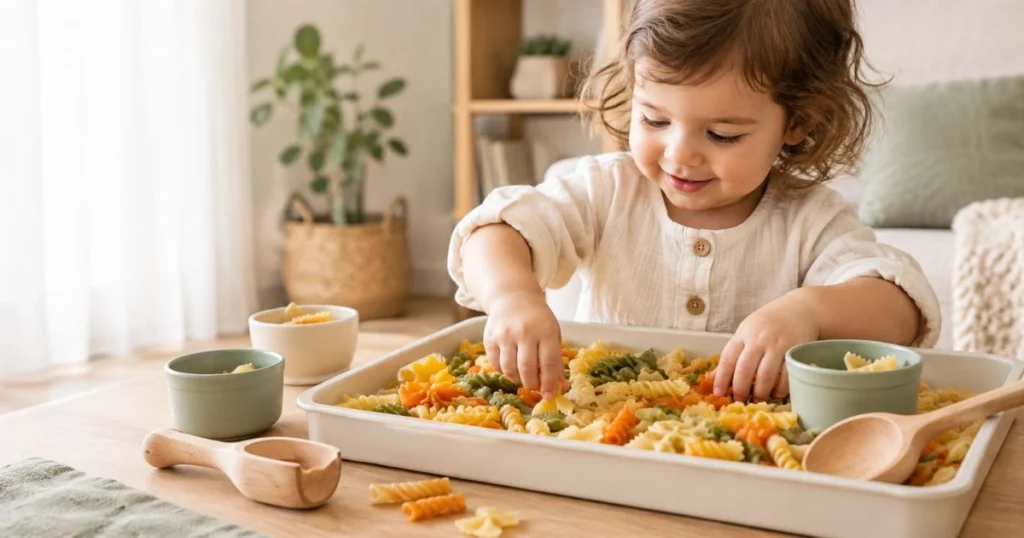
6. Cooked Pasta Sensory Bin
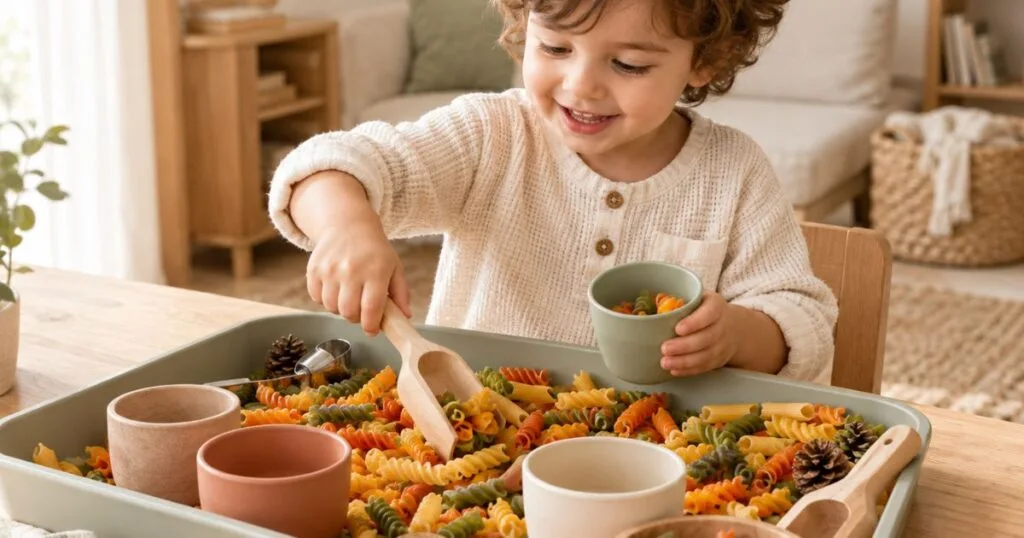
Cooked pasta offers a soft, slippery texture that toddlers often enjoy exploring.
What You Need
| Material | Suggested amount |
| Cooked pasta | 1–2 cups |
| Large tray or bowl | 1 |
| Large spoon | 1 |
| Plastic cups | 2–3 |
Place the pasta in a shallow container.
Let your toddler:
- Touch it
- Squeeze it
- Scoop it
- Transfer it
- Pretend to cook
You can introduce words such as soft, cold, slippery, long, and short.
7. Oat Sensory Bin
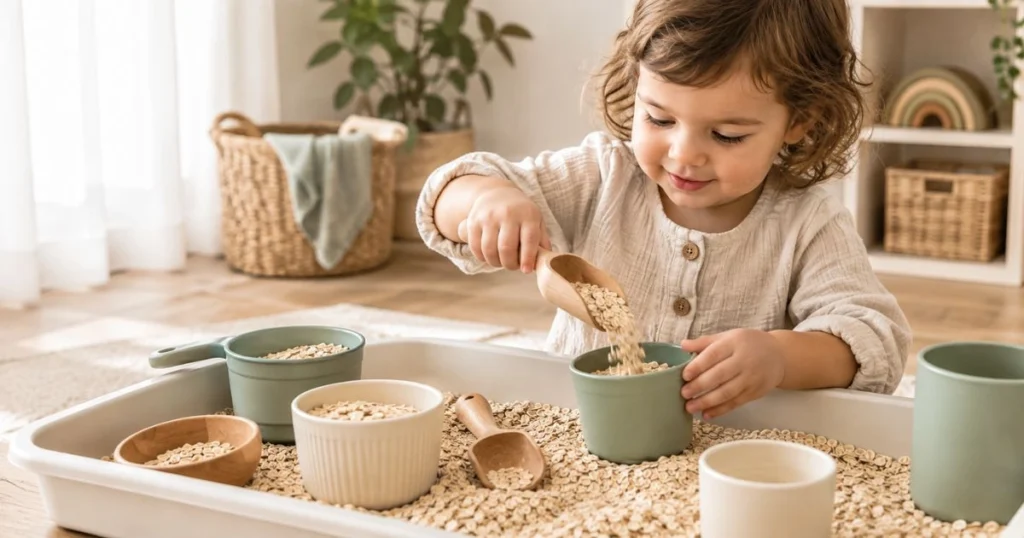
Oats provide a dry sensory experience and work well for scooping and transferring.
What You Need
| Material | Amount |
| Dry oats | 1–2 cups |
| Shallow tray | 1 |
| Large measuring cups | 2–3 |
| Large spoons | 1–2 |
Pour the oats into the tray.
Add cups and spoons and let your toddler explore.
If your child has a known food allergy or sensitivity, choose another material.
8. Taste-Safe Sensory Tray
If your toddler still frequently explores materials with their mouth, you can use appropriate foods as a sensory medium.
| Food | Texture |
| Soft cooked pasta | Squishy |
| Mashed potato | Soft and creamy |
| Soft cooked vegetables | Varied |
| Soft fruit | Juicy |
| Plain yogurt | Smooth |
Keep the food prepared in a way that is appropriate for your child’s eating abilities.
This activity can allow your toddler to explore food through touching, smelling, and tasting rather than feeling pressured to eat a particular item.
9. Sensory Soup
Fill a shallow bowl or container with water.
Add large, safe objects that your toddler can scoop and stir.
You can also use appropriate soft vegetables for pretend cooking.
Encourage words such as:
- Stir
- Scoop
- Pour
- Wet
- Floating
- Sinking
Your toddler may spend more time pretending to cook than actually exploring the materials. That’s perfectly fine.
Sensory exploration and pretend play can overlap.
Texture Sensory Activities
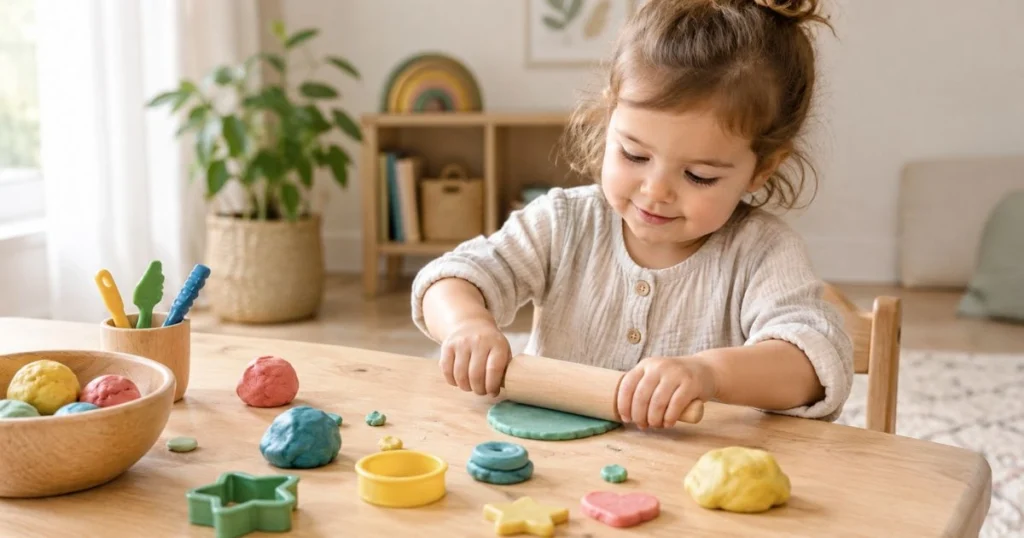
10. Homemade Playdough Sensory Play
Playdough gives your toddler plenty of opportunities to squeeze, roll, press, flatten, and pinch.
Simple Homemade Playdough Recipe
| Ingredient | Suggested amount |
| Flour | 2 cups |
| Salt | ½ cup |
| Water | About ¾ cup |
| Cooking oil | 1 tablespoon |
| Food coloring | Optional |
How to Make It
- Mix the flour and salt.
- Add water gradually.
- Add the oil.
- Knead until the mixture becomes smooth.
- Add coloring if desired.
- Allow it to cool completely before use.
Let your toddler use their hands, or provide large age-appropriate cutters and tools.
Important: Homemade playdough is not food. Supervise your toddler and prevent eating.
Playdough is also a simple way to practice hand strength and coordination, and you can find more playful ideas in our guide to Fine Motor Activities for Toddlers.
11. Cotton Ball Transfer
Place large cotton balls in one container.
Give your toddler another container, a large spoon, or another appropriate transfer tool.
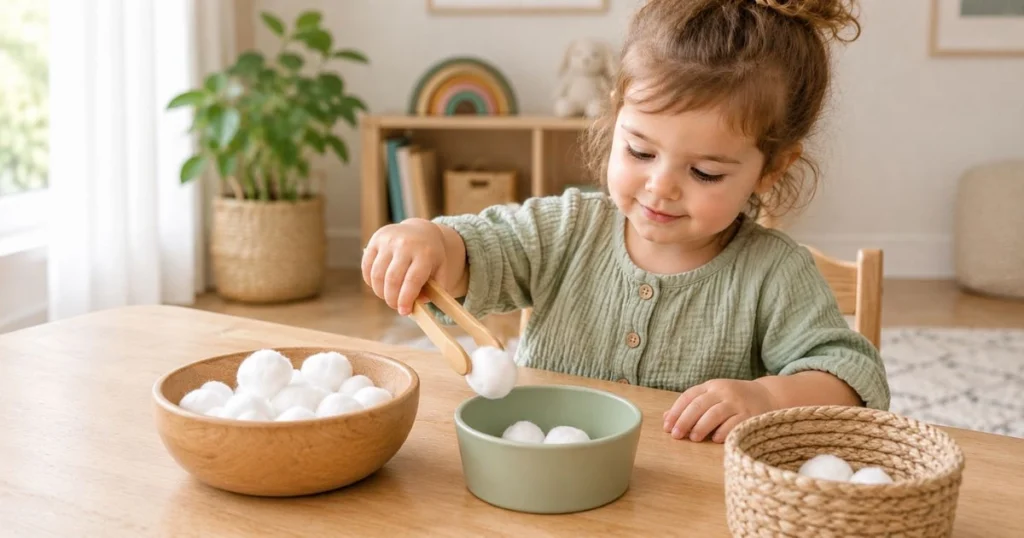
Ask:
“Can you move them over?”
You can talk about:
- Soft
- Light
- Full
- Empty
Keep loose materials away from children who are likely to put them in their mouths.
12. Texture Discovery Tray
Create a small tray containing safe objects with contrasting textures.
For example:
- Smooth
- Rough
- Soft
- Hard
- Bumpy
Let your toddler touch each item.
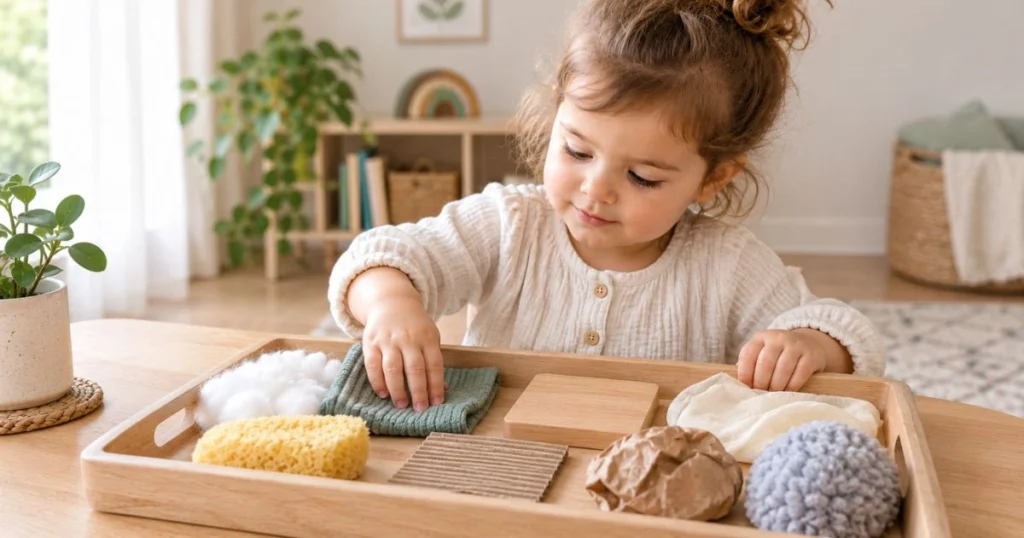
Instead of asking constant questions, make observations.
“That feels smooth.”
“This one is rough.”
“This one is soft.”
This gives your child language they can eventually use themselves.
13. Nature Sensory Tray
You don’t need to bring complicated materials into your home.
A short walk can provide inspiration.
Collect appropriate, clean, larger natural objects such as:
- Leaves
- Large flowers
- Smooth stones
- Pinecones
Let your toddler observe:
- Color
- Shape
- Texture
- Smell
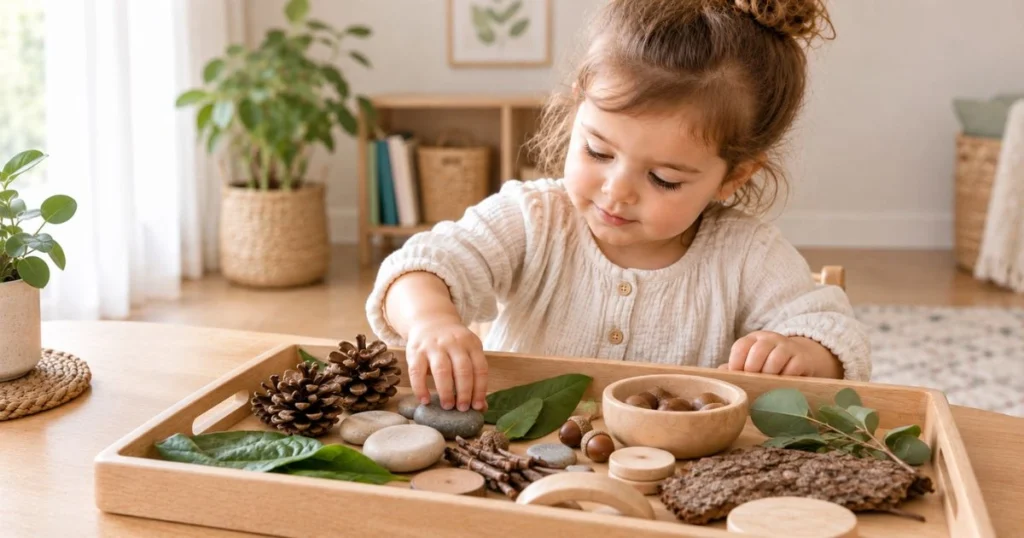
Always inspect natural materials before giving them to your child. Avoid anything poisonous, sharp, contaminated, easily broken, or small enough to present a choking risk.
14. Simple Moldable Sensory Dough
If you don’t want to make playdough, use an age-appropriate commercial modeling material.
Encourage your toddler to:
- Press
- Roll
- Flatten
- Pinch
- Tear
- Make simple shapes
You don’t need to create recognizable animals or elaborate crafts.
The hand movements are enough.
Messy Sensory Play
15. Finger Painting
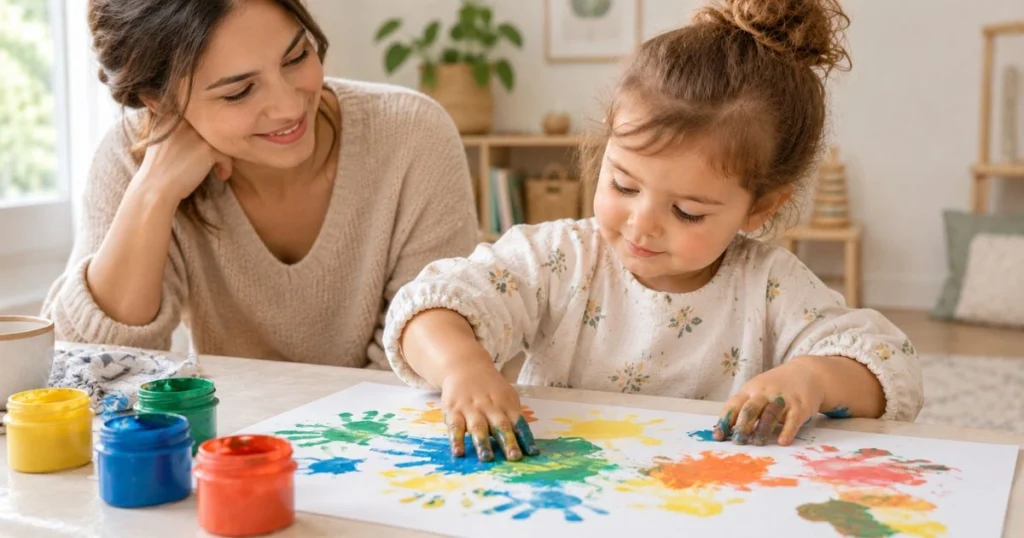
Finger painting turns touch into art.
What You Need
| Material | Amount |
| Washable toddler-appropriate paint | Small amounts |
| Large paper | 1–2 sheets |
| Tray or washable surface | 1 |
| Water | Small bowl |
Let your toddler make:
- Dots
- Lines
- Swirls
- Handprints
- Color mixtures
Don’t worry about the finished picture.
The process is the activity.
16. Shaving Foam Exploration
This activity should only be considered for toddlers who can reliably avoid putting the material into their mouths.
Place a small amount of suitable shaving foam on a washable tray.
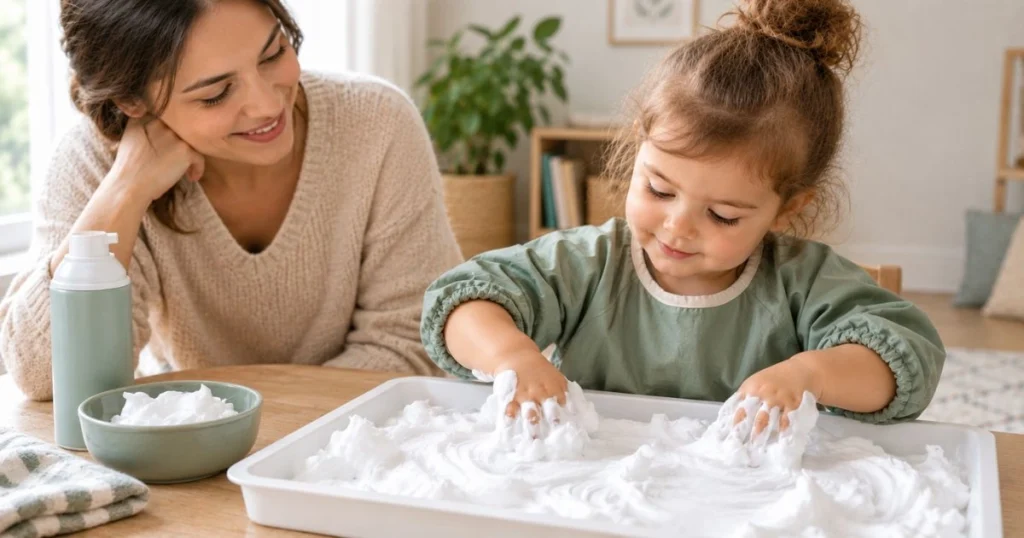
Let your toddler draw:
- Lines
- Circles
- Waves
- Simple shapes
If your child dislikes the texture, don’t force them to touch it.
You can offer a spoon or simply let them watch.
17. Sticky Tape Rescue
Place strips of painter’s tape over large, toddler-safe objects.
Leave an edge accessible.
Challenge your toddler to peel the tape away.
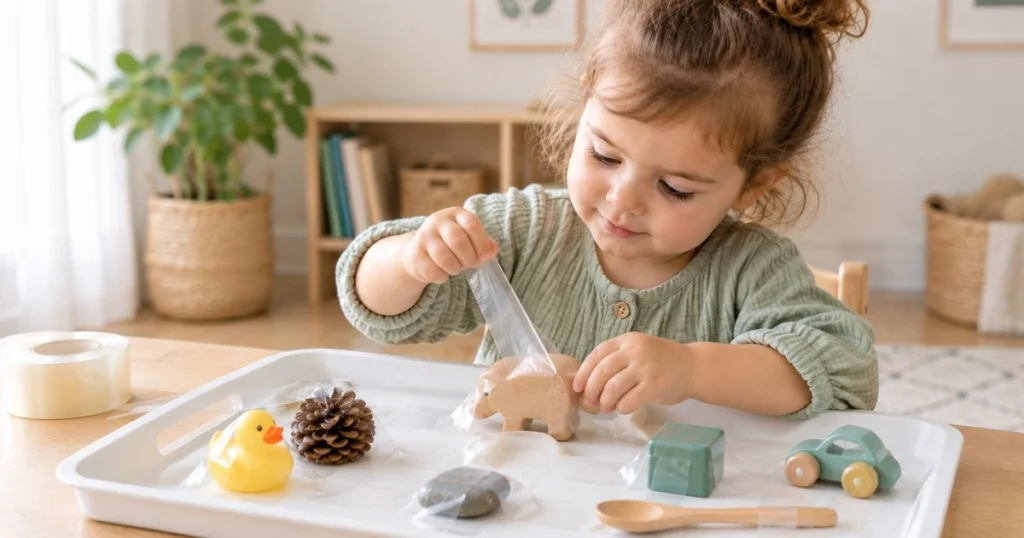
Words to use:
- Pull
- Sticky
- Stuck
- Off
- Free
This simple game gives little fingers something purposeful to work on.
Sound and Movement Sensory Play
18. Homemade Sound Bottles
Create securely sealed bottles that make different sounds when shaken.
You might use safe materials inside, provided the bottle cannot be opened by your toddler.
Let your child compare:
- Loud and quiet
- Fast and slow
- Shake and stop
Safety is essential: inspect the container regularly and don’t use it if the closure becomes loose or damaged.
19. Bubble Sensory Play
Bubbles require almost no preparation.
Blow bubbles and let your toddler:
- Chase them
- Pop them
- Reach for them
- Watch them float
Add movement words such as:
- Up
- Down
- High
- Low
- Fast
- Slow
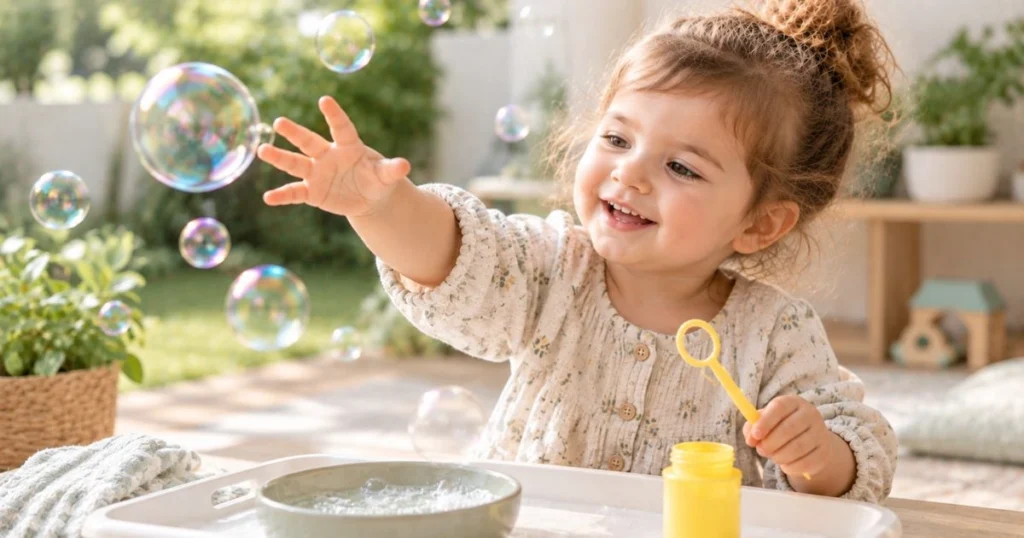
The American Academy of Pediatrics includes bubbles among examples of sensory-rich play experiences for young children.
20. Indoor Sensory Movement Path
Create a simple movement course using safe household items.
You could use:
- Cushions
- Pillows
- Soft mats
- Cardboard boxes
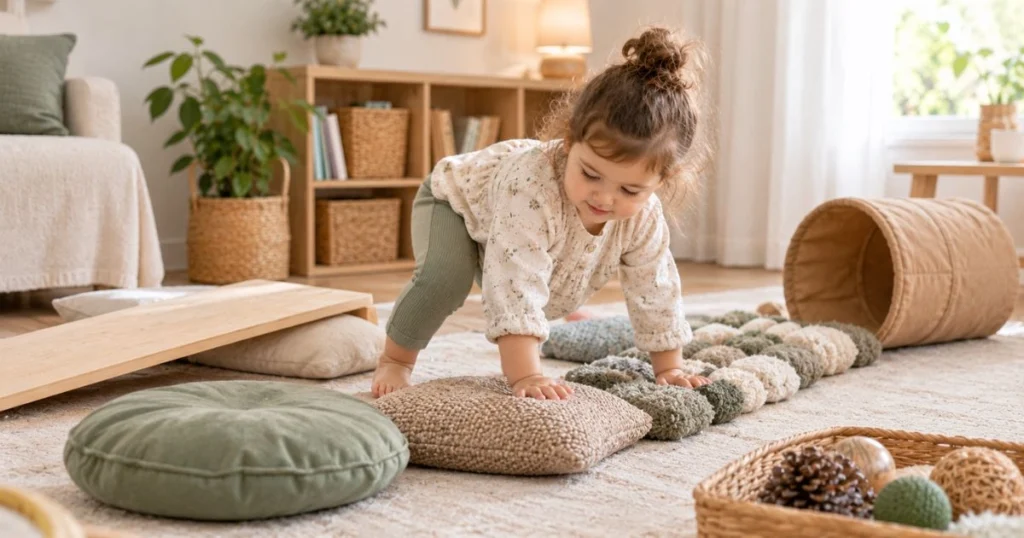
Invite your toddler to:
- Crawl under something.
- Step around a cushion.
- Walk across a soft mat.
- Carry a large soft object.
- Crawl back to the beginning.
Active play helps toddlers develop movement skills and coordination, while movement itself can become another form of sensory exploration.
For more simple ideas you can set up at home, see our guide to 30 Easy Indoor Activities for Toddlers That They’ll Love.
Sensory Discovery Games
21. Texture Scavenger Hunt
Walk around your home together.
Find something:
- Soft
- Smooth
- Hard
- Rough
- Bumpy
You don’t need a long list.
Five objects are enough.
Your toddler can touch each one while you introduce the descriptive word.
22. Sensory Sorting Game
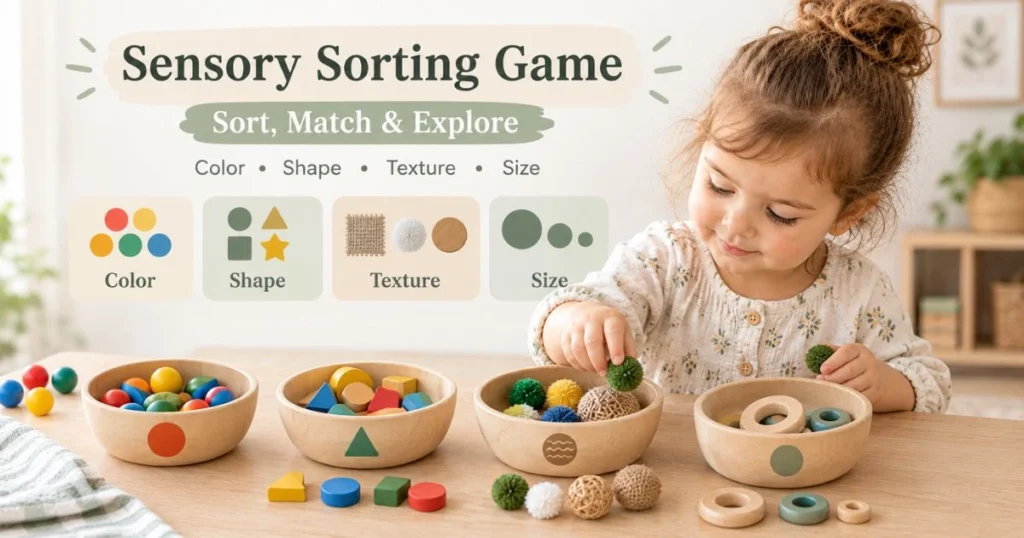
Give your toddler several large, safe objects.
Ask them to sort by:
- Color
- Size
- Shape
- Texture
Don’t expect perfect sorting.
The goal is to introduce the idea that objects can share characteristics.
23. Scoop and Transfer Game
Choose one safe sensory material and two containers.
For example:
- Cooked pasta
- Oats
- Large soft objects
Your toddler scoops from one container and transfers the material to the other.
This is particularly useful when you want a low-cost sensory activity for toddlers.
24. DIY Sensory Garden
A small garden can become a multi-sensory experience.
Let your toddler:
- Touch safe leaves.
- Smell appropriate herbs.
- Water plants.
- Look for flowers.
- Observe insects from a safe distance.
- Compare different leaves.
Make sure every plant is safe and non-toxic and that your toddler is supervised.
25. DIY Sensory Discovery Bin
When you want something flexible, create a simple sensory bin using materials you already have.
Example Setup
| Item | Purpose |
| Shallow tray | Defines the play space |
| Cups | Pouring |
| Large spoon | Scooping |
| Sponge | Texture |
| Large safe objects | Exploration |
| Water | Sensory base |
Don’t fill the container with dozens of objects.
A few carefully selected materials often give your toddler plenty to investigate.
How to Choose the Best Sensory Play Activity for Your Toddler
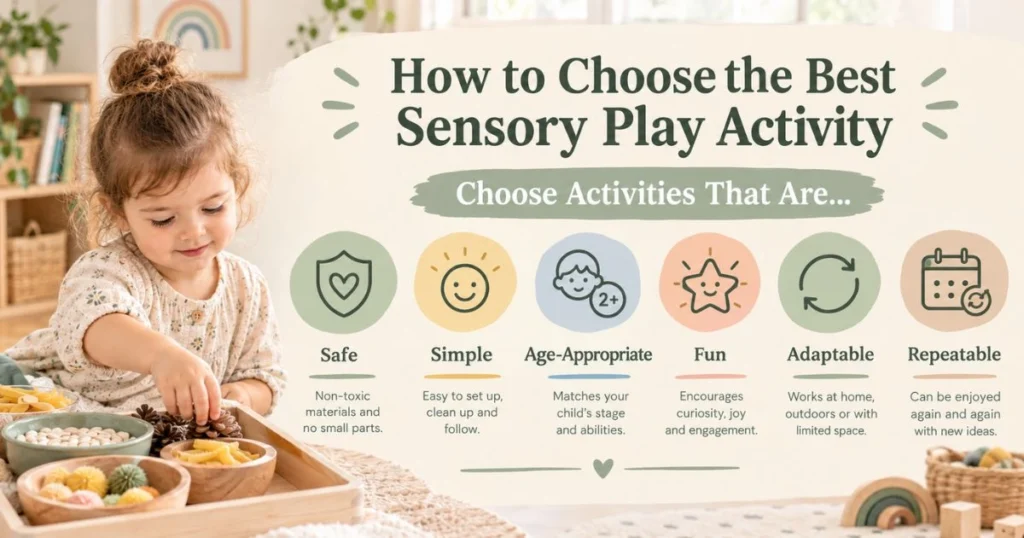
You don’t have to work through all 25 activities.
Choose according to your child’s mood, interests, and developmental stage.
If Your Toddler Loves Water
Try:
- Water pouring
- Sponge squeezing
- Ice exploration
- Colored water mixing
If Your Toddler Loves Messy Play
Try:
- Finger painting
- Cooked pasta
- Playdough
- Sensory soup
If Your Toddler Prefers Quiet Activities
Try:
- Texture discovery
- Nature tray
- Sorting
- Simple transfer games
If You Want Fine Motor Practice
Choose:
- Scooping
- Pouring
- Squeezing
- Peeling
- Rolling
- Pinching
- Transferring
How to Make Sensory Play Less Messy
The biggest obstacle isn’t usually the activity.
It’s the cleanup.
You can make things easier before your toddler starts.
Try These Simple Strategies
- Put a washable mat under the activity.
- Use a shallow tray instead of a deep container.
- Start with a small amount of material.
- Keep towels nearby.
- Dress your toddler in clothes that can get dirty.
- Move very messy activities outdoors.
- Keep a small cleanup basket nearby.
- Wash reusable materials after use.
And remember: sensory play doesn’t have to mean a huge mess.
Water in a tray can be enough.
A few pieces of playdough can be enough.
A handful of leaves can be enough.
Sensory Play Safety Tips for Toddlers
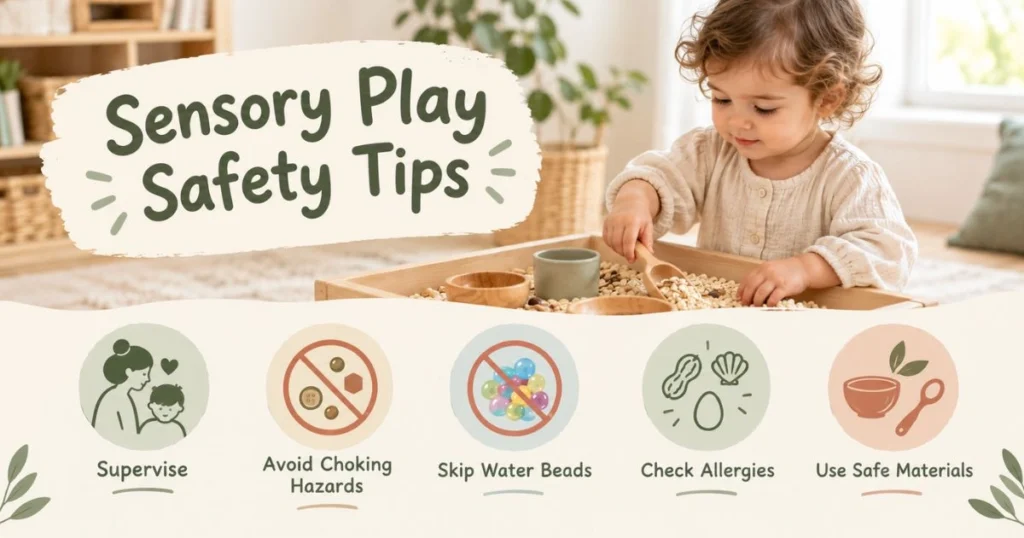
Safety should come before creativity.
Watch for Choking Hazards
Toddlers commonly explore objects with their mouths, so small materials require particular caution.
Avoid loose objects such as:
- Beads
- Buttons
- Coins
- Marbles
- Small balls
- Small toy parts
- Loose batteries
The American Academy of Pediatrics emphasizes age-appropriate toy selection and notes that age recommendations help parents consider potential choking hazards and whether an object is suitable for a child’s developmental stage.
Avoid Water Beads
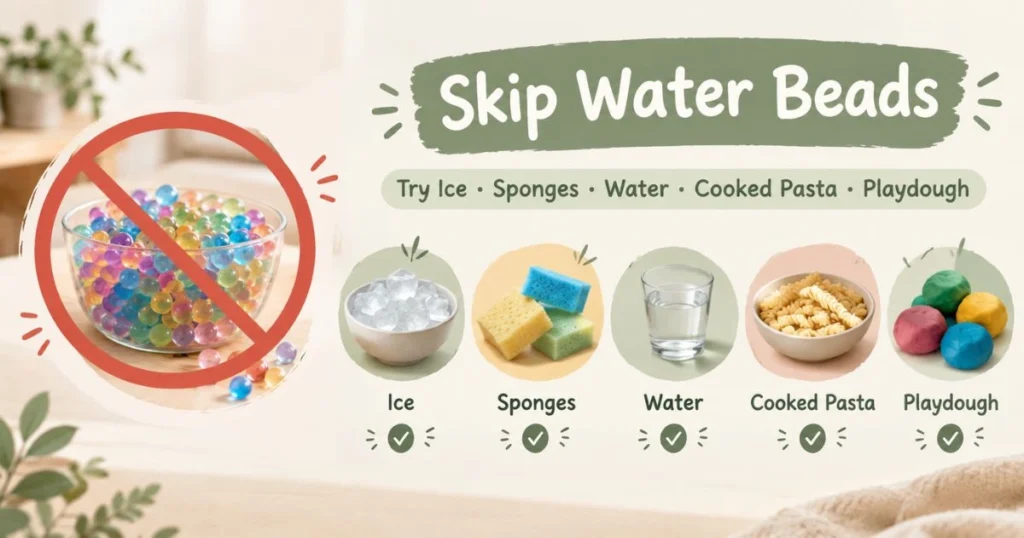
Water beads deserve special attention because they are sometimes promoted as sensory-play materials.
For toddlers, I would skip them entirely.
The American Academy of Pediatrics warns that water beads can be swallowed, inhaled, or placed in ears. They can expand after absorbing fluid and have been associated with serious injuries. The AAP recommends keeping them away from young children.
You have plenty of safer alternatives:
- Ice
- Sponges
- Cooked pasta
- Water
- Large safe objects
- Playdough
Supervise Water Play
Even shallow water isn’t a reason to step away.
Stay close and actively supervise your toddler whenever water is involved.
Think About Allergies
If you’re using food:
- Check ingredients.
- Avoid known allergens.
- Consider your child’s eating abilities.
- Don’t assume that a food is safe simply because it is being used for play.
Don’t Force a Texture
Your toddler may love touching wet pasta but hate shaving foam.
That’s okay.
If your child pulls their hands away, let them.
You can:
- Offer a spoon.
- Let them watch.
- Try a different material.
- Return to the activity another day.
Sensory exploration should be an invitation, not a battle.
How to Make Sensory Play More Educational
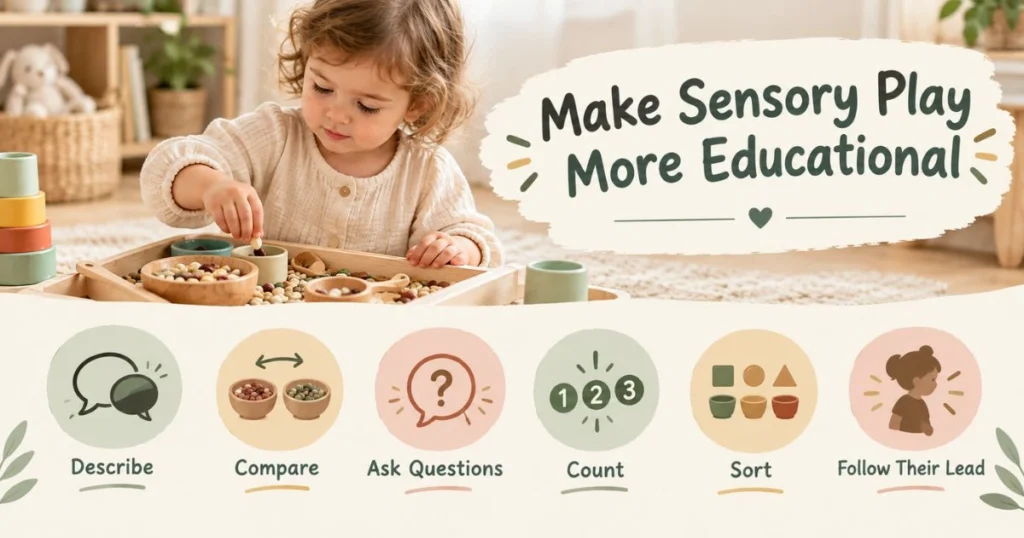
You don’t need to turn your living room into a classroom.
Your language is enough.
Talk About What Your Toddler Is Doing
Try:
- “You’re pouring the water.”
- “The ice is cold.”
- “Your sponge is full.”
- “You made a big splash.”
- “That leaf feels rough.”
Introduce Early Math
Sensory activities give you natural opportunities to talk about:
- More and less
- Full and empty
- Big and small
- Heavy and light
- One and two
- Before and after
Introduce Early Science
Use simple observations:
- Ice melts.
- Sponges absorb water.
- Water moves.
- Colors mix.
- Some objects float.
- Some objects sink.
You don’t have to explain the science behind every observation.
Let your toddler notice first.
Follow Your Toddler’s Lead
If you planned water pouring and your toddler starts pretending to cook, follow them.
That pretend play is valuable too.
The AAP recommends child-led, playful learning and notes that simple objects can support creativity and exploration without requiring expensive electronic toys.
Sensory Play Ideas by Toddler Age
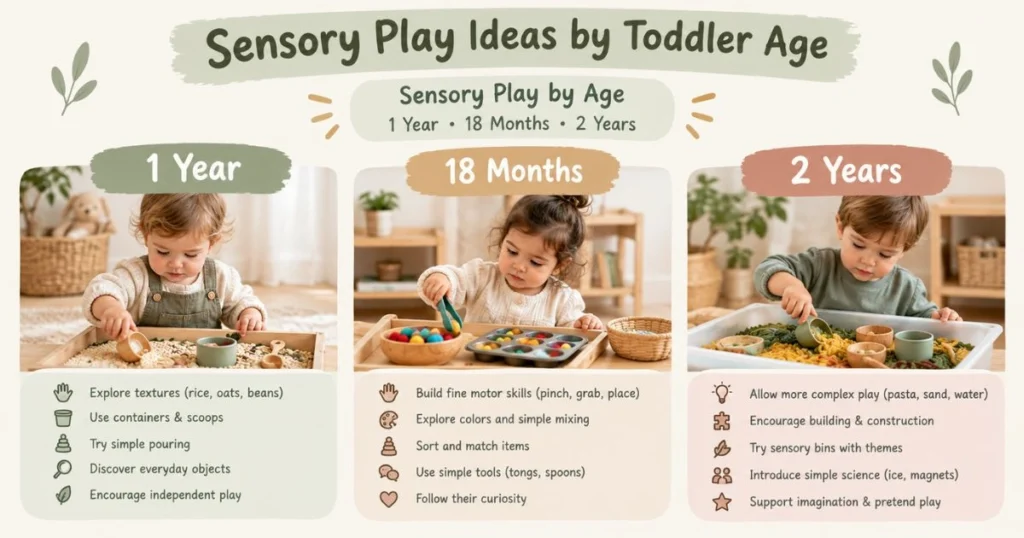
Every child develops differently, so use these age ranges as flexible suggestions rather than strict rules.
Sensory Play for 1-Year-Olds
Start with simple activities:
- Water exploration
- Large safe objects
- Sponge play
- Bubbles
- Texture exploration
- Simple containers
Keep activities uncomplicated and supervise closely.
If you’re building a daily routine around your baby’s changing needs, our Baby Wake Windows by Age: Complete Guide for 0–24 Months can help you understand age-appropriate periods of wakefulness.
Sensory Play for 18-Month-Olds
You can introduce:
- Scooping
- Pouring
- Sorting
- Simple pretend play
- Playdough
- Nature exploration
Your toddler may begin showing stronger preferences for particular textures and activities.
Sensory Play for 2-Year-Olds
You can add more open-ended challenges:
- Color mixing
- Sorting
- Frozen-object rescue
- Sensory scavenger hunts
- Simple nature experiments
- Pretend cooking
The AAP encourages unstructured play and exploration during the toddler years, while age-appropriate challenges allow children to investigate at a level that fits their abilities.
How Often Should You Do Sensory Play?
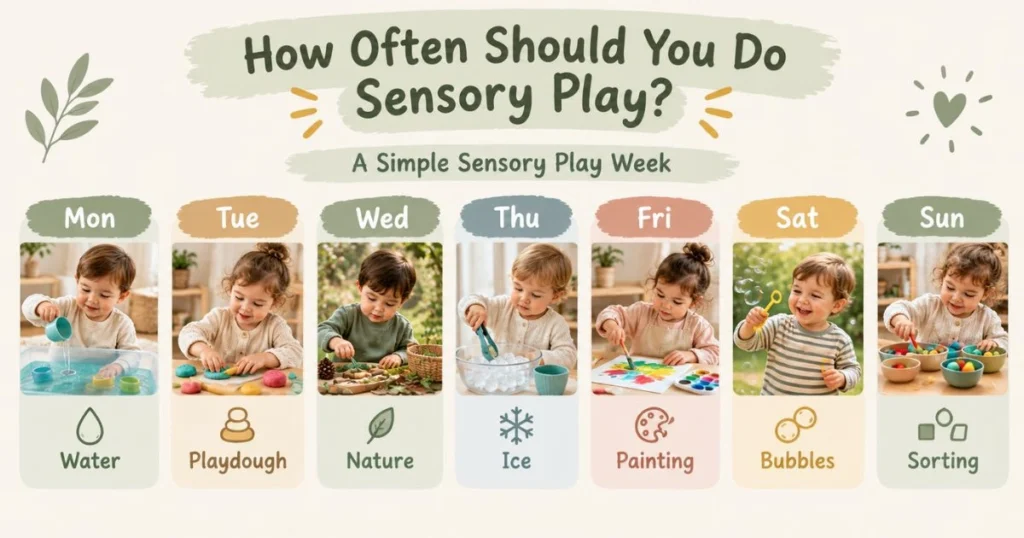
There isn’t a magic number of sensory-play sessions your toddler needs each week.
You can incorporate sensory exploration naturally into everyday life.
For example:
| Day | Activity | Setup |
| Monday | Water pouring | Quick |
| Tuesday | Playdough | Indoor |
| Wednesday | Nature tray | Low mess |
| Thursday | Ice exploration | Kitchen |
| Friday | Finger painting | Messy |
| Saturday | Bubble play | Outdoor |
| Sunday | Sorting game | Quiet |
Your toddler may play for five minutes one day and twenty minutes another.
That’s normal.
You don’t need to force an activity to continue once your child has lost interest.
The American Academy of Pediatrics emphasizes making play part of everyday childhood rather than treating it as something that must be perfectly structured.
Common Sensory Play Mistakes Parents Make
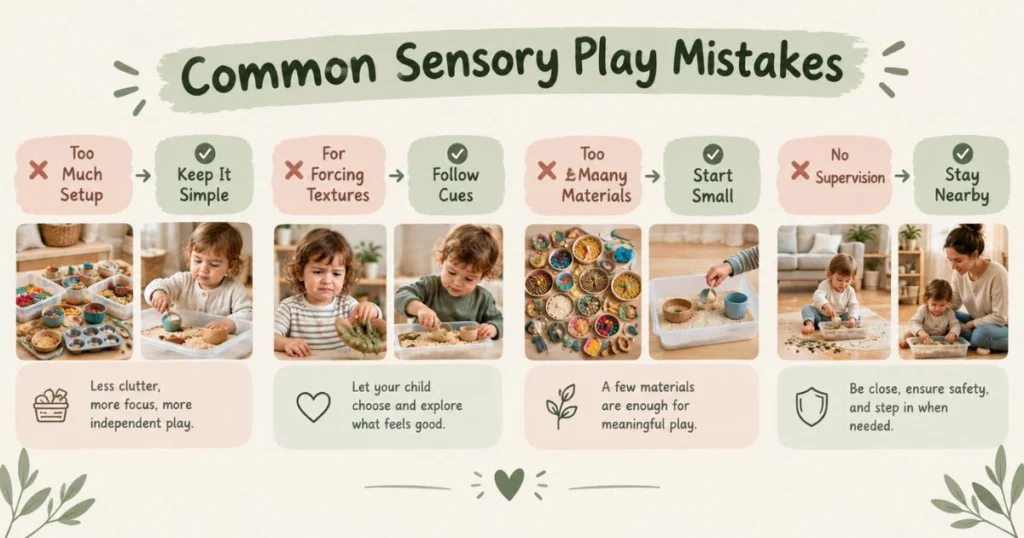
Making Activities Too Complicated
A sensory bin doesn’t need ten ingredients.
Start with one material and two tools.
Adding Too Many Materials
Too much stimulation can make an activity difficult to understand.
Simple is often easier.
Expecting Your Toddler to Play the “Right” Way
You may prepare a beautiful sensory tray.
Your toddler may ignore the intended activity and put everything into one cup.
That’s still exploration.
Forcing Uncomfortable Textures
Your child doesn’t need to touch every material you offer.
Give them control.
Forgetting About Cleanup
Prepare the space before you start.
A five-minute setup can save you twenty minutes of frustration later.
Using Unsafe Small Objects
Always consider your toddler’s developmental stage and whether they still mouth objects.
Assuming Every Sensory Activity Works for Every Child
Children have different preferences.
One toddler may love wet textures.
Another may immediately wipe their hands.
Neither response is automatically a problem.
Frequently Asked Questions About Sensory Play
What Is Sensory Play for Toddlers?
Sensory play gives toddlers opportunities to explore materials and experiences through touch, sight, sound, smell, taste, and movement. Examples include water play, ice exploration, playdough, bubbles, finger painting, texture trays, and simple transfer games.
What Are the Best Sensory Play Activities for Toddlers at Home?
Some of the easiest choices are:
- Water pouring
- Sponge squeezing
- Ice play
- Cooked pasta
- Playdough
- Bubbles
- Finger painting
- Nature exploration
- Texture sorting
You don’t need special equipment.
What Are the Benefits of Sensory Play for Toddlers?
Sensory-rich play can give your toddler opportunities to practice fine motor movements, language, exploration, problem-solving, attention, and playful learning.
More broadly, the AAP identifies play as important for children’s cognitive, language, social-emotional, and self-regulation development.
What Can I Put in a Toddler Sensory Bin?
Choose age-appropriate materials based on your child’s developmental stage.
Possible options include:
- Water
- Ice
- Cooked pasta
- Oats
- Large safe objects
- Sponges
- Playdough
- Natural materials
Avoid small choking hazards and don’t use water beads with young children.
Is Sensory Play Good for Toddlers?
Yes. Sensory-rich exploration can be a valuable form of play because it gives toddlers opportunities to investigate their environment through hands-on experiences.
It doesn’t need to be complicated or performed every day.
How Long Should Sensory Play Last?
There is no universal perfect duration.
Follow your toddler’s attention and interest.
A five-minute activity can still be worthwhile.
If your child is finished, let them finish.
How Do You Make Sensory Play Less Messy?
Use:
- Shallow trays
- Washable mats
- Small quantities
- Towels
- Old clothes
- Outdoor spaces for particularly messy activities
Start small and add more material only if needed.
What Should You Avoid in Sensory Play for Toddlers?
Avoid:
- Small choking hazards
- Water beads
- Sharp objects
- Toxic materials
- Unsafe plants
- Unsupervised water
- Materials inappropriate for your child’s developmental stage
Water beads are particularly concerning because they can expand after ingestion and cause serious internal problems.
Can Sensory Play Help a Toddler Calm Down?
Some children may find slow, repetitive, predictable activities enjoyable or calming, but children respond differently.
Water pouring, squeezing a sponge, playing with dough, or quietly exploring textures may feel relaxing to some toddlers.
Don’t treat sensory play as a guaranteed treatment for behavioral or sensory difficulties. If sensory differences are significantly interfering with your child’s everyday activities, talk with your pediatrician or an appropriately qualified professional. Occupational therapy organizations recognize sensory processing as relevant to participation in everyday activities, including play and learning.
For more gentle strategies for helping your toddler manage big feelings, see our guide to Toddler Emotions: 10 Gentle Ways to Handle Big Feelings.
Conclusion: Keep Sensory Play Simple
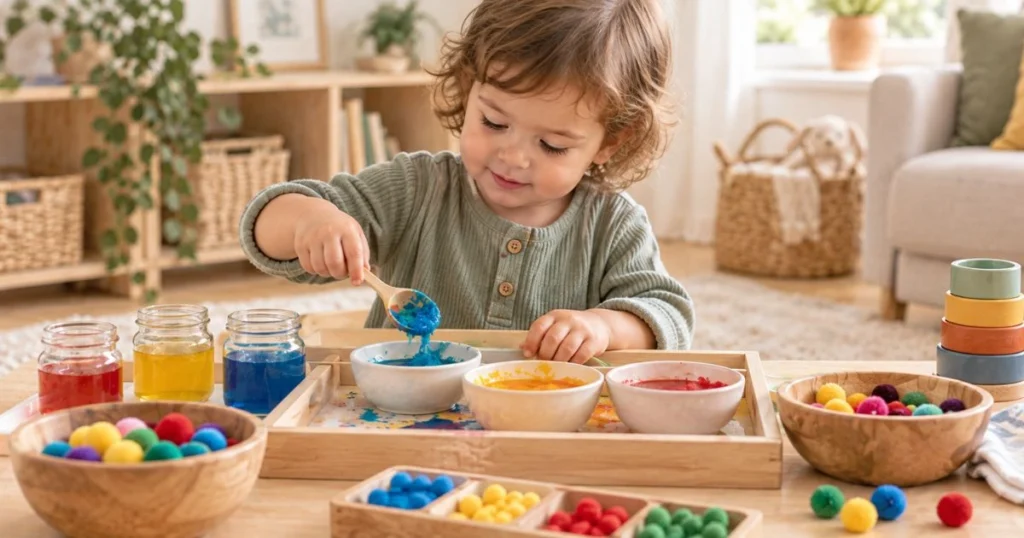
You don’t need a Pinterest-perfect playroom to give your toddler meaningful experiences.
Sometimes sensory play is nothing more than a bowl of water and two cups.
Sometimes it’s a few ice cubes melting on a tray.
Sometimes it’s cooked pasta between little fingers, bubbles floating through the backyard, or a handful of leaves collected during a walk.
What matters is the opportunity to explore.
Let your toddler scoop.
Let them pour.
Let them repeat the same action.
Let them get curious about what happens next.
And when something doesn’t go according to plan, remember that exploration rarely follows your plan anyway.
Your toddler isn’t looking for a perfect activity setup. They’re looking for a chance to discover their world.
So choose one activity from this list, gather what you already have at home, and give your child a little space to experiment today.
Which sensory play activity will you try first? Share your favorite idea with another parent who could use a simple, low-cost activity for their toddler.