You’re Not a Bad Parent—Toddler Tantrums Are a Normal Part of Growing Up
One minute, your toddler is happily nibbling on a snack. The next, they’re crying on the kitchen floor because you peeled their banana instead of letting them do it themselves.
If you’ve ever found yourself standing in the middle of a grocery store while your child screams, kicks, or refuses to move, you know how overwhelming toddler tantrums can feel. You might wonder if you’re handling the situation the right way—or if everyone around you is judging your parenting.
The truth is, every parent experiences toddler tantrums at some point. They can be exhausting, embarrassing, and emotionally draining, but they are also a completely normal part of early childhood development.
Rather than seeing tantrums as “bad behavior,” it helps to understand what they really are: a young child’s way of expressing big emotions they do not yet have the skills to manage.
The good news? You don’t need to yell, threaten, or use punishment to handle these challenging moments. Learning how to deal with toddler tantrums with patience and connection can help your child feel safe while building important emotional skills.
By using gentle toddler tantrum strategies and practicing positive discipline for toddlers, you can guide your child through difficult emotions while strengthening your bond. The goal is not to eliminate every tantrum overnight, but to teach your child healthier ways to communicate and regulate feelings.
In this guide, you’ll learn:
- What toddler tantrums really are
- Why they happen
- The most common triggers behind big emotions
- What tantrums look like at different ages
- Tantrum vs. meltdown: understanding the key differences
- Gentle strategies for how to calm a toddler tantrum
- Positive discipline approaches that actually work
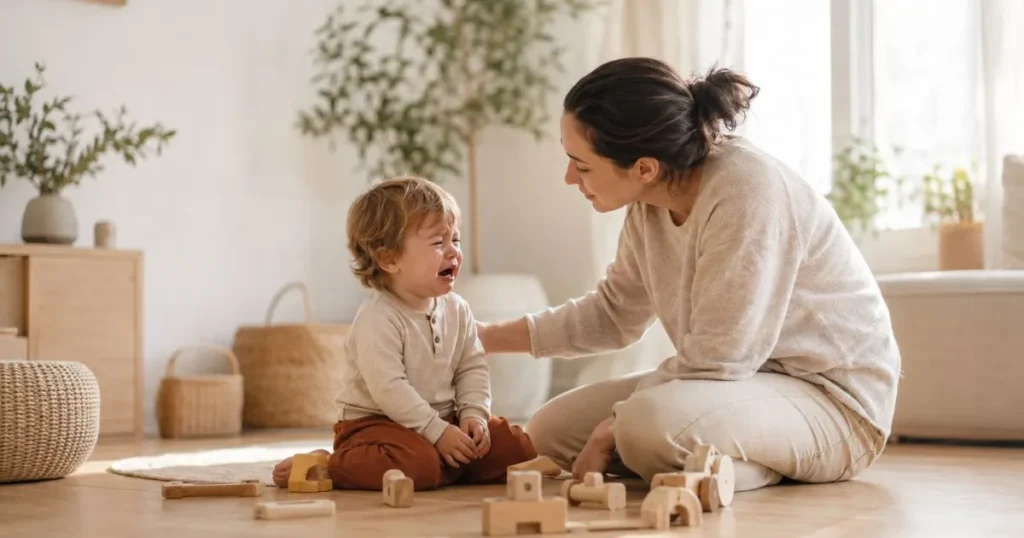
Toddler tantrums are a common part of early childhood as children learn to express big emotions and develop self-control.
Let’s begin by understanding what’s really happening behind those big emotions.
What Are Toddler Tantrums?

Toddler tantrums are sudden emotional outbursts that happen when a young child feels overwhelmed, frustrated, disappointed, tired, or unaMany Toddler Tantrums happen because young children are not yet able to communicate what they need or express their big feelings in healthy ways.
A tantrum may include:
- Crying
- Screaming
- Kicking
- Hitting
- Throwing toys
- Stomping feet
- Refusing to cooperate
- Falling to the floor
Although these behaviors can seem dramatic, toddler tantrums are usually a sign that your child is struggling with overwhelming emotions—not trying to manipulate you or intentionally misbehave.
Children between one and four years old are still developing the parts of the brain responsible for emotional regulation, self-control, and decision-making. Because these skills are still maturing, even small frustrations can trigger toddler meltdowns or emotional outbursts when children feel overwhelmed.
From a gentle parenting perspective, the goal is not simply to stop the behavior but to understand what is causing it. Instead of reacting to the tantrum itself, try asking:
“What is my child trying to communicate?”
This simple shift in perspective helps you respond with empathy, strengthen your parent-child connection, and teach the emotional skills your child needs to handle toddler tantrums more successfully over time.
Are Toddler Tantrums Normal?
Yes.
In fact, tantrums are considered a healthy part of child development.
Toddlers experience strong emotions every day, but they lack the vocabulary, impulse control, and emotional skills needed to express themselves calmly.
Think about how difficult it can be for adults to stay calm when they’re hungry, exhausted, or stressed. Now imagine experiencing those same feelings without fully understanding them or knowing how to explain them.
That’s life for a toddler.
Most children experience tantrums between 12 months and 4 years, with the highest frequency occurring around age two and three.
Typical Toddler Tantrum Characteristics
| Feature | Typical Pattern |
| Common Age | 1–4 years |
| Peak Age | 2–3 years |
| Duration | 2–15 minutes |
| Frequency | A few times each week (varies by child) |
| Common Triggers | Hunger, fatigue, frustration, transitions |
Remember that every child develops differently. Some toddlers rarely have tantrums, while others experience them more often.
Why Do Toddler Tantrums Happen?
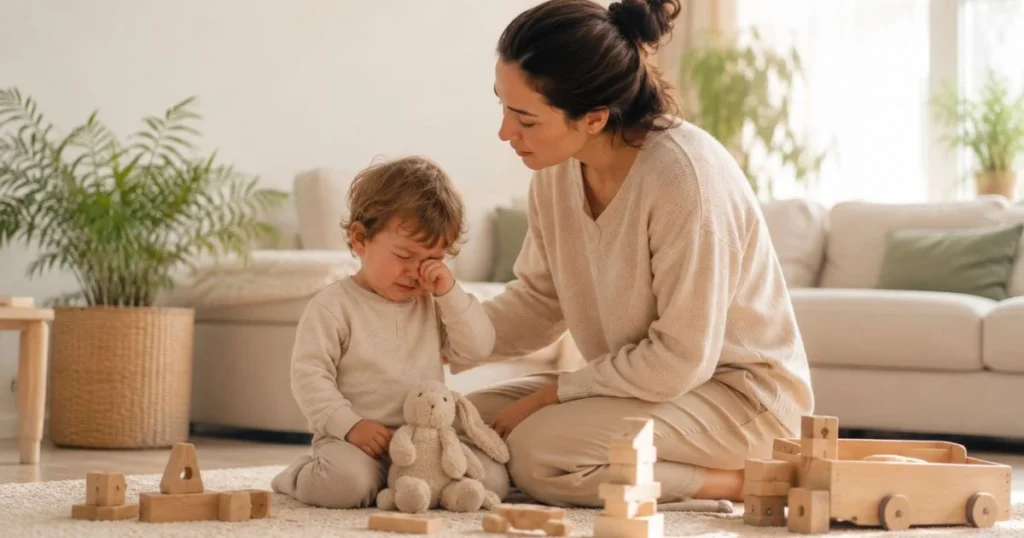
Understanding the cause of toddler tantrums makes it much easier to respond with patience instead of frustration.
Here are the biggest reasons toddlers lose control.
Their Brain Is Still Developing
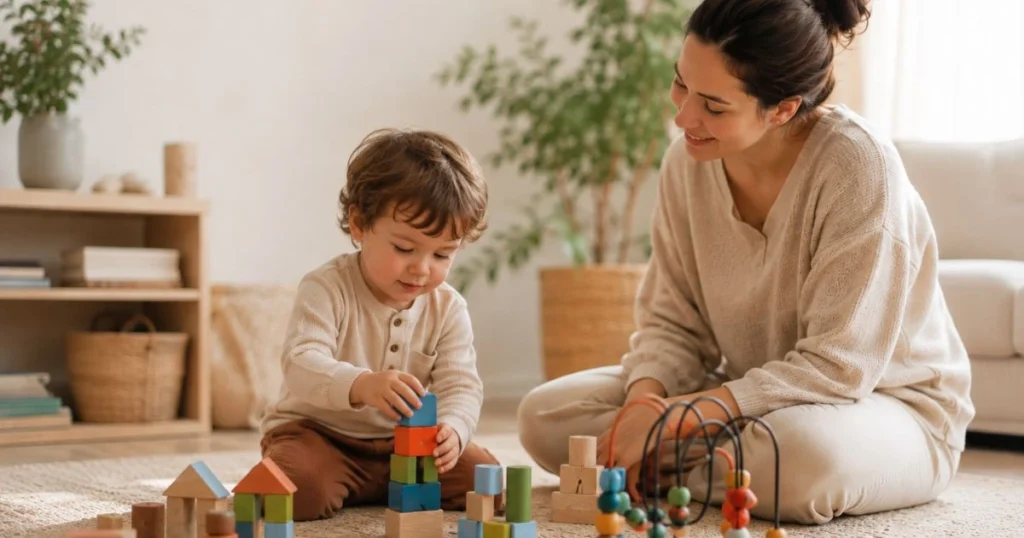
Your toddler’s brain is developing remarkably fast.
The emotional center of the brain develops much earlier than the part responsible for reasoning and self-control, known as the prefrontal cortex.
This means your child feels emotions intensely but doesn’t yet have the ability to regulate them.
When something doesn’t go as expected, their emotions often take over before logic has a chance.
That’s why a broken cracker or the wrong-colored cup can seem like the end of the world.
To adults, these situations appear small.
To toddlers, they’re enormous.
They Can’t Always Express What They Feel
Language skills develop gradually.
Even toddlers who know hundreds of words often struggle to explain complex emotions like disappointment, jealousy, or frustration.
Instead of saying,
“I’m upset because I can’t put my shoes on by myself.”
Your child might suddenly burst into tears and toss the shoes across the room.
The tantrum becomes their language.
As vocabulary grows, many children naturally experience fewer tantrums because they can communicate their needs more effectively.
They Want Independence
One of the most important milestones of the toddler years is developing independence.
You’ll probably hear phrases like:
- “Me do it!”
- “No!”
- “Mine!”
These aren’t signs of disrespect.
They’re signs that your child is discovering their own identity.
When adults constantly step in, rush them, or say no, frustration builds quickly.
Offering small choices allows your toddler to feel capable while still keeping healthy boundaries.
They Feel Big Emotions
Toddlers feel emotions just as deeply as adults—they simply haven’t learned how to manage those feelings yet.
Common emotions include:
- Anger
- Excitement
- Fear
- Jealousy
- Anxiety
- Frustration
- Sadness
- Disappointment
Since self-regulation is still developing, those big emotions can easily lead to tantrums.
Their Basic Needs Aren’t Being Met
Sometimes the real cause of a tantrum has nothing to do with behavior.
It may simply be that your child is:
- Hungry
- Overtired
- Sick
- Teething
- Overstimulated
- Uncomfortable
This is why many tantrums happen before meals, after busy outings, or near bedtime.
Meeting your child’s physical needs is often the simplest way to prevent emotional outbursts.
Common Toddler Tantrum Triggers
While every child is unique, certain situations tend to trigger tantrums more than others.
Recognizing these patterns allows you to prepare ahead of time.
Physical Triggers

Physical discomfort quickly affects a toddler’s ability to cope.
Common examples include:
- Hunger
- Fatigue
- Illness
- Teething pain
- Dirty diapers
- Being too hot or too cold
A child who skipped lunch or missed a nap has much less emotional energy available.
Emotional Triggers
Young children feel emotions intensely.
Tantrums often happen after:
- Feeling ignored
- Losing a game
- Sharing toys
- Hearing “no”
- Being corrected
- Separation from a parent
Even positive excitement, such as birthdays or holidays, can become overwhelming.
Environmental Triggers
Busy environments can overload young children.
Common triggers include:
- Loud noises
- Crowded stores
- Bright lights
- Too many activities
- Long car rides
- Busy family gatherings
If your toddler becomes overwhelmed easily, try scheduling quiet breaks throughout the day.
Routine Changes

Toddlers thrive on predictability.
Unexpected changes often lead to frustration.
Examples include:
- Leaving the playground
- Turning off the television
- Bedtime
- Getting dressed
- Transitioning between activities
- Visiting unfamiliar places
Giving advance warnings—such as “Five more minutes before we leave”—can make transitions much smoother.
Common Toddler Tantrum Triggers
| Trigger | Why It Causes Tantrums | Helpful Prevention Strategy |
| Hunger | Low energy affects mood | Offer healthy snacks before outings |
| Tiredness | Less emotional control | Maintain a consistent sleep schedule |
| Frustration | Can’t complete a task | Offer encouragement instead of taking over |
| Transitions | Toddlers dislike sudden change | Give countdown warnings |
| Overstimulation | Too much sensory input | Schedule quiet time after busy activities |
| Being Told “No” | Desire for independence | Offer two acceptable choices instead |
Toddler Tantrums by Age
During the toddler years (ages 1–3), children experience rapid growth in language, emotional regulation, and problem-solving abilities. However, these skills are still developing, which is why tantrums are a normal part of early childhood. Learn more about toddler developmental milestones from trusted child development experts.
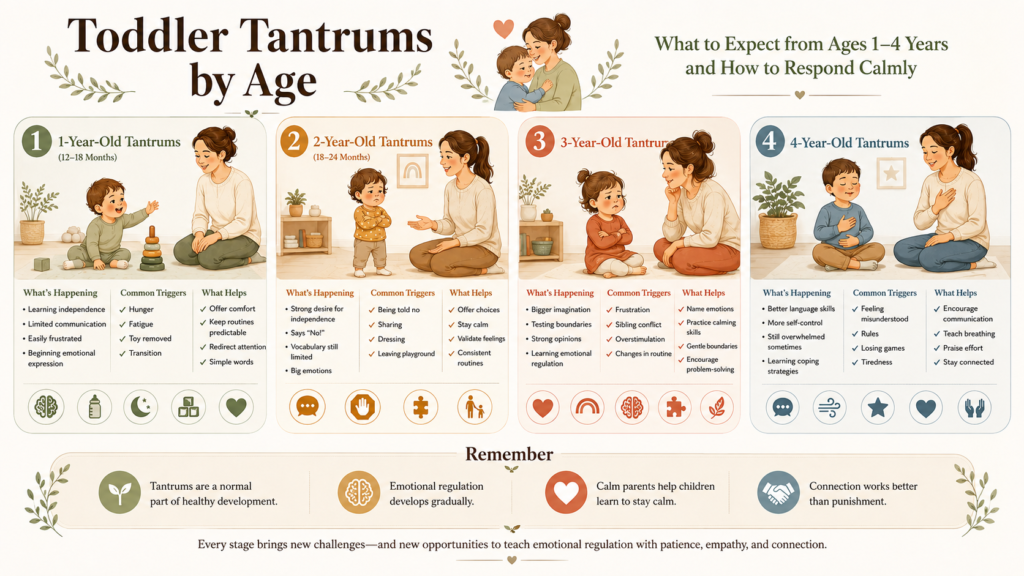
Not all tantrums look the same. As your child grows, the reasons behind their outbursts—and the best ways to respond—change as well.
1-Year-Old Tantrums (12–18 Months)
At this age, your toddler is just beginning to explore the world but has very limited language skills.
Common causes include:
- Hunger
- Fatigue
- Separation anxiety
- Frustration with communication
- Sensory overload
Most tantrums are short but intense because your child has very few ways to express what they need.
2-Year-Old Tantrums (18–24 Months)
If you’ve ever heard the term “terrible twos,” it usually refers to this stage of development. Around age two, your toddler’s desire for independence grows much faster than their ability to manage emotions. They want to make decisions, explore the world, and do things without help—but they still need guidance and support.
Common reasons for tantrums at this age include:
- Wanting to do everything independently
- Hearing the word “no”
- Difficulty waiting
- Frustration with sharing
- Limited communication skills
- Difficulty transitioning between activities
At this stage, offering simple choices can reduce power struggles. For example:
- “Would you rather use the white cup or the black cup?”
- “Would you rather put on your hat first or your jacket?
Giving your child a sense of control often prevents unnecessary conflict.
3-Year-Old Tantrums
By age three, many toddlers have stronger language skills, but they still struggle with impulse control.
Tantrums often become less frequent than they were at age two, although they may become more emotional because children can now express stronger opinions.
Common triggers include:
- Not getting their way
- Difficulty sharing
- Feeling misunderstood
- Becoming overly excited
- Changes in routine
- Testing boundaries
Three-year-olds also begin paying closer attention to fairness.
You may hear comments like:
- “That’s not fair!”
- “I wanted it first!”
- “It’s my turn!”
Responding with empathy while maintaining consistent limits helps children feel secure.
4-Year-Old Tantrums
Many four-year-olds experience fewer tantrums because their emotional regulation and communication skills have improved.
However, they can still have emotional outbursts when they are:
- Extremely tired
- Hungry
- Overstimulated
- Under stress
- Adjusting to major life changes
Rather than frequent screaming or kicking, older preschoolers may cry, argue, sulk, or refuse to cooperate.
This is a good age to begin teaching simple coping skills like:
- Taking deep breaths
- Counting to ten
- Naming emotions
- Asking for help
- Taking a brief break in a peaceful, quiet space
Toddler Tantrums by Age at a Glance
| Age | Common Behaviors | Best Parenting Response |
| 1 Year | Crying, throwing objects, frustration | Meet physical needs and comfort |
| 2 Years | Screaming, saying “No!”, falling to the floor | Offer simple choices and stay calm |
| 3 Years | Arguing, refusing, emotional outbursts | Validate feelings and keep boundaries |
| 4 Years | Crying, negotiating, frustration | Teach coping skills and problem-solving |
Tantrums vs. Meltdowns: What’s the Difference?
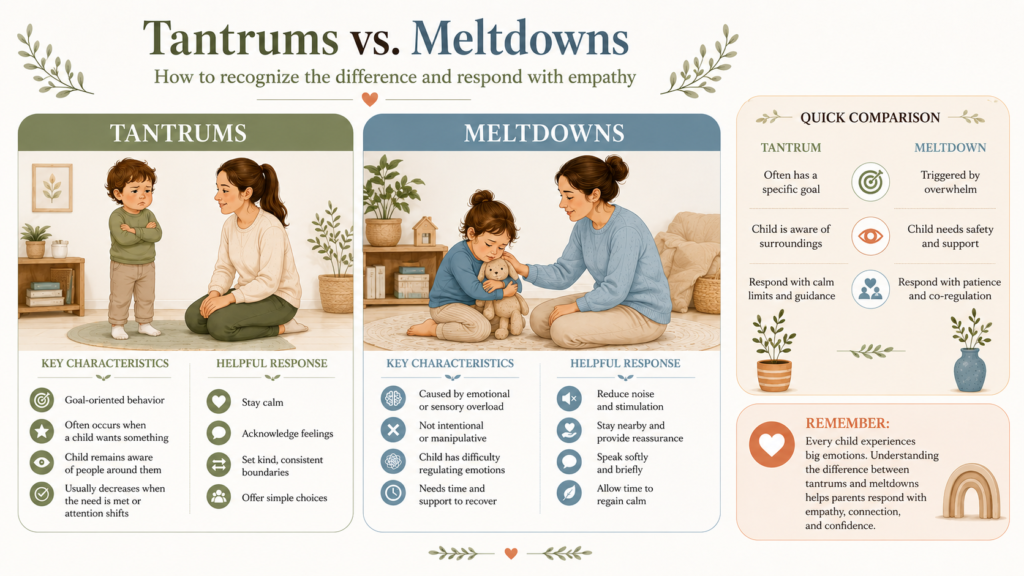
Many parents use the terms tantrum and meltdown interchangeably, but they are not the same.
Recognizing the difference helps you respond with the support your child needs.
What Is a Tantrum?
A toddler tantrum is an intense emotional reaction that usually happens when a child wants something, feels frustrated, or cannot communicate their needs effectively. Toddler tantrums are a normal part of early childhood development and often reflect big feelings rather than intentional misbehavior.
Even though the emotions are intense, your child is usually still aware of what’s happening around them. Unlike some toddler meltdowns, they may still respond to comfort, reassurance, or changes in the situation.
A toddler tantrum often ends once the child:
- Calms down
- Gets their needs met
- Feels understood
- Moves on to another activity
Understanding why toddler tantrums happen allows parents to respond with gentle parenting strategies that support emotional regulation instead of relying on punishment. This approach helps children gradually learn healthier ways to express and manage their emotions.
What Is a Meltdown?
A toddler meltdown happens when your child becomes completely overwhelmed by their emotions or environment. While toddler tantrums are often triggered by frustration or unmet needs, meltdowns are usually the result of a child reaching their emotional or sensory limit.
This may result from:
- Sensory overload
- Extreme fatigue
- Anxiety
- Emotional overload
- Unexpected changes in routine
Unlike toddler tantrums, a child experiencing a meltdown is not trying to get something or change the outcome of a situation. Instead, they have temporarily lost the ability to practice emotional regulation because their developing nervous system is overwhelmed.
During a meltdown, your child’s nervous system struggles to cope with the intensity of the moment, making it difficult for them to think clearly or respond to instructions. From a gentle parenting perspective, your priority isn’t discipline—it’s helping your child feel safe, supported, and emotionally secure until they regain control. This compassionate response builds trust and teaches the emotional skills children need as they grow.
Tantrum vs. Meltdown Comparison
| Toddler Tantrum | Toddler Meltdown |
| Usually triggered by frustration | Usually triggered by overwhelm |
| Child has some self-control | Child loses emotional control |
| May stop if the situation changes | Continues despite rewards or consequences |
| Often goal-oriented | Not goal-oriented |
| Responds well to calm boundaries | Responds best to comfort and reduced stimulation |
Recognizing the difference helps you respond in the way your child needs, rather than assuming every outburst calls for discipline.
Signs a Toddler Tantrum Is About to Happen

Tantrums rarely appear without warning. In many cases, your toddler shows small signs that they’re becoming overwhelmed.
Learning to recognize these early cues gives you the opportunity to step in before emotions escalate.
Common Warning Signs
- Whining
- Clinginess
- Frowning
- Crossing arms
- Throwing toys
- Repeating “No!”
- Becoming unusually quiet
- Rubbing eyes
- Pacing
- Refusing simple requests
- Crying over small disappointments
When you notice these behaviors, take a moment and ask yourself:
- Is my child hungry?
- Are they tired?
- Are they overstimulated?
- Have we been busy all day?
- Do they need connection?
Sometimes a five-minute cuddle, a healthy snack, or a change of environment can prevent a full-blown tantrum.
Why Staying Calm Matters
When your child experiences toddler tantrums, feeling frustrated is a completely natural reaction. After all, you’re human too. However, one of the most effective gentle parenting strategies is remembering that children learn emotional regulation by watching the adults who care for them.
If you respond by yelling, your child may learn that shouting is how people handle big feelings and frustration.
If you respond with calm confidence, your child begins to understand that strong emotions can be managed safely and that difficult moments don’t have to feel frightening.
Think of yourself as your child’s safe place during toddler tantrums and emotional outbursts. Your calm presence helps regulate your child’s developing nervous system when they cannot yet regulate it on their own.
The calmer you remain, the easier it becomes for your child to regain control. Even if your calm response doesn’t stop today’s toddler tantrum immediately, it is strengthening your parent-child connection and helping your child develop lifelong emotional regulation skills that will benefit them well beyond the toddler years..
15 Calm Ways to Stop Toddler Tantrums
Every toddler has tantrums from time to time, but how you respond can shape how your child learns to handle emotions for years to come.
The goal isn’t to eliminate every tantrum overnight. Instead, it’s to teach your child healthy ways to cope with frustration while preserving a secure, loving relationship.
The following positive discipline strategies are practical, respectful, and easy to use in everyday situations.
1. Stay Calm Before Guiding Your Child

Your child naturally looks to you for reassurance and takes emotional cues from the way you respond.
Responding with anger, yelling, or impatience can make your child feel even more overwhelmed. Staying calm doesn’t mean accepting the behavior—it means modeling the emotional control you want your child to learn.
Hunger, tiredness, frustration, and changes in routine can make emotional outbursts more likely. When toddlers do not get enough rest, they may have more difficulty managing their emotions and coping with frustration. Understanding children’s sleep needs can help parents create healthy routines that support better behavior.
Why It Works
Children naturally mirror the emotions of trusted adults. Your calm presence lets your child know they are safe and supported.
How to Do It
- Take one slow breath before responding.
- Speak in a quiet, steady voice.
- Keep your facial expression relaxed.
- Remember that your child’s behavior isn’t personal.
Example
Instead of saying:
“Stop crying right now!”
Try:
“I can see you’re really upset. I’m here with you.”
2. Meet Your Child at Eye Level
Standing over a crying toddler can feel intimidating. Kneeling beside them helps create a sense of safety and connection.
Eye-level communication also makes it easier for your child to focus on your words.
Why It Works
Children feel more secure when adults communicate respectfully rather than from a position of authority.
Try This
- Kneel beside your child.
- Make gentle eye contact.
- Keep your body language open.
- Avoid pointing fingers or crossing your arms.
3. Validate Your Child’s Feelings
Validation doesn’t mean agreeing with every behavior. It simply means acknowledging what your child is feeling.
Feeling understood often helps emotions settle more quickly.
Examples
- “I know you’re upset because it’s time to leave the park.”
- “You really wanted the blue cup.”
- “It’s frustrating when something doesn’t work.”
After validating feelings, calmly hold the boundary.
“I know you’re upset. It’s time to go home now.”
4. Use Fewer Words
During a tantrum, your child’s thinking brain isn’t fully engaged.
Long explanations often make the situation worse.
Instead, use short, reassuring phrases.
Examples
- “I’m here.”
- “You’re safe.”
- “We’ll figure this out together.”
- “Let’s take a deep breath.”
Simple language is much easier for an overwhelmed child to process.
5. Offer Two Simple Choices

Toddlers crave independence.
Offering limited choices gives them a sense of control without allowing them to decide everything.
Examples
Instead of:
“Put your shoes on.”
Try:
- “Which shoes would you like to wear today—the red pair or the blue pair?”
Instead of:
“Eat your lunch.”
Try:
- “Would you like carrots or cucumber first?”
Giving choices reduces many power struggles before they begin.
6. Keep Your Boundaries Consistent
Consistency helps children feel safe.
If you say “no” one day but give in after a tantrum the next, your child receives mixed messages.
That doesn’t mean being harsh.
You can be both kind and firm.
Example
“I know you want another cookie.
The answer is still no.
You can have fruit instead.”
Kindness and consistency can exist together.
7. Look for the Cause Instead of Only the Behavior
Tantrums usually happen for a reason.
Before reacting, pause and ask yourself:
- Is my child hungry?
- Did they miss their nap?
- Are they overstimulated?
- Are they feeling disconnected?
- Is something physically uncomfortable?
Meeting the underlying need often resolves the behavior much faster than punishment.
8. Redirect Their Attention
Young children have naturally short attention spans.
Sometimes a simple distraction is enough to prevent emotions from escalating.
Examples
- Look for birds outside.
- Blow bubbles.
- Count passing cars.
- Start a silly song.
- When you notice these behaviors, take a moment and ask yourself:
Redirection works best before the tantrum reaches its peak.
9. Practice Deep Breathing Together
Children learn emotional regulation by practicing it repeatedly.
One of the easiest techniques is slow breathing.
Fun Ways to Practice
- Smell the flower, blow out the candle.
- Pretend to blow giant bubbles.
- Blow feathers across a table.
- Slowly inflate an imaginary balloon.
When breathing becomes a daily habit, it’s much easier to use during stressful moments.
10. Use a Time-In Instead of a Time-Out
Instead of sending your child away to calm down alone, stay nearby and offer your calm presence.
A “time-in” teaches emotional regulation through connection.
During a Time-In
- Sit quietly beside your child.
- Offer a hug if they want one.
- Stay calm.
- Wait until they’re ready to talk.
Many children calm down more quickly when they know they’re not facing their emotions alone.
11. Teach Feeling Words
Children can’t explain feelings they don’t yet have the words to describe.
Help your toddler build an emotional vocabulary.
Teach words like:
- Happy
- Sad
- Angry
- Excited
- Nervous
- Scared
- Frustrated
- Proud
- Disappointed
The more words your child knows, the less they may rely on tantrums to communicate.
12. Praise Positive Behavior
Children are more likely to repeat behaviors that are noticed and encouraged with positive attention.
Instead of only noticing tantrums, celebrate moments of cooperation.
Examples
- “You stayed calm when we left the park.”
- “Thank you for using your words.”
- “I noticed how patiently you waited.”
Specific praise is more effective than simply saying “Good job.”
13. Create Predictable Daily Routines

Children are more at ease when they know what to expect.
Consistent routines reduce uncertainty, making tantrums less likely.
Helpful Daily Routine
| Time | Activity |
| 7:00 AM | Wake up and breakfast |
| 9:00 AM | Outdoor play |
| 12:00 PM | Lunch |
| 1:00 PM | Nap or quiet time |
| 3:00 PM | Snack |
| 5:30 PM | Dinner |
| 7:00 PM | Bath and bedtime routine |
| 7:30 PM | Bedtime |
A predictable schedule doesn’t need to be perfect—just consistent.
14. Reconnect After the Tantrum
Once your child is calm, avoid bringing up the tantrum with criticism or shame.
Instead, reconnect.
You might say:
- “That was a big feeling.”
- “I’m proud of how you calmed your body.”
- “Would you like a hug?”
Then briefly talk about what happened and what they can try next time.
These conversations build emotional intelligence over time.
15. Be Patient—Emotional Regulation Takes Time
Learning to manage emotions is a lifelong skill.
Your toddler won’t master it in a week—or even a month.
Some days will feel easy.
Others may feel like you’re starting over.
That’s completely normal.
Each calm response teaches your child something valuable:
- Emotions are safe.
- Problems can be solved.
- Parents can be trusted.
- Mistakes don’t end relationships.
Progress happens one interaction at a time.
Common Parenting Mistakes That Can Make Toddler Tantrums Worse
Even loving, well-intentioned parents sometimes react in ways that unintentionally increase tantrums. The encouraging news is that even small changes can have a meaningful impact.
| Common Mistake | Better Alternative |
| Yelling | Speak calmly and confidently |
| Threatening | Set clear, consistent limits |
| Giving in after screaming | Hold the boundary with empathy |
| Long lectures | Use short, simple sentences |
| Shaming (“You’re being bad.”) | Separate the behavior from the child |
| Punishing emotions | Accept feelings while guiding behavior |
| Inconsistency | Respond similarly each time |
| Expecting too much | Keep expectations age-appropriate |
Remember, your child isn’t trying to give you a hard time—they’re having a hard time.
How to Prevent Toddler Tantrums Before They Start

While it’s impossible to prevent every case of toddler tantrums, you can often reduce their frequency by meeting your child’s emotional and physical needs before frustration builds. Toddler tantrums are a normal part of development, so prevention isn’t about raising a “perfect” child—it’s about creating an environment where your toddler feels secure, understood, and supported. This proactive approach, rooted in gentle parenting, helps children develop stronger emotional regulation skills over time.
Here are simple, practical strategies that can reduce toddler tantrums, support your child’s big feelings, and make everyday situations easier for both of you.
Keep a Consistent Daily Routine
Toddlers thrive on predictability. Knowing what comes next helps them feel safe and reduces anxiety.
Try to keep these activities at roughly the same time each day:
- Wake-up time
- Meals and snacks
- Nap or quiet time
- Outdoor play
- Bath time
- Bedtime
A consistent routine doesn’t have to be rigid, but familiar patterns help your child know what to expect.
Prioritize Healthy Sleep
An overtired toddler is much more likely to become frustrated over small challenges.
To encourage better sleep:
- Follow a calming bedtime routine.
- Limit stimulating activities before bed.
- Keep bedtime consistent.
- Make the bedroom cool, quiet, and comfortable.
- Look for early signs of fatigue before your child becomes overtired.
Well-rested children usually cope with disappointment more effectively.
Don’t Skip Healthy Meals and Snacks
Low blood sugar is a common trigger for toddler tantrums. Offering balanced meals and snacks throughout the day helps maintain your child’s energy and mood.
Aim to include:
- Protein
- Healthy fats
- Whole grains
- Fruits
- Vegetables
Avoid relying on sugary snacks, which can lead to energy crashes.
Healthy Snacks That May Help Prevent Hunger-Related Toddler Tantrums
| Snack | Ingredients | Benefits |
| Banana & Peanut Butter | Banana, natural peanut butter | Healthy fats, fiber, and lasting energy |
| Greek Yogurt with Berries | Plain Greek yogurt, fresh berries | Protein, calcium, and antioxidants |
| Apple Slices with Almond Butter | Apple, almond butter | Fiber and healthy fats |
| Cheese and Whole-Grain Crackers | Cheese cubes, whole-grain crackers | Protein and complex carbohydrates |
| Hummus with Veggie Sticks | Carrot sticks, cucumber, hummus | Vitamins, minerals, and fiber |
| Oatmeal with Fruit | Oats, banana, blueberries | Slow-release energy and fiber |
Give Advance Warnings Before Transitions
Sudden changes are difficult for many toddlers.
Instead of saying,
“We’re leaving right now.”
Try giving a gentle countdown:
- “We’ll leave the park in five minutes.”
- “Two more turns on the slide.”
- “After this book, it’s bedtime.”
Visual timers or simple countdown songs can help make transitions feel easier for your child.
Encourage Independent Choices
Toddlers enjoy feeling capable.
Offer simple choices throughout the day, such as:
- Which shirt to wear
- Which fruit to eat
- Which book to read
- Which toy to bring in the car
These small decisions satisfy your child’s growing need for independence without sacrificing important boundaries.
Spend Quality Time Together Every Day
A strong parent-child connection is one of the most effective tools in positive parenting.
Even 10 to 15 minutes of uninterrupted one-on-one time can help your child feel emotionally secure.
Ideas include:
- Reading books
- Building blocks
- Drawing together
- Going for a walk
- Dancing to music
- Pretend play
When children feel connected, they’re often more cooperative throughout the day.
Limit Overstimulation
Busy environments can overwhelm young children.
Balance active outings with quiet moments.
For example:
- Read a book after visiting the playground.
- Spend quiet time after a birthday party.
- Offer a calm activity before bedtime.
Learning when your child needs a break can prevent many emotional outbursts.
Daily Toddler Tantrum Prevention Checklist
Use this simple checklist to build habits that support emotional regulation.
- □ Slept well last night
- □ Ate a healthy breakfast
- □ Had nutritious snacks
- □ Drank enough water
- □ Spent time outdoors
- □ Had opportunities for independent play
- □ Enjoyed one-on-one time with a parent
- □ Followed a predictable routine
- □ Limited excessive screen time
- □ Had enough quiet time to recharge
Even if you don’t check every box every day, consistently meeting these needs can reduce the number and intensity of tantrums over time.
Simple Calming Activities During Toddler Tantrums

Once a tantrum starts, your goal isn’t to make the emotions disappear right away. Instead, help your child gradually return to a calm state.
These activities encourage emotional regulation without punishment.
| Activity | Materials Needed | Best Age |
| Deep Breathing: “Take a slow breath in as if you’re smelling a flower, then gently breathe out like you’re blowing out a birthday candle.” | None | 2+ years |
| Bubble Blowing | Bubble solution | 2+ years |
| Reading a Favorite Book | Picture book | All ages |
| Calm Corner | Pillows, stuffed animal, books | 2+ years |
| Hug or Gentle Back Rub | None | All ages (if welcomed) |
| Listening to Soft Music | Music player | All ages |
| Coloring Together | Paper and crayons | 3+ years |
| Sensory Bottle | Water bottle with glitter or beads | 2+ years |
Remember that every child is different. Every toddler is different, so try different calming strategies to find what helps your child feel safe, calm, and secure.
When Should You Be Concerned About Toddler Tantrums?
For most children, toddler tantrums are a normal part of healthy development and usually become less frequent as they grow, improve their communication skills, and develop stronger emotional regulation. However, there are times when persistent or unusually intense toddler tantrums should be discussed with your child’s pediatrician.
Consider seeking professional advice if your child:
- Has tantrums that regularly last longer than 25–30 minutes
- Has multiple severe toddler tantrums every day for several months
- Frequently hurts themselves during tantrums
- Aggressively harms others or destroys property
- Loses previously learned language or developmental skills
- Continues having toddler tantrums with the same intensity beyond age five
- Shows significant delays in speech, communication, or social interaction
- Rarely recovers from emotional outbursts without extreme difficulty
These signs don’t necessarily mean something is wrong, but they do deserve a professional evaluation to rule out developmental, medical, behavioral, or sensory concerns. In some cases, frequent toddler meltdowns or prolonged emotional outbursts may be linked to underlying developmental or emotional needs that benefit from early support.
Seeking help early is a proactive step—not a sign of failure. Early guidance can provide reassurance, help identify the cause of persistent toddler tantrums, and give your family practical strategies to better support your child’s emotional development.
Frequently Asked Questions About Toddler Tantrums
Are Toddler Tantrums Normal?
Yes. Toddler tantrums are a normal part of child development. As toddlers learn to communicate, manage emotions, and become more independent, emotional outbursts are common.
What Causes Toddler Tantrums?
Toddler tantrums are often triggered by frustration, hunger, tiredness, overstimulation, limited communication skills, or a desire for independence. Identifying the underlying cause can help you respond more effectively.
How Long Do Toddler Tantrums Usually Last?
Most toddler tantrums usually last anywhere from 2 to 15 minutes. The exact duration varies depending on the child’s temperament, age, and the situation.
How Can You Calm Toddler Tantrums Quickly?
Stay calm, acknowledge your child’s feelings, speak in a gentle voice, keep boundaries consistent, and offer comfort without giving in to unreasonable demands. The goal is to help your child regulate emotions rather than simply stop the crying.
Should You Ignore Toddler Tantrums?
It depends on the situation. If your child is safe and seeking attention through minor behaviors, limiting attention to the behavior while staying nearby can help. However, if your child is overwhelmed or distressed, they usually benefit from your calm presence and reassurance.
At What Age Do Toddler Tantrums Peak?
Toddler tantrums are most common between 2 and 3 years of age, when children seek independence but still have limited emotional regulation and communication skills.
Can Positive Discipline Reduce Toddler Tantrums?
Yes. Positive discipline helps children learn emotional regulation, problem-solving, and cooperation through connection, empathy, and consistent boundaries rather than punishment.
What’s the Difference Between Toddler Tantrums and Meltdowns?
A tantrum is usually a response to frustration or unmet desires, while a meltdown occurs when a child becomes emotionally or sensory overwhelmed. Meltdowns require comfort and reduced stimulation rather than discipline.
Conclusion

Toddler tantrums can be challenging, especially when you’re already exhausted or dealing with a stressful day. But remember, these emotional outbursts are not a reflection of your parenting or your child’s character. They are a natural part of learning how to navigate big feelings in a world that often feels overwhelming.
When you stay calm, seek to understand your child’s behavior, and respond with empathy and consistent limits, you help build emotional skills that will benefit them for years to come. Every reassuring hug, every calm conversation, and every moment of connection helps your child build emotional resilience and confidence.
Some days will feel harder than others, and that’s a normal part of parenting. Progress isn’t measured by the absence of tantrums but by the gradual development of your child’s ability to express emotions, solve problems, and recover from disappointment.
Continue responding with patience, love, and consistency every day. Over time, those small, everyday moments will lay the foundation for a strong parent-child relationship and a child who feels safe, understood, and capable of handling life’s ups and downs.
Ready to Build a Calmer Parenting Journey?
If you found this guide helpful, explore more positive parenting resources on Parenting Whisper. You’ll find practical guidance on gentle parenting, toddler development, sleep, nutrition, and everyday family life—all designed to help you raise a confident, emotionally resilient child with kindness and confidence.
Related Articles You May Also Like
Understanding toddler tantrums is an important step toward building a stronger connection with your child. If you’re looking for more guidance on managing emotions, encouraging positive behavior, and supporting your toddler’s development, explore these helpful parenting resources:
- What Is Gentle Parenting? A Complete Beginner’s Guide to Raising Confident, Connected Kids
- Positive Discipline : How to Teach Without Punishment (12 Proven Strategies)
- Parenting Styles: The 4 Main Types and Their Powerful Impact on Your Child
- Positive Parenting: A Complete Guide to Raising Confident, Resilient, and Emotionally Healthy Children
- Gentle Parenting vs Authoritative Parenting: Which Is Better for Your Child?