

If bedtime at your house has become a nightly negotiation, you are not alone. You may begin with good intentions: dinner is finished, pajamas are ready, and you’re hoping for a peaceful story before lights out. Then your toddler suddenly needs water, another book, a different stuffed animal, or one last trip to the bathroom.
Before you realize it, bedtime has lasted much longer than you expected.
A Toddler Bedtime Routine can make these evenings feel more predictable. It gives your child familiar signals that the busy part of the day is winding down and sleep is approaching. The goal isn’t to create a flawless routine or expect your toddler to fall asleep instantly. Instead, you’re creating a calm sequence that your child can recognize and gradually come to expect.
You don’t need a complicated Toddler Bedtime Routine. A few simple, consistent steps can make bedtime easier for both you and your toddler. Activities such as washing up, brushing teeth, reading, cuddling, and getting into bed can become familiar cues that signal it’s time to slow down.
In this guide, you’ll learn how much sleep your toddler needs, how to choose a realistic bedtime, how to build an effective Toddler Bedtime Routine, what to do when your child resists sleep, and how to adjust the routine as your toddler grows.
What Is a Toddler Bedtime Routine?
A Toddler Bedtime Routine is a predictable series of activities you follow before your child goes to sleep. It gives your toddler familiar cues that the day is winding down and bedtime is approaching.
The American Academy of Pediatrics also recommends a simple, soothing bedtime routine to help toddlers relax and get ready for sleep.
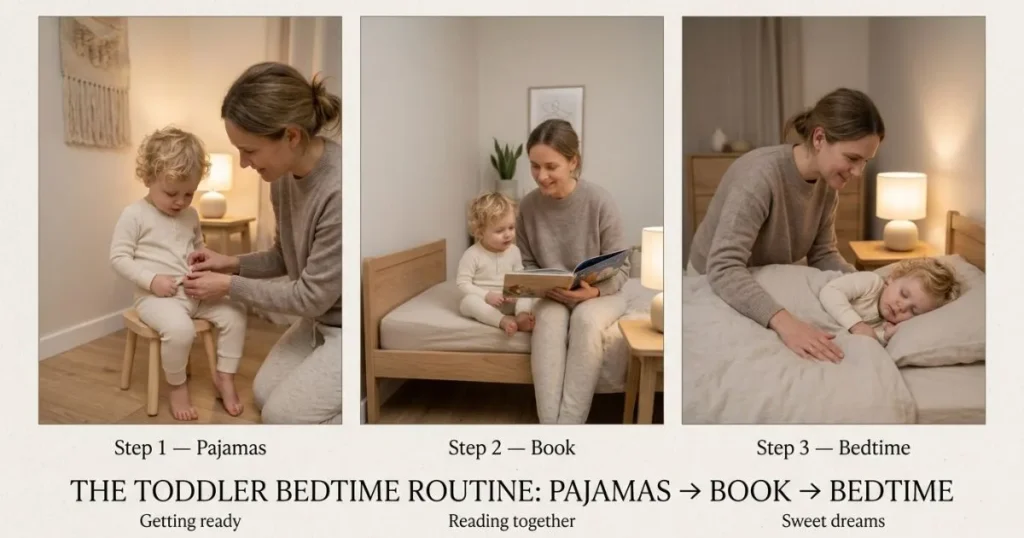
For example, you could follow a simple Toddler Bedtime Routine like this:
- Finish dinner.
- Have quiet play.
- Take a bath or wash up.
- Put on pajamas.
- Brush teeth.
- Read two books.
- Cuddle and sing a song.
- Say goodnight.
- Turn out the lights.
The exact activities are less important than the order and consistency. Your Toddler Bedtime Routine doesn’t need to be complicated to be effective.
Your toddler is learning what comes next through repetition. When the same sequence happens night after night, these familiar activities can become cues that bedtime is approaching and help your child transition more smoothly toward sleep.

Toddler Bedtime Routine vs. Toddler Sleep Schedule
These concepts are closely connected, but they serve different purposes. Your Toddler Bedtime Routine is part of the bigger picture of your child’s daily sleep schedule.
Your toddler’s overall sleep schedule includes:
- Morning wake-up
- Daytime nap
- Bedtime
- Overnight sleep
Your Toddler Bedtime Routine is the shorter sequence of activities that happens before your child goes to sleep.
Think of the sleep schedule as the timetable, while the Toddler Bedtime Routine acts as a bridge that helps your child move from daytime activity into a calmer nighttime state.
Why Predictability Matters
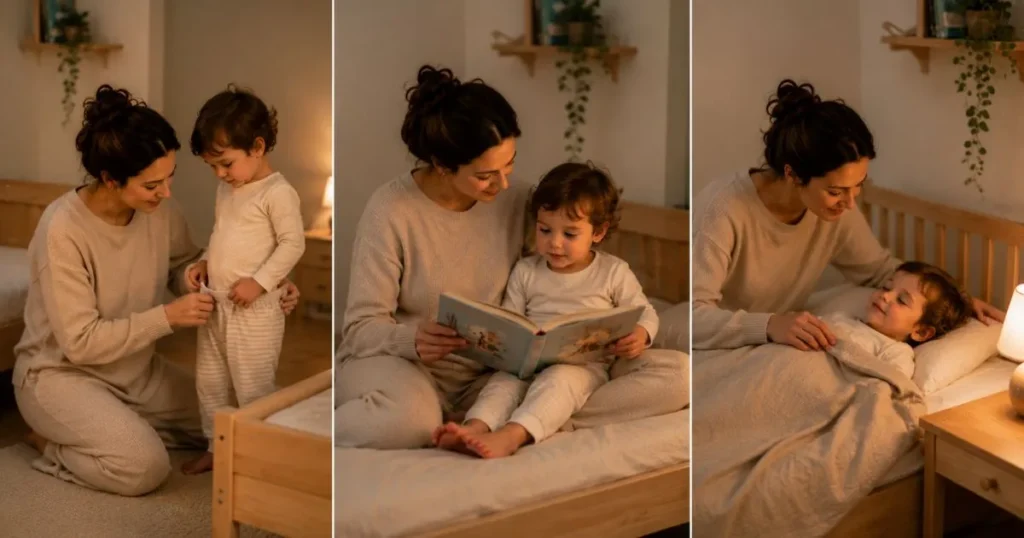
Toddlers are becoming more independent, but they still benefit from familiar and predictable patterns. A consistent Toddler Bedtime Routine helps your child understand what comes next without you having to explain the process from the beginning every evening.
You don’t need to say, “It’s bedtime” and expect your toddler to immediately switch from active play to sleep. Instead, a Toddler Bedtime Routine gradually helps lower the energy of the evening:
Play → wash → pajamas → books → cuddles → bed
Repeating these steps in the same order can make the transition toward sleep feel calmer and more manageable for both you and your child.
How Much Sleep Does Your Toddler Need?
Before changing your child’s bedtime, look at the amount of sleep your toddler needs across the entire 24-hour period. Your Toddler Bedtime Routine should fit into your child’s overall sleep schedule rather than being considered on its own.
The American Academy of Pediatrics endorses recommendations from the American Academy of Sleep Medicine stating that children ages 1–2 years generally need 11–14 hours of sleep per 24 hours, including naps. Children ages 3–5 years generally need 10–13 hours, including naps.
Toddler Sleep Needs by Age
| Age | Recommended Total Sleep | Naps Included? |
| 1–2 years | 11–14 hours | Yes |
| 3–5 years | 10–13 hours | Yes |
These are ranges rather than rigid targets. Your child may naturally need more or less sleep within the recommended range.
What matters is looking at the whole pattern.
Ask yourself:
- What time does your toddler usually wake?
- How long is the daytime nap?
- When does your child actually fall asleep?
- Does your toddler seem rested during the day?
- Is your child regularly falling asleep in the car or during quiet activities?
- Does your toddler become extremely irritable toward the end of the day?
Insufficient sleep has been associated with problems involving attention, behavior, learning, and emotional regulation, which is one reason healthy sleep habits deserve attention.
What Time Is Best for Your Toddler to Go to Bed?

No single bedtime is right for every toddler, as each child has different sleep needs and daily routines.
Instead of choosing a bedtime because another child goes to bed at that hour, start with your child’s natural schedule.
Consider:
- Morning wake-up time
- Nap timing
- Nap length
- Age
- Total sleep needs
- Family schedule
- Your child’s individual sleep pattern
If your toddler needs to wake early in the morning, bedtime may need to happen earlier than you initially expect.
Work Backward From Morning Wake-Up
A useful way to plan your Toddler Bedtime Routine is to work backward from your child’s usual morning wake-up time.
For example, if your child needs to wake around 7:00 AM and typically sleeps about 11 hours overnight, you’ll want to allow enough time in the evening for approximately 11 hours of nighttime sleep. You can then factor in the daytime nap to see whether the overall sleep pattern makes sense.
You don’t need to calculate everything perfectly every night. Instead, use these numbers as a general guide while paying attention to your child’s behavior, sleep cues, and overall sleep pattern. Your Toddler Bedtime Routine should support this schedule without making bedtime feel overly rigid.
Regularity also appears to be common among U.S. families. According to CDC data from the 2024 National Health Interview Survey, 85.6% of children ages 2–17 had a regular bedtime most days or every day. Among children ages 2–4, the figure was 86.5%.
This statistic doesn’t prove that one specific bedtime leads to better sleep. It does show that having a regular bedtime is a common part of children’s sleep routines.
According to CDC data from the 2024 National Health Interview Survey, 85.6% of children ages 2–17 had a regular bedtime most days or every day.
How to Build a Toddler Bedtime Routine That Works for Your Child
The best Toddler Bedtime Routine is one that fits naturally into your family’s evening and is easy to repeat each night.
You don’t need a 90-minute ritual packed with complicated activities. A simple, consistent sequence is often easier for you to maintain and easier for your child to recognize as a signal that bedtime is approaching.
Step 1: Give Your Toddler a Bedtime Warning
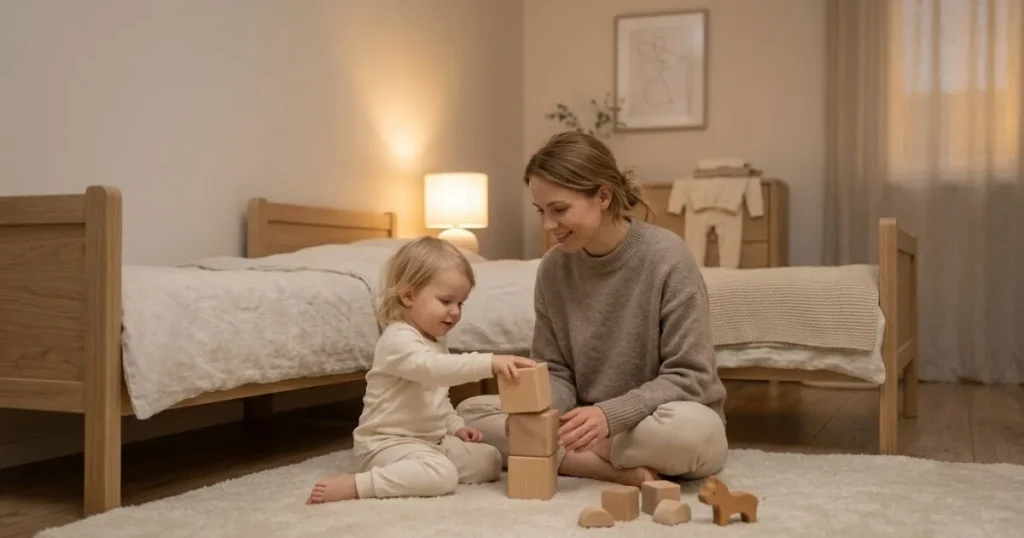
Toddlers often struggle when an enjoyable activity ends suddenly.
Instead of announcing bedtime without warning, give your child a transition cue.
You might say:
“You have 10 more minutes to play, then it’s time to start getting ready for bed.”
Then give another reminder when bedtime is closer.
This simple step can make the transition from active play to getting ready for bed feel much smoother.
Step 2: Switch to Quiet Activities
Once bedtime approaches, start lowering the energy level.
Good choices include:
- Looking at books
- Simple puzzles
- Drawing
- Building with quiet toys
- Talking about the day
- Gentle cuddling
You don’t have to eliminate all fun. You are simply moving away from highly stimulating activities.
Step 3: Have a Bath or Wash Up

A bath can be a helpful part of your routine, but it doesn’t need to happen every night.
On busy evenings, you can simply:
- Wash hands and face
- Use the toilet
- Put on pajamas
- Brush teeth
What matters is that the activity becomes part of the familiar sequence.
Step 4: Put on Pajamas and Brush Teeth
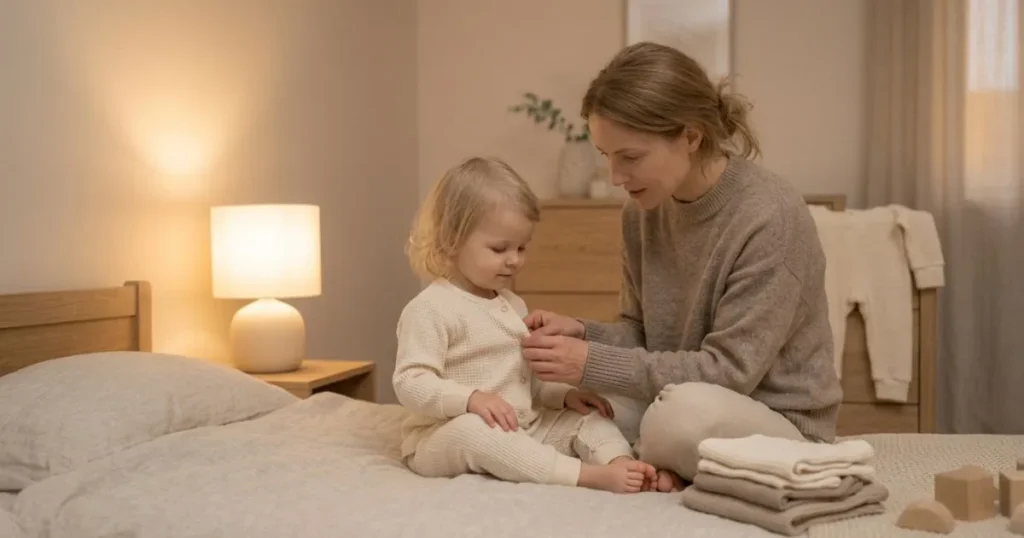
Keep this step predictable.
You can give your toddler small choices without handing over control of the entire routine.
For example:
“Do you want to wear the green pajamas or the dinosaur ones tonight?”
Both options lead toward the same destination: bedtime.
Step 5: Read a Bedtime Story

Books are a natural way to slow the evening down.
To avoid endless negotiations, decide how many books you will read before you begin.
For example:
“You can choose two books tonight.”
Your toddler can make a small choice while you still keep the bedtime limit clear.
Step 6: Add Cuddles or a Song
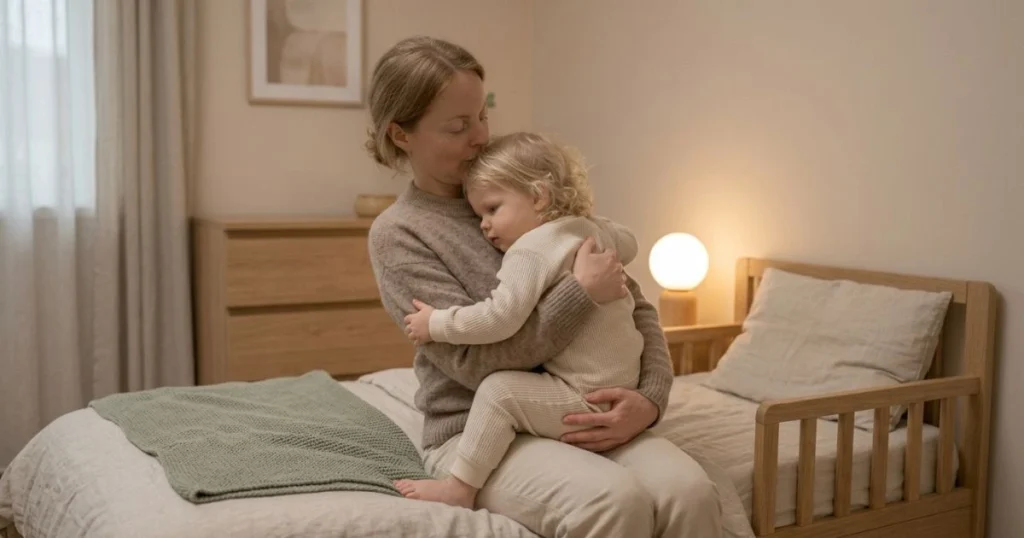
This is the part of bedtime where connection can matter most.
You might:
- Cuddle
- Sing one song
- Talk briefly about the day
- Say goodnight to favorite stuffed animals
- Give a kiss
- Use a familiar goodnight phrase
You are not wasting time by connecting with your child. You are creating a predictable ending to the day.
Step 7: Use the Same Goodnight Cue
Choose a short phrase and repeat it.
For example:
“Goodnight. I love you. It’s time to sleep.”
Over time, those words can become another familiar bedtime signal.
The 4 B’s Toddler Bedtime Routine
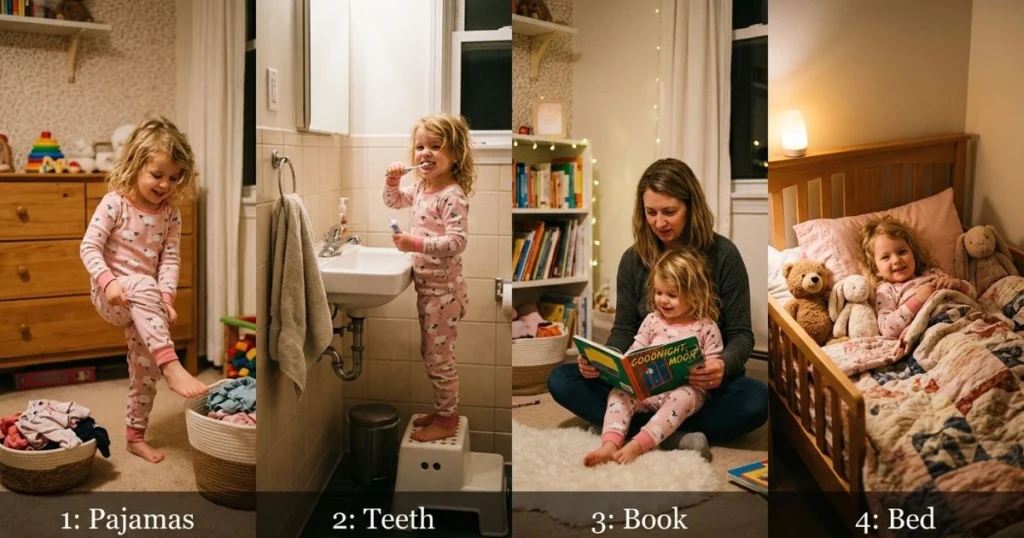
If you want a simple framework, the American Academy of Pediatrics highlights the 4 B’s: bathe, brush teeth, books, and bedtime as an example of a consistent bedtime routine.
Bathe
Take a bath or wash up.
Brush
Brush your toddler’s teeth.
Books
Read one or two calm books.
Bed
Finish with your goodnight routine and put your child to bed.
You can adapt the 4 B’s to your family. Your routine might actually be:
Wash → pajamas → brush → books → cuddle → bed
The aim isn’t to follow a bedtime formula exactly. The goal is to create a sequence your toddler recognizes.
Sample Toddler Bedtime Routine
Here’s an example of what a simple evening might look like:
| Time | Activity |
| 6:30 PM | Finish dinner |
| 6:45 PM | Quiet play |
| 7:00 PM | Bath or wash up |
| 7:10 PM | Pajamas and brush teeth |
| 7:15 PM | Two books |
| 7:25 PM | Cuddles and song |
| 7:30 PM | Into bed |
This is only an example. Your toddler may need an earlier or later bedtime depending on wake-up time, naps, age, and individual sleep needs.
How to Adjust the Routine
If you want to move bedtime earlier, don’t necessarily shift everything at once.
Instead:
- Move the beginning of the routine slightly earlier.
- Keep the order of activities the same.
- Give your toddler transition warnings.
- Observe how your child responds.
- Continue adjusting gradually if needed.
The routine should fit your real life. A schedule that looks beautiful on paper but is impossible to maintain isn’t useful.
Toddler Bedtime Routine by Age
Your toddler’s bedtime routine will naturally change as your child becomes more independent.
1-Year-Old Bedtime Routine
At this age, keep things simple.
A good routine might be:
Pajamas → Brush teeth → Read a book → Cuddle → Bed
Your child may still rely heavily on your presence and familiar cues.
Focus on repetition rather than independence.
18-Month-Old Bedtime Routine
Around 18 months, you may notice stronger opinions.
Your toddler may suddenly care deeply about:
- Which pajamas to wear
- Which book you read
- Which parent does bedtime
- Which stuffed animal goes to bed
- Whether the door stays open
Offer limited choices.
For example:
“Which book would you like tonight—the bear story or the farm story?”
This gives your toddler some control while keeping the routine moving.
2-Year-Old Bedtime Routine
A 2-year-old may be an enthusiastic negotiator.
You might hear:
- “One more book!”
- “Water!”
- “I need Mommy!”
- “I don’t want bed!”
- “Again!”
Keep your boundaries simple.
For example:
Two books → cuddle → goodnight
Keeping choices and negotiations to a minimum can make the bedtime routine more predictable and easier to follow.
3-Year-Old Bedtime Routine
By age three, imagination can become a bigger part of bedtime.
Your child may suddenly be afraid of:
- The dark
- Shadows
- Being alone
- Monsters
- Sounds outside
- Sleeping without you
Take those fears seriously without allowing them to completely take over bedtime.
You can offer reassurance while keeping the routine intact.
For example:
“I know the dark feels scary. You’re safe, and I’ll check on you after you get settled.”
How Long Should Your Toddler’s Bedtime Routine Last?
There’s no fixed amount of time that every family needs for a Toddler Bedtime Routine. For many families, setting aside around 20–45 minutes allows enough time for a relaxed transition without making bedtime feel unnecessarily long.
The right length depends on your child’s age, temperament, daily sleep schedule, and how easily your toddler settles down at night.
Your Routine May Be Too Long If:
- Your toddler becomes more energetic as bedtime progresses.
- There are constant requests.
- Every step becomes an argument.
- Your child keeps adding new activities.
- You become frustrated before bedtime is over.
Your Routine May Be Too Short If:
- Your toddler goes from active play directly into bed.
- The transition causes major distress.
- Your child seems unable to slow down.
- Your child immediately asks for additional connection.
Remember: longer doesn’t automatically mean better.
A short, predictable routine can work beautifully.
How to Handle Common Toddler Bedtime Struggles
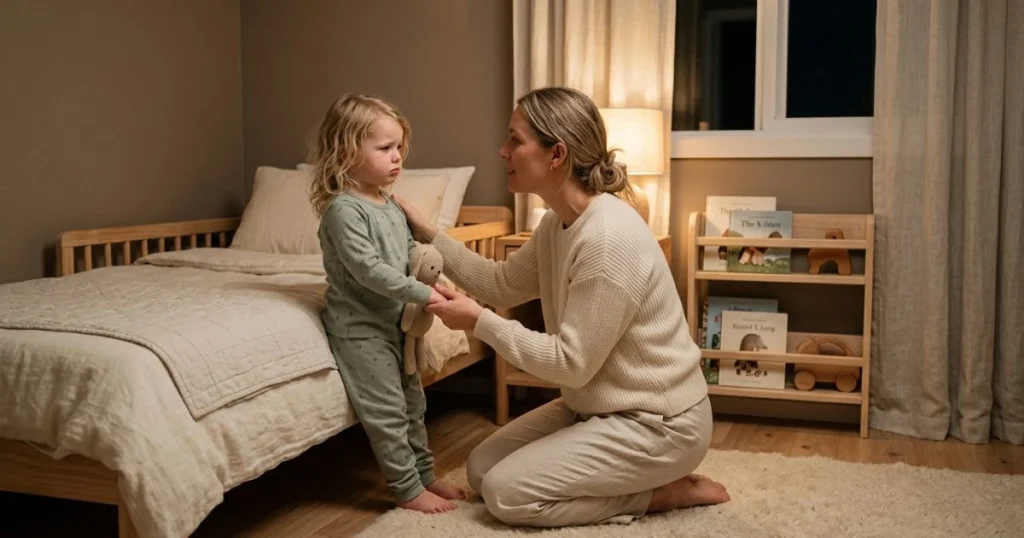
The American Academy of Pediatrics notes that toddlers commonly resist bedtime and recommends strategies such as using a quiet pre-bedtime routine and keeping bedtime consistent.
“My Toddler Keeps Getting Out of Bed”
Keep your response boring and predictable.
- Calmly return your toddler to bed.
- Keep conversation brief.
- Avoid turning it into playtime.
- Repeat the same response.
- Stay consistent.
Your goal isn’t to win a battle. You’re showing your toddler that bedtime remains bedtime.
“My Toddler Wants One More Story”
Set the limit before reading.
Try:
“You can choose two books. After the second book, we cuddle and go to bed.”
Then follow through.
If you keep adding books after every request, your toddler learns that asking again changes the answer.
“My Toddler Wants Me to Stay”
Your child may need reassurance, particularly during periods of increased independence or separation concerns.
You can acknowledge the feeling without abandoning the boundary.
Try:
“You want me to stay because you love being with me. It’s bedtime now. I’ll see you in the morning.”
If you are working toward independent sleep, choose an approach that you can apply consistently rather than changing your response dramatically from one night to the next.
“My Toddler Cries at Bedtime”
Crying can have many possible causes.
Think about recent changes:
- New daycare schedule
- Travel
- Illness
- Teething discomfort
- Nap changes
- New room or bed
- Separation concerns
- Changes at home
You don’t have to solve the entire problem during the crying episode. Start by staying calm, acknowledging your child’s feelings, and checking whether there is an obvious reason for the distress.
“My Toddler Suddenly Refuses Bedtime”
Before assuming your routine has failed, look at the bigger schedule.
Ask:
- Is the nap too long?
- Is the nap ending too late?
- Is bedtime too early?
- Is bedtime too late?
- Has your child’s sleep need changed?
- Has anything changed recently?
- Is your toddler uncomfortable or unwell?
Sometimes the routine is fine but the timing needs to change.
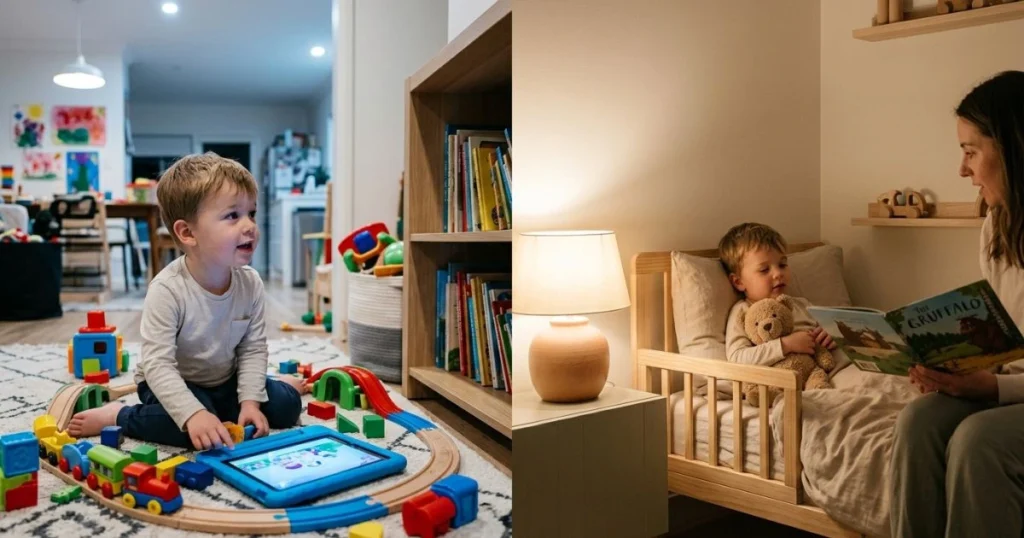
Screens and the Toddler Bedtime Routine
Screens can easily become part of a bedtime routine because they appear to calm children in the moment.
However, the American Academy of Pediatrics recommends a consistent bedtime routine that is free of screen time. Its guidance also recommends avoiding screen use around bedtime and keeping media out of the bedroom.
Instead of relying on a tablet or television to end the day, try:
- Reading
- Drawing
- Quiet puzzles
- Looking through family photos
- Talking
- Singing
- Cuddling
- Listening to calm music
You don’t need to replace screen time with a complicated activity. Often, a simple book and a few minutes of connection are enough.
Common Toddler Bedtime Routine Mistakes
Changing the Routine Every Night
If Monday includes a bath, three books, a snack, and a long cuddle but Tuesday skips everything, your child has fewer predictable cues.
Try to keep the basic sequence stable.
Making the Routine Too Complicated
More activities don’t necessarily produce better sleep.
Start with four or five essential steps.
Allowing Unlimited “One More” Requests
Boundaries are easier to maintain when you decide them before bedtime.
Turning Bedtime Into a Power Struggle
If both of you become increasingly frustrated, bedtime can become emotionally charged.
Use fewer words, calmer responses, and predictable limits.
Expecting Your Toddler to Fall Asleep Immediately
A bedtime routine helps your child wind down and get ready for sleep. It does not guarantee that your toddler will be asleep the moment the lights go out.
Some children need a little quiet settling time.
How to Make Your Toddler Bedtime Routine More Successful
If your current routine isn’t working, simplify it.
Try this 10-step approach:
- Choose a realistic bedtime.
- Keep morning wake-up time reasonably consistent.
- Look at your toddler’s nap schedule.
- Give a transition warning before bedtime.
- Reduce stimulating activities.
- Follow the same routine order.
- Offer two simple choices.
- Set limits before negotiations begin.
- Keep the bedroom calm and comfortable.
- Give the new routine time to become familiar.
Consistency is particularly important when you’re changing a sleep pattern. AAP guidance also emphasizes regular sleep schedules and consistent bedtime routines as part of healthy sleep habits.
Toddler Bedtime Routine Checklist
Save or print this simple checklist:
| Bedtime Step | Done |
| Finish dinner | ☐ |
| Quiet play | ☐ |
| Bath or wash up | ☐ |
| Pajamas | ☐ |
| Brush teeth | ☐ |
| Bedroom ready | ☐ |
| Read books | ☐ |
| Cuddle or sing | ☐ |
| Goodnight phrase | ☐ |
| Lights out | ☐ |
You don’t have to complete every item every night. The checklist is simply a visual reminder of the sequence.
Creating a Calm Toddler Sleep Environment
Your bedtime routine doesn’t exist separately from the bedroom.
Before your child gets into bed, make the environment comfortable and safe.
Consider:
- Keeping the room comfortably cool.
- Using low lighting during the wind-down period.
- Keeping screens out of the sleeping space.
- Removing obvious hazards.
- Keeping cords and other dangerous items out of reach.
- Making sure furniture is secure.
As toddlers become mobile, nighttime safety becomes increasingly important. The AAP advises parents to consider hazards such as furniture, windows, cords, and unsupervised wandering when children can climb out of a crib or move around independently.
When Toddler Sleep Problems Need Extra Attention
Occasional bedtime resistance is common, but persistent sleep difficulties deserve a closer look. If your Toddler Bedtime Routine is consistently difficult despite making reasonable adjustments, it may be worth discussing your child’s sleep with a pediatrician.
Talk with your child’s pediatrician if you notice concerns such as:
- Ongoing difficulty falling asleep
- Frequent nighttime awakenings
- Significant daytime sleepiness
- Persistent loud snoring
- Pauses in breathing
- Concerning breathing during sleep
- Major daytime behavior changes related to poor sleep
The AAP recommends that pediatricians pay attention to sleep concerns such as difficulty falling asleep or staying asleep, excessive daytime sleepiness, nighttime awakenings, irregular bedtimes, and snoring that could indicate sleep-disordered breathing.
You don’t have to figure out or diagnose the underlying problem on your own. Your pediatrician can help determine whether your child’s sleep pattern needs further evaluation and whether changes to your Toddler Bedtime Routine may be appropriate.
Frequently Asked Questions About Toddler Bedtime Routine
What Is a Good Toddler Bedtime Routine?
A good toddler bedtime routine is predictable, calming, and realistic for your family. A simple example is wash or bath → pajamas → brush teeth → books → cuddle → bed. The AAP also promotes the “4 B’s” of bathe, brush, books, and bedtime.
What Is the Best Bedtime for Your Toddler?
There isn’t a single ideal bedtime for every toddler. Your child’s bedtime should fit their usual wake-up time, nap schedule, age, total sleep needs, and individual sleep pattern.
How Much Time Should You Set Aside for Your Toddler’s Bedtime Routine?
Many families find that a routine lasting around 20–45 minutes is practical. Your routine may be shorter or longer depending on your child’s needs. Focus on a predictable sequence rather than a specific number of minutes.
What Can You Do to Help Your Toddler Stay in Bed?
Set a clear bedtime boundary and respond calmly when your toddler gets up. Return your child to bed with minimal conversation and repeat the same response consistently. Avoid turning each return into a long interaction.
Why Is Your Toddler Resisting Bedtime Every Night?
Bedtime resistance can stem from several factors, such as growing independence, changes in naps, an unsuitable bedtime, separation concerns, fears, developmental changes, or an inconsistent Toddler Bedtime Routine. Instead of focusing on one possible cause, consider your child’s overall daily sleep pattern and routine.
Should a Toddler Have a Bath Every Night?
No. A bath can be a helpful bedtime cue, but it isn’t required every night. You can replace it with a quick wash, pajamas, tooth brushing, books, and cuddles.
Can a Toddler Bedtime Routine Help My Child Sleep Better?
A consistent bedtime routine is an important part of healthy sleep habits. However, it isn’t a guaranteed solution for every sleep problem. Your child’s nap schedule, sleep environment, health, development, and individual sleep needs can also affect sleep.
What Should I Do If My Toddler Keeps Asking for “One More”?
Set the limit before the activity begins. For example, let your toddler choose two books as part of your Toddler Bedtime Routine. Once the second book is finished, move on to the next step instead of starting another negotiation.
Conclusion: Your Toddler Doesn’t Need a Perfect Bedtime
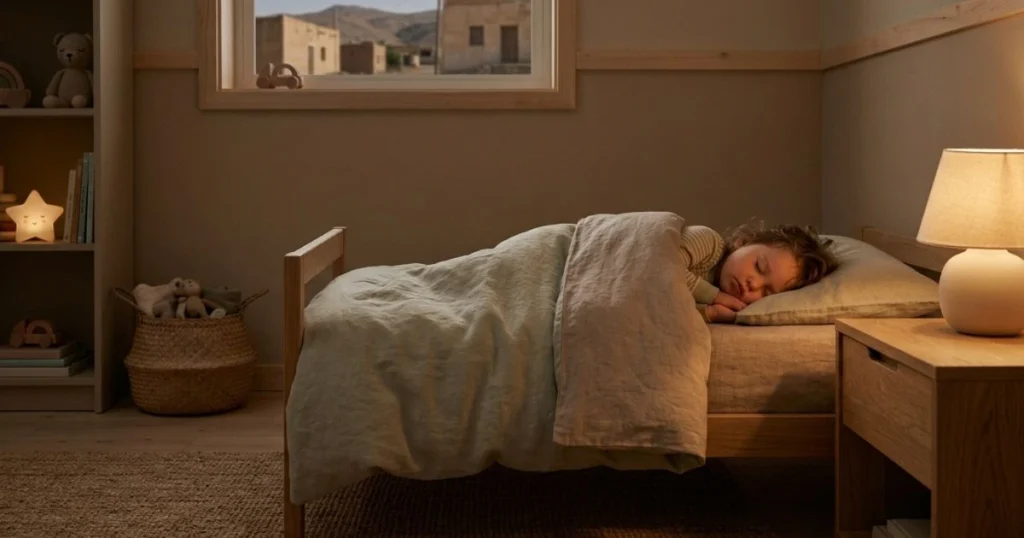
Your toddler doesn’t need a picture-perfect bedtime every night. Some evenings will go smoothly, while others may involve tears, negotiations, a missing stuffed animal, or another request for water. That’s simply part of life with a young child.
What you can offer is something much simpler: predictability.
A consistent Toddler Bedtime Routine helps your child understand what comes next and creates a gentle transition from daytime activity to nighttime rest. It also gives you a familiar framework to rely on when your toddler is tired, emotional, or testing boundaries.
Start small. Choose a few steps you can repeat every night:
Pajamas → brush teeth → books → cuddle → bed
Keep your boundaries calm, offer your toddler small choices, and adjust the schedule as your child’s needs change. Don’t measure the success of your Toddler Bedtime Routine by whether every evening is completely peaceful.
Instead, look for gradual improvements:
- Fewer bedtime negotiations
- Smoother transitions
- A more predictable evening
- Less resistance
- A child who understands what happens next
Your goal isn’t to control every minute of the night. It’s to create a bedtime your toddler can recognize, trust, and eventually move through with greater confidence.
Ready to make tonight easier? Save this Toddler Bedtime Routine, choose four or five essential steps, and start following the same sequence tonight.