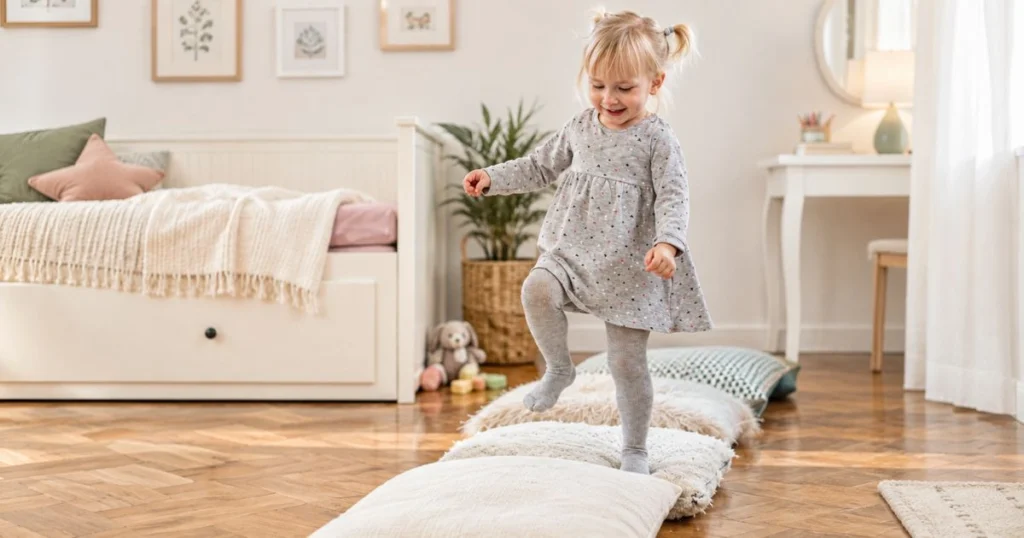
Have you ever watched your toddler run across the living room, jump from one cushion to another, or crawl under the table and wondered whether all that movement is actually helping them learn?
It is.
What looks like ordinary play is giving your child valuable opportunities to practice balance, coordination, strength, body awareness, and control. Your child doesn’t need a structured workout or expensive developmental toys to build these abilities. A balloon, a soft ball, some painter’s tape, or a few cushions can turn an ordinary afternoon into active play.
That’s where gross motor activities come in.
Gross motor skills involve the large muscles of the body, including the arms, legs, and core. Children use these muscles for movements such as walking, running, jumping, climbing, throwing, and balancing. Head Start explains that gross motor development helps children explore their environment and interact with people and objects around them.
In this guide, you’ll find 20 easy gross motor activities for toddlers and preschoolers that you can try at home, outdoors, or anywhere you have enough safe space to move.
You don’t need to make every activity complicated. The goal is simple: give your child plenty of opportunities to move, experiment, laugh, and build confidence in their growing body.
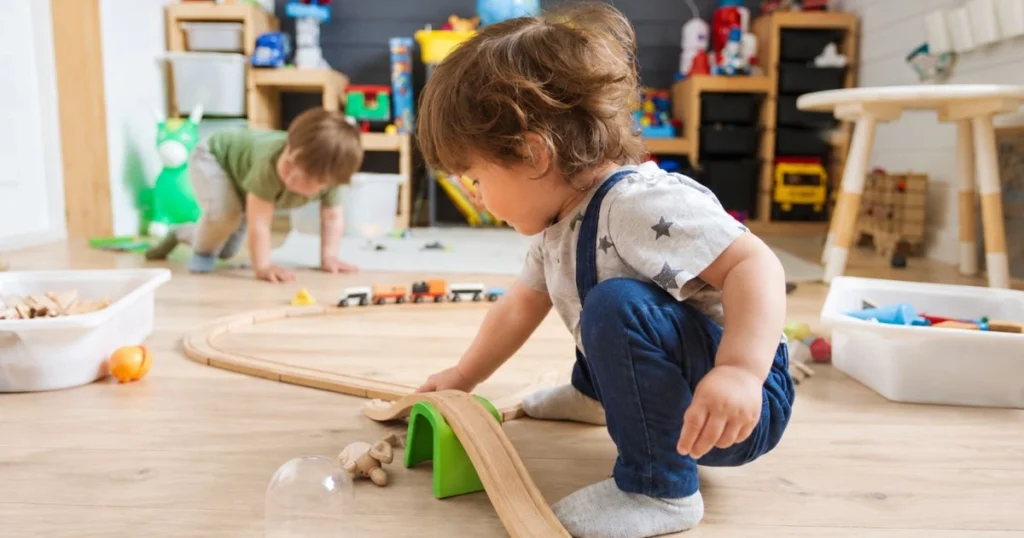
What Are Gross Motor Skills?
Gross motor skills are movements that use the body’s larger muscle groups. Your child depends on these skills for everyday activities, from getting up from the floor to running across a playground. Gross Motor Activities give children regular opportunities to practice these movements through active play.
Some common gross motor movements include:
- Walking
- Running
- Jumping
- Hopping
- Climbing
- Crawling
- Kicking
- Throwing
- Catching
- Balancing
- Changing direction
- Pushing and pulling
As children grow, these movements generally become more coordinated and controlled. Simple Gross Motor Activities can give your child plenty of chances to practice these skills while having fun.ntrolled. Head Start’s developmental guidance describes gross motor development as involving increasing control, strength, balance, and coordination of large muscles.
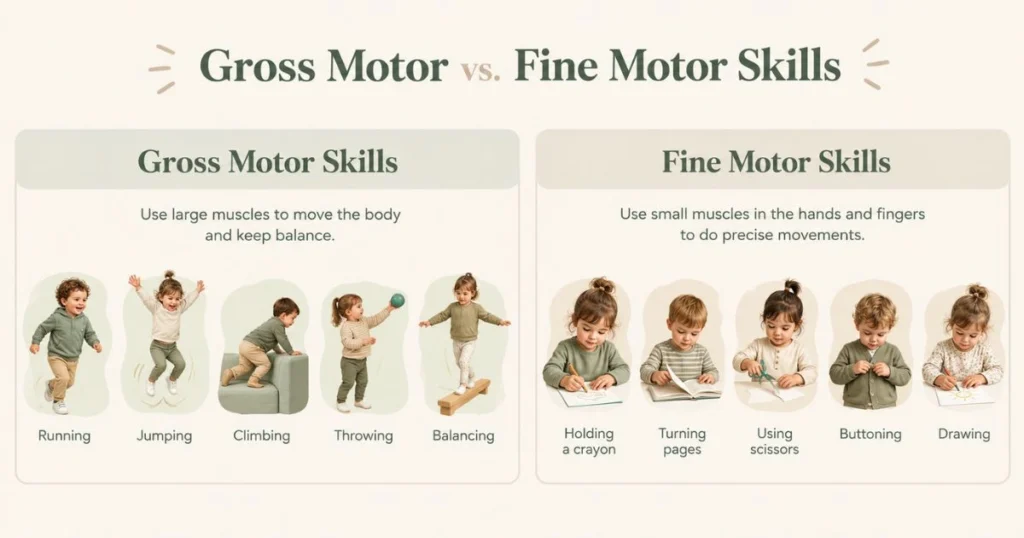
Gross Motor Skills vs. Fine Motor Skills
It can help to understand the difference between the two.
| Gross Motor Skills | Fine Motor Skills |
| Use larger muscle groups | Use smaller muscles |
| Running | Holding a crayon |
| Jumping | Turning a page |
| Climbing | Using scissors |
| Throwing a ball | Picking up small objects |
| Balancing | Buttoning clothing |
| Kicking | Drawing |
Your child needs both types of skills. Gross motor development gives them opportunities to control their larger movements, while fine motor development involves more precise movements of the hands and fingers.
Why Are Gross Motor Activities Important?
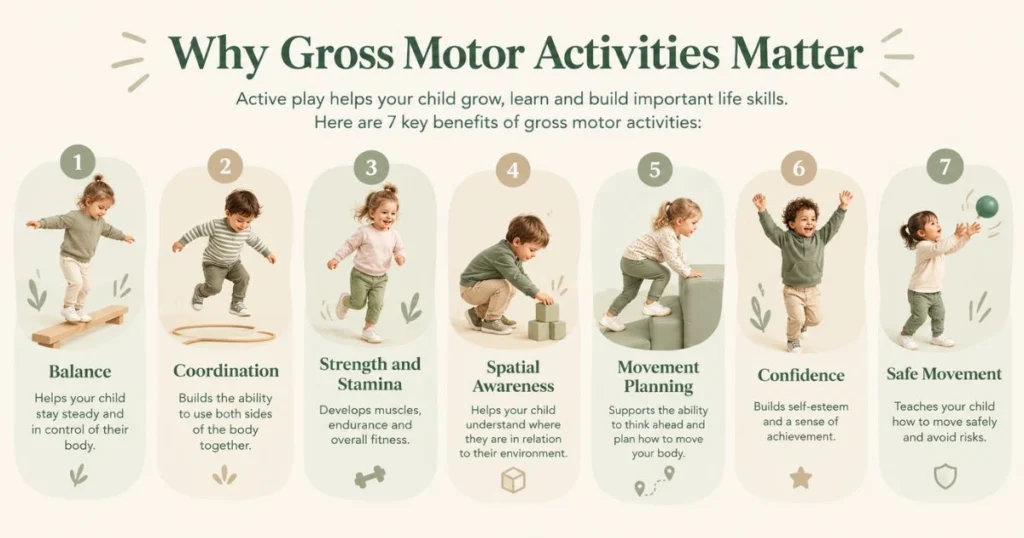
When you provide regular opportunities for active play, you’re giving your child chances to practice different movements in a fun, natural setting. Gross Motor Activities can make this practice feel more like play than exercise.
Gross motor activities can help your child practice:
- Balance and body control
- Coordination
- Strength and stamina
- Spatial awareness
- Movement planning
- Confidence during physical play
- Moving safely and comfortably around their environment
The goal isn’t for your child to perform every movement perfectly. Young children learn through repetition and everyday practice. One day, a jump may look more like a tiny bounce; after plenty of playful movement, you may begin to notice better control and coordination.
For more ways to support your child’s emotional development through everyday parenting, see our guide to [Positive Parenting].
How Much Physical Activity Do Toddlers and Preschoolers Need?
You don’t need to turn your child’s day into a schedule of formal exercise. Young children can be active through ordinary play, outdoor Movement can come from many forms of everyday play, including exploration, dancing, walking, playground time, and Gross Motor Activities.
The World Health Organization recommends that children ages 1–2 spend at least 180 minutes in physical activities of varying intensity throughout the day. For children ages 3–4, the recommendation is also at least 180 minutes throughout the day, including at least 60 minutes of moderate-to-vigorous physical activity.
For preschool-aged children, the CDC encourages physical activity throughout the day and recommends giving children opportunities for enjoyable, varied active play.
That doesn’t mean your child needs 180 minutes of structured Gross Motor Activities.
Movement can come from many places:
- Walking to the park
- Dancing in the kitchen
- Playing tag
- Climbing at the playground
- Running in the yard
- Helping with simple active chores
- Playing ball
- Exploring outdoors
Think of the activities below as opportunities for movement, not a checklist you have to complete. What matters most is creating regular chances for your child to move, play, explore, and enjoy being physically active.
You can also build active play into a realistic daily routine with these practical ideas for busy parents.
20 Easy Gross Motor Activities for Toddlers and Preschoolers
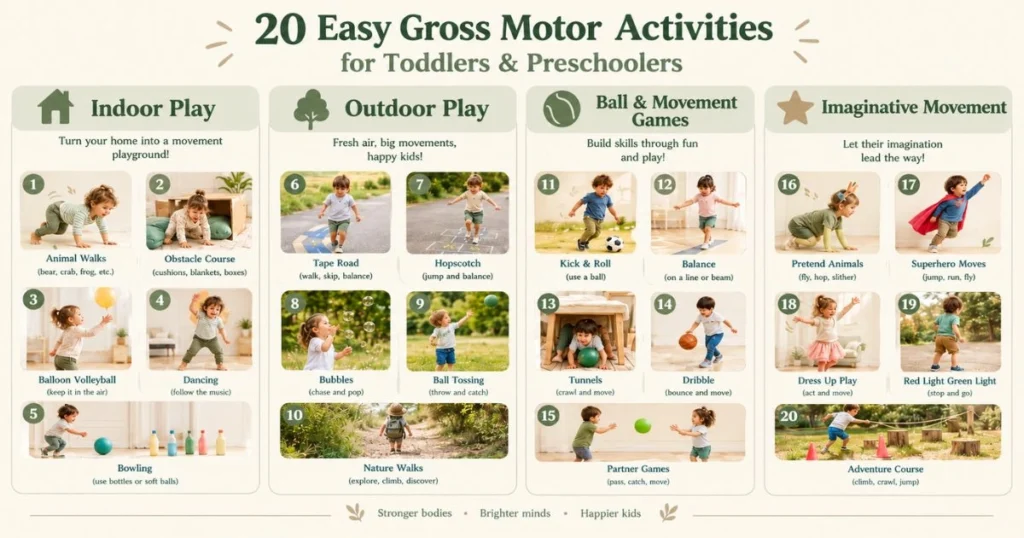
You can choose Gross Motor Activities based on your child’s age, interests, available space, and current abilities. An activity can be simplified for a younger toddler or adjusted to provide more challenge as your preschooler develops new movement skills.
1. Animal Walks
Animal walks are one of the easiest Gross Motor Activities for encouraging full-body movement and playful coordination.
Call out an animal and show your child how to move like it.
Try:
- Bear: Crawl on your hands and feet.
- Frog: Squat down and jump forward.
- Bunny: Hop or take small jumps.
- Duck: Bend your knees and waddle.
- Crab: Move sideways using your hands and feet.
- Penguin: Take small steps while keeping your arms close to your body.
You can also turn this into a guessing game. Make an animal movement yourself and let your child guess which animal you’re pretending to be.
What your child practices
- Balance
- Coordination
- Strength
- Body awareness
- Movement control
For a younger toddler, don’t worry about copying the movement exactly. Simply encouraging your child to imitate you is enough.
2. Create a Pillow Obstacle Course
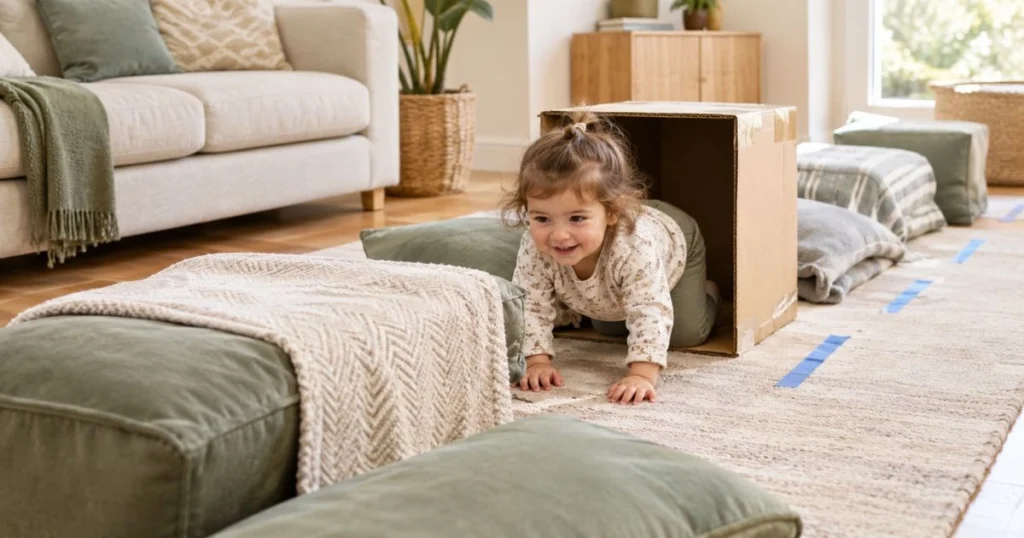
You don’t need special equipment to create a fun Gross Motor Activities obstacle course at home.
Use safe household items such as:
- Cushions
- Pillows
- Blankets
- Cardboard boxes
- Painter’s tape
Create a simple path where your child can crawl, step, walk, or move around different objects.
For example:
Crawl under a blanket → step over a cushion → walk along a tape line → touch the wall → return to the starting point.
For younger children, keep the course short and simple. Older preschoolers may enjoy helping you design their own course and deciding how to move through each section.
Head Start specifically identifies child-friendly obstacle courses as one way adults can create opportunities for children to practice gross motor development.
Safety tip: Avoid using furniture that could tip, slide, or have sharp edges. Keep the area clear of tripping hazards and supervise your child throughout the activity.tip over, and avoid making pillows or cushions into high climbing structures.
If your toddler enjoys obstacle courses, you can also explore more simple indoor play ideas for active days at home.
3. Balloon Volleyball
A balloon moves slowly through the air, giving young children more time to watch, reach, and react. This makes it a simple choice for Gross Motor Activities at home.
Blow up a balloon and encourage your child to keep it from touching the floor.
Try:
- Tap the balloon upward.
- Move toward it as it floats.
- Reach for it with both hands.
- Tap or hit it again.
- Count how many times you can keep it in the air.
Make the game more exciting by saying, “Can you keep the balloon off the floor?”
For toddlers, catching or holding the balloon is completely fine. The goal is to encourage movement, reaching, and coordination rather than follow formal volleyball rules.
Skills practiced: Reaching, balance, coordination, visual tracking, and reaction.
Safety: Always supervise balloon play. Keep uninflated balloons away from young children, and immediately collect and discard any pieces if a balloon breaks, as the CPSC warns that uninflated or broken balloons can pose a suffocation hazard.
4. Jump Over a Line
Place a strip of painter’s tape on the floor to create a simple target for one of your Gross Motor Activities.
Start by asking your child to step over the line. Once they’re comfortable, encourage them to jump across it using both feet.
Try different directions:
- Forward
- Sideways
- Over and back
- From one line to another
You can turn the movement into a little story:
“The floor is water. Can you jump over the river?”
Pretend play can make repeated movements much more enjoyable for toddlers.
For younger children who aren’t ready to jump yet, simply stepping over the line still gives them an opportunity to practice balance, body control, and movement.
5. Follow-the-Leader Movement Game
Take turns being the leader in this simple Gross Motor Activities game.
Start with easy movements:
- March
- Jump
- Crawl
- Reach up
- Touch your toes
- Spin
- Walk slowly
- Walk quickly
Then let your child take the lead and choose the movements.
This activity is especially helpful when your child wants to participate with you rather than simply follow instructions. It also gives you an easy way to introduce new movements without making them feel like formal practice.
6. Dance and Freeze
Put on a cChoose a child-friendly song and let your child dance. This simple Gross Motor Activities game can turn music time into an opportunity for active movement.
When the music stops, everyone freezes.
You can make the game more interesting by changing the movement:
- Dance like a robot.
- Dance like a butterfly.
- March like a soldier.
- Jump like a frog.
- Move slowly like a turtle.
When the music stops, freeze in whatever position you’re in.
This activity combines active movement with stopping and starting, giving your child opportunities to practice body control, balance, and coordination while having fun.
7. Animal Jumping Game
Take animal walks one step further by creating a jumping game.
Say an animal name and let your child decide how it moves.
| Animal | Movement Idea |
| Frog | Squat and jump |
| Bunny | Hop |
| Kangaroo | Jump forward |
| Bird | Flap and move |
| Bear | Crawl |
| Duck | Waddle |
You can also ask your child to invent an animal.
Can you pretend to walk like a huge elephant?
There isn’t a right or wrong answer. The imagination is part of the game.
8. Indoor Bowling
Set up several lightweight plastic bottles or child-friendly bowling pins for this simple Gross Motor Activities game.
Give your child a soft ball and encourage them to roll it toward the targets.
Start close to the pins so your child can easily reach them. As they become more comfortable, gradually move farther away and let them try again.
This activity gives your child a playful way to practice rolling, aiming, coordination, and controlled movement.
Make it a game
Ask:
- “How many can you knock down?”
- “Can you roll the ball slowly?”
- “Can you roll it toward the red bottle?”
- “Can you reset the pins?”
Indoor bowling gives your child an opportunity to practice aiming, rolling, coordination, and controlled movement.
9. Make a Tape Road
Painter’s tPainter’s tape can become a surprisingly versatile tool for Gross Motor Activities.
Create a simple road across the floor.
Your child can:
- Walk along the road.
- Push a toy car beside it.
- Stop at “traffic lights.”
- Turn at corners.
- Walk back to the starting point.
For older preschoolers, add intersections and introduce simple directions such as “turn left” or “stop at the corner.”
You can even turn it into pretend play:
“We’re driving to the grocery store. Can you follow the road?”
This gives your child a fun reason to move while encouraging imagination, coordination, and following simple directions.
10. Simon Says Movement Game
“Simon Says” can easily Simon Says can quickly become one of your favorite Gross Motor Activities because it combines movement with listening and following directions.
Try commands such as:
- “Simon says jump!”
- “Simon says crawl!”
- “Simon says march!”
- “Simon says touch your knees!”
- “Simon says reach for the ceiling!”
- “Simon says turn around!”
For younger toddlers, you don’t need to worry about the traditional rules. Simply use the game as a playful way to introduce different movements.
For older preschoolers, add the classic rule: your child should only move when you begin the command with “Simon says.” This adds an extra listening and self-control challenge while keeping the activity active and fun.
11. Simple Hopscotch
Traditional hopscotch may be too complicated for a young toddler, so simplify it.
Draw squares with sidewalk chalk outdoors or use painter’s tape indoors.
For younger toddlers
Start with:
- Walking from square to square
- Stepping over lines
- Two-foot jumps
For older preschoolers
Try:Try different movements as your child moves through the squares:
- Hopping
- Alternating feet
- Jumping from one square to another
This simple game can be a fun addition to your Gross Motor Activities because it gives your child opportunities to practice hopping, jumping, balance, and coordination.
Head Start’s preschool developmental progression describes hopping and jumping as skills that generally become more coordinated during the preschool years.
Remember that children develop these movement skills at different rates, so your child doesn’t need to master them at exactly the same age as another child.
12. Turn a Scavenger Hunt Into a Movement Game
A regular scavenger hunt can beA simple scavenger hunt can become a full-body Gross Motor Activities game with a few small changes.
Instead of saying:
“Find the red ball.”
Try:
“Hop to the red ball.”
Other ideas include:
- Crawl to the sofa.
- March to the kitchen.
- Walk like a bear to the door.
- Jump three times before picking up the toy.
- Tiptoe to the next clue.
You can hide several safe objects around a room or outdoor area and give your child a different movement challenge at each stop. This keeps the game playful while encouraging your child to walk, crawl, jump, hop, and change direction.
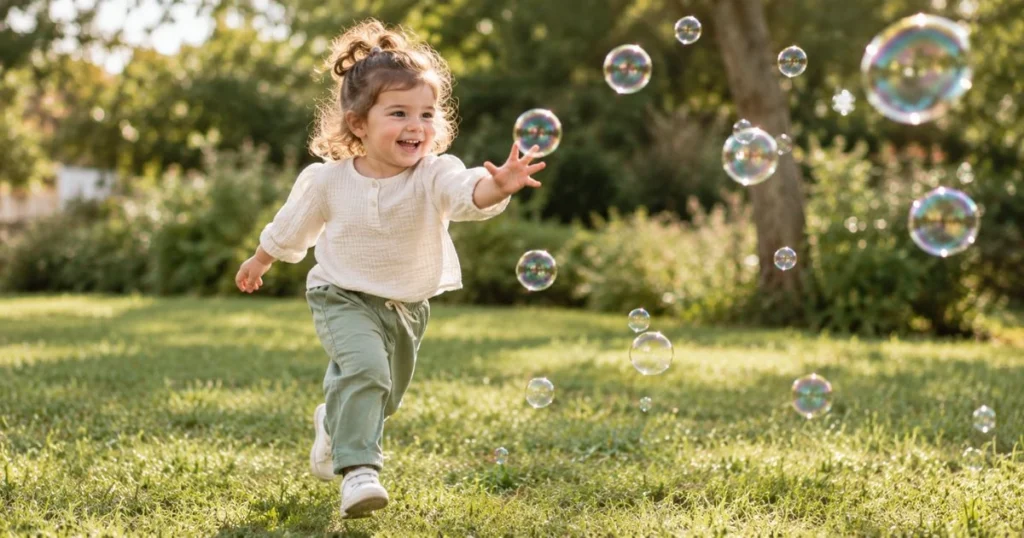
13. Go Bubble Chasing
Bubbles naturaBubbles naturally encourage children to move, making them a simple and playful option for Gross Motor Activities.
Blow bubbles and let your child chase them around the yard or an open indoor space.
Your child may:
- Walk toward the bubbles.
- Run after them.
- Reach upward.
- Squat down.
- Change direction.
- Try to pop them.
You don’t need to give many instructions. Let your child decide how to catch or pop each bubble. Chasing bubbles can encourage reaching, walking, running, jumping, and changes in direction while keeping the activity playful.
This is particularly helpful on days when your child doesn’t want to participate in a structured game. Instead of following a set of rules, they can simply move at their own pace and enjoy the chase.
14. Practice Ball Tossing and Catching
Start with a large, soft ball for this simple Gross Motor Activities game.
Don’t expect perfect catching right away. You can build the skill gradually:
Roll → toss → catch with two hands → throw toward a target
For a toddler, rolling a ball back and forth with you is already a fun way to encourage movement and coordination.
For an older preschooler, place a basket or box nearby as a target. Ask your child to throw from a short distance, then gradually move the target farther away as they become more comfortable.
Keep the focus on playful practice rather than accuracy. Your child can develop confidence as they experiment with different ways to roll, toss, catch, and throw.
15. Have a Marching Band
Your child can turn into the leader of Turn your child into a one-person marching band with this fun Gross Motor Activities idea.
Give them a safe toy instrument or shaker, or simply let them clap while marching around the room.
Try:
- Marching slowly
- Marching quickly
- Stopping
- Starting again
- Turning around
- Marching to music
You can join in too. Children often become more enthusiastic about movement when you participate alongside them instead of simply watching from the side.
16. Push and Pull a Lightweight Laundry Basket
An empty laundry basket can become a simple tool for Gross Motor Activities that encourages controlled pushing and pulling.
Place it on a clear, flat floor and encourage your child to push it from one point to another.
You could turn it into pretend play:
“We’re delivering groceries to the kitchen.”
Or:
“Can you push the train to the station?”
Keep the basket empty or extremely light. Avoid stairs, slippery surfaces, and crowded areas.
The goal isn’t to have your child move something heavy. Instead, you’re giving them a playful opportunity to practice controlled pushing, pulling, coordination, and body control.
17. Take a Nature Walk With Movement Challenges
You don’t have to turn a nature walk into a loTurn a simple walk into one of your Gross Motor Activities by adding playful movement challenges along the way.
Walk around your neighborhood, yard, or another appropriate outdoor space and encourage your child to try different movements.
Try:
- Step over a safe stick.
- Walk around a tree.
- Walk like a giant.
- Walk like a tiny mouse.
- March to the next landmark.
- Stop and balance.
- Take five big steps.
Outdoor spaces naturally give your child different surfaces, distances, and objects to navigate. These small challenges can make an ordinary walk more engaging while giving your child opportunities to practice balance, coordination, and body control.
18. Try Blanket Parachute Play
A lightweight blanket can become a simple movement prop when an This activity works best when an adult is involved, making it a fun addition to your Gross Motor Activities at home.
Hold the edges of a lightweight blanket and gently move it:
- Up
- Down
- Side to side
You can place a soft ball on top and work together to move it across the blanket.
Older preschoolers may enjoy walking around the blanket, helping you move it, or suggesting different movements. Adult-guided play can give children opportunities to explore movement while providing support when needed.
Safety: Never use the blanket to wrap around your child or cover their face. Keep the activity supervised, use a clear space, and stop if the blanket becomes tangled or difficult for your child to handle.
19. Play Red Light, Green Light
This classic game requires very little equipment.
Use three simple commands:
- Green: Go
- Yellow: Slow down
- Red: Stop
Your child can run, walk, march, or hop depending on their ability.
For older preschoolers, change the movement:
- Green = run
- Yellow = crawl
- Red = freeze
This creates repeated opportunities to start, stop, change speed, and respond to a direction.
20. Build a Mini Adventure Course
For the final activity, combine several movements your child already knows to create a fun Gross Motor Activities adventure course.
For example:
Jump → crawl → walk along a line → throw a ball → march → dance at the finish
Let your child help decide what comes next. You can also make the course longer or add new movements as your child becomes more comfortable.
Head Start notes that preschool children gradually develop greater coordination in movements such as jumping, hopping, running, balancing, changing direction, and performing more complex movements.
The beauty of an adventure course is that you can change it every time. Let your child’s ideas shape the course and keep the experience playful rather than focusing on completing it perfectly.
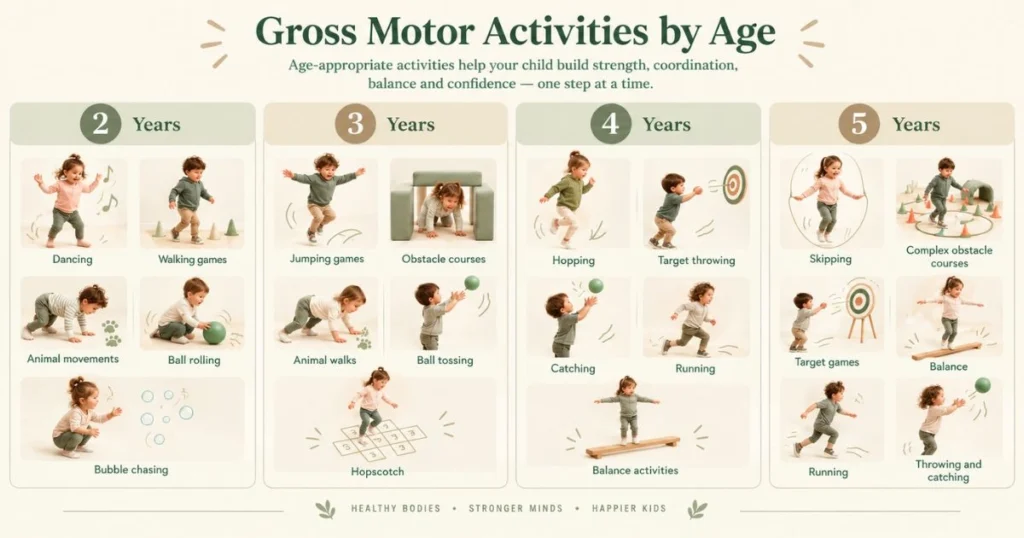
Gross Motor Activities by Age
The same activity can look very different depending on your child’s age and current abilities.
Use the following as a flexible guide rather than a strict milestone chart.
Gross Motor Activities for 2-Year-Olds
Two-year-olds may enjoy simple, repetitive movements.
Try:
- Dancing
- Walking games
- Animal movements
- Ball rolling
- Kicking a ball
- Bubble chasing
- Simple obstacle courses
- Stepping over lines
- Climbing with close supervision
Keep your instructions short.
Instead of giving a long explanation, demonstrate the movement and invite your child to copy you.
Gross Motor Activities for 3-Year-Olds
At around three, you can begin adding more variety.
Try:
- Jumping games
- Obstacle courses
- Animal walks
- Follow-the-leader
- Ball tossing
- Bubble chasing
- Simple hopscotch
- Red light, green light
You can also start combining movements.
For example:
Jump → crawl → throw
Gross Motor Activities for 4-Year-Olds
Older preschoolers may enjoy more complex challenges.
Try:
- Hopping games
- Target throwing
- Catching games
- Running games
- Balance activities
- Obstacle courses
- Movement sequences
- Nature challenges
Head Start’s developmental progression describes children between approximately 48 and 60 months as developing more coordinated jumping, hopping, running, balancing, and complex movements.
Gross Motor Activities for 5-Year-Olds
You can gradually introduce more challenging combinations.
Try:
- Skipping practice
- More complex obstacle courses
- Target games
- Balance challenges
- Running games
- Throwing and catching
- Tricycle or age-appropriate riding activities
Don’t compare your child’s progress too closely with another child’s. Development is individual, and your child may be confident in one movement while still practicing another.
Looking for more age-specific routines? Our guide to toddler sleep schedules can help you create a balanced daily rhythm that includes active play, meals, naps, and bedtime.
Indoor Gross Motor Activities for Toddlers
Rainy days don’t have to mean sitting all day.
Some of the easiest indoor gross motor activities include:
- Balloon volleyball
- Dance and freeze
- Animal walks
- Tape roads
- Indoor bowling
- Simon Says
- Pillow obstacle courses
- Movement scavenger hunts
Before starting, create a clear movement area.
Move fragile objects away, remove obvious tripping hazards, and make sure furniture isn’t likely to tip if your child bumps into it.
Head Start recommends creating home environments that give children safe opportunities for movement and specifically suggests ideas such as child-friendly obstacle courses, walking, and supervised climbing experiences.
Outdoor Gross Motor Activities for Toddlers and Preschoolers
Outdoor play gives yOutdoor spaces give your child more room to move, explore, and enjoy Gross Motor Activities.
Try:
- Running games
- Nature walks
- Bubble chasing
- Ball games
- Hopscotch
- Playground play
- Outdoor obstacle courses
- Follow-the-leader
You don’t need a large backyard to keep your child active. A safe outdoor space, playground, park, or family walk can provide plenty of opportunities for movement.
The CDC encourages families to include physical activity in everyday routines and highlights activities such as walking, running, playground play, and free-time play as simple ways for children to stay active.
How to Make Gross Motor Activities More Challenging
Once your child knows an activity well, you can change one element rather than replacing the entire game.
Change the Distance
If your child can easily throw a ball into a nearby basket, move the basket slightly farther away.
Change the Direction
Instead of always moving forward, try:
- Sideways
- Around an object
- Between two markers
Add Another Movement
Start with:
Jump → stop
Then progress to:
Jump → crawl → stop
Later:
Jump → crawl → throw → balance
Let Your Child Lead
Ask:
“Can you make up an obstacle course for me?”
Children often enjoy movement more when they get to make decisions.
The CDC recommends that young children participate in physical activities that are enjoyable, age-appropriate, and varied.
How to Include Gross Motor Activities in Your Daily Routine
You don’t need a dedicated “exercise session.”
Movement can fit naturally into your day.
| Part of the Day | Simple Gross Motor Activity |
| Morning | Dance to one song |
| Before lunch | Animal walks |
| Afternoon | Outdoor ball play |
| After preschool | Obstacle course |
| Before dinner | Red light, green light |
| Family time | Follow-the-leader |
You can also encourage movement during everyday routines:
- Walk instead of always using a stroller when appropriate.
- Take the stairs with supervision when appropriate.
- Walk to a nearby destination.
- Play outside after preschool.
- Dance while cleaning up toys.
- Have a short movement break between quiet activities.
The CDC recommends making physical activity part of a child’s daily routine and emphasizes that young children benefit from safe, enjoyable movement and play.
If your days already feel overwhelming, these practical tips can help you create a more realistic routine without trying to do everything perfectly.
How to Know if Your Child Is Enjoying Gross Motor Activities
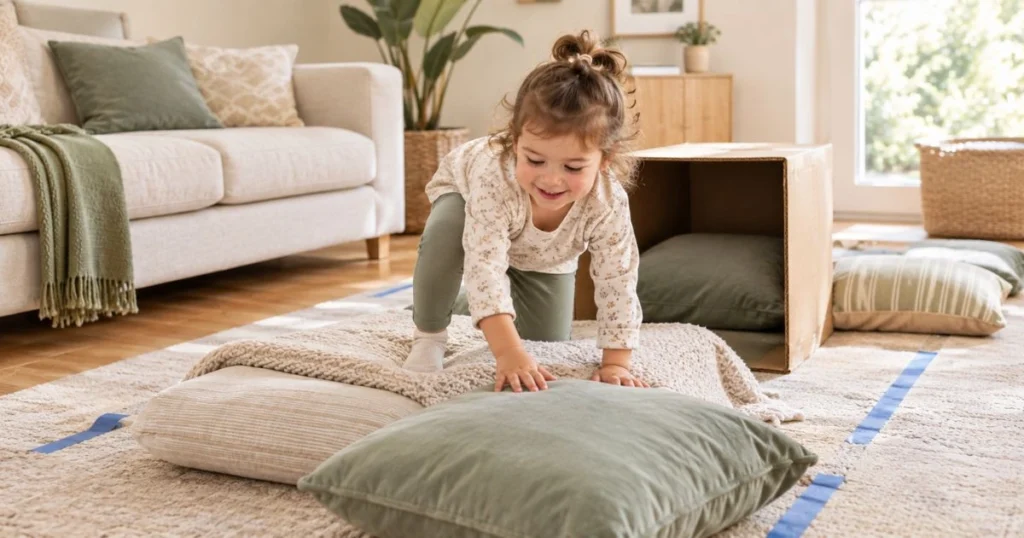
You don’tYou don’t need to measure every movement or keep track of every Gross Motor Activities session.
Instead, pay attention to how your child responds during play.
You may notice that your child:
- Asks to repeat an activity
- Creates their own movement
- Laughs or smiles during play
- Tries something new
- Becomes more willing to participate
- Moves with increasing confidence
- Invites you to join
Some children will happily repeat the same game twenty times. That’s perfectly okay.
Repetition is a natural part of how young children learn and become comfortable with new movements.
Your job isn’t to make every activity educational. Sometimes, the most valuable thing you can give your child is simply the freedom to move, explore, have fun, and feel comfortable in their growing body.
For more gentle strategies for responding to your toddler’s feelings and behavior, see our guide to handling toddler emotions.
Gross Motor Activity Safety Tips
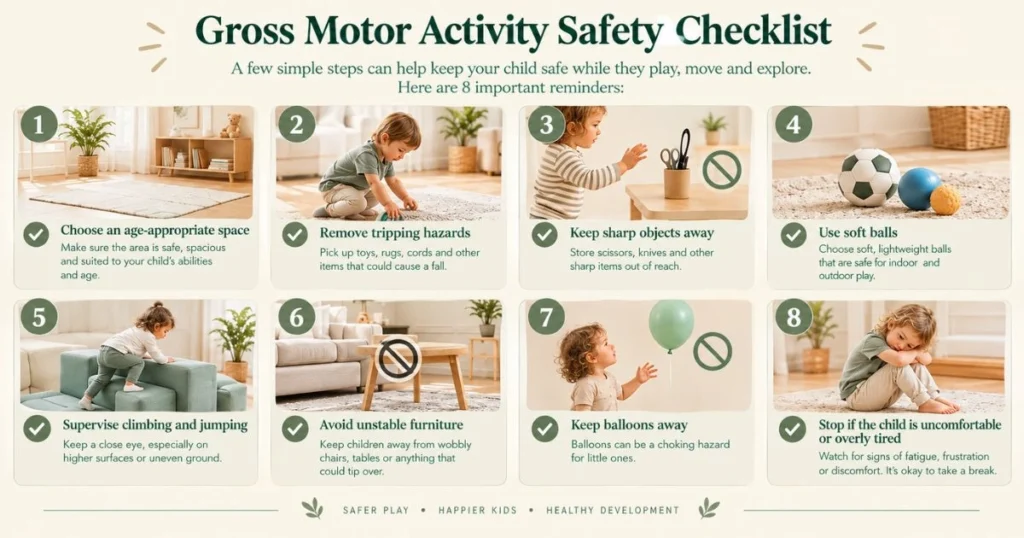
Most movemGross Motor Activities can be simple and enjoyable, but safety should always come first.
Before starting an activity:
- Choose a space that matches your child’s abilities.
- Remove obvious tripping hazards.
- Keep sharp or fragile objects out of reach.
- Use soft balls when appropriate.
- Supervise climbing, jumping, and obstacle activities.
- Avoid unstable furniture.
- Don’t build high climbing structures with cushions.
- Keep balloons and broken balloon pieces away from young children.
- Stop an activity if your child becomes uncomfortable or overly tired.
- Adjust activities to suit your child’s current abilities.
You don’t have to eliminate every challenge. Children need opportunities to move, explore, and test what their bodies can do. The key is to create a reasonably safe environment and stay nearby when an activity involves additional risk.
When Should You Talk to Your Child’s Pediatrician?
Every child develops at their ownChildren develop movement skills at different rates, so one missed skill doesn’t automatically mean something is wrong.
However, if you’re concerned about your child’s movement, balance, coordination, strength, or physical development, talk with your child’s pediatrician. Your observations can help the pediatrician better understand what you’re seeing during everyday play and Gross Motor Activities.
You can make the conversation more useful by describing specific changes or difficulties you’ve noticed.
For example:
- “My child frequently struggles to maintain balance.”
- “My child doesn’t seem comfortable with movement compared with before.”
- “My child struggles to take part in physical activities that are typical for their age.”
- “I’ve noticed a change in how my child walks or moves.”
Head Start’s developmental resources can help parents and educators understand broad developmental progressions, but they shouldn’t be used as a substitute for an individual developmental assessment.
Frequently Asked Questions About Gross Motor Activities
What are gross motor activities?
Gross motor activities are activities that involve the large muscles of the body. Running, jumping, climbing, crawling, throwing, kicking, and balancing are common examples.
What are the best gross motor activities for toddlers?
Some easy choices include:
- Animal walks
- Dancing
- Ball rolling
- Bubble chasing
- Simple obstacle courses
- Walking games
- Jumping over a line
- Follow-the-leader
Choose activities that match your child’s abilities and interests.
Which gross motor activities are suitable for preschoolers?
Preschoolers can enjoy more varied movement games, including:
- Obstacle courses
- Hopscotch
- Running games
- Hopping
- Throwing and catching
- Balance games
- Target games
- Red light, green light
The CDC recommends that preschool-aged children be physically active throughout the day and encourages varied active play.
What are easy indoor gross motor activities?
Try balloon volleyball, dance and freeze, animal walks, tape roads, indoor bowling, Simon Says, pillow obstacle courses, and movement scavenger hunts.
These activities can work in relatively small spaces when you remove hazards and adapt them to your child’s abilities.
How can I improve my toddler’s gross motor skills?
Give your toddler frequent opportunities to move in different ways.
You can encourage:
- Walking
- Running
- Dancing
- Climbing safely
- Jumping
- Ball play
- Balancing
- Crawling
- Active outdoor play
You don’t need to “train” your child. Regular opportunities for safe, enjoyable movement are the foundation.
How much physical activity does a toddler need?
WHO recommends that children ages 1–2 spend at least 180 minutes in physical activities of varying intensity spread throughout the day.
This time can include different types of movement, such as walking, playing, dancing, and exploring outdoors.
1. How much physical activity should a preschooler get each day?
For children ages 3–4, WHO recommends getting at least 180 minutes of physical activity each day, with 60 minutes involving moderate- to vigorous-intensity movement. (who.int)
The CDC also recommends that children ages 3–5 be physically active throughout the day.
Are gross motor skills different from fine motor skills?
No.
Gross motor activities involve larger muscle groups and whole-body movements such as running, jumping, and climbing.
Fine motor activities involve smaller, more precise movements, such as drawing, cutting, buttoning, and picking up small objects.
Children need opportunities to develop both.
What activities help with balance and coordination?
Many movement games can give your child opportunities to practice balance and coordination.
Try:
- Walking along a tape line
- Simple obstacle courses
- Dancing
- Animal walks
- Hopscotch
- Follow-the-leader
- Ball games
- Nature walks
Choose a difficulty level that feels appropriate for your child rather than pushing them into movements they’re not ready for.
When should you be concerned about your child’s gross motor development?
If you’re concerned about your child’s ability to move, balance, coordinate movements, or participate in physical play, talk with their pediatrician.
Rather than comparing your child with another child, describe the specific movements you’re seeing and ask whether your child’s development should be evaluated.
Conclusion: Let Your Child Move, Explore, and Grow
You don’t need a dedicated playroom, expensive equipment, or a perfectly planned activity schedule to support your child’s gross motor development.
A balloon can become a game of volleyball.
A few cushions can easily be turned into a simple obstacle course.
Painter’s tape can become a road.
A walk around the block can become an animal adventure.
And a few minutes of music can turn your living room into a dance floor.
The most important thing is to give your child regular opportunities to move, explore, experiment, and have fun.
Remember that your child’s development won’t always look perfectly predictable. One day they may confidently jump across the room; another day they may want to crawl, dance, or simply chase bubbles. That’s normal. Follow their interests, keep activities playful, and adapt the challenge as their abilities change.
The CDC encourages young children to participate in enjoyable physical activity throughout the day, while WHO recommends substantial daily opportunities for movement during the toddler and preschool years.
So pick one activity today.
Grab a balloon. Put on a favorite song. Build a tiny obstacle course. Go outside and chase bubbles.
You don’t have to make play perfect.
You just have to give your child room to move.
If you try one of these gross motor activities, share your child’s favorite in the comments—or save this guide so you can come back whenever you need a simple new movement idea.
If you’re looking for more gentle ways to support your child’s development, you may also enjoy our guide to positive parenting.