

You love your child. You want your child to feel understood, accepted, and secure. You might tell yourself, “I want my child to have a different childhood than I did.”
So when your child begs for another episode, refuses dinner, or melts down because you said no, you give in. Not because you don’t care about boundaries—but because the conflict feels exhausting, unnecessary, or emotionally painful.
One more episode becomes three. A bedtime rule becomes negotiable. A rejected dinner becomes a separate meal. A request that you originally said no to eventually becomes a yes.
If this sounds familiar, you may wonder whether you are being a gentle parent—or whether you have slipped into permissive parenting.
Permissive parenting is generally described as a parenting style characterized by high warmth and responsiveness but relatively low demandingness, behavioral control, and consistent limits. It is not the same as being loving, respectful, emotionally responsive, or gentle. In fact, a permissive parent may be deeply affectionate and highly involved in their child’s life.
The difference is what happens alongside that warmth: Are you also providing appropriate structure, expectations, and boundaries?
Research on parenting styles suggests that children tend to benefit from a combination of emotional responsiveness and appropriate behavioral guidance. You may find yourself thinking, “I want to raise my child in a way that differs from how I was raised.” It means warmth and boundaries can coexist.
The good news is that recognizing permissive patterns does not mean you have failed your child. Parenting styles are patterns of behavior, not permanent identities. Once you recognize the pattern, you can start making changes.
What Is Permissive Parenting?
Permissive parenting, sometimes called indulgent parenting, is traditionally characterized by high levels of warmth and responsiveness combined with relatively low levels of demandingness and behavioral control.
In simple terms, this parenting style may involve a parent who is warm and emotionally supportive but struggles to set limits, say no, or maintain boundaries when their child pushes back.
For example, a parent might say:
“I know it’s bedtime, but you can stay up for a little while longer.”
Or:
“You don’t want the dinner I made? That’s okay. I’ll make you something else.”
Or:
“You can have a little more tablet time because I don’t want you to get upset.”
One isolated situation does not make someone permissive. Every parent bends a rule sometimes. Children get sick, routines change, parents get exhausted, and families need flexibility.
The concern is the repeated pattern.

Permissive parenting becomes more apparent when a parent routinely avoids reasonable expectations because enforcing them might lead to disappointment, crying, arguing, or conflict.
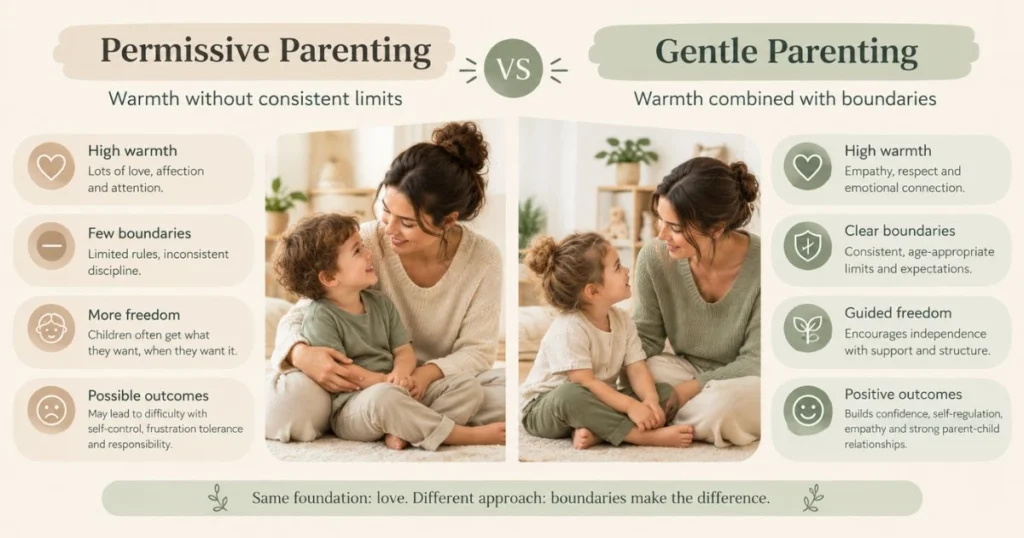
Permissive Parenting vs. Gentle Parenting
This distinction matters because permissive parenting is sometimes confused with gentle parenting.
Gentle or positive parenting does not require eliminating boundaries. You can acknowledge your child’s feelings while still keeping a clear boundary.
For example:
Permissive response:
“You’re disappointed that screen time is finished, so you can play for a few more minutes.”
Warm but firm response:
“I know you’re disappointed that screen time is over. You really wanted to keep playing. The tablet is going away now, and you can choose whether we read a book or build with blocks.”
The second response acknowledges the child’s feelings without changing the boundary.
That combination—connection plus structure—is an important distinction.
The World Health Organization’s parenting guidance similarly emphasizes responsive caregiving alongside positive parenting practices such as clear household rules, monitoring children’s behavior, positive reinforcement, communication, and nonviolent discipline.
The Four Parenting Styles Explained
The modern discussion of parenting styles has its roots in the work of developmental psychologist Diana Baumrind. Her early research described three broad patterns of parenting: authoritative, authoritarian, and permissive parenting.
Later, researchers Eleanor Maccoby and John Martin expanded the framework by describing parenting along two broad dimensions—responsiveness and demandingness—and incorporating a fourth pattern commonly called uninvolved or neglectful parenting.
A simplified way to understand how permissive parenting compares with the other three styles is:
| Parenting style | Responsiveness | Demandingness | Typical pattern |
|---|---|---|---|
| Authoritative | High | High | Warmth with clear expectations |
| Authoritarian | Low | High | Strict expectations with less emotional responsiveness |
| Permissive | High | Low | Warm and accepting with few consistent limits |
| Uninvolved | Low | Low | Limited warmth, involvement, and structure |
Authoritative Parenting
Authoritative parents combine warmth with reasonable expectations.
They may say:
“I understand that you’re angry. You’re still not allowed to hit.”
The child’s feelings are accepted, but harmful behavior is not.
Authoritarian Parenting
Authoritarian parenting emphasizes obedience, control, and firm expectations, often with less discussion or emotional responsiveness.
A parent might say:
“Because I said so. Stop arguing.”
This is different from authoritative parenting, even though the two words are often confused.
Permissive Parenting
Permissive parents tend to be highly affectionate and responsive but less likely to establish or enforce limits.
The parent may think:
“They’re only little once. I don’t want to make everything a battle.”
Uninvolved Parenting
Uninvolved parenting involves low levels of both responsiveness and demandingness. A parent may provide basic care but remain emotionally or behaviorally disengaged from the child’s daily life.
This is fundamentally different from permissive parenting, where warmth, affection, and involvement can be quite high.
How Does Permissive Parenting Show Up in Daily Life?
Permissive parenting does not always look dramatic. Often, it appears in small decisions repeated over and over.
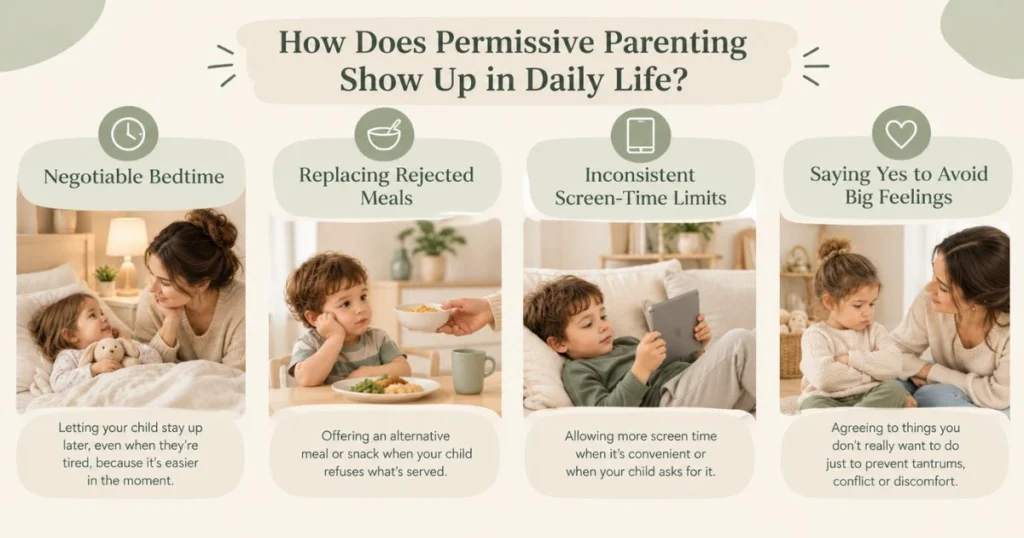
1. Bedtime Becomes Negotiable
You tell your child:
“It’s time for bed.”
They ask for another story.
You agree.
Then they want water.
Then another hug.
Then they suddenly remember something important.
Eventually, you are spending an hour negotiating because saying, “No, bedtime is over,” feels harder than simply staying.
The problem isn’t reading an extra story occasionally. The pattern becomes problematic when the child learns that persistence eventually changes the boundary.
2. Every Rejected Meal Gets Replaced
You prepare dinner. Your child refuses it.
Instead of calmly maintaining the family meal routine, you immediately make something different.
Then it happens again the next night.
And again.
Over time, your child may learn that refusing the original option reliably produces a preferred alternative.
A flexible family meal does not have to mean forcing a child to eat. You can respect appetite and preferences while still maintaining predictable mealtime expectations.
3. Screen-Time Limits Rarely Hold
You announce:
“Ten more minutes, then the tablet goes away.”
Ten minutes later, your child protests.
You add another ten.
Then another.
Eventually, the original limit has disappeared.
This is one of the clearest examples of the difference between having a boundary and following through with a boundary.
4. Saying Yes to Avoid Big Feelings
Sometimes the underlying pattern is simple:
Your child becomes upset → you feel uncomfortable → you change the answer → everyone calms down.
That can create a powerful short-term reward for both people.
The child discovers that intense protest may change the decision.
The parent discovers that giving in quickly ends the conflict.
Neither person necessarily intends to create this pattern. It can develop gradually.
Why Do Parents Become Permissive?
Permissive parenting is rarely about laziness or not caring.
Often, it develops because a parent is trying very hard to do something positive.
Confusing Validation With Accommodation
You can validate a child’s emotions without accommodating every request.
Your child can be disappointed.
Your child can be angry.
Your child can dislike your decision.
None of those feelings automatically mean you have made the wrong decision.
A parent can say:
“You’re really upset that we have to leave.”
without saying:
“Okay, we’ll stay.”
Validation communicates, “Your feelings make sense.”
Accommodation communicates, “Your feelings determine what happens next.”
Those are not the same thing.
Fear of Conflict
Some parents find their child’s distress extremely difficult to tolerate, which can contribute to permissive parenting patterns.
A tantrum can feel like failure.
Crying can feel like rejection.
Anger can feel like evidence that you are damaging the relationship.
But children are allowed to have uncomfortable emotions. Your role is not to make every uncomfortable feeling disappear.
Your role is to help your child experience those feelings safely while maintaining appropriate limits.
Guilt
Parenting guilt can make ordinary boundaries feel cruel.
You might think:
“I already said no so many times today.”
Or:
“They had such a hard day.”
Or:
“I should be more patient.”
Compassion is valuable. But compassion does not require abandoning every expectation.
Sometimes the kindest response is still:
“I know you don’t like this. The answer is still no.”
Fear That Your Child Will Love You Less
This fear can be especially powerful and may play a role in permissive parenting.
A parent may unconsciously believe that being the “fun” parent protects the relationship.
But children do not need a parent who agrees with everything. They need a dependable adult who can tolerate their disappointment while remaining emotionally connected.
Healthy boundaries can actually make family life more predictable.
Difficulty Recognizing Your Own Needs
Permissiveness can also happen when parents repeatedly put their own basic needs at the bottom of the list.
You need sleep.
You need quiet.
You need personal space.
You need cooperation.
But instead of saying those things out loud, you keep accommodating everyone else until resentment builds.
That can create an unhealthy cycle:
over-accommodation → exhaustion → resentment → anger → guilt → more accommodation
How Can Permissive Parenting Affect Children?
The effects of parenting styles are more complicated than a simple list of “good” and “bad” outcomes.
Most research in this area is observational or correlational, meaning it can identify relationships between parenting patterns and child outcomes without proving that one parenting style directly caused a particular result.
Children are also influenced by temperament, genetics, socioeconomic conditions, school experiences, culture, relationships, and many other factors.
So permissive parenting should not be treated as a prediction of how a child will turn out.
Still, research has identified several patterns worth understanding.
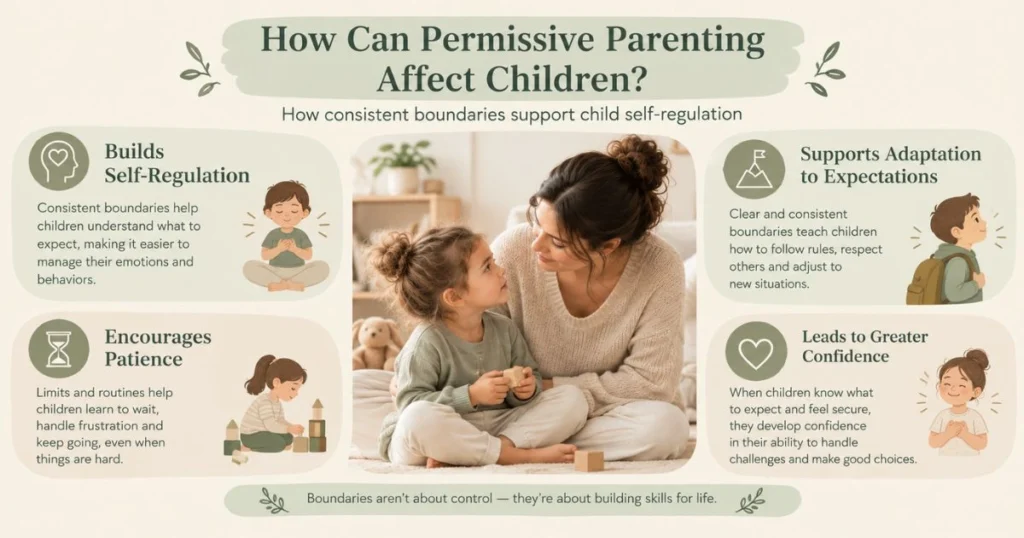
Self-Regulation Can Be More Difficult
Self-regulation involves skills such as managing impulses, waiting, shifting attention, and adjusting behavior.
One study of young children found a notable association between permissive parenting and weaker self-regulation, particularly when permissiveness involved reluctance to follow through with limits. The authors also emphasized the need for further research to understand causality.
This makes developmental sense: children gradually learn self-control partly through repeated experiences with expectations, limits, practice, and support.
A child doesn’t learn emotional regulation simply because adults prevent every frustrating experience.
They learn it by having manageable opportunities to experience frustration while an adult helps them cope.
Academic Outcomes May Be Lower on Average
A large 2016 meta-analysis examined 308 studies involving children and adolescents and found that permissive parenting was associated with lower academic achievement, although the effect sizes were small to very small. The researchers also found positive associations between academic performance and parental warmth, behavioral control, autonomy granting, and authoritative parenting.
That does not mean a permissive parent causes poor grades.
Rather, consistent structure may support habits that matter for school: completing responsibilities, managing time, tolerating frustration, and following through.
Social and Behavioral Difficulties May Appear
When children rarely encounter consistent limits, they may have fewer opportunities to practice accepting “no,” waiting their turn, managing impulses, or adapting to expectations outside the home.
Research on substance use also finds small associations between permissive parenting and substance use, although the relationship varies depending on how permissiveness is defined and measured. A 2024 systematic review and meta-analysis covering 184 studies found the association between permissive parenting and substance use was small.
This is important: parenting style is one factor among many, not a destiny.
Emotional Outcomes Are More Nuanced
It is tempting to say that permissive parenting automatically causes anxiety or depression, but the evidence does not support such a simple conclusion.
A large meta-analysis of more than 1,000 studies found that warmth, behavioral control, autonomy granting, and authoritative parenting were associated with slightly fewer internalizing symptoms, while authoritarian parenting was associated with more symptoms. Findings for neglectful parenting were more mixed.
In other words, lack of structure may create challenges for some children, but permissive parenting should not be presented as a direct cause of depression or anxiety.
What About Weight and Eating?
Research has found associations between parenting style and children’s weight-related outcomes, but the evidence is inconsistent.
An earlier systematic review of prospective studies found that several studies linked authoritative parenting with lower BMI gains, while findings for permissive parenting varied.
More recently, a 2025 systematic review and meta-analysis specifically examining parenting and feeding styles in children from 6 months to 5 years found no consistent association between permissive/indulgent parenting and adiposity. The researchers rated the overall evidence as very low certainty because of factors such as risk of bias and the small number of eligible studies.
So it is more accurate to say that family routines, feeding practices, and parenting style may interact with children’s health behaviors than to claim that permissive parenting directly causes obesity.
Are There Any Benefits to Permissive Parenting?
This is where the conversation deserves nuance.
Permissive parents often provide something children genuinely need: warmth.
They may listen carefully, show affection, encourage independence, accept emotions, and avoid harsh punishment.
Those qualities are valuable.
The issue is not that warmth is harmful. Quite the opposite: responsive caregiving is an important part of healthy child development. WHO guidance emphasizes responsive care and nurturing interactions, particularly during early childhood.
The challenge is that warmth alone may not provide enough structure.
Think of it this way:
Warmth tells a child: “You are loved.”
Structure tells a child: “You can count on me to help make life predictable.”
Children need both.
Freedom can also support independence when it is developmentally appropriate. Giving a child choices—such as choosing between two pajamas or deciding whether to brush teeth before or after a story—can encourage autonomy without handing over all decision-making authority.
The goal is not to eliminate freedom.
It is to provide freedom within appropriate boundaries.
The Permissiveness-to-Explosion Cycle
One of the most difficult patterns for permissive parents is the swing between extremes.
You say yes repeatedly.
You tolerate behavior that is exhausting you.
You ignore your own needs.
You tell yourself to be patient.
Eventually, you reach your limit.
Then you explode.
Suddenly, the parent who usually says yes is shouting:
“That’s enough! I’m done! You never listen to me!”
The child is confused because yesterday the same behavior was allowed.
The parent feels guilty.
Then the guilt leads to more accommodation.
And the cycle starts again.
This inconsistency can make family life unpredictable.
Breaking the cycle does not mean becoming stricter overnight. It means identifying your limits before you reach the point of explosion.
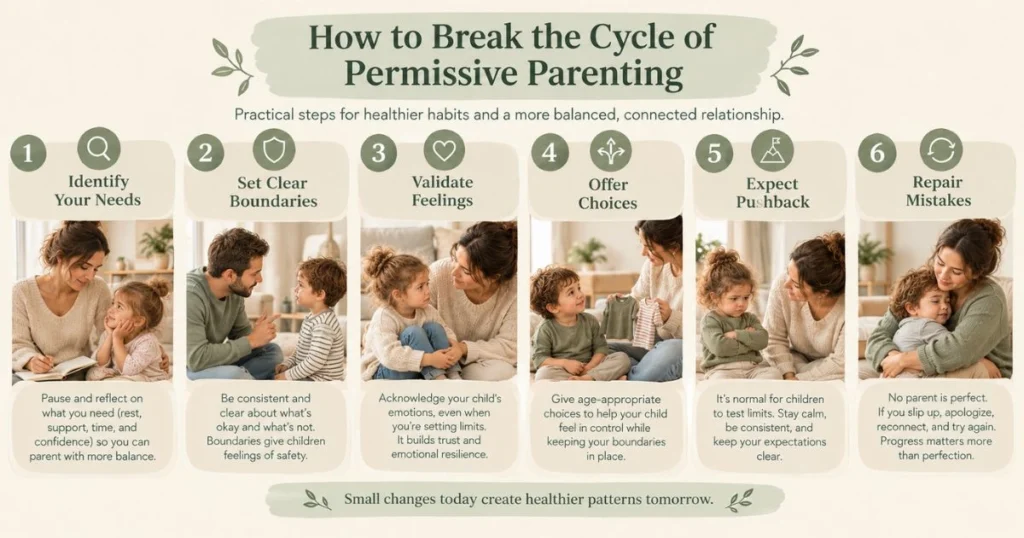
How to Break the Cycle of Permissive Parenting
1. Separate Your Child’s Need From Their Strategy
A child’s request is not always the same thing as the underlying need.
Your child may say:
“I need more screen time!”
But perhaps they really want connection, stimulation, or a break from a difficult day.
Your child may say:
“I don’t want to go to bed!”
But perhaps they want more time with you.
Understanding the need does not require agreeing to the strategy.
You can say:
“You really want more time with me. We can have ten minutes to cuddle and talk, but bedtime is still happening.”
2. Identify Your Own Needs
Ask yourself:
What am I actually struggling with right now?
Maybe you need sleep.
Maybe you need quiet.
Maybe you need your child to respect your workspace.
Maybe you need dinner to happen without preparing three separate meals.
Those needs matter too.
Try using an “I” statement:
“I need some quiet time right now. You can play here quietly, or you can play in your room.”
This is not selfish parenting.
It is teaching children that other people’s needs exist alongside their own.
3. Stop Treating Disappointment as an Emergency
Your child’s disappointment may be loud.
That does not necessarily mean something has gone wrong.
You can stay close while holding the boundary:
“I know you’re upset.”
“You really wanted that.”
“I’m here with you.”
“And the answer is still no.”
This is one of the most important skills for moving away from permissive parenting while remaining warm, supportive, and emotionally connected.
4. Start With a Few Important Boundaries
Do not attempt to change every rule in your home tomorrow.
If you are trying to move away from permissive parenting, choose two or three areas that are causing the most stress.
For example:
- Bedtime
- Screen time
- Hitting or aggressive behavior
- Leaving the house
- Mealtimes
Make the expectation simple.
Then communicate it calmly and follow through consistently.
5. Give Choices Without Giving Away the Boundary
Children need appropriate control over their lives.
You can provide it without making every decision negotiable or falling into permissive parenting.
Instead of:
“Do you want to go to bed?”
Try:
“It’s bedtime. Do you want the dinosaur pajamas or the striped ones?”
The boundary is fixed.
The child still has meaningful control.
6. Expect Pushback
If your child is accustomed to a boundary changing after enough protesting, they may protest more when you first move away from permissive parenting and become more consistent.
That does not necessarily mean the new boundary is harmful.
It may simply mean the old pattern was predictable.
Stay calm.
Repeat the message.
Avoid lengthy debates.
7. Repair When You Get It Wrong
You will still lose patience sometimes.
You will still change your mind sometimes.
You may occasionally give in because you are exhausted.
That’s parenting.
With permissive parenting, you can repair without abandoning the boundary.
Try:
“I was very frustrated earlier, and I yelled. I shouldn’t have yelled. I’m sorry. The bedtime rule is still the same, and next time I’ll try to speak more calmly.”
Repair teaches something important: adults can make mistakes, take responsibility, and try again.
The Goal Isn’t to Become a Strict Parent
If you recognize yourself in this article, you do not need to swing from permissive parenting to authoritarian parenting.
The answer is not:
“I need to become stricter.”
The more useful goal is:
“I need to become more consistent.”
You can remain affectionate.
You can listen.
You can apologize.
You can validate feelings.
You can explain your decisions.
You can give choices.
And you can still say no.
A child can cry while you hold a boundary.
A child can be angry while you remain calm.
A child can disagree with you while still knowing that you love them.
That is not a failure of connection.
It is part of learning how relationships work.
Final Thoughts

Permissive parenting often begins with something good: a parent’s desire to protect a child’s happiness, preserve connection, avoid harshness, or give their child an easier childhood than they experienced themselves.
But children do not need parents who prevent every disappointment.
They need parents who can stay emotionally connected while also providing appropriate structure.
If you have been saying yes because you are tired, guilty, afraid of conflict, or worried about your child’s reaction, you are not alone.
Start small.
Choose one boundary.
Explain it clearly.
Expect some feelings.
Stay connected.
And follow through.
You do not have to become a different kind of parent overnight. You are simply learning how to make room for two truths at the same time:
“I understand how you feel.”
“And this boundary is still important.”
That combination—warmth with appropriate limits—is at the heart of moving away from permissive parenting without losing the loving relationship you are trying so hard to protect.