Attachment parenting is built around a simple idea: babies are not trying to make life difficult. Their cries, movements, facial expressions, and behaviors are ways of communicating needs.
Instead of encouraging parents to make babies fit a predetermined schedule, attachment parenting emphasizes learning the individual child and responding with sensitivity, closeness, and consistency.
The approach was popularized in modern parenting literature by pediatrician William Sears and his family. It encourages parents to trust their observations, remain physically and emotionally available, and build a strong parent-child relationship from the earliest days of life.
But attachment parenting is sometimes presented as though it requires following a strict list of rules. It doesn’t have to.
You can value responsive caregiving without believing that every parent must breastfeed, babywear, or share a bed. In fact, separating the underlying principle—responsive, sensitive care—from specific parenting tools can make attachment parenting much more practical for real families.
Here’s what attachment parenting means, how its commonly discussed practices work, what research actually tells us, and where parents should pay particular attention to infant sleep safety.
What Is Attachment Parenting?
Attachment parenting is a parenting philosophy that emphasizes responsive caregiving, physical closeness, emotional availability, and sensitivity to a child’s signals.

The goal is to help a child develop a dependable sense that their caregiver notices their needs and responds appropriately.
For a newborn, that might mean picking them up when they cry, feeding them when they show hunger cues, holding them frequently, or providing skin-to-skin contact.
As children grow, the same philosophy can look different. A toddler may need a parent who stays nearby during a tantrum, names the child’s feelings, and calmly sets a boundary rather than leaving the child alone with overwhelming emotions.
So attachment parenting isn’t simply about holding a baby constantly. At its heart, it is about building a relationship in which the child experiences their caregiver as emotionally available and dependable.
That distinction matters because attachment parenting and secure attachment aren’t identical concepts. Secure attachment develops through many aspects of a child’s relationship with caregivers, including sensitive and responsive interactions. There isn’t one required parenting method that guarantees secure attachment.
The Philosophy Behind Attachment Parenting
Attachment parenting generally places a strong emphasis on responding to babies rather than trying to shape them into a predetermined routine.
A baby’s cry, for example, is interpreted as communication rather than manipulation.
A newborn isn’t crying to teach you a lesson or deliberately create a bad habit. They may be hungry, tired, uncomfortable, overstimulated, lonely, or simply looking for the regulating presence of a familiar caregiver.
This doesn’t mean parents have to respond perfectly every time.
No parent can anticipate every need, eliminate every cry, or remain calm every minute of every day. What matters is the broader pattern of caregiving and the relationship that develops over time.
Does Attachment Parenting Reject Sleep Training?
Some attachment-parenting advocates strongly oppose approaches such as extinction or “cry-it-out” sleep training and may prefer responsive settling methods.
The important distinction is that attachment parenting is a philosophy, not a single sleep-training protocol.
Families can have different approaches to infant sleep while still caring about responsiveness and emotional connection.
Likewise, attachment parenting generally discourages rigid schedules that ignore a baby’s cues. Instead, parents are encouraged to notice hunger, tiredness, overstimulation, and other signals.
That doesn’t mean routines are harmful.
Predictable routines can actually make family life easier and help children know what comes next. A responsive approach can include both flexibility and predictable rhythms.
The Common “Baby B’s” of Attachment Parenting
The practices associated with attachment parenting are often described through a collection of “Baby B’s.” Different sources organize or name these practices somewhat differently, but several ideas appear repeatedly.
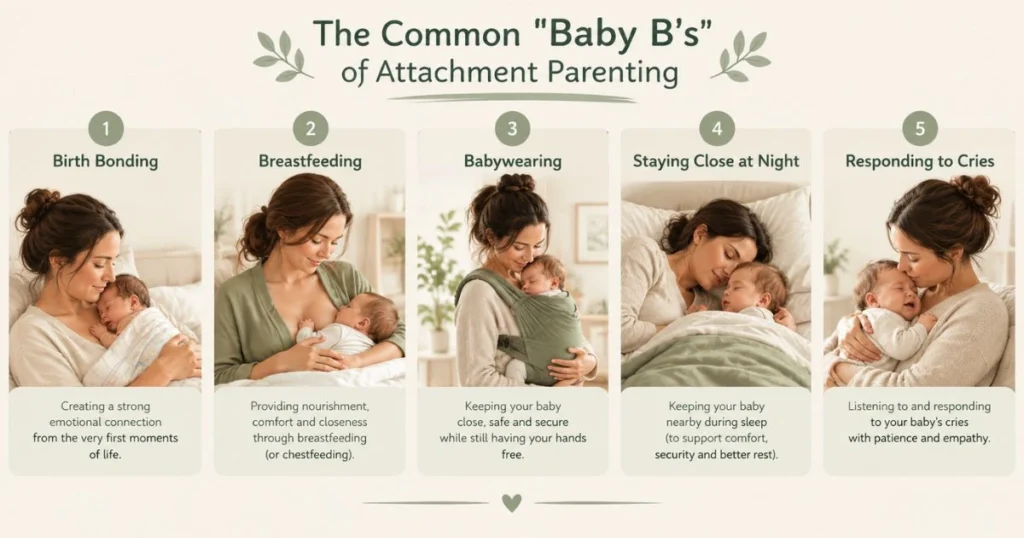
1. Birth Bonding
Attachment parenting places importance on early physical contact between parent and baby.
Skin-to-skin contact immediately after birth can support warmth, physiological regulation, breastfeeding initiation, and early interaction when medically appropriate.
But bonding isn’t limited to the first hour—or even the first six weeks.
If immediate skin-to-skin contact wasn’t possible because of a cesarean birth, medical complications, premature birth, or another circumstance, it doesn’t mean a parent has missed their opportunity to bond.
Attachment develops through thousands of ordinary interactions over time: feeding, comforting, talking, looking at your baby, responding to cries, and simply being there.
2. Breastfeeding
Breastfeeding is often closely associated with attachment parenting because feeding provides both nutrition and opportunities for physical closeness and responsive interaction.
Attachment-oriented parents may prefer feeding according to the baby’s hunger cues rather than following a rigid clock-based schedule.
Current guidance from the CDC, the American Academy of Pediatrics, and the World Health Organization supports exclusive breastfeeding for about the first six months when possible, followed by complementary foods while breastfeeding continues for two years or longer if mutually desired.
However, breastfeeding should never become a measure of whether someone is a “good” attachment parent.
Some parents cannot breastfeed. Others choose formula or combination feeding. A baby can still receive loving, responsive, emotionally attentive care.
The relationship isn’t created by breast milk alone.
3. Babywearing
Babywearing involves carrying an infant close to the caregiver using a sling, wrap, or structured carrier.
For attachment-oriented families, it can provide frequent physical contact while allowing the parent to move through daily activities.
It can also give parents opportunities to notice subtle cues—such as changes in facial expression, body movement, or fussiness—because the baby is physically close.
Safety matters, however. A carrier should be used according to its instructions, and the baby’s airway needs to remain clear. Young infants require particular attention to positioning.
Babywearing is a tool, not a requirement. A parent can build a responsive relationship without carrying their baby for much of the day.
4. Staying Close at Night
Attachment parenting often encourages keeping babies close during nighttime hours.
This can include room-sharing, where the baby sleeps in their own safe sleep space in the parent’s room.
This is an important area where attachment philosophy and infant sleep-safety recommendations need to be clearly distinguished.
The American Academy of Pediatrics recommends room-sharing without bed-sharing. The infant should sleep on a separate, firm, flat sleep surface such as an approved crib, bassinet, or play yard, ideally in the parents’ room for at least the first six months.
Bed-sharing is different from room-sharing. With bed-sharing, the infant sleeps on the same surface as an adult.
The AAP does not recommend bed-sharing as a safe infant sleep arrangement because of risks including suffocation, entrapment, and other sleep-related deaths. The risks are particularly concerning when an infant is very young or when an adult is impaired by fatigue, alcohol, medications, or other substances.
So parents who want nighttime closeness do not have to choose between attachment and safety.
A crib or bassinet positioned next to the parent’s bed can allow a parent to see, hear, feed, and comfort the baby while maintaining a separate sleep surface.
5. Believing Your Baby’s Cries
Attachment parenting encourages parents to treat crying as meaningful communication.
Instead of immediately thinking, “My baby is manipulating me,” parents are encouraged to ask:
- What might my baby need?
- Could they be hungry?
- Are they tired?
- Are they uncomfortable?
- Do they need help calming down?
- Is something different about this cry?
Over time, parents often become familiar with their baby’s individual signals.
Responsive caregiving doesn’t require instantly knowing the answer. Sometimes the parent has to try several things before discovering what the baby needs.
That process itself is part of learning one another.
Attachment Parenting From Infancy Through the Toddler Years
Attachment parenting doesn’t stop when a baby becomes mobile.
In fact, the way responsiveness looks can change dramatically as children develop.

Attachment Parenting With Babies
During the first year, attachment-oriented caregiving may involve:
- Responding sensitively to crying
- Offering frequent physical affection
- Watching for hunger and tiredness cues
- Providing opportunities for skin-to-skin contact
- Feeding responsively
- Talking and making eye contact during everyday care
- Keeping the baby nearby
- Creating a safe, predictable environment
- Responding to changes in behavior rather than assuming all crying means the same thing
The objective isn’t to eliminate every uncomfortable feeling.
Babies will still cry. They will still wake at night. They will sometimes become overstimulated or frustrated.
The parent provides a dependable source of support while the baby gradually develops their own abilities to regulate emotions and interact with the world.
Attachment Parenting With Toddlers
Toddlers introduce a new challenge: they want independence while still needing substantial emotional support.
A responsive parent doesn’t have to give a toddler everything they want.
For example:
“You really wanted another cookie. You’re upset. We’re done with cookies for today.”
That’s attachment-oriented without being permissive.
The parent acknowledges the child’s emotion while maintaining the boundary.
During a tantrum, a parent might stay nearby, speak calmly, offer physical comfort if the child wants it, and wait for the child to become more regulated before discussing what happened.
This is sometimes described as a “time-in” rather than a traditional time-out.
The goal isn’t to punish a child for having a strong emotion. It’s to help them experience the emotion safely while learning that limits still exist.
Attachment Parenting vs. Traditional Parenting
The biggest difference isn’t necessarily whether a family has routines, uses a crib, or gives a child consequences.
It’s often the reasoning behind the response.
| Area | Attachment-oriented approach | More traditional approach |
| Feeding | Responds to hunger cues and may use infant-led feeding | May emphasize scheduled feeding |
| Crying | Treats crying as communication | May encourage independent soothing sooner |
| Physical contact | Frequently emphasizes holding and closeness | May place greater emphasis on independent time |
| Sleep | Often prioritizes parental proximity | May prioritize independent sleep |
| Tantrums | Offers connection while maintaining boundaries | May use consequences or time-outs |
| Independence | Develops gradually through supported exploration | May be encouraged more explicitly and earlier |
This table describes broad tendencies, not two completely separate categories.
Many families use a combination of approaches.
A parent can respond lovingly to a crying baby and still establish routines. A parent can encourage independent sleep while remaining emotionally available. A parent can set firm limits without using harsh discipline.
Parenting doesn’t have to fit perfectly into one label.
What Does Research Say About Attachment Parenting?
This is where it’s important to separate research on responsive caregiving and attachment from research specifically evaluating “attachment parenting” as a complete package.
Research supports the importance of sensitive caregiving, but that does not mean every practice associated with attachment parenting has been proven necessary for healthy development.
For example, a 2019 meta-analysis led by Sheri Madigan examined 37 studies involving parenting behavior and children’s early language development. Sensitive-responsive parenting was positively associated with children’s language skills, with a pooled correlation of r = 0.27. The authors concluded that the findings support theories suggesting sensitive parenting may facilitate language and learning. However, the studies were observational, so they could not establish that responsive parenting directly caused the language outcomes.
More recent research has also continued to examine the relationship between caregiver sensitivity, attachment security, and child development.
This gives parents an important takeaway: being responsive to your child’s signals is meaningful, but there is no evidence that you must follow every attachment-parenting practice to create a healthy parent-child relationship.
Potential Benefits of a Responsive Parenting Approach
When attachment parenting is understood as responsive caregiving rather than a rigid checklist, several potential benefits become easier to understand.
It Can Help Parents Learn Their Child
Paying close attention to a baby’s signals can help parents recognize patterns.
You may gradually discover that your baby rubs their eyes when tired, turns away when overstimulated, or becomes particularly fussy when hungry.
That knowledge can make everyday caregiving feel more intuitive.
It Can Support Emotional Connection
Consistent, sensitive responses give children repeated experiences of having a caregiver notice and respond to them.
Over time, these interactions can contribute to a relationship in which the child expects support and feels comfortable seeking help.
It Can Encourage Responsive Communication
Talking, looking, listening, imitating sounds, and responding to a baby’s attempts to communicate all create opportunities for interaction.
These everyday exchanges are particularly relevant because sensitive responsiveness has been associated with children’s language development in research.
It Can Make Discipline More Connection-Focused
With older babies and toddlers, attachment-oriented parenting can encourage parents to separate the child’s emotion from the behavior.
A child can be angry without being allowed to hit.
A toddler can be disappointed without receiving another cookie.
A child can cry when a boundary is enforced while the parent remains calm and present.
That combination—connection plus boundaries—is different from simply giving a child whatever they want.
The Challenges of Attachment Parenting
Attachment parenting can also be demanding.
Constant physical availability can be exhausting, particularly during periods when a baby wakes frequently, feeds often, or strongly prefers one caregiver.
Breastfeeding on demand can make it difficult for some parents to sleep, work, exercise, socialize, or share caregiving responsibilities.
Babywearing can be convenient, but carrying a growing child for long periods can become physically tiring.
And expectations around being constantly responsive can sometimes create guilt.
A parent may think:
“If I need a break, am I failing at attachment parenting?”
No.
A healthy parenting relationship does not require a parent to ignore their own basic needs.
Children benefit from caregivers who have support and opportunities to rest. Asking a partner, relative, friend, or trusted caregiver for help does not undermine attachment.
It can make responsive parenting more sustainable.
You Don’t Have to Do Everything
Perhaps the most important point about attachment parenting is that there is no need to turn a parenting philosophy into a perfection test.
You can love babywearing and still use a stroller.
You can breastfeed and occasionally express milk or use formula.
You can respond promptly to crying while also developing predictable routines.
You can room-share while keeping your baby’s sleep surface separate.
You can comfort a toddler through a tantrum while firmly saying no.
You can value independence without forcing it before your child is ready.
Real families have different circumstances, cultures, work schedules, health considerations, temperaments, and support systems.
The most useful question isn’t:
“Am I doing attachment parenting correctly?”
It is:
“Is this approach helping me respond to my child’s needs while keeping both of us safe and supported?”
Infant Sleep Safety Comes First
For parents interested in attachment parenting, sleep deserves particular attention because physical closeness and safe sleep are not always the same thing.
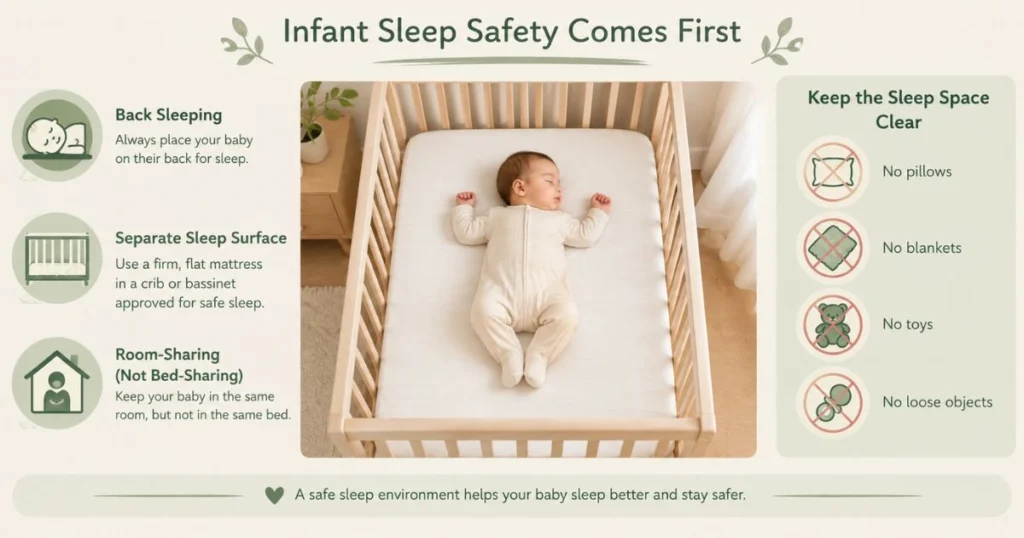
The AAP recommends that babies:
- Sleep on their backs for every sleep.
- Use a firm, flat, noninclined sleep surface.
- Sleep in an approved crib, bassinet, portable crib, or play yard.
- Have a fitted sheet and no pillows, blankets, bumper pads, stuffed animals, or other soft objects in the sleep area.
- Sleep in the parents’ room without sharing the same sleep surface, ideally for at least six months.
- Be protected from exposure to tobacco smoke, alcohol, and other substances that can increase sleep-related risk.
If you bring your baby into bed for feeding or comforting, the AAP recommends returning the baby to their own crib or bassinet when you’re ready to go back to sleep. Couches and armchairs are especially dangerous places for infant sleep.
These recommendations don’t prevent closeness.
You can hold your baby, feed your baby, cuddle your baby, respond to every cry, and keep your baby within arm’s reach while maintaining a separate, safe sleep surface.
Final Thoughts on Attachment Parenting
Attachment parenting offers a valuable reminder that babies are people with individual needs—not schedules that need to be controlled.
Its emphasis on responsiveness, closeness, emotional availability, and understanding a child’s signals can encourage parents to build strong, connected relationships.
But attachment parenting doesn’t need to become an all-or-nothing lifestyle.
You don’t have to follow every practice associated with the philosophy to be a responsive parent.
Research supports the importance of sensitive caregiving, while evidence does not establish that every specific attachment-parenting practice is necessary for healthy development. And when practices conflict with established safety guidance—particularly infant sleep safety—safety recommendations should take priority.
The goal isn’t perfect attachment parenting.
It’s a relationship in which your child repeatedly experiences something deeply important:

“My parent notices me. My feelings matter. I am safe. And when I need help, someone is there.”