
If your 8-month-old suddenly seems to have forgotten how to sleep, you are not alone. One day, your baby may settle easily for naps and sleep reasonably well at night. The next, you may be facing short naps, bedtime battles, early mornings, or several wake-ups overnight.
At 8 months, your baby’s world is changing quickly. Crawling, sitting, pulling up, becoming more aware of you, and practicing new skills can all make sleep feel different. That does not necessarily mean your routine is failing.
The goal of an 8 month sleep schedule is not to force your baby to sleep at exact times. Instead, you want to create a predictable rhythm that gives your baby enough sleep while leaving room for individual needs.
In this guide, you’ll learn how much sleep your 8-month-old needs, how to build a two-nap schedule, understand wake windows, choose bedtime, handle night waking and nap resistance, and adjust the routine when sleep stops going smoothly.
If you’re comparing your baby’s routine with other stages, this baby sleep schedule by age guide can help you understand how sleep needs change over time.

What Is a Typical 8 Month Sleep Schedule?
By 8 months, many babies settle into a two-nap pattern, with one nap in the morning and another in the afternoon before nighttime sleep.
There isn’t one 8 Month Sleep Schedule that will suit every baby. Your baby’s usual wake-up time, nap duration, temperament, feeding routine, and overall sleep needs can all affect how you structure the day.
Here is a simple starting point you can adjust to fit your baby’s natural rhythm:
| Time | Activity |
| 7:00 AM | Wake up and milk feed |
| 8:00 AM | Breakfast/solids |
| 9:30 AM | Morning nap |
| 10:30–11:00 AM | Wake |
| 12:30 PM | Lunch/solids |
| 1:30 PM | Afternoon nap |
| 3:00 PM | Wake |
| 5:30 PM | Dinner/solids |
| 6:30 PM | Bedtime routine |
| 7:00 PM | Bedtime |
Treat this as a framework rather than a timetable you must follow perfectly. If your baby wakes at 6:30 AM, the entire day may shift earlier. If your baby starts the day at 8:00 AM, naps and bedtime can move later.
8 Month Sleep Schedule at a Glance
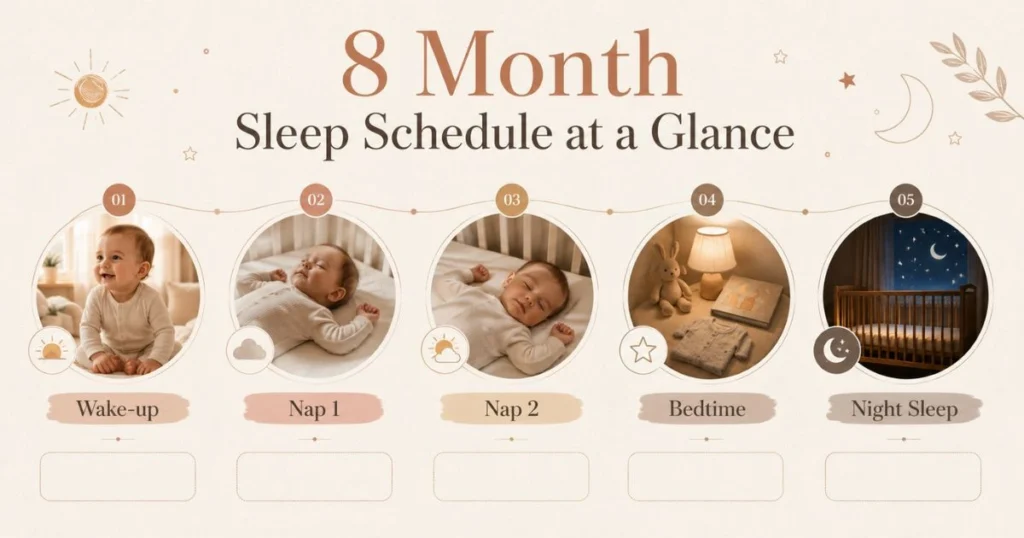
For your 8 Month Sleep Schedule, a helpful starting point is to aim for:
- 12–16 hours of sleep across 24 hours, including daytime naps
- Usually two naps during the day
- More consistent periods of awake time between sleep periods
- A familiar and calming bedtime routine
- A safe and suitable sleep environment
- Enough flexibility to adjust when naps change or new developmental skills affect sleep
The American Academy of Sleep Medicine recommends 12–16 hours of total sleep per 24 hours, including naps, for babies between 4 and 12 months of age.
How Much Sleep Does an 8-Month-Old Need?

Understanding how much sleep your baby needs can help you decide whether your 8 Month Sleep Schedule needs any adjustments.
At 8 months, your baby is within the AASM recommended range of 12–16 hours of sleep over a 24-hour period, including both nighttime sleep and daytime naps.
This is a broad range because sleep needs vary from one baby to another. Two healthy 8-month-olds may follow very different sleep patterns while still getting an appropriate amount of rest.
To understand how long your baby may comfortably stay awake between sleeps, see this guide to baby wake windows by age.
How Much Sleep Should an 8-Month-Old Get at Night?
With an 8 Month Sleep Schedule, most of your baby’s sleep may happen at night, but waking during the night can still be completely normal.
Your baby might wake briefly between sleep cycles, need some comfort, be ready for a feed, or become unsettled because of discomfort. One or several nighttime awakenings do not necessarily mean that your routine needs to change.
Instead of focusing only on whether your baby sleeps through the night, consider the full 24-hour sleep pattern, including naps, bedtime, and overnight sleep.
How Much Daytime Sleep Does an 8-Month-Old Need?
Daytime naps remain an important part of an 8 Month Sleep Schedule. Your baby needs enough rest during the day to reach bedtime comfortably, but naps that are unusually long or poorly timed may sometimes affect nighttime sleep.
When reviewing your baby’s routine, consider:
- Total sleep across 24 hours
- When each nap takes place
- How long the naps last
- Time spent awake between sleeps
- Bedtime
- Your baby’s tiredness cues and overall mood
A single short nap usually isn’t a reason to overhaul the entire sleep schedule.
How Many Naps Does an 8-Month-Old Need?

For many 8-month-olds, two naps per day provide a practical rhythm.
A typical pattern is:
- Morning wake-up
- First nap
- Longer period of awake time
- Second nap
- Final wake period
- Bedtime
If you’re wondering how naps change as your baby grows, our baby nap schedule by age guide provides a helpful overview.
Why Two Naps Are Common at 8 Months
Two daytime naps can give your baby enough rest while helping keep the afternoon nap from getting so late that it interferes with bedtime.
Within an 8 Month Sleep Schedule, one nap may be shorter and the other longer, depending on your baby’s needs that day. The two naps do not have to be the same length for the routine to work well.
How Long Should an 8-Month-Old Nap?
Nap duration can change from one day to the next. With an 8 Month Sleep Schedule, you may notice that one nap is brief while another lasts considerably longer.
Rather than trying to make every nap last the same amount of time, focus on your baby’s overall sleep throughout the day and night.
Can an 8-Month-Old Still Take Three Naps?
Occasionally, a third nap can still fit into an 8 Month Sleep Schedule.
If your baby has slept poorly during the day, a brief late-afternoon nap may help prevent an overly long stretch of awake time before bedtime. However, if your baby needs this extra nap regularly or it consistently delays bedtime, take another look at the timing and length of the first two naps and the wake windows between them.
Is Your Baby Ready to Drop a Nap?
Don’t assume that one or two skipped naps mean your baby is ready to move to one nap.
Look for a consistent pattern instead.
Your baby may need a schedule adjustment if they repeatedly:
- Refuse a nap
- Take a long time to fall asleep
- Stay cheerful and energetic during a usual nap time
- Resist bedtime after a long second nap
- Consistently wake very early
A difficult nap day by itself is not enough evidence that your baby needs a major change.
If your baby is transitioning toward a two-nap routine, you can also compare it with our 6 month sleep schedule guide.
8 Month Wake Windows: How Long Should Your Baby Stay Awake?

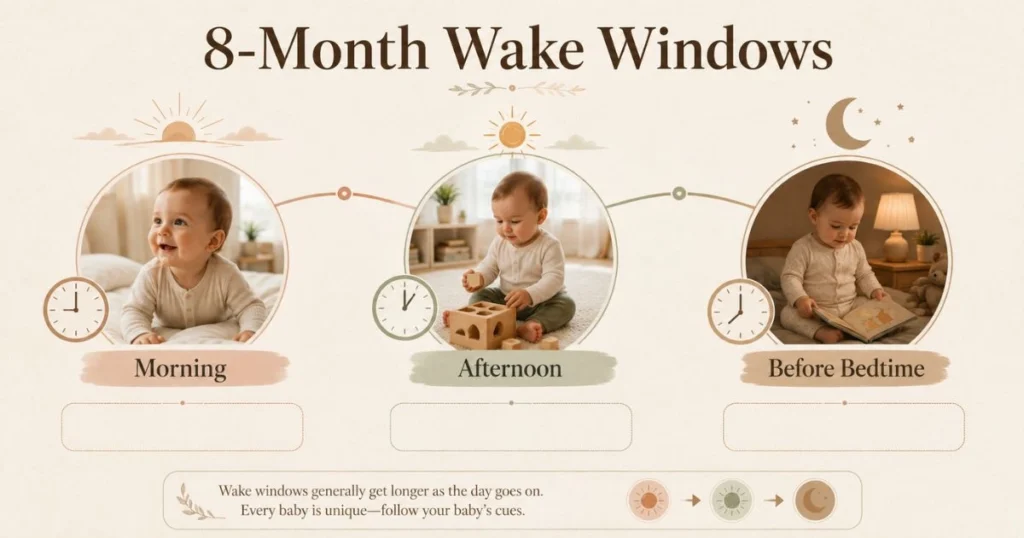
Wake windows are the periods when your baby is awake between naps and nighttime sleep. They can be helpful when planning an 8 Month Sleep Schedule, but think of them as flexible guidelines rather than fixed rules.
For many babies, you can use the following ranges as a starting point:
| Part of the Day | Example Wake Window |
| Before first nap | About 2.5–3 hours |
| Between naps | About 3 hours |
| Before bedtime | About 3–4 hours |
Your baby may do better with a little more or less awake time between sleeps.
Why Wake Windows Matter
If you try to put your baby down before they’re truly ready for sleep, they may spend the time playing, rolling, crawling, or practicing standing in the crib.
But waiting too long can have the opposite effect. Your baby may become overtired, making it harder to calm down and settle.
The aim of an 8 Month Sleep Schedule is to find a comfortable balance—giving your baby enough awake time to build sleep pressure without letting them become overly tired..
Signs the Wake Window May Be Too Short
You may notice:
- Your baby seems energetic at nap time.
- They play instead of settling.
- They take a long time to fall asleep.
- They repeatedly refuse a nap.
- Bedtime feels like another play session.
Signs Your Baby May Not Be Ready for Sleep Yet
You may see:
- Increasing fussiness
- Crying before sleep
- Difficulty settling
- Very short naps
- Strong bedtime resistance
- Your baby appearing exhausted rather than calmly sleepy
Instead of changing the schedule dramatically, try adjusting one wake window gradually and observe what happens.
For a broader look at awake periods from newbornhood through toddlerhood, explore our guide to baby wake windows.

A Complete 8 Month Sleep Schedule by Wake-Up Time
Managing an 8 Month Sleep Schedule becomes easier when you focus on your baby’s individual rhythm instead of trying to follow the exact same clock times as other families.
8 Month Sleep Schedule With a 6:00 AM Wake-Up
A possible day could look like:
- 6:00 AM — Wake
- 8:30 AM — Nap 1
- 9:30–10:00 AM — Wake
- 1:00 PM — Nap 2
- 2:30 PM — Wake
- 6:00–6:30 PM — Bedtime
If your baby struggles with this schedule, adjust the timing based on their cues rather than forcing the clock.
8 Month Sleep Schedule With a 7:00 AM Wake-Up
This can be a convenient starting point for many families:
- 7:00 AM — Wake
- 9:30 AM — Nap 1
- 10:30–11:00 AM — Wake
- 1:30 PM — Nap 2
- 3:00 PM — Wake
- 7:00 PM — Bedtime
8 Month Sleep Schedule With an 8:00 AM Wake-Up
If your baby naturally starts the day later, you could shift the schedule:
- 8:00 AM — Wake
- 10:30 AM — Nap 1
- 11:30 AM — Wake
- 2:30 PM — Nap 2
- 4:00 PM — Wake
- 8:00 PM — Bedtime
The important point is not whether your baby sleeps at exactly 9:30 or 10:30. What matters is whether the overall rhythm works for your baby and your family.

What Time Should Your 8-Month-Old Go to Bed?
There isn’t one perfect bedtime that will work for every baby. With an 8 Month Sleep Schedule, bedtime often falls in the early evening, but the ideal timing can vary depending on when your baby’s second nap ends and how long they comfortably stay awake afterward.
What Time Is Best for Your 8-Month-Old’s Bedtime?
There is no single bedtime that suits every baby. In an 8 Month Sleep Schedule, bedtime will often be in the early evening, but the best time depends on when your baby wakes from the second nap and how much awake time they need before nighttime sleep.
Should You Use an Early Bedtime After a Bad Nap Day?
An earlier bedtime can sometimes work better than keeping your baby awake just to stick to the usual clock time.
If your baby has had unusually short naps and is showing clear signs of tiredness, extending the final wake window may make it harder for them to settle at night. In an 8 Month Sleep Schedule, adjusting bedtime to match your baby’s needs can be more helpful than following the clock rigidly.
Can a Later Bedtime Help Your Baby Sleep Later?
Not always. Pushing bedtime much later does not necessarily mean your baby will sleep later the next morning. In fact, becoming overtired can make it harder for some babies to settle and may lead to more disrupted nighttime sleep. A well-balanced 8 Month Sleep Schedule should focus on your baby’s sleep needs rather than simply delaying bedtime.

A consistent baby bedtime routine can make the transition from daytime activity to nighttime sleep more predictable.
8 Month Sleep Schedule and Feeding
Sleep and feeding both play an important role in your baby’s daily routine, but waking during the night doesn’t always mean your baby is hungry.
At 8 months, your baby may still have several milk feeds while also eating age-appropriate solid foods. As you build an 8 Month Sleep Schedule, keep your baby’s individual feeding needs in mind and speak with your pediatrician if you’re unsure whether their current feeding pattern is appropriate.
Where Should Solids Fit Into an 8-Month Schedule?
A sample rhythm might look like:
| Time | Routine |
| 7:00 AM | Wake + milk feed |
| 8:00 AM | Breakfast |
| 9:30 AM | Nap |
| 11:00 AM | Milk feed |
| 12:30 PM | Lunch |
| 1:30 PM | Nap |
| 3:00 PM | Milk feed |
| 5:30 PM | Dinner |
| 6:30 PM | Bedtime routine |
| 7:00 PM | Bedtime |
This is only an example. Feeding frequency and amounts should be based on your baby’s nutritional needs and guidance from their healthcare professional.
8 Month Sleep Regression: Could It Be Affecting Your Baby?
Parents often describe sudden changes in their baby’s sleep as an 8-month sleep regression, especially when a baby who previously slept well starts waking more frequently or resisting naps.
Although the term is widely used, sleep regression is not a formal medical diagnosis. It simply describes a period when your baby’s usual sleep pattern becomes less predictable or more difficult.
Common Signs of an 8-Month Sleep Regression
You may notice:
- More frequent night waking
- Shorter naps
- Fighting naps
- Difficulty settling at bedtime
- Early morning waking
- Increased need for comfort
- More crying when you leave the room
Why Sleep May Change Around 8 Months
Your baby is becoming increasingly active and aware.
They may be:
- Crawling
- Sitting independently
- Pulling up
- Practicing new movements
- Becoming more aware when you leave
- More interested in everything happening around them
These developmental changes can temporarily make it harder for your baby to settle.
How Long Can an 8-Month Sleep Regression Continue?
There is no fixed length for an 8 Month Sleep Schedule disruption, as every baby can respond differently.
If your baby’s sleep changes are linked to developmental milestones, illness, a shift in routine, or another issue, how long the disruption lasts will depend on the underlying reason.
Rather than counting the days until sleep returns to normal, focus on what might be affecting your baby’s rest and whether their current routine still matches their needs.
What Could Be Causing Your 8-Month-Old to Wake During the Night?

Night waking can have many causes, so try not to jump immediately to “sleep regression.”
Possible reasons include:
- Normal transitions between sleep cycles
- Hunger
- Developmental changes
- Separation anxiety
- Teething discomfort
- Illness
- Changes in the sleep environment
- An inconsistent schedule
- Overtiredness
- Undertiredness
- A strong sleep association
HealthyChildren.org notes that babies have individual sleep needs and recommends calm, consistent nighttime care rather than stimulating interaction during night waking.
Is Night Waking Normal at 8 Months?
It can be completely normal. Nighttime waking doesn’t automatically mean you’ve created a sleep habit or that your 8 Month Sleep Schedule isn’t working.
Instead, look at the overall pattern: how often your baby wakes, whether they can settle back to sleep, whether they still need nighttime feeds, and how well they rest during the day.
If the nighttime waking appeared suddenly, you may also want to learn more about 8–10 month sleep regression and the changes that can affect sleep at this age.
Why Is My 8-Month-Old Fighting Naps?
Nap resistance is one of the most frustrating parts of this age.
Baby Fights the First Nap
Your baby may simply not be tired enough when nap time arrives.
If they remain cheerful, active, or interested in playing instead of settling, a small adjustment to the first wake window in your 8 Month Sleep Schedule may help.
Baby Fights the Second Nap
Think about how your baby’s naps and awake periods went earlier that day.
Ask yourself:
- Was the first nap unusually long?
- Was the first wake window too short?
- Did your baby wake from the first nap later than usual?
- Is the second nap now too close to bedtime?
What If Your Baby Skips a Nap?
Don’t panic.
Try to:
- Watch your baby’s tired cues.
- Avoid repeatedly forcing the missed nap.
- Keep the rest of the day calm.
- Consider an earlier bedtime if daytime sleep was poor.
One missed nap does not mean your baby’s entire sleep schedule has stopped working.
Why Is My 8-Month-Old Taking Short Naps?
A short nap can happen even when your schedule is otherwise working well.
Possible contributors include:
- Wake window mismatch
- Developmental excitement
- Noise or light
- Hunger
- Overtiredness
- Undertiredness
- Temporary illness or discomfort
If short naps happen occasionally, you may not need to change anything.
If they happen almost every day, look at the timing of the nap and the wake period before it.
How to Create a Healthy 8 Month Sleep Schedule
Rather than copying someone else’s routine, build yours gradually.
Step 1: Choose a Consistent Morning Wake Time
A reasonably consistent start to the day gives you a stable starting point for calculating naps.
Step 2: Build the First Wake Window
Use your baby’s behavior as feedback. If your baby consistently seems wide awake at nap time, the window may be too short.
Step 3: Protect the Two Main Naps
Try to give your baby a quiet opportunity to sleep at both nap periods.
Step 4: Adjust the Second Nap
If the second nap regularly pushes bedtime too late, review its timing and duration.
Step 5: Set a Predictable Bedtime
A consistent bedtime routine can help your baby recognize that nighttime sleep is approaching.
Step 6: Give Changes Time
Avoid changing the schedule several times in one day. Make one reasonable adjustment and observe the pattern.
For a broader look at sleep disruptions at different ages, read our guide to how long sleep regressions last.
Create an 8-Month Bedtime Routine

Your bedtime routine doesn’t have to be elaborate.
A simple 20–30 minute sequence could include:
- Dim the lights.
- Change your baby’s diaper.
- Put on pajamas or appropriate sleepwear.
- Offer the usual bedtime feed.
- Read a short book.
- Have a quiet cuddle.
- Place your baby in their sleep space.
- Say the same short goodnight phrase.
The American Academy of Pediatrics recommends consistent bedtime routines and advises putting babies down when they are drowsy rather than waiting until they are completely asleep.
For more ideas, see our complete guide on creating a bedtime routine that actually works.
Safe Sleep Still Matters at 8 Months
A healthy 8 Month Sleep Schedule should always be paired with safe sleep practices.
For babies younger than 1 year, the AAP recommends placing your baby on their back for every sleep and using a firm, flat, non-inclined sleep surface. Keep the crib simple with a fitted sheet only, and remove pillows, loose blankets, stuffed toys, bumper pads, and other soft items from the sleep area.
If you’re wondering when blankets become appropriate, see our guide on when can a baby sleep with a blanket and the safety considerations to know.
What Does Your Baby Need in Their Sleep Space?

Keep it simple:
- Firm, flat sleep surface
- Properly fitted sheet
- Baby placed on their back to start sleep
- Appropriate sleep clothing or wearable blanket if needed
If your baby can roll independently in both directions, the AAP says you do not need to repeatedly turn them back over after they roll themselves, provided the sleep space remains clear.
When Should You Talk to Your Pediatrician?
If your baby has ongoing sleep difficulties, unusual breathing while sleeping, signs of illness, feeding or growth concerns, or a noticeable change in their usual sleep pattern, speak with your baby’s healthcare professional. They can help determine whether your 8 Month Sleep Schedule is appropriate for your baby’s individual needs.
The AASM also advises parents to discuss persistent concerns about a child getting too little or too much sleep with a healthcare provider.

Common 8 Month Sleep Schedule Mistakes
Even with the best intentions, it is easy to make sleep harder by trying to control every detail.
Mistake 1: Treating the Schedule Like a Strict Timetable
Your baby is not a clock.
Use the schedule as a framework and allow reasonable flexibility.
Mistake 2: Keeping Your Baby Awake Too Long
More awake time does not automatically equal better nighttime sleep.
Mistake 3: Moving to One Nap Too Early
One difficult nap does not mean your baby is ready for a one-nap routine.
Mistake 4: Letting the Second Nap End Too Late
A late afternoon nap can reduce the sleep pressure your baby needs at bedtime.
Mistake 5: Changing the Schedule Every Day
Constant changes make it difficult to understand what is actually helping.
Mistake 6: Assuming Every Night Wake Means Hunger
Hunger is one possibility, but developmental changes, sleep associations, discomfort, and normal sleep transitions can also play a role.
Mistake 7: Comparing Your Baby With Other Babies
Your friend’s baby may sleep 12 hours straight while yours wakes twice. That difference alone does not tell you whether your baby is sleeping appropriately.
8 Month Sleep Schedule Troubleshooting Guide
| Sleep Problem | Possible Reason | What to Review |
| Refuses first nap | Not tired enough | First wake window |
| Refuses second nap | Schedule mismatch | First nap and second wake window |
| Short naps | Timing or developmental factors | Wake window and environment |
| Frequent night waking | Several possible causes | Entire 24-hour schedule |
| Early morning waking | Schedule or environment | Bedtime, naps, light and noise |
| Bedtime resistance | Overtired or undertired | Final wake window |
| Suddenly needs a third nap | Poor daytime sleep | Total daytime sleep |
When Should You Change Your 8 Month Sleep Schedule?
Don’tDon’t overhaul your 8 Month Sleep Schedule after just one difficult day. Instead, watch for a repeated pattern that suggests your current routine may no longer be working well for your baby.
You may want to make some adjustments if your baby regularly:
- Resists one or both naps
- Needs a long time to settle down
- Struggles with bedtime most evenings
- Wakes earlier than expected
- Seems to have too much energy at sleep times
- Becomes consistently overtired
- Takes an afternoon nap that makes bedtime difficult
Try changing only one part of the routine at a time. For example, you might slightly adjust a wake window before changing both naps and bedtime.
This approach helps you see more clearly which adjustment is making a positive difference to your baby’s sleep.
Frequently Asked Questions About an 8 Month Sleep Schedule
What is a good 8 month sleep schedule?
A good 8 month sleep schedule usually provides enough total sleep across 24 hours while allowing appropriate periods of awake time. Many babies do well with two naps and an early-evening bedtime, but the exact clock times should be adjusted to your baby’s individual needs.
How many naps should an 8-month-old have?
Many 8-month-olds have two naps each day. Some babies may occasionally need an extra short nap after poor daytime sleep.
What are typical 8 month wake windows?
A practical starting point is roughly 2.5–3 hours before the first nap, around 3 hours between naps, and approximately 3–4 hours before bedtime. These are flexible ranges, not strict medical requirements.
What Is a Good Bedtime for an 8-Month-Old?
Bedtime depends on when your baby wakes in the morning, when the second nap ends, and how long your baby comfortably stays awake before nighttime sleep. For many families, bedtime falls in the early evening.
How much sleep does an 8-month-old need?
The American Academy of Sleep Medicine recommends 12–16 hours of total sleep per 24 hours, including naps, for infants between 4 and 12 months.
Is there an 8-month sleep regression?
Parents commonly describe temporary sleep disruption around this age as an 8-month sleep regression. Developmental changes, increased mobility, separation anxiety, illness, or schedule changes can all contribute to disrupted sleep.
Why is my 8-month-old waking up every 2 hours?
There is no single answer. Consider hunger, normal sleep-cycle transitions, developmental changes, discomfort, illness, sleep associations, and whether your daytime schedule is appropriate.
Why is my 8-month-old fighting naps?
Your baby may not be tired enough, may be overtired, or may be distracted by developmental changes. Look at the wake window before the nap and whether the previous nap ended unusually late.
Can an 8-month-old take one nap?
Most 8-month-olds are not ready for a consistent one-nap schedule. Two naps generally provide a more appropriate structure at this age, although individual sleep patterns vary.
How long should an 8-month-old nap?
There is no single nap length that every baby needs. Focus on your baby’s total sleep over 24 hours, the quality of nighttime sleep, and whether your baby seems rested during the day.
How can you fix an 8 month sleep schedule?
Start with a consistent morning wake time, use wake windows as a guide, aim for a practical two-nap structure, protect bedtime, and make changes gradually. Avoid changing several parts of the schedule at once.
As your child gets older, nap patterns change significantly, which you can explore in our toddler nap schedule guide.
Conclusion: Finding the Right 8 Month Sleep Schedule for Your Baby

Creating an 8 Month Sleep Schedule is not about following a perfect timetable. Instead, the aim is to build a daily rhythm that suits your baby’s individual sleep needs.
At this stage, two naps can give your day a helpful structure, while wake windows can guide you toward the times when your baby is ready to sleep. Bedtime may need to shift depending on how the afternoon nap goes, and occasional night waking or nap resistance doesn’t necessarily mean there is a problem.
Keep the bigger picture in mind: babies between 4 and 12 months are generally recommended to get 12–16 hours of total sleep within 24 hours, including naps.
If your current routine isn’t working well, you don’t need to change everything at once. Start with one small adjustment, observe how your baby responds, and give the new routine some time to settle.
Most importantly, don’t judge your parenting by how perfectly your baby’s schedule follows the clock.
The goal isn’t a flawless schedule. It’s a safe, predictable rhythm that supports your baby’s sleep while giving you confidence when their needs change.
If you’re having trouble figuring out what needs adjusting, keep a simple record of your baby’s wake-up time, naps, bedtime, and nighttime waking for a few days. Seeing the pattern can make it much easier to identify what may need changing in your 8 Month Sleep Schedule.
If you’re dealing with sleep changes at another stage, our complete guide to sleep regression ages covers common sleep disruptions from 4 months through 2 years.