
Wondering why your baby suddenly stopped sleeping through the night? You’re not alone. This comprehensive guide explains the most common sleep regression ages, what causes them, how long they last, and practical, evidence-based strategies to help your baby—and you—get more restful sleep from 4 months through 2 years.

You Finally Had a Routine… Then Everything Changed
Just when you thought you had finally figured out your baby’s sleep, everything seemed to fall apart.
The bedtime routine that worked so well last week suddenly stops working. Your baby wakes every hour, naps become shorter, bedtime turns into a challenge, and you start wondering whether you have done something wrong.
If you have ever asked yourself why your baby suddenly stopped sleeping, you are not alone. Take a deep breath—you are far from alone.
Almost every parent experiences periods when their baby’s sleep changes unexpectedly. These challenging phases are often called sleep regressions. While they can feel overwhelming, they are usually a normal part of healthy development.
As babies grow, their brains mature, sleep cycles evolve, and they begin mastering exciting new skills like rolling, crawling, walking, and talking. These developmental milestones can temporarily affect even well-established sleep habits.
Understanding sleep regression ages can help parents know what to expect and recognize that these changes are often connected to important stages of growth. From the 4-month sleep regression to toddler sleep changes, sleep regressions by age can look different depending on your child’s development and personality.
The encouraging news is that sleep regressions do not last forever. Learning when sleep regressions happen, why they occur, and how long they typically last can help you respond with more confidence and less stress.
In this guide, you will learn:
- The most common sleep regression ages from 4 months to 2 years
- What causes each sleep regression stage
- How long each regression typically lasts
- Common signs to look for at every age
- Practical, expert-informed tips to support better sleep
- When sleep changes may require a conversation with your pediatrician
Whether you are caring for a four-month-old who suddenly wakes every hour or a determined two-year-old who resists bedtime, this complete sleep regression timeline will help you understand what is happening—and what you can do next.
Baby Sleep Regression Ages at a Glance

Short on time? Here’s a quick overview of the most common sleep regression ages and what you can expect.
Most Common Sleep Regression Ages
| Age | Typical Duration | Biggest Trigger |
| 4 Months | 2–6 weeks | Sleep cycle maturation |
| 6 Months | 2–4 weeks | Growth spurts and motor development |
| 8–10 Months | 2–6 weeks | Crawling, standing, separation anxiety |
| 12 Months | 2–4 weeks | Walking, language development, nap changes |
| 18 Months | 2–6 weeks | Independence and emotional development |
| 24 Months | 2–6 weeks | Imagination, bedtime resistance, toddler fears |
Common Signs
During a sleep regression, you may notice one or more of these signs:
- Frequent night waking
- Short naps
- Fighting bedtime
- Early morning waking
- Increased fussiness
- Clinginess or separation anxiety
- Wanting extra comfort or feeding
Biggest Triggers
Sleep regressions are commonly linked to:
- Brain development
- Changes in sleep cycles
- Learning new motor skills
- Separation anxiety
- Growth spurts
- Teething
- Temporary illnesses
- Changes in routine
When Should You Call Your Pediatrician?
Although sleep regressions are usually temporary, contact your pediatrician if your child:
- Has trouble breathing during sleep.
- Snores loudly or repeatedly pauses breathing.
- Has a persistent fever or appears seriously ill.
- Refuses feeds or isn’t gaining weight.
- Experiences sleep difficulties that continue well beyond 6–8 weeks without improvement.
- Appears unusually sleepy, difficult to wake, or significantly less responsive than normal.
Expert Insight: According to the American Academy of Pediatrics, persistent sleep problems accompanied by breathing difficulties, poor growth, or other concerning symptoms should always be evaluated by a healthcare professional.
Baby Sleep Regression Timeline (4 Months to 2 Years)
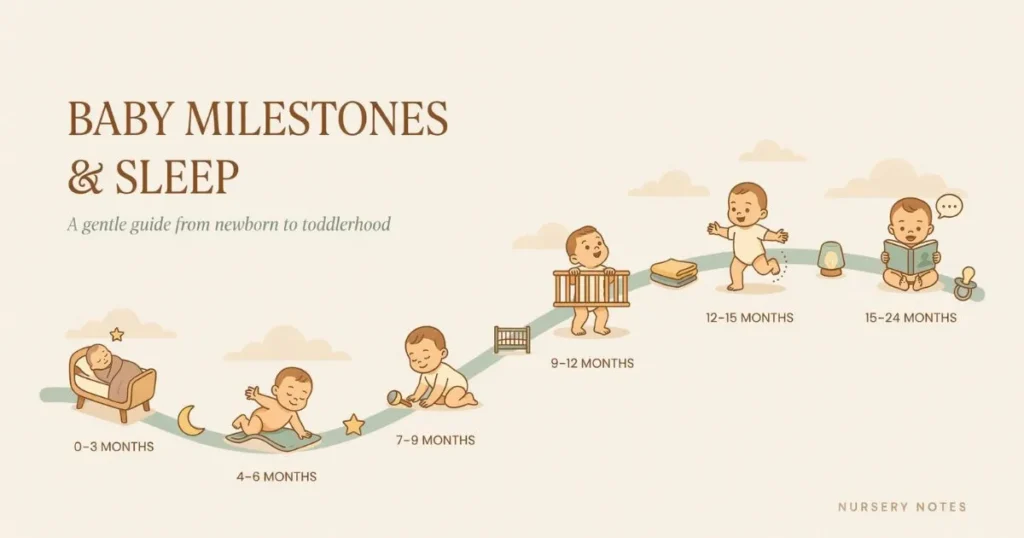
Every child develops at their own pace, but many babies experience temporary sleep disruptions around the same developmental milestones.
| Age | What’s Happening? | Sleep Changes You May Notice |
| 👶 4 Months | Sleep cycles mature | Frequent night waking and shorter naps |
| 🔄 6 Months | Rolling, sitting, growth spurts | More night waking and nap changes |
| 🧸 8–10 Months | Crawling, standing, separation anxiety | Bedtime resistance and clinginess |
| 🚶 12 Months | Walking, first words, changing nap needs | Nap refusal and early waking |
| 🗣️ 18 Months | Language explosion and growing independence | Bedtime battles and overnight waking |
| 🌙 24 Months | Imagination, fears, potty training | Bedtime stalling and night fears |
Visual Timeline
👶 4 Months
Sleep cycles mature
│
▼
🔄 6 Months
Rolling • Sitting • Growth Spurts
│
▼
🧸 8–10 Months
Crawling • Standing • Separation Anxiety
│
▼
🚶 12 Months
Walking • First Words • Nap Changes
│
▼
🗣️ 18 Months
Language Explosion • Independence
│
▼
🌙 24 Months
Imagination • Bedtime Resistance • Toddler Fears
Remember: These ages are averages. Your baby may reach developmental milestones slightly earlier or later, and that’s completely normal.
In This Guide
To help you find the information you need quickly, this guide covers:
- What sleep regressions are
- The science behind infant sleep
- Why babies experience sleep regressions
- A complete timeline from 4 months to 2 years
- Detailed guidance for every major sleep regression
- How to survive each stage
- Sleep regression vs. teething and illness
- Frequently asked questions
- When to seek medical advice
What Are Sleep Regression Ages?

Understanding sleep regression ages can help parents recognize when temporary changes in their baby’s sleep are likely to happen. A sleep regression is a temporary period when your baby’s sleep suddenly becomes more disrupted after previously following a more predictable pattern.
During a regression, your child may:
- Wake more often overnight
- Resist naps or bedtime
- Wake earlier than usual
- Need extra comfort before falling asleep
- Become fussier due to overtiredness
Most sleep regressions coincide with important developmental milestones rather than underlying sleep problems. These changes are a normal part of the sleep regression timeline as babies grow, develop new abilities, and adjust to changes in their sleep patterns.
One of the biggest misconceptions about baby sleep regression ages is that regressions mean your baby has “forgotten” how to sleep. In reality, they are often a sign that your child’s brain is rapidly developing and processing new skills.
As babies learn new abilities and their sleep patterns mature, it is common for sleep to become temporarily unsettled before improving again. Looking at sleep regressions by age helps parents understand that these phases are usually connected to growth and development.
In the next section, we will explore the science behind sleep regressions, including how infant sleep cycles change, why developmental leaps affect sleep, and why no two babies experience sleep regressions in exactly the same way.
What Causes Sleep Regressions?
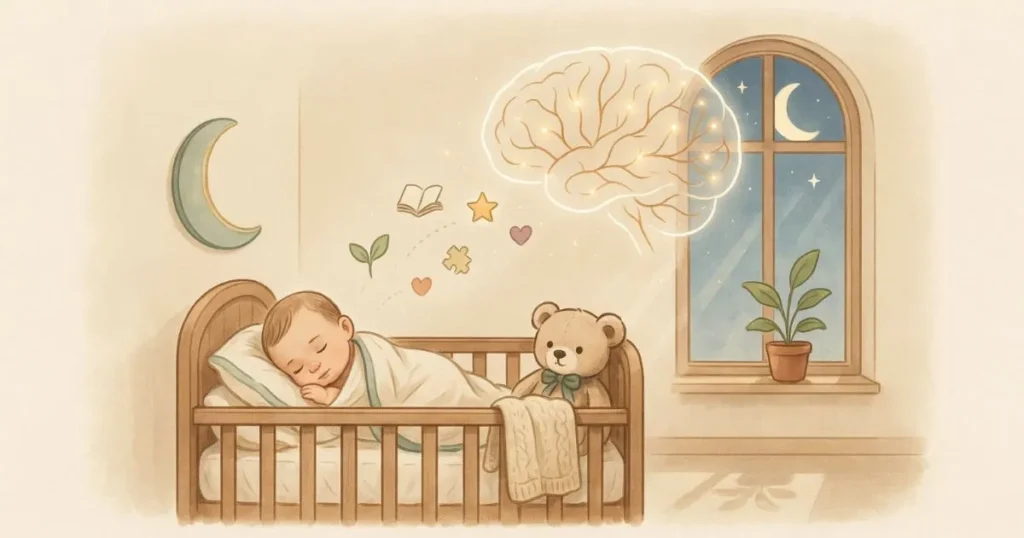
If your baby suddenly starts waking every hour after weeks of sleeping well, it is easy to wonder if something has gone wrong. In reality, sleep regressions are often a sign that something has gone right—your baby’s brain and body are developing exactly as they should.
Understanding sleep regression ages can help parents see these changes as a normal part of development rather than a sign of a sleep problem. During the first two years of life, your child experiences incredible growth, and many sleep regressions by age happen during periods of rapid learning and development.
Your baby learns to recognize faces, roll over, sit, crawl, stand, walk, speak their first words, and understand that you still exist even when you are out of sight. Each of these milestones requires significant brain development, and this progress can temporarily affect sleep patterns.
These developmental changes are one reason why the baby sleep regression ages from 4 months to 2 years are often linked to new skills, emotional growth, and changes in how children process the world around them.
Rather than viewing sleep regressions as setbacks, think of them as developmental milestones that sometimes show up at night. With patience, consistency, and understanding, most children gradually adjust and return to more settled sleep.
Why Do Sleep Regressions Happen?
Sleep isn’t a passive activity. While your baby appears peacefully asleep, their brain is incredibly active—forming new neural connections, processing memories, regulating hormones, and supporting healthy physical growth.
As these changes occur, your baby’s sleep naturally evolves.
How Changing Sleep Cycles Can Affect Your Baby’s Sleep
One of the biggest reasons babies experience sleep regressions is that their sleep architecture changes during infancy.
Newborns spend much of their sleep in active (REM) sleep, drifting between sleep and wakefulness with relatively simple sleep patterns.
Around 4 months, however, your baby’s sleep begins to mature into cycles that are much more like an adult’s. Instead of sleeping deeply for long stretches, they move through lighter and deeper stages of sleep approximately every 45 to 60 minutes.
Each time your baby reaches a lighter stage of sleep, they may briefly wake before settling back down.
If they can return to sleep on their own, they often drift back to sleep without fully waking. If they rely on being rocked, fed, or held to fall asleep, they may need the same conditions every time they reach the end of a sleep cycle.
Expert Insight: This is why the 4-month sleep regression is considered the most research-supported sleep regression. It reflects a permanent biological change in how babies sleep, not simply a temporary developmental phase.
Your Baby’s Brain Is Working Overtime
During the first two years, your baby’s brain creates millions of new neural connections every second. This incredible development is one reason many sleep regression ages are linked to periods of rapid learning and growth.
These connections support important skills such as:
- Recognizing familiar faces
- Understanding language
- Coordinating movement
- Solving simple problems
- Developing emotional attachment
- Learning cause and effect
Because the brain continues processing these new experiences during sleep, periods of rapid learning can temporarily make sleep lighter, more disrupted, and less predictable.
This is why many baby sleep regression ages happen around major developmental milestones. Whether your baby is learning to roll, crawl, walk, or communicate, these exciting changes can affect sleep patterns for a short time.
Many parents notice sleep disruptions just before or shortly after a new skill appears. Understanding the connection between development and sleep regressions by age can help you see these changes as a normal part of your child’s growth rather than a setback.
Developmental Milestones Often Interrupt Sleep
As your baby learns exciting new skills, they naturally want to practice them—even at bedtime.
You may notice your child:
- Rolling repeatedly in the crib
- Sitting up instead of lying down
- Pulling to stand after every wake-up
- Crawling around the crib instead of sleeping
- Practicing new sounds or babbling before falling asleep
These behaviors are signs of a curious, developing brain—not bad sleep habits.
Did You Know? Many babies seem to “master” a new skill just after a sleep regression ends. Researchers believe the brain continues strengthening these new abilities while babies sleep.
Separation Anxiety Can Affect Sleep
Around 8 to 10 months, many babies begin to understand that you still exist even when they can’t see you. This important cognitive milestone, called object permanence, is a healthy part of emotional development.
The downside?
Your baby may suddenly become much more aware when you leave the room.
This often leads to:
- Crying at bedtime
- Wanting extra cuddles before sleep
- Waking during the night to check that you’re nearby
- Increased clinginess during the day
Although exhausting for parents, separation anxiety is actually a sign that your baby’s emotional attachment is developing normally.
Growth Spurts May Lead to More Night Wakings
Babies grow rapidly during their first year.
During periods of accelerated growth, your child may:
- Wake more frequently
- Feed more often
- Sleep longer on some days
- Become fussier than usual
Because growth spurts often happen around the same ages as sleep regressions, it’s common for the two to overlap.
For younger babies especially, hunger can play a role in nighttime waking during these periods.
Teething Isn’t Always the Main Cause
Teething is often blamed for every difficult night, but research suggests it’s only one piece of the puzzle.
Although tender gums can make babies uncomfortable for a short time, especially as new teeth begin to emerge, teething by itself is unlikely to be the cause of sleep disruptions that continue for several weeks.
Instead, many babies experience teething at the same time they’re also:
- Learning new skills
- Going through growth spurts
- Developing separation anxiety
- Experiencing a sleep regression
If your baby has swollen gums, increased drooling, and a strong urge to chew on objects, teething may be contributing to their sleep changes—but it’s rarely the only reason.
Why Sleep Regressions Can Look Different for Every Baby
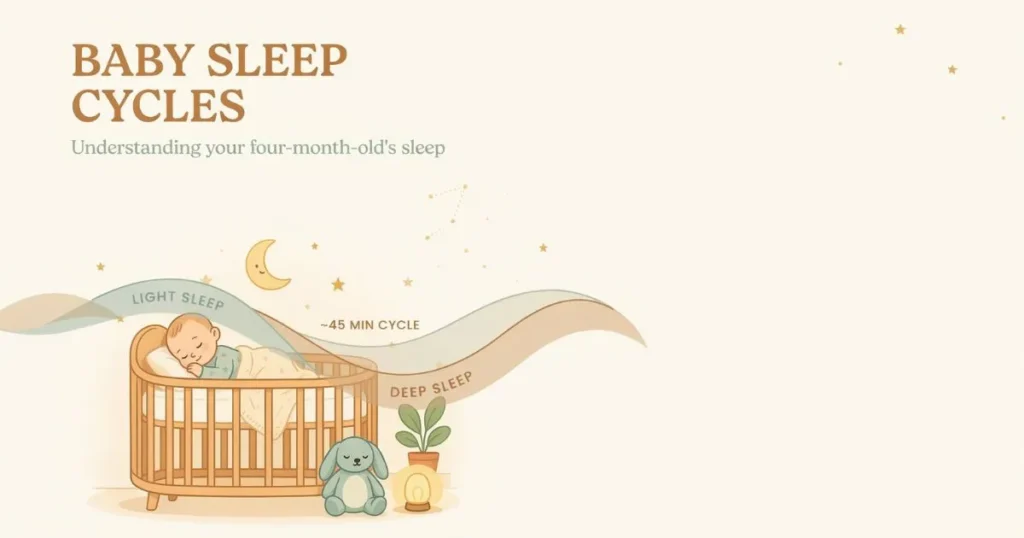
If you’ve ever wondered why your baby sleeps differently from another child, you’re not alone. Every baby develops unique sleep habits, and it’s completely normal for their sleep patterns to vary.
Some babies breeze through the 6-month stage but struggle at 8 months. Others seem to skip certain regressions altogether.
That’s because every child develops at their own pace.
Several factors influence how your baby experiences sleep regressions, including:
- Temperament
- Genetics
- Feeding patterns
- Overall health
- Daily routines
- Sleep environment
- Developmental timing
This is why experts recommend focusing on your baby’s progress rather than comparing milestones with other families.
Are Sleep Regressions a Normal Part of Development?
It may not feel like it during another sleepless night, but in many cases, yes.
Sleep regressions often happen because your child is reaching important developmental milestones.
Although they can leave everyone feeling tired, they usually indicate that your baby’s brain and body are growing exactly as expected.
Instead of asking, “Why is my baby suddenly sleeping so badly?”, a more helpful question might be:
Instead of asking, “Why isn’t my baby sleeping?”, try asking yourself, “What new developmental skill is my baby learning right now?”
That small shift in perspective can make these challenging weeks feel a little less overwhelming.
Key Takeaways
- Sleep regressions are a normal part of healthy child development.
- The 4-month sleep regression is linked to permanent changes in sleep cycles.
- Later sleep regressions are usually triggered by developmental milestones, emotional growth, and learning new skills.
- Every baby experiences sleep regressions differently.
- Most sleep regressions improve as your child becomes comfortable with their newest abilities.
Next: Now that you understand why sleep regressions happen, let’s look at each sleep regression age in detail, starting with the 4-month sleep regression, the first—and often the most significant—sleep milestone your baby will experience.
4 Month Sleep Regression: Signs, Causes & How Long It Lasts
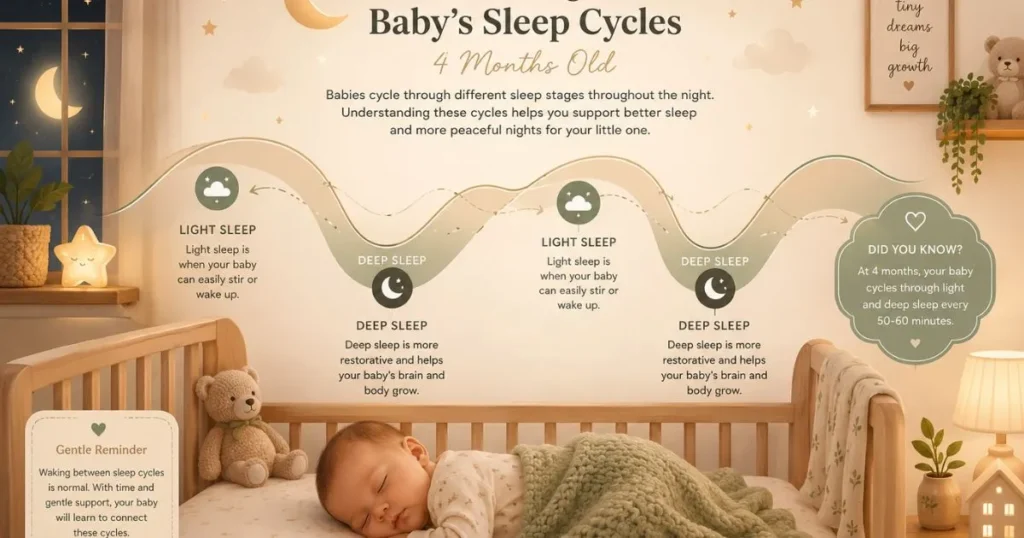
Quick Answer: The 4-month sleep regression is one of the most common sleep regression ages, usually beginning between 3½ and 5 months of age. Unlike many later sleep regressions, this stage is linked to a permanent change in how your baby’s sleep cycles develop.
As your baby’s sleep matures, they begin moving through lighter and deeper stages of sleep, similar to adult sleep patterns. These changes can make it easier for your baby to wake between sleep cycles and have difficulty settling back to sleep.
Understanding the baby sleep regression ages can help parents recognize that this phase is not a sign that their baby has forgotten how to sleep—it is a normal part of neurological development.
Why Does the 4 Month Sleep Regression Happen?
Unlike many other sleep regressions, the 4-month sleep regression is primarily driven by biology rather than behavior. It is one of the earliest and most significant stages in the sleep regression ages timeline because it marks a major change in how your baby’s sleep works.
During the newborn stage, babies spend much of their sleep in active (REM) sleep and transition between sleep and wakefulness differently from older children.
Around four months, that begins to change.
Your baby’s sleep starts organizing into more predictable sleep cycles with lighter and deeper stages. These cycles repeat approximately every 45 to 60 minutes.
At the end of each sleep cycle, your baby briefly enters a lighter stage of sleep. If they have developed the ability to settle themselves, they may return to sleep without fully waking. However, if they rely on being rocked, fed, or held, they may wake completely and look for the same comfort to fall asleep again.
Understanding this stage of baby sleep regression ages can help parents recognize that frequent waking is not caused by a mistake—it is a normal developmental shift in infant sleep.
Expert Insight: Many pediatric sleep experts describe the 4-month sleep regression as a sleep progression because it reflects healthy brain development and growing sleep skills rather than a step backward.
Signs of the 4 Month Sleep Regression
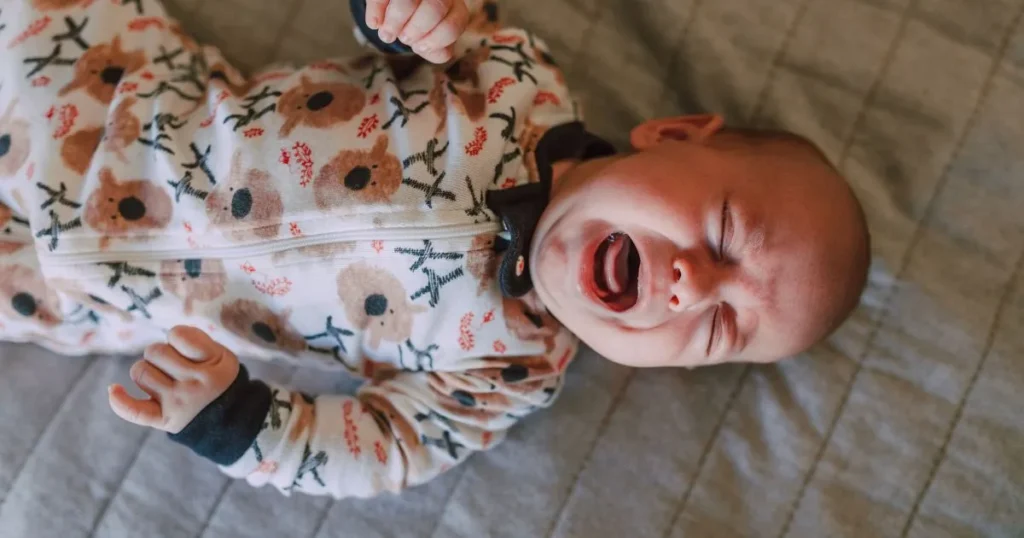
Although every baby experiences this stage differently, many show one or more of the following signs of the 4-month sleep regression:
- Waking every one to two hours overnight
- Taking short naps lasting 30–45 minutes
- Fighting bedtime despite appearing tired
- Becoming fussier than usual
- Feeding more often during the night
- Frequently waking within minutes of being laid down in the crib
- Having difficulty connecting sleep cycles
These changes often appear suddenly, which can leave parents feeling confused or discouraged. However, understanding where this stage fits within the sleep regression ages timeline can help parents recognize that these disruptions are a normal part of development.
The baby sleep regression ages from 4 months to 2 years include several periods when sleep may temporarily change as children develop new skills. The good news is that this phase does not last forever. In most cases, your baby’s sleep gradually improves as they adjust to their new developmental milestones and mature sleep patterns.
How Long Does the 4 Month Sleep Regression Last?
Most babies move through the 4-month sleep regression within two to six weeks.
However, it is important to remember that your baby’s new sleep cycles are permanent. The regression itself ends, but their more mature sleep pattern remains.
As one of the first major stages in the sleep regression ages timeline, the 4-month regression can feel especially challenging because it represents a lasting change in how your baby moves between sleep cycles.
How quickly your baby adjusts depends on several factors, including:
- Their temperament
- Consistency of bedtime routines
- Sleep environment
- Opportunities to practice self-settling
- Overall health and development
Understanding baby sleep regression ages can help parents set realistic expectations and recognize that every child adapts differently. Some babies settle into these new sleep patterns quickly, while others need more time and support.
Some babies adjust within a couple of weeks, while others take a little longer.
How Is the 4 Month Sleep Regression Different From Other Sleep Changes?
The 4-month sleep regression stands apart because it represents a lasting biological change rather than a temporary developmental leap.
Here’s how it compares with later regressions:
| 4-Month Sleep Regression | Later Sleep Regressions |
| Caused by maturing sleep cycles | Caused mainly by developmental milestones |
| Permanent change in sleep architecture | Temporary changes in sleep behavior |
| Backed by strong scientific evidence | Often based on developmental observations |
| Usually the first major sleep challenge | Occur as babies learn new skills |
Understanding this difference can help you respond with realistic expectations.
How to Help Your Baby Through the 4 Month Sleep Regression
While you can’t stop this developmental milestone from happening, you can make the transition smoother.
1. Keep a Predictable Bedtime Routine
Babies thrive on consistency, especially during challenging phases like the 4-month sleep regression and other stages in the sleep regression ages timeline.
Following the same calming bedtime routine each evening helps your baby recognize that it is time to slow down and prepare for sleep. Over time, these familiar cues create a stronger connection between the routine and bedtime, making it easier for your baby to settle.
During different baby sleep regression ages, maintaining familiar sleep habits can provide comfort and security when your baby’s sleep patterns are changing. Instead of creating a completely new routine, focus on keeping bedtime predictable and responding to your baby’s needs with patience.
For example:
- Warm bath (optional)
- Clean diaper and pajamas
- Feeding
- Quiet story or lullaby
- Cuddles
- Into the crib while calm and sleepy
A consistent bedtime routine will not prevent every sleep disruption, but it can help your baby feel more secure while adjusting to new developmental changes.
Even a 15–20 minute routine can provide powerful sleep cues.
2. Watch Wake Windows
When a baby becomes overtired, settling down can become much more challenging. During the 4-month sleep regression, overtiredness may make sleep disruptions feel more intense, especially as your baby is adjusting to new sleep patterns.
Your baby may have difficulty falling asleep at bedtime, wake more frequently during the night, or struggle to connect sleep cycles, making it harder to stay asleep for longer stretches.
At four months, many babies do best with wake windows of approximately 1½ to 2 hours, although individual needs can vary. Understanding these changes within the sleep regression ages timeline can help parents create realistic expectations and respond to their baby’s needs.
Learning your baby’s sleepy cues—such as rubbing their eyes, looking away, yawning, or becoming quieter—can help you avoid overtiredness. Paying attention to these signals is especially helpful during different baby sleep regression ages, when sleep needs may shift as your child develops.
3. Create a Sleep-Friendly Environment
Small changes to the sleep environment can make a noticeable difference, especially during challenging stages in the sleep regression ages timeline.
Creating a calm and consistent sleep space can help your baby feel more comfortable as they adjust to changing sleep patterns. Aim to:
- Use a dark, quiet room to encourage restful naps and nighttime sleep.
- Maintain a comfortable room temperature.
- Use continuous white noise to create a calmer, more predictable sleep setting by helping mask unexpected household sounds that may disturb your baby’s sleep.
- Follow safe sleep guidelines by placing your baby on their back in an empty crib with a firm mattress.
A supportive sleep environment will not eliminate every wake-up, but it can make it easier for your baby to settle and practice healthy sleep habits during different baby sleep regression ages.
Creating a peaceful sleep environment won’t stop the 4-month sleep regression from happening, but it can help your baby settle more easily and transition between sleep cycles with greater comfort.
4. Give Your Baby Opportunities to Practice Falling Asleep
As sleep cycles mature, learning to settle between cycles becomes more important, especially during key stages in the sleep regression ages timeline.
If appropriate for your family and your baby’s age, try giving your baby a brief moment to see whether they can settle before immediately stepping in. This can help them begin practicing the skills needed to move between sleep cycles more smoothly.
This does not mean ignoring your baby or leaving them to cry alone. Instead, it provides a gentle opportunity for your baby to gradually develop healthy, lifelong sleep habits while feeling supported and secure.
Every family has different comfort levels, and there is no single approach that works for everyone. Understanding baby sleep regression ages can help parents choose a response that fits their child’s needs, temperament, and family values.
5. Offer Comfort Without Feeling Guilty
Your baby still needs you, especially during challenging stages in the sleep regression ages timeline.
If they are hungry, frightened, uncomfortable, or simply seeking reassurance, responding with warmth and consistency helps build trust, security, and a strong sense of connection.
Supporting your baby during a sleep regression will not “spoil” them. These temporary changes are a normal part of many baby sleep regression ages as children grow, develop new skills, and experience changes in their sleep patterns.
The goal is not perfection—it is helping your child feel safe, supported, and understood while maintaining healthy sleep habits whenever possible.
Common Mistakes During the 4 Month Sleep Regression
When you’re exhausted, it can be tempting to try anything that promises more sleep. However, making too many changes at once during the sleep regression ages stages can sometimes create new challenges later.
During different baby sleep regression ages, your baby’s sleep needs may change, but sudden adjustments can make it harder to understand what is helping and what is not.
Common mistakes include:
- Changing bedtime every night
- Dropping naps too early
- Delaying sleep in the hope that your baby will sleep longer later
- Introducing multiple new sleep strategies at once
- Expecting the regression to end overnight
Instead, focus on consistency, patience, and small adjustments that support your baby’s changing sleep patterns. Remember that most sleep regressions are temporary parts of development.
Choose one consistent approach, then give your baby the time and reassurance they need to adjust.
Remember: Progress isn’t always linear. Your baby may have two great nights followed by a difficult one. That’s a normal part of development.
When Should You Be Concerned?
Frequent waking during the 4-month sleep regression is common and expected, but certain symptoms should be discussed with your pediatrician.
Understanding the difference between normal changes during the sleep regression ages timeline and signs of a possible health concern can help parents know when to seek support.
Contact your child’s healthcare provider if your baby:
- Has difficulty breathing during sleep.
- Snores loudly or regularly pauses breathing.
- Has a persistent fever or signs of illness.
- Refuses several feedings in a row.
- Is not gaining weight appropriately.
- Is unusually difficult to wake or seems less alert than usual.
Most baby sleep regression ages involve temporary changes in sleep patterns, but trusting your instincts and asking for medical advice when something does not seem right is always important.
If something feels different from your baby’s usual behavior, trust your instincts and seek medical advice.
4 Month Sleep Regression: Practical Tips for Parents
✔ Remember that this stage is temporary. Sleep changes during the sleep regression ages timeline are a normal part of your child’s development and will not last forever.
✔ Prioritize consistency over perfection. During different baby sleep regression ages, a calm and predictable approach can help your child feel secure.
✔ Accept help from family or friends when possible. Rest and support can make challenging sleep phases easier to manage.
✔ Take the opportunity to rest whenever your baby is sleeping, especially if you’re feeling exhausted.
✔ Focus on healthy sleep habits rather than expecting immediate results. Building positive sleep patterns takes time and patience.
✔ Acknowledge every small step forward—lasting improvements often happen little by little.
At a Glance: 4-Month Sleep Regression
| Question | Answer |
| When does it start? | Around 3½–5 months |
| How long does it last? | Usually 2–6 weeks |
| Main cause | Permanent maturation of sleep cycles |
| Most common signs | Frequent night waking, short naps, bedtime resistance |
| Best way to help | Maintain predictable routines and create a peaceful sleep environment. |
Want to learn more? Explore our in-depth guide to the 4-Month Sleep Regression, where you’ll find age-specific schedules, sample routines, wake windows, and practical solutions for frequent night wakings.
Now that your baby’s sleep cycles have matured, the next stage is driven less by biology and more by rapid physical development. In the next section, we’ll explore the 6-Month Sleep Regression, including why many babies suddenly start waking again after rolling, sitting, and becoming more active.
6 Month Sleep Regression: Signs, Causes & What to Expect

Quick Answer: The 6-month sleep regression is one of the common stages parents may notice within the sleep regression ages timeline. Although it is not considered a universal milestone, many babies experience temporary sleep disruptions around this age. Rolling, sitting independently, rapid brain development, growth spurts, and changing feeding patterns can all contribute to more frequent night waking and shorter naps.
Just when it seemed your baby’s sleep was improving after the 4-month sleep regression, frequent night wakings may suddenly return. This type of change is a common part of baby sleep regression ages as infants continue developing new physical and cognitive skills.
Around six months, many babies become much more active. Each day brings new discoveries as your baby learns to roll, sit confidently, reach for objects, and explore their surroundings with growing curiosity. While these milestones are exciting, they can temporarily interrupt sleep as your baby’s brain works hard to practice and master each new skill.
Understanding sleep regressions by age can help parents recognize that these changes are usually temporary and connected to normal development rather than a sign that something is wrong.
The encouraging part is that this phase does not last forever. As your baby becomes more comfortable with these new developmental changes, sleep often settles into a more predictable pattern again.
Is the 6 Month Sleep Regression Real?
Unlike the 4-month sleep regression, there is not strong scientific evidence showing that every baby experiences a sleep regression at six months.
Instead, pediatricians and sleep experts generally view this stage as a period when several developmental changes often overlap, making sleep temporarily more challenging. This is why the 6-month sleep regression is considered one of the possible stages within the broader sleep regression ages timeline rather than a milestone that happens to every baby.
Some babies move through this stage with very few problems, while others experience noticeable changes in nighttime waking, naps, or bedtime routines for several weeks.
This is one reason you may hear very different experiences from other parents. Sleep regressions by age can vary greatly depending on a child’s temperament, development, environment, and individual sleep patterns.
Expert Insight: Child development is not a strict timeline. Two healthy babies can reach the same milestone weeks apart, which is why sleep regressions do not happen on exactly the same day—or even in the same month—for every child.
Why Does the 6 Month Sleep Regression Happen?
Several important changes often occur at the same time.
Rapid Motor Development
By six months, many babies are learning to:
- Roll both ways
- Sit independently
- Push up on their hands
- Reach for objects with greater coordination
- Prepare for crawling
These exciting new abilities can make it difficult for your baby to relax at bedtime.
It’s common for babies to practice rolling or sitting repeatedly in the crib instead of settling down to sleep.
Increased Awareness
By six months, your baby’s curiosity is expanding rapidly as they become more engaged with the people and things around them. This stage is one of the common periods discussed in the sleep regression ages timeline because rapid development can temporarily affect sleep.
They notice sounds, lights, movement, and familiar faces more easily than before. Their growing awareness and new skills can make it harder to slow down at bedtime or stay asleep through the night.
With so much to discover, settling down for sleep is not always your baby’s top priority. These changes are a normal part of baby sleep regression ages as your child continues learning, growing, and adapting to the world around them.
Growth Spurts
Many babies experience another period of rapid growth around this age, which can sometimes overlap with changes seen during the 6-month sleep regression.
During this stage of the sleep regression ages timeline, growth spurts and changing nutritional needs may contribute to temporary sleep disruptions. You may notice:
- Increased appetite
- More frequent breastfeeding or bottle feeds
- Extra fussiness
- Temporary night waking
If your baby genuinely seems hungry overnight, speak with your pediatrician if you are unsure whether nighttime feeding is still appropriate for their age, development, and growth.
Remember that baby sleep regression ages can involve many different factors, including developmental changes, physical growth, and evolving sleep needs. Every baby experiences these transitions differently.
Starting Solid Foods
Around the six-month mark, many babies are ready to begin exploring solid foods alongside their usual milk feeds. This stage often appears within the sleep regression ages timeline because several developmental changes can happen at the same time.
Starting solid foods is not considered a direct cause of sleep regression. However, as your baby adjusts to new tastes, textures, and changing feeding patterns, you may notice temporary changes in sleep, including more night waking or difficulty settling.
These changes are a common part of baby sleep regression ages and may happen alongside other milestones such as sitting, rolling, and increased awareness of the world around them.
Signs of the 6 Month Sleep Regression
Every baby experiences this stage differently.
Common signs include:
- Waking more often overnight
- Taking shorter naps
- Fighting naps despite showing sleepy cues
- Waking earlier than usual
- Practicing rolling or sitting in the crib
- Becoming more distracted during feedings
- Wanting extra comfort before bedtime
These changes are usually temporary and improve as your baby becomes more comfortable with their new skills.
How Long Does the 6 Month Sleep Regression Last?
For most babies, sleep disruptions around six months improve within two to four weeks.
As one of the possible stages in the sleep regression ages timeline, the 6-month sleep regression can vary from one baby to another. Some infants adjust quickly, while others need more time to settle into their changing sleep patterns.
How long this phase continues can depend on several factors, including:
- Your baby’s temperament
- How quickly they master new skills
- Whether several milestones happen at once
- Overall health and sleep habits
Understanding baby sleep regression ages can help parents set realistic expectations and remember that temporary sleep changes are often connected to normal growth and development.
If sleep changes continue for much longer or are accompanied by concerning symptoms, it’s a good idea to discuss them with your pediatrician.
How to Help Your Baby Sleep During the 6 Month Sleep Regression
Although you can’t stop developmental changes, you can make this stage easier by supporting healthy sleep habits.
1. Give Plenty of Time for Practice During the Day
Your baby wants to master their newest skills, and this is one reason developmental changes can affect sleep during certain stages of the sleep regression ages timeline.
Give your baby plenty of supervised floor time throughout the day to explore new movements like rolling, sitting, reaching, and practicing other emerging skills. These daytime opportunities allow your baby to build confidence and satisfy their curiosity.
During baby sleep regression ages, many babies want to practice new abilities at bedtime or during nighttime wake-ups. A baby who has had plenty of daytime practice is often less likely to spend their sleep time working on these exciting new skills.
2. Protect Your Bedtime Routine
Even if naps vary from day to day, aim to keep bedtime at a familiar time each evening. A predictable schedule can provide comfort and stability during stages in the sleep regression ages timeline.
A familiar bedtime routine helps signal that it is time to slow down, relax, and prepare for sleep. Consistency is especially helpful during the 6-month sleep regression, when your baby’s sleep patterns may be changing due to development.
Your routine might include:
- Bath (if part of your routine)
- Pajamas
- Feeding
- Story or lullaby
- Goodnight cuddles
- Into the crib while calm and sleepy
Maintaining these familiar steps during different baby sleep regression ages can help your baby feel secure while adjusting to new developmental changes.
Children often find comfort in familiar routines during periods of rapid development.
3. Watch for Overtiredness
It’s tempting to keep your baby awake longer if naps have been short, especially during challenging stages like the 6-month sleep regression.
Unfortunately, overtired babies often have an even harder time falling asleep, settling at bedtime, or connecting sleep cycles. During different sleep regression ages, adjusting wake time based on your baby’s needs can make a big difference.
Let your baby’s sleep cues guide you rather than relying only on the clock. Watching for signs like rubbing eyes, looking away, or becoming quieter can help you support your baby’s changing sleep needs during these developmental stages.
4. Continue Encouraging Healthy Sleep Habits
If your baby is capable of settling between sleep cycles, give them a brief opportunity to do so before stepping in. This can be especially helpful during stages in the sleep regression ages timeline, when babies are learning to adjust to changing sleep patterns.
If they need comfort, respond calmly and consistently. Providing reassurance during a baby sleep regression age does not create bad habits—it helps your baby feel safe while developing healthy sleep skills.
The goal is not to ignore your baby’s needs, but to avoid introducing several new sleep habits at once simply because sleep has become more difficult. A consistent and responsive approach can help your baby navigate developmental changes with confidence.
5. Keep the Sleep Environment Calm
A dark room, comfortable temperature, and a consistent bedtime routine can reduce unnecessary stimulation and help your baby relax, especially during challenging stages in the sleep regression timeline.
Small environmental changes will not eliminate a sleep regression, but they can make it easier for your baby to settle and adjust to changing sleep patterns. During different baby sleep regression ages, a calm and predictable sleep environment can provide a greater sense of comfort and security.
6 Month Sleep Regression: Common Mistakes to Avoid
Parents naturally want to solve sleep problems quickly, but some well-intentioned changes can make things more confusing for babies, especially during challenging stages in the sleep regression ages timeline.
During different baby sleep regression ages, it can be tempting to make several adjustments at once. However, consistency often helps babies feel more secure while they adapt to developmental changes and shifting sleep patterns.
Try to avoid:
- Dropping naps too soon
- Changing bedtime every night
- Assuming every wake-up means hunger
- Introducing multiple sleep methods at the same time
- Comparing your baby’s sleep to another child’s
Remember that every baby develops differently. What works for one child may not work for another, and temporary sleep changes are a normal part of many developmental stages.
Remember, your baby’s sleep journey is unique.
When Should You Contact Your Pediatrician?
Temporary sleep disruptions are expected during periods of rapid development, including some stages within the sleep regression ages timeline.
Most baby sleep regression ages involve temporary changes in sleep patterns as your child learns new skills and adapts to development. However, some symptoms should be discussed with your pediatrician.
Contact your pediatrician if your baby:
- Has difficulty breathing while asleep.
- Develops a persistent fever.
- Refuses feeds or is not producing enough wet diapers.
- Shows poor weight gain.
- Appears unusually sleepy or difficult to wake.
- Continues having significant sleep difficulties long after the developmental changes have passed.
Trust your instincts if something does not seem right. While sleep regressions are usually temporary, ongoing concerns may require guidance from your child’s healthcare provider.
6 Month Sleep Regression: Practical Tips to Help Your Baby Sleep
✔ Offer plenty of active play during the day.
✔ Keep bedtime calm and predictable.
✔ Don’t rush to eliminate naps because your baby resists them occasionally.
✔ Remember that this stage won’t last forever—sleep often becomes more settled as these new milestones become part of your baby’s everyday routine.
✔ Focus on consistency instead of searching for a quick fix.
6 Month Sleep Regression at a Glance
| Question | Answer |
| When does it happen? | Around 6 months |
| How long does it last? | Usually 2–4 weeks |
| Main causes | Motor development, growth spurts, changing routines |
| Most common signs | Night waking, short naps, bedtime resistance |
| Best way to help | Give your baby plenty of opportunities to build new skills during the day, then follow a calming, familiar bedtime routine each evening. |
Looking for more detailed advice? Want more detailed guidance? Explore our complete guide to the 6-Month Sleep Regression for sample schedules, age-appropriate wake windows, feeding tips, and practical strategies to handle common sleep challenges.
.
Between 8 and 10 months, many babies experience another shift in sleep as rapid physical development and growing separation awareness take center stage.
In the next section, you’ll learn why this stage can feel especially intense and how to help your baby sleep with confidence while they explore these exciting new milestones.
8–10 Month Sleep Regression: Signs, Causes & What to Expect

Quick Answer: The 8–10 month sleep regression commonly occurs between 8 and 10 months of age and is one of the important stages in the sleep regression ages timeline. During this period, many babies learn to crawl, pull themselves up, cruise along furniture, and develop stronger attachment to their caregivers. These exciting milestones can temporarily lead to frequent night waking, bedtime resistance, and shorter naps.
Many parents describe this stage as one of the more challenging baby sleep regression ages because so many developmental changes happen at the same time.
Your baby is becoming more mobile, more curious, and much more aware of the people around them. Instead of simply falling asleep, they may suddenly want to practice standing in the crib, crawl toward you, or cry when you leave the room.
Although these changes can feel overwhelming, they are also signs that your baby’s physical, cognitive, and emotional development is progressing beautifully. Understanding sleep regressions by age can help parents see these temporary disruptions as a normal part of growth rather than a step backward.
What Causes the 8–10 Month Sleep Regression?

Several major developmental changes often happen at the same time, making this stage especially intense.
Crawling and Standing
Around this age, many babies begin to:
- Crawl confidently
- Pull themselves up to stand
- Cruise along furniture
- Improve balance and coordination
- Explore their surroundings independently
These new skills are exciting, and your baby may want to practice them everywhere—including the crib.
It’s common to walk into the nursery and find your baby happily standing instead of sleeping.
Separation Anxiety
One of the biggest reasons sleep changes during this stage is separation anxiety.
As your baby’s understanding of the world grows, they realize that you can leave—even though they know you’ll come back.
This new awareness may lead to:
- Crying when you leave the room
- Wanting to be held more often
- Bedtime becoming more emotional
- Waking overnight to check that you’re nearby
This behavior isn’t manipulation. It’s a healthy sign of a secure attachment and normal emotional development.
Expert Insight: Separation anxiety usually peaks sometime between 8 and 18 months. Although it can lead to more nighttime wake-ups, it also shows that your baby’s emotional development is progressing in healthy ways.
Rapid Brain Development
Your baby’s brain is processing an incredible amount of new information every day.
At this age, they’re learning to:
- Understand simple words
- Recognize familiar routines
- Solve simple problems
- Remember where objects are hidden
- Copy gestures and facial expressions
Because much of this learning is reinforced during sleep, it’s common for sleep to become lighter and more fragmented for a short time.
8–10 Month Sleep Regression Signs to Look For
Although every baby is different, you may notice:
- Frequent night waking
- Crying as soon as you leave the room
- Pulling up to stand or crawling around the crib instead of settling down to sleep.
- Fighting naps
- Shorter daytime naps
- Increased clinginess
- Difficulty settling without extra reassurance
- Early morning waking
Some babies also become more vocal at bedtime, practicing new sounds and babbling before falling asleep.
How Long Can the 8–10 Month Sleep Regression Last?
For most babies, this regression lasts two to six weeks.
The exact timing depends on:
- When developmental milestones occur
- Your baby’s temperament
- How quickly they gain confidence in new skills
- Consistency of bedtime routines
As your baby gains confidence with these new milestones and adjusts to this stage of development, sleep often becomes more settled again.
How to Help Your Baby Sleep During the 8–10 Month Sleep Regression
1. Practice New Skills During the Day
The more opportunities your baby has to crawl, stand, and cruise while awake, the less likely they are to spend bedtime practicing those skills. This can be especially helpful during the 8–10 month sleep regression, a common stage within the sleep regression ages timeline.
Give your baby plenty of safe floor time every day to explore movement, build confidence, and practice new abilities during waking hours.
During different baby sleep regression ages, many babies wake up excited to practice newly learned skills. If your baby stands in the crib but cannot sit back down, gently help them practice sitting during playtime so they become more confident and comfortable with these movements.
2. Respond Calmly to Separation Anxiety
It’s completely normal for your baby to need extra reassurance.
Instead of disappearing suddenly, try creating predictable bedtime rituals.
For example:
- Give a hug.
- Say the same goodnight phrase every evening.
- Leave confidently without prolonging the goodbye.
Predictable routines help babies feel secure.
3. Keep Your Bedtime Routine Consistent
A familiar bedtime routine becomes even more valuable during periods of emotional development.
Aim for the same sequence each evening:
- Bath (optional)
- Pajamas
- Feeding
- Quiet story
- Lullaby or cuddles
- Into bed while calm and sleepy
Consistency gives your baby clear signals that it’s time to sleep.
4. Give Your Baby Time to Settle
If your baby briefly stands in the crib or fusses for a moment, pause before immediately picking them up. This can be especially helpful during the 8–10 month sleep regression, when many babies are learning new movement skills and adjusting to changes within the sleep regression ages timeline.
Sometimes babies simply need a few minutes to reposition themselves, practice settling, or find a comfortable position before returning to sleep.
If your baby becomes increasingly distressed, respond with comfort and reassurance. During different baby sleep regression ages, offering consistent support helps your baby feel secure while they continue developing healthy sleep skills.
5. Avoid Creating New Sleep Habits Out of Exhaustion
When you’re sleep-deprived, it is tempting to introduce new habits just to get through the night, especially during challenging stages in the sleep regression ages timeline.
Before making major changes, ask yourself whether the new habit is something you will still want to continue a month from now. During baby sleep regression ages, temporary sleep disruptions can make it easy to react quickly, but consistency often helps babies feel more secure.
Small, consistent responses are usually more helpful than constantly changing your approach. A predictable and reassuring response can support your baby as they adjust to developmental changes and evolving sleep patterns.
8–10 Month Sleep Regression: Common Mistakes to Avoid
Parents often make these understandable mistakes:
- Rushing into the room at every small noise
- Dropping naps because bedtime has become difficult
- Assuming every night waking is caused by hunger
- Frequently changing bedtime routines
- Comparing their baby’s sleep with friends’ children
Remember, sleep isn’t a competition. Each baby reaches developmental milestones on their own timeline.
When Should You Contact Your Pediatrician?
Sleep disruption is expected during this stage, but seek medical advice if your baby:
- Has breathing difficulties during sleep.
- Develops a persistent fever or other signs of illness.
- Refuses feeds or loses weight.
- Appears unusually lethargic.
- Continues having severe sleep problems for many weeks with no improvement.
Expert Tips for the 8–10 Month Sleep Regression
✔ Create plenty of opportunities for your baby to explore crawling, pulling up, and cruising during the day.
✔ Keep bedtime routines simple and predictable.
✔ Offer reassurance without feeling pressured to change your entire sleep routine.
✔ Be patient with separation anxiety—it is a healthy developmental stage.
✔ Celebrate new milestones, even if they temporarily interrupt sleep.
At a Glance: 8–10 Month Sleep Regression
| Question | Answer |
| When does it happen? | Between 8 and 10 months |
| How long does it last? | Usually 2–6 weeks |
| Main causes | Crawling, standing, separation anxiety, brain development |
| Most common signs | Night waking, clinginess, bedtime resistance, standing in the crib |
| Best way to help | Encourage daytime practice, maintain routines, provide calm reassurance |
Want more age-specific guidance? Read our complete 8-Month Sleep Regression Guide, where you’ll find sample schedules, wake windows, and practical strategies for handling separation anxiety and bedtime resistance.
As your baby’s first birthday approaches, sleep can change once again. In the next section, we’ll explore the 12-Month Sleep Regression, including why walking, language development, and changing nap needs often lead to another temporary period of disrupted sleep.
12-Month Sleep Regression: Walking, First Words, and Changing Sleep Needs

Quick Answer: The 12-month sleep regression often appears around your baby’s first birthday and is one of the important stages within the sleep regression ages timeline. During this stage, many children are learning to walk, saying their first words, becoming more independent, and experiencing changing nap patterns. These exciting milestones can temporarily lead to bedtime resistance, shorter naps, and more frequent night waking.
Your baby’s first birthday is an incredible milestone.
Over the past year, they have gone from a tiny newborn to a curious little explorer with a growing personality. They are taking first steps, understanding familiar words, pointing to objects, and communicating in new ways every day.
With so much happening, it is no surprise that sleep can become unpredictable again. These developmental changes are a common part of baby sleep regression ages, as children continue developing new physical, cognitive, and emotional skills.
The encouraging news is that this phase is usually temporary. Once your child adjusts to these new abilities and changing routines, their sleep often becomes more settled again.
Why Does the 12-Month Sleep Regression Happen?
Around the first birthday, several developmental changes often happen at the same time.
Learning to Walk
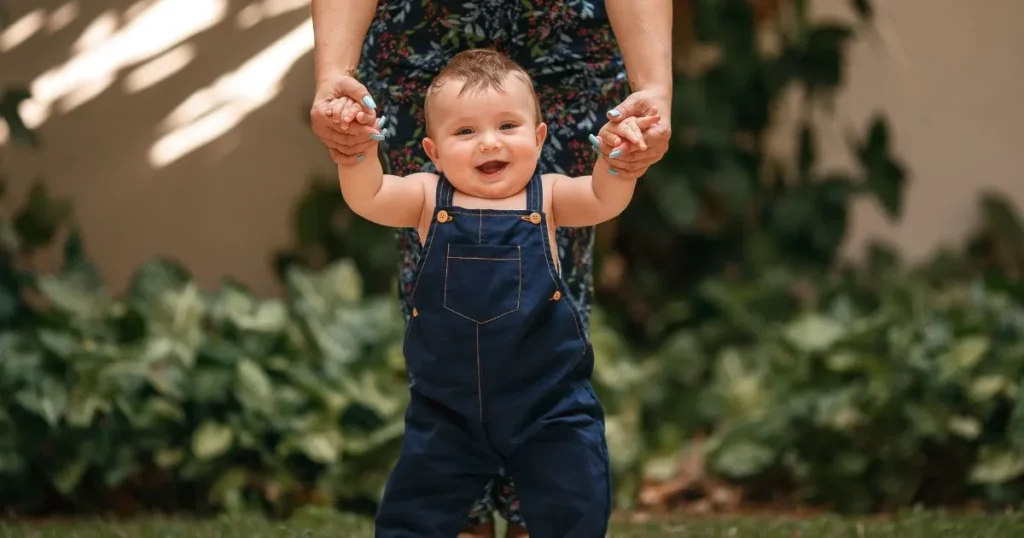
Many babies take their first independent steps between 9 and 18 months, with many beginning around their first birthday.
Walking requires balance, coordination, muscle strength, and confidence. It’s such a significant milestone that many babies continue practicing throughout the day—and sometimes even after bedtime.
Don’t be surprised if your child wants to stand, squat, or walk around the crib instead of lying down to sleep.
Language Development
Your baby’s communication skills are growing rapidly.
Around this age, they may:
- Say their first meaningful words
- Understand simple instructions
- Point to familiar objects
- Copy sounds and gestures
- Respond to their name consistently
Because the brain continues organizing these new language skills during sleep, temporary disruptions are common.
Growing Independence
Your baby is becoming more aware that they can make choices.
You may notice them:
- Shaking their head “no”
- Wanting to feed themselves
- Exploring independently
- Testing limits
- Resisting transitions, including bedtime
Bedtime resistance doesn’t necessarily mean your child isn’t tired—it may simply reflect their growing desire for independence.
Changing Nap Patterns
One of the biggest challenges around 12 months is deciding whether your child is ready to move from two naps to one. This transition often becomes a concern during the 12-month sleep regression, a stage that appears within the broader sleep regression ages timeline.
Many parents assume that nap resistance means it is time to drop a nap. However, during different baby sleep regression ages, temporary changes in sleep behavior do not always mean your child is ready for a permanent schedule adjustment.
In reality, most babies still benefit from two naps until around 15 to 18 months, although every child develops at their own pace.
Dropping to one nap too early can lead to overtiredness, making bedtime and nighttime sleep even more difficult. Before making changes, consider your child’s overall sleep needs rather than reacting to a short period of disruption.
Expert Tip: Before eliminating a nap, look at your child’s overall sleep pattern for one to two weeks. Temporary nap resistance during a sleep regression does not necessarily mean they are ready for a permanent schedule change.
Signs of the 12-Month Sleep Regression
Your child may:
- Wake more frequently during the night
- Resist bedtime
- Fight one or both naps
- Wake earlier than usual
- Want more comfort before sleep
- Practice walking or standing in the crib
- Become more emotional or clingy
- Show frustration during transitions
Some toddlers also seem unusually energetic at bedtime, even though they’re actually tired.
How Long Can the 12-Month Sleep Regression Last?
Most children adjust within two to four weeks, although some experience shorter or longer periods depending on their development.
The duration may be influenced by:
- Walking milestones
- Language development
- Nap schedule
- Teething
- Illness
- Daily routine consistency
Once your child becomes more confident in their new abilities, sleep usually begins to improve.
How to Help Your Child Through the 12-Month Sleep Regression

1. Don’t Rush to Drop the Second Nap
This is one of the most common mistakes parents make around the first birthday, especially during the 12-month sleep regression, which is a common stage in the sleep regression ages timeline.
Instead of eliminating a nap immediately, try maintaining your usual schedule for another week or two while observing your child’s overall sleep patterns. During baby sleep regression ages, temporary changes in naps or bedtime behavior do not always mean your child’s sleep schedule needs a permanent adjustment.
Many children return to sleeping well once the regression passes and their new developmental skills become more familiar.
2. Encourage Active Play During the Day
Walking, climbing, pushing toys, and exploring safely all help your child practice new physical skills while awake.
The more opportunities they have during the day, the less likely they are to spend bedtime practicing instead of sleeping.
3. Keep Bedtime Predictable
A familiar bedtime routine provides reassurance during periods of rapid change.
A simple routine might include:
- Bath (optional)
- Pajamas
- Tooth brushing
- Story time
- Goodnight cuddles
- Into bed while calm and sleepy
Repeating the same routine each night helps your child understand what comes next.
4. Support Growing Independence
Your toddler wants to do more on their own.
Offer small choices that don’t interfere with sleep.
For example:
- “Would you like the blue pajamas or the green pajamas?”
- “Which bedtime story should we read tonight?”
Giving simple choices satisfies your child’s growing independence while keeping the bedtime routine on track.
5. Stay Consistent
It’s normal to comfort your child during difficult nights, but try to avoid making major changes to bedtime every evening.
Consistency helps children feel secure, especially when everything else in their world seems to be changing.
Common Mistakes During the 12-Month Sleep Regression
Parents often unintentionally make sleep more difficult by:
- Dropping to one nap too early
- Allowing bedtime to become much later each night
- Assuming every wake-up is caused by teething
- Frequently changing bedtime routines
- Expecting perfect sleep while major milestones are happening
Remember that temporary setbacks are part of healthy development.
When Should You Contact Your Pediatrician?
Although this regression is usually temporary, seek medical advice if your child:
- Snores loudly or has pauses in breathing.
- Develops a persistent fever.
- Refuses food or fluids.
- Is losing weight or not growing appropriately.
- Appears unusually sleepy during the day.
- Continues to have sleep difficulties for much longer than expected, with little or no improvement over time.
Expert Tips for the 12-Month Sleep Regression
✔ Give your child plenty of opportunities to walk and explore during the day.
✔ Resist the urge to drop the second nap too soon.
✔ Offer simple bedtime choices to support growing independence.
✔ Keep routines calm, predictable, and consistent.
✔ Remember that progress isn’t always linear.
At a Glance: 12-Month Sleep Regression
| Question | Answer |
| When does it happen? | Around 12 months |
| How long does it last? | Usually 2–4 weeks |
| Main causes | Walking, language development, changing nap needs, independence |
| Most common signs | Bedtime resistance, night waking, nap refusal |
| Best way to help | Maintain routines, encourage daytime activity, avoid dropping naps too early |
Need more detailed guidance? Explore our complete 12-Month Sleep Regression Guide, where you’ll find age-specific sleep schedules, wake windows, sample routines, and practical solutions for nap transitions during this important stage of the sleep regression ages timeline.
Your child’s first birthday is not the last time sleep may become challenging. As part of the journey through baby sleep regression ages, toddlers can experience new periods of disrupted sleep as they reach different developmental milestones.
Around 18 months, toddlers enter another exciting stage of development marked by rapid language growth, stronger emotions, and a growing desire for independence. In the next section, we will explore the 18-Month Sleep Regression and how to handle bedtime battles with confidence.
18-Month Sleep Regression: Independence, Big Emotions, and Bedtime Battles

Quick Answer: The 18-month sleep regression often occurs between 16 and 20 months and is one of the important stages within the sleep regression ages timeline. During this stage, toddlers experience rapid language development, stronger emotions, increased independence, and sometimes a nap transition. These developmental changes can temporarily cause bedtime resistance, night waking, and early morning waking.
If the baby who once fell asleep easily now refuses bedtime, cries when you leave the room, or suddenly wakes in the middle of the night, you are not alone. These changes are a common part of baby sleep regression ages as toddlers develop new emotional and cognitive skills.
Around 18 months, toddlers become much more aware of themselves and the world around them. They want to make decisions, test boundaries, and communicate their preferences—even when they do not yet have the words to express exactly what they need.
Although this stage can make nights more challenging, it is also a reflection of the remarkable emotional, social, and cognitive growth taking place. Understanding sleep regressions by age can help parents respond with patience and confidence while their toddler navigates this exciting period of development.
Why Does the 18-Month Sleep Regression Happen?
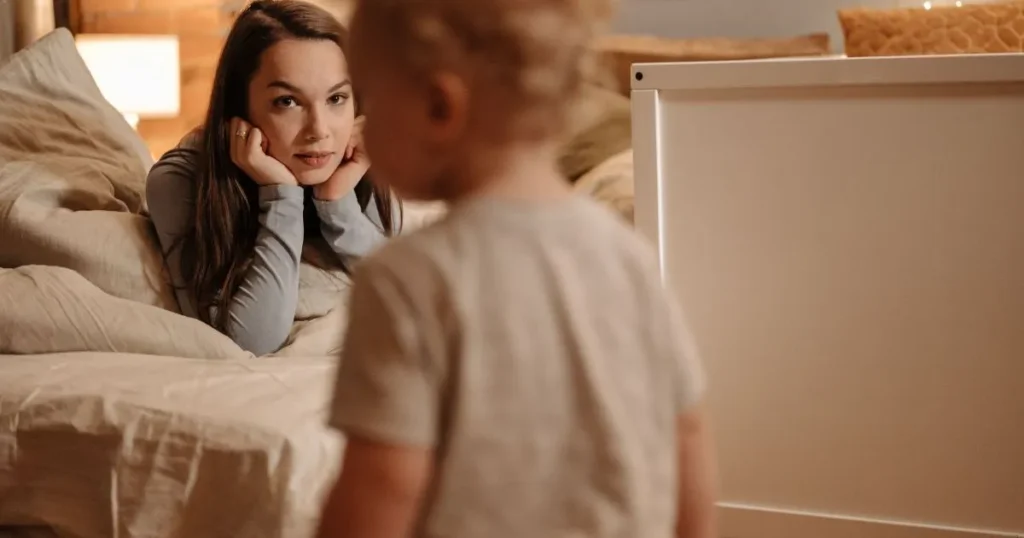
Unlike the earlier regressions, which are often linked to new physical abilities, the 18-month sleep regression is more closely connected to your toddler’s emotional and cognitive growth. This stage is another important point in the sleep regression ages timeline, where changes in independence and communication can strongly influence sleep.
Several developmental changes often happen at once, including language growth, stronger emotions, increased awareness, and a desire for more control over daily routines.
During different baby sleep regression ages, sleep disruptions can look different depending on your child’s stage of development. At 18 months, bedtime challenges are often less about physical skills and more about emotions, independence, and learning to express new feelings.
A Growing Sense of Independence
Around this age, toddlers begin realizing they can make choices.
You may hear the word “no” much more often than before.
Your child may:
- Refuse pajamas
- Resist brushing their teeth
- Ask for “one more book”
- Delay bedtime in creative ways
- Want to do everything independently
These behaviors are normal and reflect healthy development—not stubbornness.
Language Explosion
Between 18 and 24 months, many toddlers go through a period of rapid language development as their vocabulary begins to expand quickly.
Every day they are:
- Learning new words
- Following simple instructions
- Naming familiar objects
- Combining two-word phrases
- Understanding much more than they can say
As your child’s language skills develop rapidly, their brain remains busy processing these new abilities, which can temporarily make sleep less settled.
Bigger Feelings
Toddlers experience emotions intensely, but they have not yet developed all the skills needed to regulate them. This emotional growth is one reason the 18-month sleep regression can be a challenging stage within the sleep regression ages timeline.
Excitement, frustration, disappointment, and separation from parents can all feel overwhelming for a toddler who is learning independence and discovering new emotions.
As a result, bedtime may become more emotional than it was a few months earlier. During different baby sleep regression ages, sleep changes are often connected to the developmental stage your child is moving through.
Some toddlers suddenly need extra hugs, reassurance, or a little more time to settle before falling asleep. Offering calm support and consistent routines can help your toddler feel secure while navigating these big emotional changes.
Changes in Daily Routine
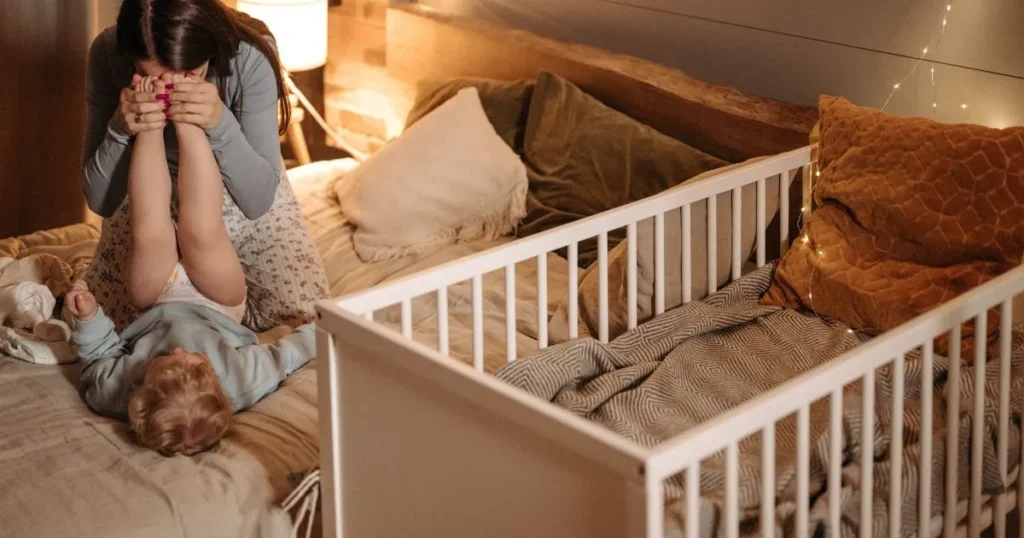
Around this age, many toddlers experience changes such as:
- Starting daycare
- Traveling
- Welcoming a new sibling
- Moving to a new home
- Family schedule changes
Even positive changes can temporarily affect sleep.
Signs of the 18-Month Sleep Regression
Your toddler may:
- Fight bedtime every evening
- Wake during the night
- Wake very early in the morning
- Resist naps
- Cry when you leave the room
- Ask for repeated drinks, hugs, or stories
- Become more emotional or clingy
- Test bedtime limits
These behaviors often become easier to manage as your toddler grows more confident and adapts to these new emotional and developmental changes.
How Long Can the 18-Month Sleep Regression Last?
For many toddlers, sleep begins to settle within two to six weeks, although the timeline can vary from child to child.
The timeline varies depending on:
- Temperament
- Daily routine
- Sleep habits
- Developmental progress
- Consistency at bedtime
Some toddlers move through this stage quickly, while others need a little more time.
Practical Ways to Support Your Toddler During the 18-Month Sleep Regression

1. Keep Bedtime Predictable
Toddlers thrive on routines.
A familiar bedtime routine helps them feel secure, especially when emotions are running high.
A calming routine might include:
- Bath
- Pajamas
- Tooth brushing
- Two bedtime stories
- A cuddle
- Lights out
Keep the bedtime routine in the same sequence each night to help your toddler know what to expect.
2. Offer Limited Choices
Supporting your toddler’s growing independence doesn’t mean giving them complete control over bedtime. Instead, offer small, age-appropriate choices within clear boundaries. This helps your child feel involved while still keeping the routine calm and predictable.
For example:
- “Would you like to wear the red pajamas or the blue pajamas tonight?”
- “Would you like to read the bear book or the truck book for your bedtime story?”
- “Would you like your teddy or your bunny to sleep with you tonight?”
These simple choices give your toddler a sense of independence and cooperation while helping bedtime stay structured and stress-free.
3. Set Loving but Consistent Boundaries
Toddlers often test limits because they are learning how the world works. This behavior is especially common during the 18-month sleep regression, a stage within the sleep regression ages timeline when independence and emotional development are rapidly increasing.
If your child asks for “just one more story” every night, respond calmly and consistently. During different baby sleep regression ages, clear and predictable boundaries can help toddlers feel secure while they navigate new emotions and growing independence.
For example:
“We’ve already read two stories. Now it’s time for sleep. We’ll read another one tomorrow.”
Consistency helps your toddler know what to expect and reduces bedtime battles over time.
4. Encourage Plenty of Active Play
Running, climbing, dancing, and exploring outdoors help toddlers use their growing energy during the day. These activities can be especially beneficial during the 18-month sleep regression, a stage within the sleep regression ages timeline when toddlers are becoming more active and independent.
Daily physical activity encourages healthy sleep by helping toddlers feel ready to rest when bedtime arrives. However, avoid high-energy games during the hour before bedtime, as too much stimulation can make it harder for your toddler to calm down.
During different baby sleep regression ages, maintaining a balanced routine with active play, quiet time, and predictable bedtime habits can help support better sleep.
5. Stay Calm During Bedtime Battles
After repeated bedtime delays, it is completely understandable to start feeling frustrated, especially during challenging stages like the 18-month sleep regression within the sleep regression ages timeline.
Take a slow, calm approach instead. During different baby sleep regression ages, toddlers often need extra patience and reassurance as they adjust to developmental changes and stronger emotions.
Your toddler is more likely to relax and fall asleep when you stay calm, consistent, and reassuring.
Remember, your child is not trying to make bedtime difficult—they are learning how to navigate big emotions, develop independence, and feel secure during this important stage of growth.
Common Mistakes During the 18-Month Sleep Regression

Parents often make these understandable mistakes:
- Negotiating bedtime every night
- Letting bedtime become later and later
- Giving in to repeated bedtime requests
- Removing naps too early
- Reacting differently each evening
A predictable response usually works better than a perfect one.
When Should You Contact Your Pediatrician?
Although bedtime resistance is common at this age, seek medical advice if your toddler:
- Frequently snores loudly or briefly stops breathing while asleep.
- Has persistent pain or signs of illness.
- Stops gaining weight appropriately.
- Consistently sleeps much less than is typical for their age.
- Seems unusually tired or difficult to wake during the day.
Expert Tips for the 18-Month Sleep Regression
✔ Stick to a consistent bedtime routine.
✔ Offer simple choices instead of open-ended questions.
✔ Keep limits kind, calm, and predictable.
✔ Praise positive bedtime behavior.
✔ Remember that this stage is temporary, even when it feels endless.
At a Glance: 18-Month Sleep Regression
| Question | Answer |
| When does it happen? | Around 16–20 months |
| How long does it last? | Usually 2–6 weeks |
| Main causes | Emotional development, independence, language growth |
| Most common signs | Bedtime resistance, night waking, nap resistance |
| Best way to help | Maintain routines, set loving boundaries, offer simple choices |
Need more toddler-specific advice? Read our complete 18-Month Sleep Regression Guide for sample schedules, bedtime routines, and gentle strategies to manage bedtime battles during this stage of the sleep regression ages timeline.
As your toddler approaches their second birthday, sleep can become challenging for different reasons. Within the journey of baby sleep regression ages, new developmental stages can bring changes in emotions, independence, communication, and sleep needs.
As your toddler’s imagination grows, new fears may emerge, and bedtime can quickly become a time for bargaining and negotiation. In the next section, we will explore the 2-Year Sleep Regression and practical ways to help your growing toddler sleep with confidence.
2-Year Sleep Regression: When Bedtime Becomes a Negotiation

Quick Answer: The 2-year sleep regression typically appears between 24 and 30 months of age. Unlike earlier regressions, this stage is less about rapid physical milestones and more about your toddler’s growing imagination, independence, communication skills, and desire to make their own decisions. Bedtime often becomes a series of negotiations rather than a simple routine.
If you’ve ever tucked your toddler into bed only to hear:
- “One more story!”
- “I need a drink.”
- “I have to use the potty.”
- “Stay with me.”
- “I’m not sleepy.”
…welcome to the two-year sleep regression.
At this age, your toddler isn’t just resisting sleep—they’re discovering that they have opinions, preferences, and the language to express them.
While bedtime may suddenly feel like the hardest part of the day, this stage also reflects remarkable emotional and cognitive growth.
Why Does the 2-Year Sleep Regression Happen?
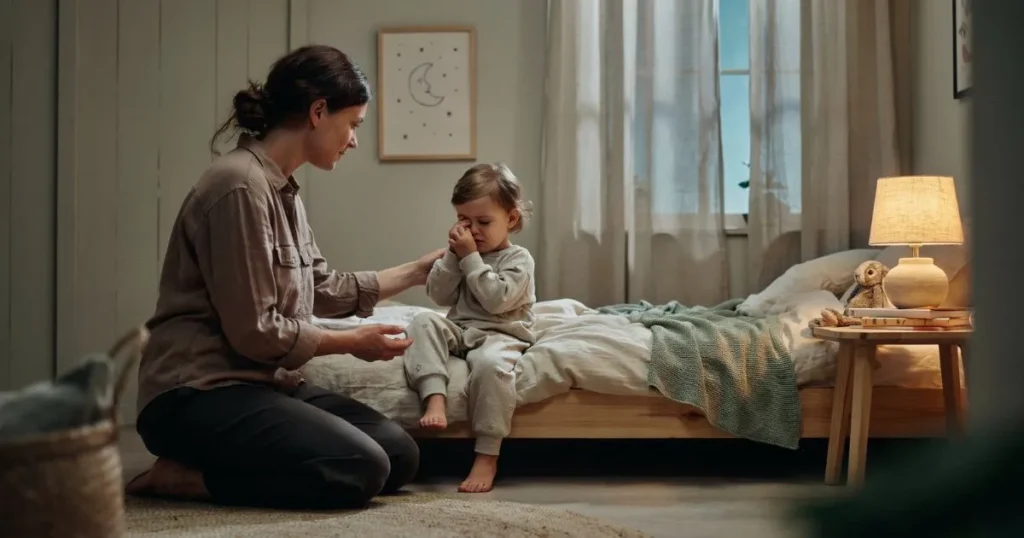
Several developmental changes often overlap around your child’s second birthday.
A Powerful Imagination
Around age two, your toddler’s imagination blossoms.
They may begin to:
- Pretend to cook meals
- Talk to stuffed animals
- Invent games
- Dream more vividly
- Become afraid of the dark or unfamiliar sounds
Although imagination is wonderful for learning and creativity, it can also make bedtime more challenging.
A shadow on the wall may suddenly seem scary, or a perfectly ordinary noise may feel frightening.
Independence Reaches a New Level
Your toddler now understands that they can make choices—and they often want to make all of them.
Bedtime may suddenly include:
- Refusing pajamas
- Wanting to choose every book
- Insisting on a different blanket
- Delaying lights out
- Leaving the bedroom repeatedly
These behaviors are usually expressions of growing independence rather than defiance.
Better Language Means Better Negotiation
Your toddler’s communication skills improve dramatically around age two.
It also means they’re becoming surprisingly good at negotiating.
You might hear requests like:
“Just one more hug.”
“I forgot to tell you something.”
“I need another kiss.”
While these requests are sweet, responding differently every night can unintentionally turn bedtime into a prolonged negotiation.
Major Life Changes
By this stage, many toddlers go through developmental changes that can temporarily disrupt their sleep, including:
- Potty training
- Moving to a toddler bed
- Starting daycare or preschool
- Welcoming a new sibling
- Traveling
- Changes in childcare
Even positive transitions can temporarily disrupt established sleep routines.
Signs of the 2-Year Sleep Regression
Your toddler may:
- Refuse to go to bed
- Stall bedtime with repeated requests
- Wake during the night
- Leave their bed or bedroom
- Wake earlier than usual
- Resist naps
- Become afraid of the dark
- Need extra reassurance before sleeping
Some toddlers also become more attached to comfort items such as a favorite stuffed animal or blanket.
How Long Does the 2-Year Sleep Regression Typically Last?
Most toddlers adjust within two to six weeks, although major life changes can extend the process.
Remaining patient and sticking to a consistent routine often has the greatest impact.
Gentle Strategies That Really Help
Keep Your Bedtime Routine Short and Predictable
Aim for a calm routine lasting 20–30 minutes.
For example:
- Bath
- Pajamas
- Brush teeth
- Two books
- Goodnight cuddle
- Lights out
Following the same bedtime routine each night helps your toddler feel safe and secure.
Set Loving Boundaries
Your toddler needs empathy and consistency, especially during challenging stages like the 18-month and 2-year sleep regressions within the sleep regression ages timeline.
If they ask for another story after you have already read two, acknowledge their feelings while holding the limit. During different baby sleep regression ages, toddlers often test boundaries as they develop independence and learn to express their needs.
For example:
“I know you’d love another story. Tonight we’ve finished our books. We’ll read more tomorrow.”
Responding calmly teaches that bedtime routines are predictable and helps your toddler feel secure while learning healthy sleep habits.
Give Choices Before Bedtime

Offer small choices earlier in the routine instead of during lights out.
Examples include:
- Which pajamas to wear
- Which two books to read
- Which stuffed animal to sleep with
Small choices satisfy your toddler’s need for independence without turning bedtime into a debate.
Address New Fears
If your toddler seems frightened at bedtime:
- Check the room together.
- Use a soft night-light if needed.
- Offer reassurance without reinforcing unrealistic fears.
- Keep comfort brief and calm.
Most bedtime fears gradually fade with patience and reassurance.
Common Bedtime Stalling Tactics
| Toddler Says… | A Gentle Response |
| “One more story.” | “We’ve finished our stories for tonight. We’ll read more tomorrow.” |
| “I’m thirsty.” | Offer one small drink before bed, then gently remind them bedtime has started. |
| “Stay with me.” | Stay for a moment, then leave after saying the same comforting goodnight phrase each night. |
| “I’m not tired.” | Keep the bedtime routine the same, even if your toddler insists they’re awake. |
| “I need another hug.” | Give one final hug, then confidently end the routine. |
Expert Tips for the 2-Year Sleep Regression
✔ Expect some bedtime resistance—it’s a normal part of toddler development.
✔ Keep routines predictable rather than perfect.
✔ Avoid turning bedtime into a negotiation.
✔ Praise cooperative bedtime behavior.
✔ Stay calm and consistent, even after difficult nights.
At a Glance: 2-Year Sleep Regression
| Question | Answer |
| When does it happen? | Around 24–30 months |
| How long does it last? | Usually 2–6 weeks |
| Main causes | Independence, imagination, language development, routine changes |
| Most common signs | Bedtime stalling, night waking, nap resistance, fears |
| Best way to help | Consistent routines, loving boundaries, reassurance without prolonged negotiations |
Want more toddler sleep tips? Explore our complete 2-Year Sleep Regression Guide, where you will find bedtime routines, sample schedules, and gentle strategies for managing toddler sleep challenges during this stage of the sleep regression ages journey.
Congratulations—you have now explored the complete journey of the most common sleep regression ages, from the first major sleep changes at 4 months through the growing independence, emotions, and imagination of the 2-year sleep regression.
Understanding baby sleep regression ages can help you recognize that sleep changes are often connected to your child’s development rather than a sign that something is wrong.
Next, we will bring everything together with practical strategies that work across every age, helping you navigate future sleep regressions by age with greater confidence and a calmer approach.
How to Survive Every Sleep Regression: 12 Gentle Strategies That Really Work

No two sleep regressions look exactly the same, but one thing is true for almost every family: they can feel exhausting.
Whether your baby is waking every hour at 4 months or your toddler is negotiating bedtime at 2 years, it is natural to wonder if you are doing something wrong. Understanding the different sleep regression ages can help you recognize that these changes are often connected to normal growth and development.
Fortunately, sleep regressions are only a temporary stage and will eventually pass. While you cannot stop developmental milestones from happening, you can create healthy sleep habits that make these challenging phases easier for your child—and for yourself.
The following tips can support healthy sleep during different baby sleep regression ages. Adapt them to your child’s age, temperament, and developmental stage, because every child’s sleep journey is unique.
1. Keep a Consistent Bedtime Routine

Children thrive on predictability.
A familiar routine helps your child’s brain recognize that bedtime is approaching and provides a sense of comfort during periods of rapid development.
A simple bedtime routine may include:
- Bath (optional)
- Pajamas
- Feeding or a light bedtime snack (age appropriate)
- Brushing teeth
- Reading a book
- Singing a lullaby
- Goodnight cuddles
- Into bed while calm and sleepy
Aim to keep the routine in the same order each evening.
Consistency is far more important than having a “perfect” bedtime routine.
2. Follow Age-Appropriate Wake Windows
Many sleep difficulties happen because children become overtired, especially during challenging stages in the sleep regression ages timeline.
An overtired baby often finds it harder to fall asleep, stay asleep, and connect sleep cycles. This can make periods like the 4-month sleep regression, 6-month sleep regression, and other baby sleep regression ages feel even more challenging.
Paying attention to your baby’s sleepy cues and age-appropriate wake windows can help prevent overtiredness and support healthier sleep habits during times of developmental change.
Typical Wake Windows by Age
| Age | Wake Window | Typical Naps |
| 4 Months | 1.5–2 hours | 3–4 naps |
| 6 Months | 2–3 hours | 3 naps |
| 8–10 Months | 2.5–3.5 hours | 2 naps |
| 12 Months | 3–4 hours | 2 naps |
| 18 Months | 5–6 hours | 1 nap |
| 2 Years | 5–6 hours | 1 nap |
These are averages, not strict rules. Watch your child’s sleepy cues as well as the clock.
3. Create a Calm Sleep Environment
A comfortable sleep space helps reduce unnecessary stimulation.
Consider these simple adjustments:
- Keep the room dark.
- Maintain a comfortable temperature.
- Use white noise if it helps mask household sounds.
- Choose sleepwear that matches the temperature of your child’s room.
- Follow safe sleep recommendations for babies.
A calm environment won’t eliminate a sleep regression, but it can make it easier for your child to settle.
4. Encourage Practice During the Day
Sleep regressions often happen because children are mastering exciting new skills.
Give your child plenty of opportunities to practice while they’re awake.
Examples include:
- Rolling
- Crawling
- Standing
- Walking
- Climbing (age appropriate)
- Language development through conversation and reading
The more confident your child becomes during the day, the less likely they are to spend bedtime practicing instead of sleeping.
5. Respond with Comfort and Consistency
Every family approaches sleep differently, especially during the different stages of the sleep regression ages timeline.
Some parents choose to respond immediately, while others prefer to pause briefly before offering comfort. During baby sleep regression ages, there is no single approach that works for every child, and what matters most is finding a response that supports your baby’s needs and your family’s values.
No matter which approach you use, being consistent is more important than getting everything perfect.
Respond to your child’s needs in a calm, predictable way that aligns with your family’s values while helping your child feel secure through temporary sleep changes.
6. Introduce Changes One Step at a Time
When you’re exhausted, it is tempting to try every sleep tip you read online, especially during difficult stages in the sleep regression ages timeline.
Instead, make one change at a time and give it several days before deciding whether it is helping. During different baby sleep regression ages, sudden sleep changes can make parents feel pressured to find a quick solution, but consistency usually works better than constantly changing strategies.
Changing bedtime routines, feeding schedules, and sleep methods all at once can make it difficult to know what is actually working. A calm, predictable approach can help your child adjust while you learn what supports their sleep best.
7. Don’t Compare Your Child to Others
Every baby develops on their own timeline, which is why the different sleep regression ages can look very different from one child to another.
Some children experience every common sleep regression, while others seem to skip several stages entirely. Both experiences are completely normal, and neither is better or worse.
During the journey through baby sleep regression ages, it is important to remember that development does not follow an exact schedule. Your child’s sleep patterns may change depending on their temperament, milestones, and individual needs.
Focus on your child’s unique development rather than comparing sleep patterns with friends, relatives, or social media. Every child’s sleep journey is different.
8. Protect Naps Whenever Possible
Daytime sleep supports nighttime sleep.
Skipping naps because bedtime has become difficult often leads to overtiredness, making nighttime sleep even more challenging.
Unless your child is genuinely ready for a schedule change, try to keep naps as consistent as possible.
9. Take Care of Yourself Too
Sleep regressions don’t only affect babies—they affect parents as well.
If possible:
- Share nighttime responsibilities with your partner.
- Accept help from family or friends.
- Rest when opportunities arise.
- Lower expectations for household tasks during particularly difficult weeks.
Looking after yourself isn’t selfish. It helps you care for your child with more patience and energy.
10. Be Patient

Perhaps the hardest part of any sleep regression is not knowing when it will end.
Remember:
Most regressions last two to six weeks.
Progress often comes gradually rather than all at once.
You may notice two good nights followed by a difficult one before sleep becomes more consistent again.
That doesn’t mean you’re moving backward—it simply means your child is still adjusting.
11. Celebrate Developmental Milestones
It’s easy to focus on the sleepless nights.
Try to notice the exciting achievements happening alongside them.
Your baby may be:
- Rolling for the first time
- Crawling across the room
- Taking their first steps
- Saying new words
- Showing affection
- Solving simple problems
These milestones are reminders that your child is growing in wonderful ways, even if sleep is temporarily challenging.
12. Remember: This Stage Will Pass
One of the most comforting truths about sleep regressions is that they’re temporary.
The nights may feel long now, but your child won’t need extra cuddles, bedtime stories, or reassurance forever.
With time, consistency, and patience, most families settle into a more predictable sleep routine again.
Sleep Regression Survival Checklist
Use this simple checklist if your child’s sleep suddenly becomes more challenging.
✔ Keep bedtime consistent.
✔ Watch wake windows.
✔ Protect naps.
✔ Encourage daytime practice of new skills.
✔ Create a calm sleep environment.
✔ Offer comfort without guilt.
✔ Stay patient.
✔ Avoid comparing your child to others.
✔ Talk to your pediatrician if you notice anything that concerns you.
Save this checklist or bookmark this guide so you can return to it whenever the next sleep regression arrives.
Sleep Regression vs. Teething vs. Growth Spurts vs. Illness: How to Tell the Difference
One of the hardest parts of parenting is figuring out why your child suddenly isn’t sleeping well.
Is it a sleep regression? Could it be teething? Maybe they’re going through a growth spurt—or are they getting sick?
The truth is that these situations can look very similar, and sometimes they even happen at the same time. Looking at your child’s overall behavior—not just their sleep—can help you understand what’s most likely going on.
Remember: A sleep regression doesn’t protect your child from teething, illness, or growth spurts. More than one factor can affect sleep at the same time.
Quick Comparison Table
| Possible Cause | Common Signs | Typical Duration | What Usually Helps |
| Sleep Regression | Night waking, nap resistance, bedtime struggles, clinginess, practicing new skills | 2–6 weeks | Consistent routines, patience, age-appropriate sleep habits |
| Teething | Swollen gums, drooling, chewing, irritability, mild sleep disruption | A few days around tooth eruption | Cold teething toys, comfort, pediatrician-approved pain relief if needed |
| Growth Spurt | Increased hunger, more frequent feeding, temporary fussiness, longer or more frequent sleep | Several days to one week | Feed on demand (as appropriate), allow extra rest |
| Illness | Fever, cough, vomiting, diarrhea, congestion, unusual fatigue | Varies depending on the illness | Medical care, hydration, rest, follow your healthcare provider’s advice |
Signs You’re Probably Dealing With a Sleep Regression
Sleep regressions are most likely when your child:
- Is otherwise healthy.
- Is reaching a new developmental milestone.
- Suddenly wakes more often after previously sleeping well.
- Becomes more clingy or emotionally sensitive.
- Starts resisting naps or bedtime.
- Continues eating and playing normally during the day.
The important clue is that your child generally seems well apart from the sleep changes.
Signs It May Be Teething
Teething is often blamed for every difficult night, but it’s usually only one piece of the puzzle.
Your child may be teething if you notice:
- Swollen or tender gums
- Excessive drooling
- Chewing on fingers or toys
- Mild irritability
- Wanting to bite everything
While teething can certainly make your child uncomfortable, it usually causes short-term sleep disruption rather than several weeks of frequent night waking on its own.
Signs of a Growth Spurt
Growth spurts often happen during infancy and can temporarily affect sleep.
Your baby may:
- Want to feed more often.
- Wake hungry during the night.
- Seem unusually hungry during the day.
- Sleep more than usual on some days.
- Become fussier between feeds.
These changes typically improve within several days once the growth spurt slows down.
Signs Your Child May Be Sick
Illness often causes sleep changes, but it usually comes with other symptoms.
Watch for signs such as:
- Fever
- Persistent cough
- Runny or blocked nose
- Vomiting
- Diarrhea
- Rash
- Poor feeding
- Low energy
- Difficulty breathing
If your child seems unwell, focus on treating the illness rather than assuming the sleep changes are simply a regression.
Can Teething and a Sleep Regression Happen Together?
Yes.
This is actually quite common.
For example, an eight-month-old who is learning to crawl may also be cutting their first teeth at the same time.
Similarly, a one-year-old may be:
- Learning to walk
- Developing new language skills
- Experiencing separation anxiety
- Teething with molars
When several developmental events overlap, sleep may become especially challenging.
Rather than looking for a single explanation, consider the whole picture.
A Simple Checklist for Parents
Ask yourself these questions:
Is it probably a sleep regression?
✔ My child is reaching a new developmental milestone.
✔ They seem healthy during the day.
✔ Sleep suddenly became more difficult.
✔ They still eat, play, and interact normally.
Is it probably teething?
✔ Their gums look swollen.
✔ They’re drooling much more than usual.
✔ They constantly chew on objects.
✔ The discomfort seems worse around the time a tooth is erupting.
Is it probably a growth spurt?
✔ They seem much hungrier.
✔ They’re asking for more milk or food.
✔ The sleep changes have only lasted a few days.
Is it possibly an illness?
✔ They have a fever or other symptoms.
✔ They seem unusually sleepy or uncomfortable.
✔ They aren’t eating or drinking normally.
✔ Their behavior is very different from usual.
If you answer “yes” to these questions, contact your child’s healthcare provider.
When Should You Call a Pediatrician?
Although sleep regressions are a normal part of development, some situations deserve medical attention.
Contact your pediatrician if your child:
- Has difficulty breathing during sleep.
- Snores loudly or repeatedly pauses breathing.
- Has a fever that concerns you or lasts longer than expected.
- Refuses feeds or becomes dehydrated.
- Is losing weight or not gaining weight appropriately.
- Is difficult to wake or unusually sleepy.
- Experiences sleep problems that continue well beyond several weeks without improvement.
Trust your instincts. You understand your child better than anyone.
Key Takeaways
- Sleep regressions usually happen alongside developmental milestones.
- Teething often causes short-term discomfort but rarely explains weeks of disrupted sleep by itself.
- Growth spurts often make babies and toddlers hungrier, but they usually last just a few days.
- Illness usually causes additional symptoms beyond sleep changes.
- Sometimes more than one factor is affecting your child’s sleep at the same time.
Understanding the difference can help you respond with confidence instead of guessing—and it can also help you recognize when it’s time to seek medical advice.
Sleep Regression Myths: 10 Common Misconceptions Every Parent Should Know

If you’ve spent time reading parenting forums or scrolling through social media, you’ve probably come across conflicting advice about sleep regressions.
Some people insist you should never comfort your baby. Others claim every difficult night is caused by teething. You may even hear that sleep regressions aren’t real at all.
The truth is more nuanced.
While researchers continue studying infant sleep, pediatricians agree that temporary sleep disruptions commonly occur alongside periods of rapid development. Understanding what the evidence does—and doesn’t—say can help you make informed decisions for your family.
Let’s separate fact from fiction.
Myth #1: Every Baby Experiences Every Sleep Regression
The Truth: No two children follow the exact same timeline.
Some babies experience several noticeable sleep regressions, while others have only one or two.
Developmental milestones happen at different ages, and each child’s temperament is unique.
If your friend’s baby slept through the night at eight months while yours suddenly wakes every two hours, that doesn’t mean anything is wrong.
Every child develops differently.
Myth #2: A Sleep Regression Means You’re Doing Something Wrong
The Truth: Sleep regressions are usually a normal part of development.
Parents often blame themselves when sleep suddenly changes.
In reality, your baby isn’t waking because you failed to create the “perfect” bedtime routine.
Their brain is developing, their body is growing, and they’re learning exciting new skills.
Those changes can temporarily affect sleep—even in families with excellent sleep habits.
Myth #3: Sleep Regressions Last Forever
The Truth: Most regressions improve within two to six weeks.
When you’re waking multiple times every night, it can feel like sleep will never improve.
Fortunately, most developmental sleep disruptions are temporary.
As your child becomes more comfortable with their new skills, sleep usually becomes more predictable again.
Patience and consistency often make the biggest difference.
Myth #4: You Should Keep Your Baby Awake Longer to Help Them Sleep Better
The Truth: Overtired children often sleep worse—not better.
It’s a common assumption that skipping naps or delaying bedtime will make a child “sleep harder.”
In fact, overtired babies and toddlers often:
- Take longer to fall asleep.
- Wake more frequently.
- Wake earlier in the morning.
- Become fussier during the day.
Protecting age-appropriate naps and bedtime is usually a better approach.
Myth #5: Teething Is the Cause of Every Night Waking
The Truth: Teething is only one possible reason.
Teething can certainly make your child uncomfortable for a few days.
However, weeks of disrupted sleep are often better explained by developmental changes, growth spurts, illness, or changes in routine.
Instead of assuming every wake-up is teething, consider your child’s overall behavior and any new milestones they’re reaching.
Myth #6: Comforting Your Baby During a Sleep Regression Creates Bad Habits
The Truth: Responding with warmth and consistency supports secure attachment.
One of the most persistent myths is that comforting your baby during difficult nights will “spoil” them.
Current child development research does not support that idea.
Providing reassurance when your child is distressed helps them feel safe and secure.
As your child matures, you can continue encouraging healthy sleep habits while still responding to their emotional needs.
Comfort and consistency can exist together.
Myth #7: Sleep Training Must Stop Forever During a Sleep Regression
The Truth: It depends on your child, your goals, and your family’s approach.
Some families choose to pause formal sleep training during periods of rapid development because their child needs extra reassurance.
Others continue with a consistent, gentle approach.
There isn’t a single correct answer.
If you’re considering sleep training—or wondering whether to continue—it’s reasonable to discuss your approach with your pediatrician or a qualified pediatric sleep professional.
Myth #8: Sleep Regressions Happen on Exact Dates
The Truth: Development isn’t a calendar.
A “4-month sleep regression” doesn’t necessarily begin on the day your baby turns four months old.
Some babies experience it at three and a half months.
Others closer to five months.
The same is true for later regressions.
Think of these ages as averages rather than deadlines.
Myth #9: Babies Who Sleep Well Never Experience Another Sleep Regression
The Truth: Even great sleepers experience developmental changes.
Even if your baby has been sleeping well for months, developmental milestones like crawling, walking, or talking can temporarily disrupt their sleep.
Good sleepers can have sleep regressions.
Children who struggle with sleep can also become excellent sleepers over time.
Sleep isn’t a straight line.
Myth #10: Once a Sleep Regression Ends, Sleep Will Be Perfect Forever
The Truth: Child sleep continues to evolve.
From infancy through toddlerhood, your child’s sleep needs will keep changing.
Illness, travel, new siblings, developmental milestones, and changing routines can all temporarily affect sleep.
Rather than expecting perfection, aim for healthy, flexible sleep habits that can adapt as your child grows.
What Sleep Experts Want Parents to Remember
Although every child is unique, pediatric sleep specialists generally agree on several key principles:
- Sleep regressions are usually temporary.
- Developmental milestones often affect sleep.
- Consistent routines help children feel secure.
- Safe sleep practices remain important throughout infancy.
- Responding to your child’s needs and encouraging healthy sleep habits are not mutually exclusive.
There is no single “perfect” parenting approach that works for every family.
The best sleep plan is one that is safe, responsive, and realistic for your child’s temperament and your family’s needs.
Key Takeaways
✔ Sleep regressions are a normal part of development—not a sign of failure.
✔ Every baby experiences sleep differently.
✔ Comforting your child does not spoil them.
✔ Overtiredness often makes sleep more difficult.
✔ Most sleep regressions resolve with patience, consistency, and time.
When you understand the facts, it’s easier to tune out conflicting advice and respond with confidence.
Coming Up Next: We’ll answer the most frequently asked questions about sleep regression ages, including when regressions start, how long they last, whether babies skip regressions, and when it’s time to seek medical advice
Frequently Asked Questions About Sleep Regression Ages
1. At What Ages Do Sleep Regressions Most Commonly Occur?
The most common sleep regression ages are around 4 months, 6 months, 8–10 months, 12 months, 18 months, and 2 years. These stages often coincide with major developmental milestones, such as learning to roll, crawl, walk, talk, or becoming more independent. Not every child experiences every regression, and the timing can vary by several weeks.
2. Which sleep regression is usually the hardest?
Many parents consider the 4-month sleep regression the toughest because it marks a lasting shift in a baby’s sleep patterns. Others feel the 8–10 month or 18-month sleep regressions are more difficult due to separation anxiety, increased mobility, or bedtime resistance. Every family’s experience is different.
3. How long do sleep regressions usually last?
Most sleep regressions typically resolve within two to six weeks. How long a sleep regression lasts varies based on your child’s temperament, development, health, and the consistency of their sleep routine. Some children adjust within days, while others need a little more time.
4. Do all babies go through every sleep regression age?
No. Although the commonly discussed sleep regression ages follow typical developmental patterns, many babies skip one or more regressions entirely. Development isn’t identical for every child, so it’s normal for sleep changes to happen earlier, later, or not at all.
5. Can sleep regressions happen earlier or later than expected?
Yes. The ages mentioned in this guide are averages, not exact milestones. For example, the 4-month sleep regression may begin anywhere between 3½ and 5 months, while the 8–10 month regression may occur closer to 7 or 11 months for some babies.
6. Can a baby have more than one sleep regression?
Yes. Many babies experience temporary sleep disruptions at several developmental stages. A child who goes through the 4-month sleep regression may later experience another period of disrupted sleep around 8–10 months, 12 months, or during toddlerhood.
7. Can teething cause a sleep regression?
Teething itself doesn’t cause a sleep regression, but it can certainly disrupt sleep. If teething happens at the same time as one of the common sleep regression ages, the combination may make bedtime and night wakings more challenging.
8. Should You Change Your Bedtime Routine During a Sleep Regression?
Usually not. A consistent bedtime routine provides comfort and predictability during periods of rapid development. Rather than starting a completely new bedtime routine, stick with familiar habits while gently adapting to your child’s changing needs.
9. Is it okay to comfort my baby during a sleep regression?
Yes. Comforting your child when they need reassurance supports a secure attachment. Offering cuddles, calm words, or gentle reassurance during a difficult night won’t “spoil” your baby. The goal is to balance responsiveness with healthy, consistent sleep habits.
10. Should I stop sleep training during a sleep regression?
There isn’t one correct answer. Some families choose to pause formal sleep training while their child is experiencing a developmental leap, while others continue using gentle, consistent methods. If you’re unsure, discuss your situation with your pediatrician or a qualified pediatric sleep professional.
11. Can travel or changes in routine trigger a sleep regression?
Changes such as travel, moving house, starting daycare, welcoming a sibling, or illness can temporarily disrupt sleep. Although these aren’t true developmental sleep regressions, they may look very similar and usually improve once your child adjusts to the new routine.
12. When should I call my pediatrician about sleep problems?
Contact your pediatrician if your child has difficulty breathing during sleep, snores loudly, has persistent fever, refuses feeds, loses weight, seems unusually difficult to wake, or if significant sleep problems continue well beyond the expected timeframe without improvement.
13. Do toddlers have sleep regressions too?
Yes. Many toddlers experience temporary sleep disruptions around 18 months and 2 years. At these ages, growing independence, language development, imagination, bedtime fears, and changing routines are common reasons for sleep challenges.
14. Can sleep regressions affect naps as well as nighttime sleep?
Absolutely. During the common sleep regression ages, children may take shorter naps, resist naps altogether, or have difficulty settling for daytime sleep. These nap changes are often temporary and improve as developmental milestones are mastered.
15. Will my child’s sleep ever become consistent again?
For most families, yes.
Although sleep regressions can feel overwhelming in the moment, they’re usually temporary. As your child grows, masters new skills, and settles into predictable routines, sleep often becomes much more consistent.
Keep in mind that occasional sleep disturbances are a normal part of growing up, even for children who usually sleep well.
Key Takeaways
- The most common sleep regression ages occur around 4 months, 6 months, 8–10 months, 12 months, 18 months, and 2 years.
- Most regressions last two to six weeks.
- Sleep regressions are closely linked to healthy developmental milestones.
- Every child experiences sleep changes differently.
- Consistency, patience, and responsive caregiving are usually the most effective strategies.
Conclusion: Sleep Regressions Are Temporary, but Your Support Lasts a Lifetime
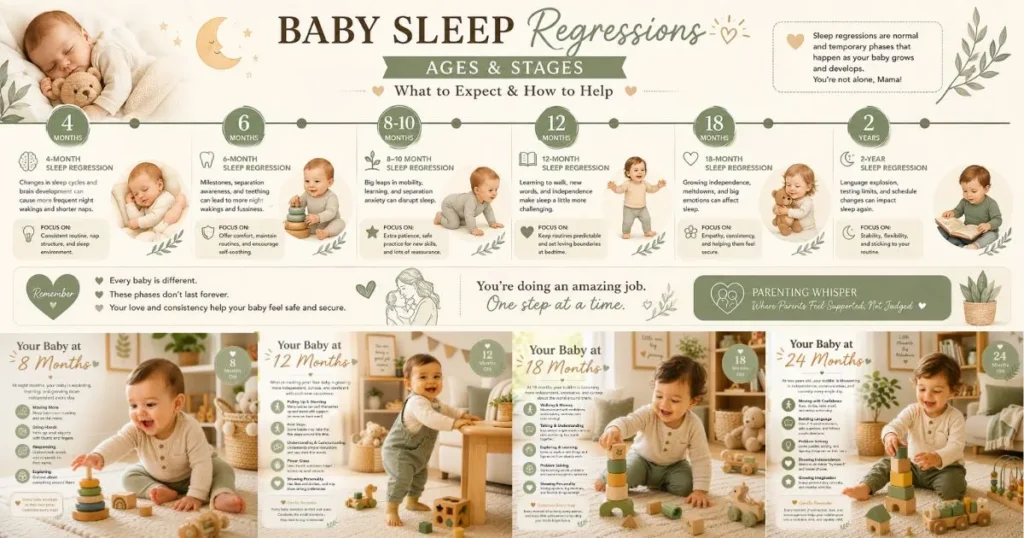
Watching your child struggle with sleep can be exhausting. Whether you’re soothing a four-month-old who wakes every hour or guiding a determined two-year-old through bedtime battles, it’s easy to wonder if restful nights will ever return.
The encouraging news is that sleep regressions are a normal part of growing up. Each stage reflects incredible progress—your child is learning new skills, developing emotionally, and building the foundation for future independence.
While you can’t prevent every sleep regression, you can make these transitions easier by staying consistent, creating comforting bedtime routines, and responding to your child’s needs with patience and confidence.
Remember, there is no such thing as a perfect sleeper or a perfect parent.
Every family experiences difficult nights. What matters most is providing a safe, loving environment where your child can continue to grow and thrive.
With time, these challenging phases pass—and the milestones you’re celebrating today will soon become cherished memories.
Final Thoughts
If this guide was helpful, consider saving it so you can return to it whenever you need support. Sleep changes often happen quickly, and having reliable, evidence-based information at your fingertips can make those sleepless nights feel much less overwhelming.
You may also find these related guides helpful:
- 4-Month Sleep Regression
- 6-Month Sleep Regression
- 8-Month Sleep Regression
- 12-Month Sleep Regression
- 18-Month Sleep Regression
- 2-Year Sleep Regression
- Dream Feed: The Complete Guide
- Toddler Nap Schedule by Age
- When Can Babies Sleep With a Blanket?
Share Your Experience
Every child’s sleep experience is different, and your story could give hope to another exhausted parent.
Which sleep regression has been the most challenging for your family?
We’d love to hear your thoughts—share your experience in the comments below! We’d love to hear what worked for your family, and your insights could encourage another parent facing the same challenge.
If you found this guide useful, consider sharing it with another parent who could use a little extra support today.
Key Takeaways
If there’s only one section you remember, make it these key takeaways:
- Sleep regressions are a normal part of healthy development. Sleep regressions often occur as children develop new physical, cognitive, or emotional abilities.
- The most common sleep regression ages are around 4 months, 6 months, 8–10 months, 12 months, 18 months, and 2 years.
- The 4-month sleep regression is unique because it reflects a permanent change in your baby’s sleep cycles.
- Most sleep regressions last 2–6 weeks, although every child develops at their own pace.
- Consistent bedtime routines, age-appropriate sleep schedules, and responsive caregiving can make regressions easier to manage.
- Temporary sleep disruptions don’t mean your child has developed a long-term sleep problem.
- If your child has breathing difficulties, poor growth, persistent illness, or prolonged sleep problems, contact your pediatrician.
Sleep Regression Ages Cheat Sheet
Bookmark or save this quick reference for those nights when you’re wondering, “Is this another sleep regression?”
| Age | Main Developmental Milestone | Typical Duration | Most Common Sleep Changes |
| 4 Months | Sleep cycles mature | 2–6 weeks | Frequent night waking, short naps |
| 6 Months | Rolling, sitting, growth spurts | 2–4 weeks | Night waking, nap changes |
| 8–10 Months | Crawling, standing, separation anxiety | 2–6 weeks | Bedtime resistance, clinginess |
| 12 Months | Walking, language development | 2–4 weeks | Nap resistance, early waking |
| 18 Months | Independence, emotional growth | 2–6 weeks | Bedtime battles, night waking |
| 2 Years | Imagination, fears, communication | 2–6 weeks | Bedtime stalling, leaving bed |
Expert-Reviewed Sleep Tips
While every child is different, pediatric sleep experts consistently recommend these healthy sleep practices:
Build Predictable Routines
Children feel more secure when bedtime follows the same calming sequence each evening.
Follow Safe Sleep Guidelines
For infants, always place your baby on their back to sleep, use a firm, flat sleep surface, and keep the sleep space free of pillows, blankets, toys, and crib bumpers.
Focus on Long-Term Habits
One difficult week won’t undo months of healthy sleep habits. Focus on overall sleep patterns instead of judging progress based on a single night.
Watch Your Child, Not the Calendar
Developmental milestones don’t happen on exact birthdays. Use your child’s behavior and cues as your best guide.
Trust Your Instincts
If something feels unusual—especially if your child has breathing problems, persistent illness, or significant changes in feeding or alertness—seek medical advice.
Recommended Reading
If you’re looking for more evidence-based parenting advice, continue with these helpful guides:
Baby Sleep
- 4-Month Sleep Regression
- 6-Month Sleep Regression
- 8-Month Sleep Regression
- 12-Month Sleep Regression
- 18-Month Sleep Regression
- 2-Year Sleep Regression
- Dream Feed: The Complete Guide
- When Can Babies Sleep With a Blanket?
- When Can Babies Sleep on Their Stomach?
Toddler Sleep
- Toddler Nap Schedule by Age
- How Much Sleep Does a Toddler Need?
- Signs It’s Time for Your Toddler to Drop a Nap
Parenting & Development
- Gentle Parenting for Beginners
- Positive Parenting Strategies
- Parenting Styles Explained
- Daily Routine for Moms
Our Editorial Standards
At Parenting Whisper, our goal is to provide parenting information that is supportive, practical, and based on trusted evidence.
Every article is carefully researched using guidance from respected organizations such as the:
- American Academy of Pediatrics (AAP)
- Centers for Disease Control and Prevention (CDC)
- National Health Service (NHS)
- Sleep Foundation
Our content is designed to support—not replace—the advice of your child’s healthcare provider. If you have concerns about your baby’s sleep, growth, or overall health, consult your pediatrician.
References
The information in this guide is based on recommendations and educational resources from organizations including:
- American Academy of Pediatrics. Safe Sleep Recommendations.
- Centers for Disease Control and Prevention. Developmental Milestones.
- National Health Service (NHS). Sleep Advice for Babies and Toddlers.
- Sleep Foundation. Infant and Toddler Sleep Resources.
- American Academy of Sleep Medicine. Pediatric Sleep Health Guidance.
About Parenting Whisper
At Parenting Whisper, we believe that every parent deserves evidence-based guidance delivered with empathy—not judgment.
Whether you’re navigating newborn sleep, toddler nutrition, gentle parenting, or everyday family life, our mission is to provide practical advice that helps you feel more confident every step of the way.
Because parenting doesn’t have to be perfect—it just needs support.
.