
If you’ve ever spent what feels like forever getting your baby to sleep, only for them to wake 20 minutes later, you’re not alone. Even when you think you’ve found a baby sleep routine that works, naps and bedtime can suddenly change.
One week, your baby may settle easily for every nap. The next, they might resist naps, wake before dawn, or start waking several times during the night.
The good news is that your baby doesn’t need a perfectly timed schedule to get the rest they need. A baby sleep schedule by age should give you a helpful starting point rather than a strict timetable.
Your baby’s age, sleep needs, baby wake windows, feeding pattern, development, and individual temperament can all affect their daily sleep. As these needs change, their routine may change too.
In this guide, you’ll learn how much sleep your baby needs, what a baby sleep schedule can look like from birth to 12 months, how wake windows work, when nap patterns usually change, and how to handle common sleep challenges.
Most importantly, you’ll learn how to use a schedule as a flexible guide while still following your baby’s cues.

What Is a Baby Sleep Schedule?
A baby sleep schedule is a predictable pattern for your baby’s daytime naps, nighttime sleep, wake periods, and bedtime.
It does not mean your baby has to sleep at exactly 9:00 AM every morning or stay awake until a specific time.
Babies are not machines. Their sleep can change because of:
- Growth and developmental changes
- Hunger or feeding changes
- Illness
- Teething
- Increased mobility
- Separation anxiety
- Changes in naps
- Sleep regressions
- Individual temperament
Rather than following a strict timetable, you can build a flexible daily rhythm that gives your baby plenty of chances to rest.
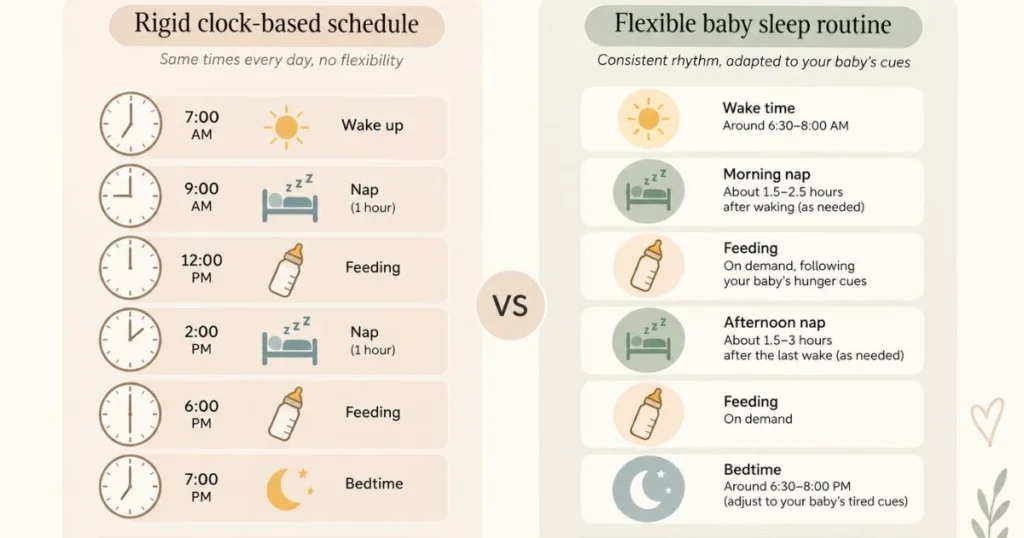
Baby Sleep Schedule vs. a Strict Timetable
A strict timetable might tell you:
“My baby must nap at 10:00 AM.”
A more flexible approach could be:
“My baby usually naps about two hours after waking, but I adjust the timing based on their sleepy cues.”
The second approach is often easier to follow because your baby’s needs can change from one day to the next. Your baby nap schedule should provide structure without forcing you to follow the clock exactly.
The goal is predictability without rigidity.
How Much Sleep Does a Baby Need?
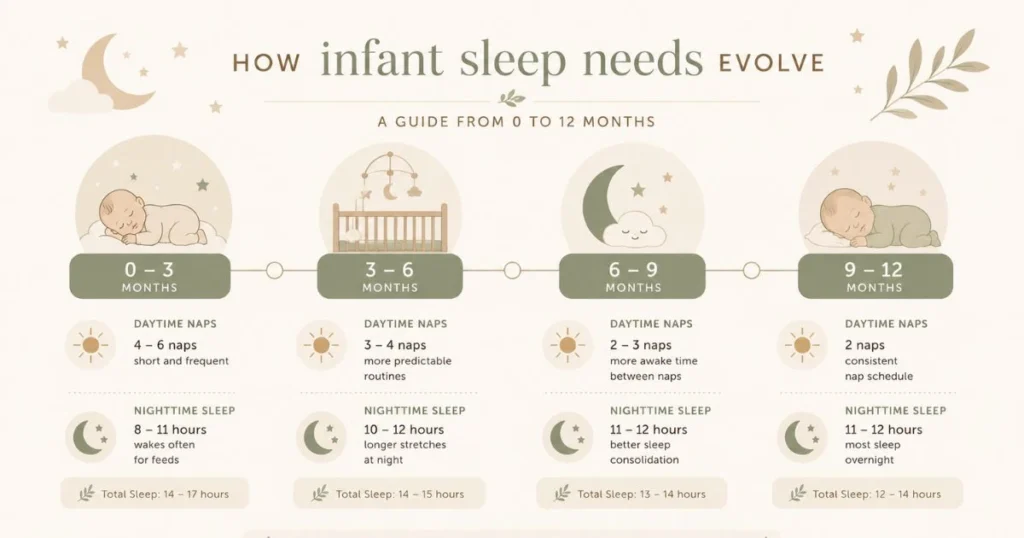
Your baby’s total sleep needs can change quite a bit during the first year. According to the CDC, newborns ages 0–3 months generally need 14–17 hours of sleep in a 24-hour period, while infants ages 4–12 months typically need 12–16 hours, including naps.
These ranges can help you understand your baby’s overall sleep needs, but they aren’t strict targets your baby has to reach every single day. Use them as a general guide alongside your baby’s behavior, baby wake windows, and sleepy cues.
Baby Sleep Needs by Age
| Age | Recommended/Typical Total Sleep | What You May Notice |
| 0–3 months | 14–17 hours | Sleep is spread across day and night |
| 4–5 months | 12–16 hours | Sleep becomes more organized |
| 6–8 months | 12–16 hours | Longer awake periods and fewer naps |
| 9–12 months | 12–16 hours | Two naps are common for many babies |
Newborn sleep looks quite different from the sleep patterns you may see later in infancy. The American Academy of Pediatrics notes that newborns can sleep around 16–17 hours a day, often in short stretches of just one or two hours.
So, if your newborn sleeps in brief periods instead of following a predictable baby sleep schedule, there’s usually no reason to expect a neat daytime routine yet. At this stage, responding to your baby’s feeding needs and sleepy cues is more important than following the clock.
Does Every Baby Need the Same Amount of Sleep?
No
two babies sleep exactly the same way, even when they are the same age. One 7-month-old may take longer naps, while another may sleep for shorter periods during the day and get more of their rest at night.
Instead of comparing your baby with another child, focus on your baby’s overall sleep pattern and individual needs. A baby sleep schedule by age can give you a useful reference, but it should not be treated as a standard every baby must follow.
If your baby’s sleep suddenly changes significantly, or you have concerns about feeding, growth, breathing, or overall health, talk with your pediatrician.
Baby Sleep Schedule by Age
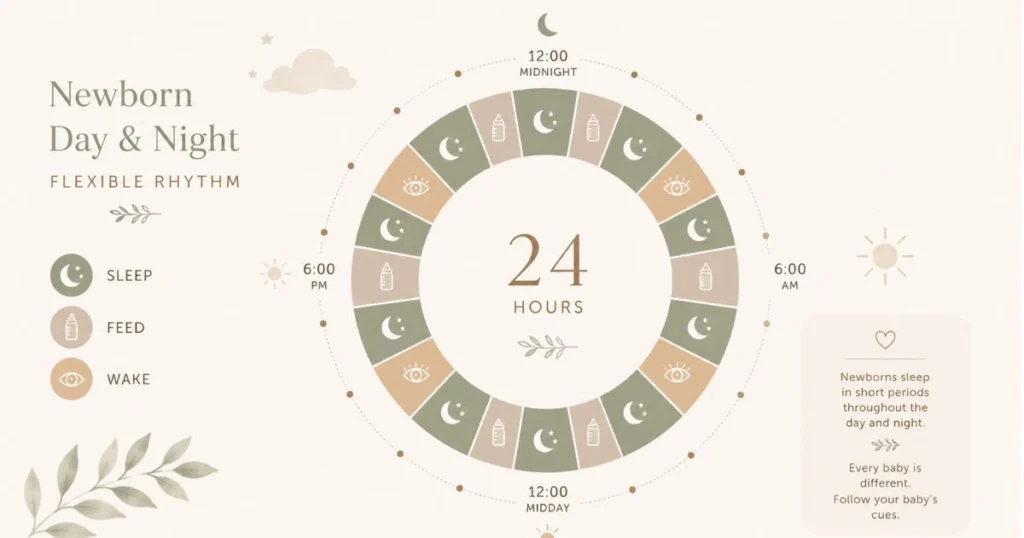
One of the easiest ways to understand a baby sleep schedule by age is to see how your baby’s sleep needs and daily rhythm change as they grow.
The schedules below are sample routines, not strict rules. You can adjust them based on your baby’s usual wake-up time, feeding needs, nap lengths, and sleepy cues.
Newborn sleep looks quite different from the sleep patterns you may see later in infancy. The American Academy of Pediatrics newborn sleep guidance explains that newborns may sleep for much of the day but often wake frequently because their sleep periods are still short and irregular.
Newborn Sleep Schedule: 0–3 Months

A helpful way to understand a baby sleep schedule by age is to look at how your baby’s sleep needs and daily rhythm evolve over time.
The schedules below are sample routines, not fixed rules. Adjust them according to your baby’s usual wake-up time, feeding needs, nap duration, and sleepy cues.
What Newborn Sleep Usually Looks Like
Your newborn may:
- Sleep several times during the day
- Wake frequently at night
- Feed during the night
- Take short naps
- Have unpredictable nap lengths
- Confuse day and night
- Fall asleep while feeding
- Need help settling
At this stage, your priority is not creating a perfect clock-based schedule.
Instead, focus on feeding your baby as needed, providing plenty of opportunities for sleep, and gradually helping your baby recognize the difference between daytime and nighttime.
A Flexible Newborn Sleep Rhythm
| Part of Day | Possible Pattern |
| Morning | Wake + feed |
| Early morning | Short awake period |
| Morning | Sleep |
| Late morning | Feed + awake time |
| Afternoon | Several sleep periods |
| Evening | Feed + calming routine |
| Night | Sleep with normal waking and feeding |
Think of this as a rhythm, not a schedule.
As your baby gets older, their periods of wakefulness will generally become longer and their sleep pattern more predictable.
3–4 Month Baby Sleep Schedule
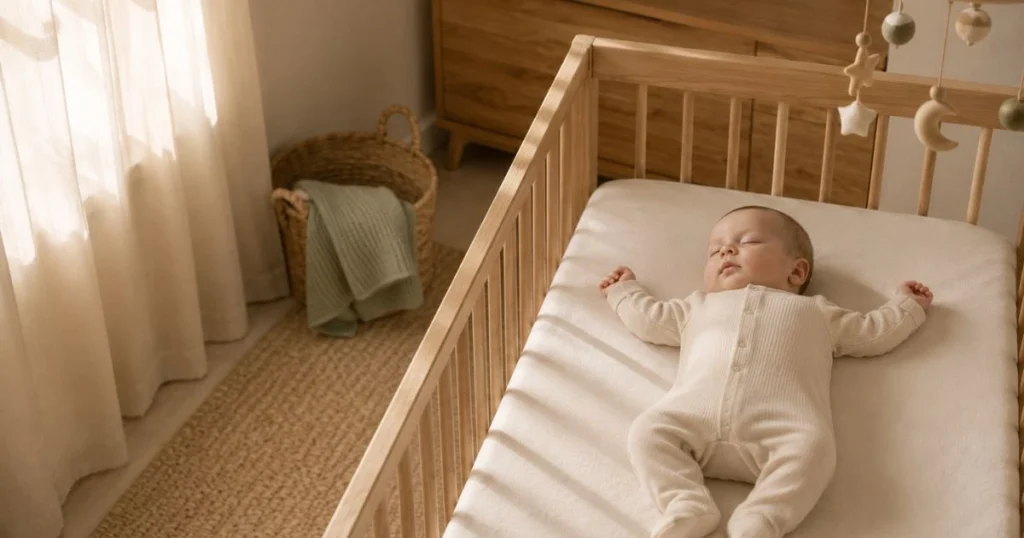
Around 3–4 months, you may notice that your baby’s days begin to develop more structure.
Your baby may stay awake longer, have clearer periods of daytime activity, and begin sleeping for longer stretches at night.
What Changes Around 3–4 Months?
You may notice:
- Longer awake periods
- More recognizable naps
- A more consistent bedtime
- Greater interest in daytime play
- Changes in nighttime waking
- Temporary sleep disruption around this developmental stage
Sample 4-Month Baby Sleep Schedule
| Time | Activity |
| 7:00 AM | Wake |
| 8:30 AM | Nap |
| 11:00 AM | Nap |
| 2:00 PM | Nap |
| 4:30 PM | Short late nap if needed |
| 6:30 PM | Bedtime routine |
| 7:00 PM | Bedtime |
You do not have to copy these exact times.
If your baby wakes at 6:30 AM, the entire day may shift earlier. If your baby wakes at 7:30 AM, the naps may shift later.
The important thing is the pattern.
If your baby’s sleep suddenly becomes more unsettled around this age, you may be noticing signs commonly associated with the 4-month sleep regression. Understanding why sleep changes can help you respond without completely abandoning your routine.
5–6 Month Baby Sleep Schedule
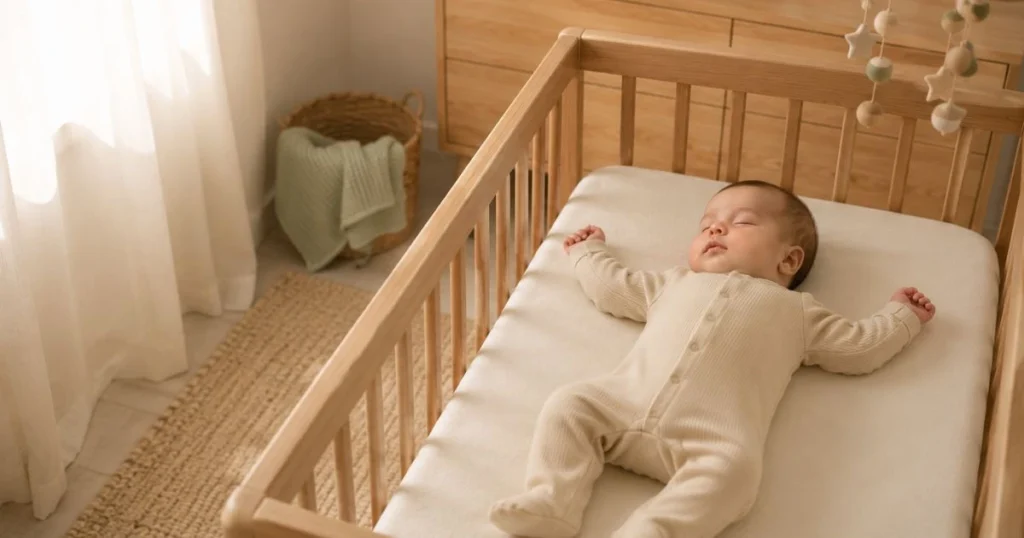
By 5–6 months, many babies can stay awake for longer periods and begin moving toward a more predictable nap routine.
The CDC recommends 12–16 hours of total sleep per 24 hours for babies from 4–12 months, including naps.
How Sleep Changes at 5–6 Months
Your baby may:
- Take fewer naps than during the newborn stage
- Sleep longer at night
- Have more predictable naps
- Resist a late nap
- Begin developing a consistent bedtime
- Still wake during the night
Night waking can still be normal at this age. The AAP specifically notes that nighttime waking can occur even around 6 months.
Sample 6-Month Baby Sleep Schedule
| Time | Activity |
| 7:00 AM | Wake |
| 9:00 AM | Nap 1 |
| 12:30 PM | Nap 2 |
| 3:30 PM | Short nap if needed |
| 6:30 PM | Bedtime routine |
| 7:00 PM | Bedtime |
If your baby refuses the third nap, you may find that an earlier bedtime works better.
If your baby suddenly begins waking more often, resisting naps, or struggling to settle at bedtime, learn more about 6-month sleep regression and the developmental changes that can affect sleep around this stage.
7–8 Month Baby Sleep Schedule
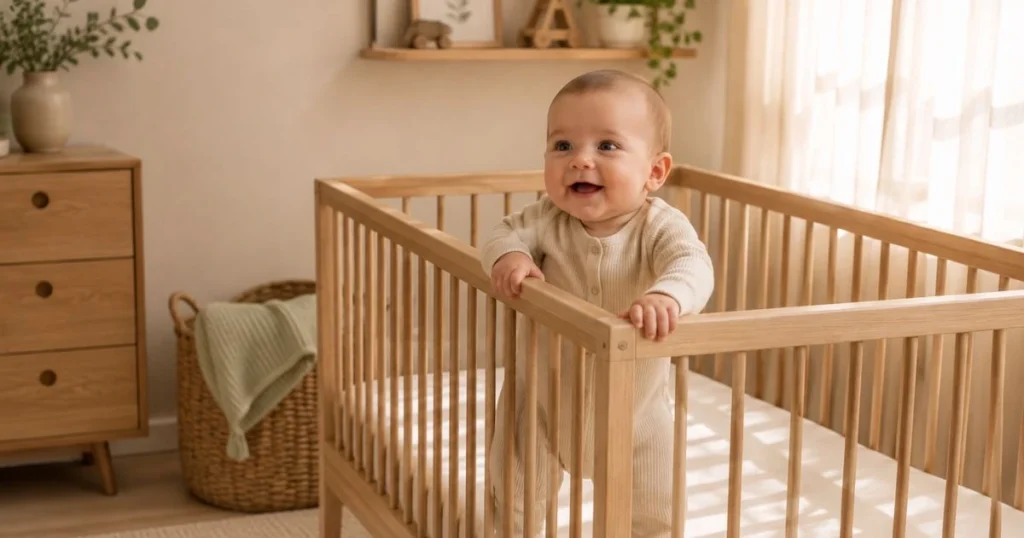
Between 7 and 8 months, many babies settle into a two-nap pattern, although some still need an occasional third nap.
Your baby is becoming more active, mobile, and aware of what’s happening around them. Crawling, rolling, sitting, pulling up, and other new skills can temporarily interfere with sleep.
What Sleep Looks Like at 7–8 Months
You may notice:
- Longer periods of wakefulness
- Two more established naps
- More predictable bedtime
- Separation anxiety
- Increased physical activity
- Nap resistance
- Temporary nighttime disruption
Sample 8-Month Baby Sleep Schedule
| Time | Activity |
| 7:00 AM | Wake |
| 9:30 AM | Nap 1 |
| 1:30 PM | Nap 2 |
| 6:30 PM | Bedtime routine |
| 7:00 PM | Bedtime |
If your baby takes an unusually long second nap, bedtime may need to move slightly later. If naps are very short, an earlier bedtime may be more appropriate.
If these developmental changes are followed by sudden nap resistance, bedtime struggles, or more frequent nighttime waking, your baby may be going through an 8-month sleep regression. The disruption is often temporary and may improve as your baby adjusts to new skills.
What If Your 8-Month-Old Suddenly Fights Sleep?
Before assuming something is wrong, look at what has changed.
Your baby may be:
- Practicing new physical skills
- Experiencing separation anxiety
- Ready for a slightly different nap schedule
- Overtired
- Not tired enough at the usual nap time
A temporary disruption does not necessarily mean your entire routine needs to be replaced.
9–10 Month Baby Sleep Schedule

By 9–10 months, two naps are common, and your baby may have a fairly predictable daytime rhythm.
This is also a busy developmental period.
Your baby may be learning to crawl, stand, and pull up while becoming more curious about their surroundings and more attached to you.
Typical Sleep Pattern at 9–10 Months
You may see:
- Two daytime naps
- Longer awake periods
- More consistent bedtime
- Resistance to one or both naps
- Early morning waking
- Increased separation anxiety
Sample 9–10 Month Baby Sleep Schedule
| Time | Activity |
| 7:00 AM | Wake |
| 9:45 AM | Nap 1 |
| 2:00 PM | Nap 2 |
| 6:30 PM | Bedtime routine |
| 7:00 PM | Bedtime |
Again, these times are examples. Your baby’s actual schedule may be different.
11–12 Month Baby Sleep Schedule

As your baby approaches their first birthday, you may notice another round of changes.
Some babies continue happily with two naps. Some babies may start resisting one of their naps, which can be an early sign that they’re gradually moving toward a one-nap routine.
What Changes Near 12 Months?
Your baby may:
- Stay awake longer
- Resist the second nap
- Take longer to settle
- Become more active
- Wake because of developmental changes
- Experience separation anxiety
- Continue needing two naps
Turning 12 months doesn’t necessarily mean your baby is ready to drop to one nap.
If two naps are still working, there is no need to rush the transition.
Sample 12-Month Baby Sleep Schedule
| Time | Activity |
| 7:00 AM | Wake |
| 9:45 AM | Nap 1 |
| 2:00 PM | Nap 2 |
| 6:30 PM | Bedtime routine |
| 7:00 PM | Bedtime |
Sleep can become unsettled again during periods of rapid development. If you want to understand how sleep disruptions can occur at different stages, explore our guide to 12-Month Sleep Regression.
Baby Sleep Schedule at a Glance
If you want a quick reference, use this table as a starting point:
| Age | General Nap Pattern | Total Sleep Guidance | Main Focus |
| 0–3 months | Multiple sleep periods | 14–17 hours | Feeding and sleep cues |
| 4–5 months | Several naps | 12–16 hours | Building a rhythm |
| 6–8 months | Often 2–3 naps | 12–16 hours | Longer awake periods |
| 9–12 months | Usually 2 naps | 12–16 hours | Consistency and transitions |
The total sleep recommendations above come from CDC guidance.
Understanding Wake Windows in a Baby Sleep Schedule
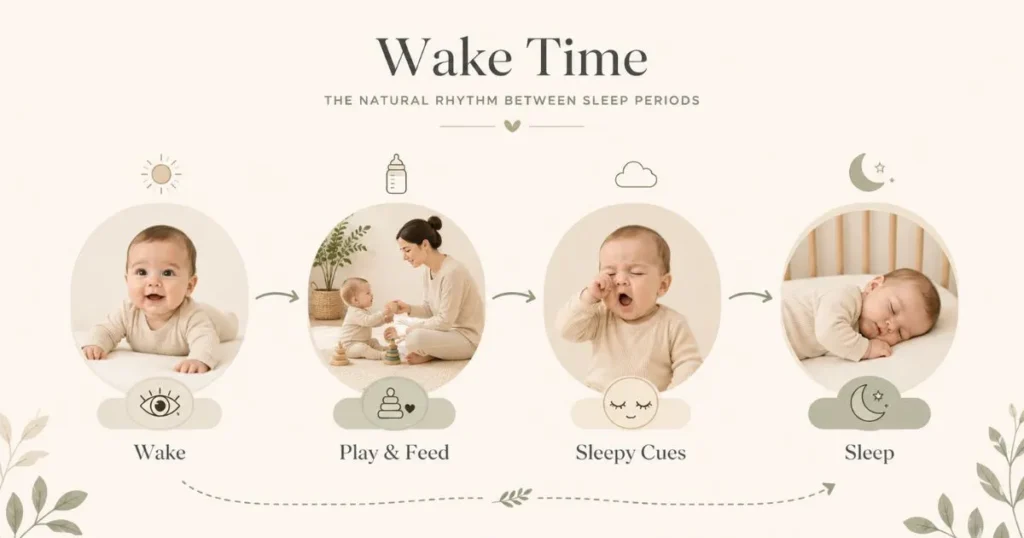
A wake window is simply the period your baby stays awake between sleep periods.
Wake windows are useful because they help you understand when your baby may be ready for another sleep period.
However, you should not treat a wake window like a stopwatch.
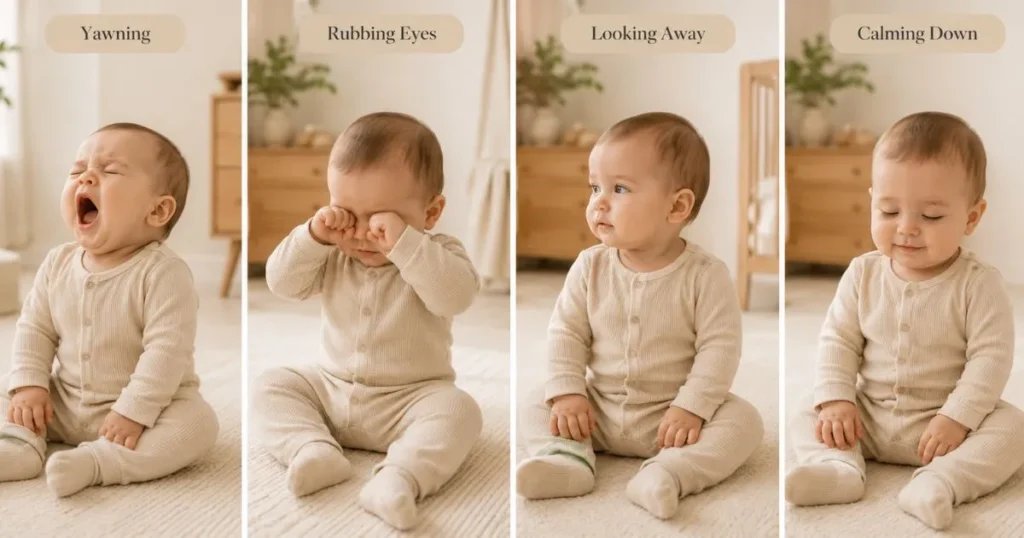
Signs Your Baby May Be Ready for Sleep
Look for:
- Yawning
- Rubbing their eyes
- Looking away
- Becoming quieter
- Losing interest in toys
- Fussiness
- Reduced activity
- Becoming harder to engage
Your baby’s cues become especially helpful when their schedule doesn’t quite match the clock.
Signs Your Schedule May Need Adjusting
Your baby may need a change if they consistently:
- Refuse naps
- Take a long time to fall asleep
- Become extremely fussy before sleep
- Take very short naps
- Fight bedtime every evening
- Wake unusually early
Look for patterns over several days rather than changing your schedule after one difficult nap.
How Many Naps Does a Baby Need?
Nap needs change throughout infancy.
Newborns typically sleep in many short periods rather than following a predictable nap schedule. As babies mature, their daytime sleep usually becomes more organized.
General Nap Pattern
- 0–3 months: Multiple sleep periods throughout the day
- 4–6 months: Several naps are common
- 7–9 months: Many babies move toward two naps
- 10–12 months: Two naps often continue
The exact number matters less than whether your baby is getting enough overall sleep and functioning well during their awake periods.
Signs Your Baby May Be Ready to Drop a Nap
Look for a consistent pattern rather than a single bad day.
You may notice:
- Your baby repeatedly refuses one nap.
- Your baby takes a while to fall asleep for that nap.
- The current schedule repeatedly pushes bedtime too late.
- Your baby comfortably stays awake longer.
- The change continues for several days rather than happening once.
If your baby repeatedly resists one nap and comfortably stays awake for longer periods, you may be approaching the transition from two naps to one. Before making the change, learn more about Toddler Nap Schedule and the signs that your baby may actually be ready.
What Bedtime Works Best for Your Baby?
There isn’t one bedtime that works perfectly for every baby.
Your baby’s bedtime depends on:
- Morning wake time
- Nap timing
- Nap length
- Final awake period
- Total daytime sleep
- Individual sleep needs
For many families, an early-evening bedtime works well because it gives the baby enough opportunity for nighttime sleep without pushing them into an overtired state.
Is 7 PM Too Early for a Baby?
Not necessarily.
A 7 PM bedtime can work well for many babies, especially if your baby wakes around 6–7 AM and gets enough daytime sleep.
If your baby consistently struggles at bedtime, look at the whole day rather than simply moving bedtime later.
How to Create a Healthy Baby Sleep Routine

You do not need a complicated routine.
A simple, repeatable pattern can make bedtime easier to predict.
Step 1: Start With a Consistent Morning
Aim to keep your baby’s morning wake-up time fairly consistent when you can.
Step 2: Use Wake Periods as a Guide
Keep track of how long your baby has been awake, but also pay attention to their sleepy cues.
Step 3: Watch for Sleepy Cues
If your baby becomes tired earlier than expected, you can adjust the schedule.
Step 4: Create a Predictable Nap Routine
You might use:
Diaper change → Sleep sack → Short book → Cuddle → Nap
Keep it simple.
Step 5: Create a Calming Bedtime Routine

For example:
Bath → Pajamas → Feeding → Book → Song → Bed
The purpose isn’t to create a magical sleep formula. It is to give your baby familiar signals that nighttime is approaching.
Step 6: Keep the Sleep Environment Consistent
A calm, dark environment can make sleep easier for many babies.
If you use white noise, keep it at a safe volume and place the device away from your baby’s sleep space.
Baby Sleep Schedule vs. Sleep Cues: Which Should You Follow?

You can use both approaches together rather than choosing just one.
The best approach is:
Age + routine + wake period + sleepy cues + individual needs
For example, if your baby’s usual nap is at 10:00 AM but they are clearly tired at 9:30 AM, you don’t have to keep them awake simply because the clock says it is too early.
Your schedule should serve your baby—not the other way around.
Common Baby Sleep Schedule Problems
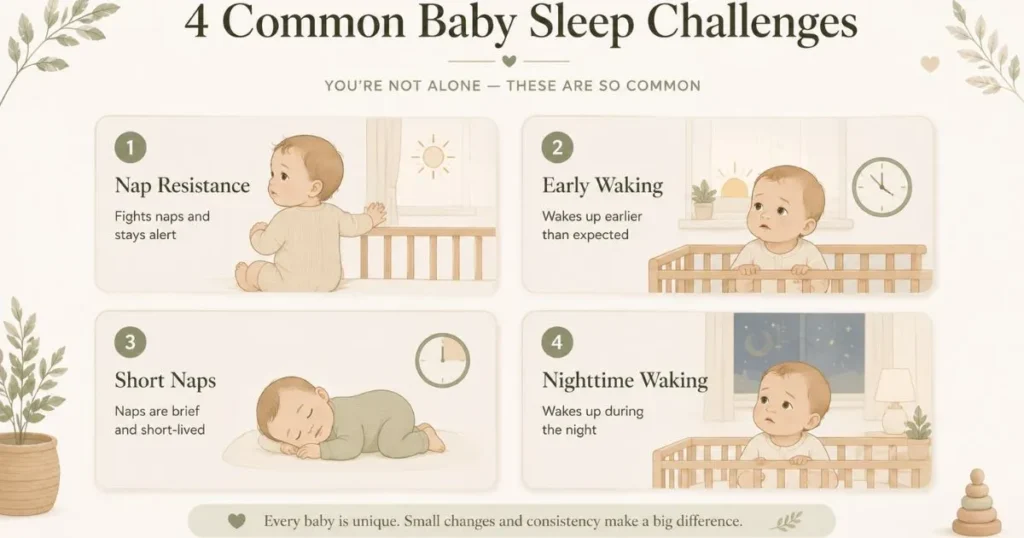
Why Is My Baby Fighting Naps?
Possible reasons include:
- Your baby isn’t tired enough.
- Your baby has become overtired.
- A developmental change is occurring.
- The nap timing no longer fits.
- Your baby’s environment is distracting.
Look at the pattern before making a major change.
Why Is My Baby Waking Too Early?
Early waking can have several possible causes, including:
- Nap timing
- Bedtime timing
- Developmental changes
- Hunger
- Environmental factors
- Individual sleep patterns
Avoid automatically assuming that an early bedtime causes early waking. Sometimes moving bedtime earlier can actually help an overtired baby sleep more comfortably.
Why Does My Baby Take Short Naps?
Short naps can happen because of developmental changes, sleep-cycle transitions, timing, or individual differences.
One short nap isn’t necessarily a problem.
If every nap is consistently very short and your baby seems tired or unhappy, it may be worth reviewing the schedule with your pediatrician.
Why Is My Baby Waking Frequently at Night?
Night waking is not automatically a sign that your baby’s schedule is wrong.
Young babies wake for many reasons, including feeding and normal sleep-cycle transitions. Even at around 6 months, your baby may still wake during the night.
Baby Sleep Regressions and Schedule Changes
Just when your baby’s sleep starts feeling predictable, development can shake things up.
Common periods parents often describe as sleep regressions include:
- Around 4 months
- Around 6 months
- Around 8 months
- Around 12 months
These changes can overlap with developmental milestones, increased mobility, separation anxiety, or changing nap needs.
Teething can also make sleep more difficult, so it can be helpful to understand the difference between developmental sleep changes and discomfort. See our guide to sleep regression vs. teething for a closer look at the two.
If your baby suddenly starts waking more frequently, fighting naps, or resisting bedtime, don’t immediately throw away the entire routine.
First ask:
- Has my baby’s development changed?
- Has the nap pattern changed?
- Is my baby getting enough daytime sleep?
- Are wake periods appropriate?
- Is my baby sick or uncomfortable?
- Has separation anxiety increased?
Sometimes the best response is a small adjustment rather than a complete schedule reset.
Safe Sleep: The Most Important Part of Any Baby Sleep Schedule

A good sleep schedule is helpful, but safe sleep comes first.
The American Academy of Pediatrics safe sleep recommendations advise placing babies on their backs for every sleep and using a firm, flat, non-inclined sleep surface.
Always Put Your Baby on Their Back to Sleep
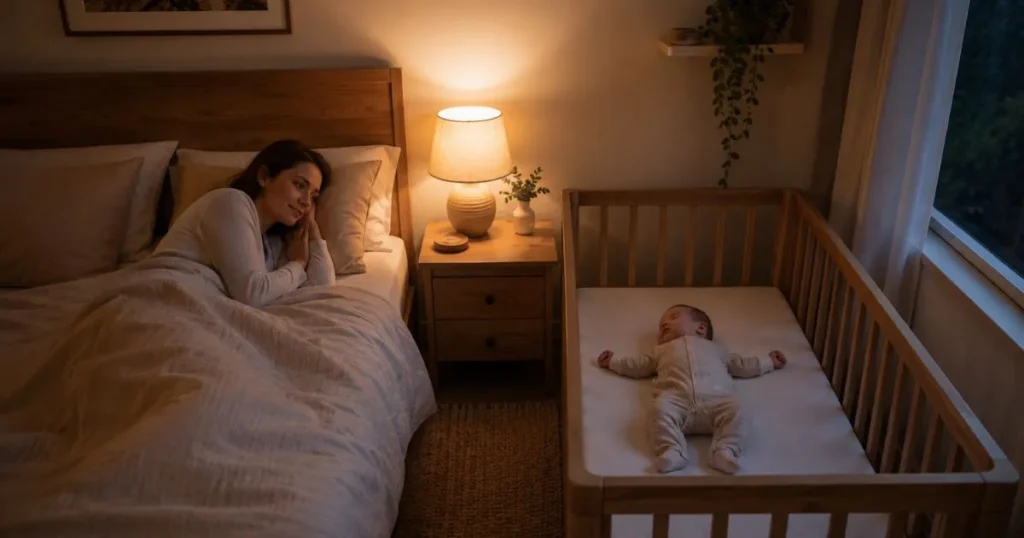
Always place your baby on their back for naps and nighttime sleep. If you’re wondering when babies can sleep on their stomach, remember that you should always place your baby on their back at the beginning of every sleep period and follow current safe-sleep recommendations.
Use a Firm, Flat Sleep Surface
Use a safety-approved crib, bassinet, or portable play yard with a firm, flat mattress and fitted sheet.
Keep the Sleep Space Clear
The AAP recommends keeping pillows, loose blankets, stuffed toys, bumpers, and other soft objects out of your baby’s sleep space. If you’re wondering when your baby can sleep with a blanket, our guide explains what parents should know about blankets and infant sleep safety.
The AAP safe sleep guidance recommends keeping pillows, loose blankets, stuffed toys, bumpers, and other soft objects out of your baby’s sleep space.
Room-Sharing Is Different From Bed-Sharing
The AAP recommends room-sharing without bed-sharing, meaning your baby can sleep close to you while remaining on a separate infant sleep surface.
Never Let a Schedule Override Safety
A baby who takes a longer nap in an unsafe location does not have a “better” sleep schedule.
Your baby’s sleep environment should always meet safe-sleep recommendations.
When Should You Talk to Your Pediatrician About Your Baby’s Sleep?

Talk to your pediatrician if you’re concerned about any of the following:
- Your baby’s breathing during sleep
- Persistent or concerning snoring
- Significant changes in feeding
- Growth or weight concerns
- Unusual sleep behavior
- Persistent sleep problems that worry you
- Your baby’s overall health or development
You know your baby best. If something doesn’t seem right, asking your pediatrician is appropriate.
Frequently Asked Questions About Baby Sleep Schedule
What Is a Good Baby Sleep Schedule?
A good baby sleep schedule is one that provides age-appropriate opportunities for sleep while remaining flexible enough to respond to your baby’s individual needs. Use regular wake times, naps, bedtime routines, and sleepy cues as your framework rather than following an exact clock.
How Do You Create a Baby Sleep Schedule?
Start with a relatively consistent morning, consider your baby’s age and total sleep needs, use wake periods as a guide, watch for sleepy cues, and establish a predictable bedtime routine. Adjust the routine gradually when your baby’s needs change.
How Much Sleep Does a Baby Need?
According to the CDC, newborns ages 0–3 months generally need 14–17 hours of sleep per 24 hours, while babies ages 4–12 months need 12–16 hours, including naps.
How Many Naps Should My Baby Have?
Nap patterns vary by age. Newborns usually sleep in multiple periods throughout the day, while older babies gradually move toward fewer and longer naps. Many babies around 7–12 months follow a two-nap pattern, but individual needs vary.
What Time Should Your Baby Go to Bed?
There is no single correct bedtime for every baby. Your baby’s bedtime should fit their morning wake time, naps, final awake period, and individual sleep needs. An early-evening bedtime can be appropriate for many infants.
Should You Follow a Baby Sleep Schedule or Sleep Cues?
Ideally, you use both. Your schedule gives your day structure, while your baby’s sleepy cues tell you when adjustments may be needed.
Why Is My Baby Suddenly Fighting Naps?
Your baby may be experiencing a developmental change, becoming more mobile, developing separation anxiety, or moving toward a different nap pattern. Check whether your baby’s current schedule still fits before making major changes.
When Will Your Baby Begin Sleeping Through the Night?
There isn’t one specific age when every baby starts sleeping through the night. Many babies continue to wake during the night for feeding, comfort, or help settling back to sleep.
When Should a Baby Transition From Two Naps to One?
Nap transitions can happen at different times for every baby. Instead of dropping a nap just because your baby reaches a certain age, look for consistent signs that one of their naps no longer fits comfortably into their daily routine.
Could Your Baby Be Sleeping Too Much During the Day?
Daytime naps are a normal and important part of healthy infant sleep. If your baby suddenly starts sleeping much more than usual, is difficult to wake, feeds poorly, or appears unwell, contact your pediatrician for guidance.
Conclusion: Your Baby Doesn’t Need a Perfect Sleep Schedule

Creating a baby sleep schedule by age doesn’t mean every day needs to look exactly the same.
Your newborn may sleep in unpredictable stretches. At 6 months, your baby might suddenly resist a nap. By 8 months, new skills such as crawling or standing may lead to more frequent night waking. Around 12 months, your baby might skip a nap one day and seem to need extra sleep the next.
None of this means you’re doing anything wrong.
Use your baby’s age and overall sleep needs as a starting point. Build familiar patterns around naps and bedtime, watch for sleepy cues, and make small changes as your baby grows and develops.
Most importantly, keep safe sleep practices at the heart of your routine. Place your baby on their back, use a firm, flat sleep surface, keep the sleep area free of loose items, and have your baby sleep on a separate infant sleep surface in your room.
You don’t need a perfect routine. You need a baby sleep routine that works well for your baby and your family.
Save this guide so you can come back to it as your baby’s sleep changes, and explore our age-specific sleep guides for practical tips throughout your baby’s first year.