

The final weeks of pregnancy can feel like a countdown that never ends. Your back may ache, sleep may be difficult, and even a short walk can leave you exhausted. If your due date is approaching—or has already passed—you may find yourself searching for ways to help your baby arrive.
You might have heard that eating dates, walking, having sex, or drinking raspberry leaf tea can start contractions. But how to induce labor naturally is a question that deserves more than a list of home remedies. If you’re researching how to induce labor, it’s important to understand that some approaches have been studied, while others have little scientific support. Even a method that sounds gentle can carry risks during pregnancy.
The good news is that you can learn what research actually says, which popular methods remain unproven, and when medical induction may be worth discussing with your healthcare professional. Understanding how to induce labor safely starts with knowing the evidence and recognizing which methods may not be appropriate for you.
Let’s look at the evidence so you can make informed decisions without feeling pressured to rush your baby’s arrival.

What Does It Mean to Induce Labor Naturally?
Natural labor induction usually refers to activities, foods, or complementary therapies people try to encourage labor without prescription medication or a medical procedure. Common examples include walking, sexual intercourse, eating dates, and using herbal products. If you’re researching how to induce labor naturally, you may come across many of these approaches online.
However, trying a natural method is not the same as successfully inducing labor. No home method has been proven to safely and reliably start labor on demand. Before exploring how to induce labor at home, it’s important to understand the available evidence and potential risks. The NHS specifically advises that evidence does not support commonly promoted home remedies as dependable ways to begin labor. (NHS)
How Does Labor Begin Naturally?
Labor involves several interacting processes that prepare your body for childbirth. Your cervix gradually softens, thins, and opens, while uterine contractions help move your baby toward delivery.
Hormones and chemical signals from your body, placenta, and baby contribute to this process. Researchers continue to study how these signals work together, which is why no single food or activity can reliably switch labor on. When exploring how to induce labor naturally, it’s important to remember that encouraging these processes is not the same as reliably starting labor.
As your due date approaches, you may notice changes such as pelvic pressure, irregular contractions, or the loss of your mucus plug. These signs can occur before labor, but they do not tell you exactly when contractions will become established. Understanding these early signs can help you make informed decisions about how to induce labor safely and when to contact your healthcare professional.
Natural Labor Induction vs. Medical Induction
It helps to understand the difference between three terms when researching how to induce labor:
- Spontaneous labor: Contractions and cervical changes begin without a planned induction procedure.
- Natural approaches: Activities or foods people try in the hope of encouraging labor naturally.
- Medical induction: A healthcare professional uses medications or procedures to start labor when appropriate.
Natural approaches are not automatically safer than medical care. If you’re exploring how to induce labor, remember that their effectiveness and potential risks depend on the method you consider and the circumstances of your pregnancy.
When Is It Safe to Try to Encourage Labor?
Before exploring how to induce labor or trying to trigger contractions, consider how many weeks pregnant you are and whether you have any pregnancy complications.
Can You Try to Induce Labor Before 39 Weeks?
Pregnancy is divided into several stages that are important to understand before considering how to induce labor:
- Early term: From 37 weeks to 38 weeks and 6 days of pregnancy.
- Full term: From 39 weeks to 40 weeks and 6 days of pregnancy.
- Late term: From 41 weeks to 41 weeks and 6 days of pregnancy.
- Postterm: 42 weeks of pregnancy and beyond.
If you and your baby are healthy, elective medical induction should not take place before 39 weeks. However, certain medical conditions may make an earlier delivery the safer option.
Before trying to figure out how to induce labor at home, discuss your plans with your obstetrician or midwife. If you’re 37 or 38 weeks pregnant and feeling uncomfortable, ask your healthcare professional about safe ways to manage your symptoms rather than attempting to trigger contractions.
Medical Conditions That Can Change Your Options
Some conditions require special consideration before deciding how to induce labor or may make vaginal birth unsafe. Examples include:
- Placenta previa, a condition in which the placenta partially or completely covers the cervix.
- Certain types of previous cesarean incisions or other uterine surgeries.
- Breech or transverse fetal positioning.
- Unexplained vaginal bleeding.
- Pregnancy complications that require a specific delivery plan.
These conditions do not all have the same implications. Your healthcare professional can assess your circumstances and determine which methods, if any, are appropriate. In some situations, a cesarean birth may be necessary instead of labor induction. Before exploring how to induce labor, make sure your provider knows your medical history and any complications affecting your pregnancy.
Questions to Ask Your Doctor or Midwife
Before tryinBefore trying any method for how to induce labor, consider asking your healthcare professional:
- Is there a medical reason to induce labor now?
- Are there any activities or remedies I should avoid?
- What are the benefits and risks of waiting?
- When should I contact the maternity unit?
- What options are available if labor does not begin naturally?
These questions can help you make informed decisions based on your health and your baby’s well-being, rather than feeling pressured by your due date or advice you encounter online.
How to Induce Labor Naturally: What Really Works?
When researching how to induce labor naturally, you’ll find plenty of confident recommendations online. However, scientific evidence is more limited than many of these lists suggest.
The methods below vary in how much research supports them, and none should be considered a guaranteed way to start labor. Before trying any approach, consider its potential risks and discuss it with your healthcare professional.
Can Walking Help Induce Labor?
Walking is a popular suggestion for people exploring how to induce labor naturally because it allows you to stay upright and move comfortably during late pregnancy. Gentle movement may help you maintain mobility and manage some of the physical discomfort that comes with waiting for your baby to arrive.
Some people believe that gravity and pelvic movement encourage the baby to move lower. However, walking has not been proven to reliably initiate labor.
If your pregnancy care team has approved normal physical activity, you may enjoy a gentle walk as you prepare for childbirth, provided you feel comfortable. Choose a manageable pace, drink water, and stop if you feel dizzy, short of breath, unusually tired, or in pain.
Avoid exhausting yourself in an attempt to induce labor. Rest is also valuable as you prepare for childbirth, and walking should be viewed as a way to stay comfortable rather than a guaranteed method of starting contractions.
Can Sex Induce Labor?
Sex is sometimes suggested when exploring how to induce labor naturally because semen contains prostaglandins, substances involved in cervical ripening. Orgasm may also cause temporary uterine contractions.
However, these biological explanations do not prove that sexual intercourse can reliably start labor. Research has not established a consistent benefit for labor induction.
Sex may be unsuitable in certain circumstances, including if your waters have broken, your healthcare professional has advised you to avoid intercourse, or you have a pregnancy complication that affects this recommendation. Before trying sex as a way to induce labor, ask your healthcare professional if you’re unsure whether it is safe for you.
Can Nipple Stimulation Start Labor?
Nipple stimulation is sometimes discussed when researching how to induce labor naturally because it can trigger the release of oxytocin, a hormone that causes uterine contractions. For this reason, researchers have investigated whether stimulation might help labor begin.
However, contractions are not automatically harmless simply because they occur naturally. Contractions that are too frequent or prolonged can affect your baby’s well-being, and current evidence does not establish that this method is safe for every pregnancy.
Avoid using nipple stimulation as a do-it-yourself method to induce labor. Speak with your maternity care professional before considering it, especially if you have a high-risk pregnancy or a history of uterine surgery.
Do Dates Help Soften the Cervix?
Dates are among the foods researchers have studied for their possible effects on labor and childbirth outcomes. Some studies have found associations between eating dates during late pregnancy and cervical readiness, the timing of labor, or the need for certain medical interventions. This has led some people researching how to induce labor naturally to consider adding dates to their diet.
However, the findings are not conclusive. A systematic review published in 2024 examined dates and childbirth outcomes but identified limitations in the available evidence, including uncertainty about the strength of the findings and the reporting of safety outcomes. (BMC Pregnancy and Childbirth)
You can discuss eating dates during pregnancy with your healthcare professional, taking your nutritional needs and any relevant medical conditions into account. Although dates may be part of a balanced diet, there is no guarantee that eating a particular number will induce labor or help you avoid medical induction.
Does Raspberry Leaf Tea Induce Labor?
Raspberry leaf tea has traditionally been used during late pregnancy, often because of the belief that it helps prepare the uterus for childbirth. As you research how to induce labor naturally, you may come across recommendations to drink this herbal tea.
However, scientific evidence is insufficient to show that raspberry leaf tea reliably induces labor or improves delivery outcomes. Herbal products can also vary in strength and composition, and information about their safety during pregnancy may be limited.
Before using raspberry leaf tea or any other herbal product to prepare for labor, speak with your healthcare professional. A traditional remedy should not be treated as a proven medical intervention or a guaranteed way to start contractions.
Can Acupuncture or Acupressure Induce Labor?
Acupuncture involves inserting fine needles into specific points on the body, while acupressure applies physical pressure to selected areas. Some people try these therapies to relax or manage discomfort during pregnancy, and they may encounter them while researching how to induce labor naturally.
However, research has not established acupuncture or acupressure as reliable methods for starting labor. If you choose either therapy for another reason, seek a qualified practitioner with experience in pregnancy care and inform your maternity team about your plans before beginning treatment.
Do Spicy Foods or Pineapple Help Start Labor?
Spicy foods, pineapple, and other specific foods often appear on lists of natural ways to induce labor. However, there is no convincing scientific evidence that eating these foods reliably starts contractions. If you’re exploring how to induce labor naturally, it’s important to distinguish popular advice from methods supported by research.
Spicy meals may worsen heartburn or digestive discomfort, which can already be common during late pregnancy. Pineapple can be enjoyed as part of your regular diet if it suits you, but eating excessive amounts in the hope of triggering contractions is not recommended.
The same principle applies to other foods promoted for labor induction: enjoy pregnancy-appropriate foods for their nutritional value rather than relying on them to start labor or replace medical guidance.
Natural Labor Induction Methods Compared
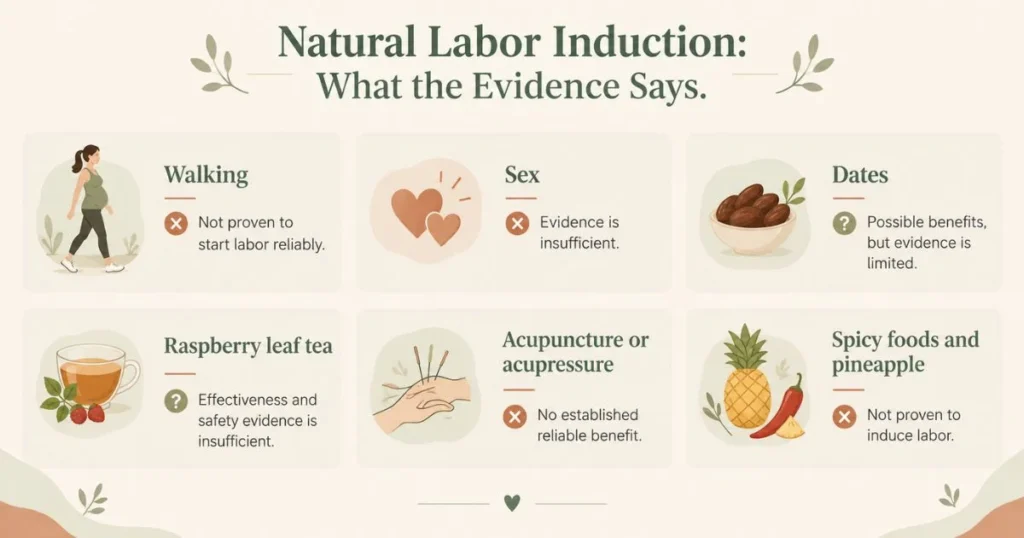
Use this table as a quick reference when evaluating common suggestions.
| Method | What the evidence suggests | Practical takeaway |
| Walking | Not established as a reliable induction method | Gentle movement may support comfort |
| Sex | Insufficient evidence of reliable induction | Check safety, especially if waters break |
| Nipple stimulation | Can trigger contractions; safety evidence is limited | Do not attempt without clinical guidance |
| Dates | Possible benefits reported in some studies, but evidence is limited | Treat as food, not an induction treatment |
| Raspberry leaf tea | Insufficient evidence of reliable effectiveness | Ask about herbal-product safety |
| Acupuncture or acupressure | No established reliable induction benefit | Do not rely on either to start labor |
| Spicy foods or pineapple | No convincing evidence of reliable induction | Eat ordinary amounts for enjoyment and nutrition |
The key distinction is between a method that has a possible biological explanation and one that has been shown to safely and consistently start labor. These are not the same thing.
Foods and Drinks People Use to Try to Induce Labor
Although food cannot reliably start labor, you can still choose nourishing snacks that help you feel comfortable and maintain your energy during late pregnancy.
Foods Commonly Associated With Labor Induction
| Food or drink | Why people try it | What you should know |
| Dates | Studied for possible effects on cervical readiness | Evidence is limited; dates do not guarantee labor |
| Pineapple | Believed to contain substances that affect the cervix | Not proven to induce labor |
| Spicy foods | Thought to stimulate contractions | May worsen heartburn or digestive discomfort |
| Raspberry leaf tea | Traditionally used before childbirth | Effectiveness and safety evidence is insufficient |
| Castor oil | Used in some traditional practices | Not recommended as a do-it-yourself induction method |
You do not need to follow a special diet to make labor begin. Instead, focus on foods that you tolerate well and that fit your nutritional needs.
Simple Late-Pregnancy Snack Ideas
These recipes are intended for nourishment, not labor induction.
| Snack | Ingredients | Nutritional purpose |
| Yogurt and date bowl | Pasteurized yogurt, chopped dates, oats | Provides carbohydrates, protein, and fiber |
| Fruit oatmeal | Oats, milk or a suitable alternative, sliced fruit | Provides energy and fiber |
| Whole-grain toast | Whole-grain bread, nut butter if tolerated | Offers carbohydrates and fats |
Food safety reminder: Choose pasteurized dairy products, wash fresh produce, and account for allergies or dietary restrictions. If you have gestational diabetes or another condition affecting your diet, ask your healthcare professional which foods and portions suit your needs.
Natural Labor Induction Methods You Should Avoid
When researching how to induce labor naturally, you may come across remedies that promise quick results. Be cautious of recommendations that claim to start labor overnight, guarantee contractions, or suggest that a strong physical reaction proves the method works.
Is Castor Oil Safe for Inducing Labor?
Castor oil is a laxative that can cause significant digestive discomfort, including diarrhea, nausea, and abdominal cramps. These side effects can make late pregnancy even more uncomfortable and may contribute to dehydration.
Although researchers have studied castor oil for labor induction, the available evidence does not establish it as a safe and reliable home method. If you’re searching for how to induce labor naturally, it’s important to know that the UK’s National Institute for Health and Care Excellence (NICE) does not support using castor oil to induce labor based on the available evidence. (NICE recommendations)
Avoid taking castor oil to trigger contractions unless your healthcare professional has given you specific medical advice about its use. It is not a proven, risk-free way to start labor at home.
What About Herbal Supplements and Essential Oils?
Products such as blue cohosh, black cohosh, evening primrose oil, and clary sage are sometimes promoted as ways to prepare for labor. However, evidence supporting their effectiveness and safety is limited, and some products may cause serious adverse effects. When researching how to induce labor naturally, remember that a product marketed as a natural remedy is not necessarily safe during pregnancy.
Herbal preparations can vary in concentration, interact with medications, or affect your body in unpredictable ways. Essential oils intended for external use should not be swallowed unless a qualified healthcare professional has specifically advised you to do so.
Avoid using herbs, oils, or concentrated supplements on your own to trigger contractions. Before considering any product for labor preparation, consult your healthcare professional about its potential risks and suitability for your pregnancy.
Why You Should Never Try to Break Your Own Waters
Your amniotic sac provides protection for your baby throughout pregnancy. Trying to break your waters yourself as a way to learn how to induce labor can cause injury, infection, and other complications.
If your waters break on their own, contact your maternity care team promptly, even if contractions have not started. Make a note of when the fluid appeared, its amount and color, and any other symptoms you experience. Follow your healthcare professional’s instructions instead of attempting to speed up labor on your own.
What Should You Do Instead?
If you’re tired of waiting and wondering how to induce labor, consider taking these steps:
- Confirm how many weeks pregnant you are.
- Ask your healthcare professional whether it is appropriate to continue waiting.
- Discuss any home method before trying it.
- Learn which symptoms require urgent medical assessment.
- Ask about medical options if induction may be necessary.
You deserve clear guidance and support as you prepare for childbirth, not pressure to try increasingly aggressive remedies to make labor begin.
Signs Your Body May Be Getting Ready for Labor
When learning how to induce labor, recognizing the signs of labor can help you understand the changes in your body without assuming that every new symptom means your baby will arrive soon.
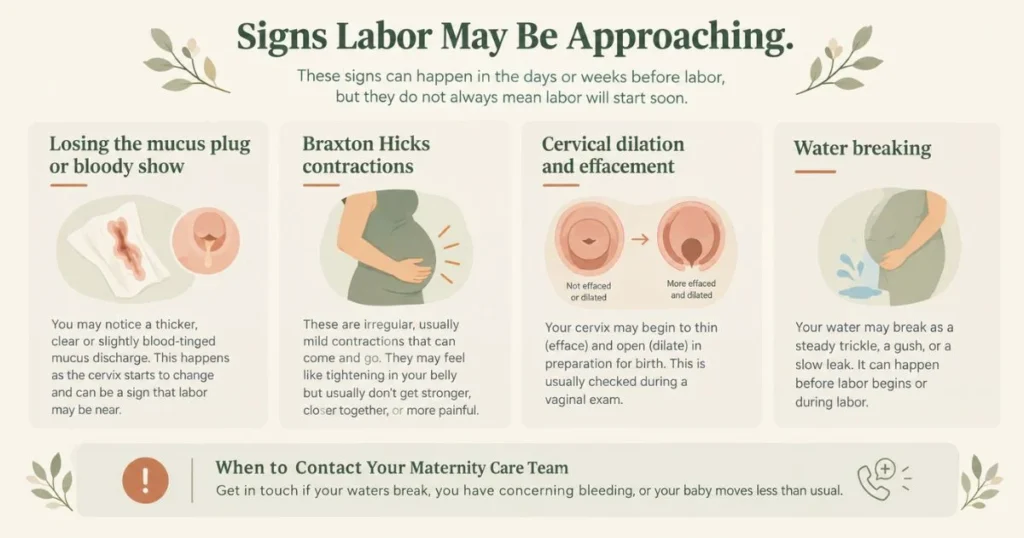
Losing Your Mucus Plug or Having a Bloody Show
The mucus plug helps protect your cervix throughout pregnancy. As your cervix begins to change, you may notice thick mucus that is clear, pink, or lightly streaked with blood.
This is often called a bloody show. If you’re researching how to induce labor, remember that losing your mucus plug is a natural sign of cervical changes, but it does not mean labor will begin immediately. It may happen shortly before labor or several days earlier.
Heavy vaginal bleeding is different from lightly blood-streaked mucus and requires urgent medical assessment.
Braxton Hicks Contractions vs. True Labor
Braxton Hicks contractions, often known as practice contractions, can occur for weeks before labor begins and may become more uncomfortable as your due date approaches. If you’re wondering how to induce labor, remember that these contractions do not necessarily mean true labor is starting.
| Feature | Braxton Hicks contractions | Possible true labor |
| Pattern | Often irregular | Tend to develop a more regular pattern |
| Intensity | May vary | Often become stronger over time |
| Frequency | Does not consistently increase | Often become closer together |
| Effect of changing position | May ease | May continue despite rest or movement |
| Cervical changes | Do not establish progressive labor | Progressive cervical changes support a diagnosis of labor |
These patterns are useful clues, but they cannot confirm labor in every case. If you think labor has started, contact your maternity care team for advice.
Cervical Dilation and Effacement
Your cervix gradually changes as your body prepares for childbirth, an important process to understand when learning how to induce labor.
- Dilation refers to how far your cervix has opened.
- Effacement describes how much your cervix has thinned.
Your cervix may begin changing before you notice contractions, or it may remain relatively closed until labor gets closer. If an examination shows little dilation, it does not necessarily mean labor is still far away.
Cervical findings are just one part of assessing labor and cannot reliably predict the exact day or hour your baby will arrive.
What Happens When Your Water Breaks?
Your waters may break in a sudden gush or as a slow trickle of fluid. This can happen before contractions start or after labor is underway. If you’re exploring how to induce labor, remember that your waters breaking is a sign to contact your maternity care team, not a reason to try to speed up labor yourself.
If you suspect your waters have broken:
- Contact your maternity care team promptly.
- Use a sanitary pad instead of a tampon.
- Note the fluid’s color, smell, and approximate time it started.
- Avoid vaginal intercourse and inserting anything into your vagina.
- Follow the instructions you receive about assessment and delivery.
Greenish, brownish, or foul-smelling fluid, vaginal bleeding, fever, or reduced fetal movement requires urgent medical attention. Do not wait for contractions to become stronger before seeking advice. (ACOG: How to Tell When Labor Begins)
What If You’re 40 or 41 Weeks Pregnant and Labor Hasn’t Started?
Reaching your due date without experiencing contractions can feel frustrating, especially if you’ve been researching how to induce labor. However, it does not automatically mean something is wrong. Your due date is an estimate, and spontaneous labor begins at different times for different people.
Is It Normal to Go Past Your Due Date?
Yes, pregnancy can continue beyond 40 weeks. As you approach 41 weeks, your healthcare professional may discuss additional monitoring and the possible benefits of medical induction, especially if you’re wondering how to induce labor safely.
The right decision depends on your pregnancy, your baby’s well-being, your medical history, and your preferences. Your provider can explain whether waiting remains appropriate and when the balance of potential risks may favor delivery.
When Should You Consider Medical Induction?
Medical induction may be recommended when continuing a pregnancy poses greater risks than delivering the baby. If you’re exploring how to induce labor, it’s helpful to understand the medical circumstances in which your healthcare professional may recommend induction, including:
- Pregnancy continuing beyond the recommended timeframe.
- High blood pressure or preeclampsia.
- Certain cases of gestational diabetes.
- Concerns about your baby’s growth.
- Low amniotic fluid levels.
- Certain infections or complications involving the membranes.
Your healthcare professional may also discuss elective induction at 39 weeks if you’re having your first baby and have an otherwise healthy, full-term singleton pregnancy. According to ACOG, this option may reduce the chance of cesarean birth for eligible patients. However, it is not a universal recommendation for every pregnancy. (ACOG: Induction of Labor at 39 Weeks)
What Is a Membrane Sweep?
A membrane sweep, also known as membrane stripping, is a procedure performed by a trained healthcare professional during a vaginal examination when the cervix allows it. If you’re exploring how to induce labor, this is one medical option you may wish to discuss with your provider.
During the procedure, the clinician inserts a gloved finger to separate the membranes surrounding the amniotic sac from the lower part of the uterus. This may stimulate the release of substances that help soften and prepare the cervix for labor.
A membrane sweep may cause discomfort, cramping, or light spotting, and it does not guarantee that labor will begin. Ask your healthcare professional whether this procedure is appropriate for you and what you can expect afterward.
What Are the Medical Methods of Inducing Labor?
If medical induction is recommended, the method your healthcare team chooses will depend partly on how ready your cervix is and your medical history. When considering how to induce labor safely, it’s helpful to understand the main medical options:
- Cervical-ripening medication: Certain medicines help soften and prepare the cervix for labor.
- Balloon catheter: A small balloon applies gentle pressure to help the cervix open.
- Oxytocin: This medication is given through an IV to stimulate uterine contractions.
- Amniotomy: A trained healthcare professional deliberately opens the amniotic sac when appropriate.
Some methods take time to work, and more than one approach may be needed. Your healthcare team will explain your induction plan and monitor your contractions and your baby’s response throughout the process.
What Are the Advantages and Disadvantages of Medical Labor Induction?
Medical induction can help reduce the risks of continuing a pregnancy when delivery is recommended for medical reasons. However, the process may take many hours and can involve additional monitoring or procedures. If you’re learning how to induce labor, understanding these potential benefits and risks can help you prepare for a discussion with your healthcare professional.
Possible complications include overly frequent contractions, changes in your baby’s heart rate, infection, and, in certain circumstances, uterine rupture. Induction does not automatically lead to a cesarean birth, and the likelihood of success varies depending on individual circumstances.
Before deciding whether to proceed, discuss the potential benefits, risks, alternatives, and possibility of waiting with your healthcare professional. They can help you understand which option best fits your pregnancy and medical needs.
When to Contact Your Healthcare Professional Immediately
When learning how to induce labor, knowing when to contact your healthcare provider is far more important than trying another method to trigger contractions.
Warning Signs You Should Never Ignore
Contact your maternity care team promptly if you experience any of the following:
- Your baby is moving less than usual.
- Your waters break or you suspect amniotic fluid is leaking.
- You have vaginal bleeding beyond light spotting or a typical bloody show.
- You experience persistent or worsening abdominal pain.
- You develop a fever or notice fluid with an unusual or unpleasant smell.
- You experience regular contractions before 37 weeks of pregnancy.
A severe headache, vision changes, or other concerning symptoms during pregnancy also require urgent medical assessment. Do not delay seeking care to try another home remedy or wait for contractions to become stronger.
When to Seek Emergency Care
Seek emergency medical care if you experience heavy bleeding, severe and persistent abdominal pain, chest pain, difficulty breathing, fainting with ongoing symptoms, or another medical emergency. If you feel a strong urge to push and believe your baby is about to arrive, call emergency services immediately.
When researching how to induce labor, remember that no food, drink, supplement, or exercise routine should delay urgent medical care. Your maternity team can assess your symptoms, determine what is happening, and guide you on the next steps.
For additional guidance, read ACOG’s advice on recognizing labor.
Frequently Asked Questions About How to Induce Labor Naturally
How to Induce Labor Naturally at Home?
If you’re wondering how to induce labor naturally, remember that no home method has been proven to start labor safely and reliably. Gentle activity may help you stay comfortable when appropriate for your pregnancy, but foods, herbal products, and other popular remedies should not be considered dependable ways to induce labor. Speak with your healthcare professional to understand your options and choose an approach that prioritizes your health and your baby’s well-being.
What Is the Fastest Way to Induce Labor Naturally?
When exploring how to induce labor, remember that no natural method has been proven to make labor begin quickly or reliably. If delivery needs to happen soon, your healthcare professional can explain whether medical induction is appropriate and which method best fits your pregnancy, medical history, and individual circumstances.
How Can I Go Into Labor Tonight?
If you’re wondering how to induce labor overnight, understand that you cannot reliably make labor begin on a specific schedule. Rather than trying several home remedies, focus on rest, hydration, and comfort, provided these are appropriate for your pregnancy. If you’re past your due date or worried about your symptoms, contact your maternity care team to discuss safe options and the next steps.
Can Walking Induce Labor at 39 Weeks?
If you’re exploring how to induce labor at 39 weeks, remember that walking has not been established as a reliable method for starting labor. If your healthcare provider has not restricted your activity, gentle walking may help you stay comfortable and mobile. Stop if you feel unwell, dizzy, or experience pain, and check with your provider if you’re unsure which activities are appropriate for your pregnancy.
Can Sex Help Induce Labor Naturally?
If you’re researching how to induce labor naturally, current evidence does not establish sexual intercourse as a reliable method for starting labor. Sex may be inappropriate if your waters have broken or your healthcare professional has advised you to avoid it. Ask your provider for individualized advice, especially if you have pregnancy complications or concerns about whether sex is safe for you.
What Foods Can Help Induce Labor?
When researching how to induce labor naturally, you may come across claims about dates, pineapple, and spicy foods. Dates have been studied for their possible effects on cervical readiness and labor outcomes, but the evidence remains limited. Pineapple and spicy foods have not been shown to reliably start labor. Choose foods for their nutritional value rather than expecting them to trigger contractions or help you induce labor.
Can I Induce Labor Naturally at 37 Weeks?
If you’re wondering how to induce labor at 37 weeks, avoid trying to start labor at home unless your healthcare provider has specifically advised you to do so. Although 37 weeks is classified as early term, it is not full term. If you have a medical complication that makes delivery necessary, your healthcare professional can explain the safest approach and whether medical induction is appropriate for your situation.
What If I’m 40 Weeks Pregnant and Not Dilated?
If you’re wondering how to induce labor at 40 weeks, remember that not being dilated does not necessarily mean anything is wrong or that labor is far away. Your cervix can change as labor approaches, and dilation alone cannot predict exactly when labor will begin. Discuss your symptoms, monitoring, and options with your healthcare professional rather than trying to force cervical dilation at home.
Is Medical Induction Safer Than Waiting for Natural Labor?
When considering how to induce labor or whether to wait for labor to begin naturally, neither option is universally best. The right choice depends on your gestational age, health, your baby’s condition, and other individual factors. Your healthcare professional can help you weigh the benefits and risks of medical induction against those of continuing the pregnancy so you can make an informed decision.

Conclusion: You Don’t Have to Force Labor to Begin
Waiting for your baby can be physically tiring and emotionally challenging, especially when your due date has passed. It is understandable to look for something that might help labor begin.
However, the best answer to how to induce labor naturally is that no home method is proven to work safely and reliably for everyone. Walking may support comfort, dates have shown some promising but inconclusive research findings, and many other popular remedies lack convincing evidence.
Avoid castor oil, unapproved herbal products, and attempts to break your own waters. Before trying any method intended to trigger contractions, speak with your obstetrician or midwife. If you reach 41 weeks, develop concerning symptoms, or have questions about your baby’s well-being, ask for individualized advice rather than relying on home remedies.
You do not have to make labor happen on a particular schedule to be doing everything right. Sometimes the next step is waiting with appropriate support; sometimes it is discussing medical induction. Both deserve thoughtful, informed care.
Your next step: Save this guide for your late-pregnancy planning, discuss your questions at your next prenatal appointment, and explore more Parenting Whisper resources on birth preparation, recognizing labor signs, and postpartum recovery.