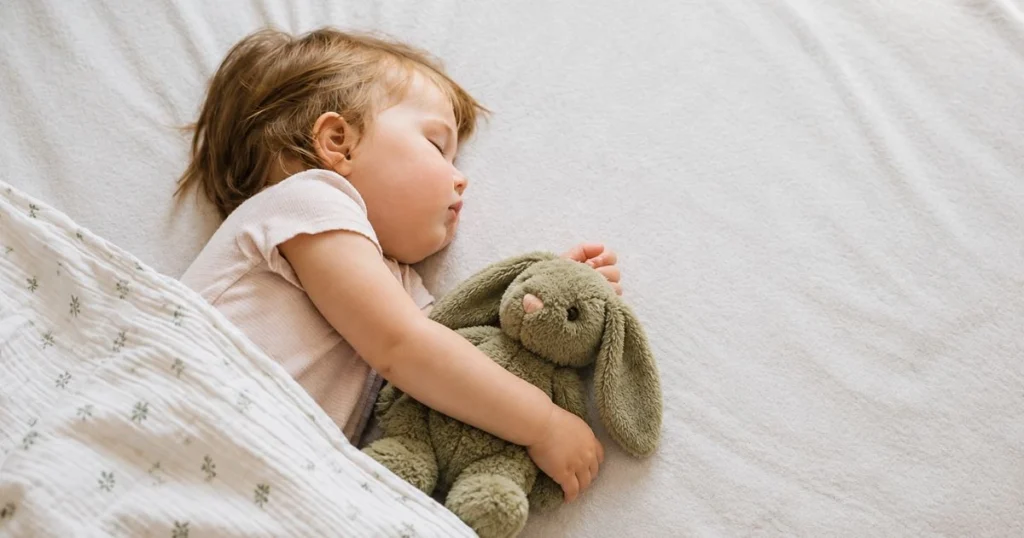
There comes a point when your child’s afternoon nap starts to feel less predictable.
One day, they fall asleep easily after lunch. The next, they spend the entire nap period chatting, playing, or looking through books instead of sleeping. Then, just when you think naps are finally over, they fall asleep in the car on the way home and are exhausted by dinner.
If this sounds familiar, you may be wondering: When do kids stop taking naps?
The answer to when do kids stop taking naps varies from one child to another. Some children gradually lose interest in their afternoon sleep during the toddler years, while others continue to nap well into the preschool stage. For some families, the change happens slowly, with a mix of nap days and no-nap days for quite a while.
So rather than choosing an age and deciding that naps are finished, it helps to look at how your child handles the day without one.
Are they still cheerful and engaged in the afternoon? Can they reach bedtime without becoming extremely tired? Are they sleeping well at night? And most importantly, are they getting enough sleep over the entire 24-hour period?
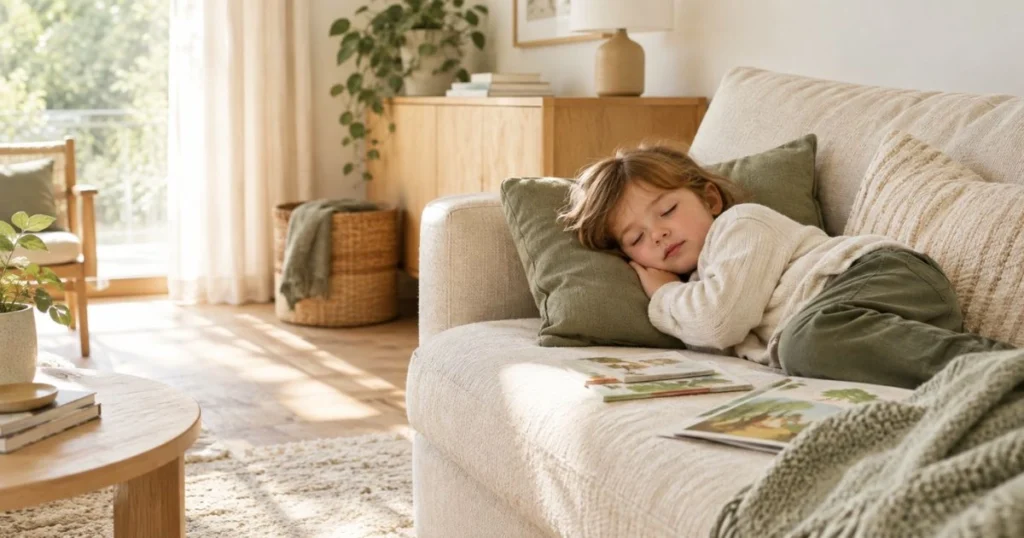
When Do Kids Usually Stop Napping?
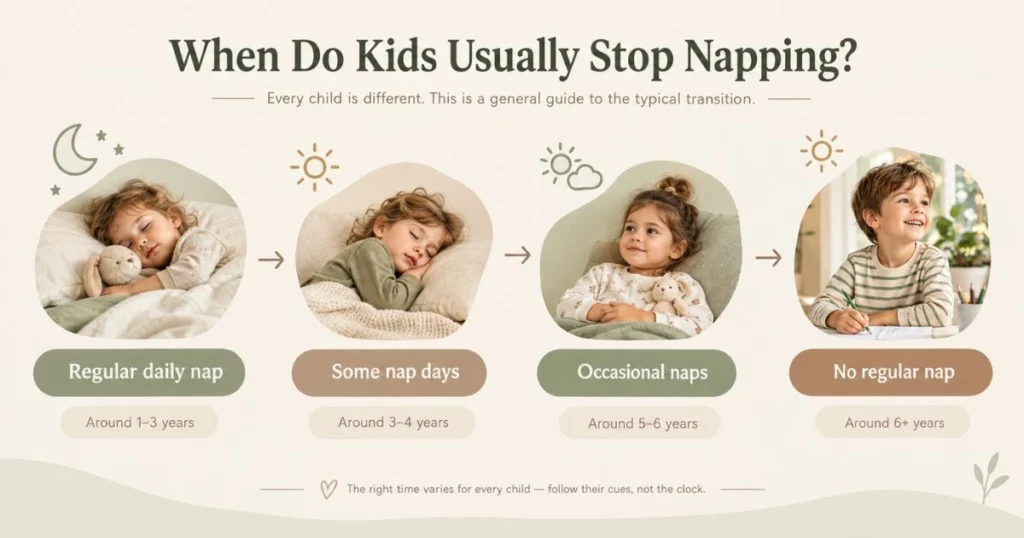
Most parents eventually wonder when do kids stop taking naps, as children gradually move from a regular afternoon nap to a schedule with little or no daytime sleep. This change commonly happens during the preschool years, but there is plenty of normal variation.
A two-year-old may still rely heavily on a daily nap, while another child of the same age may occasionally refuse it. Around age three, you may notice more children beginning to skip naps, shorten them, or nap only after especially busy days. By the later preschool years, daily naps become less common for many children.
That doesn’t mean there is a deadline.
Sleep needs change as children grow, and learning when do kids stop taking naps is usually part of a gradual transition rather than something that happens overnight.
If your child is still taking regular naps, you can compare their daytime sleep pattern with our guide to age-based toddler naps.
Is There a Specific Age When Children Should Stop Napping?
Not really.
There isn’t one birthday when children suddenly stop needing daytime sleep. Two children who are the same age can have very different sleep patterns and still be developing normally.
If you’re wondering when do kids stop taking naps, a more useful question is whether your child can comfortably manage the day without that afternoon sleep.
For example, a preschooler who skips a nap but remains energetic, reaches bedtime without a major struggle, and sleeps well overnight may be ready for fewer naps. Another child of the same age might skip a nap and become irritable, fall asleep in the car, or struggle through the evening. That child may still benefit from daytime sleep.
In other words, age can give you a general idea, but your child’s behavior gives you better information.
How Much Sleep Does a Child Need After Giving Up Naps?
Dropping a nap doesn’t mean your child’s need for sleep suddenly disappears.
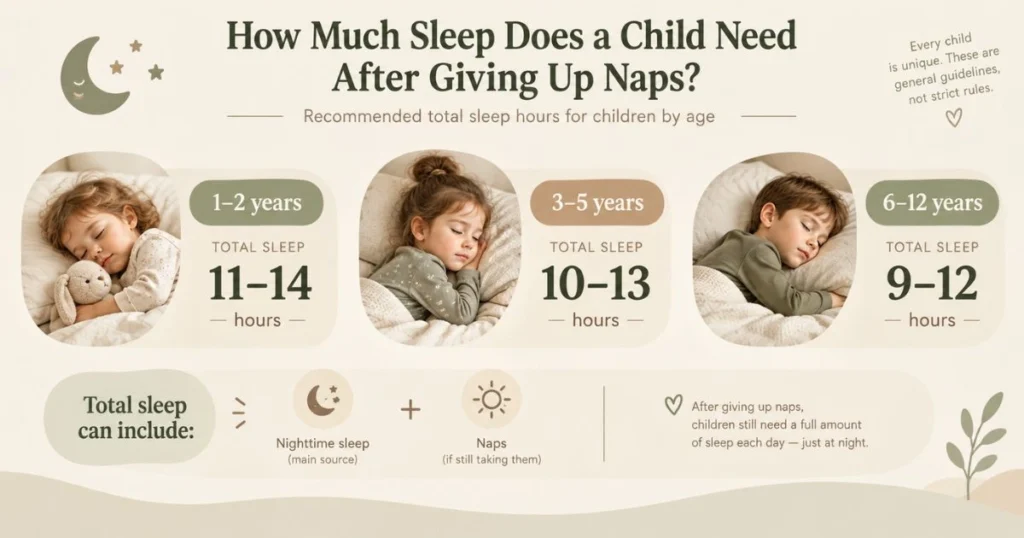
Instead, some of the sleep that previously happened during the afternoon may gradually shift into nighttime hours. If you’re wondering When Do Kids Stop Taking Naps, it’s helpful to consider your child’s total sleep rather than focusing only on whether they slept after lunch. Looking at their overall sleep, mood, and energy can give you a clearer picture of whether they are ready to move away from regular naps.
The American Academy of Sleep Medicine recommends approximately:
| Age | Recommended Sleep in 24 Hours |
| 1–2 years | 11–14 hours |
| 3–5 years | 10–13 hours |
| 6–12 years | 9–12 hours |
These figures refer to sleep across the full day and night, so naps can be part of the total. When Do Kids Stop Taking Naps is a question that often comes up as your child’s sleep needs begin to change.
For instance, a preschooler may eventually meet their sleep needs through nighttime sleep alone. Another child may continue to need occasional daytime sleep to get enough rest.
That’s why understanding when do kids stop taking naps should be less about reaching a particular milestone and more about watching how your child responds.
Understanding your child’s total sleep needs can help you decide whether a nap is still an important part of their daily routine.
Why Total Sleep Matters
It can be tempting to celebrate the end of naps. After all, an extra hour or two in the afternoon can make family schedules much easier.
But a nap-free schedule only works if your child is still getting enough sleep.
If you’re wondering when do kids stop taking naps, remember that a child who isn’t ready may look fine for a few days and then begin showing signs of tiredness. You might notice more emotional outbursts, difficulty concentrating, trouble settling at bedtime, or unexpected sleepiness later in the day.
Instead of asking only, “Did my child nap today?”, consider the bigger picture:
- How much did they sleep overnight?
- How were they behaving during the afternoon?
- Did they become unusually tired before bedtime?
- Did skipping the nap make nighttime sleep better or worse?
- Are they still getting enough sleep overall?
These observations can help you decide whether your child is genuinely moving beyond naps or simply going through a period of nap resistance.
If you’re also trying to understand how sleep changes at different ages, see our complete guide to sleep schedules by age.
10 Signs Your Child May Be Ready to Stop Taking Naps

Nap refusal can be an early clue that your child’s sleep needs are changing. However, skipping a nap once—or even for several days—doesn’t necessarily mean they are ready to stop napping.
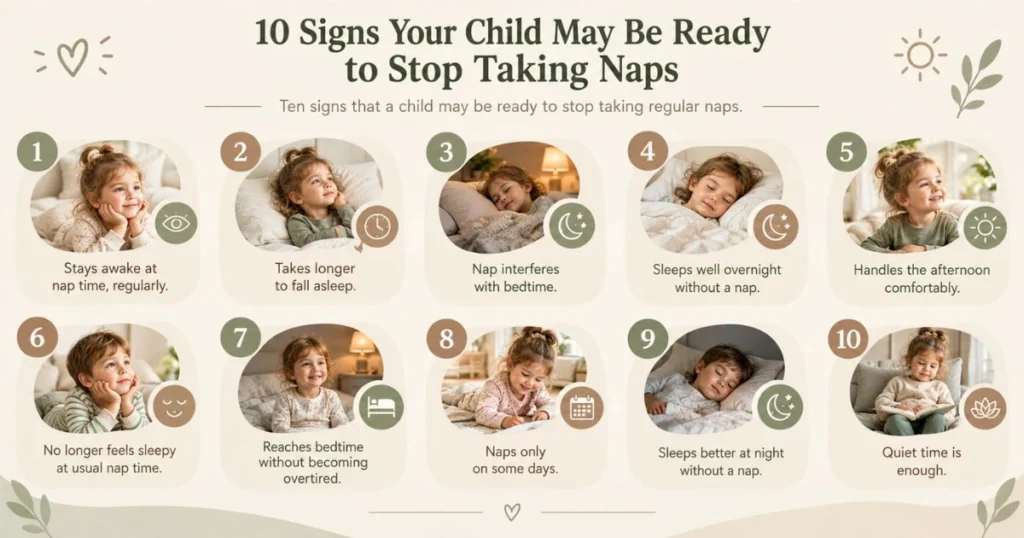
If you’re wondering when do kids stop taking naps, look for several signs that continue over time.
1. Your Child Regularly Stays Awake at Nap Time
Maybe your child used to fall asleep shortly after lunch, but now nap time has become a period of talking, singing, playing, or simply lying awake.
An occasional skipped nap isn’t unusual. Children may have a particularly exciting morning, be distracted by something new, or simply have a day when they aren’t as tired.
The stronger signal is consistency.
If you’re wondering when do kids stop taking naps, pay attention to whether your child repeatedly stays awake throughout nap time and remains comfortable without that sleep. This may indicate that their daytime sleep needs are changing.
2. Getting to Sleep for the Nap Takes Much Longer
Another common clue is a noticeable change in how long your child takes to settle for a nap.
A nap that once happened easily may now involve 30 minutes—or even longer—of trying to get comfortable, leaving the room, asking questions, or simply staying awake.
This can happen as your child’s need for daytime sleep decreases.
If you’re wondering when do kids stop taking naps, don’t focus only on how long your child takes to fall asleep. Pay attention to what happens afterward. If they remain comfortable and function normally throughout the afternoon, they may be moving toward a nap-free routine.
3. The Afternoon Nap Starts Interfering With Bedtime
Sometimes the clearest sign isn’t what happens during nap time—it’s what happens at night.
If your child takes a long afternoon nap and then has little interest in going to bed, the daytime sleep may be reducing their sleepiness in the evening.
You might notice that bedtime becomes later, your child takes much longer to settle, or they suddenly seem full of energy when everyone else is ready to wind down.
That doesn’t automatically mean the nap needs to disappear. Instead, look at the pattern over several days.
If you’re wondering when do kids stop taking naps, consistently easier bedtime on no-nap days—while your child remains comfortable throughout the afternoon—can be a useful sign that their sleep schedule is changing.
A consistent bedtime routine can make this transition easier, especially when your child’s daytime sleep begins to change.
4. Your Child Sleeps Well Overnight on No-Nap Days
A no-nap day can give you valuable information.
Pay attention to what happens overnight. Does your child fall asleep reasonably easily? Do they stay asleep as usual? Do they wake around their normal time? Do they seem rested the following morning?
If nighttime sleep remains healthy after skipping the nap, your child may be able to get enough rest without a daily afternoon sleep. This can help you understand when do kids stop taking naps based on your child’s individual sleep pattern.
On the other hand, if removing the nap repeatedly leads to an exhausted child, disrupted nighttime sleep, or a very difficult evening, they may not be ready to give it up completely.
If bedtime or nighttime sleep is becoming difficult, our guide to toddler bedtime routines can help you build a more predictable evening rhythm.
5. Your Child Handles the Afternoon Without Falling Apart
The hours between lunch and bedtime can tell you a lot.
A child who is ready to move away from daily naps will generally be able to play, interact with family, eat meals, and participate in normal activities without becoming unusually exhausted.
They don’t have to be cheerful every minute. Tiredness and occasional crankiness are normal.
What you’re looking for is a consistent change in their usual behavior.
If you’re wondering when do kids stop taking naps, pay attention to how your child handles the afternoon without a nap. If skipping it regularly leads to intense irritability, frequent meltdowns, or a child who can barely make it to bedtime, daytime sleep may still be useful.
6. Your Child No Longer Seems Sleepy at Their Usual Nap Time
You may remember a time when lunch was followed almost automatically by sleepy eyes, cuddles, and a nap.
Now your child may reach the same time of day and seem ready to keep going.
If you’re wondering when do kids stop taking naps, this repeated change can be a sign that their natural sleep pattern is shifting. Their body may simply be able to stay awake for longer stretches than it could before.
Give the change some time before making a permanent adjustment.
7. Your Child Can Reach Bedtime Without Becoming Overtired
Being able to stay awake isn’t quite enough.
A child may remain awake all afternoon but become increasingly irritable, emotional, or clumsy as bedtime approaches.
If you’re wondering when do kids stop taking naps, remember that a child who is truly ready to stop napping should generally be able to get through the afternoon without becoming severely overtired.
Look at the difference between a child who is comfortably awake and one who is fighting sleep.
Comfortably awake might look like:
- Playing normally
- Talking and interacting with others
- Exploring and participating in activities
- Enjoying family time
- Staying engaged and content until bedtime
If you’re wondering when do kids stop taking naps, these behaviors can be reassuring signs that your child is managing the afternoon well without becoming overly tired.
Signs the afternoon may be too long include:
- Falling asleep unexpectedly
- Becoming extremely irritable
- Crying over small frustrations
- Having an unusually difficult evening
- Struggling to stay awake before bedtime
If you’re wondering when do kids stop taking naps, these signs may suggest that your child still needs some daytime sleep. If this pattern happens frequently, consider continuing to offer a nap or quiet rest period rather than removing daytime sleep completely.
8. Your Child Starts Napping Only on Some Days
The transition away from naps is often a bit messy.
You may have a child who naps on Monday, skips Tuesday, sleeps again on Wednesday, and stays awake Thursday. This back-and-forth can continue for a while.
It doesn’t necessarily mean that your child is confused or that you’ve made the wrong decision.
If you’re wondering when do kids stop taking naps, keep in mind that sleep needs can change gradually. Your child may not yet be ready to go without daytime rest every day.
Instead of thinking in terms of “nap” or “no nap,” allow some flexibility. A nap can still be useful after an especially active morning or a night when your child didn’t sleep as well.
For more guidance on changing nap patterns, see our age-by-age toddler nap schedule.
9. Nights Are Better When There Is No Nap
Another clue can appear after bedtime.
If you’re wondering when do kids stop taking naps, notice whether your child consistently sleeps more peacefully on days when they skip the afternoon nap. You may see them fall asleep faster, resist bedtime less, or sleep for a longer stretch overnight.
One good night isn’t enough to draw a conclusion. Children can have unusual sleep days for all sorts of reasons.
Watch for a pattern over time.
If several no-nap days lead to easier nights while your child remains happy and alert during the afternoon, it may be a sign that the daily nap is becoming less necessary.
10. Quiet Time Becomes Enough
Not every child who stops napping needs to spend the afternoon moving from one activity to another.
Your child may still benefit from a slower part of the day, even if they no longer fall asleep.
This is where quiet time can be especially helpful, particularly when you’re figuring out when do kids stop taking naps and how to adjust their daytime routine.
You could offer:
- Picture books
- Coloring
- Simple puzzles
- Drawing
- Quiet building activities
- Listening to a story
- Calm independent play
The purpose isn’t to secretly make your child nap. Instead, quiet time gives them a chance to slow down and recharge after a busy morning.
Some children may occasionally fall asleep during quiet time. That’s perfectly fine.
Is Your Child Ready to Stop Napping—or Just Fighting Sleep?

One of the most challenging parts of this transition is knowing when to make the change.
A child may resist a nap even when they still genuinely need the extra sleep.
Toddlers and preschoolers are becoming increasingly independent. They may be far more interested in continuing their game than stopping for sleep. Excitement, changes in routine, developmental stages, travel, or simply not wanting to miss anything can all make nap time difficult.
If you’re wondering when do kids stop taking naps, remember that nap resistance alone doesn’t necessarily mean your child has outgrown daytime sleep.
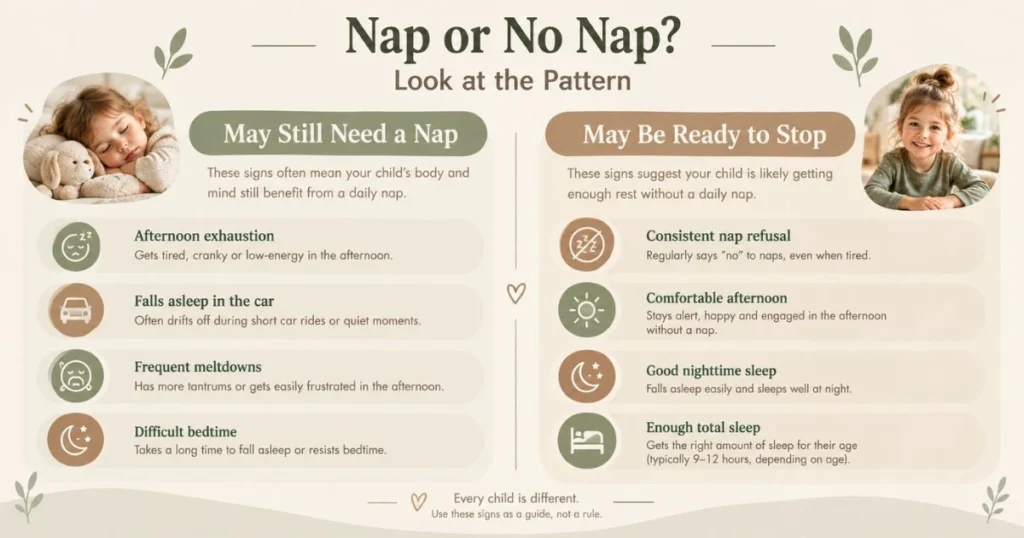
Signs Your Child May Still Need a Nap
Consider continuing to offer daytime sleep or quiet rest if you’re wondering when do kids stop taking naps and your child regularly:
- Becomes extremely tired without a nap
- Falls asleep unexpectedly in the car
- Has intense afternoon meltdowns
- Struggles to make it comfortably to their usual bedtime
- Sleeps worse at night after skipping the nap
- Becomes very sleepy in the late afternoon
- Seems noticeably more rested on days when they nap
These signs may indicate that your child still needs some daytime sleep or rest, even if they occasionally resist taking a nap.
Signs Your Child May Be Ready to Stop Napping
The picture looks different when your child:
- Refuses naps consistently
- Remains comfortable throughout the afternoon
- Sleeps well overnight without a nap
- Settles more easily at bedtime
- Stays reasonably alert until evening
- Continues getting enough sleep overall
If you’re wondering when do kids stop taking naps, remember that these signs can help you understand whether your child is ready to move away from regular daytime sleep.
The signs don’t all have to appear at the same time. Consider them together rather than relying on any one sign on its own.
When Do Kids Stop Taking Naps by Age?
Parents often want a simple answer based on age.
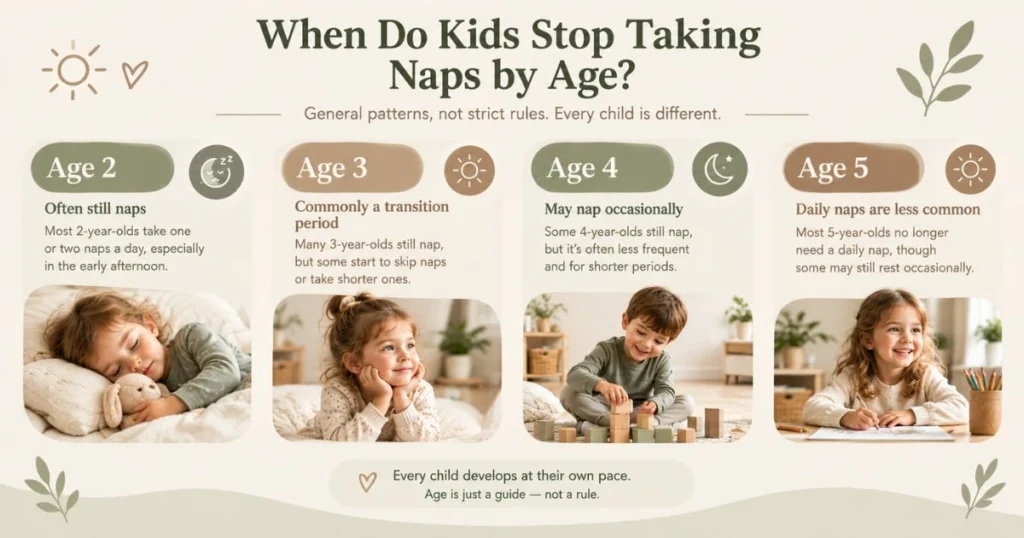
Unfortunately, children’s sleep doesn’t always follow a neat timeline. If you’re wondering when do kids stop taking naps, age can provide useful context, but it shouldn’t be the only factor you consider when deciding whether to continue offering a nap.
Pay attention to your child’s behavior, energy levels, nighttime sleep, and overall ability to manage the day without daytime sleep.
Sleep needs and daily routines can change considerably as children move from infancy into toddlerhood.
Do 2-Year-Olds Still Need Naps?
For many two-year-olds, yes.
Children at this stage commonly still benefit from daytime sleep. If you’re wondering when do kids stop taking naps, remember that the CDC sleep guidance cited in your original article recommends 11–14 hours of total sleep over 24 hours for children ages 2–3, including naps.
That doesn’t mean every two-year-old needs the same amount of afternoon sleep.
If your child occasionally refuses a nap but becomes tired later, keeping a regular rest period may make more sense than removing the nap completely.
The goal is to give your child an opportunity to sleep without turning every afternoon into a battle.
If your child is around this age, you may also find our 1-year-old sleep schedule helpful when comparing how sleep routines change as toddlers grow.
When Do 3-Year-Olds Stop Napping?
Three is often a transition period.
Some children continue taking a reliable afternoon nap, while others begin skipping it more often. If you’re wondering when do kids stop taking naps, age three can be a time when you start noticing a gradual shift in your child’s sleep pattern.
You might find that your three-year-old:
- Sleeps only on certain days
- Needs less daytime sleep than before
- Goes to bed more easily without a nap
- Benefits from quiet time instead of sleeping
According to the AASM guidance used in the original article, children ages 3–5 generally need 10–13 hours of total sleep within 24 hours, including naps.
If your three-year-old stops sleeping during the afternoon, pay attention to whether nighttime sleep is providing enough rest to make up for the change.
Do 4-Year-Olds Still Need Naps?
Some four-year-olds still nap occasionally, while others have completely moved away from daytime sleep.
If you’re wondering when do kids stop taking naps, you may find that by age four, naps happen mainly after particularly busy or active days.
For example, your child might stay awake all afternoon most days but fall asleep after a long day at the park, a family outing, or an unusually active morning.
An occasional nap doesn’t necessarily mean they have gone backward. It may simply be their body’s way of catching up on rest.
Is It Normal for a 5-Year-Old to Nap?
AA regular daily nap becomes less common as children approach school age, but occasional daytime sleep can still happen.
If you’re wondering when do kids stop taking naps, try not to focus too much on one unexpected nap. Instead, consider your child’s overall sleep pattern and daily routine.
Ask yourself:
- Are they sleeping enough at night?
- Are they unusually sleepy during the day?
- Can they participate normally in everyday activities?
- Are there ongoing sleep difficulties?
- Does daytime sleep interfere with bedtime?
The goal isn’t to stop every daytime sleep episode. What matters most is whether your child is getting enough healthy, restorative sleep overall.
How to Stop a Nap Without Making Your Child Overtired

Once the signs start lining up, you don’t have to eliminate the nap overnight.
If you’re wondering when do kids stop taking naps, remember that the transition doesn’t have to happen all at once. A gradual change is often easier for both you and your child.
Think of it as adjusting the daily routine rather than taking something away.
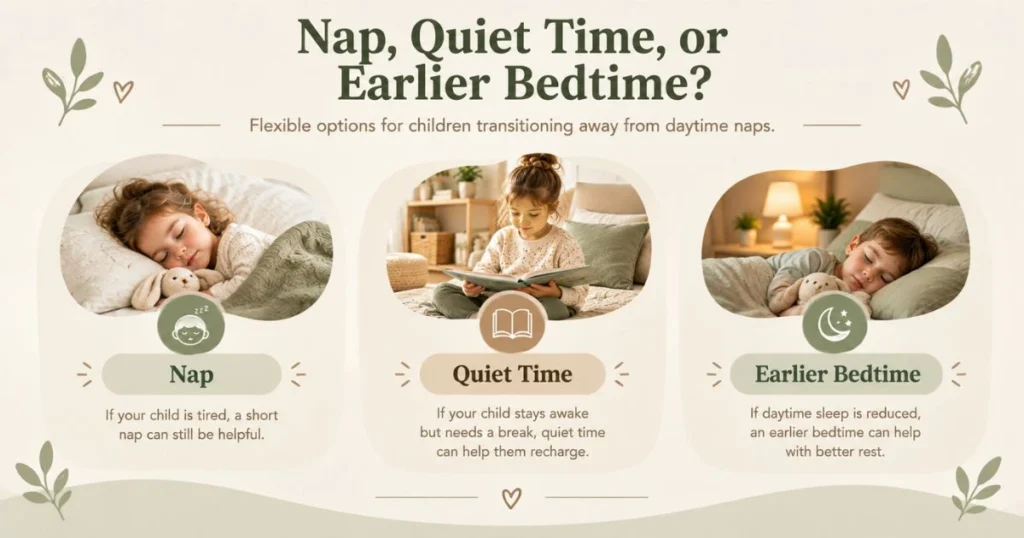
1. Keep the Afternoon Break at First
Even if you suspect the nap is no longer necessary, you don’t have to remove it overnight.
If you’re wondering when do kids stop taking naps, remember that keeping the familiar rest period can make the transition easier for your child.
You can introduce the idea of quiet time instead. After lunch, your child might spend some time in a calm environment with books, puzzles, or another quiet activity.
If they fall asleep, let them sleep when appropriate. If they remain awake, that’s okay too.
Keeping the familiar rhythm can make the transition away from naps feel much less dramatic.
2. Turn Nap Time Into Quiet Time
Quiet time can act as a bridge between regular naps and a completely nap-free schedule.
If you’re wondering when do kids stop taking naps, quiet time can help your child adjust to spending the afternoon awake without losing the opportunity to slow down and rest.
Choose activities that don’t create a lot of excitement:
- Reading
- Coloring
- Simple puzzles
- Building with quiet toys
- Looking at picture books
- Listening to an audiobook
- Resting in a comfortable room
The idea is to give your child’s body and mind a chance to slow down. Quiet time shouldn’t become a second round of energetic play.
3. Consider an Earlier Bedtime
One common challenge after dropping a nap is keeping exactly the same bedtime.
If you’re wondering when do kids stop taking naps, keep in mind that your child may have lost a significant amount of daytime sleep. Expecting them to stay awake until their usual bedtime can sometimes leave them overtired.
An earlier bedtime may be helpful, especially during the first few weeks of the transition.
For example, a child who normally falls asleep at 7:30 p.m. after an afternoon nap may temporarily do better with an earlier bedtime on days without a nap.
You don’t need to choose a new bedtime permanently. Use your child’s evening behavior as your guide and make small adjustments when needed..
4. Keep the Evening Routine Familiar
When daytime sleep changes, a predictable bedtime routine can provide some stability.
If you’re wondering when do kids stop taking naps, keeping a familiar bedtime routine can help your child adjust as their daytime sleep needs change.
You might follow a simple sequence such as:
- Bath or wash-up
- Pajamas
- Brush teeth
- Story
- Cuddles
- Lights out
The exact activities aren’t as important as the consistency. A familiar sequence helps your child recognize that the active part of the day is coming to an end.
A predictable evening routine can help your child adjust when daytime sleep begins to decrease.
What Should a No-Nap Day Look Like?
There isn’t one perfect schedule for every child.

Your family’s morning start time, meals, activities, and bedtime will all affect the routine.
Here is one example of how a nap-free preschool day could be organized:
| Time | Activity |
| 7:00 AM | Wake up |
| 7:30 AM | Breakfast |
| 9:30 AM | Active play |
| 12:00 PM | Lunch |
| 1:00 PM | Quiet time |
| 2:00 PM | Outdoor play or another activity |
| 5:30 PM | Dinner |
| 6:30 PM | Bedtime routine |
| 7:00 PM | Bedtime |
Treat this as a starting point, not a strict timetable.
Some children will need more downtime. Others may naturally eat, play, and sleep at different times.
The best schedule is the one that supports your child’s energy and sleep needs while fitting reasonably well into family life.
Why Quiet Time Still Matters After the Nap Is Gone

Giving up naps doesn’t mean your child suddenly needs to stay busy from breakfast until bedtime.
If you’re wondering when do kids stop taking naps, remember that an afternoon pause can still be valuable even after regular naps become less necessary.
Quiet time gives children a chance to step away from constant stimulation, relax, look at books, or simply spend a few minutes doing something independently.
It also leaves room for flexibility. If your child is genuinely tired, they may fall asleep. If they aren’t, they still get a break.
That middle ground can make the transition away from naps much easier.
What If Your Child Still Falls Asleep During the Day?
Don’t assume that an occasional nap means the entire transition has failed.
If you’re wondering when do kids stop taking naps, remember that children may still need extra sleep after an unusually demanding day.
A daytime nap may happen after:
- A very active outing
- A poor night’s sleep
- Travel
- Illness
- An unusually early morning
- A physically demanding day
What matters is the overall pattern.
There is a big difference between a child who usually manages well without a nap but occasionally falls asleep after a busy family day and a child who needs a long afternoon nap almost every day.
Look at the pattern over time rather than judging the transition based on one isolated day.
What About Car Naps?
Car naps can make the transition particularly confusing.
If you’re wondering when do kids stop taking naps, keep in mind that a child who seems perfectly capable of skipping a nap may suddenly fall asleep during a late-afternoon drive. Even a short nap at that time of day can make bedtime more difficult.
If this happens occasionally, it isn’t necessarily something to worry about.
However, repeated, unplanned daytime sleep can provide useful clues about your child’s current sleep needs.
If your child regularly falls asleep unintentionally during the day, it may be worth reconsidering whether they are truly ready to give up daytime sleep completely.
What If Your Child Becomes Cranky After Dropping the Nap?
Some adjustment is normal.
If you’re wondering when do kids stop taking naps, keep in mind that some temporary tiredness can be part of the transition. However, ongoing or significant tiredness shouldn’t simply be dismissed as an adjustment period.
Pay attention to whether your child’s behavior changes noticeably after naps are removed, especially if they become unusually tired, irritable, or struggle to manage the afternoon and evening.
Possible signs that your child is becoming overtired include:
Watch for signs that your child may be struggling with the transition, such as:
- More frequent emotional outbursts
- Increased irritability
- Trouble settling at bedtime
- Falling asleep unexpectedly
- Very early morning waking
- More disrupted nighttime sleep
- A noticeable change in afternoon behavior
If you’re wondering when do kids stop taking naps, keep in mind that these signs may suggest the new schedule is asking your child to stay awake longer than they can comfortably manage.
You could experiment with:
- Moving bedtime earlier
- Keeping a shorter daytime rest period
- Offering quiet time
- Allowing occasional naps
- Choosing calmer activities later in the afternoon
You don’t have to choose between forcing a nap every day and eliminating all daytime rest. There is plenty of room in between.
Changes in sleep can sometimes overlap with other developmental sleep disruptions, so it can help to understand common sleep regressions by age.
Common Mistakes Parents Make When Dropping a Nap
Moving away from naps can be a relief when afternoons become easier, but if you’re wondering when do kids stop taking naps, there are a few common mistakes that can make the transition harder than it needs to be.
Ending the Nap Too Abruptly
Your child may be ready to sleep less during the day without being completely ready to give up daytime sleep.
If you’re wondering when do kids stop taking naps, remember that the transition doesn’t have to happen all at once. Instead of removing the nap immediately, consider offering a flexible quiet rest period that gives your child an opportunity to sleep on days when they need it.
This gradual approach can also help you understand whether the change is working for your child.
Keeping the Old Bedtime
If your child no longer sleeps for an hour during the afternoon, they may not be able to comfortably stay awake until the same bedtime they had before.
If you’re wondering when do kids stop taking naps, pay attention to how your child handles the last few hours of the day.
If they become increasingly emotional, irritable, or exhausted, an earlier bedtime may be more appropriate while they adjust to getting less daytime sleep.
Assuming Nap Resistance Means the Nap Is Finished
Children sometimes refuse naps for reasons that have nothing to do with being ready to stop taking them.
If you’re wondering when do kids stop taking naps, remember that a few difficult nap days aren’t enough to make that decision. Your child may be excited about playing, testing their independence, going through a developmental change, or simply not feel sleepy at that particular moment.
Look for a consistent pattern over time rather than making a permanent change based on a short period of nap resistance.
Removing Quiet Time Along With the Nap
No longer sleeping during the afternoon doesn’t necessarily mean your child no longer needs a pause during the day.
If you’re wondering when do kids stop taking naps, remember that quiet time can still give your child a chance to slow down, relax, and reset.
It can also leave room for an occasional nap when they genuinely need the extra sleep.
Comparing Your Child With Other Children
No longer sleeping during the afternoon doesn’t necessarily mean your child no longer needs a pause during the day.
If you’re wondering when do kids stop taking naps, remember that quiet time can still give your child a chance to slow down, relax, and reset.
It can also leave room for an occasional nap when they genuinely need the extra sleep.
Focusing Only on the Nap
The biggest mistake is treating the nap as the only measure of your child’s sleep.
If you’re wondering when do kids stop taking naps, a more useful question is whether your child is getting enough rest across the entire 24-hour period.
One child may stop napping and still sleep well at night, while another may need an afternoon nap to meet their overall sleep needs.
Ultimately, the outcome matters more than whether your child gets that sleep at a particular time of day.
When Should You Talk to Your Child’s Pediatrician About Sleep?
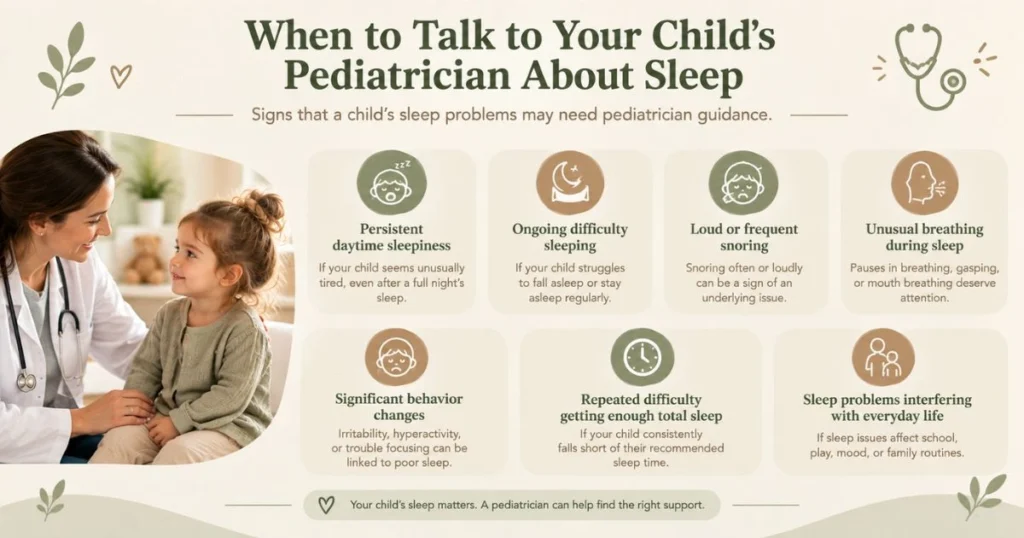
For most children, moving away from naps is simply part of growing and changing sleep needs.
If you’re wondering when do kids stop taking naps, remember that ongoing sleep concerns are still worth discussing with your child’s pediatrician.
Consider seeking professional guidance if your child has:
- Persistent or unusual daytime sleepiness
- Ongoing difficulty sleeping
- Loud or frequent snoring
- Unusual breathing while asleep
- Significant behavior changes that seem connected to poor sleep
- Repeated difficulty getting enough total sleep
- Sleep problems that interfere with everyday life
Don’t assume that severe daytime tiredness or breathing problems are simply part of giving up a nap.
If something about your child’s sleep doesn’t seem right, a pediatrician can help you determine whether there may be another issue worth investigating.
Frequently Asked Questions About Kids and Naps
When Do Kids Stop Taking Naps?
There isn’t one universal age when children stop taking naps.
If you’re wondering when do kids stop taking naps, remember that many children gradually reduce their daytime sleep during the preschool years. Some stop taking a daily nap earlier, while others continue napping for longer.
Your child’s ability to handle the afternoon, nighttime sleep, mood, and total sleep are more useful indicators than age alone.
What Age Do Kids Stop Napping?
Children can move away from naps at different ages.
If you’re wondering when do kids stop taking naps, remember that some toddlers begin resisting their afternoon sleep, while some preschoolers continue to nap regularly. Others go through a transition period where they nap on certain days but stay awake on others.
Instead of treating a particular age as a deadline, watch how your child responds when the nap is skipped. Their mood, energy, nighttime sleep, and ability to manage the afternoon can give you a clearer picture of whether they are ready.
When Do Toddlers Stop Taking Naps?
Many toddlers still benefit from daytime sleep.
If you’re wondering when do kids stop taking naps, remember that the CDC guidance cited in the original article recommends 11–14 hours of total sleep per 24 hours for children ages 2–3, including naps.
If your toddler occasionally skips a nap but becomes tired later, it may be better to continue offering a regular rest period rather than deciding that naps are finished.
When Should Kids Stop Taking Naps?
Your child may be approaching the end of the nap stage when several signs appear consistently.
If you’re wondering when do kids stop taking naps, look for patterns such as your child regularly refusing the nap, remaining comfortable throughout the afternoon, sleeping well overnight without it, and still getting enough total sleep.
There’s no need to make the decision based on one unusual day. Look for a consistent pattern over time before changing the routine.
How Can I Tell If My Child Is Ready to Stop Napping?
Look at the overall pattern rather than focusing on one sign.
If you’re wondering when do kids stop taking naps, useful clues include:
- Nap refusal happening regularly
- Taking much longer to fall asleep at nap time
- Sleeping well overnight without daytime sleep
- Having an easier bedtime without a nap
- Staying comfortable and alert throughout the afternoon
- Showing no consistent signs of overtiredness
The more of these signs you see together, the more likely your child may be ready to transition to a nap-free routine.
Is It Normal for a 3-Year-Old to Stop Napping?
Yes.
If you’re wondering when do kids stop taking naps, keep in mind that some three-year-olds begin moving away from regular naps, while others still benefit from them.
Children ages 3–5 are generally recommended to get 10–13 hours of sleep over 24 hours, including naps, according to the AASM guidance referenced in the article.
If your three-year-old stops napping, make sure their nighttime sleep continues to provide enough overall rest.
Should I Force My Child to Nap?
You generally don’t need to force your child to fall asleep.
If you’re wondering when do kids stop taking naps, focus on maintaining a predictable opportunity for rest rather than making sleep a requirement.
Your child can have some quiet time even if they don’t actually sleep. If they consistently remain awake and seem well-rested, that rest period may eventually replace the daily nap.
Forcing sleep can also turn the afternoon into a struggle, which isn’t helpful for either parent or child.
What Can My Child Do Instead of Napping?
Quiet activities can replace the sleep portion of the afternoon while keeping the break itself.
If you’re wondering when do kids stop taking naps, quiet time can help maintain that familiar pause even when your child no longer sleeps.
Try:
- Reading books
- Drawing
- Coloring
- Simple puzzles
- Quiet toys
- Looking at picture books
- Listening to a calm story
- Independent play in a comfortable space
Keep the environment relatively calm rather than turning quiet time into another high-energy period.
Does Dropping a Nap Mean My Child Needs an Earlier Bedtime?
Possibly.
If you’re wondering when do kids stop taking naps, keep in mind that losing a significant amount of daytime sleep may cause your child to become tired earlier in the evening.
An earlier bedtime can be especially helpful during the first stage of the transition.
Watch your child’s behavior rather than assuming you need to move bedtime by a specific amount. You can make small adjustments as needed and gradually settle into a routine that works for your child.
Can a Child Start Napping Again After They Have Stopped?
Yes.
If you’re wondering when do kids stop taking naps, an occasional nap doesn’t necessarily mean your child needs to return to a daily nap schedule.
A child who normally manages well without a nap may still fall asleep after a particularly busy day, a poor night’s sleep, travel, illness, or an unusually early morning.
Focus on what happens most of the time rather than placing too much importance on one unexpected nap.
The Bottom Line: Let Your Child’s Sleep Pattern Guide You

So, when do kids stop taking naps?
There isn’t a universal answer.
For many children, the transition happens gradually during the preschool years. The daily nap may become shorter, then occasional, and eventually disappear. Some children may still need a nap from time to time, even after they have moved away from a regular daily nap.
What matters most is how your child functions without it.
Pay attention to:
- How often they refuse the nap
- Whether they stay comfortable through the afternoon
- How they sleep at night
- Whether bedtime becomes easier or more difficult
- Whether they show signs of being overtired
- How much sleep they get over the entire 24-hour period
If your child seems ready, you don’t have to make a dramatic change.
Start by replacing the nap with quiet time. Keep afternoons calm, consider an earlier bedtime when needed, and allow occasional naps when your child genuinely seems tired.
Understanding when do kids stop taking naps can help you recognize your child’s individual sleep needs without comparing them to other children.
And remember: children don’t all follow the same sleep timeline.
One preschooler may happily give up naps while another still needs an afternoon break. Neither is necessarily doing anything wrong.
The goal isn’t simply to eliminate the nap.
The goal is to help your child get the rest they need while creating a routine that works for your family.
Parenting Whisper Reminder
If your child is still napping while another child the same age has already stopped, there’s no need to rush the transition.
Pay attention to your child’s sleep, mood, energy, and behavior over time. If you’re wondering when do kids stop taking naps, let these patterns guide you rather than comparing your child’s sleep schedule with someone else’s.
If naps are gradually becoming less frequent, remember that the transition doesn’t have to happen all at once. Some days may include a nap, while others may simply involve a quiet afternoon break.
That’s perfectly okay.
Growing out of naps is a gradual developmental change—not a milestone your child has to reach by a particular date.