

You tell your child that it’s time to switch off the TV.
“Five more minutes!”
You say it’s time to stop.
“No!”
Suddenly, what started as a calm request has escalated into tears, arguing, shouting, or an intense power struggle.
If this sounds familiar, you may have wondered whether you are supposed to be more firm—or more gentle. Maybe you worry that setting limits too often will make you a harsh parent. Or perhaps you’ve tried being endlessly patient, only to find yourself eventually losing your temper.
There is another way.
Gentle parenting does not mean parenting without limits. Children need clear expectations, predictable routines, and boundaries that keep them safe. Learning how to set limits with kids can help you stay both compassionate and consistent. The American Academy of Pediatrics (AAP) includes setting clear, consistent limits among healthy discipline strategies, while the CDC recommends clear rules, consistency, predictability, and follow-through.
The aim is not to make your child comply without asking questions. It is to help your child understand what is expected while knowing that their feelings are still welcome.
You can be warm and firm.
You can say no without shaming.
You can set limits and maintain a clear boundary without allowing every challenging moment to become a struggle.

What Does It Mean to Set Limits With Kids?
A limit is a clear boundary around behavior. It tells your child what is acceptable, what isn’t, or what you will do to keep everyone safe.
For example:
- “I won’t let you hit.”
- “Food stays at the table.”
- “The tablet is finished for today.”
- “We hold hands in the parking lot.”
- “It is time to leave the playground.”
A useful limit is clear, realistic, and appropriate for your child’s age and abilities.
The CDC recommends family rules that are specific enough for children to understand and remember. For toddlers and preschoolers, the CDC notes that starting with a small number of rules—around two or three at a time—can make them easier to learn and follow.
Limits vs. Rules vs. Boundaries vs. Punishment
These words are often used interchangeably, but they aren’t quite the same.
| Concept | What it means | Example |
| Limit | A boundary around behavior | “I won’t let you hit.” |
| Rule | A clearly stated family expectation | “We use gentle hands.” |
| Boundary | What you will allow or do | “I’ll move you away if you keep hitting.” |
| Consequence | What follows a behavior | “If you throw the toy, it will be put away for now.” |
| Punishment | A response intended to penalize behavior | “You’re bad, so you can’t play.” |
Setting a limit does not require you to frighten, humiliate, or shame your child.
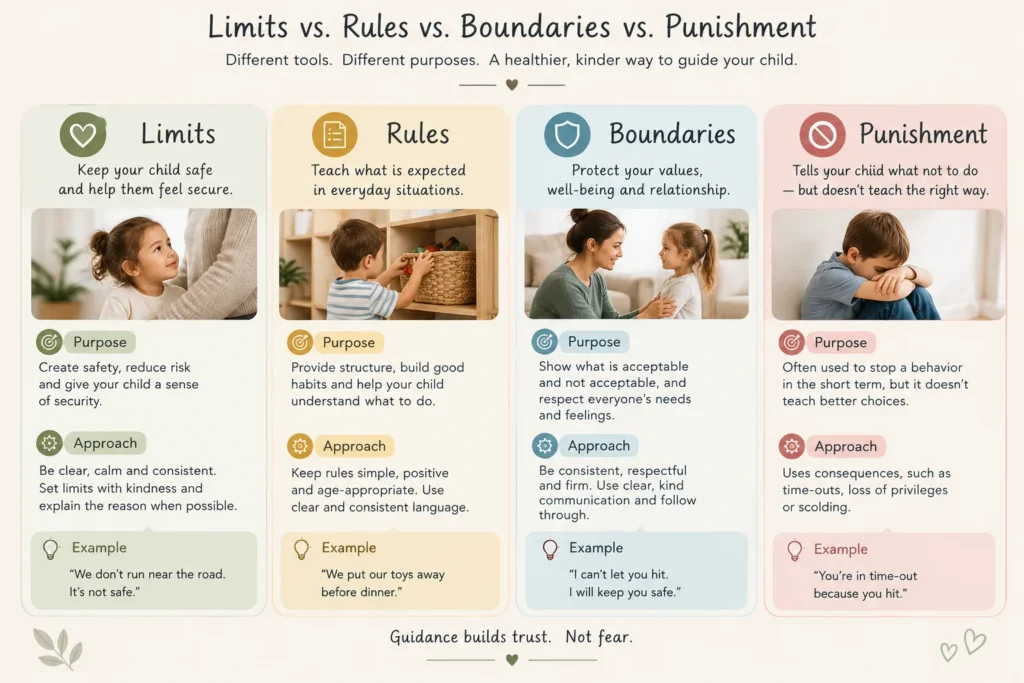
The AAP encourages positive discipline strategies that include teaching children what behavior is expected, establishing clear limits, redirecting inappropriate behavior, and applying appropriate consequences. It advises against physical punishment, threatening, insulting, humiliating, or shaming children.
Does Gentle Parenting Mean Having No Limits?
No.
Your child can feel completely loved while still being told “no” when necessary.
Gentle parenting is not about removing every frustration from your child’s life.What matters is how you respond when setting a limit becomes necessary.
You can say:
“I know you want another cookie. We’re not having another one.”
That is a limit.
You can also acknowledge the disappointment:
“You’re really upset about that.”
That is connection.
You don’t have to choose between the two.
Why Kids Need Clear and Consistent Limits
It can feel uncomfortable when your child becomes upset after you set a boundary. You may wonder whether you should simply give in to stop the crying.
But children’s feelings and parents’ boundaries can coexist.
Limits Give Children Predictability
When your responses are reasonably consistent, your child has a better idea of what to expect.
The CDC describes consistency, predictability, and follow-through as important parts of creating structure for young children. Predictable routines and rules can help children know what will happen next.
Think about bedtime.
If bedtime means pajamas, brushing teeth, a story, and lights out most nights, your child gradually learns the sequence.
That doesn’t mean your child will happily cooperate every night.
It means the expectation becomes familiar.
Limits Help Keep Children Safe
Some limits are not negotiable because safety comes first.
Examples include:
- Holding hands near traffic
- Staying away from unsafe water
- Not touching hot appliances
- Keeping hands away from another person’s body
- Staying in a safe area at a playground
The CDC emphasizes close supervision and environmental safety during the toddler years because young children are increasingly mobile while still developing their understanding of danger.
Limits Teach Social Expectations
Children have to learn that other people have boundaries too.
“Wanting something does not automatically mean your child is allowed to take it.”
“I’m angry” doesn’t mean “I can hit.”
“Not wanting to leave does not mean your child can simply run off.”
Your limit helps translate those ideas into something concrete:
“You can be angry. I won’t let you hit.”
Your Child Can Be Upset and the Limit Can Still Stand
This is a key idea to keep in mind: when your child cries after you set a limit or say no, it does not necessarily mean that your decision was wrong.
Your job isn’t to eliminate every uncomfortable feeling.
Your job is to help your child experience those feelings safely while maintaining necessary boundaries.
Before You Set a Limit, Ask: Is This Really a Limit I Need?
Not every behavior needs correction.
Before stepping into a conflict, pause for a moment.
Ask yourself:
- Is this actually unsafe?
- Is it disrespectful or harmful?
- Is this an important family expectation?
- Is my expectation appropriate for my child’s age?
- Does my child actually have the skill to do what I’m asking?
- Could hunger, tiredness, overstimulation, or a difficult transition be contributing?
This doesn’t mean you excuse harmful behavior.
It means recognizing the difference between a child who is unwilling to do something and one who is not yet able to do it.
The CDC specifically recommends giving directions that match a child’s developmental ability. It emphasizes that a child’s inability to follow through is not necessarily the same as refusing to cooperate.
A two-year-old may understand “Put your shoes here,” but that doesn’t mean they will consistently manage a complicated multi-step morning routine independently.
Sometimes the better limit is paired with more help.
The Listen → Limit → Listen Approach
When you’re unsure what to say, use this simple three-step framework.
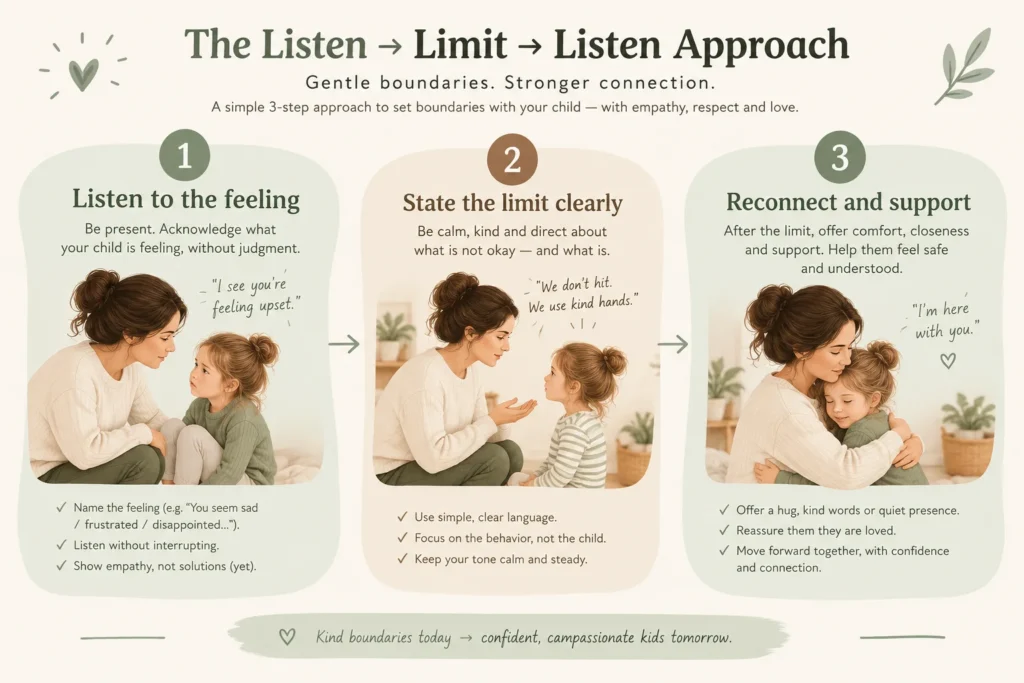
Step 1: Listen
Before reacting, look at what is happening.
You don’t necessarily need to ask a long series of questions. Simply notice.
Your child may be:
- Tired
- Hungry
- Overwhelmed
- Struggling with a transition
- Frustrated by a limit
- Unable to communicate what they need
- Still learning the expected behavior
Listening doesn’t mean agreeing.
It involves understanding the situation first before choosing how you will respond.
Step 2: Limit
When you have determined that a boundary is needed, communicate it in a clear and straightforward way.
Get close enough to make sure your child can hear you. Use simple language.
Try:
“I won’t let you hit.”
Or:
“It’s time to leave.”
Or:
“The tablet is finished.”
For young children, the CDC recommends clear, specific directions and suggests telling children what to do rather than relying only on vague commands such as “Stop” or “Don’t.”
Step 3: Listen Again
At this point, you can acknowledge your child’s feelings while keeping the boundary firmly in place.
“You really wanted to keep playing.”
“You’re angry that I said no.”
“You wish we could stay longer.”
You can stay emotionally connected to your child even when they disagree with your decision.
That is the heart of gentle limits.
How to Set Limits With Kids Without Punishment
When you need to set a boundary, try this sequence:
Connect → State → Validate → Hold → Support
1. Connect Before You Correct
Move toward your child instead of shouting instructions from another room.
You might say:
“You were having so much fun.”
This doesn’t mean you’re asking permission.
You are simply acknowledging and recognizing what your child is going through.
2. State the Limit Clearly
Keep the important part short.
“Playtime is over.”
“I won’t let you hit.”
“Food stays on the table.”
Long explanations aren’t always necessary, especially when emotions are already high.
3. Validate the Feeling
Validation is not the same as agreement.
You can say:
“You’re disappointed.”
without saying:
“You’re right, so you can have another hour.”
The feeling is accepted.
The limit remains.
4. Hold the Boundary
This is where consistency matters.
If the limit is important, try not to turn it into a ten-minute negotiation.
You might calmly repeat:
“I know you don’t want to stop. It’s still time to go.”
5. Support Your Child Through the Reaction
Your child may cry.
They may complain.
They may become angry.
When your child is safe, you can remain close as they process and cope with their disappointment.
If the behavior becomes unsafe, your responsibility changes from simply supporting the emotion to protecting your child or someone else.
Seven Gentle Parenting Scripts for Setting Limits
Sometimes knowing the principle isn’t enough. You need the exact words.
Formula 1: Validate + Limit + Choice
“You want more screen time. It’s hard to stop when you’re having fun. Screen time is finished. You can read a book or play with your blocks.”
Formula 2: Calm, Firm, Repeat
Your child may continue arguing.
You don’t need to come up with a different explanation each time.
“I know you want to stay. It’s time to go.”
If they ask again:
“I know. It’s still time to go.”
Formula 3: “I Won’t Let You”
This works particularly well when safety or aggression is involved.
“I won’t let you hit your brother.”
Then guide your child toward a safer way to respond or behave.
The AAP recommends teaching acceptable behavior and using limit-setting and redirection rather than harsh discipline.
Formula 4: Give Choices Within the Boundary
Instead of asking an open-ended question such as:
“Do you want to get dressed?”
when getting dressed isn’t optional, give two acceptable choices:
“Do you want the blue shirt or the green shirt?”
The CDC specifically recommends offering young children two choices to encourage independence without overwhelming them.
Formula 5: Set Expectations Before the Situation
Some limits are easier when your child hears them before the difficult moment.
Before entering a store:
“We’re buying groceries today. You can help me choose the apples, but we’re not buying toys.”
Before visiting the playground:
“We’ll play until it’s time to go. 6. “When I let you know it’s time to go, we’ll head over to the car.”
Formula 6: Use Related Consequences
If your child continues throwing the toy, you can calmly remove it and put it out of reach for th
“I won’t let you throw the truck. The truck is going away for now.”
The consequence is connected to the behavior.
Formula 7: Use Playfulness When It Fits
Not every situation needs a serious tone.
If your child is refusing to put on their pajamas, you can make the moment more playful by saying:
“I wonder if your pajamas know how to find their way onto your feet!”
Play can sometimes make transitions easier.
But don’t use playfulness to avoid necessary boundaries. When safety is involved, be clear and direct.
How to Set Limits Without Power Struggles
A power struggle often begins when both parent and child become focused on winning.
You don’t have to win.
You need to hold the boundary.
Don’t Turn Every Limit Into a Debate
Your child might come up with countless reasons for wanting one more cookie.
You don’t have to answer all ten.
“I hear you. We’re done with cookies.”
Use Fewer Words
When your child is already overwhelmed, giving a lengthy explanation may make the situation even more difficult. Keep your message brief and use one clear sentence.
Offer Two Choices
Giving your child a couple of choices allows them to have some control while you still maintain the overall boundary.
“You can go to the bathroom on your own, or I can help you get there.”
Don’t Threaten
Avoid:
“If you don’t stop crying, you’ll be sorry.”
Instead:
“You’re upset. I’m here. I’m not changing the limit.”
Follow Through Calmly
The CDC notes that rules are most effective when parents apply them consistently, provide predictable expectations, and follow through with what they have communicated.
How to Set Limits With Toddlers
Toddlers are becoming more independent while still having limited impulse control and emotional regulation.
The CDC notes that toddlers between 2 and 3 are developing greater independence and can express a wide range of emotions while continuing to learn how to follow simple instructions.
That means your toddler may understand a rule and still struggle to follow it consistently.
Keep Toddler Limits Short
Instead of:
“How many times do I need to remind you not to throw your food?”
Try:
“Food stays on the table.”
Tell Your Toddler What to Do
Instead of:
“Don’t run!”
Try:
“Walk beside me.”
Clear directions give your toddler something specific to copy.
Expect Repetition
You may find yourself restating the same boundary over and over again.
That isn’t necessarily failure.
Your toddler is learning.
Use Predictable Routines
A familiar routine can reduce the number of decisions and surprises your child has to manage.
For example:
Dinner → Bath → Pajamas → Books → Bed
The CDC recommends simple, predictable routines because they help children know what to expect.
Everyday Examples of Limits With Kids
| Situation | Limit | Gentle Response |
| Hitting | People are not for hitting | “I won’t let you hit. I’m going to help you keep your hands safe.” |
| Throwing toys | Toys aren’t for throwing | “I won’t let you throw the truck. I’ll put it away for now.” |
| Screen time | Screen time has an endpoint | “Screen time is finished. You can be upset.” |
| Leaving the playground | It’s time to leave | “You wish you could stay. It’s time to go. You can walk or I can help you.” |
| Bedtime | The bedtime routine has begun | “It’s time for pajamas. Do you want the blue or green ones?” |
| Throwing food | Food stays on the table | “Food stays on the table. If you’re finished, we can clean up.” |
| Unsafe climbing | Some places aren’t safe to climb | “I won’t let you climb there. I’ll help you find a safe place.” |
| Hitting a pet | Animals need gentle treatment | “I won’t let you hurt the dog. You can touch gently or move away.” |
What to Do When Your Child Says No to a Limit
When Your Child Screams
You don’t need to scream back.
Try:
“You’re really angry. I’m listening. I’m not changing the limit.”
When Your Child Cries
Stay close if your child wants your support.
“You can cry. I know you’re disappointed.”
When Your Child Says, “That’s Not Fair!”
Try:
“It doesn’t feel fair to you.”
You don’t have to prove that the decision is fair.
When Your Child Keeps Asking
Stay boring and predictable.
“I know you want it. My answer is still no.”
When Your Child Hits or Kicks
Safety comes first.
Block the behavior and say:
“I won’t let you hit.”
Then help your child move away from the situation and calm down.
The AAP specifically recommends teaching children that anger is acceptable while hitting and hurting others are not.
Natural Consequences, Logical Consequences, and Punishment
Consequences can be useful, but not every consequence is automatically respectful or appropriate.
What Is a Natural Consequence?
A natural consequence happens without you deliberately creating it.
For example, a child leaves a toy outside and it gets wet in the rain.
Natural consequences should never be allowed when the outcome could seriously hurt a child.
What Is a Logical Consequence?
A logical consequence is connected to the behavior.
If your child repeatedly throws a toy, you may put the toy away for a period of time.
The connection is understandable:
Throwing the toy → toy is temporarily unavailable.
When Does a Consequence Become Punishment?
Pay attention to the purpose and delivery.
A consequence becomes problematic when it is excessive, humiliating, threatening, unrelated, or primarily intended to make the child suffer.
You want your response to teach rather than shame.
The AAP recommends calm limit-setting and appropriate consequences while advising against physical punishment, threatening, insulting, humiliating, and shaming children.
How to Stay Calm While Holding a Firm Limit
Sometimes, the real challenge is not figuring out what words to use.
It’s saying it when you’re exhausted.
Regulate Yourself First When You Can
Take one breath.
Lower your shoulders.
Pause before answering.
When everyone is safe, taking a brief pause can give you time to respond thoughtfully instead of reacting on impulse.
Don’t Match Your Child’s Volume
Your child doesn’t need you to become louder in order to understand you.
A calm voice can communicate:
“I’m going to keep this boundary, and you’re allowed to have whatever feelings come with it.”
Separate the Behavior From the Child
Instead of:
“You’re being bad.”
Try:
“Hitting isn’t okay.”
The first statement attacks identity.
The second addresses behavior.
Repair When You Lose Your Patience
You will not handle every limit perfectly.
If you yell, you can repair.
“I was frustrated and I yelled. I’m sorry. I should have used a calmer voice. The limit still stays.”
Repair doesn’t erase the boundary. It shows your child how accountability works.
Common Mistakes Parents Make When Setting Limits

Setting Too Many Rules
Your child can’t realistically remember dozens of rules.
The CDC recommends starting with a small number of clear rules for toddlers and preschoolers.
Using Vague Instructions
“Be good” is too vague to help a child understand what behavior you expect from them.
Try:
“Use gentle hands.”
Giving Empty Threats
Avoid stating consequences unless you are prepared to follow through with them.
Explaining Too Much
Your child doesn’t need a courtroom argument for every boundary.
Changing the Limit Because Your Child Cries
Comfort the child without necessarily changing the decision.
Expecting Instant Compliance
Learning takes repetition.
Using Shame
Avoid labels such as:
- Bad
- Selfish
- Naughty
- Disappointing
- Embarrassing
Describe the behavior instead.
Real-Life Examples: Putting the Framework Into Practice
Leaving the Playground
Your child refuses to leave.
Listen:
“You really wanted to keep playing.”
Limit:
“It’s time to go.”
Choice:
“You can walk to the car on your own, or I can carry you there.”
Listen again:
“You’re upset because you wanted more time.”
You don’t need to convince your child that leaving is wonderful.
You simply help them through it.
When Your Child Hits a Sibling
Move in quickly.
“I won’t let you hit your sister.”
Protect the other child first.
Then help your child calm down. Once everyone is settled, you can talk about what happened and help your child practice a different response.
Bedtime Resistance
Your child keeps coming up with one more request—a drink, another story, an extra blanket, or another visit to the bathroom.
You can acknowledge the need while keeping the routine intact:
“You want another book. We’ve finished our books for tonight. It’s time to sleep.”
If a genuine need appears, respond to it. But you don’t have to create a new negotiation every time your child makes another request.
A Simple Daily Plan for Setting Limits With Kids
You don’t have to completely change the way you parent all at once.
Start with one recurring struggle.
Before the Situation
Ask:
- What is the actual limit?
- Is it necessary?
- Is it appropriate for my child’s age?
- What words will I use?
- What will I do if my child resists?
During the Situation
Remember:
Listen → Limit → Listen
- Understand what is happening.
- State the boundary.
- Acknowledge the emotion.
- Hold the limit.
- Support your child through the reaction.
After the Situation
Notice what worked.
Ask yourself:
- Was the limit clear?
- Did my child understand what I wanted them to do?
- Could I make the transition easier next time?
- Did I stay consistent?
- Do I need to repair anything?
You may discover that changing the routine prevents the same conflict tomorrow.
Frequently Asked Questions About Setting Limits With Kids
How do I set limits with kids without punishment?
Start with a clear, age-appropriate expectation. State what you want your child to do, acknowledge their feelings, and calmly follow through when the limit is challenged. Appropriate consequences can be used when necessary without relying on shame or physical punishment.
Does gentle parenting mean having no limits?
No. Gentle parenting can include clear, consistent limits. The AAP specifically recommends setting limits and using age-appropriate consequences as part of healthy discipline.
How do I set limits with kids without yelling?
Use fewer words, move closer, get your child’s attention, state the expectation clearly, and follow through. If you feel yourself becoming overwhelmed, pause when safety allows.
How do I set limits with a toddler?
Keep limits simple and concrete. Tell your toddler what to do rather than only what not to do, offer two acceptable choices when appropriate, and expect to repeat important rules.
How do I stop power struggles when setting limits?
Don’t turn every boundary into a debate. Acknowledge your child’s feelings, state the limit clearly, offer a choice when possible, and calmly repeat the boundary rather than adding more arguments.
What should I do when my child refuses a limit?
First, make sure your child understood the expectation. Then calmly restate it and follow through. If the behavior is unsafe, intervene immediately. If the child is simply disappointed, allow the emotion without abandoning an important boundary.
Should I use consequences when setting limits?
Consequences can be appropriate when they are reasonable, understandable, and connected to the behavior. The AAP and CDC both include consequences within broader positive-discipline guidance.
How do I stay firm without being harsh?
Focus on the behavior instead of attacking your child’s character. You can say, “I won’t let you hit,” rather than, “You’re a bad kid.” Firmness describes what will happen; harshness adds fear, humiliation, or shame.
Is it okay for my child to be angry about a limit?
Yes. Your child can be angry, disappointed, or frustrated while you maintain a necessary boundary. You can acknowledge the feeling without changing the decision.
Parenting Whisper Reminder
Your child’s big feelings don’t mean your limit is wrong.
You can say no and stay connected.
You can hold a boundary while allowing disappointment.
You can be firm without becoming harsh.
And you can make mistakes, repair, and try again.
Conclusion: Limits Can Be Loving

Setting limits with kids isn’t about winning a battle.
It’s about giving your child a clear and predictable framework while they are still learning how to manage impulses, emotions, relationships, and everyday responsibilities.
You don’t have to choose between being gentle and being firm.
You can say:
“I know you don’t want to stop. It’s time to go.”
You can say:
“You’re angry. I won’t let you hit.”
You can say:
“You wanted another cookie. We’re done for today.”
And you can stay beside your child while they feel disappointed.
That is what makes a limit different from rejection.
Your boundary says, “This behavior isn’t okay.”
Your connection says, “You are still okay, and I’m here to help you.”
Start with one limit that causes frequent conflict in your home. Make it clear. Keep it realistic. Decide what you will say before the next difficult moment arrives.
Then practice Listen → Limit → Listen.
You don’t need perfect words or perfect patience. You need a clear boundary, a willingness to stay connected, and the consistency to keep trying.
If this approach helps you, save this guide for your next difficult parenting moment and share it with another parent who needs a gentler way to hold firm boundaries.