

Raising a child doesn’t come with a perfect set of instructions. Most parents hope to teach their children good behavior, respect for boundaries, and the skills they need to become responsible adults. But the way those goals are pursued can make a meaningful difference.
Authoritarian parenting involves setting demanding expectations and strict boundaries while maintaining strong control and offering limited attention to a child’s emotional needs. In an authoritarian household, obedience may be valued more highly than discussion, and children may hear messages such as, “Because I said so,” rather than an explanation of why a particular rule exists.
At first glance, this approach can appear effective. A child may obey quickly because they want to avoid punishment or criticism. Yet immediate compliance does not necessarily mean a child is learning self-control, emotional regulation, or responsible decision-making.

Understanding authoritarian parenting can help you recognize the difference between being a firm parent and relying on fear or excessive control. It can also provide a starting point for changing family patterns without abandoning boundaries or expectations.
What Is Authoritarian Parenting?
Authoritarian parenting is generally described as a combination of high demandingness and low responsiveness.
Authoritarian parents tend to establish many rules and expect children to follow them closely. At the same time, they may provide limited emotional warmth, flexibility, or opportunity for the child to explain their perspective.
The underlying message can become:
“Parents make the choices, and children are expected to do as they are told.”
This parenting approach is rooted in the framework introduced by psychologist Diana Baumrind, who identified several major parenting styles, including authoritarian, authoritative, and permissive parenting. Later research expanded these categories and incorporated uninvolved parenting as another commonly discussed style.
The distinction between authoritarian and authoritative parenting is particularly important.
Both approaches can involve rules, expectations, and boundaries. What sets them apart is the way parents communicate and uphold those boundaries.
An authoritarian parent may say:
“Enough arguing. I’ve already asked you to do it, so please follow through.”
An authoritative parent might say:
“I know you’d like to play longer, but it’s time to go. You can walk to the car by yourself, or I can come with you and help.”
The second response still contains a firm boundary. What changes is the combination of warmth, explanation, respect, and appropriate choice.
Common Characteristics of Authoritarian Parenting
Authoritarian parenting can look different from family to family, but several behaviors commonly appear.
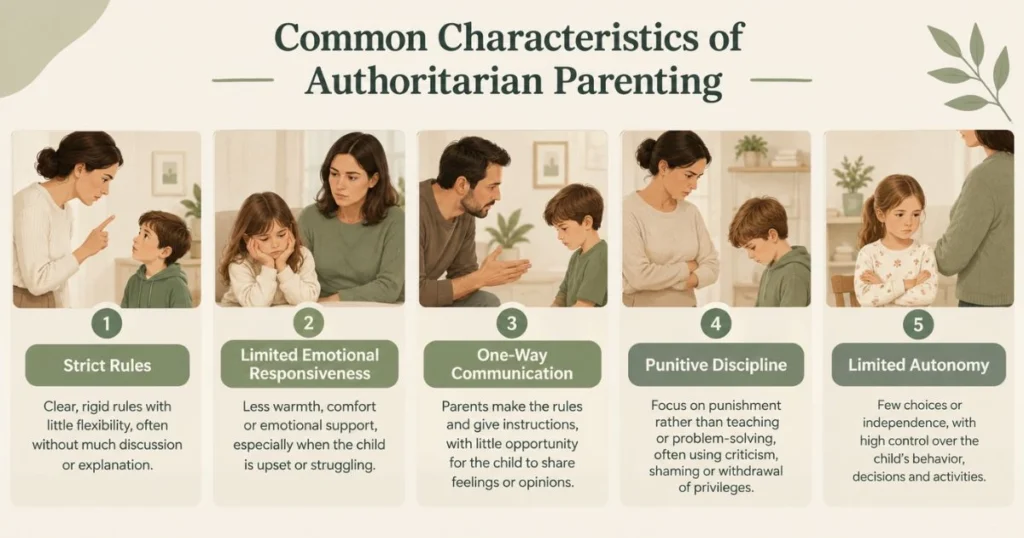
1. Strict Rules and High Expectations
Authoritarian parents often establish clear expectations about behavior, schoolwork, manners, chores, appearance, or daily routines.
Having expectations is not inherently harmful. Children need boundaries.
The concern is what happens when expectations become extremely rigid or when normal childhood mistakes are treated as unacceptable disobedience.
For example, spilling a drink might be treated as an opportunity to teach responsibility in one household. In another, it might lead to yelling, humiliation, or disproportionate punishment.
The difference is not simply whether a rule exists. It is how the parent responds when the child struggles to meet it.
2. Limited Emotional Responsiveness
Children have emotional needs as well as behavioral needs.
A child can be required to behave respectfully while still being allowed to feel angry, disappointed, frightened, or frustrated.
In authoritarian parenting, emotional expression may sometimes be interpreted as disrespect or defiance.
A child who cries after losing a game might hear:
“Stop crying. It’s not a big deal.”
A child who questions a rule might be told:
“Don’t talk back.”
Over time, the child may learn that certain emotions or opinions are unwelcome rather than learning how to understand and manage them.
3. One-Way Communication
Communication in an Authoritarian Parenting environment may primarily move from parent to child.
The parent gives an instruction. The child is expected to follow it.
Questions can be discouraged, particularly when they are interpreted as challenges to parental authority.
Instead of explaining a safety rule, for example, a parent may simply say:
“Because I said so.”
There are certainly situations in which parents need children to follow instructions immediately, especially when safety is involved. A parent does not need to negotiate every rule.
However, outside urgent situations, explaining age-appropriate reasons can help children gradually understand why boundaries exist.
4. Punitive Discipline
Punishment is often central to Authoritarian Parenting.
Discipline may include yelling, threats, harsh criticism, excessive restrictions, or corporal punishment. Some parents may also use fear to discourage unwanted behavior.
The goal is generally immediate compliance.
The problem is that punishment can address what a child did without necessarily teaching the skill the child needs to behave differently next time.
For example, telling a child, “You’re terrible for hitting your brother,” attacks the child’s character.
A teaching-oriented response would separate the child from the behavior:
“I won’t let you hit. You were angry, but hitting hurts. Let’s figure out what you can do instead.”
The boundary remains firm while the child receives guidance.
5. Shame and Frequent Criticism
Children inevitably make mistakes.
They forget homework, spill food, lose patience with siblings, interrupt conversations, and sometimes make poor decisions.
Authoritarian Parenting may respond to these mistakes with criticism that focuses on the child’s character rather than the behavior.
Negative comments like “You’re lazy,” “You’re selfish,” or “What’s wrong with you?” may cause a child to believe that their mistakes reflect poorly on them as a person.
Constructive discipline does something different: it identifies the behavior, explains the boundary, and teaches what to do next time.
6. Limited Autonomy
Authoritarian parents may make many decisions for their children, even when the child is developmentally capable of participating.
Choices can be limited because parents fear that giving children independence will undermine authority.
But age-appropriate autonomy is an important part of growing up.
A preschooler might choose between two outfits. An older child might decide when to complete homework within an agreed timeframe. A teenager might gradually take responsibility for managing parts of their schedule.
Giving a child reasonable choices does not mean giving them unlimited control.
It means allowing them to practice decision-making while an adult remains responsible for safety and boundaries.
Why Do Parents Become Authoritarian?
There is rarely one explanation for Authoritarian Parenting.
Parenting is influenced by family history, personality, stress, cultural expectations, beliefs about discipline, and the environment in which a parent was raised.
Parenting Patterns Can Be Passed Between Generations
Some parents repeat the parenting style they experienced themselves.
A person who grew up hearing, “Children should be seen and not heard,” may naturally assume that strict obedience is what responsible parenting looks like.
This does not necessarily mean the parent consciously wants to hurt their child.
Sometimes familiar parenting patterns feel normal simply because they are familiar.
Recognizing a pattern creates an opportunity to change it.
Personality and Emotional Factors
Research has examined relationships between parenting behavior and various parental characteristics, including personality traits and emotional functioning.
For example, high levels of anxiety or chronic stress may make some parents more reactive, controlling, or critical.
Certain personality characteristics may also influence how parents respond to disagreement or perceived disobedience.
These findings should not be used to diagnose individual parents. A parenting style cannot be explained simply by assigning a personality label to someone.
Cultural and Social Context
Parenting does not happen in isolation.
Cultural traditions can influence beliefs about obedience, family hierarchy, academic achievement, respect for elders, and children’s independence.
Some cultures place stronger emphasis on parental authority than others. However, it is important not to assume that an entire cultural group uses one parenting style.
Research involving Asian and immigrant families, for example, has shown that the relationship between parental control and child outcomes can be influenced by cultural meaning, parental warmth, family closeness, and social context.
A behavior that looks highly controlling from one cultural perspective may have a different meaning within another family system.
Stress Can Change Parenting Responses
Chronic stress can make patient parenting much harder.
Financial pressure, relationship conflict, lack of sleep, demanding work schedules, limited support, and ongoing family challenges can all reduce a parent’s emotional resources.
A parent who normally responds calmly may become much more reactive when overwhelmed.
This is one reason it can be more useful to ask, “What is happening in this family?” rather than simply labeling a parent as good or bad.
How Can Authoritarian Parenting Affect Children?
Research has associated Authoritarian Parenting with a range of child and adolescent outcomes. However, these relationships are complex.
Parenting style is only one influence on development. A child’s temperament, genetics, peers, school environment, socioeconomic circumstances, culture, and other family relationships also matter.
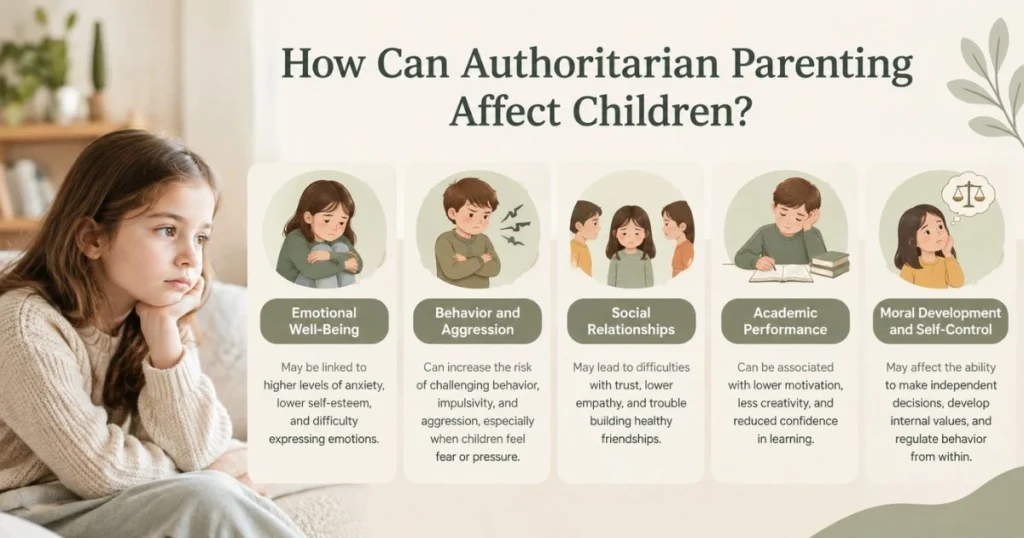
Emotional Well-Being
Children raised in highly controlling and low-responsive environments may experience difficulties with emotional well-being.
Research has associated authoritarian parenting with outcomes such as increased anxiety, depressive symptoms, lower self-esteem, and difficulties with emotional regulation.
One possible explanation is that children receive many messages about what they should do but fewer opportunities to learn how to understand and manage their internal experiences.
A child who repeatedly hears, “Don’t be upset,” may learn to hide distress without learning what to do with it.
Behavior and Aggression
Strict control does not automatically prevent challenging behavior.
Some research has linked authoritarian parenting with externalizing behaviors, including aggression, defiance, and other conduct problems.
Children learn not only from what parents tell them but also from what parents demonstrate.
If conflict is regularly handled through yelling, threats, or aggression, a child may have fewer opportunities to observe calm problem-solving.
This does not mean every authoritarian household produces an aggressive child. Development is far more complicated than that.
Social Relationships
Children also learn social skills through family relationships.
When children have opportunities to express feelings, listen, negotiate, repair mistakes, and consider another person’s perspective, they can practice skills that are useful with peers.
Highly controlling parenting has been associated in some research with lower social competence and difficulties in peer relationships.
Children may also become more sensitive to perceived hostility. Research on hostile attribution bias suggests that some children who experience harsh environments may become more likely to interpret ambiguous actions from others as intentionally hostile.
Academic Performance
Parents often become strict because they want their children to succeed.
Yet academic pressure and academic support are not the same thing.
Authoritarian parenting has generally been associated with less favorable academic outcomes in many studies, although results vary across populations and cultural settings.
A child may work hard because they fear disappointing a parent, but fear-driven motivation is different from developing curiosity, persistence, independence, and confidence in problem-solving.
There are also important cultural nuances. In some communities, children may achieve academically despite highly controlling parenting, particularly when parental expectations coexist with emotional closeness, strong family relationships, supportive peers, or other protective factors.
Academic achievement alone therefore cannot tell us what a child’s overall experience at home is like.
Moral Development and Self-Control
The long-term purpose of discipline is not simply to make a child obey while an adult is watching.
The goal is eventually for children to develop internal self-control.
When rules are always externally imposed, a child may learn:
“I shouldn’t do this because I’ll get punished.”
A more developed understanding is:
“I shouldn’t do this because it could hurt someone.”
The second involves internal reasoning rather than simple fear of consequences.
Research has associated authoritarian parenting with differences in moral reasoning and self-regulation. Adolescents who experience parental authority as overly controlling or illegitimate may also become more likely to challenge or reject that authority.
Authoritarian vs. Authoritative Parenting
The two terms are easy to confuse because they sound almost identical.
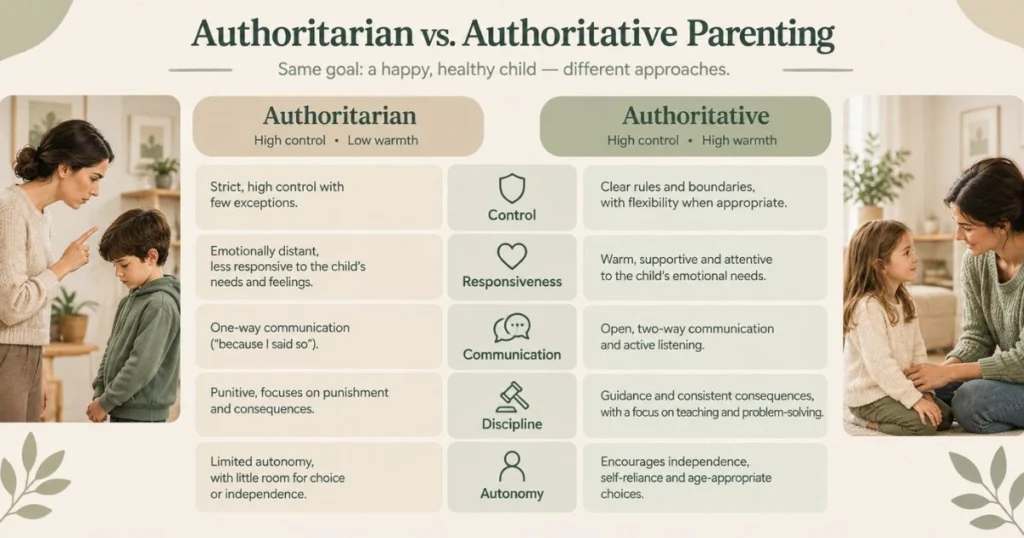
But they describe different approaches.
| Authoritarian Parenting | Authoritative Parenting |
| High control | High expectations with appropriate flexibility |
| Lower responsiveness | High responsiveness |
| Rules are often imposed | Rules are explained and discussed when appropriate |
| Obedience is strongly emphasized | Responsibility and understanding are emphasized |
| Punishment may be prominent | Consequences and teaching are emphasized |
| Limited child autonomy | Age-appropriate independence is encouraged |
| Emotional expression may be discouraged | Feelings are acknowledged while boundaries remain |
| “Because I said so” | “Here’s why this rule matters” |
Authoritative parenting does not mean permissive parenting.
An authoritative parent can say no.
They can enforce bedtime, limit screen time, require respectful behavior, stop unsafe behavior, and follow through with consequences.
The difference is that firmness exists alongside warmth, responsiveness, communication, and respect for the child’s developmental needs.
Consider bedtime.
An authoritarian response might be:
“Go to bed right now. I don’t want to hear another word.”
An authoritative response might be:
“It’s bedtime. You can choose whether you want to brush your teeth first or put your pajamas on first, but we’re getting ready for bed now.”
The boundary has not disappeared.
The child simply has a small amount of appropriate control within it.
How to Move Away From Authoritarian Parenting
Changing Authoritarian Parenting does not require becoming a completely different person overnight.
Small changes can gradually transform everyday interactions.

Start With Active Listening
Before correcting behavior, pause and listen.
You can recognize your child’s point of view without necessarily agreeing with it.
Try:
“You really didn’t want to leave.”
Or:
“You’re angry because your sister took the toy.”
Validation does not mean giving permission.
You can validate the emotion while maintaining the boundary:
“It’s okay to be angry. It’s not okay to hit.”
This helps children recognize that their feelings are okay, while unsafe or hurtful actions still have boundaries.
Replace Shame With Teaching
Rather than asking, “Why do you always make things so difficult?” calmly focus on what happened.
For example:
“The crayons were left on the floor. Let’s put them back in the box.”
The second approach addresses the problem without attacking the child’s identity.
Use Logical and Related Consequences
In Authoritarian Parenting, consequences can be used to respond to children’s behavior, but they work best when children can understand the connection between what they did and what happens next.
For example, if a child keeps leaving toys outdoors, they may need to put them away and have limited access to them for a short time while they work on developing a more consistent habit.
The purpose should be learning and responsibility, not making the child suffer.
Offer Limited Choices
Choices can reduce unnecessary power struggles while preserving parental authority.
Instead of:
“Put your shoes on.”
Try:
“Which would you prefer to wear—the black shoes or the brown ones?”
Instead of letting your child choose when to go to bed, keep the bedtime routine in place while offering a simple choice:
“Would you like to read one story or two before bedtime?”
This communicates:
“The adult is still in charge of the boundary, but you have a voice within it.”
Explain Rules When There Is Time
You do not need to give a ten-minute explanation every time your child asks why.
But brief explanations can help children understand the purpose behind boundaries.
Saying, “Hold my hand because cars are moving through the parking lot,” gives a child more understanding than simply saying, “Because I said so.”
Over time, children can begin to internalize the reason for the rule.
Repair After Losing Your Temper
Parents are human.
If you yell, you can repair the relationship afterward.
You might say:
“I yelled, and I shouldn’t have. I was frustrated, but yelling wasn’t a good way to handle it. The rule still matters, and next time I’m going to try to speak more calmly.”
Apologizing does not weaken parental authority.
It models accountability.
Seek Support When Patterns Feel Difficult to Change
Some parenting patterns are deeply rooted, particularly when they come from a person’s own childhood.
Parenting books, evidence-based parenting programs, classes, support groups, and family or individual therapy can provide practical tools.
Seeking support is a healthy step and does not mean you are failing as a parent.
Sometimes changing a long-standing pattern is easier when another person helps you recognize triggers, practice new responses, and develop realistic strategies.
The Goal Is Not Perfect Parenting
Moving away from authoritarian parenting does not mean becoming permissive or allowing children to do whatever they want.
Children still need boundaries.
They need adults who can say no, establish routines, protect them from danger, and follow through consistently.
The difference is that discipline can be both firm and compassionate.
You can say:
“I won’t let you hit.”
And also:
“I know you’re really angry.”
You can maintain a bedtime while acknowledging that your child wants to keep playing.
You can expect respectful behavior without demanding that your child never disagree with you.
You can correct a mistake without making your child feel like a mistake.
That balance is at the heart of healthier discipline.
Frequently Asked Questions About Authoritarian Parenting

Is authoritarian parenting the same as strict parenting?
Not necessarily. Strict parenting can involve firm rules and high expectations without necessarily being authoritarian. The key distinction is the combination of high control with relatively low responsiveness and warmth. A parent can have clear boundaries while still listening, explaining, validating emotions, and supporting age-appropriate independence.
Is authoritarian parenting abusive?
Authoritarian parenting and child abuse are not interchangeable terms. Authoritarian parenting describes a broad parenting style. Some behaviors associated with harsh authoritarian parenting, such as physical punishment, humiliation, or severe emotional abuse, can cross into harmful or abusive behavior depending on what occurs. Specific concerns should be evaluated based on the behavior, severity, frequency, context, and applicable child-safety standards.
Can authoritarian parents change?
Yes. Authoritarian Parenting patterns can change. Recognizing an unhealthy pattern is an important first step. Parents can practice listening, emotional validation, consistent boundaries, logical consequences, and calmer communication. Professional support can also help when patterns are difficult to change independently.
Is authoritative parenting permissive?
No. Authoritative parenting involves clear expectations and boundaries. The difference is that those expectations are combined with warmth, responsiveness, communication, and age-appropriate autonomy.
Can authoritarian parenting affect children as adults?
Some research has found associations between Authoritarian Parenting and later emotional, interpersonal, and well-being outcomes. However, childhood experiences do not determine an adult’s future. Relationships, personality, environment, resilience, culture, and many other factors influence development.
Final Thoughts
Authoritarian parenting often begins with a desire to raise respectful, responsible, successful children.
The difficulty is that control alone does not teach everything a child needs to learn.
Children need boundaries, but they also need connection. They need expectations, but they also need room to make mistakes. They need guidance, but they also need opportunities to develop judgment and independence.
If you recognize some authoritarian habits in your own parenting, that does not mean you are a bad parent. It may simply mean that some strategies you learned are no longer serving your family.
Start small.
Listen before correcting. Name the feeling. Keep the boundary. Replace shame with teaching. Offer reasonable choices. Repair when you lose your temper.
You do not have to choose between being a firm parent and being a warm parent.
You can be both.