Choosing where your baby will sleep can feel like one of those decisions that should be simple—but somehow isn’t.
You may be looking at a bassinet and wondering whether your newborn really needs one. Then you see a crib and start thinking about whether it makes more sense to skip the bassinet altogether. Add questions about safety, room size, portability, weight limits, and when your baby should move to a crib, and a straightforward purchase can suddenly feel overwhelming.
The good news is that you don’t need to find a magical “perfect” product.
When you compare a bassinet vs crib, the most important question isn’t which one looks nicer or which one another parent chose. What matters is whether the sleep space is designed for infant sleep, meets applicable safety requirements, fits your baby’s current stage, and allows you to follow safe-sleep recommendations.
Both bassinets and cribs can be appropriate sleep spaces when they meet current safety standards and are used correctly. The American Academy of Pediatrics (AAP) recommends a firm, flat, non-inclined sleep surface covered with a fitted sheet and no other bedding or soft objects.
So, should you choose a bassinet or a crib? Let’s look at the differences, safety considerations, practical advantages, and signs that it’s time to move your baby from one sleep space to another.
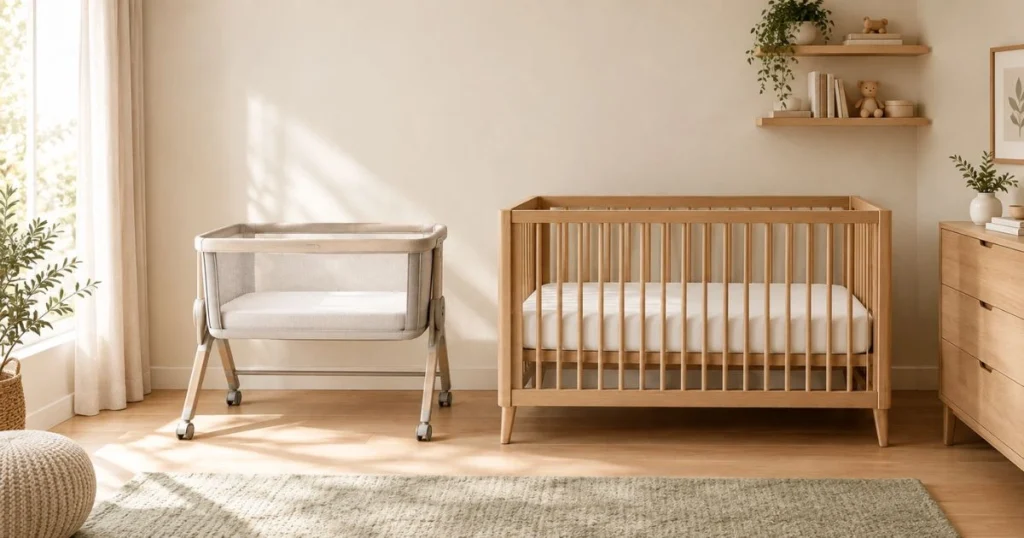
Bassinet vs Crib: What’s the Difference?
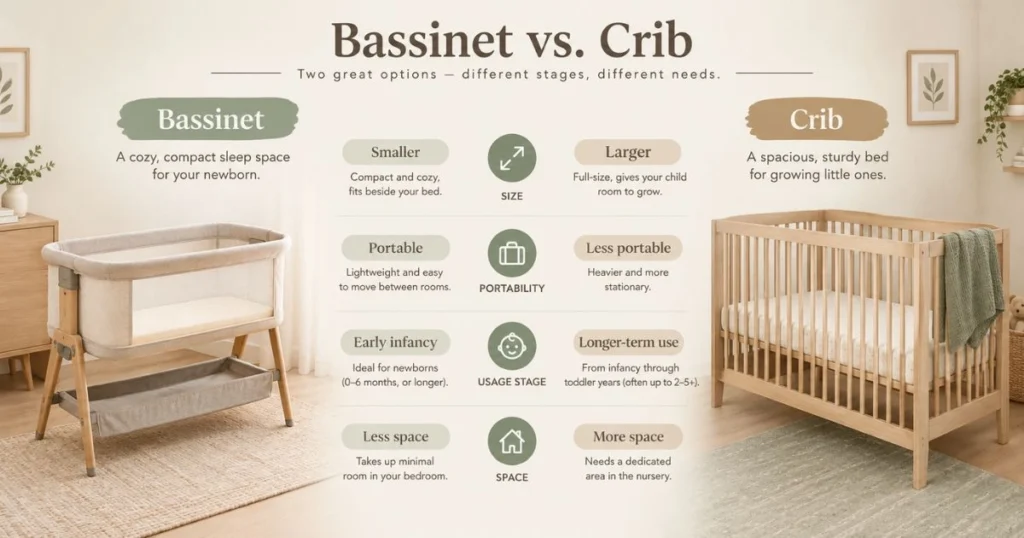
The easiest way to understand the Bassinet vs Crib difference is to think about size, portability, and how long you expect to use the sleep space.
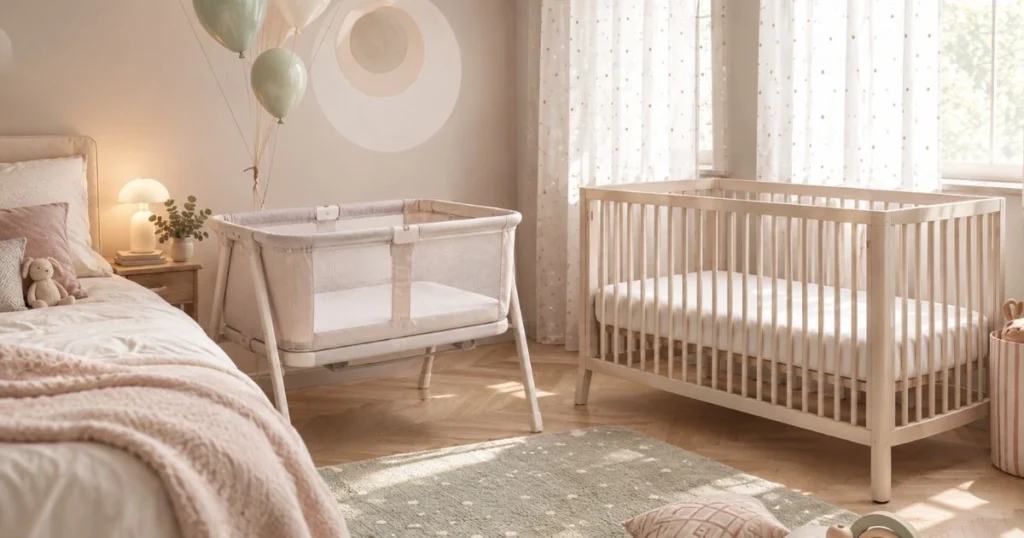
A bassinet is generally a smaller sleep product designed for infants. A crib is a larger, more permanent sleep space that can usually be used for much longer.
The U.S. Consumer Product Safety Commission (CPSC) defines a bassinet or cradle as a small bed designed primarily to provide sleeping accommodations for infants. Its standards also address structural stability, openings, folding, sharp edges, and other potential hazards.
What Is a Bassinet?
A bassinet gives you a compact place for your baby to sleep during the early months.
When considering Bassinet vs Crib, a bassinet may be:
- Lightweight
- Easy to move
- Designed to sit beside your bed
- Smaller than a crib
- Easier to fit into a small bedroom
- Intended for a limited stage of infancy
That smaller footprint can be particularly useful when you want your baby close to you at night without putting your baby in your bed.
The AAP notes that smaller sleep surfaces such as bassinets can appeal to families because they are smaller, more portable, and typically more affordable.
However, a bassinet is not automatically better simply because it is smaller. You still need to check that the specific product is intended for infant sleep and that you’re following its instructions.
What Is a Crib?
A crib provides a larger, more permanent sleep space.
When comparing Bassinet vs Crib, you may choose a crib because you want:
- A long-term sleep solution
- More room for your growing baby
- A dedicated sleep space in the nursery
- Fewer transitions between sleep products
- A product you can continue using beyond the newborn stage
A crib can also be placed in your bedroom during the early months if its size allows and the arrangement is practical.
The AAP recommends that your baby sleep in your room, close to your bed but on a separate sleep surface designed for infants, ideally for at least the first six months.
Bassinet vs Crib at a Glance
| Feature | Bassinet | Crib |
| Size | Smaller | Larger |
| Portability | Usually easier to move | Usually less portable |
| Space needed | Less | More |
| Typical purpose | Early infancy | Longer-term sleep |
| Sleep surface | Smaller | Larger |
| Main advantage | Convenience and portability | Longevity and space |
| Main limitation | Shorter period of use | Larger footprint |
These are general differences rather than strict rules. Individual products vary, so always check the manufacturer’s instructions before using a particular bassinet or crib.
Bassinet vs Crib for a Newborn: Which Is Better?
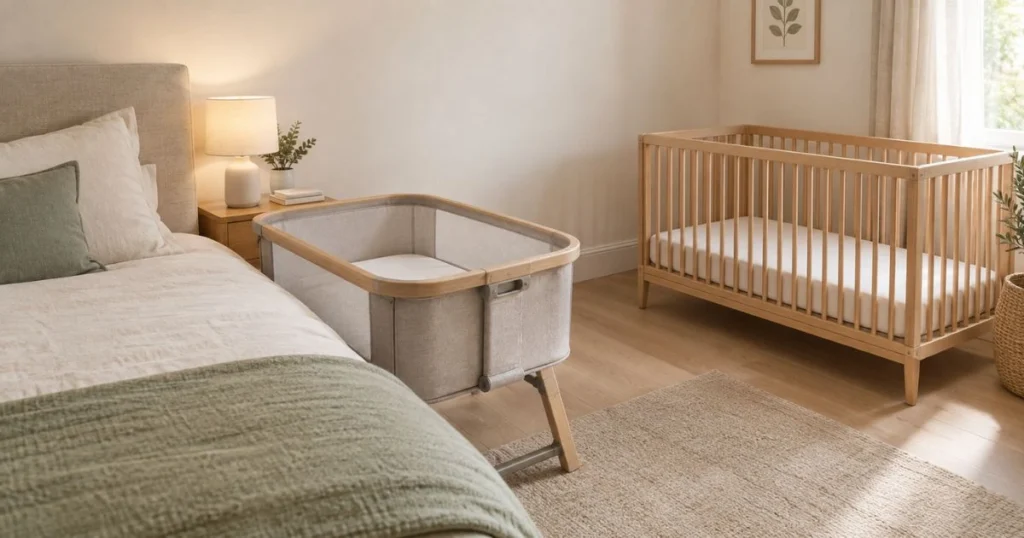
If you’re preparing for a newborn, you may be wondering whether one option is actually better.
The answer is more nuanced when comparing Bassinet vs Crib than simply choosing one over the other.
A newborn does not automatically need a bassinet.
A crib that meets current safety standards can be used as your baby’s sleep space from the beginning. A safety-approved bassinet can also be appropriate. What matters is that the product is designed for infant sleep and that you use it according to safe-sleep recommendations.
If you’re also trying to understand how much sleep your newborn needs, see our Newborn Sleep Schedule guide for a simple look at sleep during the first three months.
When a Bassinet May Make Sense
A A bassinet may fit your needs if you:
- Have limited bedroom space
- Want your baby close to your bed
- Prefer a smaller sleep space during the early months
- Need something easier to move
- Plan to use a crib later
- Want a sleep product specifically designed for the early stage
When considering Bassinet vs Crib, convenience is often one of the biggest reasons families choose a bassinet.
You may find it easier to reach your baby for nighttime feeds, check on your baby, or settle your baby without getting out of bed repeatedly.
When a Crib May Make More Sense
A crib may be a better option if you:
- Have enough space for one
- Want a longer-term sleep solution
- Prefer not to buy two separate sleep products
- Want your baby to become familiar with the crib from the beginning
- Can safely position the crib in your bedroom during the early months
When comparing Bassinet vs Crib, there is nothing wrong with starting with a crib simply because you prefer a larger, longer-lasting sleep space.
Do You Need a Bassinet for a Newborn?
No.
A bassinet is a convenience, not an automatic requirement.
If you already have a suitable crib and can safely keep it near your bed, you may decide that buying a separate bassinet doesn’t make sense for your family.
On the other hand, if you live in a small space or want a highly portable sleep surface, a bassinet may be worth considering.
When deciding between Bassinet vs Crib, the choice should come down to safe sleep, your baby’s stage, your available space, and what works realistically for your family.
Bassinet vs Crib Safety: What Matters Most?
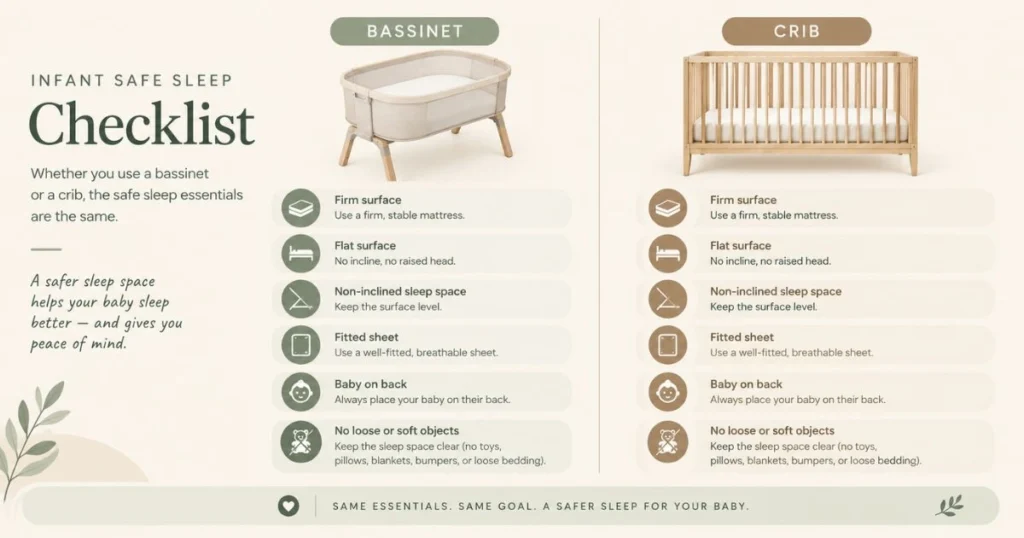
When comparing Bassinet vs Crib, safety should come before appearance, price, convenience, or nursery style.
The AAP recommends using a crib, bassinet, portable crib, or play yard that meets applicable safety standards. The sleep surface should be firm, flat, and non-inclined, with a fitted sheet and no other bedding or soft ob
For more guidance on creating a safe sleep environment, you can also read our guide to when babies can safely sleep with a blanket.
Choose a Firm, Flat Sleep Surface
YWhen considering Bassinet vs Crib, your baby’s sleep surface should:
- Be firm
- Be flat
- Not be inclined
- Maintain its shape
- Fit the product properly
- Use the mattress intended for that specific product
A soft mattress can allow an infant’s head or face to sink into the surface. The AAP explains that soft or conforming surfaces can increase the possibility of rebreathing or suffocation.
That means you should resist the temptation to make your baby’s sleep space softer with an extra mattress pad, cushion, pillow, or topper.
More cushioning does not mean safer sleep.
Keep the Sleep Space Bare
When considering Bassinet vs Crib, your baby’s sleep space should be simple.
For routine sleep, avoid putting these items inside the bassinet or crib:
- Pillows
- Loose blankets
- Quilts
- Comforters
- Crib bumpers
- Stuffed animals
- Sleep positioners
- Cushions
- Other loose or soft objects
The CDC recommends keeping soft bedding such as blankets, pillows, bumper pads, and soft toys out of the baby’s sleep area.
CPSC also uses the simple message “Bare is Best” for infant sleep spaces.
A fitted sheet on the correct mattress is all you need for the sleep surface.
Always Place Your Baby on Their Back
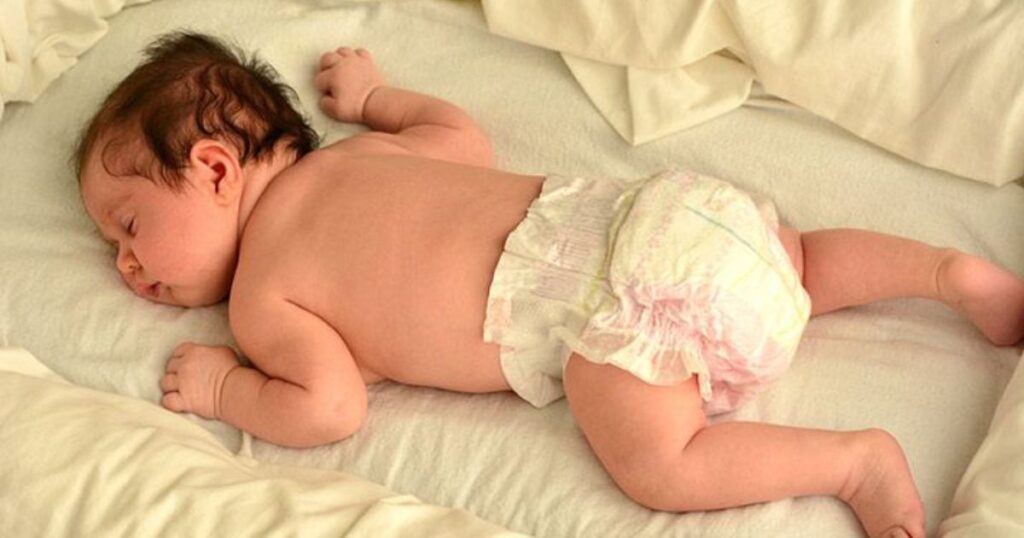
When considering Bassinet vs Crib, place your baby on their back for naps and nighttime sleep.
The CDC explains that babies who sleep on their backs are much less likely to die from SIDS than babies placed on their side or stomach.
You don’t need to create a complicated sleep position. Simply remember: Back to sleep, every sleep.
Room-Share Without Bed-Sharing
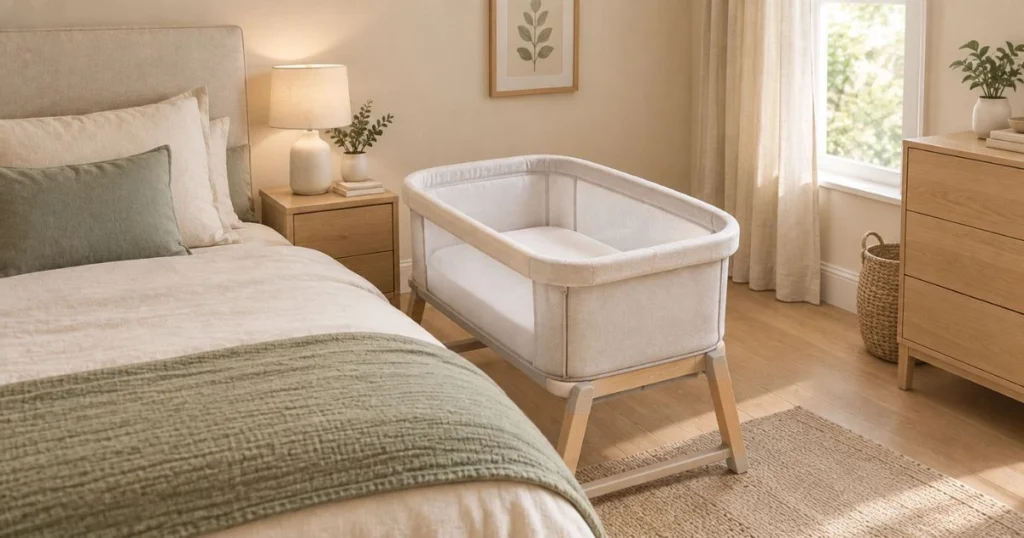
When comparing Bassinet vs Crib, you may want your baby nearby, especially during the newborn stage. That’s one reason a bassinet can be so convenient.
But keeping your baby close doesn’t mean putting your baby in your bed.
The AAP recommends room-sharing, meaning your baby sleeps in your room on a separate sleep surface. The recommendation is to room-share ideally for at least the first six months. The AAP reports that room-sharing without bed-sharing can reduce SIDS risk by as much as 50%.
This means either a bassinet or a crib may work in your bedroom, depending on your available space.
If you’re planning your baby’s sleep routine around room-sharing, our Baby Sleep Schedule by Age guide can help you understand how sleep patterns change as your baby grows.
Check the Product Before You Use It
Before choosing between Bassinet vs Crib, check the following:
- The manufacturer’s instructions.
- The product’s weight and developmental limits.
- The correct mattress.
- The condition of the frame and hardware.
- Whether the product has been recalled.
- Whether all required parts are included.
- Whether it has been assembled exactly according to the instructions.
The AAP recommends checking that infant sleep products meet current safety standards and have not been recalled. It also advises against using damaged cribs or cribs with missing parts.
If you’re considering a secondhand crib, be especially careful. An older product may not meet current safety requirements, could be missing hardware, or may no longer have its original assembly instructions.
Bassinet vs Crib: Pros and Cons
Once you understand the safety basics, the practical differences become easier to evaluate.
Bassinet Pros
A bassinet may be a good fit if you value:
- Portability: You can often move it more easily than a full-size crib.
- Compact size: It can work better in a smaller bedroom.
- Bedside convenience: You can keep your baby close to your bed.
- Early-use design: Many are intended specifically for the early months.
- Simple setup: Some models require less space and equipment than a full crib.
Bassinet Cons
There are also a few trade-offs to consider when comparing Bassinet vs Crib:
- Your baby may outgrow a bassinet relatively quickly.
- The product may have specific weight or developmental limits.
- You may eventually need to purchase a crib.
- Not every bassinet is suitable for every stage of development.
- A portable design can make it tempting to move the product frequently, so you should always make sure it is placed and used according to the manufacturer’s instructions.
Crib Pros
A crib can offer:
- Longevity: You may use it for much longer than a bassinet.
- More space: Your baby has a larger sleep surface.
- One main sleep solution: You may not need a separate newborn sleep product.
- A permanent nursery setup: It can become part of your child’s room as they grow.
- Less need for a transition: Your baby can eventually remain in the same general sleep environment.
Crib Cons
A crib also has limitations:
- It takes up more floor space.
- It is harder to move.
- It may not fit comfortably beside your bed.
- The initial setup can require more room.
- If your bedroom is small, positioning it safely may be difficult.
There isn’t a winner here.
The better option is the one that combines safe sleep with realistic use in your home.
How Long Can a Baby Sleep in a Bassinet?
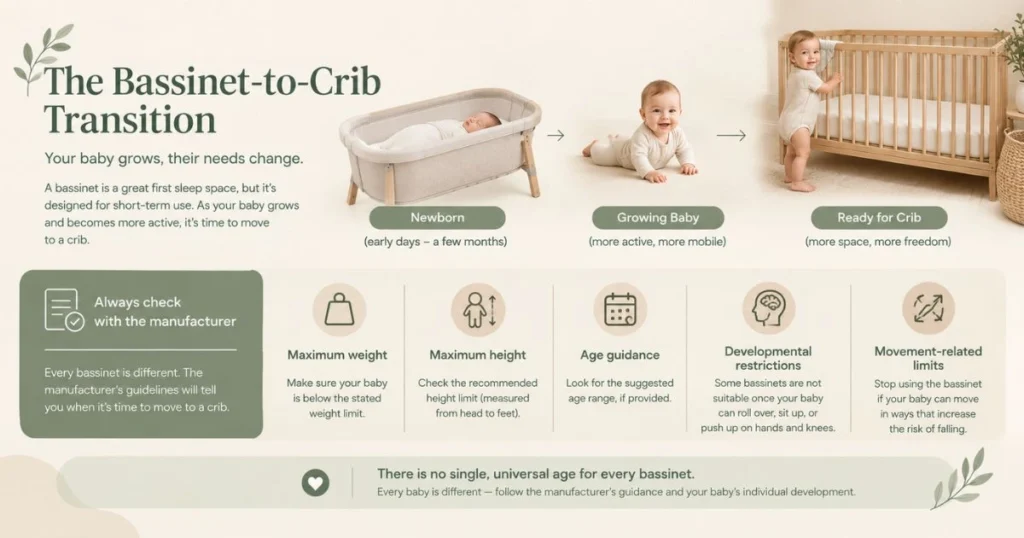
This is one of the most important questions to answer carefully because there isn’t one universal age that applies to every bassinet.
Instead of asking only, “How old is my baby?” ask:
Has my baby reached the bassinet’s specific limits?
Follow the Bassinet’s Limits
When comparing Bassinet vs Crib, check the manufacturer’s instructions for:
- Maximum weight
- Maximum height, if provided
- Age guidance
- Developmental restrictions
- Any instructions related to rolling or other movement
- Conditions requiring you to stop using the product
The AAP specifically advises parents to follow the manufacturer’s guidelines regarding the maximum infant weight for alternative sleep products.
This is important because two bassinets may look almost identical but have different safety limits and instructions..
When Should You Stop Using a Bassinet?
When considering Bassinet vs Crib, you should stop using the bassinet when the manufacturer says it is no longer appropriate for your baby.
That might be because:
- Your baby has reached the maximum weight.
- Your baby has reached another stated size limit.
- Your baby has reached a developmental stage that makes the product unsuitable.
- The manufacturer specifies that use should stop at a particular stage.
- The product has become damaged or no longer functions as intended.
Don’t rely on a friend’s experience with a different bassinet.
As your baby grows, their wake periods and sleep needs also change, so our Baby Wake Windows by Age guide can help you recognize age-appropriate sleep patterns.
When Is It Time to Transition Your Baby From a Bassinet to a Crib?
Moving from a bassinet to a crib isn’t necessarily about reaching one particular birthday.
Instead, think about your baby’s development and the limits of the bassinet you’re using.
Signs It May Be Time to Transition
When considering Bassinet vs Crib, you may need to transition your baby when:
- Your baby approaches the bassinet’s maximum weight.
- Your baby reaches a stated height or size limit.
- Your baby reaches a developmental stage when the bassinet is no longer appropriate.
- The manufacturer instructs you to stop using it.
- The bassinet is no longer suitable for your baby’s current stage of development.
Don’t wait until the bassinet feels obviously too small.
The manufacturer’s instructions are there to help you recognize when the product has reached the end of its intended safe use.
What If Your Baby Starts Moving More?
Babies don’t all develop at exactly the same pace.
When comparing Bassinet vs Crib, review your specific bassinet’s instructions as your baby becomes more mobile and pay attention to its developmental limits.
This is especially important because some products are designed only for a specific stage of infancy.
If you’re unsure whether your baby has outgrown the bassinet, contact the manufacturer or your pediatrician instead of guessing.
Bassinet vs Crib for Room Sharing
Where you place your baby’s sleep space matters just as much as choosing the right product when comparing Bassinet vs Crib.
The AAP recommends that your baby sleep in your room, close to your bed, but on a separate sleep surface designed for infants, ideally for at least the first six months.
Using a Bassinet Beside Your Bed
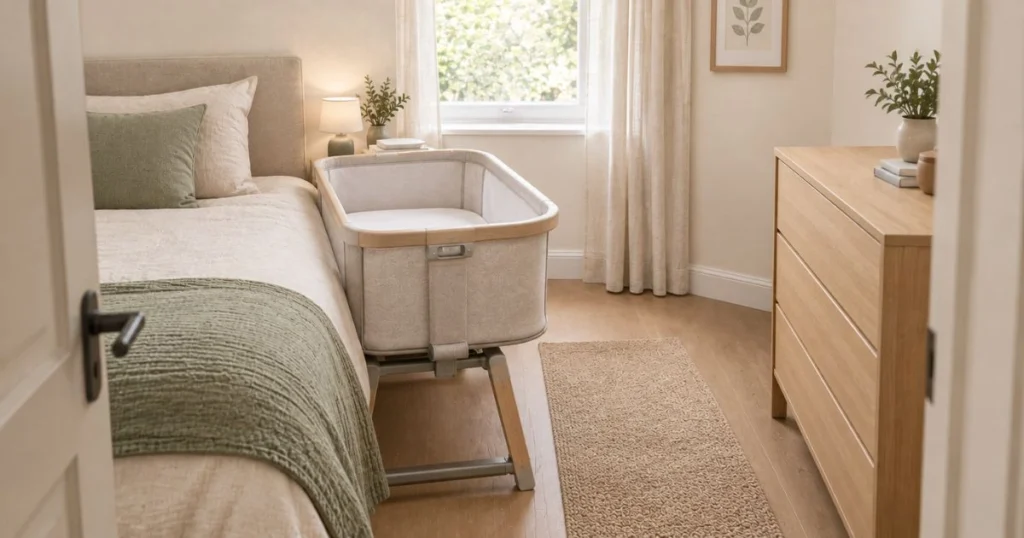
A bassinet can make room-sharing easier because of its smaller size, which is one factor to consider when comparing Bassinet vs Crib.
You may find it easier to:
- Reach your baby during nighttime feeds
- Check on your baby
- Comfort your baby
- Keep the sleep space close without sharing your bed
Using a Crib in Your Bedroom
A crib can also be a practical choice when your bedroom has enough space, which is another factor to consider when comparing Bassinet vs Crib.
You don’t have to move your baby into a separate nursery simply because you’ve chosen a crib.
If the crib fits safely in your bedroom and is set up according to the manufacturer’s instructions, it can serve as your baby’s sleep space from the beginning.
The key point is that room-sharing does not require a bassinet.
Bassinet vs Crib for a Small Bedroom
If you’re working with limited space, measure before you buy.
A bassinet often makes the most sense when every inch matters, but a crib can still work if you have enough room for it.
Choose a Bassinet If Space Is Very Limited
A bassinet may be practical when:
- Your bedroom is small.
- You want the baby beside your bed.
- You need to move the sleep space from time to time.
- You have limited space and cannot fit a full-size crib.
Choose a Crib If You Have Space for a Long-Term Sleep Setup
A crib may be more practical if:
- You have enough floor space.
- You want one primary sleep solution.
- You don’t mind keeping the crib in one place.
- You want to avoid buying a bassinet and then purchasing a crib later.
Measure Before You Buy
Before ordering anything, measure:
- The space beside your bed
- Doorways
- Walking paths
- Available floor space
- Distance from windows and cords
- The footprint of the assembled product
Don’t judge the size based on photographs online.
A product can look compact in a product photo and surprisingly large once assembled in your bedroom.
If your baby’s daytime sleep is changing around the same time, our Baby Nap Schedule guide can help you understand how nap patterns develop during the first year.
Do You Really Need Both a Bassinet and a Crib?
Not necessarily.
When comparing Bassinet vs Crib, you may choose to buy both because each can serve a different practical purpose. Alternatively, you may find that one safe and suitable sleep space is all your baby needs.
You May Want Both If…
A bassinet plus crib combination can make sense if:
- You want a very compact newborn sleep space.
- You want your baby’s sleep space close to your bedside.
- You plan to use a crib later.
- Your budget allows for two products.
- You value portability during the early months.
You May Need Only a Crib If…
A crib alone may work well if:
- You have enough room.
- You want a long-term solution.
- You don’t need a portable sleep space.
- You can keep the crib safely in your bedroom during the early months.
You May Start With a Bassinet
If you choose only a bassinet initially, remember that it is a short-term solution.
You will eventually need another suitable sleep space once your baby outgrows the bassinet. Planning for this transition in advance can help make the change easier and less stressful.
Once you’ve prepared a safe sleep space, you can build a simple baby bedtime routine to help your little one recognize when it’s time to wind down.
How to Choose Between a Bassinet and a Crib
If you’re still undecided, forget the product photos for a moment and think about your actual daily life.
Choose a Bassinet If You Prioritize…
- A smaller footprint
- Portability
- Bedside convenience
- A newborn-focused sleep space
- Moving the sleep space more easily
Choose a Crib If You Prioritize…
- Long-term use
- More room
- One main sleep solution
- A permanent nursery setup
- Avoiding an additional transition
Ask Yourself These 5 Questions
Before you buy, ask:
- Where will my baby sleep during the first six months?
- How much space do I really have?
- Do I need a portable sleep space?
- What are the product’s weight and developmental limits?
- Does the product meet current safety requirements?
Your answers will probably make the decision much easier.
If you’re preparing for the early months, our Newborn Sleep Schedule guide can help you understand what sleep may look like before your baby’s routine becomes more predictable.
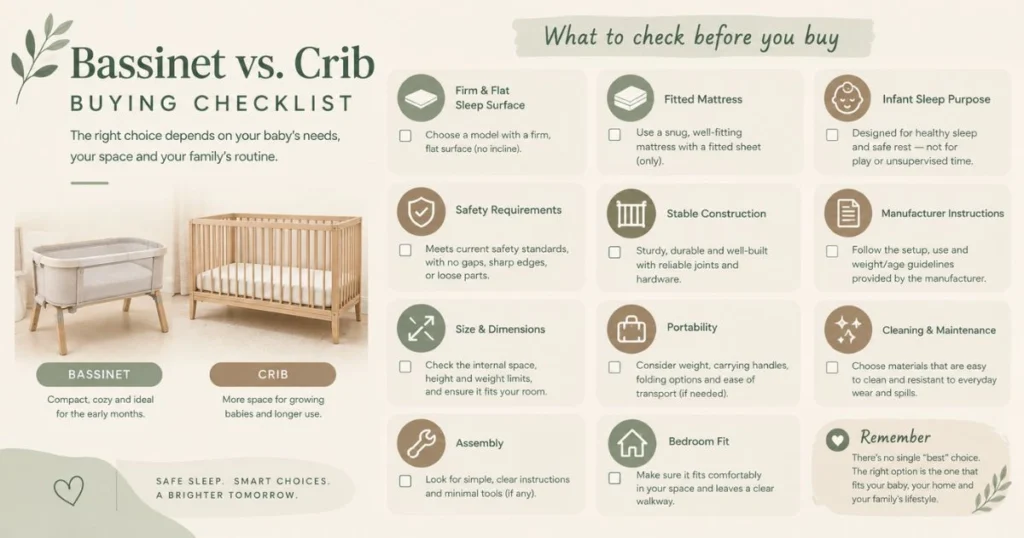
Bassinet vs Crib: What to Look for Before Buying
Once you’ve decided which type of product fits your needs, look beyond appearance.
Safety Features
Look for:
- A firm, flat sleep surface
- A properly fitted mattress
- A product intended for infant sleep
- Compliance with applicable safety requirements
- Stable construction
- Clear manufacturer’s instructions
- No unnecessary soft padding
The AAP recommends a firm, flat, non-inclined surface and says that the crib, bassinet, portable crib, or play yard should conform to applicable CPSC safety standards.
Practical Features
You can then consider:
- Size
- Portability
- Cleaning
- Storage
- Ease of assembly
- Weight
- Wheels or mobility features, if applicable
- How easily it fits into your bedroom
These features matter—but they come after safety.
Be Careful With Products That Encourage Unsafe Sleep
When comparing Bassinet vs Crib, you may see products marketed as cozy, soothing, or sleep-enhancing.
Be cautious with products that encourage your baby to sleep:
- At an incline
- On a soft surface
- Surrounded by cushions
- With positioners
- With loose padding
- In an environment that isn’t intended for routine infant sleep
The AAP recommends a flat, non-inclined sleep surface and notes that inclined sleep products are unsafe for infant sleep.
The CPSC also warns about the risks associated with soft objects and semi-reclined or seated positions during infant sleep.
If your baby falls asleep somewhere that isn’t intended for routine sleep, such as a stroller, swing, or car seat outside of travel, move your baby to an appropriate sleep surface as soon as practical. The AAP does not recommend routine sleep in sitting devices.
Bassinet vs Crib: Common Mistakes to Avoid
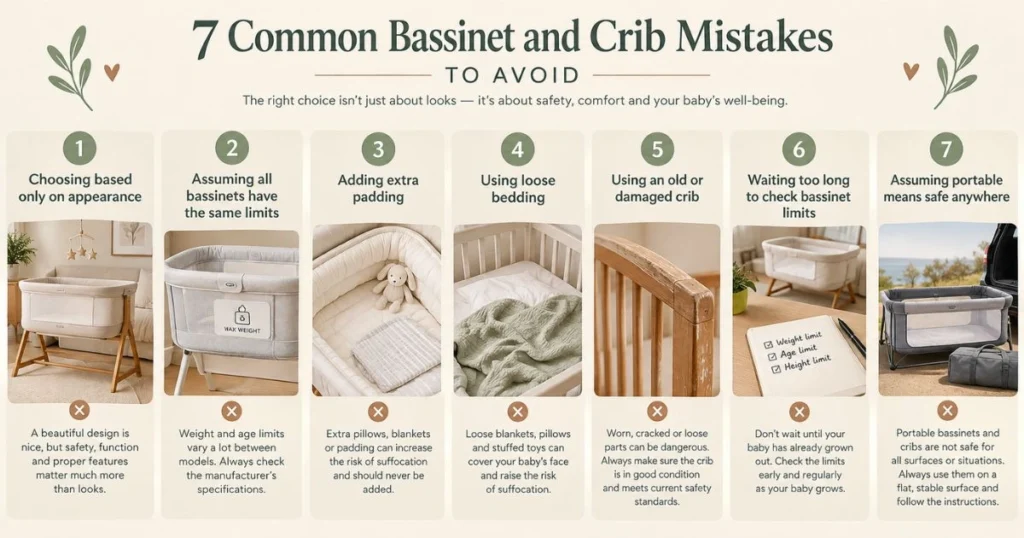
Even when parents know the basic recommendations, a few mistakes are easy to make.
1. Choosing Based Only on Appearance
A beautiful nursery doesn’t automatically mean a safe nursery.
Prioritize the sleep product’s intended use, safety requirements, and instructions before choosing a color or design.
2. Assuming Every Bassinet Has the Same Limits
They don’t.
Always check the exact model you’re using.
3. Adding Extra Padding
A mattress may feel firm to you, but adding a topper or cushion changes the sleep surface.
The AAP recommends using the mattress designed for the product and keeping pillows and cushions out of the sleep space.
4. Using Loose Bedding
Your instinct may be to add a blanket because your newborn feels small in a large sleep space.
Instead, follow current safe-sleep guidance and keep loose bedding out of the sleep area.
5. Using an Old or Damaged Crib
Missing hardware, broken components, or an outdated design can create safety concerns.
The AAP recommends using a new crib because older cribs may not meet current safety standards or may be missing parts.
6. Waiting Too Long to Check the Bassinet Limits
Don’t wait until your baby physically looks cramped.
Review the manufacturer’s limits before your baby reaches the point of needing a transition.
7. Assuming “Portable” Means “Safe Anywhere”
A portable sleep product still needs to be used exactly as intended.
Check where it can safely be placed, whether it needs a particular stand or base, and whether it has restrictions on movement or use.
Bassinet vs Crib FAQs
Bassinet vs Crib: Which Is Safer?
Neither option is automatically safer simply because it is a bassinet or crib.
When comparing Bassinet vs Crib, both a safety-approved bassinet and crib can provide an appropriate sleep surface for your baby when used according to current safe-sleep recommendations. The AAP recommends a firm, flat, non-inclined surface with a fitted sheet and no soft or loose objects.
Bassinet vs Crib: Which Is Better for a Newborn?
Both can work for a newborn when they are designed and approved for infant sleep and used correctly.
When comparing Bassinet vs Crib, a bassinet may be more convenient if you want a compact, portable sleep space beside your bed. A crib may be a better choice if you prefer a larger, longer-term sleep solution.
Bassinet vs Crib: Do I Need Both?
No.
You can start with a bassinet and switch to a crib later, or choose a suitable crib for your baby from the beginning.
Your available space, budget, portability needs, and preferences can help you decide.
Can a Newborn Sleep in a Crib?
Yes.
A newborn can sleep in a safety-approved crib when the sleep environment follows safe-sleep recommendations. The AAP recommends a firm, flat, non-inclined sleep surface with a fitted sheet and no other bedding or soft objects.
How Long Is It Safe for a Baby to Use a Bassinet?
There is no specific age when every baby should stop using a bassinet. Follow the manufacturer’s recommended weight, size, age, and developmental limits.
The AAP specifically recommends following manufacturer guidelines for maximum infant weight when using alternative sleep products.
When Is It Time to Move Your Baby From a Bassinet to a Crib?
Move your baby to a crib once the bassinet reaches any of its manufacturer-specified limits.
This may be based on weight, size, age, developmental stage, or another product-specific limitation.
Can Your Baby Sleep Safely in a Bassinet Overnight?
A bassinet intended for infant sleep can be used overnight when it is set up according to the manufacturer’s instructions and current safe-sleep guidelines.
The sleep surface should be firm, flat, and non-inclined, with only the appropriate fitted sheet.
Can a Crib Be Used in the Parents’ Bedroom?
Yes.
A crib can fit safely in your bedroom as long as you have enough space for proper setup and use.
The AAP recommends room-sharing, with your baby on a separate sleep surface, ideally for at least the first six months.
What Should You Put in Your Baby’s Bassinet or Crib?
Keep the sleep surface simple:
- Firm mattress designed for the product
- Properly fitted sheet
- Baby placed on their back
Keep pillows, loose blankets, bumpers, stuffed toys, cushions, and other soft or loose objects out of the sleep space.
Are Inclined Sleep Products Safe for Babies?
The AAP recommends a flat, non-inclined sleep surface. Its evidence review notes that inclined sleep surfaces can increase the risk associated with rolling and suffocation.
If a product is marketed as a sleep solution but places your baby on an inclined surface, don’t assume that “sleep” in the product’s marketing means it is appropriate for routine infant sleep.
Conclusion: Bassinet vs Crib—Which One Is Right for Your Baby?
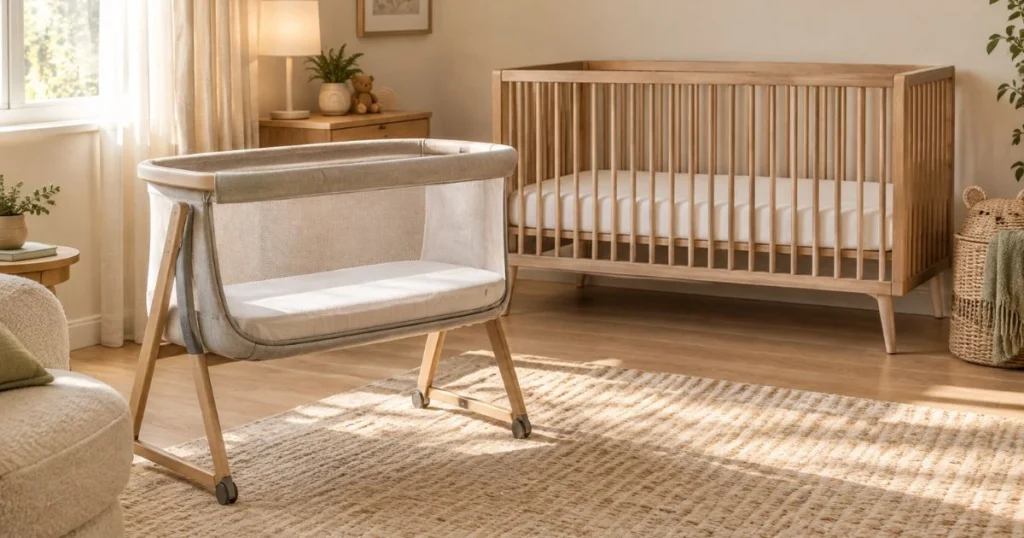
When you’re comparing Bassinet vs Crib, you don’t need to find one answer that works for every family.
A bassinet can be a practical choice when you want a compact, portable sleep space close to your bed during the early months. A crib can be a better fit when you want a larger, longer-term sleep solution.
You also don’t necessarily need both.
Your decision can come down to five things:
- Your baby’s current stage
- The product’s safety requirements and limits
- The space available in your home
- Whether portability matters to you
- Whether you want a short-term or longer-term solution
Most importantly, don’t let the size, style, or price tag distract you from the basics.
Your baby’s sleep space should be firm, flat, non-inclined, and free of loose or soft objects, and your baby should be placed on their back for sleep.
You don’t have to create a perfect nursery before your baby arrives. You simply need a safe sleep space that fits your baby and your family’s real life.
If you’re still preparing for your baby’s first months, explore our Baby Sleep Schedule by Age guide for more practical sleep guidance from newbornhood through the first year.
Parenting Whisper Reminder: Wherever your baby sleeps, safe and simple is better than complicated and cozy.
Ready to prepare your baby’s sleep space?
Before you buy a bassinet or crib, save this article and use the safety checklist above when comparing your options. If you’re already using a bassinet, check its manufacturer’s limits now so you know what to expect when your baby is ready for the next sleep space.