

Yes. This paragraph already contains the focus keyword “newborn sleep schedule” naturally, so I would not add it again.
For better keyword density, keep this version:
If you are searching for a newborn sleep schedule at 2 a.m. while holding a baby who has decided that nighttime is the perfect time to be wide awake, you are not alone.
The newborn stage can make sleep feel completely unpredictable. One day your baby may nap for two hours; the next, every nap seems to last 30 minutes. You may wonder whether your baby is sleeping too much, not enough, or simply at all the wrong times.
The reassuring part is that newborn sleep is different from the sleep of an older baby or toddler. Newborns do not begin life with a reliable day-and-night rhythm, and their sleep is closely connected to feeding and their developing biological clock.
Instead of trying to force your baby into a strict timetable, think of the first three months as a gradual transition toward a flexible sleep rhythm.
In this guide, you’ll learn how much sleep your baby needs, how wake windows work, how to recognize sleepy cues, and how to encourage healthier day-and-night patterns while keeping safe sleep a priority.

What Is a Newborn Sleep Schedule?

A newborn sleep schedule looks very different from the structured timetable you may use with an older baby.
During the first few weeks, your baby’s day often follows a simple pattern:
Feed → brief awake time → sleep → wake → feed → repeat.
Because newborns are still developing their sleep patterns, frequent waking is expected, especially for feeding. The American Academy of Pediatrics explains that newborns may sleep for roughly 16–17 hours over a 24-hour period, usually divided into several short stretches rather than one long period.
If you’re learning how long your baby can comfortably stay awake, see our guide to [Baby Wake Windows by Age].
Do Newborns Really Need a Sleep Schedule?
Not necessarily. A rigid timetable usually isn’t the goal during the newborn stage.
Instead, focus on a few important signals and habits:
- Your baby’s feeding needs
- Appropriate wake periods
- Signs that your baby is becoming sleepy
- Natural daylight during the day
- A simple, calming bedtime routine
- Your baby’s total sleep over a 24-hour period
Think of a Newborn Sleep Schedule as a flexible guide rather than a set of exact times. If your baby falls asleep at 9:15 a.m. one day and closer to 9:45 a.m. the next, that small difference does not mean something is wrong..
Newborn Sleep Schedule vs. Newborn Sleep Routine
These terms are easy to confuse.
A schedule tells you when something happens.
A routine gives your baby familiar steps that happen in roughly the same order.
For example, your bedtime routine might be:
- Dim the lights.
- Change the diaper.
- Put on sleepwear.
- Feed.
- Burp.
- Cuddle.
- Place your baby in their sleep space.
You can keep this sequence relatively consistent even when bedtime itself changes from day to day.
How Much Sleep Does a Newborn Need?
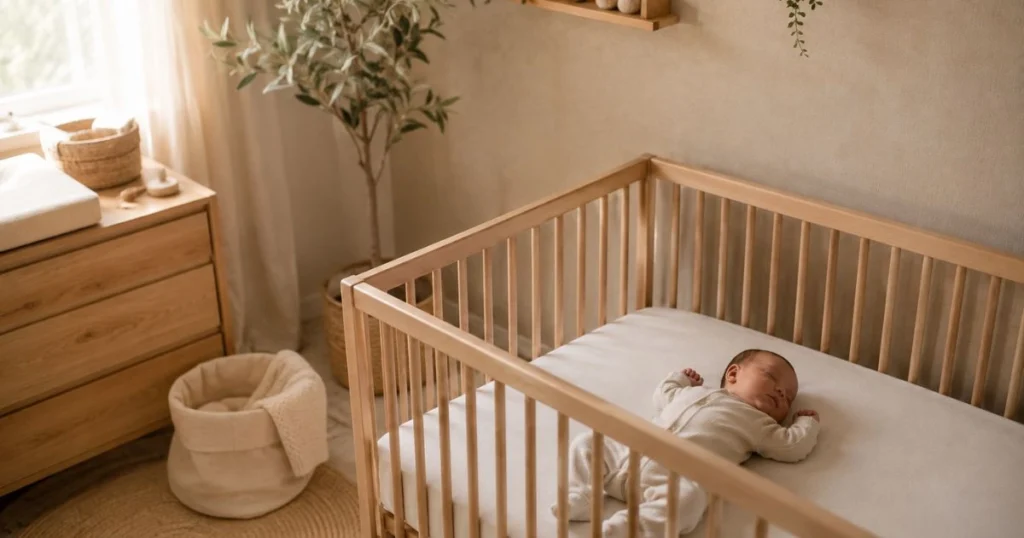
Knowing how much sleep your baby generally needs gives you a helpful starting point, but your newborn sleep schedule may not divide neatly into separate daytime naps and nighttime sleep.
The CDC recommends 14–17 hours of total sleep within a 24-hour period for babies from birth to 3 months. However, every baby is different, so your baby’s sleep may naturally fall at a different point within this range.
For a more detailed look at sleep needs as your baby grows, see our [Baby Sleep Schedule by Age] guide.
You can find additional information about infant sleep recommendations from the American Academy of Sleep Medicine.
Newborn Sleep Needs at a Glance
| Age | Total Sleep in 24 Hours | What You May Notice |
| 0–1 month | Around 14–17 hours | Frequent short sleep periods |
| 1–2 months | Around 14–17 hours | Day/night pattern gradually develops |
| 2–3 months | Around 14–17 hours | Some babies become more predictable |
The important thing is to look at the whole 24-hour period, not one individual nap.
How Long Do Newborns Sleep at a Time?
During the early weeks, your baby may sleep for just an hour or two before waking again. This is common because newborns need frequent feeds, and their small stomachs cannot hold large amounts of milk at once.
Your newborn sleep schedule may include a variety of sleep periods, such as:
- A 30-minute nap
- A 60–90-minute sleep
- A two-hour stretch
- Several short naps throughout the day
- Multiple wake-ups during the night
These variations can be a normal part of newborn sleep, so try to look at your baby’s overall pattern rather than expecting every sleep period to be the same length.
If you want to understand how daytime sleep changes as babies grow, explore our [Baby Nap Schedule: A Complete Guide by Age].
How Much Do Newborns Sleep at Night?
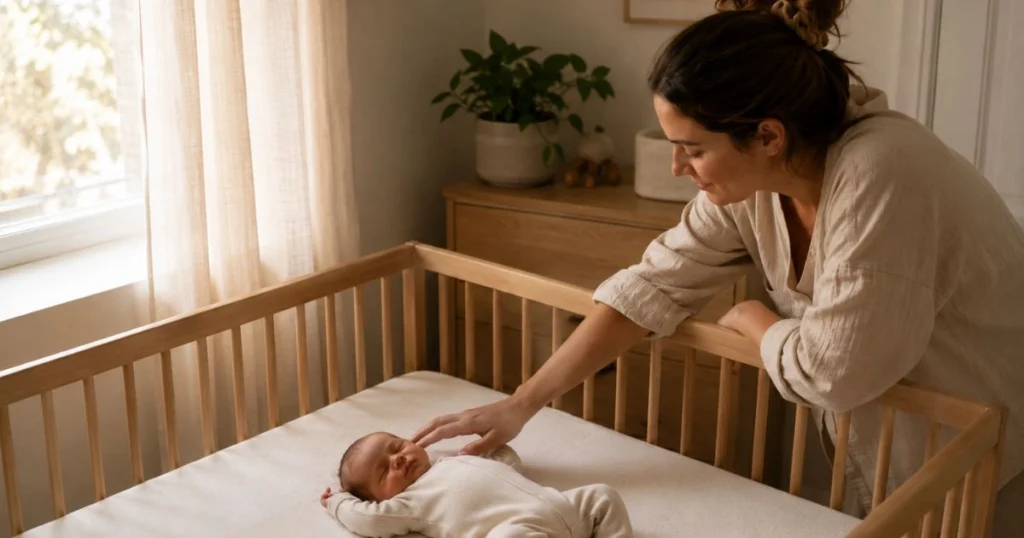
Nighttime sleep does not mean your baby will necessarily stay asleep from evening until morning. During the early months, your newborn sleep schedule will often include several periods of waking overnight.
Your baby may wake because they need to:
- Feed
- Have a diaper change
- Get more comfortable
- Settle back to sleep with your help
Frequent nighttime waking is a normal part of early infancy and does not mean your baby is a bad sleeper. Regular waking is expected while your baby’s sleep patterns are still developing. and does not mean your baby is a poor sleeper. The AAP also notes that regular nighttime waking is expected during this stage.
The American Academy of Pediatrics’ guidance on day-night reversal also offers practical suggestions for helping babies gradually distinguish daytime from nighttime.
Newborn Wake Windows by Age
Once you understand how much sleep your newborn needs, the next helpful part of your newborn sleep schedule is learning about wake windows.
A wake window is the approximate period your baby can comfortably stay awake between two sleep periods. It starts when your baby wakes and includes all the activities that happen before the next nap or sleep.
During this time, your baby may:
- Feed
- Burp
- Have a diaper change
- Cuddle with you
- Look around and observe their surroundings
- Listen to you talk
- Enjoy a short session of supervised tummy time while awake
- Wind down and get ready for sleep

Newborn Wake Windows: 0–3 Months
Wake windows are estimates, not deadlines.
| Age | Approximate Wake Window |
| Birth–1 month | About 30–60 minutes |
| 1–3 months | About 1–2 hours |
Cleveland Clinic gives approximately 30–60 minutes for babies from birth to 1 month and about 1–2 hours for babies from 1–3 months.
Because these ranges are broad, your baby’s behavior matters just as much as the clock.
Why Wake Windows Shouldn’t Become a Strict Rule
You may find that your newborn seems ready for sleep after 40 minutes on one occasion but remains content and alert for almost an hour at another time. That’s completely normal.
Your baby’s wake window may vary depending on factors such as:
- Feeding needs
- Growth spurts
- A shorter or disrupted previous nap
- The amount of stimulation during awake time
- Illness or physical discomfort
- Your baby’s individual temperament
Use wake windows as a general reference within your newborn sleep schedule, but always pay attention to your baby’s sleepy cues as well.
How to Tell When Your Newborn Is Ready for Sleep
You don’t need to wait for your baby to cry before starting the sleep routine. Recognizing those early signs of tiredness can make your Newborn Sleep Schedule easier to follow and help you settle your baby before they become overtired.
Early Newborn Sleep Cues
Look for signs such as:
- Looking away
- Becoming quieter
- Losing interest in interaction
- Decreased activity
- Staring into space
- Yawning
Late Sleep Cues
If you miss those early sleep cues, your baby may begin to show:
- Fussiness
- Crying
- Irritability
- Difficulty settling
- Frantic movements
The AAP recommends paying attention to signs of sleepiness and overtiredness because recognizing them early can help you settle your baby more easily.
Should You Follow Sleep Cues or the Wake Window?

Use both approaches. Your newborn sleep schedule can give you an idea of when your baby may be ready for sleep, while your baby’s behavior gives you a clearer indication of when they actually need to rest.
For example, if your 5-week-old has been awake for only 35 minutes but is already yawning, looking away, and becoming quieter, you don’t need to keep your baby awake simply to reach a specific time on the clock.
Newborn Sleep Schedule by Age: 0–3 Months
The first three months can change quickly, so it helps to look at them in smaller stages.
0–4 Weeks: A Flexible Newborn Sleep Rhythm
During the first month, forget the idea of a perfectly predictable schedule.
Your baby’s day may revolve around feeding and sleeping.
A typical rhythm might look like:
Wake → feed → burp → brief interaction → sleep.
Then the cycle repeats.
Sample 0–4 Week Newborn Sleep Rhythm
| Approximate Time | Possible Activity |
| 7:00 a.m. | Wake and feed |
| 7:30 a.m. | Sleep |
| 9:00 a.m. | Wake and feed |
| 9:30 a.m. | Sleep |
| 11:00 a.m. | Feed and brief awake time |
| 11:45 a.m. | Sleep |
| Afternoon | Repeated feed/wake/sleep cycles |
| Evening | Feeding, cuddling and short sleep periods |
| Overnight | Feed and return to sleep as needed |
This is not a schedule your baby must follow. The times are simply an example of how a newborn’s day can flow.
At this stage, feeding needs should not be sacrificed simply to make the sleep schedule look more organized.
4–8 Weeks: Starting to See a Pattern
Around the second month, you may begin noticing small changes.
Your baby may:
- Stay awake a little longer.
- Have more alert periods during the day.
- Show clearer sleepy cues.
- Begin having a somewhat longer first nighttime sleep period.
- Respond more consistently to a bedtime routine.
You may still have nights when everything falls apart.That doesn’t mean you’ve lost the progress you’ve made.
A Flexible 4–8 Week Rhythm
Instead of planning every minute, aim for a repeating pattern:
Morning light → feed → awake time → nap → feed → awake time → nap → repeat → calming evening routine → nighttime sleep.
Some days will contain more sleep periods than others.
8–12 Weeks: A More Predictable Rhythm
By the end of the newborn period, some babies begin showing a clearer distinction between daytime and nighttime.
You may notice:
- Longer periods of daytime alertness
- More consistent sleepy cues
- A recognizable evening routine
- A somewhat longer nighttime stretch
- More predictable nap opportunities
However, this does not mean every 3-month-old will sleep through the night.
Sleep development varies from baby to baby, and research shows that biological rhythmicity becomes increasingly organized during the early months of life.
For the next stages, see our complete guide to [Baby Sleep Schedule by Age].
How Many Naps Does a Newborn Need?
This is one area where trying to force a specific number can create unnecessary stress.
A newborn may sleep many times throughout the day because their sleep is spread across frequent periods.
How Many Naps Should a Newborn Take?
There isn’t a fixed number of naps that every newborn should have each day.
Instead of focusing on:
“Does your baby need exactly four naps each day?”
ask yourself:
“Is your baby getting enough daytime sleep while feeding and behaving normally?”
As part of your newborn sleep schedule, your baby may take several brief naps, a combination of short and longer naps, or longer sleep periods at different times throughout the day.
If you want to understand how daytime sleep changes as babies grow, explore our [Baby Nap Schedule: A Complete Guide by Age].
How Long Should a Newborn Nap?
Newborn naps can vary considerably.
A short nap on its own doesn’t necessarily indicate a problem.
Your baby might sleep for:
- 20–30 minutes
- 45 minutes
- 1–2 hours
- Longer or shorter periods on different days
Look at patterns over time rather than judging your baby’s sleep based on one nap.
What If Your Newborn Only Sleeps for 20–40 Minutes?
Before assuming that you need to “fix” the nap, check:
- Was your baby hungry?
- Did you catch the sleepy cues?
- Was your baby awake for an appropriate amount of time?
- Was the room stimulating?
- Was your baby uncomfortable?
Sometimes the answer is simply that your newborn is still developing more organized sleep patterns.^ù*
Newborn Day and Night Confusion

You may feel as though your baby has completely reversed your schedule.
Your newborn sleeps peacefully during the day and becomes surprisingly alert after dark.
This is often referred to as day and night confusion.
Why Is My Newborn Awake at Night?
Newborns don’t begin with a mature circadian rhythm.
They also wake frequently because they need regular feeds and care.
The HSE notes that newborns wake regularly to feed during both day and night, while their day/night pattern develops gradually.
How to Help Your Newborn Learn Day From Night
You don’t need complicated sleep training.
Try these simple habits:
- Use natural light during the day. Open curtains and spend time in normal daytime surroundings.
- Keep daytime interactions engaging. Talk, cuddle, and interact with your baby when they are awake.
- Dim the lights at night. Help nighttime feel different from daytime.
- Keep nighttime feeds calm. Avoid turning every night waking into playtime.
- Limit unnecessary stimulation overnight.
- Repeat the same general evening routine.
The AAP similarly recommends keeping nighttime interactions quiet and calm while making daytime more active.
How to Create a Newborn Bedtime Routine

Your newborn may not have a consistent bedtime yet, but you can still introduce familiar signals that tell your baby that nighttime is approaching.
Simple Newborn Bedtime Routine
Try a short sequence such as:
- Dim the lights.
- Change your baby’s diaper.
- Put on pajamas or appropriate sleepwear.
- Feed your baby.
- Burp.
- Cuddle quietly.
- Use a calm voice.
- Put your baby down in a safe sleep area.
You don’t need an elaborate routine.
The goal is to make bedtime familiar and calm, not to force your newborn to sleep at a specific hour.
You can also use these principles when creating a consistent [Baby Bedtime Routine] as your baby gets older.
Safe Sleep for Newborns: The Most Important Part of Any Sleep Schedule
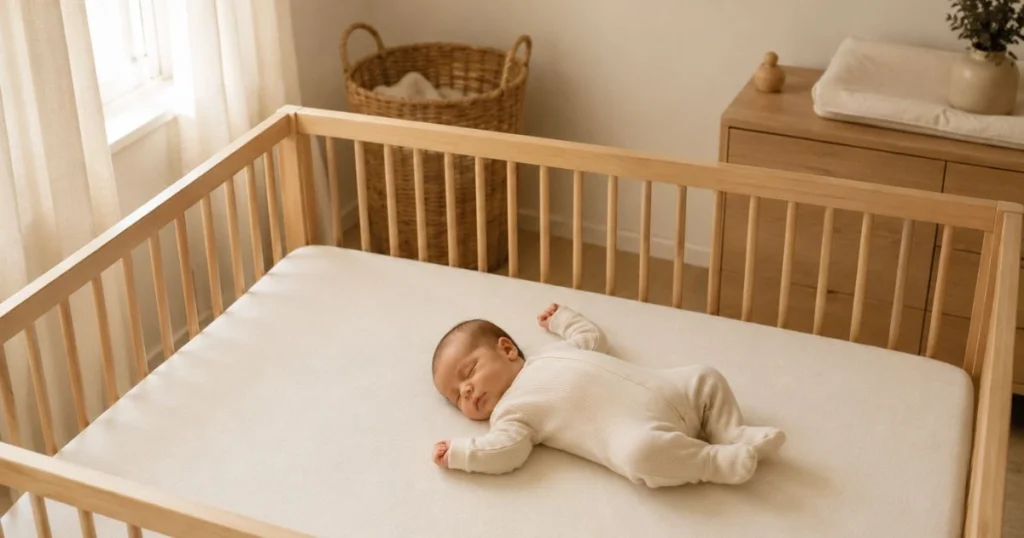
Safe sleep should always take priority over following a specific newborn sleep schedule.
Current AAP guidance recommends placing your baby on their back for every sleep on a firm, flat, non-inclined surface. Keep the sleep area clear of loose bedding, pillows, bumper pads, stuffed animals, and other soft items.
The Safest Newborn Sleep Environment
Your baby’s sleep space should include:
- A firm, flat mattress
- A fitted sheet
- A crib, bassinet, portable crib, or play yard designed to meet current safety standards.
- Baby placed on their back
- No pillows
- No loose blankets
- No stuffed toys
- No bumper pads
The AAP advises keeping your baby’s sleep space in your room, without sharing the same bed, ideally for the first six months.
Can a Newborn Sleep With a Blanket?
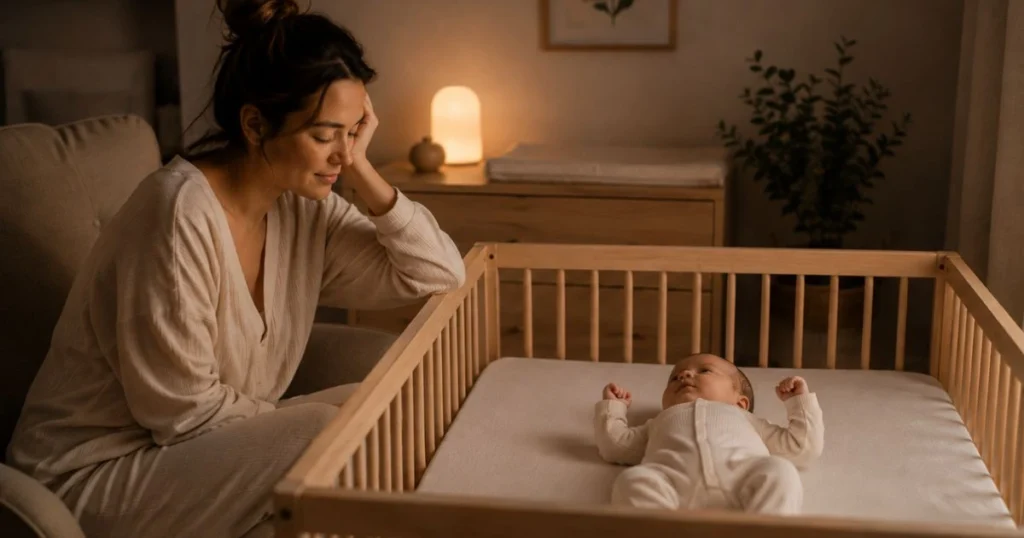
Loose blankets should not be placed in your newborn’s sleep area.
If your baby needs additional warmth, appropriately sized sleep clothing or a wearable blanket can be used instead. Weighted sleep products should be avoided.
If you swaddle your newborn, always place them on their back and stop swaddling when they begin showing signs of trying to roll.
If you’re wondering when blankets become appropriate as your baby gets older, read our guide to [When Can a Baby Sleep With a Blanket? Safe Age, Risks & Expert Tips] for age-specific safety guidance.
Should You Wake a Newborn to Feed?
There isn’t one universal answer for every newborn.
Whether you should wake your baby may depend on factors such as:
- Age
- Weight gain
- Feeding pattern
- Whether your baby was premature
- Medical conditions
- Your pediatrician’s recommendations
If your newborn has feeding or weight-gain concerns, follow individualized medical advice rather than a generic sleep schedule.
Common Newborn Sleep Problems
Even when you understand newborn sleep, some nights can still be difficult.
Why Won’t My Newborn Sleep Unless I Hold Them?
Newborns naturally seek warmth, gentle movement, feeding, and close physical contact. Wanting to be held does not mean you’ve created a bad habit or disrupted your Newborn Sleep Schedule.
However, if you feel yourself becoming sleepy while holding your baby, place them in a safe, separate sleep space. Falling asleep with your baby on a sofa or armchair can be especially dangerous.
Why Does My Newborn Wake Every 30 Minutes?
Possible reasons include:
- Hunger
- Normal newborn sleep patterns
- Discomfort
- An unsuitable wake period
- Difficulty settling between sleep periods
- Environmental stimulation
Look at the whole picture rather than assuming every short sleep means your baby has a sleep problem.
Why Is My Newborn Sleeping During the Day but Awake at Night?
Why Is My Newborn Fighting Sleep?
Your baby may be:
- Hungry
- Overtired
- Under-tired
- Overstimulated
- Uncomfortable
- Ready for sleep but already past their easiest settling window
Respond to your baby’s early signs of tiredness instead of waiting until they become very upset.
How to Adjust Your Newborn Sleep Schedule

You don’t need to overhaul your entire day because one nap went badly.
Instead, make small adjustments.
If Your Newborn Is Waking Very Frequently
Check:
- Feeding needs
- Sleep environment
- Wake window
- Temperature and clothing
- Whether your baby is becoming overtired
If Your Newborn Sleeps Mostly During the Day
Try:
- More natural daytime light
- More interaction during awake periods
- Quiet, dim nighttime feeds
- A consistent evening sequence
If Your Newborn Refuses Naps
Try:
- Watching for early sleepy cues.
- Reducing stimulation.
- Starting the calming routine earlier.
- Checking whether your baby needs to feed.
- Offering sleep again rather than trying to force a particular nap time.
If Every Day Looks Different
That can be completely normal.
During the newborn stage, your Newborn Sleep Schedule doesn’t need to look exactly the same every day. Instead, focus on creating familiar and predictable sleep cues that gradually help your baby recognize when it’s time to rest.
Newborn Sleep Schedule Mistakes to Avoid
Mistake 1: Forcing a Strict Clock-Based Schedule
Newborns aren’t ready for the kind of rigid timetable that may work better for an older baby, so your Newborn Sleep Schedule should remain flexible.
Mistake 2: Keeping Your Baby Awake to Make Them Sleep Longer
Longer awake periods do not automatically produce better nighttime sleep.
Instead, watch for your baby’s natural signs of tiredness.
Mistake 3: Ignoring Early Sleep Cues
Waiting until your baby is extremely upset can make settling harder.
Mistake 4: Comparing Your Baby’s Sleep With Other Babies’ Sleep
One newborn may sleep for a two-hour stretch while another wakes every hour.
Neither pattern automatically tells you which baby is “better” at sleeping.
Mistake 5: Choosing Convenience Over Safe Sleep
Don’t alter your baby’s sleep position or sleep environment just because an unsafe setup appears to help your baby sleep for longer.
Newborn Sleep Schedule: What Is Normal at 0–3 Months?
During the first three months, a flexible Newborn Sleep Schedule may naturally include:
- Frequent nighttime waking
- Short daytime naps
- Occasional longer naps
- Overnight feeding
- Day-and-night confusion
- Different sleep patterns from one day to the next
- Gradually longer periods of awake time
- The beginnings of a bedtime routine
Around three months, some babies start developing a clearer distinction between daytime and nighttime, while others need more time. There is no specific age when your baby is expected to suddenly become a predictable sleeper.
Frequently Asked Questions About Newborn Sleep Schedule
What Is a Good Newborn Sleep Schedule?
A healthy Newborn Sleep Schedule should stay flexible, following your baby’s feeding needs, sleepy cues, and approximate wake periods instead of relying on rigid sleep times.
Should a Newborn Have a Sleep Schedule?
A rigid timetable usually isn’t necessary during the newborn stage. A flexible Newborn Sleep Schedule, built around your baby’s natural rhythm and a few simple routines, is often a more realistic approach.
How Can You Help Your Newborn Develop a Sleep Routine?
Start with a few consistent habits:
- Use natural light during the day.
- Keep nighttime interactions calm.
- Watch wake windows.
- Respond to sleepy cues.
- Repeat a simple bedtime routine.
- Keep safe sleep practices consistent.
How Many Hours Should a Newborn Sleep?
Babies from birth to 3 months generally need around 14–17 hours of total sleep within a 24-hour period, including both daytime naps and nighttime sleep. This overall amount can be considered when building a flexible Newborn Sleep Schedule.
How Long Should a Newborn Stay Awake?
Wake windows are different for every baby. During the first month, your newborn may stay awake for around 30–60 minutes, while this period can gradually extend to about 1–2 hours between 1 and 3 months. Use these ranges as a helpful reference within your newborn sleep schedule, not as fixed times your baby must follow.
How Many Naps Should a Newborn Take?
There isn’t a set number of naps that every newborn should have. In the early months, babies sleep at different times throughout the 24-hour day, so the number and length of naps can vary considerably as part of a flexible Newborn Sleep Schedule.
What Time Should a Newborn Go to Bed?
Your newborn may not have a predictable bedtime yet. Rather than forcing a specific clock time, make your Newborn Sleep Schedule more flexible by creating a calm evening routine and responding to your baby’s sleepy cues.
When Do Newborns Start Sleeping Longer at Night?
Sleep often becomes more predictable during the first few months, but every baby develops at their own pace. As your Newborn Sleep Schedule gradually takes shape, remember that sleeping through the night by three months is not an expectation for every baby.
Can Newborns Normally Sleep Most of the Day?
Newborns naturally spend much of the day sleeping, but talk with your baby’s healthcare provider if your baby is unusually hard to wake, has trouble feeding, or shows other changes that concern you. This is more important than trying to adjust your Newborn Sleep Schedule on your own.
How Do You Know When Your Newborn Is Overtired?
Possible signs include:
- Fussiness
- Irritability
- Crying
- Difficulty settling
- Looking away
- Increased restlessness
When to Contact Your Baby’s Healthcare Provider About Sleep
Most newborn sleep questions are part of normal early parenthood, but some situations deserve professional attention.Most newborn sleep concerns are a normal part of those early weeks, but certain signs should be discussed with a healthcare professional.
Contact your baby’s healthcare provider if you notice:
- Problems with feeding
- Poor or inadequate weight gain
- Difficulty waking your baby for feeds
- Breathing difficulties during sleep
- Unusual sleepiness or reduced alertness
- A noticeable change in your baby’s usual behavior
- Any sleep-related concern that seems unusual or worries you
Your pediatrician can assess your baby’s individual health, growth, and feeding needs rather than relying only on a general newborn sleep schedule.
Conclusion: Your Newborn’s Sleep Doesn’t Have to Be Perfect
The first three months are not about making your baby follow a perfectly timed routine. They are about getting to know your baby’s natural sleep patterns and building a Newborn Sleep Schedule that works with those patterns.
Some days, your newborn may sleep peacefully and take easy naps. On other days, naps may be short and unpredictable. You might finally sit down with a cup of coffee, only to hear your baby wake a few minutes later. That is part of newborn life—and it doesn’t mean you’re doing anything wrong.
A realistic Newborn Sleep Schedule should leave room for flexibility. You can use approximate wake windows, watch for early tiredness cues, offer plenty of natural light and interaction during the day, keep nighttime calm, and follow a simple bedtime routine. At the same time, safe sleep should always remain a priority: place your baby on their back, use a firm, flat sleep surface, and keep loose bedding and soft objects out of the sleep area.
Most importantly, try not to measure your parenting success by how long your newborn sleeps at one time.
You’re not trying to create a perfect sleeper at three weeks old.
You’re giving your baby the conditions to gradually learn the difference between day and night while responding to what they need right now.
If this guide helped you understand your baby’s sleep, save it and come back as your newborn grows. And if you’re struggling with a particular sleep pattern—short naps, frequent night waking, or day-and-night confusion—start by looking at your baby’s cues rather than trying to force the clock.