Some days, keeping your toddler entertained can feel like a full-time job.
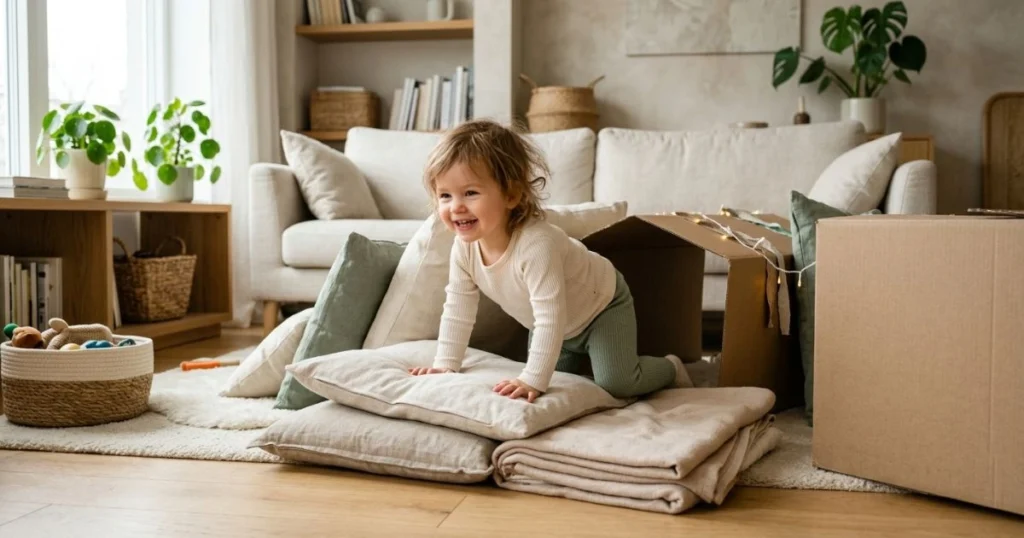
You clean up the toys, only to watch them dump everything onto the floor five minutes later. You offer a favorite toy, and suddenly it isn’t interesting anymore. And then comes the familiar cry: “I’m bored!”
The good news is that you don’t need a house full of expensive toys or a complicated craft planned for every hour of the day. Some of the best indoor activities for toddlers can be made with things you already have at home. These simple Indoor Activities can keep your little one busy while encouraging play, curiosity, and creativity.
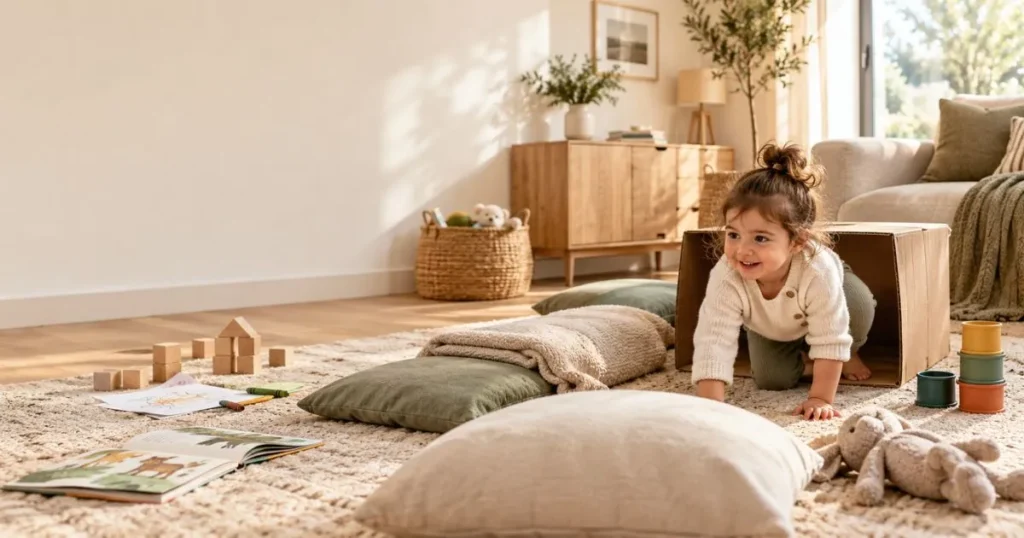
A blanket can become a fort. A few cushions can turn into an obstacle course. A cardboard box can become a car, house, shop, or spaceship. Even a few plastic containers can provide an opportunity for your toddler to explore, sort, stack, and pretend.
The goal isn’t to keep your toddler entertained every minute. Instead, you want to give your child opportunities to move, explore, create, imagine, solve little problems, and connect with you.
In this guide, you’ll find 30 easy Indoor Activities for Toddlers, including screen-free ideas, quick activities for busy days, creative play, pretend play, movement games, and simple activities using everyday household items.
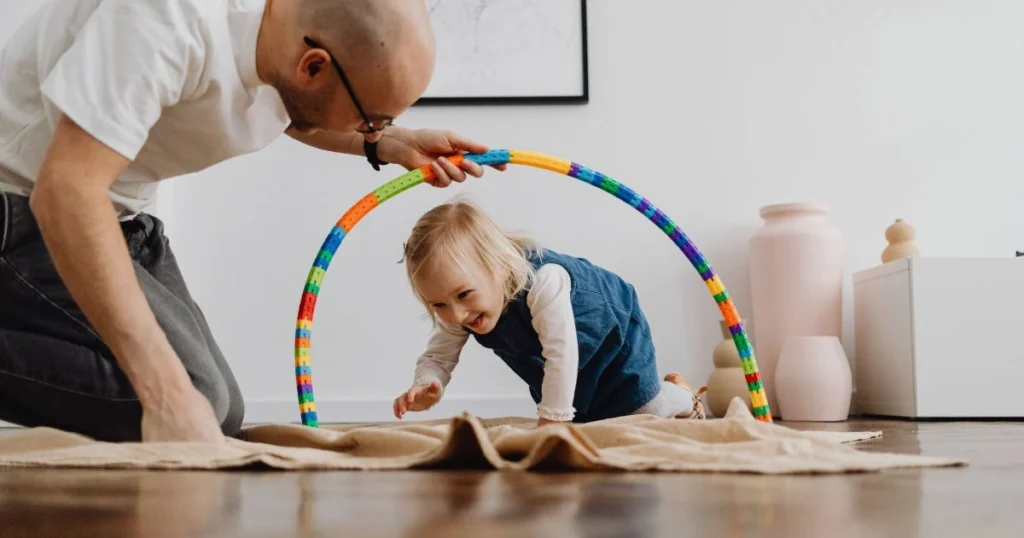
Why Indoor Activities Are Important for Toddlers
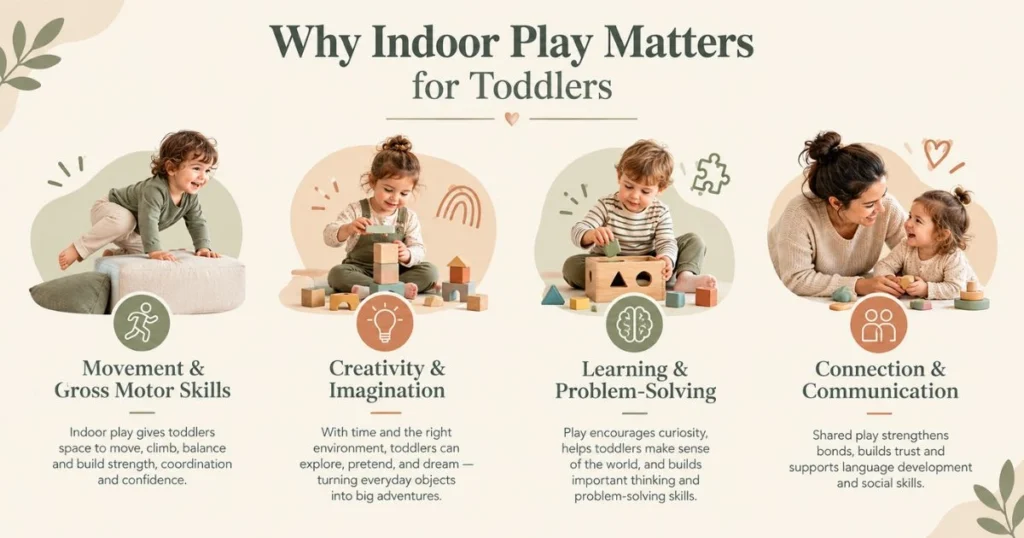
Indoor play isn’t simply something you use when the weather keeps you inside. Indoor Activities can also give your toddler valuable opportunities to learn, move, and explore in a familiar environment.
Your toddler is learning through everyday play. When your child stacks blocks, carries objects, pretends to cook, dances to music, or tries to complete a puzzle, they’re practicing different skills while having fun.
For more information, see our article on [Positive Parenting].
The CDC explains that developmental milestones include the ways children play, learn, speak, act, and move. Its guidance for 2-year-olds also suggests activities such as simple art, puzzles, blocks, songs, helping with household tasks, and exploratory play.
Indoor Play Gives Your Toddler Opportunities to Move
Some Indoor Activities are naturally active and give your toddler plenty of chances to move their body.
You can easily turn your living room into a fun space for:
- Dancing
- Crawling
- Balancing
- Kicking
- Walking around obstacles
- Pretending to be animals
- Throwing or rolling a soft ball
This matters because young children need plenty of opportunities for movement throughout the day.
The World Health Organization recommends that children ages 1–2 spend at least 180 minutes in a variety of physical activities throughout the day, at any intensity.
For more information, see the [WHO physical activity guidelines for children under 5].
For children ages 3–4, the recommendation is also at least 180 minutes, including at least 60 minutes of moderate-to-vigorous activity. That doesn’t mean every Indoor Activity needs to be energetic. Quiet play, creative activities, and pretend games also have an important place in your toddler’s day.our toddler needs to exercise for three hours at once. Movement can happen naturally in short bursts throughout the day.
For more information, see our article on [Toddler Emotions].
Indoor Activities Can Support Learning Through Play
You don’t need to turn Indoor Activities into a lesson every time your toddler plays.
A simple sorting game can introduce colors and categories. Building blocks can encourage problem-solving. Reading together can support language development. Pretend grocery shopping can introduce everyday vocabulary in a fun, natural way.
The CDC’s 2-year-old guidance specifically includes activities such as creating simple art, completing puzzles, playing with blocks, singing songs, and helping with simple household tasks.
Screen-Free Play Gives You Another Option
Screens aren’t the only way to fill a quiet afternoon. Indoor Activities can give your toddler something fun to do without relying on a screen.
You can keep a few simple screen-free toddler activities ready for moments when you want something different.
The WHO recommends limiting sedentary screen time for young children and encourages interactive alternatives such as reading and storytelling with a caregiver.
The idea isn’t to make yourself feel guilty about screen use. It’s simply helpful to have other options available, including easy Indoor Activities you can set up at home.
How to Choose the Best Indoor Activities for Toddlers
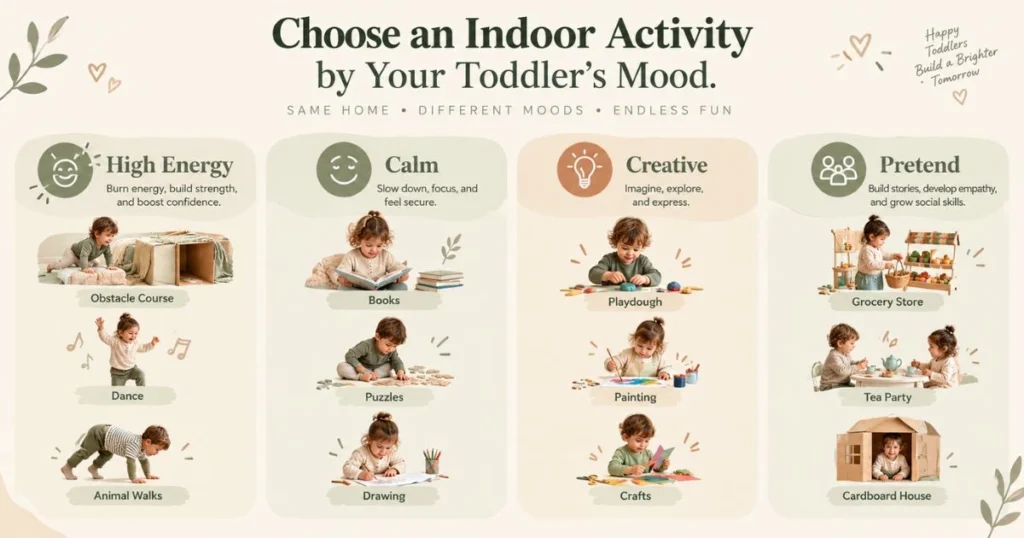
Before choosing Indoor Activities, think about what your toddler needs at that moment.
Are they bursting with energy? Are they tired? Do they need something quiet while you prepare dinner? Are they fascinated by animals, vehicles, colors, or pretend cooking?
The best Indoor Activity is often the one that matches your child’s current mood.
Consider Your Toddler’s Energy Level
For a high-energy toddler, try:
- A pillow obstacle course
- A dance party
- Indoor bowling
- Animal walks
- A blanket tunnel
For a calmer period, try:
- Reading
- Stickers
- Puzzles
- Drawing
- Playdough
- A busy box
For more ideas about your toddler’s daily rhythm, see our article on [Toddler Nap Schedule].
Consider How Much Preparation You Have
You don’t always have 30 minutes to prepare an activity.
| Activity | Preparation | Best For |
| Dance party | 1 minute | Active play |
| I Spy | None | Language and observation |
| Color hunt | 1–2 minutes | Learning |
| Block building | None | Creative play |
| Pillow obstacle course | 5 minutes | Movement |
| Playdough | 2 minutes | Fine motor play |
| Sensory bin | 5–10 minutes | Sensory exploration |
| Blanket fort | 5 minutes | Pretend play |
On busy days, choose something you can start immediately.
Follow Your Toddler’s Interests
You don’t have to follow an Indoor Activity exactly as you first imagined it.
If you build a cardboard house and your toddler decides it’s a bus, let it become a bus.
If your child turns a pretend grocery store into a restaurant, go with it.
Child-led play can support independence, confidence, and connection between you and your child. The CDC recommends giving toddlers opportunities to lead play while you observe, imitate, describe, and respond to what they’re doing.
For more information, see our article on [Toddler Emotions].
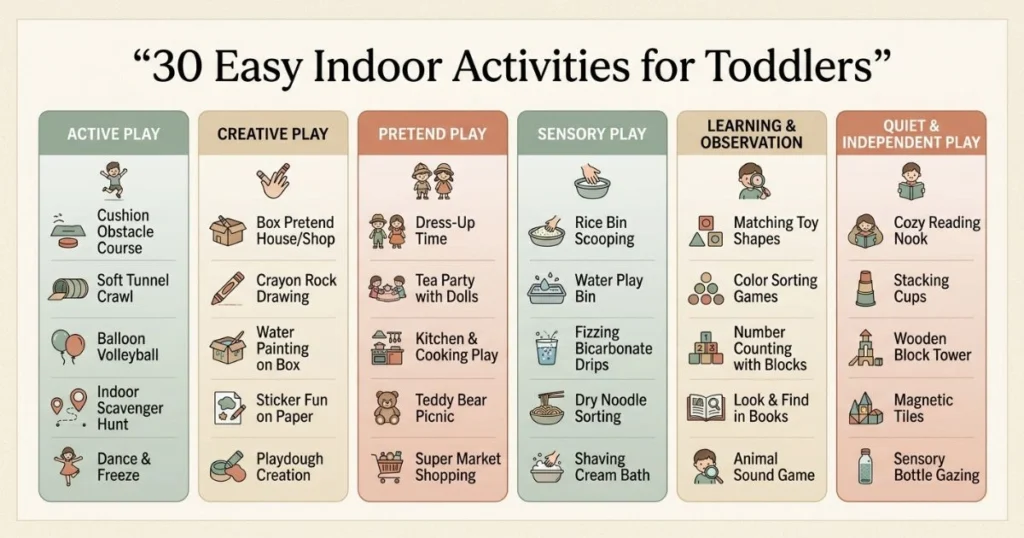
30 Easy Indoor Activities for Toddlers
Ready for some ideas?
These indoor activities for toddlers are designed to be simple, flexible, and realistic for everyday family life. You don’t need to try all 30 in one week. Choose a few that fit your child’s interests and your available time.
1. Create a Toddler Obstacle Course
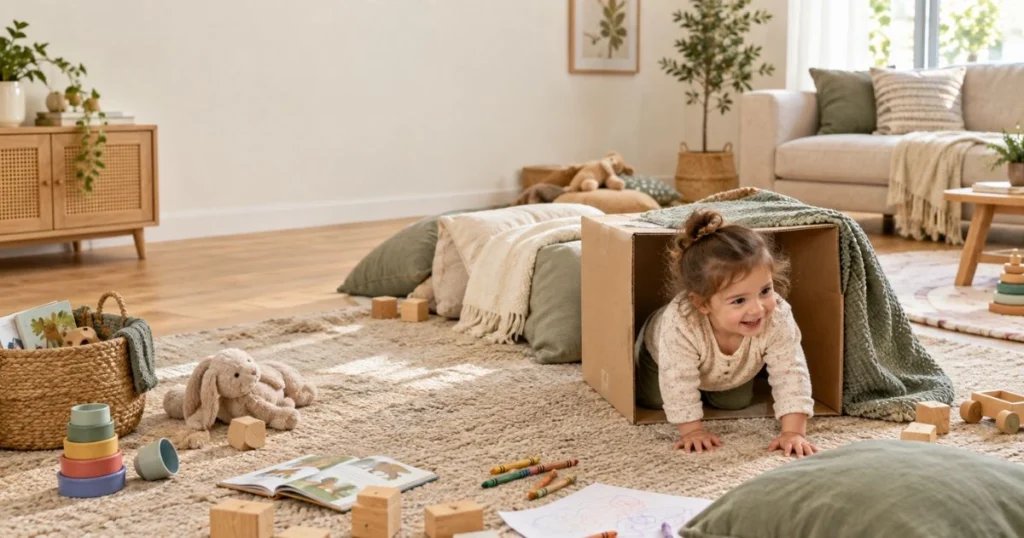
You don’t need a play gym to create an obstacle course.
Use safe, sturdy household items such as:
- Pillows
- Cushions
- Blankets
- Soft toys
Create a simple path that encourages your toddler to walk around, crawl under, step over, or move between objects.
You can say:
“Walk around the pillow.”
“Crawl through the tunnel.”
“Step over the blanket.”
Keep the course simple and supervise your child closely.
Best for: gross motor skills, balance, coordination, and active play.
For more information about positive ways to guide your toddler, see our article on [Positive Discipline].
2. Have a Toddler Dance Party
Sometimes the easiest activity is the one that requires almost nothing.
Put on a few child-friendly songs and dance together.
You can add simple games:
- Freeze when the music stops.
- Clap along with the beat.
- Jump when you hear a certain word.
- Let your toddler choose the next song.
- Copy each other’s movements.
You don’t need to worry about doing the “right” dance. Your toddler is there to move and have fun.
Best for: movement, rhythm, coordination, and connection.
3. Build a Cozy Blanket Fort
Gather a few blankets and cushions and create a small supervised play space.
Once your fort is ready, you can:
- Read books inside.
- Bring stuffed animals inside.
- Have a pretend picnic.
- Pretend you’re camping.
- Use flashlights for a simple shadow game.
A blanket fort can turn an ordinary room into a completely different environment.
Best for: imagination, pretend play, language, and quiet time.
For more ideas for creating a calm bedtime environment, see our article on [Toddler Bedtime Routine].
4. Try a Simple Color-Sorting Game
Choose several large, safe objects in different colors.
Put them in a pile and ask your toddler to sort them.
For example:
- Red objects together
- Blue objects together
- Yellow objects together
You can also make it a treasure hunt.
“Can you find something green?”
“Can you bring me something yellow?”
Make it fun and playful instead of turning it into a test.
Best for: color recognition, categorization, observation, and early problem-solving.
5. Go on an Indoor Treasure Hunt
Hide a few familiar toys around one room.
Then give your toddler simple clues.
Try:
- “Can you find something soft?”
- “Can you find your teddy?”
- “Can you find something red?”
- “Can you find a book?”
- “Can you find something round?”
For younger toddlers, make the clues very obvious. As your child becomes more comfortable, make them slightly harder.
Best for: vocabulary, memory, observation, and problem-solving.
6. Make a Sticker Picture
Give your toddler paper and large, age-appropriate stickers.
Let your child decide where the stickers go.
You can turn it into a simple story:
“Where should the animal go?”
“Should the flower go here?”
“What color is your sticker?”
Don’t worry about creating a perfect picture.
The process is what matters.
Best for: fine motor skills, creativity, and decision-making.
7. Play With Playdough
Playdough is a simple way to give little hands something to manipulate.
Encourage your toddler to:
- Roll it.
- Squish it.
- Flatten it.
- Pinch it.
- Make balls.
- Make simple shapes.
- Pretend to cook.
You can use cookie cutters designed for playdough if they’re appropriate for your child’s age.
Always choose age-appropriate materials and supervise your toddler, especially if there is any possibility of putting the material in their mouth.
Best for: fine motor development, hand strength, creativity, and sensory exploration.
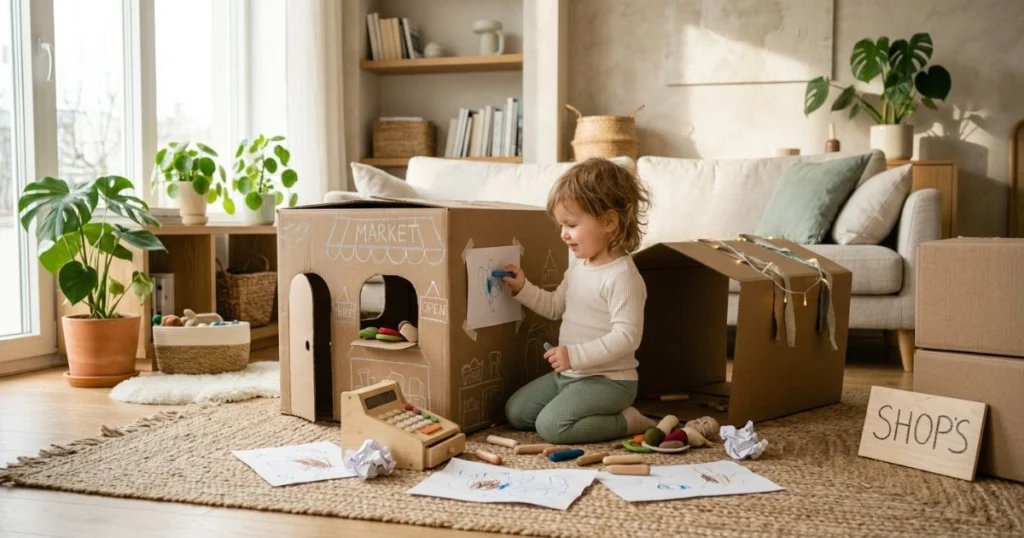
8. Turn a Cardboard Box Into a Pretend House
Before throwing away a large cardboard box, give it another life.
With your toddler, transform it into:
- A house
- A car
- A bus
- A shop
- A rocket
- An animal shelter
You can add drawings with child-safe crayons.
Then let your toddler decide what the box becomes.
This kind of open-ended play gives your child plenty of room to use imagination.
Best for: pretend play, creativity, language, and problem-solving.
9. Have an Indoor Picnic
Spread a blanket on the floor and have a simple snack together.
Your toddler can help:
- Carry napkins.
- Place cups.
- Arrange safe foods.
- Pretend to serve you.
- Feed a stuffed animal.
The CDC recommends giving toddlers simple opportunities to help with mealtime tasks, such as carrying plastic cups or napkins to the table.
You can turn an ordinary snack into a small adventure without making extra work for yourself.
Best for: independence, language, social interaction, and pretend play.
For more easy mealtime ideas, see our article on [Easy Toddler Meals].
10. Play “I Spy” Around the House
You don’t need a complicated setup.
Say:
“I spy something blue.”
Let your toddler look around the room.
For younger children, start with obvious objects.
Once your child understands the game, you can make the clues more interesting:
“I spy something we use to read.”
“I spy something soft.”
“I spy something we wear.”
Best for: vocabulary, observation, listening, and memory.
11. Make a Simple Sensory Bin
A sensory bin gives your toddler an opportunity to explore textures, movement, and objects.
You can use larger, age-appropriate materials such as:
- Cups
- Spoons
- Sponges
- Large toy animals
- Safe containers
Let your child scoop, pour, transfer, and explore.
However, don’t assume every sensory-bin material is safe for every toddler. Avoid small objects that could become choking hazards and stay close during play.
Best for: sensory exploration, fine motor skills, and curiosity.
12. Play Simon Says
This classic game works surprisingly well indoors.
Start with very simple instructions:
- “Simon says touch your head.”
- “Simon says clap your hands.”
- “Simon says sit down.”
- “Simon says jump.”
- “Simon says turn around.”
You can eventually let your toddler become Simon.
Best for: listening, body awareness, movement, and following directions.
13. Build a Tower With Blocks
Put a collection of blocks on the floor and start building.
You can:
- Build a tall tower.
- Make a house.
- Build a bridge.
- Make a garage.
- Knock the tower down and start again.
The CDC specifically recommends block play for 2-year-olds and suggests taking turns building towers and knocking them down.
Don’t worry about whether your toddler builds something recognizable.
The experimentation is part of the activity.
Best for: problem-solving, coordination, spatial awareness, and creativity.
14. Let Your Toddler Be Your Kitchen Helper
You can turn everyday household tasks into simple activities.
Depending on your child’s age and abilities, your toddler might:
- Carry napkins.
- Put plastic utensils on the table.
- Wash produce with you.
- Stir something cool and safe.
- Put toys away afterward.
The CDC recommends giving toddlers opportunities to help with simple household tasks.
You don’t need to create a special Montessori-style setup. Sometimes simply allowing your child to participate in what you’re already doing is enough.
Best for: independence, language, practical skills, and connection.
15. Make a Simple Paper Plate Animal
Grab a paper plate and create an animal.
You could make:
- A lion
- A fish
- A cat
- A dog
- A butterfly
Your toddler can help choose colors, place stickers, or add marks with crayons.
Keep the project simple.
The goal isn’t a perfect craft worthy of a wall display. It’s giving your toddler something to explore.
Best for: creativity, fine motor skills, and language.
16. Try Supervised Indoor Water Play
Water can keep a toddler interested for surprisingly long periods.
Place a small amount of water in a shallow container and add:
- Cups
- Spoons
- Sponges
- Safe containers
Let your toddler scoop, pour, squeeze, and transfer.
Never leave your toddler unattended around water, even when the container is shallow.
You should also place the activity somewhere where spills won’t create a slipping hazard.
Best for: sensory exploration, coordination, and cause-and-effect learning.
17. Set Up Indoor Bowling
You can make a simple bowling game with empty plastic bottles and a soft ball.
Set up the bottles.
Then encourage your toddler to:
- Roll the ball.
- Knock down the bottles.
- Count the ones that fell.
- Help put them back.
- Try again.
Don’t worry about keeping score.
For your toddler, repeating the movement and seeing what happens is part of the fun.
Best for: hand-eye coordination, movement, and cause-and-effect learning.
18. Have an Animal Movement Parade
Choose an animal and copy how it moves.
Try:
- Hop like a bunny.
- Crawl like a bear.
- Waddle like a penguin.
- Stomp like an elephant.
- Stretch like a cat.
- Fly like a bird.
Then let your toddler choose the next animal.
This is particularly useful when your child has a lot of energy and needs to move around.
Best for: gross motor skills, imagination, vocabulary, and movement.
19. Read a Book and Act It Out
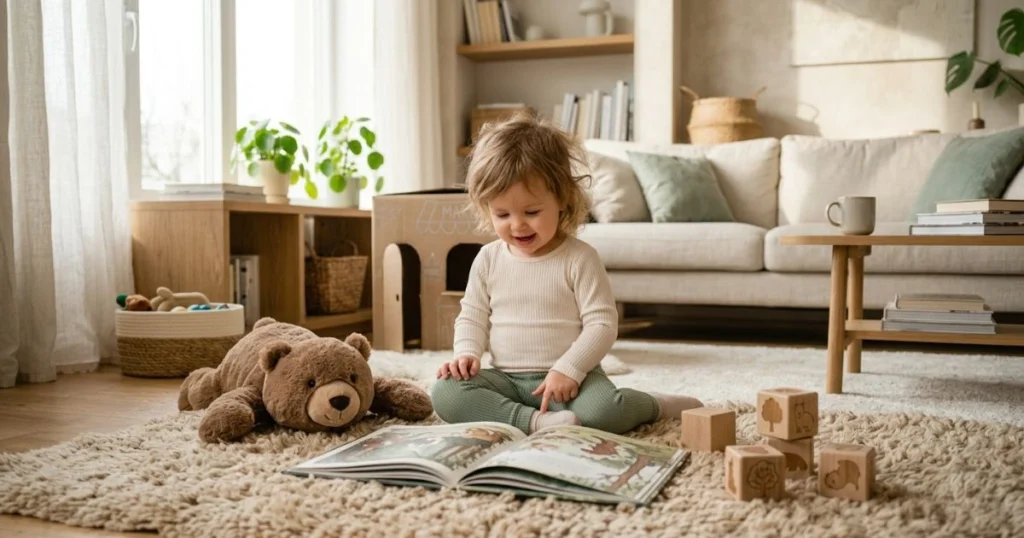
Choose a familiar story and read it together.
Then take the story off the page.
You can:
- Make animal sounds.
- Pretend to be characters.
- Repeat favorite phrases.
- Act out simple movements.
- Ask your toddler what happens next.
Reading doesn’t have to mean sitting perfectly still from beginning to end.
WHO encourages reading and storytelling with caregivers as an interactive alternative during sedentary time.
Best for: language, memory, imagination, and connection.
For more information about creating a consistent bedtime routine, see our article on [Toddler Bedtime Routine].
20. Make a Simple Toddler Puzzle
Choose a puzzle with large, age-appropriate pieces.
Help your toddler:
- Match shapes.
- Identify colors.
- Name animals.
- Find where pieces belong.
- Celebrate when the picture is complete.
The CDC includes simple puzzles among activities that can help toddlers explore shapes, colors, and animals.
If the puzzle is too difficult, simplify the challenge rather than turning it into a frustrating experience.
Best for: problem-solving, concentration, visual skills, and patience.
21. Create a Homemade Music Station
You can explore rhythm using safe household items.
For example:
- Tap a wooden spoon against a suitable container.
- Shake an age-appropriate shaker.
- Clap your hands.
- Stomp your feet.
- Create a simple rhythm for your toddler to copy.
Let your toddler experiment with different sounds.
Best for: rhythm, listening, coordination, and creative expression.
22. Try an Indoor Scavenger Hunt
Create a simple list of objects your toddler can find.
For example:
- Something soft
- Something yellow
- A book
- A stuffed animal
- Something round
You can make the hunt easier by showing your toddler pictures instead of using words.
Best for: observation, vocabulary, memory, and movement.
23. Make a Sealed Sensory Bottle
A sensory bottle can provide a calm visual activity.
Your toddler can:
- Shake it.
- Roll it.
- Watch objects move.
- Talk about colors.
- Follow moving objects with their eyes.
Make sure the bottle is securely sealed and inspect it regularly for damage.
Don’t give your toddler a sensory bottle with a loose lid or damaged container.
Best for: visual exploration, sensory play, and quiet time.
24. Create a Pretend Grocery Store
Gather clean, safe empty food containers and a basket.
Your toddler can pretend to:
- Shop.
- Choose food.
- Put groceries in a basket.
- Pay.
- Pack the groceries.
- Take them home.
- Pretend to cook.
Ask questions such as:
“What should we buy?”
“Where are the apples?”
“Who is going to carry the bag?”
This simple game can become a surprisingly rich language activity.
Best for: pretend play, vocabulary, social skills, and imagination.
25. Try Simple Toddler Yoga
You don’t need a formal yoga routine.
Try simple movements:
- Reach toward the ceiling.
- Touch your toes.
- Stretch like a cat.
- Stand like a tree.
- Bend down and stand up.
- Take slow breaths together.
Keep it playful and stop if your toddler isn’t interested.
Best for: movement, balance, body awareness, and calm play.
26. Make a Blanket Tunnel
Create a simple tunnel using stable furniture and blankets.
Your toddler can crawl through it, send a soft toy through it, or pretend they’re traveling through a cave.
Before starting, make sure everything is stable and that there are no loose or heavy objects that could fall.
Best for: crawling, coordination, spatial awareness, and imaginative play.
27. Paint With Household Objects
You don’t always need traditional paintbrushes.
Depending on the materials and your child’s age, you can experiment with:
- Sponges
- Large cotton pads
- Safe cardboard pieces
Let your toddler make dots, lines, circles, or simple patterns.
The CDC recommends simple art experiences such as crayons and finger painting as ways to let toddlers explore creativity.
Best for: creativity, fine motor skills, and sensory exploration.
28. Create a Toddler Busy Box
A busy box can give you a ready-made option for moments when you need something quiet.
You might include:
- Board books
- Large-piece puzzles
- Reusable stickers
- Blocks
- Child-safe crayons
You don’t have to put everything inside at once.
Rotate the contents every few days so familiar items feel interesting again.
Best for: independent play, concentration, and quiet time.
For more information about raising confident and connected children, see our article on [Positive Parenting].
29. Have a Pretend Tea Party
Invite your toddler’s favorite stuffed animals to a tea party.
Use age-appropriate toy dishes or safe household items.
Your toddler can:
- Pour pretend tea.
- Serve food.
- Give everyone a cup.
- Talk to the stuffed animals.
- Pretend to clean up.
Don’t worry if the tea party turns into a completely different game five minutes later.
That’s part of toddler imagination.
Best for: pretend play, language, social-emotional development, and creativity.
30. Make a Quiet-Time Activity Basket
At the end of a busy morning, your toddler may need something calmer.
Create a basket with:
- A few books
- Simple puzzles
- Coloring materials
- Reusable stickers
- Soft toys
Keep it somewhere accessible and bring it out when you want to transition from active play to quieter activities.
Best for: independent play, concentration, and calming down.
The Best Indoor Activities for Toddlers by Goal
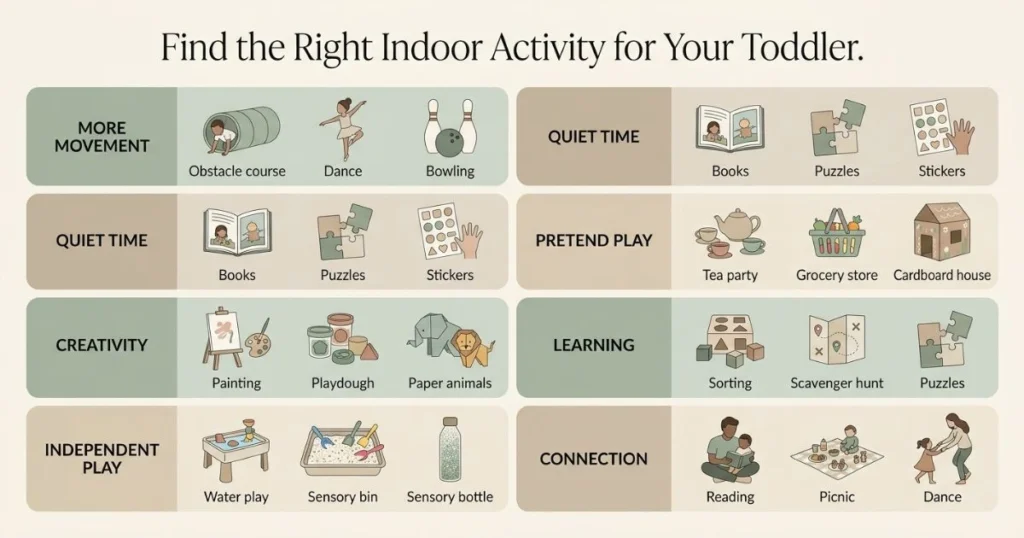
Sometimes you don’t need 30 ideas. You simply need to know which activity fits your toddler right now.
| Your Toddler Needs… | Try These Activities |
| More movement | Obstacle course, dance party, bowling |
| Quiet time | Books, puzzles, stickers |
| Creativity | Painting, playdough, paper animals |
| Pretend play | Tea party, grocery store, cardboard house |
| Sensory play | Water play, sensory bin, sensory bottle |
| Learning | Sorting, scavenger hunt, puzzles |
| Independent play | Busy box, blocks, quiet basket |
| Connection | Reading, indoor picnic, dance party |
You can also combine different Indoor Activities throughout the day.
For example, after a dance party, transition to a book. After an obstacle course, offer a puzzle. After sensory play, move into quiet drawing.
This gives your toddler a natural rhythm instead of expecting one activity to hold their attention for a long time.
Screen-Free Indoor Activities for Toddlers
If you’re trying to reduce screen use or simply want more variety in your toddler’s day, keep a short list of Indoor Activities you can reach for quickly.
Some easy screen-free activities for toddlers include:
- Building blocks
- Reading together
- Playdough
- Indoor treasure hunts
- Pretend grocery shopping
- Dancing
- Coloring
- Puzzles
- Blanket forts
- Animal movement games
The WHO recommends that young children spend time being physically active and limits sedentary screen time according to age. For 2-year-olds, its guidance says sedentary screen time should be no more than one hour per day, with less being better. For 1-year-olds, sedentary screen time is not recommended.
You don’t need to approach this as an all-or-nothing rule. Having easy Indoor Activities available can make screen-free periods much easier.
Easy Indoor Activities for Toddlers When You Have Only 5 Minutes
You won’t always have time to prepare a craft.
When you’re busy, try these almost-no-preparation ideas.
1-Minute Activities
- Dance party
- I Spy
- Simon Says
- Animal movements
- Clap-and-copy games
5-Minute Activities
- Color hunt
- Block challenge
- Sticker picture
- Indoor bowling
- Scavenger hunt
10-Minute Activities
- Blanket fort
- Pretend grocery store
- Sensory bin
- Indoor picnic
- Story acting
Remember that your toddler doesn’t have to stay with the activity for the entire suggested time.
If they play for three minutes and move on, that’s okay.
Indoor Toddler Activities With Everyday Items You Already Have at Home
One of the easiest ways to avoid buying more toys is to look at ordinary household objects differently.
| What You Have | Try This Activity |
| Blankets | Fort or tunnel |
| Pillows | Obstacle course |
| Cardboard boxes | Pretend house or car |
| Plastic bottles | Indoor bowling |
| Paper | Drawing or animal craft |
| Blocks | Building challenge |
| Cups | Supervised water play |
| Stuffed animals | Tea party |
| Books | Story acting |
| Safe kitchen utensils | Music activity |
Before giving your toddler any household object, make sure it’s safe for their age and doesn’t contain small detachable parts, sharp edges, or other hazards.
How to Keep Indoor Activities Fun for Toddlers
Even the most enjoyable Indoor Activity can lose its appeal if you keep it going for too long.
Keep Activities Short
Toddlers often move quickly from one interest to another.
You don’t need to make a 30-minute activity out of something your child enjoys for five minutes.
Five minutes of focused play is still play.
Let Your Toddler Lead
If your toddler uses the blocks to make a pretend cake instead of a tower, let them.
You can follow their idea rather than correcting it.
The CDC’s child-led play guidance encourages parents to let children take the lead and recommends using attention, imitation, description, and reflection during play.
For more information, see our article on [Respectful Parenting].
Rotate Activities
Instead of putting every toy and activity in front of your toddler, rotate them.
You could keep:
- A few books available.
- One puzzle.
- A small basket of blocks.
- One creative activity.
Then change the options later.
Don’t Expect Every Activity to Work
This is important.
You can spend 20 minutes preparing a beautiful sensory activity and your toddler may play with the empty container instead.
That doesn’t mean the activity failed.
It doesn’t mean you failed.
Toddlers are unpredictable. Their interests change quickly, and sometimes the simplest object is the most fascinating thing in the room.
Indoor Toddler Activity Safety Tips
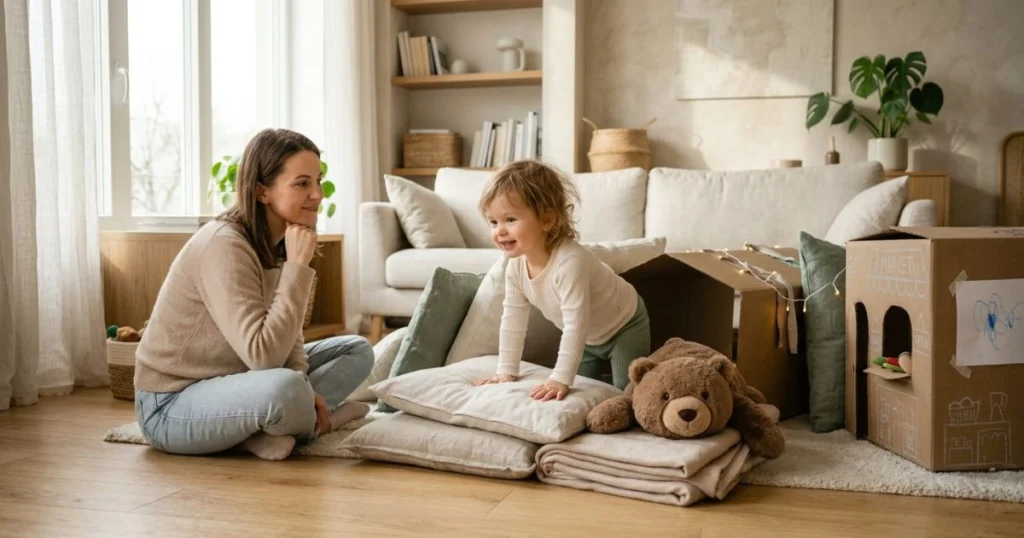
Fun comes first, but safety comes with it.
Watch for Choking Hazards
Be careful with:
- Small craft pieces
- Tiny toy parts
- Small sensory materials
- Objects that can easily fit in your toddler’s mouth
Choose materials appropriate for your child’s age and supervise activities involving unfamiliar objects.
Always Supervise Water Play
Even a little water can pose a serious safety risk.
Stay within arm’s reach during water activities and never leave your toddler unattended.
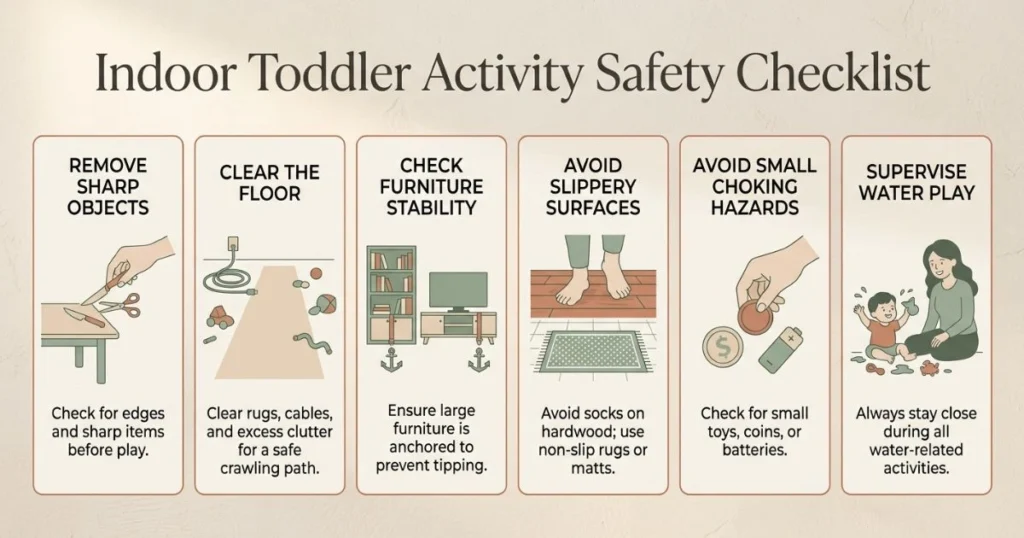
Make Active Play Areas Safe
Before creating an obstacle course:
- Remove sharp objects.
- Move fragile items.
- Clear the floor.
- Check that furniture is stable.
- Avoid slippery surfaces.
- Use soft materials where possible.
Choose Activities for Your Child’s Abilities
A game that is appropriate for one toddler may not be appropriate for another.
Consider your child’s:
- Age
- Motor skills
- Ability to follow instructions
- Tendency to put objects in their mouth
- Experience with the materials
If you’re unsure whether an activity is suitable, simplify it or choose another one.
How Much Active Play Does a Toddler Need?
If your toddler spends a lot of time indoors, you may wonder whether they’re getting enough movement. The good news is that many Indoor Activities can naturally encourage your child to stay active throughout the day.
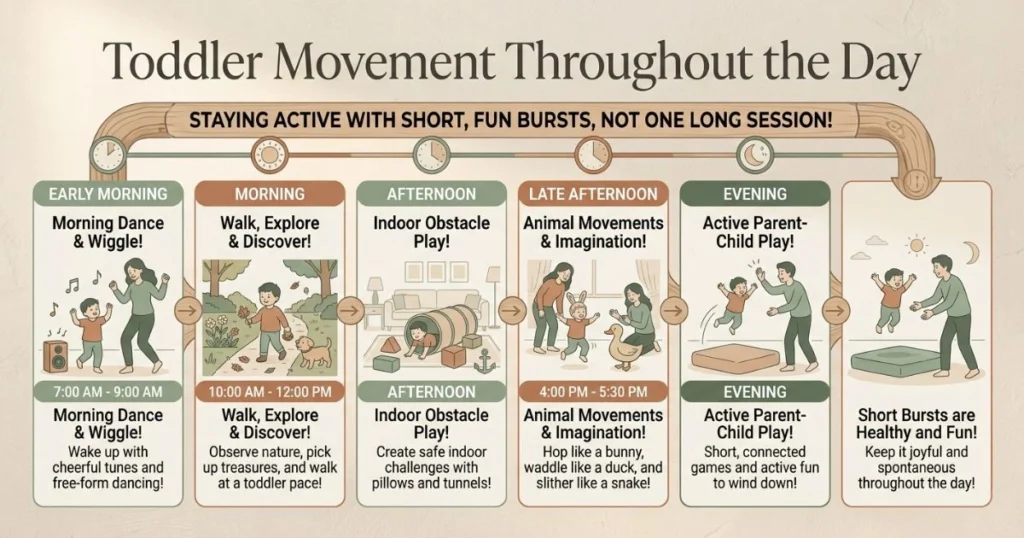
For children ages 1–2, WHO recommends at least 180 minutes of physical activity across the day, including different types of activity and different intensities. For children ages 3–4, WHO also recommends at least 180 minutes, with at least 60 minutes at moderate-to-vigorous intensity.
This isn’t a requirement to turn your home into a gym.
Movement can be spread throughout the day through simple Indoor Activities.
Your toddler might:
- Dance in the morning.
- Walk around the house.
- Help carry safe objects.
- Play an obstacle game.
- Chase bubbles.
- Kick a soft ball.
- Move like animals.
- Play actively with you.
The CDC also notes that by age 2, many children are developing movement skills such as running and kicking a ball.
Think about movement as something that naturally happens throughout your child’s day rather than one formal exercise session.
For more ideas for creating a balanced daily routine, see our article on [Toddler Nap Schedule].
Frequently Asked Questions About Indoor Activities for Toddlers
What are the best indoor activities for toddlers?
The best Indoor Activities for Toddlers are usually simple, age-appropriate options that give your child a chance to move, explore, create, or use their imagination. Good choices include building blocks, obstacle courses, dancing, puzzles, sensory play, reading, pretend grocery shopping, and simple art activities.
What are some easy indoor activities for toddlers at home?
If you need a quick Indoor Activity right away, try:
- Dancing
- I Spy
- Simon Says
- Animal movements
- Block building
- Color hunts
- Reading a book
These Indoor Activities require little or no preparation.
How do I keep my toddler busy indoors without screens?
CreatKeep a small rotation of Indoor Activities rather than trying to entertain your toddler constantly.
You can alternate between:
- Active play
- Creative play
- Pretend play
- Books
- Puzzles
- Independent play
This gives your toddler variety without requiring you to come up with a new Indoor Activity every hour.
What are good indoor activities for toddlers on rainy days?
Rainy days are perfect for simple Indoor Activities such as:
- Blanket forts
- Obstacle courses
- Indoor bowling
- Dance parties
- Treasure hunts
- Pretend grocery stores
- Puzzles
- Painting
- Playdough
- Indoor picnics
Choose an Indoor Activity based on your toddler’s energy level.
What can you do with a bored toddler?
Start simple with Indoor Activities.
Ask your toddler to choose between two options:
“Do you want to build a tower or have a dance party?”
Giving your child a limited choice can be easier than asking an open-ended question such as “What do you want to do?”
You can also bring out an Indoor Activity your toddler hasn’t seen for a few days to make it feel fresh and exciting again.
What are easy indoor activities for toddlers with no preparation?
Some of the easiest choices are:
Try these simple Indoor Activities:
- Simon Says
- Dance
- I Spy
- Animal walks
- Storytelling
- Block building
- Singing songs
You don’t need a craft or sensory bin every time. Simple Indoor Activities can be just as engaging.
Are indoor activities good for toddler development?
Yes. Indoor Activities give toddlers opportunities to practice movement, communication, problem-solving, creativity, and social interaction.
The CDC’s developmental guidance emphasizes that toddlers learn through the ways they play, learn, speak, act, and move. It also recommends activities such as blocks, puzzles, art, songs, helping with household tasks, and exploring their surroundings.
How can you entertain a toddler without buying more toys?
Look around your home for inspiration for simple Indoor Activities.
A cardboard box can become a house. Blankets can become a fort. Cushions can become an obstacle course. Books can become an acting game. Safe kitchen items can become part of pretend play.
The goal isn’t to create more stuff. It’s to give your toddler opportunities to turn everyday items into new Indoor Activities through imagination and play.
Conclusion: You Don’t Need to Entertain Your Toddler All Day
The next time your toddler tells you they’re bored, you don’t have to panic.
You don’t need another expensive toy, a complicated craft, or a perfectly planned activity schedule.
Sometimes, all you need is a blanket on the floor, a few cushions, some blocks, a favorite book, or a cardboard box. These everyday items can become simple Indoor Activities with a little imagination.
The most valuable part of these Indoor Activities for Toddlers isn’t whether your child completes the activity exactly as planned. It’s the opportunity to move, explore, imagine, experiment, and spend time together.
And remember: if your toddler loses interest after five minutes, that isn’t a parenting failure. Toddlers are curious, unpredictable, and constantly moving on to the next thing.
Choose one Indoor Activity that fits your child’s mood today.
If they need to move, try the obstacle course or dance party. If they need something calm, bring out a puzzle or book. If they want to pretend, build a cardboard house or open a pretend grocery store.
You don’t need to fill every minute.
You simply need to create little opportunities for your toddler to play, explore, and enjoy being a toddler.
Save this list for the next rainy afternoon, share it with another parent who has heard “I’m bored!” one too many times, and come back whenever you need a simple idea to make staying home a little more fun.