
Feeding your baby can feel surprisingly complicated. At first, you may only be thinking about when your baby will nurse or take a bottle. Then, almost overnight, you are wondering when to start solids, how much food to offer, whether your baby needs three meals a day, and if they are eating enough.
That is where a Baby Feeding Chart can make things easier.
The important thing to remember is that a feeding chart is a guide, not a strict schedule. Your baby may eat more at one meal and barely touch another. Their appetite can change from day to day, and their feeding needs develop as they grow.
This Baby Feeding Chart guide walks you through feeding from birth to 12 months, including milk feeds, starting solids, age-appropriate foods, meal frequency, sample schedules, recipes, hunger cues, and feeding safety.
Quick note: Babies develop at different rates. Use the information below as general guidance, and talk with your pediatrician or another qualified healthcare professional about your baby’s individual nutritional needs.
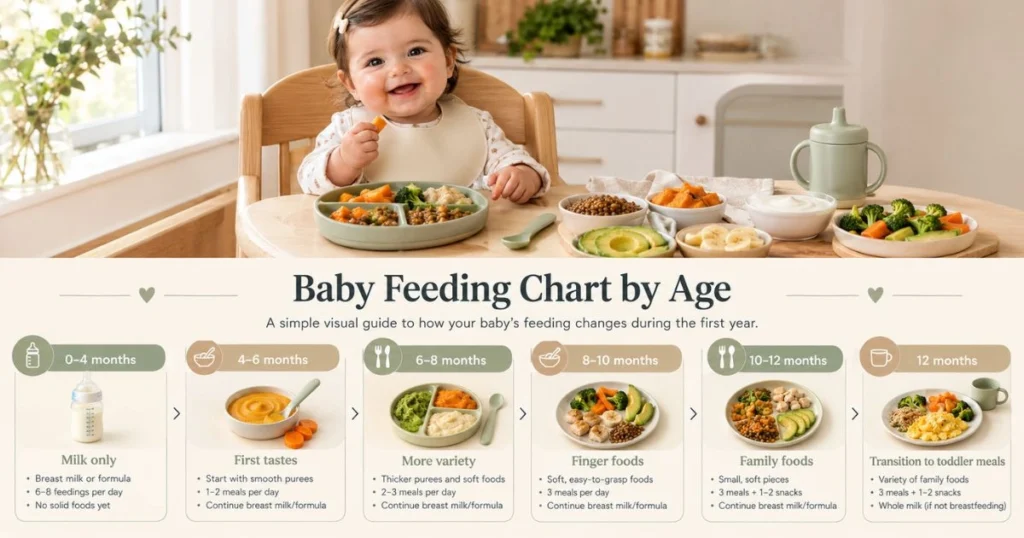
Baby Feeding Chart by Age: 0–12 Months at a Glance
| Age | Main Nutrition | Solid Foods | Typical Food Opportunities | Main Focus |
| 0–3 months | Breast milk or infant formula | None | Milk feeds based on cues | Responsive feeding |
| 4–5 months | Breast milk or infant formula | Usually not yet | Milk remains primary | Watch for readiness |
| Around 6 months | Breast milk/formula + complementary foods | Begin when developmentally ready | 2–3 meals | Iron-rich foods and textures |
| 7–8 months | Breast milk/formula + solids | Increasing variety | 2–3 meals | Texture and self-feeding |
| 9–11 months | Breast milk/formula + solids | Wider variety | 3–4 meals | Family foods and independence |
| 12 months | Milk + family foods | Balanced meals | 3–4 meals + snacks as appropriate | Family-style eating |
WHO recommends introducing complementary foods around 6 months and gradually increasing food variety, texture, amount, and frequency. For breastfed infants, WHO recommends 2–3 complementary meals daily from 6–8 months and 3–4 meals daily from 9–23 months.
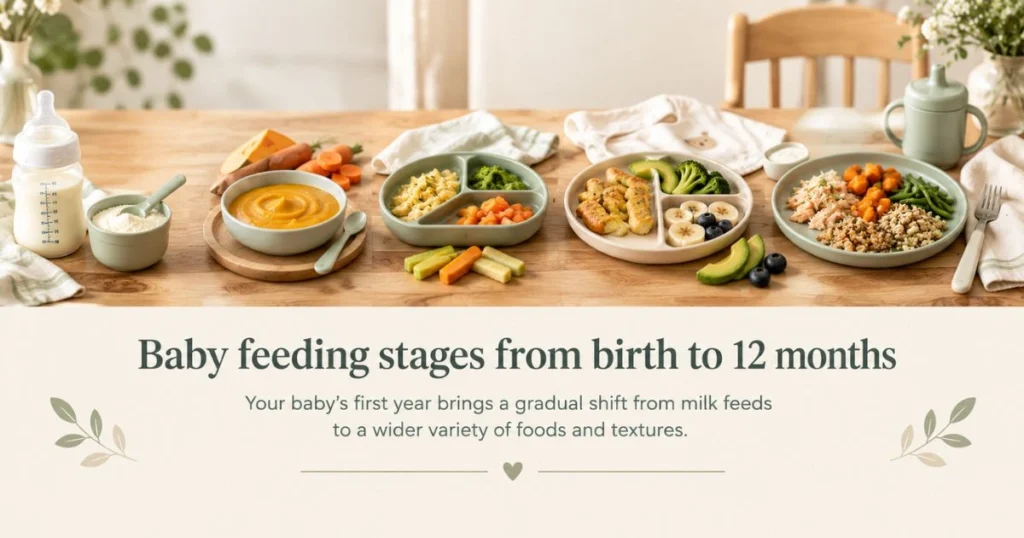
How Baby Feeding Changes During the First Year
Your baby’s feeding journey has several distinct stages.
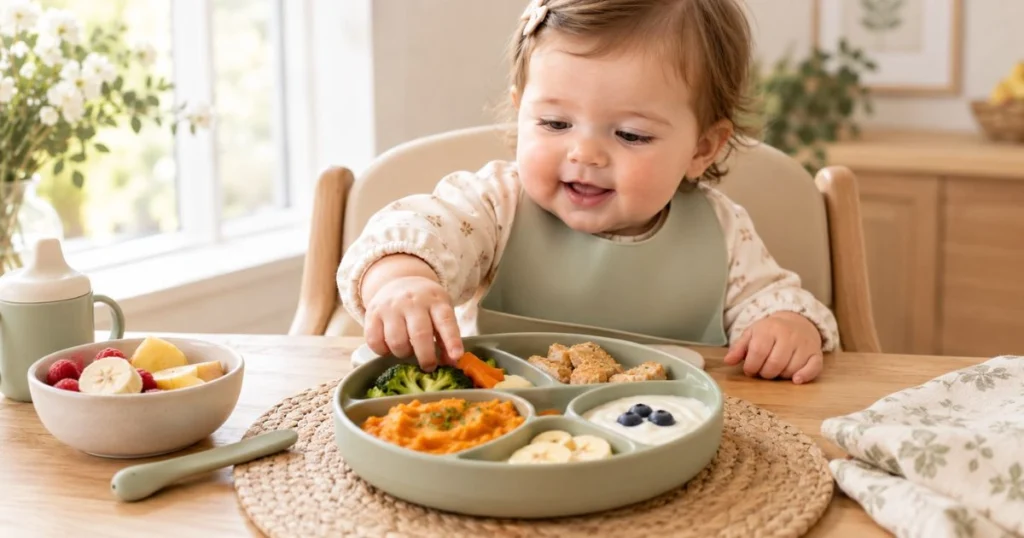
0–6 Months: Milk Comes First
During the early months, breast milk or infant formula provides most of your baby’s nutrition. A Baby Feeding Chart can help you understand how feeding patterns may change as your baby grows, but it should not replace your baby’s individual cues.
Rather than trying to make every feed happen at exactly the same time, pay attention to signs that your baby is hungry or full. Some babies want to feed frequently, while others naturally settle into a different rhythm.
If you breastfeed, it can be difficult to know exactly how much milk your baby takes at each feed. Instead of focusing on a specific number, look at your baby’s overall feeding behavior, growth, wet diapers, and regular healthcare assessments.
Around 6 Months: Complementary Foods Begin
Around 6 months, your baby’s nutritional needs start to increase beyond what breast milk alone can provide, making complementary foods an important part of their diet.
At this point, solid foods are not meant to replace milk right away. Instead, you gradually introduce foods alongside breast milk or infant formula as your baby becomes ready for new tastes and textures.
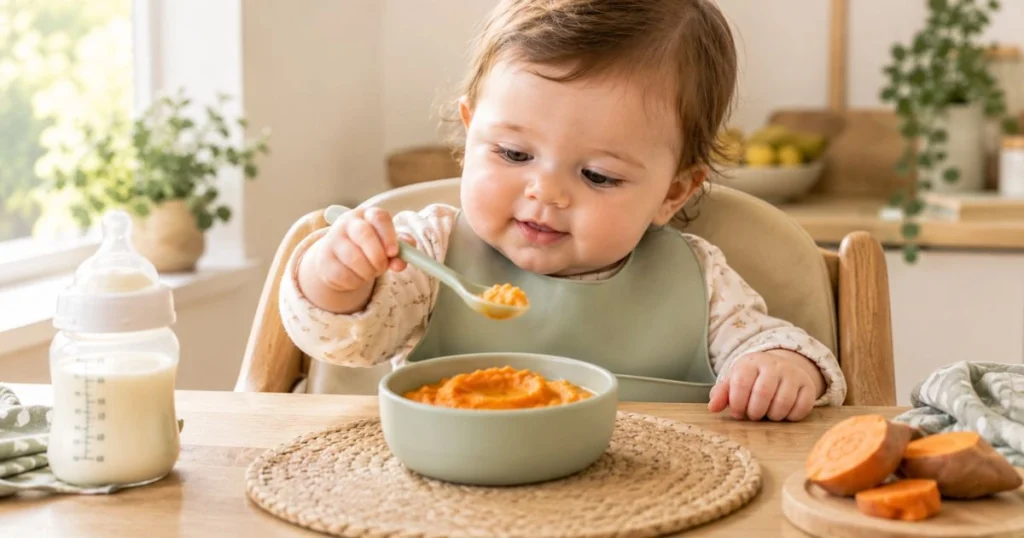
The World Health Organization recommends introducing complementary foods around 6 months while continuing breast milk or formula.
7–11 Months: Food Variety and Skills Grow
As your baby becomes more comfortable with solids, you can gradually move from smooth or mashed foods to thicker textures, soft lumps, and appropriately prepared bite-sized pieces. This progression can be reflected in your Baby Feeding Chart as your baby’s eating skills develop.
By around 8 months, many babies can also begin eating appropriately prepared finger foods.
During these months, you can introduce a wider variety of foods, including:
- Vegetables
- Fruits
- Eggs
- Meat and poultry
- Fish
- Beans and lentils
- Whole grains
- Plain yogurt and other suitable dairy foods
- Healthy fats
The CDC recommends offering a variety of vegetables, fruits, protein foods, dairy without added sugars, healthy fats, and whole grains from around 6 months. Choose textures and sizes that match your baby’s developmental abilities and prepare foods safely to reduce choking risks.
Around 12 Months: Moving Toward Family Meals
By 12 months, your baby can usually start enjoying more of the same healthy foods your family eats. Your Baby Feeding Chart can now include a wider variety of family foods, as long as they are prepared safely and match your baby’s chewing and swallowing abilities.
Baby Feeding Chart for 0–3 Months
What Should a 0–3-Month-Old Eat?
For young infants, the primary foods are:
- Breast milk
- Infant formula
At this stage, feeding is largely about responding to your baby’s hunger and fullness signals.
How Often Should a Newborn Eat?
There isn’t one feeding schedule that works for every newborn.
Your baby may:
- Feed frequently during certain periods.
- Have cluster-feeding periods.
- Wake during the night for feeds.
- Take different amounts at different feeds.
Rather than focusing only on the clock, learn your baby’s individual feeding cues.
Early Hunger Cues
Your baby may:
- Stir or become more alert.
- Open their mouth.
- Turn toward the breast or bottle.
- Bring their hands toward their mouth.
- Make sucking movements.
Fullness Cues
Your baby may:
- Slow down sucking.
- Stop feeding.
- Relax their hands and body.
- Turn away from the breast or bottle.
“Because sleep can influence your baby’s daily rhythm, it can also help to understand age-appropriate wake windows when planning a flexible feeding routine.”
Baby Feeding Chart for 4–5 Months
What Should a 4-Month-Old Eat?
Breast milk or infant formula remains the primary nutrition during this stage.
You may notice your baby watching you eat or reaching toward your food. Interest in food alone, however, does not necessarily mean your baby is ready for solids.
When Is Your Baby Ready for Solid Foods?
Readiness involves developmental skills, not simply reaching a particular birthday.
Signs to look for include:
- Good head and neck control.
- Sitting with support.
- Bringing objects toward the mouth.
- Showing interest in food.
- Being able to swallow food rather than repeatedly pushing it out.
The American Academy of Pediatrics recommends watching for these developmental signs around 6 months when considering complementary foods.
6-Month Baby Feeding Chart: Starting Solid Foods
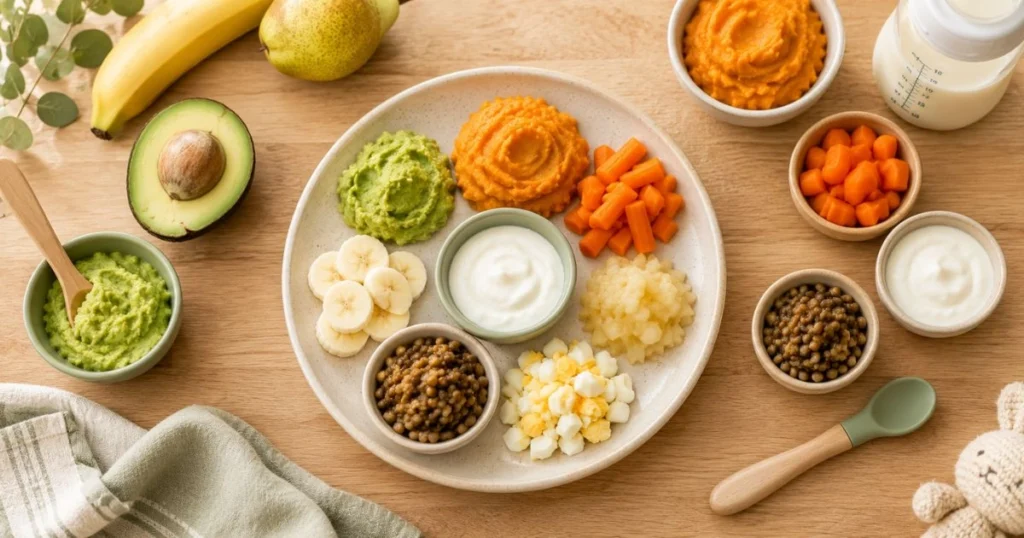
Six months is a major transition in your baby’s feeding journey.
What Should a 6-Month-Old Eat?
Start with small amounts of soft, age-appropriate foods.
Good options include:
- Iron-fortified infant cereal
- Mashed lentils or beans
- Pureed or finely prepared meat
- Fully cooked egg
- Mashed avocado
- Soft sweet potato
- Cooked carrots
- Banana
- Pear
- Plain full-fat yogurt without added sugar
Iron and zinc deserve particular attention when introducing complementary foods. The AAP recommends offering foods such as meat and iron-fortified cereals.
If you are also trying to coordinate feeds, naps, and bedtime, a flexible baby sleep schedule can help you see how these parts of the day fit together.
How Much Should a 6-Month-Old Eat?
Start small and let your baby’s appetite guide you.
WHO gives a useful starting reference of approximately 2–3 tablespoons per feeding, gradually increasing toward about ½ of a 250 mL cup or bowl as the baby becomes accustomed to eating. These are reference amounts, not requirements that every baby must finish.
How Many Meals Should a 6-Month-Old Have?
WHO recommends 2–3 complementary-food meals per day for babies 6–8 months old, alongside continued milk feeding.
Sample 6-Month Feeding Schedule
| Approximate Time | Example |
| Morning | Breast milk or formula |
| Breakfast | Small serving of soft complementary food |
| Midday | Breast milk or formula |
| Lunch | Small serving of mashed or soft food |
| Afternoon | Breast milk or formula |
| Evening | Breast milk or formula or small food opportunity |
| Bedtime | Breast milk or formula |
This is an example rather than a schedule you need to follow exactly.
For parents building a daily rhythm around this stage, a 6-month sleep schedule can help you see where naps and bedtime may fit around feeding.
7-Month Baby Feeding Chart
By 7 months, your baby may be ready for more variety and gradually thicker textures.
Foods for a 7-Month-Old
Try combinations such as:
- Lentils + sweet potato
- Egg + avocado
- Chicken + carrot
- Banana + plain yogurt
- Oatmeal + pear
- Beans + soft vegetables
Keep textures appropriate for your baby’s developmental abilities.
Sample 7-Month Feeding Schedule
| Time | Example |
| Morning | Breast milk/formula |
| Breakfast | Oatmeal + mashed pear |
| Midday | Breast milk/formula |
| Lunch | Lentils + soft vegetables |
| Afternoon | Breast milk/formula |
| Evening | Egg + avocado |
| Bedtime | Breast milk/formula |
8-Month Baby Feeding Chart
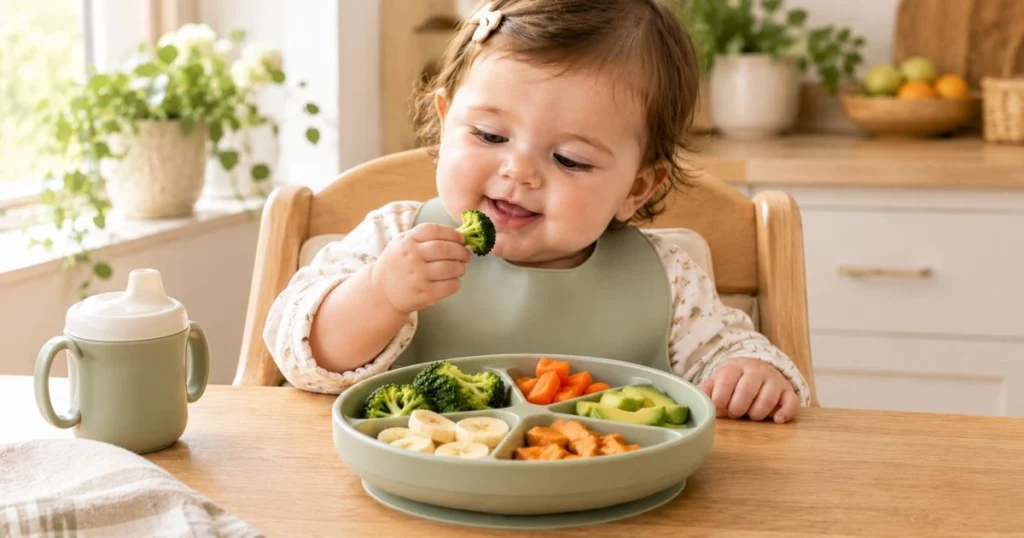
How Many Meals Should an 8-Month-Old Have?
At 8 months, WHO recommends 2–3 complementary meals per day, with continued breastfeeding or other milk feeding.
Best Foods for an 8-Month-Old
| Food Group | Examples |
| Iron-rich foods | Beef, chicken, egg, lentils, beans |
| Vegetables | Broccoli, carrot, peas, sweet potato |
| Fruits | Banana, pear, avocado, melon |
| Grains | Oatmeal, rice, iron-fortified cereal |
| Dairy | Plain full-fat yogurt, suitable pasteurized cheese |
| Healthy fats | Avocado, thinly spread nut butter, olive oil |
By around 8 months, many babies can also begin eating appropriately prepared finger foods.
9-Month Baby Feeding Chart
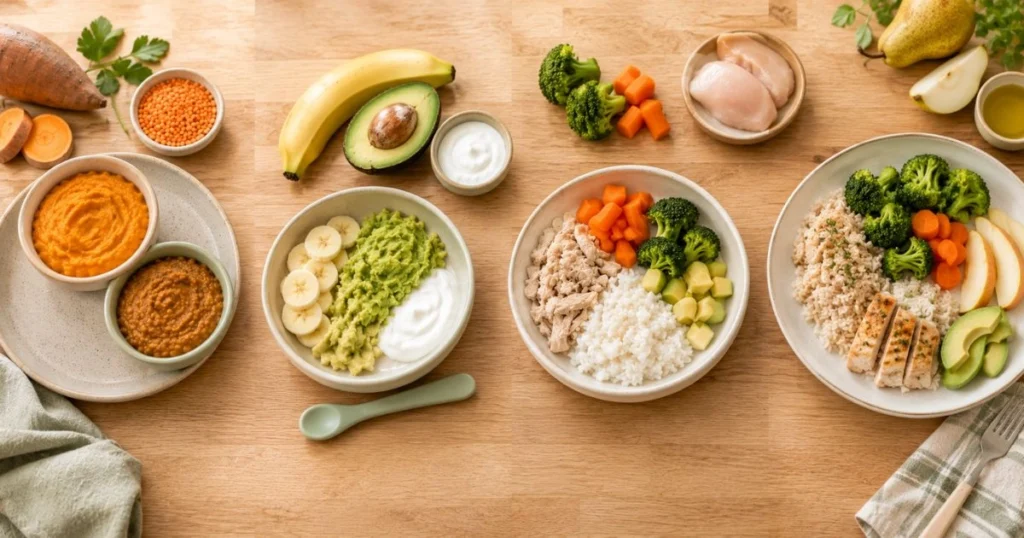
At 9 months, your baby’s eating routine may start to look more like regular meals.
How Many Meals Should a 9-Month-Old Have?
WHO recommends increasing complementary foods to 3–4 meals per day from 9 months onward.
What Should a 9-Month-Old Eat?
Aim for variety across the week:
- Protein-rich foods
- Iron-rich foods
- Vegetables
- Fruits
- Whole grains
- Healthy fats
- Suitable dairy foods
Your baby may also be increasingly interested in feeding themselves.
10-Month Baby Feeding Chart
Foods for a 10-Month-Old
At 10 months, you can continue expanding your baby’s menu with appropriately prepared versions of family foods.
Examples include:
- Soft shredded chicken
- Finely flaked fish with bones removed
- Soft-cooked vegetables
- Mashed beans
- Soft pasta
- Rice
- Egg
- Soft fruit
- Plain yogurt
Encourage Self-Feeding
Let your baby practice:
- Picking up soft pieces.
- Bringing food to their mouth.
- Holding a preloaded spoon.
- Drinking from an appropriate cup with help.
Expect mess. Learning to eat is a developmental skill, not a clean activity.
11-Month Baby Feeding Chart
What Should an 11-Month-Old Eat?
Your baby’s meals can increasingly resemble healthy family meals, with modifications for texture, size, and safety.
Think about building meals around:
- A protein or iron-rich food.
- A vegetable or fruit.
- A grain or starchy food.
- A healthy fat when appropriate.
Sample 11-Month Meal
| Ingredient | Example |
| Protein | Shredded chicken |
| Grain | Soft rice |
| Vegetable | Cooked carrots |
| Healthy fat | Avocado |
| Fruit | Soft pear |
12-Month Baby Feeding Chart: Your Baby’s First Birthday
The first birthday brings another noticeable shift.
How Many Meals Should a 1-Year-Old Have?
WHO recommends 3–4 meals per day for children 12–23 months, with 1–2 nutritious snacks when appropriate.
What Should a 12-Month-Old Eat?
You can increasingly offer balanced family meals containing:
- Vegetables
- Fruits
- Eggs
- Meat
- Fish
- Beans and lentils
- Whole grains
- Dairy foods
- Healthy fats
CDC notes that once children reach 12 months, pasteurized plain whole cow’s milk can be offered as a beverage, when appropriate.
As your baby’s daily rhythm changes, a predictable bedtime routine can also make evenings easier to navigate.
Sample 12-Month Feeding Schedule
| Time | Example Meal |
| Breakfast | Egg + soft toast + fruit |
| Morning | Milk or breastfeeding as appropriate |
| Lunch | Chicken + rice + cooked vegetables |
| Afternoon | Plain yogurt + soft fruit |
| Dinner | Lentils + potato + vegetables |
| Bedtime | Milk or breastfeeding as appropriate |
Easy Baby Food Recipes by Age
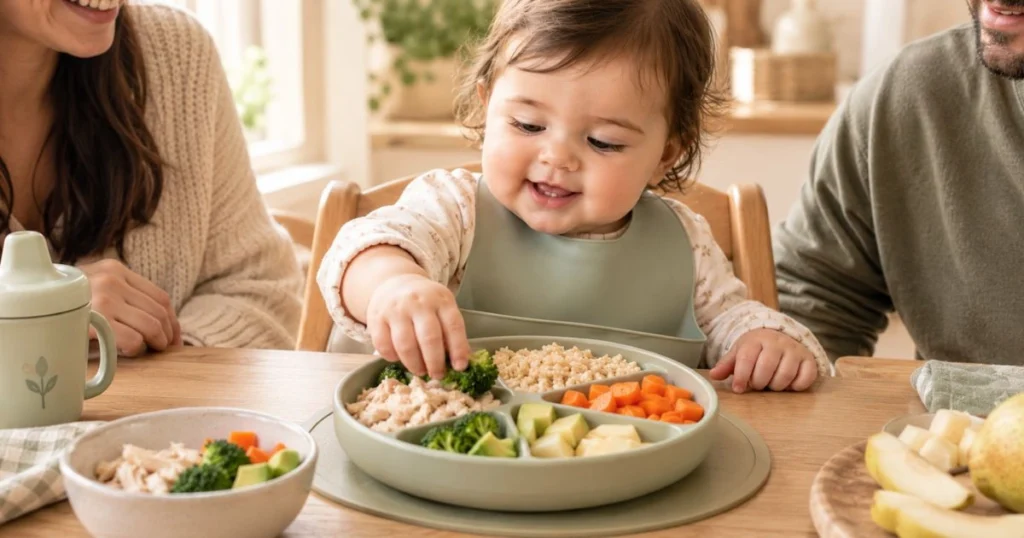
These simple combinations can help you turn the information in your baby feeding chart into actual meals.
6-Month Recipe: Sweet Potato & Lentil Purée
| Ingredient | Amount |
| Sweet potato | ½ small |
| Red lentils | 1–2 tbsp |
| Water | As needed |
| Olive oil | Small amount, optional |
Method: Cook the sweet potato and lentils until very soft. Mash or blend to a texture your baby can safely manage.
7–8 Month Recipe: Banana, Avocado & Yogurt
| Ingredient | Amount |
| Ripe banana | ½ |
| Ripe avocado | ¼ |
| Plain full-fat yogurt | 1–2 tbsp |
Method: Mash everything together. Leave a little texture if your baby is ready for thicker foods.
9–11 Month Recipe: Chicken, Rice & Vegetables
| Ingredient | Amount |
| Cooked chicken | Small portion |
| Cooked rice | 2–3 tbsp |
| Soft carrot | 1–2 tbsp |
| Soft broccoli | 1–2 tbsp |
| Water | As needed |
Method: Finely shred the chicken and combine with very soft rice and vegetables. Adjust the texture to your baby’s eating skills.
12-Month Recipe: Soft Family Dinner Plate
| Ingredient | Example |
| Chicken or lentils | Small serving |
| Potato | Soft cooked pieces |
| Carrot | Soft cooked pieces |
| Broccoli | Soft pieces |
| Fruit | Soft pieces |
Avoid adding excessive salt or sugar simply to make the meal more appealing.
How Much Milk Does Your Baby Need?
Milk remains an important part of feeding throughout the first year.
Breastfed Babies
It can be harder to measure how much breast milk your baby takes compared with formula. Rather than focusing on exact amounts, use your Baby Feeding Chart alongside your baby’s hunger and fullness cues, feeding behavior, growth, and routine healthcare assessments to understand whether they are getting enough.
Formula-Fed Babies
Always prepare infant formula according to the manufacturer’s instructions and follow any recommendations from your healthcare professional.
When using a Baby Feeding Chart, remember that the amounts shown are general guidelines. You do not need to make your baby finish a bottle just because the chart suggests a certain amount. Instead, watch for your baby’s hunger and fullness cues and let them guide the feed.
Does Milk Become Less Important After Starting Solids?
Starting solid foods does not mean that milk feeds become less important overnight. Your Baby Feeding Chart should continue to include breast milk or infant formula while you gradually introduce complementary foods. During this transition, milk remains an important source of nutrition as your baby explores new foods, flavors, and textures.
Introducing Common Allergens
Common allergenic foods you may introduce when your baby is ready include:
- Peanut
- Egg
- Milk
- Wheat
- Soy
- Fish
- Shellfish
- Tree nuts
Current guidance does not recommend delaying these foods solely as a way to prevent allergies. Once your baby is ready for complementary foods, you can discuss introducing common allergens with your healthcare professional. If your baby has severe eczema or an egg allergy, ask their healthcare professional for specific advice before introducing peanut.
Include allergenic foods in a safe, age-appropriate form, and watch your baby closely for any signs of an allergic reaction. Your Baby Feeding Chart can help you keep track of new foods as you gradually expand your baby’s diet.
Baby Feeding Safety: Foods to Avoid and Choking Hazards

A nutritious food can still be unsafe if it is served in the wrong shape, size, or texture.
Foods to Avoid or Limit
Before 12 months, avoid:
- Honey
- Added sugars
- Unpasteurized foods and drinks
- Fruit or vegetable juice
- Cow’s milk as the main drink
CDC specifically advises against honey before 12 months because of the risk of infant botulism.
Common Choking Hazards
Be particularly careful with:
- Whole grapes
- Whole nuts
- Hard raw vegetables
- Large chunks of meat
- Sausages or hot dogs
- Whole beans
- Chunks of cheese
- Popcorn
- Sticky spoonfuls of nut butter
- Uncut berries or cherry tomatoes
CDC recommends preparing foods according to your child’s developmental abilities and avoiding hard, sticky, or difficult-to-chew foods.
How to Make Food Safer
- Cook hard foods until soft.
- Remove bones, pits, and hard seeds.
- Modify food shape and size appropriately.
- Serve your baby sitting upright.
- Stay with your baby throughout the meal.
- Keep mealtimes calm and free from distractions.
Responsive Feeding: Let Your Baby Guide How Much They Eat
A feeding chart can tell you what is generally appropriate for your baby’s age, but your baby tells you how much they need at a particular meal.
Signs Your Baby May Be Hungry
- Reaching toward food
- Opening their mouth
- Becoming excited when food appears
- Leaning toward food
Signs Your Baby May Be Full
- Turning away
- Closing their mouth
- Pushing food away
- Losing interest
- Becoming distracted
Try to encourage your baby without pressuring them to finish.
WHO recommends responsive feeding, including feeding slowly and patiently, encouraging children to eat, and avoiding force.
Baby Feeding Chart vs. Baby Feeding Schedule
You may hear these terms used interchangeably, but they actually refer to slightly different things.
Baby Feeding Chart
A chart shows how feeding generally changes as your baby grows.
Baby Feeding Schedule
A schedule shows how feeds and meals might fit into one particular day.
Your baby’s schedule may change because of:
- Sleep
- Growth spurts
- Teething
- Illness
- Appetite
- Family routines
Use a schedule as a flexible framework rather than a rulebook.
Common Baby Feeding Mistakes to Avoid
Avoid turning feeding into a daily battle.
Common mistakes include:
- Treating the feeding chart as a strict requirement.
- Comparing your baby’s appetite with another baby’s.
- Replacing milk feeds too quickly.
- Serving food in unsafe textures.
- Pressuring your baby to finish.
- Offering too little variety.
- Delaying allergens without medical reason.
- Giving honey before 12 months.
- Offering foods with lots of added sugar or salt.
- Ignoring your baby’s developmental feeding skills.
Baby Feeding Chart by Age: Frequently Asked Questions
What is the best baby feeding chart by age?
A useful Baby Feeding Chart gives you age-appropriate guidance without turning feeding amounts into strict rules. Every baby is different, so consider your baby’s developmental stage, appetite, milk intake, hunger and fullness cues, and individual healthcare needs when planning feeds.
How much should a baby eat at each age?
There is no single amount that every baby needs to eat. Around 6 months, the Baby Feeding Chart may suggest starting complementary foods with about 2–3 tablespoons per meal and gradually increasing the portion as your baby becomes more comfortable with solids. By 9–11 months, a general reference is around ½ of a 250 mL cup or bowl per meal, while your baby’s appetite and hunger and fullness cues should still guide how much they actually eat.
When should babies start eating solid foods?
Complementary foods are usually introduced around 6 months, when your baby shows signs of being ready for solids. Your Baby Feeding Chart can help you plan this transition, but readiness matters most. Look for signs such as steady head and neck control, sitting with support, and being able to move food from the front of the mouth and swallow it safely.
How many meals should a 6-month-old have?
WHO recommends 2–3 complementary-food meals each day for babies 6–8 months old, alongside continued milk feeding.
How many meals should a 9-month-old have?
From 9–11 months, WHO recommends 3–4 complementary meals per day. One or two nutritious snacks may also be offered depending on appetite.
Does my baby still need breast milk or formula after starting solids?
Yes. Solid foods are introduced alongside breast milk or infant formula rather than replacing milk feeds right away. Your Baby Feeding Chart should continue to include milk as an important source of nutrition throughout your baby’s first year, while solid foods gradually add variety, nutrients, and new textures.
What if my baby refuses solid foods?
Avoid forcing your baby to eat. If they refuse a food, offer it again at another meal and try changing the texture, preparation, or food combination. Use your Baby Feeding Chart as a flexible guide while continuing to follow your baby’s hunger and fullness cues. If food refusal continues or you are concerned about your baby’s growth, feeding, or swallowing, talk with your baby’s healthcare professional.
Can I follow the same baby feeding chart every day?
Use your Baby Feeding Chart as a helpful reference rather than a strict daily schedule. You don’t need every day to look the same because your baby’s appetite, sleep, activity level, and developmental changes can all affect how much they want to eat.
Printable Baby Feeding Chart by Age: 0–12 Months
| Age | Main Feeding Pattern | Complementary Foods | Main Goal |
| 0–3 months | Breast milk/formula | None | Follow hunger/fullness cues |
| 4–5 months | Breast milk/formula | Usually not yet | Look for readiness |
| 6 months | Milk + solids | First foods | Iron + variety |
| 7–8 months | Milk + solids | More textures | Explore and self-feed |
| 9–11 months | Milk + solids | Wider variety | 3–4 meals |
| 12 months | Milk + family foods | Balanced meals | Family-style eating |
Conclusion: There Is No Perfect Baby Feeding Chart

YoYour baby’s first year of eating is a gradual learning process. You don’t need every meal to be perfect, and your baby does not have to eat exactly the amount listed on a chart.
Use this Baby Feeding Chart to understand the general feeding changes that happen from 0 to 12 months:
- Milk provides the main source of nutrition during the early months.
- Complementary foods are generally introduced around 6 months when your baby shows signs of readiness.
- Food variety and textures gradually become more diverse as your baby’s skills develop.
- The number of meals usually increases as your baby gets older.
- Responsive feeding helps you recognize and respond to your baby’s hunger and fullness cues.
- Safe food preparation is just as important as offering nutritious foods.
Most importantly, give yourself time to learn alongside your baby. Some meals may be eaten with enthusiasm, while others might end with food on the floor. That’s a normal part of learning how to eat.
Save this baby feeding chart for later, share it with another parent who is starting solids, and explore more baby and toddler feeding guides on Parenting Whisper for simple, practical ideas you can actually use.