

Things to avoid after losing mucus plug are important to understand during pregnancy, especially as you get closer to your due date. Losing your mucus plug can be an unexpected moment. You might notice thick, jelly-like discharge when you use the bathroom and immediately wonder whether labor is about to begin. If you’re approaching your due date, you may feel excited to meet your baby, but it’s also understandable to feel uncertain about what you should do next.
The good news is that losing your mucus plug does not automatically mean you need to rush to the hospital or stop your usual activities. It can be a normal sign that your cervix is changing in preparation for birth. However, your pregnancy week and any symptoms you experience alongside the discharge matter.
Knowing the things to avoid after losing your mucus plug can help you make informed decisions without worrying unnecessarily. From recognizing signs of labor to understanding when to contact your maternity care team, here’s what you need to know to protect your health and prepare for your baby’s arrival.

What Is the Mucus Plug, and Why Does It Matter When Learning Things to Avoid After Losing Mucus Plug?
The mucus plug is a collection of thick cervical mucus that forms in the opening of your cervix during pregnancy. Your cervix is the lower part of your uterus that opens into the vagina. Understanding this process can help you learn about things to avoid after losing mucus plug.
This mucus creates a protective barrier that helps limit the movement of bacteria from the vagina toward the uterus. It is one part of your body’s natural defenses during pregnancy.
As your pregnancy progresses, your cervix may begin to soften, thin out, and open in preparation for labor. These changes can cause some or all of the mucus plug to come away and pass through your vagina.
What Does a Lost Mucus Plug Look Like?
Your mucus plug may look different from someone else’s. You might notice:
- Thick, sticky, or jelly-like discharge.
- A clear, white, or slightly yellowish appearance.
- Pink or brown streaks caused by a small amount of blood.
- A single noticeable blob or several smaller pieces over a few days.
You may lose your mucus plug while wiping after using the bathroom, in your underwear, or when taking a shower. Some people never notice it passing because it comes away gradually or mixes with other vaginal discharge. Understanding these changes can help you recognize things to avoid after losing mucus plug.
A small amount of blood mixed with mucus can occur as the cervix changes. However, heavy bleeding or fresh bleeding that resembles a menstrual period should not automatically be dismissed as a normal part of labor.
Mucus Plug vs. Normal Pregnancy Discharge vs. Bloody Show
Understanding these differences can help you decide what to do next and recognize things to avoid after losing mucus plug, although appearance alone cannot always tell you exactly what is happening.
| Feature | Mucus plug | Normal pregnancy discharge | Bloody show |
| Texture | Thick, sticky, jelly-like | Usually thin or creamy | Mucus mixed with blood |
| Appearance | Clear, whitish, pink, or brownish | Often clear or white | Usually pink, red, or brownish |
| Timing | Can pass before labor | Can occur throughout pregnancy | Often associated with cervical changes near labor |
| What it means | Cervical mucus has come away | Usually a normal pregnancy change | May indicate that labor is approaching |
If you notice watery fluid that gushes or continues to trickle, do not assume it is ordinary discharge or mucus. Your waters may have broken, so contact your maternity care team promptly.
9 Things to Avoid After Losing Your Mucus Plug
Losing your mucus plug can raise questions about hygiene, sex, exercise, and how soon you should expect labor. When learning about things to avoid after losing mucus plug, the important thing to remember is that mucus plug loss alone does not automatically make every everyday activity unsafe.
Your circumstances may be different if you’re less than 37 weeks pregnant, your waters have broken, you have bleeding, or your healthcare professional has given you specific restrictions.
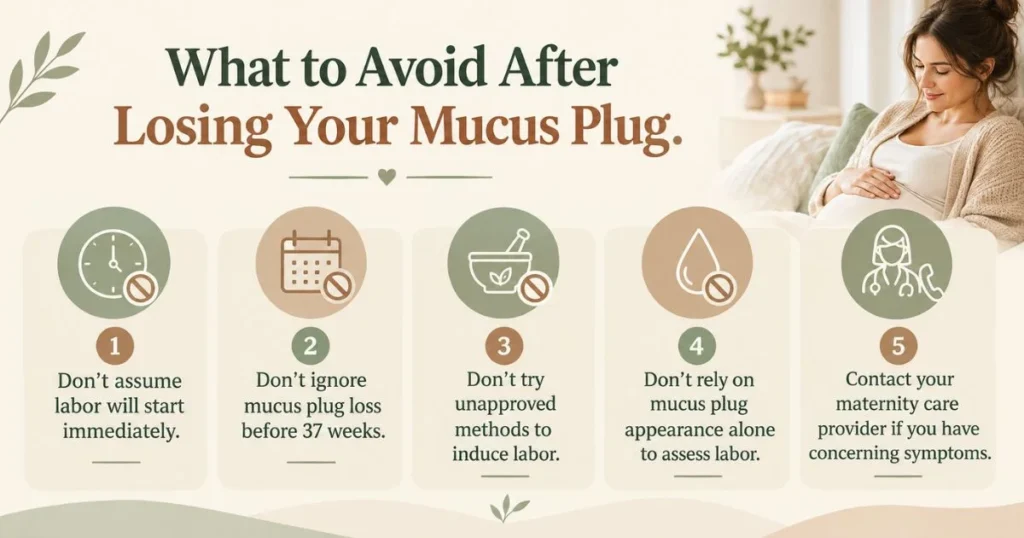
1. Don’t Assume Labor Will Start Immediately
One of the first things to avoid after losing your mucus plug is assuming that your baby will arrive within the next few hours.
Although mucus plug loss can occur as your cervix prepares for birth, it does not provide a reliable timeline. Some people go into labor soon afterward, while others remain pregnant for days or longer.
You may notice the plug passing before contractions begin. In other cases, you might not recognize that you’ve lost it at all.
Instead of trying to predict your delivery date from this single sign, pay attention to other changes, including:
- Contractions that become regular, stronger, and closer together.
- Increasing pelvic pressure or lower back discomfort.
- A gush of fluid or persistent watery leakage.
- Changes in your baby’s usual movement pattern.
If you are approaching your due date and feel well, mucus plug loss alone does not necessarily require a hospital visit. Follow your maternity team’s instructions about when to call or go in, and keep these things to avoid after losing mucus plug in mind as you monitor your symptoms.
2. Don’t Ignore Mucus Plug Loss Before 37 Weeks
If you are less than 37 weeks pregnant, take possible signs of labor seriously. A change in vaginal discharge can sometimes accompany cervical changes or preterm labor, particularly when other symptoms occur. Knowing the things to avoid after losing mucus plug can help you recognize when to seek medical advice.
Losing the mucus plug alone does not prove that you are in preterm labor. Nevertheless, you should contact your maternity care professional promptly if you notice it before 37 weeks and are concerned, especially if you also experience:
- Regular abdominal tightening or contractions.
- Menstrual-like cramps.
- Persistent lower backache.
- Pelvic pressure or a feeling that your baby is pushing downward.
- Watery fluid leaking from your vagina.
What If You Lose Your Mucus Plug at 36 Weeks?
At 36 weeks, your pregnancy is still considered preterm. When considering things to avoid after losing mucus plug, contact your maternity care team for advice rather than assuming that delivery is imminent or waiting for contractions to become painful.
Your clinician can assess your symptoms and determine whether you need an examination or additional monitoring. If you have heavy bleeding, severe pain, suspected water breaking, or reduced fetal movement, seek urgent assessment.
3. Don’t Dismiss Heavy or Fresh Vaginal Bleeding
A small pink or brown streak in thick mucus may occur as your cervix changes. However, heavier bleeding is different and needs prompt attention. One of the important things to avoid after losing mucus plug is assuming that all bleeding is a normal part of labor.
Do not assume that bright red blood, bleeding similar to a period, or bleeding that continues is simply a bloody show.
Heavy bleeding during pregnancy may signal a serious condition that needs immediate medical evaluation. If you experience significant bleeding, seek emergency maternity care rather than waiting to see whether contractions begin.
Seek emergency medical care if the bleeding occurs with intense abdominal pain, dizziness, feeling faint, or a general sense of being seriously unwell.
When you contact your maternity team, explain how much blood you noticed, its color, whether it is continuing, and how many weeks pregnant you are.
4. Don’t Ignore Signs That Your Water Has Broken
Your mucus plug and your amniotic fluid are not the same thing. The mucus plug is thick and sticky, while amniotic fluid is usually watery and Your waters may break in a sudden gush or as a slow, persistent trickle. Knowing this is important when learning about things to avoid after losing mucus plug.
Sometimes, it can be difficult to distinguish fluid leakage from normal discharge or urine.
If you think your waters may have broken:
- Contact your maternity care team promptly, even if you have no contractions.
- Use a sanitary pad rather than a tampon to observe the fluid.
- Note when the leakage began, its color, and whether it continues.
- Follow the instructions you receive about assessment and what activities to avoid.
Green or brown fluid, unpleasant-smelling fluid, fever, or feeling unwell warrants urgent medical advice. Contact your healthcare provider for advice rather than waiting for labor to begin.
Your maternity team can determine whether the membranes have ruptured and advise you on the safest next steps.
5. Don’t Assume You Must Avoid Sex in Every Situation
You may wonder whether sex is safe after losing your mucus plug. The answer depends on your pregnancy, symptoms, and whether your waters have broken. Understanding this is one of the important things to consider when learning about things to avoid after losing mucus plug.
Losing the mucus plug alone does not automatically mean that sex is prohibited. However, you should avoid sexual intercourse and vaginal insertion if you suspect your waters have broken or your healthcare professional has advised pelvic rest.
You should also seek individualized advice if you have vaginal bleeding, a pregnancy complication, or any other reason your clinician has recommended avoiding sex.
If you are uncertain about your situation, ask your maternity care team before having intercourse. This is especially important if the discharge is accompanied by watery leakage or other unusual symptoms.
6. Don’t Insert Tampons or Use Vaginal Douches
After noticing your mucus plug, you might feel tempted to clean the area thoroughly or use a tampon to manage discharge. You do not need to do either. These are important things to avoid after losing mucus plug.
For routine hygiene, gently wash the external genital area with water and change your underwear as needed. Avoid vaginal douching and unapproved vaginal products, which can irritate the vaginal tissues and disrupt their normal balance.
If you want to monitor discharge or suspect fluid leakage, a sanitary pad can help you observe its color and amount.
Avoid trying to check your cervix yourself or removing any remaining mucus. You cannot reliably determine cervical dilation or whether your waters have broken by performing a self-examination.
If you suspect your membranes have ruptured, contact your maternity care team and follow its advice about vaginal insertion and examinations.
7. Avoid Using Unproven Home Methods to Start Labor
Losing your mucus plug can make you feel that delivery must be close, particularly if you are tired of waiting for your baby. You might consider castor oil, herbal products, nipple stimulation, or other techniques meant to trigger contractions. However, one of the important things to avoid after losing mucus plug is trying to start labor without appropriate medical guidance.
Before trying anything to induce labor, speak with your maternity care professional.
Home induction methods are not all supported by strong evidence, and some can cause unwanted effects. Castor oil, for example, can cause significant diarrhea and abdominal discomfort. Herbal preparations may have uncertain ingredients, effects, or safety during pregnancy.
Eating dates or taking a walk may be part of your normal routine if these activities are appropriate for your pregnancy, but neither should be presented as a guaranteed way to start labor.
If induction is medically recommended, your clinician can explain appropriate options, such as a membrane sweep or medication administered under medical supervision.
Your goal is not to make labor happen as quickly as possible. The goal is to help ensure a safe birth for both you and your baby.
8. Don’t Assume You Need Bed Rest or Must Stop Normal Activities
Another common concern is whether you should spend the rest of the day in bed after losing your mucus plug. When learning about things to avoid after losing mucus plug, remember that mucus plug loss alone does not automatically mean you need bed rest.
In an uncomplicated pregnancy, mucus plug loss alone generally does not mean you need bed rest or must stop your usual activities.
If you feel well and your healthcare provider hasn’t advised you to limit activity, you can generally carry on with comfortable daily routines, such as walking around the house, making meals, and taking breaks when you feel tired.
However, your advice may be different if you have a high-risk pregnancy, suspected preterm labor, bleeding, ruptured membranes, or another complication.
Avoid pushing yourself through strenuous activity if you feel unwell, and follow any restrictions your healthcare professional has provided. You do not need to force yourself to exercise or remain active to encourage labor.
For more ideas on appropriate movement during pregnancy, read our guide to staying active during pregnancy.
9. Don’t Ignore Changes in Your Baby’s Movements
As your due date approaches, you may hear that babies move less because there is less room in the uterus. However, one of the important things to avoid after losing mucus plug is assuming that reduced movement is normal because your baby has less space.
Your baby’s movements should continue to be monitored according to the guidance provided by your maternity team.
If you notice reduced movement or a meaningful change in your baby’s normal pattern, contact your maternity unit immediately. Don’t delay until the following day or depend on a home Doppler for reassurance.
This advice remains important even if losing your mucus plug is the only other change you have noticed.
What Should You Do After Losing Your Mucus Plug?
Once you have noticed the discharge, a few simple steps can help you decide what to do without becoming unnecessarily anxious. Knowing these steps is helpful when learning about things to avoid after losing mucus plug.
- Note what you saw. Remember the color, texture, approximate amount, and time it occurred.
- Check your pregnancy week. If you are before 37 weeks, contact your maternity care professional promptly if you are concerned about possible labor.
- Pay attention to other symptoms. Watch for contractions, fluid leakage, bleeding, severe pain, and changes in fetal movement.
- Use a sanitary pad if fluid leakage is suspected. Avoid tampons and contact your maternity team for guidance.
- Keep your hospital or maternity unit’s contact information nearby. You do not need to wait for several symptoms to develop before asking for help.
- Continue normal activities only as appropriate. Follow any restrictions specific to your pregnancy.
As your due date approaches, preparing your hospital bag in advance can help you feel more organized for your baby’s arrival.”
If you are at term, feel well, and have no warning signs, you may simply need to monitor how you feel and follow the instructions you have already received.
Remember that seeking advice does not mean something is necessarily wrong. It is a sensible way to clarify what is happening and determine whether you need an assessment.
When Should You Call Your Doctor After Losing Your Mucus Plug?

Knowing when to seek medical advice is one of the most important things to understand when learning about things to avoid after losing mucus plug. Although this change can be normal near the end of pregnancy, certain symptoms should never be ignored.
Contact Your Maternity Care Team Promptly If:
- You are less than 37 weeks pregnant and suspect that labor may be beginning.
- You think your waters have broken, even if contractions have not started.
- You experience regular contractions, ongoing pelvic pressure, or unusual lower back pain.
- You are unsure whether the discharge is mucus, amniotic fluid, or another type of vaginal discharge, and need guidance on things to avoid after losing mucus plug.
Seek Urgent Medical Assessment If:
- You experience heavy or fresh vaginal bleeding.
- Your baby is moving less than usual, or you notice a change in their normal movement pattern.
- You have severe or persistent abdominal pain.
- You notice concerning fluid leakage, particularly green or brown fluid, or feel feverish or seriously unwell.
Do not wait for several symptoms to appear together before seeking help. If you are worried about your health or your baby’s well-being, contact your maternity unit and follow its instructions. Knowing which warning signs matter is an important part of understanding things to avoid after losing mucus plug.
The NHS advises contacting your midwife or maternity unit urgently if you experience vaginal bleeding, suspect your waters have broken, notice reduced fetal movement, or think labor may be starting before 37 weeks. These symptoms need attention even if you initially noticed only mucus plug loss.
How Long After Losing Your Mucus Plug Does Labor Start?
There is no exact amount of time between losing your mucus plug and giving birth. For some people, labor begins soon afterward. For others, the mucus plug passes days before contractions become established, and some people do not notice it passing at all. Understanding this timing is helpful when learning about things to avoid after losing mucus plug.
The timing depends on how your cervix is changing and whether other signs of labor develop.
You might notice the plug coming away in one piece or in smaller amounts over several days. Its appearance alone cannot tell you how dilated your cervix is or how soon your baby will arrive.
As labor develops, you may experience contractions that become longer, stronger, and more frequent. Your waters may also break before or during labor.
If you are at term and feel well, you can generally follow your maternity team’s advice while waiting for labor to progress. If you are before 37 weeks or experience concerning symptoms, seek medical guidance promptly rather than waiting for a particular timeline.
Can You Shower, Walk, Sleep, or Go to Work After Losing Your Mucus Plug?
You do not necessarily need to change your entire routine after losing your mucus plug. When learning about things to avoid after losing mucus plug, remember that if your pregnancy is uncomplicated, you feel well, and your clinician has not advised restrictions, many ordinary activities remain reasonable.
The following table offers general guidance.
| Activity | What you should know |
| Taking a shower | Generally fine if you feel well and have no concerning symptoms. |
| Walking | Usually fine during an uncomplicated pregnancy unless your clinician has restricted activity. |
| Sleeping | Rest whenever you need to; mucus plug loss alone does not mean you must stay awake. |
| Going to work | Consider your symptoms, the physical demands of your job, your pregnancy week, and your clinician’s advice. |
| Having sex | Depends on whether your waters have broken, your symptoms, and any medical restrictions. |
| Taking a bath | Generally reasonable in an uncomplicated pregnancy. If your waters may have broken, contact your maternity team for guidance. |
| Eating normal meals | Continue eating normally unless you have specific dietary instructions. Food is not a reliable way to induce labor. |
| Exercising | Comfortable everyday activity may be appropriate, but follow any individual restrictions and stop if you feel unwell. |
Important: These are general guidelines, not a personal medical assessment. If your waters have broken, you have bleeding, or you have a pregnancy complication, ask your maternity care team what is appropriate for you.
Frequently Asked Questions About Things to Avoid After Losing Your Mucus Plug
What are the most important things to avoid after losing your mucus plug?
The most important things to avoid after losing mucus plug are ignoring warning signs, trying unapproved labor-induction methods, and assuming that every normal activity is unsafe. Contact your maternity care team if you suspect your waters have broken, experience significant bleeding, notice reduced fetal movement, or think labor may be starting before 37 weeks.
Should I go to the hospital after losing my mucus plug?
Not necessarily. If you are at term, feel well, and have no other symptoms, losing your mucus plug alone does not always require a hospital visit. However, when considering things to avoid after losing mucus plug, remember to contact your maternity team if your waters may have broken, you have bleeding, your baby’s movements change, or you experience signs of preterm labor.
Can I walk after losing my mucus plug?
Yes, walking is generally acceptable in an uncomplicated pregnancy unless your healthcare professional has restricted your activity. Losing the mucus plug alone does not usually mean you need bed rest, which is one of the things to understand when learning about things to avoid after losing mucus plug. If walking brings on concerning symptoms or you feel unwell, stop and seek medical advice.
Can I have sex after losing my mucus plug?
Losing the mucus plug alone does not automatically mean you must avoid sex. However, one of the things to avoid after losing mucus plug is intercourse or vaginal insertion if you suspect your waters have broken or your clinician has advised pelvic rest. If you have bleeding, complications, or concerns about your symptoms, ask your maternity team for individualized guidance.
Does losing the mucus plug mean labor will start within 24 hours?
No. Labor may begin soon after mucus plug loss, but it can also take days or longer. Some people do not notice the plug passing. When learning about things to avoid after losing mucus plug, remember that contractions and other symptoms can provide additional clues, but mucus plug loss alone cannot reliably predict when your baby will arrive.
What happens if I lose my mucus plug at 36 weeks?
At 36 weeks, your pregnancy is still preterm. Contact your maternity care professional promptly for advice, particularly if you experience contractions, menstrual-like cramps, pelvic pressure, backache, or fluid leakage. Seek urgent assessment if you have heavy bleeding, severe pain, or reduced fetal movement.
Can the mucus plug grow back after it comes out?
Cervical mucus continues to be produced during pregnancy, so additional mucus may appear after you have noticed the plug passing. However, seeing more mucus does not establish whether the cervix is closed or predict when labor will begin. When considering things to avoid after losing mucus plug, seek medical advice if you have concerning symptoms rather than relying on the appearance of the discharge.
What is the difference between losing the mucus plug and your water breaking?
The mucus plug is usually thick, sticky, and jelly-like. When your waters break, amniotic fluid may come out as a gush or a continuing trickle of watery liquid. Because the two can sometimes be difficult to distinguish, contact your maternity team promptly if you suspect fluid leakage. Use a sanitary pad rather than a tampon while following their instructions.
Conclusion: Stay Calm, Know What to Avoid, and Watch for Warning Signs
Losing your mucus plug can be an unfamiliar experience, especially when you are counting down the days until you meet your baby. Although it can indicate that your cervix is changing, it does not necessarily mean labor is about to begin.
For a broader overview of the changes and preparations involved in becoming a parent, explore our guide to pregnancy and postpartum.
The most important things to avoid after losing your mucus plug are ignoring concerning symptoms, attempting unproven ways to induce labor, and assuming that you must stop every normal activity. In an uncomplicated pregnancy, you can often continue your usual routine while following your healthcare professional’s advice.
Pay particular attention to your pregnancy week, any signs that your waters have broken, vaginal bleeding, contractions, and your baby’s usual movement pattern. If you are before 37 weeks and suspect labor may be starting, or if you notice a warning sign at any stage, contact your maternity care team promptly.
You do not have to figure everything out on your own. If something feels unusual or you are unsure what to do next, asking for medical guidance is a sensible step for both you and your baby.
A little reassurance goes a long way, but your instincts matter, too. Share this article with another expectant parent who may find it helpful, and leave a comment with any questions you’d like to discuss with your healthcare professional.
Medical Sources and Further Reading
Use these trusted references to support the article’s medical information and help readers find additional guidance.
- American College of Obstetricians and Gynecologists (ACOG): What Does It Mean to Lose Your Mucus Plug?
- ACOG: How to Tell When Labor Begins
- ACOG: Preterm Labor and Birth
- National Health Service (NHS): Signs That Labour Has Begun
- NHS: Your Baby’s Movements
Medical disclaimer: This article provides general educational information and does not replace individualized prenatal care, diagnosis, or treatment. Always follow your maternity care team’s advice about your specific pregnancy.