
Your child cries because a game didn’t go their way. They become frustrated when a puzzle feels too difficult. A change in plans can turn an ordinary afternoon into a storm of tears, yelling, or “I can’t do it!”
As a parent, you may want to make the difficult feeling disappear as quickly as possible.
You might offer a replacement toy, fix the problem, change the plan, or say, “It’s okay. Don’t worry.”
Sometimes that is exactly what your child needs.
But children also need something else: the opportunity to discover that hard feelings can be managed and difficult moments can be survived.
That is where Emotional Resilience comes in.
Emotional resilience doesn’t mean raising a child who never cries, gets angry, feels disappointed, or struggles. Instead, Emotional Resilience helps your child gradually develop the skills and confidence to cope with those experiences while knowing they don’t have to face them alone.
The good news is that you don’t need complicated programs to start building Emotional Resilience. Many of the foundations of resilience can grow through ordinary moments at home: listening, naming feelings, setting loving boundaries, allowing manageable challenges, and showing your child how you handle your own difficult moments.

What Is Emotional Resilience in Kids?
Emotional reEmotional resilience in kids is the developing ability to cope with difficult emotions and experiences, adapt when things change, seek support, and recover after setbacks.
Emotional Resilience is not a fixed personality trait that determines whether a child is “strong” or “sensitive.” Instead, research increasingly shows that supportive relationships and opportunities to build healthy coping skills play an important role in developing resilience. Harvard’s Center on the Developing Child explains that resilience grows through supportive relationships, skill development, and positive experiences that help children cope with challenges, adversity, and changes in their lives.
For your child, emotional resilience may look surprisingly ordinary.
It might mean:
- Trying a puzzle again after getting frustrated
- Accepting that a favorite activity has ended
- Asking for help instead of giving up
- Recovering after an argument with a sibling
- Talking about feeling nervous before a new experience
- Trying a different approach when the first one doesn’t work
- Handling a small disappointment without completely losing hope
- Returning to play after becoming upset
These aren’t signs that your child never struggles. They are signs that your child is gradually learning how to move through struggle and develop stronger emotional resilience over time.
What Emotional Resilience Is Not
It is equally important to understand what emotional resilience does not mean.
Emotional resilience isn’t:
- Never crying
- Staying calm all the time
- Hiding uncomfortable emotions
- Handling every problem independently
- Being cheerful during painful experiences
- Accepting mistreatment without speaking up
- “Toughening up” because adults refuse to help
A child with emotional resilience can still need a hug.
They can still cry after losing.
They can still ask you to stay beside them.
In fact, knowing when to seek support is itself an important coping skill. True emotional resilience is not about facing every difficulty alone; it also involves knowing when connection and support are needed.
Is Emotional Resilience a Trait or a Skill?
Children naturally differ in temperament. One child may happily approach a new activity, while another may need more time to warm up. Some children recover quickly from frustration; others need more support.
But these differences don’t mean your child’s emotional future is fixed.
Emotional resilience can develop through relationships, practice, experience, and support. The American Academy of Pediatrics emphasizes that safe, stable relationships and positive experiences can help children develop emotional, problem-solving, and communication skills.
That means you don’t have to wait for your child to “grow out of” difficult emotions.
You can help your child build emotional resilience gradually by giving them opportunities to practice coping, problem-solving, and recovering from everyday challenges.
How Does Emotional Resilience Develop in Children?
Before you focus on specific strategies, it helps to understand the environment in which resilience grows.
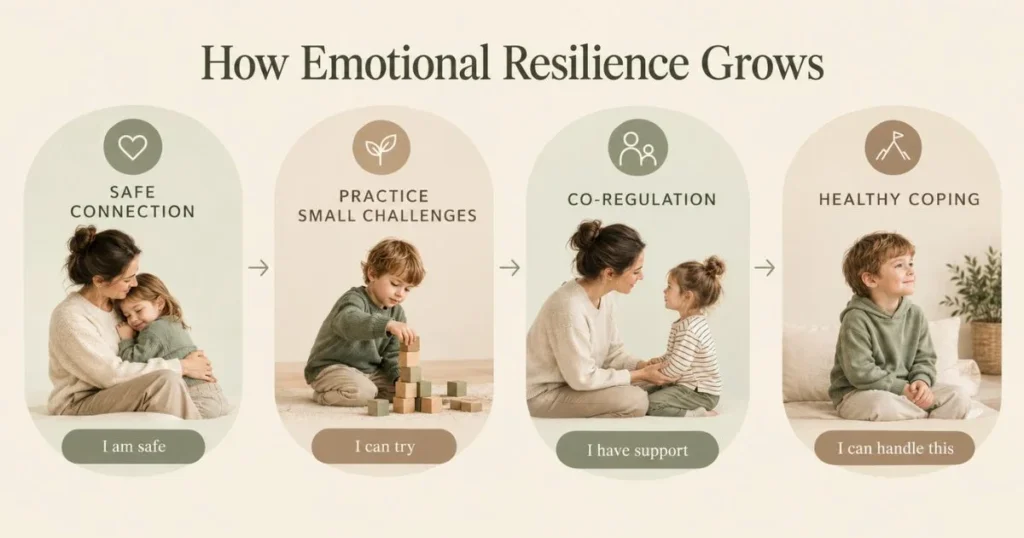
Safe, Supportive Relationships Build Resilience
The connection you have with your child is an important part of helping them develop emotional resilience. It provides a foundation for learning how to cope with difficult experiences.
When children feel safe, connected, and supported, they have a secure base from which to explore challenges and gradually develop emotional resilience.
The AAP describes safe, stable, nurturing relationships as an important foundation for healthy mental and emotional development.
This doesn’t require you to be available every second.
Small moments count:
- Listening when your child wants to talk
- Reading together before bed
- Sitting beside them after a disappointment
- Playing without constantly directing the activity
- Sharing a meal
- Taking a walk together
- Following their lead during a few minutes of play
These moments communicate something powerful:
“You are safe with me, even when life feels difficult.”
That sense of safety gives your child a stronger foundation for building emotional resilience as they face everyday challenges.
Children Develop Resilience Through Practice
You cannot teach resilience entirely through explanations.
Your child needs opportunities to practice it.
If you solve every age-appropriate problem before your child gets a chance to try, they may miss opportunities to discover what they can do.
That doesn’t mean leaving your child alone with frustration.
Instead, stay nearby while giving them room to participate.
You might say:
“That puzzle piece isn’t fitting. Want to try another one?”
Or:
“I’m here if you need help. What do you want to try first?”
Co-Regulation Comes Before Independent Regulation
Young children often need an adult’s help to calm their bodies and organize their emotions.
Your calm voice, presence, predictable response, and physical closeness can help create the conditions in which your child gradually learns to regulate emotions independently.
The AAP recommends acknowledging emotions, naming them, validating them, and helping children learn calming strategies.
So when your child is overwhelmed, the goal isn’t always:
“How do I make my child calm down?”
A better question can be:
“How can I support my child so they feel secure enough to work through this?”
How Gentle Parenting Can Help Build Emotional Resilience in Kids
Gentle parenting isn’t about preventing every uncomfortable experience.
It means balancing connection with boundaries, empathy with direction, and support with independence that fits your child’s age.
Here are eight practical ways to start.
1. Validate Your Child’s Feelings
When your child is upset, your first response can shape what happens next.
Validation doesn’t mean agreeing with every behavior. You can recognize your child’s feelings while still maintaining a clear boundary.
For example:
”You’re really upset that it’s time to leave the playground. It’s okay to be angry. We still need to go home.”
Your child hears two messages at once:
Your feeling is acceptable. The boundary still exists.
What to Say
Try phrases such as:
- “You look really disappointed.”
- “You wanted that to happen.”
- “That was frustrating.”
- “I can see that you’re angry.”
- “It’s hard when plans change.”
- “I’m here with you.”
What to Avoid
Avoid brushing aside your child’s feelings with phrases like:
- “You’re fine.”
- “It’s not a big deal.”
- “Stop crying.”
- “There’s nothing to be upset about.”
- “Big kids don’t act like this.”
The AAP’s emotion-coaching guidance recommends acknowledging, naming, and validating children’s emotions while helping them learn how to manage them.
2. Help Your Child Name Their Emotions
Sometimes your child’s behavior tells you they are overwhelmed before they have the words to explain why.
You can help by putting language to what you observe.
For example:
“Your face looks tense, and your hands are clenched. I wonder if you’re frustrated.”
Over time, emotional vocabulary gives your child more ways to communicate what is happening inside.
Build an Emotional Vocabulary
Depending on your child’s age, introduce words such as:
- Happy
- Sad
- Angry
- Worried
- Frustrated
- Disappointed
- Nervous
- Embarrassed
- Excited
- Jealous
- Overwhelmed
- Proud
You don’t have to make this moment into a teaching lesson.
Use ordinary moments.
When a tower falls:
“You put a lot of effort into that, and now you’re feeling frustrated.”
When a friend doesn’t share:
“You look disappointed because you wanted a turn.”
The AAP recommends helping children understand and manage emotions through emotion coaching, including identifying and naming feelings.
3. Teach Coping Skills for Big Feelings
Coping skills give your child something practical to do when emotions become intense.
But timing matters.
Trying to teach a new breathing exercise while your child is already screaming may not work very well. Practice when your child is calm so the strategy becomes familiar.
Depending on age and preference, you can introduce:
- Slow breathing
- Taking a short break
- Sitting beside a trusted adult
- Drawing
- Listening to calming music
- Moving the body
- Drinking water
- Looking at a favorite book
- Asking for help
- Spending a few quiet moments together
The AAP includes strategies such as deep breathing, relaxation, mental imagery, and taking breaks among techniques that can help children manage stress.
The important point is that coping skills are tools, not commands.
“Calm down” is not a coping strategy.
“Let’s take three slow breaths together” gives your child something concrete to practice.
4. Let Your Child Experience Small, Safe Struggles
Watching your child go through a difficult moment can be hard.
Your instinct may be to step in immediately.
Sometimes you should.
But when the problem is safe and appropriate for your child’s age, giving them a little space to work through it can build confidence.
For example, you might let your child:
- Try putting on their shoes
- Work on a simple puzzle
- Attempt a difficult drawing
- Decide how to solve a small disagreement
- Try again after a block tower falls
- Experience losing a simple game
You remain available.
The goal isn’t:
“Figure it out yourself.”
It’s:
“You can try. I’m here if you need me.”
The AAP similarly emphasizes preparing children to deal with challenges while strengthening relationships and showing them how adults cope with uncertainty.
5. Teach Problem-Solving Instead of Fixing Everything
When your child says, “I can’t do it,” you don’t always need to provide the answer.
You can help them think.
Ask:
- “What happened?”
- “What could you try?”
- “Would you like some help, or would you rather give it a try on your own first?”
- “What might make this easier?”
- “Is there another way?”
- “What’s one small thing you could do?”
Suppose your child can’t build the tower they imagined.
Instead of immediately taking over, you could say:
“The blocks keep falling. What do you notice?”
That small question turns frustration into investigation.
Your child may discover that the base needs to be wider, the blocks need to be arranged differently, or they need another kind of block.
The lesson isn’t simply how to build the tower.
It’s:
“When one approach doesn’t work, I can try a different one.”
6. Help Your Child Learn From Mistakes
Mistakes can either become sources of shame or opportunities for learning.
Your response can make a difference.
Instead of:
“You should have been more careful.”
Try:
“That didn’t work the way you expected. What happened?”
Then:
“What could you try next time?”
This doesn’t mean you have to put a positive spin on every mistake.
Sometimes your child simply needs comfort.
The goal is to help them gradually understand that making a mistake does not mean they are incapable.
A mistake can be information.
It shows that something may need to be changed, practiced more, or handled in a different way.
7. Encourage Persistence and Flexible Thinking
Resilience includes persistence, but persistence shouldn’t mean forcing your child to continue when they are exhausted or overwhelmed.
Sometimes the resilient choice is to pause.
Sometimes it is to ask for help.
Sometimes it is to try a different strategy.
You can encourage flexible thinking with phrases such as:
- “That way didn’t work. What else could we try?”
- “We can take a break and come back.”
- “You don’t have to get everything right on your first attempt.”
- “Let’s try one small step.”
- “Would you like me to help?”
Instead of praising only the final result, notice useful behaviors:
“You kept trying even when it was frustrating.”
“You realized that approach wasn’t working and decided to try something different.”
That helps your child connect success with effort, strategy, and learning, rather than perfection.
8. Model Emotional Resilience Yourself
Your child learns not only from your words but also from the way you respond and behave.
If frustration makes you quickly blame someone else, your child learns that this is one way to respond when things go wrong.
If you say:
“I’m frustrated. “I’m going to pause, take a breath, and think about what I can do next.”
your child sees another.
You can model:
- Taking a pause
- Asking for help
- Admitting mistakes
- Apologizing
- Trying again
- Accepting disappointment
- Setting healthy boundaries
- Talking about feelings without shame
And you don’t have to model perfect emotional control.
If you lose your patience, repair matters.
You can say:
“I was frustrated and I raised my voice. I’m sorry. I should have spoken more calmly. I’m going to try again.”
The AAP specifically highlights the importance of parents managing their own feelings and modeling healthy ways of coping with uncertainty and difficult experiences.
How to Help Kids Handle Disappointment and Setbacks
Disappointment is one of the most accessible opportunities to practice emotional resilience.
Your child doesn’t need you to make every disappointment disappear.
They need your support to move through those emotions in a safe way.
When Your Child Loses a Game
You might say:
“You really wanted to win. Losing feels disappointing.”
Give them time to feel it.
You don’t have to immediately say:
“It doesn’t matter!”
It mattered to them.
Once they’re calmer, you can talk about what happens next.
When Plans Suddenly Change
Prepare your child when possible:
““We planned to go to the park, but now it’s raining. You’re disappointed. Let’s think about what we can do instead.”
This teaches an important sequence:
Feel the disappointment → receive support → adapt → move forward.
When Your Child Says “I Can’t Do It”
Start by slowing things down.
“It feels too hard right now.”
Then:
“Would you like help, a break, or another try?”
You’re not pretending that the task is easy for your child.
You’re showing them that difficult does not have to mean impossible.
Create a Home Environment That Supports Emotional Resilience
Resilience isn’t built only during major challenges.
It grows through hundreds of ordinary interactions.
Create Predictable Routines
Predictability can help children feel secure.
Consider keeping regular rhythms around:
- Meals
- Bedtime
- Morning routines
- School preparation
- Family connection
The AAP recommends predictable routines as one way parents can create stability and connection for children.
Make Connection Part of Everyday Life
You don’t need elaborate activities.
Try:
- Reading together
- Cooking
- Walking
- Playing
- Talking during bedtime
- Sharing a meal
- Doing simple household tasks together
The AAP recommends everyday relationship-building activities such as shared activities, listening, play, and routines as ways to strengthen supportive relationships.
Give Your Child Trusted People to Turn To
Parents aren’t the only source of support.
Depending on your family, trusted adults may include:
- Grandparents
- Relatives
- Teachers
- Coaches
- Family friends
- School counselors
- Pediatricians
A strong support network gives children more places to turn when life feels difficult.
Emotional Resilience Activities for Kids
You don’t need a formal resilience curriculum at home. 5. Simple activities give children chances to practice recognizing emotions and developing coping skills.
Feelings Check-In
Ask at the end of the day:
- “What made you happy today?”
- “Was anything frustrating?”
- “Did anything worry you?”
- “What helped when something felt difficult?”
Emotion Naming Game
Take turns acting out emotions without saying the word.
Your child can guess:
- Angry
- Excited
- Worried
- Sad
- Proud
- Frustrated
The AAP suggests activities such as emotion charades to help children practice recognizing and identifying different feelings.
Create a Calm-Down Toolbox
Place a few age-appropriate items your child enjoys in a small box.
For example:
- Crayons and paper
- A favorite book
- A soft stuffed animal
- Simple sensory items
- A picture showing slow breathing
Use the box as a familiar option, not a punishment.
Play “What Could You Try?”
Give your child a simple scenario:
“Your friend takes the toy you were using. What could you do?”
Brainstorm several possible responses.
There can be more than one correct answer.
Talk About Mistakes
At dinner or bedtime, casually share something that didn’t go perfectly.
Ask:
“What happened?”
Then:
“What did you learn?”
The purpose isn’t to force a lesson out of every mistake. It’s to make imperfection feel normal.
Emotional Resilience in Kids by Age
Children develop these skills gradually, so your expectations should change as they grow.
Toddlers
Focus on:
- Naming simple emotions
- Co-regulation
- Comfort
- Simple choices
- Predictable routines
- Short coping strategies
A toddler who cries because you said no isn’t failing at resilience. They are still learning how to handle and regulate strong emotions.
Preschoolers
You can gradually encourage:
- Emotional vocabulary
- Waiting
- Taking turns
- Simple problem-solving
- Trying again
- Handling small disappointments
- Practicing calming strategies
School-Age Children
You can increasingly encourage:
- Independent problem-solving
- Flexible thinking
- Handling mistakes
- Managing friendship difficulties
- Asking for help
- Reflecting on what worked and what didn’t
The AAP notes that children’s needs and abilities change across development, while supportive relationships remain important throughout childhood.
What Parents Should Avoid When Building Emotional Resilience
Even well-intentioned parenting can accidentally make difficult emotions harder to handle.
Don’t Shame Your Child for Having Big Feelings
Crying isn’t failure.
Anger isn’t automatically bad.
Fear isn’t weakness.
The behavior may need a boundary, but the emotion can still be acknowledged.
Don’t Force Your Child to Stop Crying
“Stop crying” may end the visible behavior without teaching your child what to do with the emotion underneath it.
Try:
“You can cry. I’m staying with you. I won’t let you hit.”
That combines emotional acceptance with a clear boundary.
Don’t Solve Every Problem Immediately
Give your child room to participate when the situation is safe and appropriate.
Don’t Expect Adult-Level Emotional Regulation
A five-year-old and a ten-year-old don’t have the same emotional skills.
Expecting children to respond like adults can create unnecessary shame.
Don’t Compare Your Child With Other Children
One child may recover quickly from disappointment while another needs more time.
Comparison doesn’t teach resilience.
Support does.
Don’t Confuse Resilience With Emotional Suppression
This distinction is worth remembering:
Emotional resilience:
“I feel upset, and I can eventually work through this.”
Emotional suppression:
“I must not show that I’m upset.”
You want to help your child build the first one.
Gentle Parenting Phrases That Build Emotional Resilience
| Situation | Instead of Saying | Try Saying |
| Your child is frustrated | “Stop getting upset.” | “This is really frustrating.” |
| Your child makes a mistake | “You should have known better.” | “Mistakes happen. What can we try now?” |
| Your child gives up | “Don’t be lazy.” | “Would you like to try another way?” |
| Your child loses a game | “It’s not a big deal.” | “You really wanted to win. Losing can feel disappointing.” |
| Your child is overwhelmed | “Calm down.” | “I’m here. Let’s take this one step at a time.” |
| Your child asks for help | “I’ll just do it.” | “Would you like me to help, or would you like to try it yourself first?” |
| Plans change | “Stop complaining.” | “You were expecting something different.” |
| Your child is angry | “There’s no reason to be angry.” | “You can be angry. I won’t let you hurt anyone.” |
Keep in mind that gentle parenting does not mean removing boundaries. Your child can have a valid emotion while you still set a firm limit on unsafe behavior.
When Your Child May Need Additional Support
Strong emotions are part of childhood. But sometimes emotional or behavioral difficulties become persistent, severe, or disruptive enough that additional support is appropriate.
Consider talking with your child’s pediatrician or another qualified professional if you notice ongoing difficulties that significantly affect:
- Everyday functioning
- School or learning
- Family relationships
- Friendships
- Sleep
- Eating
- Behavior
- Your child’s ability to participate in ordinary activities
The AAP recommends discussing concerns with your child’s pediatrician, who can help assess emotional and behavioral health and connect families with additional support when needed.
If your child has experienced a frightening or traumatic event, don’t assume that they simply need to “be resilient.” Children may need additional emotional and professional support after significant stress. The AAP emphasizes safety, supportive relationships, routines, and help with emotional regulation when children are coping with traumatic experiences.
Frequently Asked Questions About Emotional Resilience in Kids
What Is Emotional Resilience in Kids?
Emotional resilience in kids is the developing ability to cope with difficult emotions and challenges, adapt to change, seek support, and recover after setbacks. It doesn’t mean a child never becomes upset or needs help.
How Do You Build Emotional Resilience in Kids?
You can build emotional resilience by:
- Creating a safe, supportive relationship
- Validating emotions
- Teaching emotional vocabulary
- Practicing healthy coping skills
- Allowing manageable challenges
- Encouraging problem-solving
- Supporting persistence
- Modeling healthy emotional responses
- Maintaining predictable routines
Resilience develops over time rather than through one parenting technique. Supportive relationships and skill-building are central themes in the research on children’s resilience.
Why Is Emotional Resilience Important for Children?
Emotional resilience can help children navigate everyday frustrations, changes, mistakes, and setbacks. It helps children build coping, emotional regulation, communication, and problem-solving skills.
What Are Signs of Emotional Resilience in Kids?
A resilient child may:
- Recover after becoming upset
- Ask for help
- Try again after a mistake
- Express feelings with increasing clarity
- Adapt to age-appropriate changes
- Look for solutions
- Accept comfort
- Learn from experience
Remember that resilience isn’t constant. Even resilient children have difficult days.
How Can Gentle Parenting Build Emotional Resilience?
Gentle parenting can support resilience by combining connection and boundaries. You acknowledge your child’s feelings while still guiding their behavior and giving them opportunities to practice coping and problem-solving.
For example:
“I know you’re angry. I won’t let you hit. You can sit with me until you’re ready to try again.”
The emotion is accepted.
The unsafe behavior is not.
How Can You Help Your Child Cope With Disappointment?
Start by acknowledging the disappointment rather than immediately trying to erase it.
A useful sequence is:
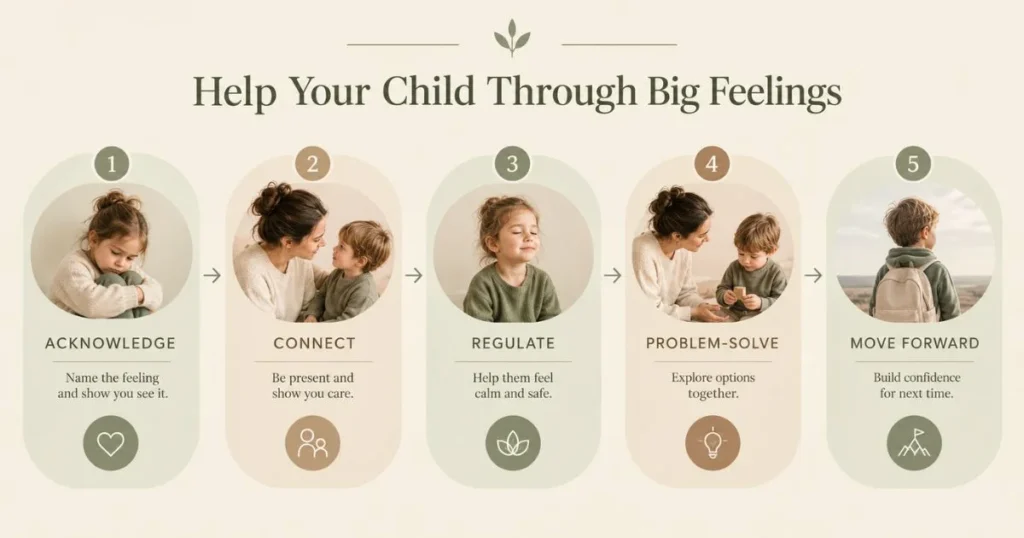
Acknowledge → Connect → Regulate → Problem-solve → Move forward.
Your child may need a hug before they are ready to talk about solutions. That’s okay.
What Are Good Emotional Resilience Activities for Kids?
Simple activities include:
- Feelings check-ins
- Emotion charades
- Calm-down tools
- Problem-solving games
- Talking about mistakes
- Practicing breathing
- Reading stories about emotions
- Playing cooperative games
The best activity is one your child can actually use and enjoy.
At What Age Do Children Develop Emotional Resilience?
Emotional resilience develops throughout childhood and continues to evolve as children gain language, self-awareness, problem-solving abilities, and greater independence.
Toddlers generally need more co-regulation and adult support, while older children can gradually take greater responsibility for coping and problem-solving.
Conclusion: Emotional Resilience Grows Through Connection, Practice, and Support

You don’t need to create a childhood without frustration, disappointment, mistakes, or difficult emotions.
You couldn’t do that even if you tried.
And you don’t need to.
What your child needs is the repeated experience of moving through difficult moments with a supportive adult nearby.
Sometimes that means listening.
Sometimes it means setting a boundary.
Sometimes it means offering a hug.
Sometimes it means stepping back and allowing your child to try.
And sometimes it means saying:
“This is hard. I’m here. Let’s figure it out together.”
Over time, those ordinary moments can become powerful lessons.
Your child begins to learn:
“My feelings are safe.”
“I can ask for help.”
“I can make mistakes.”
“I can try another way.”
“I don’t have to handle everything alone.”
That is at the core of building emotional resilience in kids.
You don’t need to raise a child who never faces difficulties.
You can help raise a child who knows that when struggles come, they have support, skills, and the confidence to take the next step.
Start small today: the next time your child faces a frustrating moment, pause before fixing it. Name the feeling, stay connected, and ask, “What could we try together?”
That one question can become the beginning of a much bigger skill.