
If your child has ever kicked you during a tantrum, lashed out at a sibling over a toy, or suddenly used their feet when you said “no,” you may have wondered, Why does my child behave this way?
You might also feel frustrated, embarrassed, or unsure about what to do next.
You know this behavior can hurt. You want your child to learn that hurting people is not okay. At the same time, you may not want to yell, spank, shame, or use harsh punishment to make it stop.
The good news is that you do not have to choose between being gentle and being firm.
You can take this behavior seriously while remembering that your child is still learning how to manage anger, frustration, disappointment, and impulses. Young children often need adults to help them understand strong emotions and learn safer ways to express them. The CDC recommends helping young children recognize and manage emotions while setting appropriate limits on behavior.
The goal is not to make your child feel bad for having a big emotion. The goal is to make sure everyone stays safe while teaching your child safer ways to respond.what they can do instead.

Why Do Kids Kick?
There can be many reasons behind this behavior, and there is rarely one explanation that applies to every child.
A toddler who lashes out because they cannot find the words to say “I’m frustrated” may need something different from an older child who reacts physically during repeated conflicts with a sibling.
Common reasons children may behave this way include:
- Anger or frustration
- Difficulty communicating
- Limited impulse control
- Wanting independence
- Feeling overwhelmed
- Being tired or hungry
- Struggling with transitions
- Conflict with siblings or peers
- Difficulty solving a problem
- Wanting an immediate reaction
Understanding the reason does not mean excusing the behavior. It simply gives you more information about what your child may need to learn.
Kicking Can Happen When Kids Feel Angry or Frustrated
Imagine your child has been building a tower for several minutes. Another child knocks it over.
Your child screams, drops to the floor, and lashes out with their feet.
This reaction may be the outward expression of an emotion that feels enormous to your child in that moment.
Young children are still developing the skills needed to express emotions, communicate needs, wait, take turns, and solve problems. The CDC notes that toddlers experience major changes in their thinking, social and emotional abilities while also becoming increasingly independent.
Your child may understand the rule when calm but struggle to use that knowledge when overwhelmed.
Kids May Kick When They Cannot Find the Words
SomeSometimes the behavior is communicating something your child cannot yet express clearly.
The message underneath the physical reaction might be:
- “I’m angry.”
- “I don’t want to stop.”
- “That’s mine.”
- “Help me.”
- “I can’t do this.”
- “I don’t know how to handle this.”
- “I want you to listen.”
This is especially relevant for younger children whose language skills are still developing.
Instead of focusing only on stopping the behavior, you can gradually teach the words that can replace it.
For example:
“You wanted the toy. Say, ‘My turn.’”
Or:
“You’re angry. You can say, ‘I’m mad.’ You cannot hurt people with your feet.”
Kids Are Still Learning Impulse Control
A child may know that kicking hurts and still kick when extremely upset.
That does not mean the child should be allowed to continue. It means you may need to provide more support in the moment.
Think about the difference between:
“You know better, so you should stop.”
and:
“You are having trouble stopping right now, so I need to help you stop safely.”
The second approach still holds the boundary. It simply recognizes that learning self-control takes practice.
Kicking Can Be About Independence
Toddlers and preschoolers often want to have more control over what happens to them.
They may strongly resist:
- Leaving the playground
- Getting dressed
- Turning off a screen
- Going to bed
- Sitting at the table
- Sharing a toy
- Holding hands
- Getting into the car
When you say, “It’s time to go,” your child may hear a limit they dislike.
This reaction does not mean you should remove the limit. Instead, it gives you an opportunity to teach your child how to disagree without hurting someone.
Is Kicking Normal Behavior for Kids?
This behavior can occur during early childhood, particularly when children are dealing with strong emotions and still developing communication and self-regulation skills.
But there is an important distinction:
A behavior can be developmentally common without being acceptable.
You do not need to tell yourself, “They’re just a toddler,” and ignore unsafe behavior.
You can say:
“I understand that you’re angry. I won’t let you hurt someone.”
That sentence contains both understanding and a boundary.
The CDC recommends teaching young children acceptable ways to express upset feelings while giving attention and praise to positive behavior.
So your response does not have to be either extremely harsh or completely permissive.
You can be warm and firm at the same time.
What Usually Triggers Kicking?
If you want to understand your child’s kicking, start paying attention to what happens immediately before it.
Rather than asking only, “How do I stop this?”, ask:
“What happened right before my child kicked?”
You may begin to notice a pattern.
| Possible trigger | What may be happening |
| Being told “no” | Your child is frustrated by a limit |
| Leaving somewhere fun | Your child is struggling with the transition |
| Sibling conflict | Your child lacks a problem-solving strategy |
| Hunger or tiredness | Self-regulation may be harder |
| Difficult task | Your child becomes frustrated |
| Too much noise or activity | Your child may feel overwhelmed |
| Toy being taken | Your child needs help communicating |
| Sudden change | Your child struggles with unpredictability |
Keeping a simple record for several days can help you identify patterns.
Kicking During Tantrums
Kicking can appear during intense tantrums because children may temporarily have difficulty managing the strength of their emotions.
The CDC explains that young children can become overwhelmed or distressed and need adult help learning how to respond to emotions. Its emotion-coaching guidance emphasizes staying calm, ensuring safety, naming emotions, and helping children find solutions.
That means you do not need to solve the entire problem during the peak of a tantrum.
First, help your child become safe and calmer.
Then teach.
Kicking During Transitions
Transitions are common flashpoints.
Your child is happily playing, and suddenly you announce:
“Time to go.”
For you, it may be a simple instruction. For your child, it means losing an enjoyable activity.
Try giving advance warnings:
- “Five more minutes, then we leave.”
- “Two more minutes.”
- “One more turn.”
- “It’s time to go. Do you want to walk or hold my hand?”

You are still leaving. The choice simply gives your child a small amount of control within a firm boundary.
What to Do When Your Child Kicks
When kicking happens, you do not need a complicated speech.
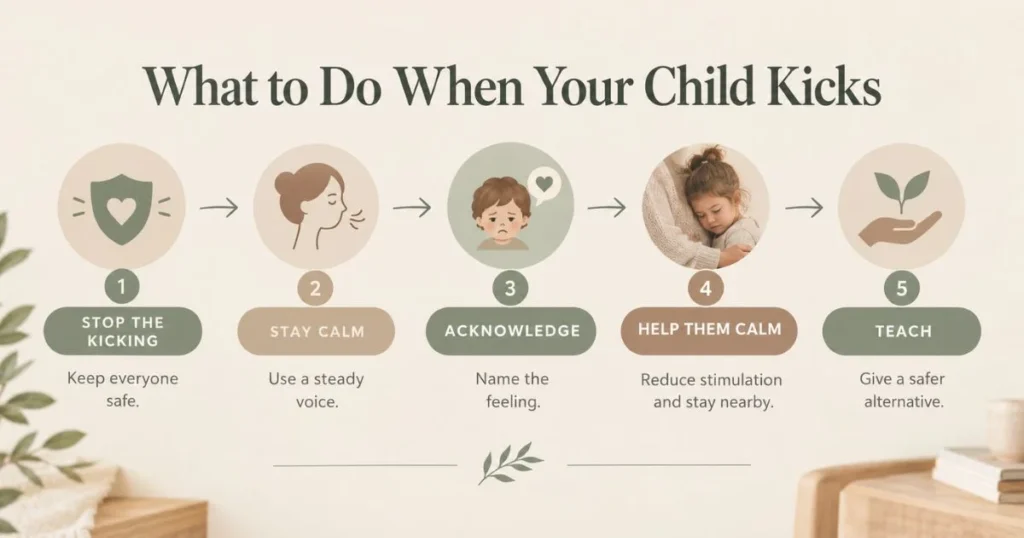
Use this simple sequence:
Stop → Protect → Connect → Set the limit → Teach
1. Stop the Kicking
Your first responsibility is safety.
Use a calm, clear statement:
“I won’t let you kick me.”
Or:
“Kicking hurts. I’m going to keep everyone safe.”
If another child is nearby, create physical space between the children.
You do not need to yell.
2. Stay Calm
This can be difficult, especially if the kick hurt you.
Before responding, take one slow breath if you can.
Use:
- A steady voice
- Short sentences
- A calm facial expression
- Simple instructions
Avoid turning the situation into a battle of who can become louder.
The CDC’s current emotion-coaching guidance specifically recommends staying calm, ensuring safety, and modeling self-regulation when helping young children manage strong emotions.
3. Acknowledge the Feeling
You can recognize the emotion without approving the behavior.
Try:
“You are really angry.”
“You didn’t want to leave.”
“You wanted the toy.”
Then add the boundary:
“It’s okay to be angry. I won’t let you kick.”
This distinction is powerful because your child learns that feelings are allowed, but hurting people is not.
4. Help Your Child Calm Down
When a child is overwhelmed, a long explanation usually isn’t the most useful response.
You might:
- Move to a quieter area.
- Reduce stimulation.
- Stay nearby.
- Give your child some physical space.
- Speak slowly.
- Wait until your child is calmer before discussing what happened.
Helping your child calm down does not mean you are rewarding the behavior.
You are helping your child develop the skills needed to handle the next difficult moment.
5. Teach What Your Child Can Do Instead
Once your child is calmer, give them a replacement.
Instead of only saying:
“Don’t kick.”
teach:
“Say, ‘I’m angry.’”
“Ask me for help.”
“Say, ‘My turn.’”
“You can move away.”
“You can tell me you don’t like it.”
The replacement behavior needs to be realistic for your child’s age and abilities.
How to Respond to Kicking Without Punishment
Not using punishment does not mean allowing kicking.
You can set a strong boundary without using physical punishment, humiliation, or fear.
A useful approach is:
Connect → Limit → Redirect → Teach
Connect
Recognize what your child may be feeling.
“You really wanted to keep playing.”
Limit
State what you will not allow.
“I won’t let you kick.”
Redirect
Show what your child can do.
“You can tell me, ‘Five more minutes.’”
Teach
Practice the replacement behavior later.
This approach is consistent with evidence-informed positive parenting strategies. The AAP recommends positive reinforcement, limit-setting, redirection, and clear expectations rather than spanking, hitting, threatening, insulting, humiliating, or shaming children.
Gentle Does Not Mean Permissive
This distinction matters.
| Gentle and firm | Permissive |
| “You’re angry, and I won’t let you kick.” | “You’re upset, so it’s okay.” |
| Stops unsafe behavior | May fail to stop it |
| Names the emotion | Focuses only on avoiding distress |
| Teaches an alternative | May not teach a replacement |
| Maintains a boundary | Boundary may remain unclear |
You can be compassionate about the emotion while being completely clear about the behavior.
Why You Shouldn’t Hit, Spank, or Shame a Child for Kicking
When your child kicks you, it can be tempting to respond with something physical because you want to make the seriousness of the behavior clear.
But hitting a child to teach them not to hit or kick creates a confusing lesson.
The American Academy of Pediatrics advises parents not to use spanking, hitting, slapping, threats, insults, humiliation, or shame as forms of discipline. Instead, it recommends positive reinforcement, limit-setting, redirection, and setting expectations.
The AAP also notes that repeated corporal punishment is associated with increased aggression and conflict between parents and children.
Shaming can be equally unhelpful.
Try not to say:
- “You’re a bad kid.”
- “What’s wrong with you?”
- “You’re acting like a baby.”
- “Good children don’t behave like this.”
- “I’m ashamed of you.”
Instead, separate the child from the behavior:
“You are having a hard time. Kicking is not safe.”
Your child can learn that a behavior needs to change without learning that they themselves are bad.
What Not to Do When Your Child Kicks
When emotions are running high, certain reactions can make the situation harder.
Don’t Kick or Hit Back
You want your child to learn that frustration does not justify hurting someone.
Model that lesson yourself.
Don’t Give a Long Lecture
When your child is having a meltdown, they may not be able to take in or understand a lengthy explanation.
Keep the first response short.
“I won’t let you kick.”
Save the teaching for later.
Don’t Use Labels
A label such as “aggressive child” can become part of how a child sees themselves.
Talk about the behavior instead:
“Kicking hurts.”
Not:
“You are mean.”
Don’t Ignore Kicking Completely
Some minor attention-seeking behaviors can sometimes be handled by reducing attention, but physical aggression requires attention to safety.
Your child needs to learn that kicking reliably results in a calm boundary.
How to Teach Your Child Not to Kick
Stopping the behavior in the moment is only one part of the process.
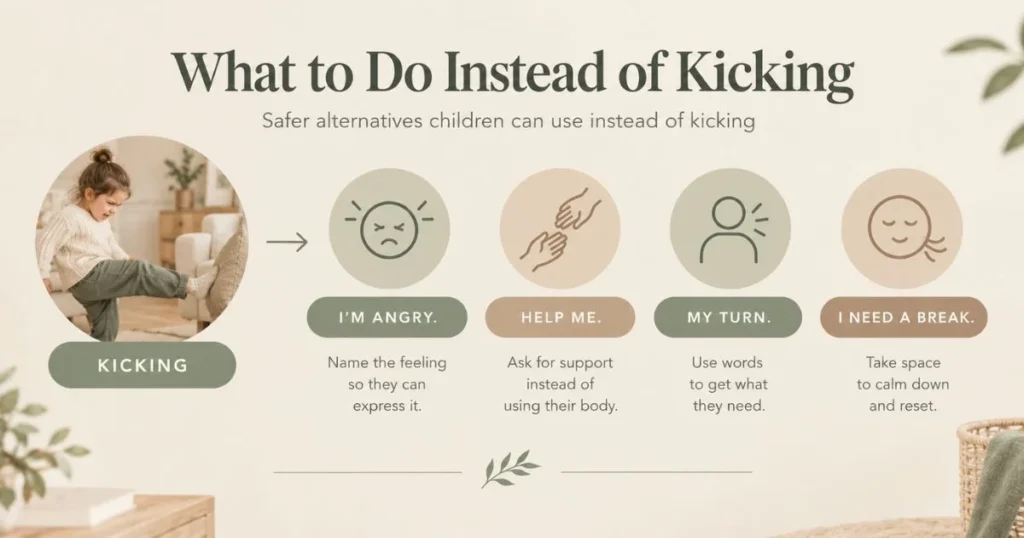
The long-term goal is to help your child develop alternatives.
Teach Feeling Words
Use simple words your child can actually remember:
- Mad
- Sad
- Frustrated
- Worried
- Tired
- Scared
- Disappointed
- Overwhelmed
You can name emotions during everyday situations, not just after a kick.
“You’re frustrated because the block fell down.”
Over time, your child begins connecting internal feelings with words.
Practice When Your Child Is Calm
Do not wait for the next meltdown.
During a relaxed moment, act out a situation.
You:
“I take your toy. What can you say?”
Your child:
“My turn!”
You:
“What if you’re really angry?”
Practice:
“I’m angry!”
This may feel silly at first, but repetition makes the response easier to access when emotions are high.
Teach Problem-Solving
Help your child work through everyday conflicts.
Ask:
- “What happened?”
- “What do you want?”
- “What could you say?”
- “What could we try?”
- “Do you want help?”
For preschoolers, the CDC recommends helping children solve problems when they are upset and giving them limited choices.
Notice the Behavior You Want
Do not wait until something goes wrong to give your child attention.
Notice the small successes:
“You were angry, but you used your words.”
“You wanted the toy, and you waited.”
“You asked for help instead of kicking.”
The CDC recommends giving children attention and praise when they follow instructions and show positive behavior.
How to Prevent Kicking Before It Happens
Prevention does not mean you can eliminate every difficult behavior.
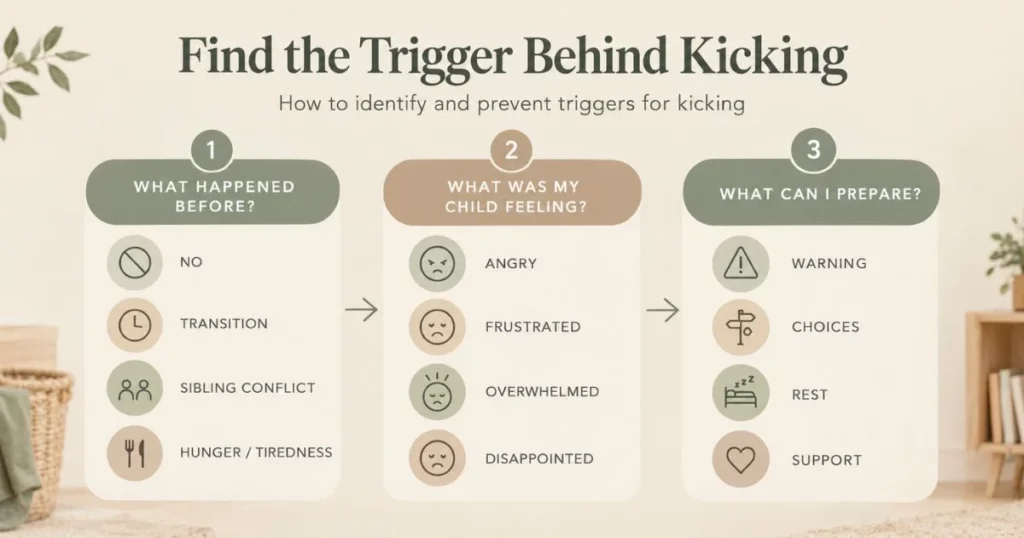
It means you can make some situations easier to handle.
Identify Your Child’s Triggers
For a week, write down:
- What happened before the kicking?
- What was your child doing?
- What emotion seemed to be present?
- What happened after the kick?
- What response helped?
You may discover that kicking happens almost exclusively during transitions, sibling conflicts, or when your child is overtired.
Prepare for Difficult Transitions
Give your child information before the change happens.
“Five more minutes of playing.”
Then:
“Two more minutes.”
Then:
“Last turn.”
Finally:
“Playtime is finished.”
Consistency helps children know what to expect.
Offer Limited Choices
Choices can provide autonomy without removing the boundary.
Instead of:
“Get dressed now.”
Try:
“Would you like to wear the blue shirt or the green one?”
Instead of:
“We’re leaving.”
Try:
“Do you want to walk to the car or hold my hand?”
Protect Sleep and Regular Meals
A tired or hungry child may have a harder time coping with frustration.
The CDC recommends that children ages 2–3 get 11–14 hours of sleep per 24 hours, including naps.
Sleep is not a cure for kicking, but adequate rest is one part of supporting a young child’s overall regulation and well-being.
What to Say When Your Child Kicks
Sometimes, the most difficult part is figuring out what to say in the moment.
Here are simple scripts you can adapt to your situation.
| Situation | What you can say |
| Your child kicks you | “I won’t let you kick me.” |
| Your child is angry | “You’re angry. It’s okay to be angry. I won’t let you hurt me.” |
| Your child kicks another child | “I’m stopping you. Kicking hurts.” |
| Your child kicks after hearing “no” | “You don’t like my answer. The answer is still no. I won’t let you kick.” |
| Your child kicks during a transition | “You don’t want to leave. It’s hard to stop playing. I won’t let you kick.” |
| Your child kicks over a toy | “You wanted the toy. Kicking isn’t how we ask. Say, ‘My turn.’” |
Notice that these statements are short.
You are not trying to win an argument.
You are teaching a boundary.
What to Do After Your Child Has Calmed Down
The calmer moment is often where the most useful teaching can happen.
Start with connection.
“That was really hard for you.”
Then briefly describe what happened.
“You were angry when we left the park, and you kicked me.”
Then teach:
“Next time, you could say, ‘I don’t want to go.’”
You can even practice it together.
If someone was hurt, help your child participate in repair.
That might mean:
- Checking on the person.
- Bringing them something they need.
- Saying sorry when they are ready.
- Helping fix what was damaged.
- Practicing what to do differently next time.
The purpose is not to force a dramatic apology.
The purpose is to help your child understand that their actions affect other people.
When Is Kicking a Reason for Concern?
Occasional kicking can happen during childhood, but you should pay attention if the behavior becomes persistent, severe, increasingly difficult to manage, or disruptive to your child’s everyday life.
It may be helpful to talk with your child’s pediatrician or another qualified professional if:
- Kicking happens very frequently.
- Someone is regularly getting injured.
- The behavior is becoming more intense.
- Kicking occurs across several settings.
- It significantly affects daycare, school, friendships, or family life.
- You are concerned about your child’s communication skills or overall development.
- You are having difficulty keeping your child or other people safe.
- The behavior represents a sudden and significant change.
You do not have to figure out or diagnose the underlying cause on your own.
A pediatrician can help you consider the bigger picture, including development, communication, behavior patterns, and other factors that may be relevant.
Before an appointment, it can help to keep notes about when the kicking occurs, what happened beforehand, how you responded, and what happened afterward.
Frequently Asked Questions About Kicking
Why do kids kick?
Kids may kick when they are angry, frustrated, overwhelmed, tired, struggling to communicate, dealing with conflict, or having difficulty controlling an impulse. Young children are still developing emotional and social skills, so they often need adults to teach safer ways to express strong feelings.
Why does my child kick when angry?
Anger can feel intense, particularly for a young child who has not yet developed strong self-regulation or communication skills. Kicking may become an impulsive physical response to that emotion. Your job is to acknowledge the anger while setting a clear limit on kicking.
Is kicking normal for toddlers?
Kicking can occur during early childhood, but that does not mean you should ignore it. Toddlers are developing independence, communication, emotional skills, and self-control. You can respond with a calm safety boundary while teaching your child a more appropriate response.
How do I stop my child from kicking?
Start by stopping the unsafe behavior and keeping everyone safe. Then acknowledge the emotion, state the boundary, help your child calm down, and teach an alternative such as asking for help, using feeling words, or moving away from a conflict.
Should I punish my child for kicking?
You do not need to use physical punishment, humiliation, or shame to teach your child not to kick. The AAP recommends positive reinforcement, clear limits, redirection, and setting expectations instead of spanking, hitting, insulting, humiliating, or shaming.
What should I say when my child kicks me?
Keep it short:
“I won’t let you kick me. You’re angry, and I’m here to help.”
You can add more explanation after your child is calm.
Why does my child kick during tantrums?
During a tantrum, your child’s emotions may become much stronger than their ability to manage them. They may need your help to become calm before they can listen, communicate, or problem-solve effectively. The CDC recommends staying calm, ensuring safety, naming emotions, and helping children find solutions.
How can I teach my child to express anger without kicking?
Practice when your child is calm. Teach simple phrases such as “I’m angry,” “Help me,” “My turn,” or “I need a break.” Role-play common situations and praise your child when they use these skills in real life.
When should I worry about my child’s kicking?
Consider getting professional guidance if kicking is persistent, severe, causes injuries, occurs in multiple settings, significantly disrupts everyday life, or occurs alongside concerns about communication or development.
Conclusion: Your Child Needs a Boundary, Not Shame
When your child kicks, it is understandable to want the behavior to stop immediately.
You do need to stop it.
But stopping kicking does not require you to shame your child, frighten them, or hurt them.
You can respond with a firm boundary:
“I won’t let you kick.”
And still communicate:
“I’m here to help you.”
Those two messages can exist together.
Your child may need support learning how to cope with anger, frustration, disappointment, changes in routine, conflict, or intense emotions. That learning takes repetition. Some days your child may use their words beautifully. Other days, a difficult moment may end with a kick before they remember what you practiced.
That does not mean the teaching is failing.
Keep returning to the same simple pattern:
- Stop the kicking.
- Keep everyone safe.
- Stay calm.
- Name the feeling.
- Hold the boundary.
- Teach a safer alternative.
- Practice when your child is calm.
- Notice and praise progress.
Gentle parenting does not mean allowing unsafe behavior. It means recognizing that your child can be responsible for learning a better behavior while still needing your help to learn it.
Kicking does not make your child a “bad kid.
The behavior needs to change—and you can help them change it without making them feel bad for having big feelings.
If your child is going through a challenging behavior phase, save this guide and come back to the scripts when you need them. And explore more Parenting Whisper guides on gentle parenting, emotional literacy, setting limits, and helping children handle big feelings—because you do not have to navigate the hard moments alone.