

Motherhood can be beautiful, but it can also feel like a never-ending list of things that need your attention.
There are meals to prepare, laundry to fold, appointments to remember, toys to pick up, emotions to navigate, and little people calling your name before you’ve even finished your coffee.
Sometimes, you move through the day so quickly that you don’t have time to notice it while it’s happening.
And then someone tells you, “Enjoy it. It goes so fast.”
You know they’re right. But hearing that doesn’t magically make an exhausting day feel easier.
Gratitude in Motherhood isn’t about pretending every moment is wonderful. It’s about learning to notice the moments that are good—even when the day as a whole feels messy.
A warm hug before breakfast. Your child’s laugh from the next room. A tiny hand reaching for yours. The funny sentence they said that you’ll probably remember years from now.
These moments don’t need a perfect day around them to matter. Gratitude in Motherhood can simply mean pausing long enough to recognize them.

What Is Gratitude in Motherhood?
Gratitude in Motherhood means intentionally noticing and appreciating the people, experiences, relationships, and ordinary moments that bring meaning to your life as a parent.
It can be as simple as thinking:
I’m tired, but I’m thankful for this cuddle.
Or:
Today was difficult, but my child made me laugh.
Or even:
I don’t love every part of this stage, but I know this little voice won’t always sound like this.
Practicing Gratitude in Motherhood doesn’t require you to feel happy all the time. It simply gives you a way to pause and recognize something meaningful that might otherwise disappear into the rush of the day.
Sometimes, Gratitude in Motherhood is simply about noticing what is already there—the small moments of connection, love, laughter, and comfort that can easily be overlooked when you’re busy getting through the day.
Gratitude Doesn’t Mean Motherhood Is Always Easy
You can be grateful for your children and still feel exhausted.
You can love being a mother and desperately need an hour alone.
You can appreciate your family while feeling frustrated by the mess, noise, or demands of the day.
Those things can exist together.
Gratitude in Motherhood doesn’t mean ignoring the difficult parts or forcing yourself to feel thankful every minute. You can acknowledge the hard moments while still appreciating the love, connection, and meaning your children bring to your life.
In fact, making room for both sides may be healthier than expecting yourself to feel grateful all the time. Gratitude in Motherhood can coexist with tiredness, frustration, and the very real need for rest.
Gratitude Is Not the Same as Toxic Positivity

There’s an important difference between noticing something good and forcing yourself to find a positive spin on everything.
| Healthy gratitude | Gratitude pressure |
| “This moment made me smile.” | “I shouldn’t be complaining.” |
| “Today was hard, but this part was beautiful.” | “I should enjoy every moment.” |
| “I’m grateful for the help I received.” | “Other mothers have it worse.” |
| “I love my child, and I need a break.” | “If I’m grateful, I shouldn’t feel overwhelmed.” |
You don’t have to turn a difficult experience into a lesson before you’re ready.
Sometimes the most honest form of gratitude is simply noticing one small good thing while acknowledging that the rest of the day was hard.
Why Gratitude May Matter for Your Well-Being
Gratitude in Motherhood can be understood within the broader research on gratitude and psychological well-being. Research suggests that gratitude practices can have positive—but generally modest—effects.
A 2025 meta-analysis examining 145 papers, 163 samples, and more than 24,000 participants across 28 countries found a small overall association between gratitude interventions and well-being. The results suggest that gratitude can be useful, but they don’t support the idea that Gratitude in Motherhood is a cure-all for stress or emotional difficulties.
That distinction matters. Gratitude in Motherhood can be one small tool for noticing meaningful moments, but it doesn’t replace rest, emotional support, practical help, or professional care when those are needed.
What Research Says About Gratitude
Research on gratitude generally points toward potential benefits for aspects of well-being, including positive emotions and how people evaluate their lives.
But results aren’t identical across every study or every person. Gratitude in Motherhood should therefore be understood as a personal practice rather than something that produces the same result for every parent.
For parents in particular, Gratitude in Motherhood should be viewed as one small tool, not a replacement for practical support, rest, social connection, or professional help when needed.
Parenting itself can place considerable demands on your emotional resources. Research involving parents has found meaningful relationships between parental stress and well-being, reinforcing why caring for the caregiver matters too.
What Gratitude Can’t Do
Gratitude in Motherhood can’t:
- make sleep deprivation disappear
- solve financial or childcare stress
- remove the demands of parenting
- make every developmental stage easy
- replace help from your partner, family, or community
- replace professional mental-health support when you need it
You don’t need to become more grateful before you deserve support.
Gratitude in Motherhood is not about convincing yourself that everything is okay when you are struggling. Sometimes the most supportive thing you can do for yourself is ask for help and appreciate the help when it arrives.
Finding Joy in the Little Moments of Motherhood
You don’t have to search for extraordinary experiences to practice Gratitude in Motherhood.
Some of the moments you’ll treasure most may be incredibly ordinary. Gratitude in Motherhood can begin with noticing the simple things—a quiet cuddle, a sleepy smile, a shared laugh, or a few peaceful minutes together.
Morning Cuddles
Maybe your child climbs into your lap while you’re still waking up.
Maybe their hair is messy. Their pajamas are inside out. They’re warm and sleepy.
You may not have time to linger.
But you can notice it.
This is my child, right here, in my arms.
This is one of the quiet moments that Gratitude in Motherhood can help you recognize. That tiny pause can turn an automatic moment into a remembered one.
Tiny Hands in Yours
A little hand reaching for yours in a parking lot.
Fingers wrapped around yours while walking down the sidewalk.
A hand resting on your arm while your child tells you a very important story.
These are the kinds of details that are easy to overlook because they’re part of everyday life.
But everyday doesn’t mean insignificant. Gratitude in Motherhood can help you slow down enough to notice these small moments of connection and recognize how meaningful they can be.
Your Child’s Laughter
Children can laugh at things adults barely notice.
A funny noise.
A silly face.
Water splashing in the bath.
A sock falling off.
When you hear that laughter, try letting yourself listen for a few seconds rather than immediately moving on to the next task.
You don’t have to manufacture joy. Gratitude in Motherhood can sometimes be as simple as pausing long enough to hear your child’s laughter and appreciate the happiness in that moment.
Sometimes you simply have to notice it.
Funny Things Your Child Says
Children have a remarkable way of making ordinary conversations memorable.
Write down the funny phrases.
Save the voice message.
Tell your partner.
Put a note in your phone.
Gratitude in Motherhood can include holding onto these little moments instead of letting them disappear into the busyness of the day.
Years from now, you may not remember what you were rushing to finish that afternoon—but you may remember the sentence that made you laugh.
Bedtime Conversations
Bedtime can be exhausting.
You may be counting the minutes until you can finally sit down.
But sometimes, just before sleep, children become unexpectedly talkative.
They tell you something they remembered.
They ask a strange question.
They give you a hug.
They say, “I love you.”
You don’t need to turn bedtime into a meaningful family ritual every night.
But when one of those little moments happens, give yourself permission to notice it. Gratitude in Motherhood can be as simple as pausing for a few seconds and appreciating the connection before the day comes to an end.
Ordinary Moments You’ll Miss
You may eventually miss things you currently find exhausting.
The repeated questions.
The little footsteps behind you.
The way your child insists on helping with something that would take you 30 seconds alone.
The bedtime story you’ve read so many times you know it by heart.
This doesn’t mean you should romanticize exhaustion.
It simply means that ordinary moments can hold meaning even when they’re inconvenient. Gratitude in Motherhood can help you notice that meaning without pretending the difficult parts aren’t difficult.
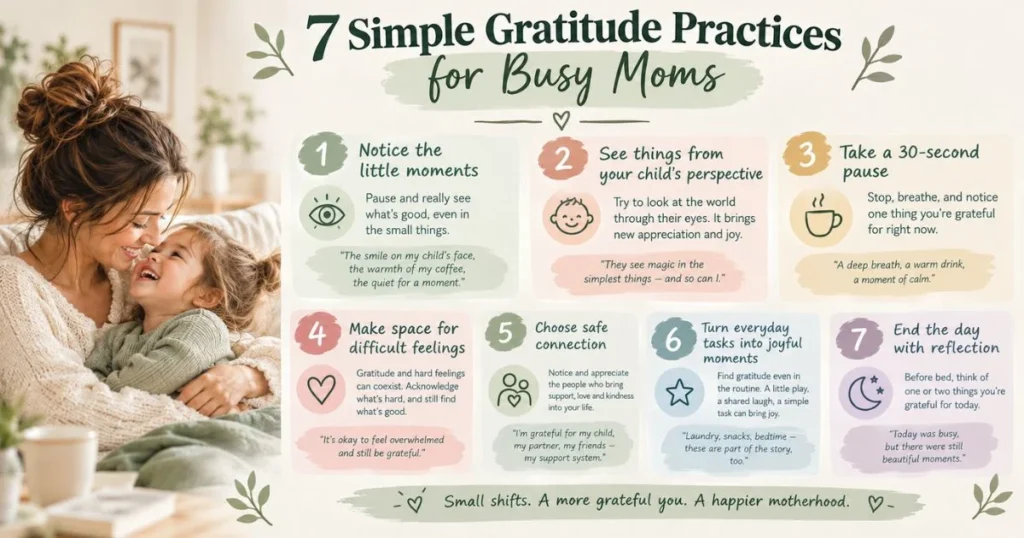
7 Simple Ways to Practice Gratitude in the Middle of a Busy Day
Gratitude doesn’t have to become another item on your to-do list.
You can weave Gratitude in Motherhood into things you’re already doing, allowing it to become a simple habit of noticing the meaningful moments that are already part of your day.
1. Make the Little Moments Bigger in Your Attention
Instead of rushing past a sweet moment, stay with it for a few extra seconds.
If your child gives you an unexpected hug, notice how it feels.
If they laugh, listen.
If they’re fascinated by something ordinary, watch them.
You’re not creating more time.
You’re simply giving a small piece of existing time your full attention. Gratitude in Motherhood can begin with this simple pause—being fully present for a moment you might otherwise rush past.
2. See the World Through Your Child’s Eyes
Children can find wonder in things adults have stopped noticing.
A puddle becomes an adventure.
A cardboard box becomes a house.
Bubbles become fascinating.
Rain becomes something worth watching from the window.
The next time your child becomes excited about something simple, pause before dismissing it.
Ask yourself:
What are they noticing that I’ve stopped seeing?
You don’t have to become a child again.
You can simply borrow their curiosity for a moment. Gratitude in Motherhood can grow from these small pauses, when you slow down and see something ordinary through your child’s eyes.
3. Take a 30-Second Gratitude Pause
You don’t need a 30-minute meditation session.
Try this instead:
- Stop what you’re doing if it’s safe to do so.
- Take one comfortable breath.
- Notice where you are.
- Name one thing you appreciate.
- Continue your day.
It might be:
I’m grateful for this quiet moment.
I’m grateful my child is laughing.
I’m grateful I have someone I can call.
I’m grateful for this cup of coffee.
This simple pause can become part of Gratitude in Motherhood without adding another complicated routine to your day.
The goal isn’t to feel dramatically different.
It’s simply to interrupt autopilot and give yourself a moment to notice something meaningful.
4. Let Difficult Feelings Exist
Gratitude works better when you don’t use it to silence your emotions.
If you’re angry, you can acknowledge that you’re angry.
If you’re sad, you can acknowledge that you’re sad.
If you’re overwhelmed, you can say, I’m overwhelmed.
Then, when you’re ready, you can also notice something supportive.
Two truths can exist at once.
You can be having a terrible morning and love your child deeply.
You can feel frustrated and still be grateful for your family.
You can need help and appreciate the people who support you.
That’s an important part of Gratitude in Motherhood: making room for appreciation without asking yourself to deny what you’re genuinely feeling.
5. Say “Yes” to Safe Moments of Connection
Motherhood involves saying “no” a lot.
No, you can’t climb there.
No, we can’t eat cookies for breakfast.
No, we can’t stay at the playground forever.
Boundaries are important.
But when something is safe and reasonable, look for opportunities to say yes.
“Yes, let’s splash in the puddle.”
“Yes, you can help me stir.”
“Yes, I’ll read that book one more time.”
“Yes, let’s dance in the kitchen.”
These small moments can create connection without requiring a special activity or expensive outing. Gratitude in Motherhood can mean noticing and appreciating these simple opportunities for connection as they happen.
6. Make Mundane Tasks More Playful
Some parts of motherhood are simply repetitive.
Laundry.
Dishes.
Tidying.
Packing bags.
Cleaning up toys.
When possible, make one of those tasks playful.
Sing while you tidy.
Let your child put socks into the basket.
Race yourself to finish one small chore.
Turn cleanup into a short game.
You don’t have to make every household task fun.
Even one lighter moment can change the feel of a routine. Gratitude in Motherhood can also mean noticing the small moments of connection that happen in the middle of ordinary tasks.
7. Notice One Good Thing Before Bed
Before bed, take a moment to reflect on your day and ask yourself:
What is one moment from today that I’d like to remember?
It doesn’t have to be impressive.
Maybe your child gave you a kiss.
Maybe you had five quiet minutes.
Maybe someone helped you.
Maybe you laughed.
Maybe you managed a challenging moment better than you thought you would.
This simple reflection can become part of Gratitude in Motherhood, helping you notice the moments that brought connection, comfort, or meaning to an otherwise ordinary day.
One good thing is enough.
Simple Gratitude Practices for Busy Moms
If you enjoy structured practices, choose one that feels realistic for your life.
| Practice | Time needed | Simple example |
| One Good Thing | 30 seconds | “My child made me laugh today.” |
| Gratitude Pause | 10–30 seconds | Notice a hug or quiet moment |
| Phone Notes | 1 minute | Save one memory |
| Gratitude Walk | 5–10 minutes | Notice three things around you |
| Gratitude Jar | 1 minute | Write down one meaningful moment |
| Gratitude Letter | 10–15 minutes | Thank someone who supports you |
Keep a One-Line Gratitude Journal
You don’t need a beautiful notebook or a complicated journaling routine.
Write one sentence.
“Today I’m grateful for ______.”
That’s enough.
If you have more on your mind, feel free to keep writing.
If you’re exhausted, stop after one sentence.
Use Your Phone Notes App
Your phone can become a tiny memory box.
Create a note called Little Things I Want to Remember.
Add:
- funny things your child says
- unexpected hugs
- family outings
- firsts and milestones
- ordinary moments that made you smile
This can become especially meaningful when you look back later.
Create a Gratitude Jar
Keep a small jar somewhere accessible.
Whenever something makes you smile, write it on a piece of paper and put it inside.
You can read the notes at the end of the month, on a birthday, or whenever your family needs a reminder of good memories.
A simple gratitude jar can become a meaningful part of Gratitude in Motherhood, giving you a tangible collection of the small moments you might otherwise forget.
Take a Gratitude Walk
You don’t need a scenic hiking trail.
Walk around your neighborhood, garden, or local park.
As you walk, notice three things:
Pay attention to one thing you see, one thing you hear, and one thing you can feel.
Your child’s laughter.
The sound of birds.
The warmth of the sun.
A cool breeze.
A tree changing with the season.
This simple practice can support Gratitude in Motherhood by helping you slow down and notice the ordinary details around you.
The goal isn’t to create a perfect mindfulness experience.
It’s simply to become more aware of where you are.
Gratitude When Motherhood Feels Hard
Some days don’t need a gratitude exercise.
Some days you need food, sleep, help, reassurance, or a chance to cry.
If you’re going through a particularly difficult period, don’t turn gratitude into another expectation you can fail.
You Can Feel Grateful and Still Feel Overwhelmed
Appreciating your family doesn’t mean you have to hide how you’re feeling. You can love the people in your life while also feeling tired, frustrated, or in need of more support.
You might think:
“I’m thankful for my child, but I’m completely worn out.”
“I love my family, and I also need some time to myself.”
“I appreciate my partner, but I could really use more support right now.”
These feelings can exist together. Being honest about what you need doesn’t make your gratitude any less genuine.
None of these statements cancels the others.
You Don’t Have to Find the Positive Immediately
Sometimes the first step is simply acknowledging what happened.
You had a difficult day.
Your child had a huge meltdown.
You lost your patience.
You felt lonely.
You were touched out.
You don’t have to immediately say, “But at least…”
Give yourself room to process.
Gratitude can come later.
Gratitude Shouldn’t Become Another Source of Mom Guilt
If you forget your gratitude practice for three days, nothing has gone wrong.
If you don’t feel grateful today, you haven’t failed motherhood.
If another mother seems more positive than you, that doesn’t mean she’s doing motherhood better.
Gratitude is an invitation, not a performance.
How to Avoid Comparison and Find Your Own Version of Joy
Social media can sometimes make motherhood appear more polished and effortless than it really is.
There are coordinated outfits, spotless playrooms, elaborate lunches, family traditions, peaceful bedtime routines, and smiling photographs.
Real life can look very different.
Your family doesn’t need to reproduce someone else’s version of motherhood.
Your Motherhood Can Be Your Own
Maybe your meaningful moment is drinking coffee while your child colors beside you.
Maybe it’s eating dinner together at the kitchen table.
Maybe it’s a five-minute walk.
Maybe it’s singing the same song in the car every morning.
The moments that matter don’t have to look impressive from the outside.
Choose Progress Over Perfection
You don’t need to become a perfectly mindful, endlessly patient, constantly grateful mother.
You simply need opportunities to reconnect.
Notice one moment.
Take one breath.
Apologize when necessary.
Try again.
Enjoy what you can.
Rest when you need to.
That’s enough.
Stop Waiting for the “Perfect” Stage
It’s easy to think:
I’ll enjoy this more when my child sleeps through the night.
I’ll have more time when they’re older.
I’ll feel less overwhelmed when they’re in school.
But every stage changes.
Waiting for the next stage to become easier can make it harder to notice the life you’re actually living.
You don’t need to enjoy every stage equally.
You can simply ask:
What is here today that I don’t want to overlook?
Teaching Children Gratitude Through Everyday Life
Children don’t learn gratitude because we repeatedly tell them to say “thank you.”
They learn it through relationships, modeling, conversation, and everyday experiences.
Model Gratitude Instead of Demanding It
Let your child hear you say:
“Thank you for helping me.”
“I’m really glad we had the chance to share this moment together.”
“That was kind of you.”
“I really appreciated your help.”
You’re showing them what appreciation sounds like.
Use Age-Appropriate Gratitude Questions
With young children, keep questions simple:
- What made you smile today?
- What was your favorite part of today?
- Who helped you today?
- What was something fun?
- What are you looking forward to tomorrow?
These questions don’t need to feel like a test for your child.
If your child doesn’t want to answer, that’s okay.
Create a Family Gratitude Ritual
Your family might share one good thing during:
- dinner
- bath time
- bedtime
- the weekend
- a family walk
Keep it flexible.
The purpose is connection—not compliance.
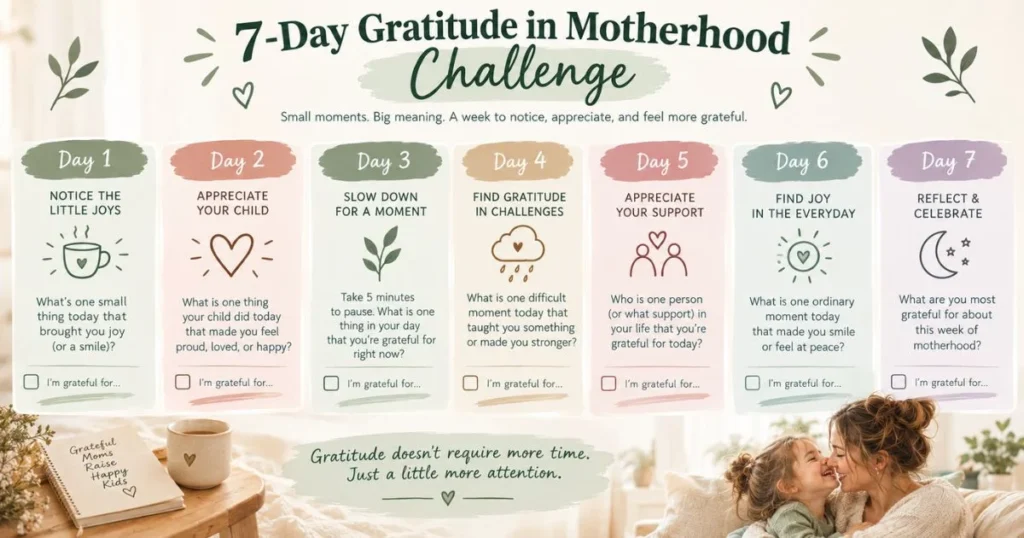
A 7-Day Gratitude in Motherhood Challenge
If you want to try gratitude without making it complicated, start with one week.
| Day | Gratitude prompt |
| Day 1 | What made you smile today? |
| Day 2 | What ordinary moment do you want to remember? |
| Day 3 | What did your child teach you today? |
| Day 4 | Who supported you recently? |
| Day 5 | What do you appreciate about yourself as a mother? |
| Day 6 | What family moment felt meaningful today? |
| Day 7 | What do you appreciate about this stage of motherhood? |
You can write your answers down or simply think about them.
There is no perfect way to complete the challenge.
If you miss a day, continue the next day.
Frequently Asked Questions About Gratitude in Motherhood
What does gratitude in motherhood mean?
Gratitude in motherhood means intentionally noticing and appreciating meaningful moments, relationships, and experiences while recognizing that motherhood can also be difficult, exhausting, and imperfect.
How can I practice gratitude in motherhood every day?
Start small. Notice one moment that makes you smile, write one sentence in your phone, pause during a hug, or think of one thing you appreciated before going to bed. A gratitude practice doesn’t need to take more than a few seconds.
What are simple gratitude activities for moms?
Simple activities include keeping a one-line gratitude journal, creating a gratitude jar, taking a gratitude walk, writing a thank-you note, sharing one good thing at dinner, or keeping a list of funny and meaningful things your children say.
Can gratitude help when motherhood feels overwhelming?
Gratitude may help you notice positive experiences during stressful periods, and research suggests gratitude practices can have modest effects on aspects of well-being. However, gratitude shouldn’t be used as a replacement for practical support, rest, or professional help when you’re struggling.
Do I have to feel grateful every day as a mother?
No. You don’t have to feel grateful every day. Difficult emotions are a normal part of life, and acknowledging them doesn’t mean you appreciate your family any less.
How can I teach my children gratitude?
Model gratitude in everyday situations, use simple questions about meaningful moments, encourage children to thank others naturally, and create small family rituals. Avoid making gratitude feel like a performance or obligation.
What are some little things to be grateful for in motherhood?
You might appreciate a morning cuddle, your child’s laughter, a funny question, a tiny hand in yours, a bedtime conversation, someone helping you, a peaceful cup of coffee, or simply having a few quiet minutes together.
Conclusion: You Don’t Have to Make Motherhood Perfect to Appreciate It

Motherhood doesn’t have to be perfect for you to find moments of joy in it.
You don’t need more sleep, a cleaner house, an easier routine, or a completely stress-free day before you’re allowed to appreciate your life.
Sometimes Gratitude in Motherhood is much smaller than that.
It’s the tiny hand reaching for yours.
The laugh coming from the next room.
The sleepy cuddle before bedtime.
The ridiculous thing your child said that made you laugh.
The person who helped when you needed it.
The quiet cup of coffee you finally got to drink.
These moments may seem ordinary now.
But ordinary moments are often the ones that quietly become memories.
So don’t put pressure on yourself to be grateful for everything.
Instead, try noticing one good thing.
One moment.
One connection.
One small reason to pause.
Because Gratitude in Motherhood doesn’t mean ignoring the hard parts.
It means remembering that the hard parts aren’t the only parts.
What is one little moment from today that you’d like to remember?