

Real talk, reassurance, and realistic ways to care for yourself while caring for your baby.
Self-Care for First-Time Moms can look very different from the picture-perfect routines you may see online. Becoming a mom for the first time can make your world feel wonderfully full—and completely upside down.
Suddenly, there is a tiny person who needs you for almost everything. Feeding. Diapers. Soothing. Appointments. Laundry. More feeding. And somewhere between all those newborn needs, you may realize that you have barely had time to eat, shower, breathe, or remember what you used to enjoy.
You may even find yourself thinking:
“But when do I get a moment to take care of myself?”
That question matters.
For first-time moms, self-care can be much simpler than a spa day, a weekend getaway, or hours of uninterrupted downtime. Sometimes it looks much smaller: eating a real meal while it is still warm, taking a ten-minute walk, asking someone else to hold the baby while you shower, or sitting quietly with your coffee before the day gets busy.
Those moments count.
Your needs still matter after your baby arrives. In fact, looking after your physical and emotional well-being is part of caring for your family, too. The World Health Organization describes quality postnatal care as supporting mothers, babies, partners, and families with information, reassurance, and support—not simply focusing on the baby.
So instead of asking whether you have earned a break, try asking:
“What would help refill my cup today?”

What Does “Refilling Your Cup” Mean for First-Time Moms?
The phrase “refill your cup” is a simple way to describe restoring some of the physical, emotional, and mental energy you use every day.
For first-time moms, Self-Care for First-Time Moms can mean:
- Getting enough food and fluids
- Resting whenever you realistically can
- Caring for your postpartum body
- Spending a few minutes outside
- Talking to someone you trust
- Asking for practical help
- Doing something you enjoy
- Moving your body when you are ready
- Protecting a small part of your identity outside motherhood
- Getting professional support when you need it
You don’t need another long list of expectations to add to your day. Instead, self-care for first-time moms should be simple enough to fit naturally into your life and feel genuinely manageable.
Self-Care Is More Than Pampering
There is nothing wrong with enjoying a bath, applying a face mask, getting a massage, or taking a quiet afternoon for yourself.
But Self-Care for First-Time Moms can be much more basic—and sometimes much more important.
If you have not eaten since breakfast, a nourishing meal may be more valuable than a beauty treatment.
If you are exhausted, getting some rest may help more than pushing yourself through another chore.
If you feel isolated, calling someone who makes you feel understood may matter more than buying something new.
Think of self-care for first-time moms as maintenance, not indulgence.
You Don’t Have to Be Completely Empty Before You Rest
You don’t have to finish every chore before you give yourself permission to sit down.
There will almost always be another load of laundry, another bottle to wash, another dish in the sink, or another message waiting for your attention.
Taking ten minutes for yourself is a small but meaningful part of Self-Care for First-Time Moms. It doesn’t mean you have stopped being a good mother.
It simply means you are a person with needs, too—and those needs deserve care.
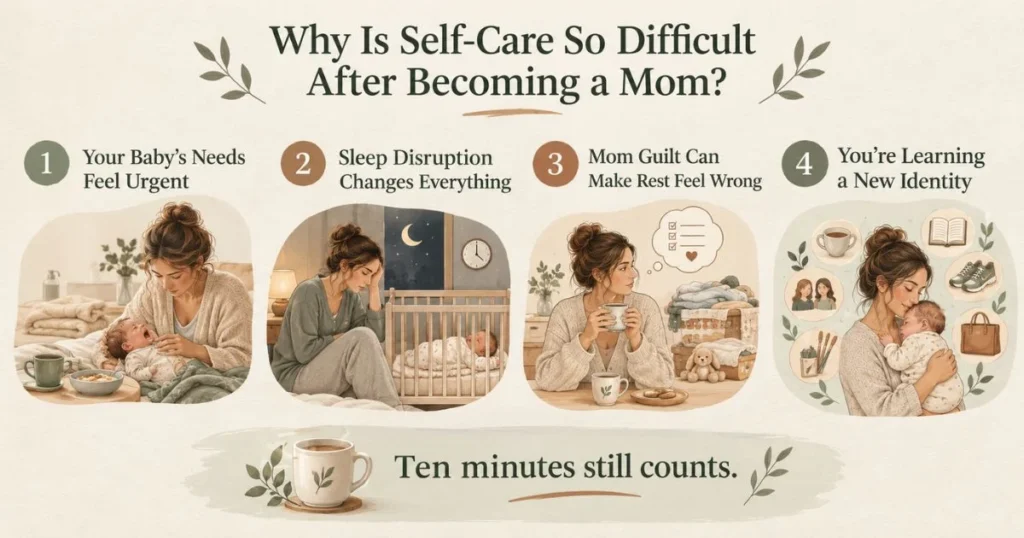
Why Is Self-Care So Difficult After Becoming a Mom?
Knowing that you need self-care and actually finding time for it are two very different things.
For many first-time moms, Self-Care for First-Time Moms can feel difficult to fit into an already unpredictable day. Even simple tasks can suddenly feel more complicated once you are adjusting to life with a new baby.
For many moms, the invisible planning and constant responsibility of caring for a family can make it difficult to switch off, even when the day is finally over.
Your Baby’s Needs Feel Urgent
Your baby may need you when you are trying to shower, eat, or simply take a moment to yourself.
When your baby is hungry, uncomfortable, crying, or having trouble settling, your attention naturally shifts toward them.
That instinct is completely normal.
But when so much of your time and energy goes toward meeting someone else’s needs, your own can gradually slip to the bottom of the list. That’s why Self-Care for First-Time Moms matters—it reminds you that your needs deserve attention, too.
Sleep Disruption Changes Everything
Newborn sleep patterns can make even ordinary tasks feel much more difficult.
When you’re tired, preparing a meal, exercising, replying to messages, or simply deciding what to do next can take more energy than usual.
That’s why Self-Care for First-Time Moms may need to look smaller and more flexible after birth.
You may not have an hour to yourself.
You may only have ten minutes.
And ten minutes still counts.
Mom Guilt Can Make Rest Feel Wrong
Some new mothers feel guilty when they take time for themselves or step away from their baby for a while.
You might find yourself thinking:
- “I should be doing something for the baby.”
- “The house is a mess.”
- “Someone else needs me.”
- “Other moms seem to manage everything.”
- “I haven’t done enough to deserve a break.”
But Self-Care for First-Time Moms isn’t something you have to earn by finishing every task on your list. Rest is a basic need, not a reward for getting everything done.
If you often feel guilty for taking time for yourself, you may also find it helpful to explore these practical ways to understand and manage mom guilt.
You’re Learning a New Identity
Becoming a mother can bring a major shift in how you see yourself and your everyday life.
You can love your baby deeply while still missing parts of the routine you had before motherhood.
You might miss spontaneous outings, uninterrupted sleep, quiet mornings, work, hobbies, friendships, or simply having a little time when no one needs anything from you.
Missing those parts of your old life does not mean you love your baby any less. Self-Care for First-Time Moms can also include making space for the parts of your identity and life that still matter to you.
It simply means you’re adjusting to a new chapter.
If motherhood has been feeling especially heavy lately, remember that feeling overwhelmed does not mean you’re failing.
Start With the Basics: Your Body Needs Care, Too
Becoming a mother can bring a major shift in how you see yourself and your everyday life.
You can love your baby deeply while still missing parts of the routine you had before motherhood.
You might miss spontaneous outings, uninterrupted sleep, quiet mornings, work, hobbies, friendships, or simply having a little time when no one needs anything from you.
Missing those parts of your old life does not mean you love your baby any less. Self-Care for First-Time Moms can also mean making space for the parts of your identity and life that still matter to you.
It simply means you’re adjusting to a new chapter.
Eat Regularly
When your day revolves around feeding a baby, it is surprisingly easy to forget to feed yourself.
Try keeping easy foods within reach.
Quick Meal Ideas for New Moms
| Meal | Ingredients | Why It’s Practical |
| Overnight oats | Oats, milk or yogurt, berries, chia seeds | Prepare ahead and grab from the refrigerator |
| Egg and avocado toast | Eggs, whole-grain toast, avocado | Quick and filling |
| Yogurt bowl | Yogurt, fruit, oats or granola | Requires almost no preparation |
| Peanut butter banana toast | Toast, peanut butter, banana | Fast when you need food immediately |
| Simple smoothie | Milk or yogurt, banana, berries, oats | Easy to drink while holding the baby |
You do not need to prepare a perfect postpartum menu.
You need food that is realistic enough to eat.
Keep Easy Snacks Nearby
As part of Self-Care for First-Time Moms, consider keeping a small snack station near the place where you usually feed your baby.
Easy options include:
- Fresh fruit
- Yogurt
- Nuts or nut butter, if appropriate for you
- Whole-grain crackers
- Cheese
- Hard-boiled eggs
- Oat bars
- Cut vegetables
- Sandwiches prepared ahead of time
If you’re breastfeeding, keeping a water bottle within reach can also make it easier to stay hydrated throughout the day.
Stay Hydrated
As part of Self-Care for First-Time Moms, consider setting up a small snack station near the spot where you usually feed your baby.
Easy options include:
- Fresh fruit
- Yogurt
- Nuts or nut butter, if appropriate for you
- Whole-grain crackers
- Cheese
- Hard-boiled eggs
- Oat bars
- Cut vegetables
- Sandwiches prepared ahead of time
If you’re breastfeeding, keeping a water bottle within reach can also make it easier to stay hydrated throughout the day.
Rest Whenever You Can
“Sleep when the baby sleeps” sounds simple until you’re facing dishes, laundry, messages, meals, and a home that somehow became messy overnight.
You don’t have to sleep every time your baby sleeps. But Self-Care for First-Time Moms also means recognizing when your body needs a break.
Ask yourself:
“Would resting help me more right now than finishing this chore?”
Sometimes, the answer will be yes.
When it is, let the dishes wait. Your rest matters, too.
Care for Your Postpartum Body
Your postpartum body deserves patience, care, and time to recover.
Depending on your pregnancy, birth experience, recovery, and individual medical needs, you may need to wait before returning to certain activities. Your healthcare provider can guide you on what is safe and appropriate for your recovery.
Self-Care for First-Time Moms should include more than emotional rest. Postpartum care can also involve supporting your physical recovery, nourishing your body, getting breastfeeding support when relevant, and paying attention to your emotional well-being.
Try not to compare your recovery with another mother’s. Your body and hers have not gone through the exact same pregnancy, birth experience, or recovery journey.
15 Simple Self-Care Ideas for First-Time Moms
Self-Care for First-Time Moms doesn’t have to be complicated or time-consuming.
Here are 15 realistic ways to refill your cup, even when life with a new baby feels busy and unpredictable.
1. Take a Shower Without Rushing
As part of Self-Care for First-Time Moms, ask your partner, a family member, or another trusted person to stay with the baby while you take a shower.
Even ten uninterrupted minutes can feel completely different from rushing through a shower while listening for every little sound.
2. Step Outside
Stepping outside for some fresh air and a different view can help you feel refreshed and reset.
Sit on the balcony, stand in the garden, or take a short walk if you feel physically ready.
3. Eat Before You Become Starving
Don’t wait until you are completely depleted.
Keep simple foods available so you can eat before hunger becomes overwhelming.
4. Take a Short Break From Your Phone
Constant messages and social media can make your brain feel even busier.
Try five phone-free minutes.
5. Listen to Something You Enjoy
Play music, a podcast, an audiobook, or simply enjoy silence.
Choose something that reminds you that you are still you.
6. Call a Friend
You don’t need a deep conversation.
Sometimes hearing a familiar voice is enough.
7. Ask Someone to Bring Food
When someone asks, “How can I help?” you can answer honestly.
“Could you bring dinner?”
is a perfectly reasonable request.
8. Let Someone Else Hold the Baby
You don’t always have to be the person holding, soothing, or entertaining your baby.
If you have a trusted support person available, let them help.
9. Get Dressed for the Day
You do not need to dress up.
Put on something comfortable that makes you feel good in your current body.
10. Take a Gentle Walk When Appropriate
If your healthcare professional has cleared you for activity and walking feels comfortable, a short walk can become a simple part of your routine.
Start where you are.
11. Protect One Small Ritual
Choose one thing that belongs to you.
Maybe it is:
- Morning coffee
- A favorite podcast
- Reading before bed
- A short walk
- Skincare
- Calling your sister
- Writing in a journal
It does not have to take long.
12. Say No Without Over-Explaining
You don’t have to accept every visit, invitation, request, or opinion.
Sometimes protecting your energy means saying:
“Not today.”
13. Accept Practical Help
If someone offers to:
- Wash dishes
- Fold laundry
- Grocery shop
- Cook
- Vacuum
- Watch the baby
let them.
You do not need to supervise every task.
14. Do Something That Has Nothing to Do With Motherhood
Watch a show.
Read a novel.
Work on a hobby.
Listen to your favorite music.
Talk about something other than babies.
You are still a whole person.
15. Give Yourself Credit
You don’t need to have everything figured out.
You are learning.
You are adapting.
You’re learning to navigate a completely new chapter of life.
That deserves recognition.
Self-Care for First-Time Moms When You Have Only 5 Minutes
Sometimes five minutes really is all you have.
Instead of deciding that five minutes “doesn’t count,” use them intentionally.
Five-Minute Self-Care Ideas
- Drink a glass of water.
- Eat a snack.
- Sit somewhere quiet.
- Take several slow breaths.
- Step outside.
- Stretch gently.
- Send a message to a friend.
- Listen to one favorite song.
- Apply moisturizer.
- Close your eyes and rest.
If You Have 15 Minutes
Try:
- Taking a shower
- Going for a short walk
- Reading several pages
- Having coffee alone
- Doing gentle stretching
- Calling someone you love
If You Have an Hour
You could:
- Take a nap
- Go for a longer walk
- Meet a friend
- Have a quiet meal
- Attend an appointment
- Enjoy a hobby
- Spend uninterrupted time alone
The important part is not the length.
The important part is whether the time actually restores something you need.
Emotional Self-Care for First-Time Moms
Physical care is only one part of Self-Care for First-Time Moms.
Your emotional well-being deserves attention, too.
According to the WHO, emotional and psychological support during pregnancy and the postpartum period can help reduce the risk of depression and anxiety while supporting a mother’s ability to cope, adjust, and stay connected with people she trusts.
Give Yourself Permission to Have Mixed Feelings
You can feel grateful and exhausted at the same time.
You can deeply love your baby while still missing parts of the life you had before motherhood.
You might feel confident in the morning and completely overwhelmed by the evening.
Self-Care for First-Time Moms also means making room for these different emotions without judging yourself for having them.
Motherhood doesn’t come with just one feeling at a time.
Talk to Someone You Trust
As part of Self-Care for First-Time Moms, choose someone you can talk to openly—someone who listens without judging, comparing your experience, or telling you how you should handle things.
That might be:
- Your partner
- A close friend
- Your sister
- Another mother
- Your healthcare professional
- A therapist or counselor
You don’t always need someone to solve the problem for you.
Sometimes, having someone who simply listens and helps you feel understood is enough.
Protect Your Identity Outside Motherhood
As part of Self-Care for First-Time Moms, ask yourself:
“What parts of my identity do I want to continue nurturing as I embrace motherhood?”
Maybe you love reading.
Maybe you enjoy fashion.
Maybe you’re passionate about your career.
Maybe you love cooking, photography, fitness, music, travel, or simply having long conversations.
You don’t have to recreate your old life exactly as it was.
Instead, you can carry meaningful parts of who you are into this new chapter of motherhood.
Mom Guilt and Self-Care: You Don’t Have to Earn Rest

Mom guilt can turn even a five-minute break into an emotional debate.
You may find yourself thinking:
“Shouldn’t I be doing something for my baby?”
But Self-Care for First-Time Moms doesn’t mean choosing yourself instead of your baby. Taking care of yourself and caring for your baby can exist side by side.
Your baby needs a mother who is human—not someone who never gets tired, never needs help, and never takes a break.
Try replacing:
“I should be doing more.”
with:
“What do I need right now?”
Maybe the answer is food.
Maybe it is sleep.
Maybe it is a shower.
Maybe it is reassurance.
Maybe it is professional support.
Learning to recognize what you need in the moment is an important part of self-care.
Build Your Support Village
You were never meant to prove that you can navigate motherhood completely on your own.
Self-Care for First-Time Moms can include accepting help and allowing trusted people to support you when you need it.
WHO postnatal guidance emphasizes the importance of information, reassurance, and support for women, babies, partners, parents, caregivers, and families.
Let Your Partner Help
As part of Self-Care for First-Time Moms, try giving your partner clear, specific responsibilities instead of simply asking them to “help more.”
For example:
- “Could you handle the dishes tonight?”
- “Could you take the baby after the next feed so I can shower?”
- “Could you prepare breakfast tomorrow?”
- “Could you take care of the laundry this week?”
Clear, specific requests can make it easier for others to understand what you need and how they can support you.
Let Family and Friends Help
As part of Self-Care for First-Time Moms, don’t be afraid to accept practical help when someone you trust offers it.
Instead of automatically saying:
“I’m fine, thank you.”
try being specific:
“Actually, could you bring dinner?”
or:
“Could you look after the baby for a little while so I can take a break?”
Accepting support isn’t a sign that you’re struggling to handle motherhood. Sometimes, letting others help is simply one way of taking care of yourself.
Build Your Mommy Village
Your support system can include people beyond your immediate family. Self-Care for First-Time Moms can also mean building connections with people who understand what you’re going through.
Depending on where you live, your support network might include:
- Other new mothers
- Parenting groups
- Lactation professionals
- Postpartum support groups
- Community organizations
- Your healthcare team
Having people you can turn to for information, encouragement, or a listening ear can make the transition into motherhood feel less lonely.
Motherhood can be demanding even when you love it deeply, and understanding why motherhood is hard can make it easier to let go of unrealistic expectations.
Create a Realistic Self-Care Routine

Your routine doesn’t have to look perfect or impressive on paper.
Self-Care for First-Time Moms should be realistic enough to work in your actual day-to-day life.
What matters is finding small habits that support you, even when your schedule changes.
A Simple Morning
For Self-Care for First-Time Moms, try choosing just three simple priorities:
- Drink some water.
- Eat something nourishing.
- Get dressed.
If you have extra time, add a short walk, a cup of coffee, some music, or another small ritual you enjoy.
A Simple Afternoon
As part of Self-Care for First-Time Moms, pause throughout the day and ask yourself:
Have I eaten?
Have I had something to drink?
Do I need to sit down?
Could someone else take over for a few minutes?
These simple check-in questions can help you notice your own needs before they get pushed completely aside.
A Simple Evening
As part of Self-Care for First-Time Moms, your evening routine might include a few simple choices:
- Take a shower
- Prepare tomorrow’s breakfast
- Put your phone away
- Write down one thing that went well
- Do some gentle stretching
- Go to bed instead of finishing another chore
You don’t need a perfect routine.
You need a simple, repeatable one that works for you.
A realistic daily routine for moms can also make it easier to protect time for meals, rest, and small moments for yourself.
Your First-Time Mom Self-Care Checklist
Save this section for the days when everything feels overwhelming.
Daily
☐ I ate something nourishing.
☐ I drank enough fluids for my needs.
☐ I had a few minutes to myself.
☐ I rested when I could.
☐ I cared for my body.
☐ I connected with someone.
☐ I asked for help if I needed it.
☐ I did at least one thing I enjoyed.
☐ I reminded myself that I don’t have to do everything perfectly.
And remember:
You do not need to check every box every day.
This checklist is a reminder—not another standard you can fail.
When Self-Care Isn’t Enough
Self-Care for First-Time Moms can support your overall well-being, but it isn’t a replacement for professional care when you need it.
If sadness, anxiety, exhaustion, anger, hopelessness, or other emotional symptoms are persistent, intense, or interfering with your ability to function, talk with your healthcare professional.
The CDC notes that postpartum depression is more intense and lasts longer than the “baby blues” and recommends seeking care from a healthcare provider if you think you may be experiencing depression or postpartum depression.
You should also seek medical attention for physical symptoms or changes that concern you after pregnancy. The CDC’s Hear Her guidance emphasizes that unusual or concerning symptoms during pregnancy or the year after pregnancy should not be ignored.
You know your body and your usual emotional state better than anyone else.
If something doesn’t feel right, speak up.
Reaching out for professional support is a meaningful part of taking care of yourself.
Self-Care Doesn’t Have to Be Perfect
There will be days when you do everything “right” and still feel exhausted.
There will be days when your baby needs you almost constantly.
There will be days when dinner is simply whatever you can manage to eat with one hand.
There will even be days when your only self-care is brushing your teeth and drinking some water.
That still counts.
Self-Care for First-Time Moms isn’t about creating a picture-perfect routine. It’s about noticing what you need and responding to yourself with the same compassion you would offer someone you love.
Some days, your cup will feel full.
Other days, it may feel almost empty.
That’s part of motherhood.
The goal isn’t perfection.
The goal is learning how to refill your cup, little by little.
You don’t have to do everything perfectly, and learning to focus on what matters most can make difficult seasons of motherhood feel more manageable.
FAQ: Self-Care for First-Time Moms

What is self-care for first-time moms?
Self-Care for First-Time Moms means taking practical steps to support your physical, emotional, mental, and social well-being as you adjust to motherhood. It can include eating regularly, getting enough rest, accepting help, spending time outside, staying connected with others, and making room for activities that help you feel like yourself.
What are the best self-care ideas for first-time moms?
The best Self-Care for First-Time Moms ideas are the ones you can realistically maintain in your everyday life. For one mother, that might be a daily walk. For another, it could be taking a shower, enjoying a nourishing meal, calling a friend, or having 20 minutes of uninterrupted rest.
How can I practice self-care with a newborn?
Start small with Self-Care for First-Time Moms. Keep water and easy snacks within reach, accept practical help, rest whenever you can, take short breaks, and protect one small daily ritual that helps you feel refreshed. You don’t need hours of free time for self-care to make a meaningful difference.
How can a first-time mom find time for herself?
With Self-Care for First-Time Moms, look for small pockets of time instead of waiting for a completely free afternoon. Ask your partner or someone you trust to care for the baby for a little while, share or delegate household tasks, and choose simple activities you can enjoy in five, ten, or fifteen minutes.
Is self-care selfish for a new mom?
No. Taking care of your own basic needs is an important part of protecting your health and well-being. Self-Care for First-Time Moms doesn’t mean putting your baby aside. It means recognizing that you need nourishment, rest, emotional support, and time to recover, too.
What should I do if I feel overwhelmed as a first-time mom?
As part of Self-Care for First-Time Moms, start by sharing what you’re experiencing with someone you trust. Be specific about the practical help you need, and talk with your healthcare professional if these feelings persist, feel overwhelming, or begin to interfere with your everyday life.
When should a first-time mom seek professional help?
As part of Self-Care for First-Time Moms, talk with your healthcare professional if emotional or physical symptoms are concerning you, especially if sadness, anxiety, exhaustion, hopelessness, or difficulty managing daily life continues or feels unusually intense. Postpartum mental health concerns can be treated, and reaching out for support early can make it easier to get the care you need.
Refill Your Cup, One Small Moment at a Time
You don’t have to become a different person to become a good mother.
You don’t have to finish every chore before you rest.
You don’t have to respond to every message.
You don’t have to prepare every meal from scratch.
And you don’t have to wait until you’re completely drained before giving yourself permission to pause.
Self-Care for First-Time Moms can look different from one day to the next.
Maybe today, refilling your cup means eating a proper breakfast.
Maybe it means asking someone to hold the baby while you take a shower.
Maybe it means stepping outside for some fresh air.
Maybe it means calling a friend who makes you feel understood.
Maybe it means simply saying, “I need help.”
Whatever you need today, start small. Even a few minutes of rest, connection, nourishment, or quiet can matter.
Your baby deserves love and care—but so do you.
A Gentle Reminder From Parenting Whisper
Where parents feel supported, not judged.
Motherhood was never meant to be done perfectly.
It’s a journey of learning, adjusting, growing, and finding your way—one day at a time.
So ask yourself:
What is one small thing I can do for myself today?
Start there.