

Understanding a 6 month old sleep schedule can help you set your baby up for better sleep and make nighttime changes easier to navigate.
Learn how to create a 6 month old sleep schedule that supports better sleep — even when your baby’s sleep suddenly becomes unpredictable — without losing your mind in the process.
If you’re reading this at 3 a.m. with a baby who was sleeping like a dream last month and is suddenly wide awake every ninety minutes, welcome. You’re not doing anything wrong, and you’re definitely not alone. At this age, changes in sleep patterns can leave even the most well-rested households feeling exhausted. The good news is that once you understand what your baby needs from their 6 month old sleep schedule, it gets a lot easier to navigate those challenging nights.

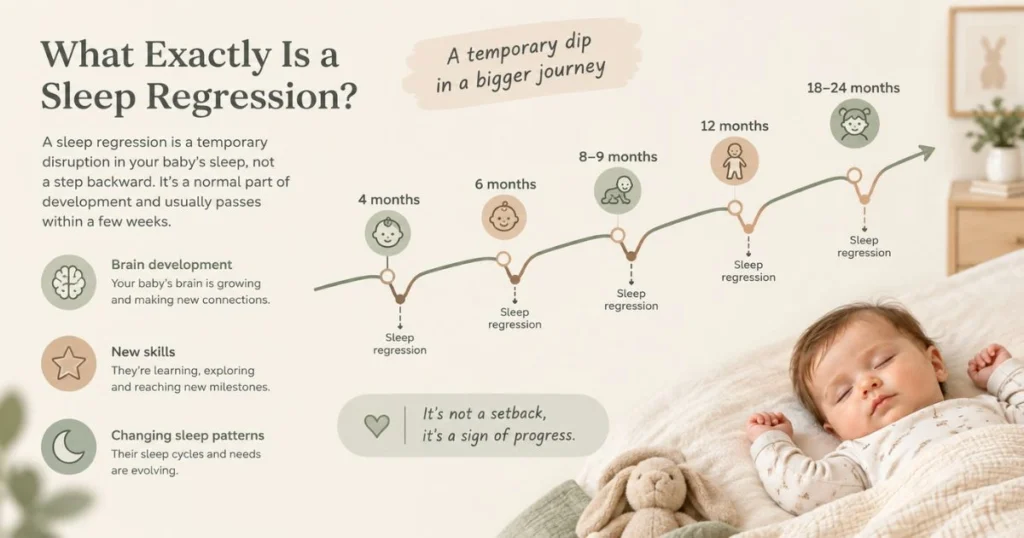
What Exactly Is a Sleep Regression?
A sleep regression is a sudden dip in a baby’s sleep quality after a stretch of things going relatively smoothly. At this age, having a consistent 6 month old sleep schedule can help parents understand and respond to changes in their baby’s sleep patterns. One week your baby may be stringing together five or six hours at night; the next, they’re waking every hour or two, and bedtime has turned into a battle. Instead of the one or so wakeups you’d grown used to, you might now be facing two, three, or more.
Here’s the reassuring part: this isn’t a step backward. Baby sleep, in general, trends toward longer and more consolidated stretches over the first two years, and regressions are simply bumps along that upward climb. They tend to show up around predictable ages — 4 months, 8 to 9 months, 12 months, and again somewhere between 18 and 24 months — each one lining up with a major leap in brain development. The 6-month sleep regression specifically tends to hit as babies become far more tuned in to the world around them. All those new sights, sounds, and sensations are exciting, but they’re also incredibly disruptive to sleep.
6 month old sleep schedule : Why Won’t My Baby Sleep?
If it feels like your baby is the only one struggling, the numbers say otherwise. Research published in Pediatrics found that nearly 38% of 6-month-olds aren’t yet sleeping six consecutive hours at night, and 57% haven’t reached the eight-hour mark. Flip that around, and you’ll see that only about 62% manage six-hour stretches and just 43% make it a full eight hours without waking. In other words, broken sleep is common at this age, which is why understanding your baby’s 6 month old sleep schedule can help you set realistic expectations about nighttime sleep.
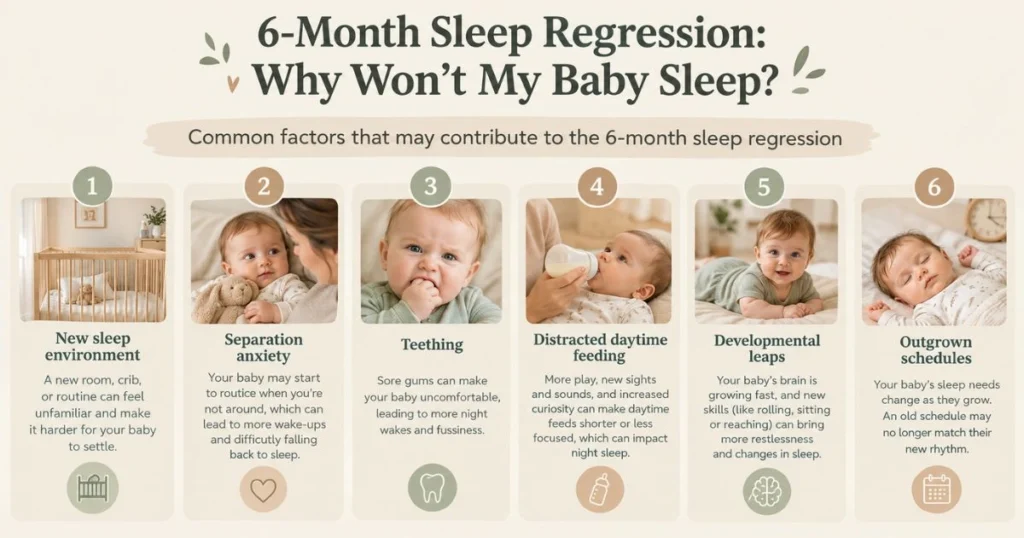
A handful of factors tend to come together around six months and can disrupt your baby’s 6 month old sleep schedule:
- A new sleep environment. Moving from a bassinet to a cot, or from your room to a nursery, without any warm-up period can throw babies off.
- Separation anxiety. This can actually start as early as 4 or 5 months and peaks for many babies right around this stage.
- Teething. Sore gums are a common (and painful) companion to the six-month mark.
- Distracted daytime feeding. A baby who’s too busy people-watching to nurse properly during the day may wake at night to make up the calories.
- Developmental leaps. Practicing new skills like sitting up doesn’t stop just because the lights are off — some babies will literally sit themselves up in their sleep and then get stuck, upset, and awake.
- An outgrown schedule. Wake windows are stretching to 2–4 hours, and many babies are ready to drop that late-afternoon catnap, which can throw the whole day’s rhythm out of sync.
What “Normal” Sleep Looks Like at 6 Months
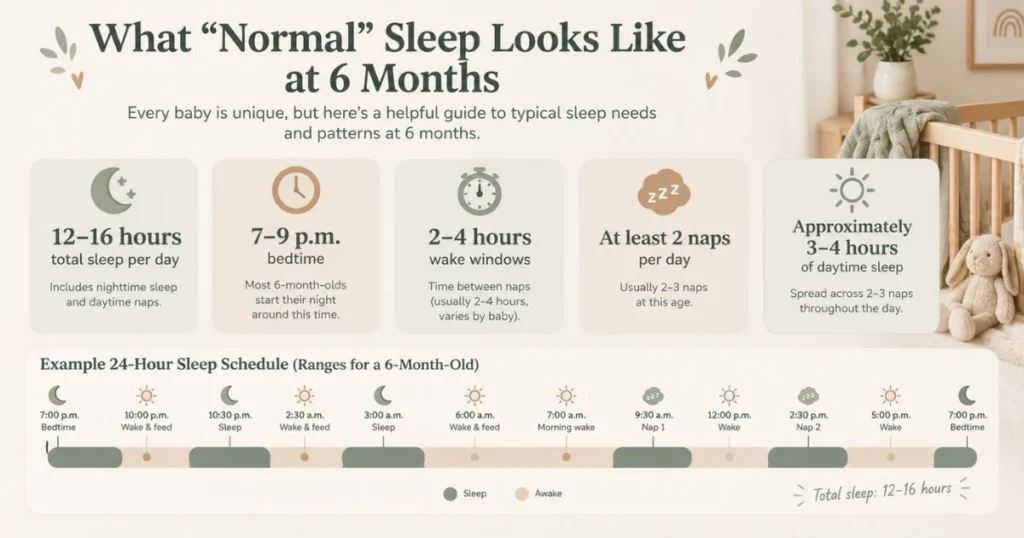
It helps to know what you’re aiming for, especially when you’re trying to establish a healthy 6 month old sleep schedule and unsure what “normal” even looks like anymore. Most 6-month-olds need somewhere between 12 and 16 hours of sleep across a full day.
Bedtime usually lands between 7 and 9 p.m., with wake windows of 2 to 4 hours in between. Babies at this age typically take at least two naps, adding up to 3 to 4 hours of daytime sleep, and most have outgrown the need for overnight feeds.
A sleep-friendly setup matters too: a cot free of blankets, pillows, or stuffed animals, a genuinely dark room, and a white noise machine running throughout the night. And a quick reassurance — not every baby goes through the 6-month sleep regression. Some sail through with sleep that’s actually improving. Both scenarios are completely normal.
Spotting the Signs
Changes in your baby’s sleep can be a clear sign that their 6 month old sleep schedule needs some adjustment: more frequent night wake-ups, difficulty falling asleep, an appetite that shifts up or down, naps that become unpredictable (either much shorter or unusually long), and more crying or fussiness after dark.
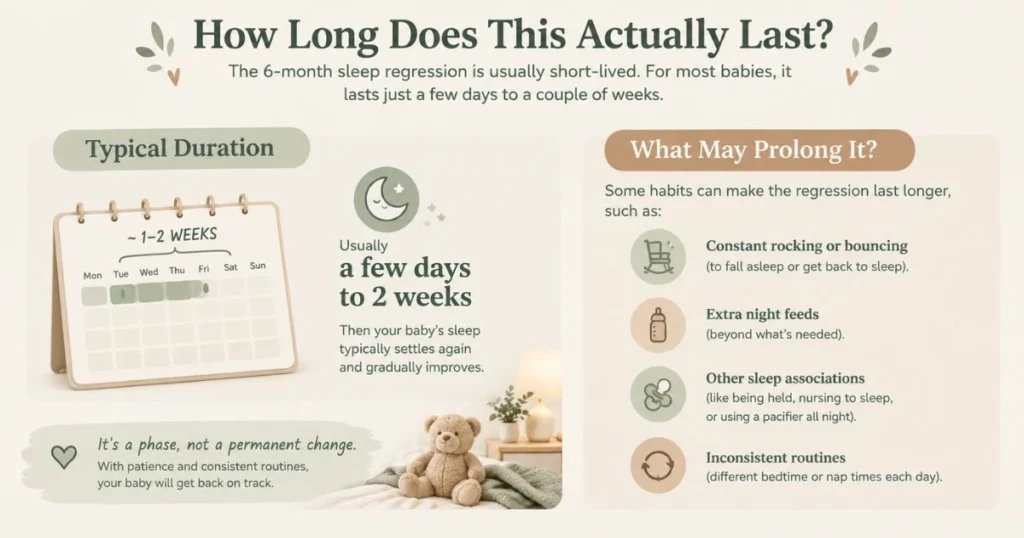
How Long Does This Actually Last?
The good news: most sleep disruptions around 6 months are short — often just a few days. The catch is that if new habits develop during this window, they can interfere with your baby’s 6 month old sleep schedule. Think constant rocking to sleep or extra night feeds that continue out of habit rather than hunger. If these patterns become established, sleep disruptions may sometimes continue for weeks or even months.
Getting Through It as a Parent
This stretch can be genuinely hard on the adults in the house, not just the baby, especially when you’re trying to maintain a consistent 6 month old sleep schedule. A few things that may help:
- Remind yourself this is temporary — it will pass, even when 2 a.m. doesn’t feel like it.
- Resist comparing your baby’s sleep to a friend’s or to what you see on social media. Every baby’s timeline is different.
- Trade off night duty with a partner where possible, lean on your support system, and don’t hesitate to talk to your pediatrician if exhaustion starts affecting your own wellbeing.
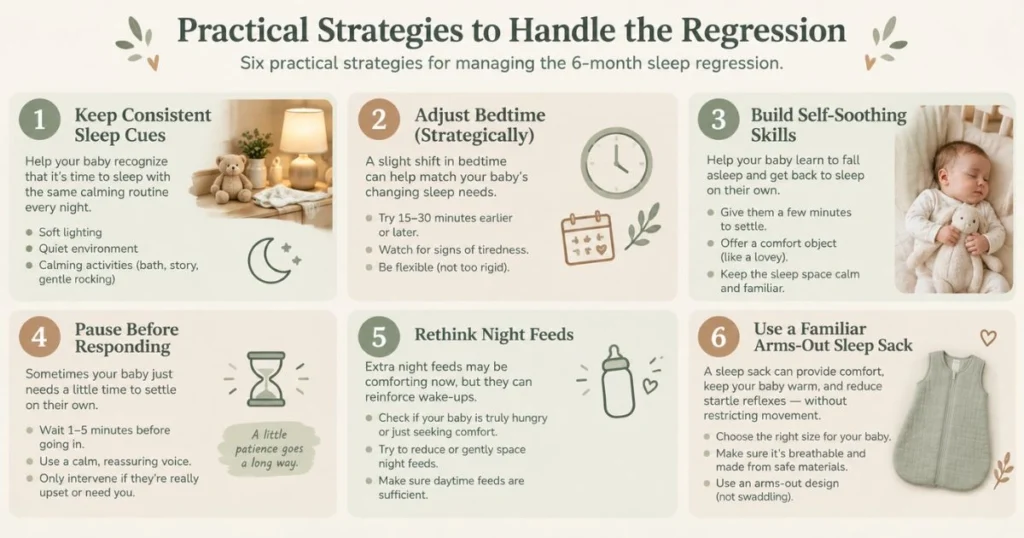
Practical Strategies to Handle the Regression
- Keep sleep cues consistent. Stick to the same wind-down routine and use continuous white noise to mask both distracting sounds and teething discomfort.
- Adjust bedtime strategically. If your baby is fighting sleep or waking early, push bedtime 15 minutes later every few nights. If they seem overtired or extra fussy, move it 15 minutes earlier instead.
- Build self-soothing skills. Try placing your baby in the cot drowsy but still awake, or use Dr. Harvey Karp’s “wake and sleep” trick — gently rousing a baby who’s dozed off in your arms just enough that they settle themselves the rest of the way.
- Pause before rushing in. Give it a minute or two after a cry before responding, so your baby has a chance to resettle on their own. A dim nightlight can help if you do need to check in.
- Rethink night feeds. At this stage, most night wakings are habit rather than hunger, so gradually trimming feed volume or nursing time can help break the cycle.
- Stick with familiar comfort items. Transitioning to an arms-out sleep sack keeps a sense of continuity while still allowing safe movement.
The Bigger Picture
Try to hold onto this: changes in your baby’s sleep don’t mean you’ve done anything wrong as a parent. Your baby’s brain is doing important work, and their 6 month old sleep schedule may shift as they move through this period of rapid development.
To stack the odds in your favor, keep the room between 16°C and 20°C, block out light completely, and turn on a low, steady white noise machine 30 to 60 minutes before bedtime, leaving it running through the night. A pacifier can also ease the transition for some babies. None of this guarantees an instant fix, but creating a consistent environment can support your baby’s 6 month old sleep schedule and help your family gradually get back to more restful nights.