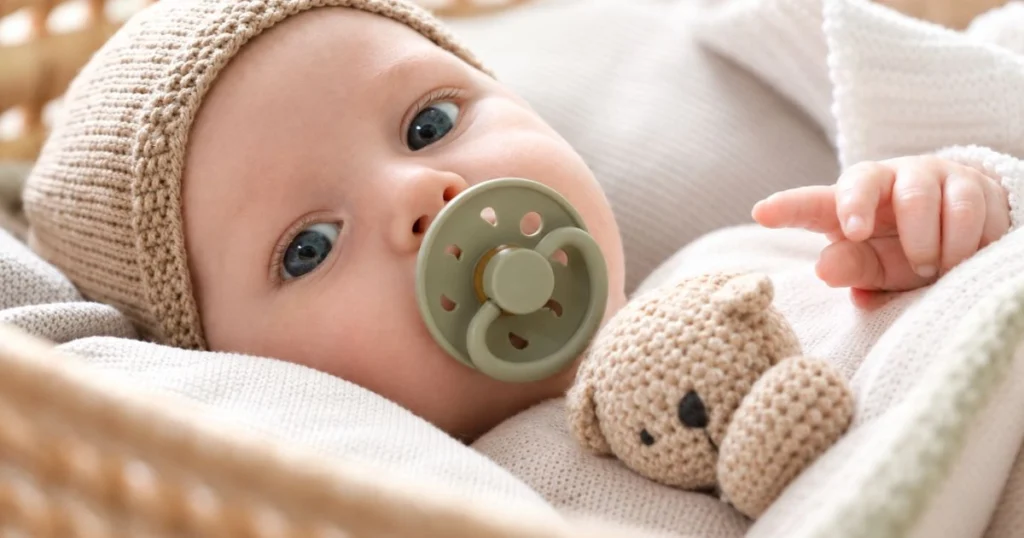
Your newborn has been fed, changed, cuddled, and rocked, yet those little lips are still searching for something to suck.
You reach for a pacifier, hoping it will bring a little comfort. Then another thought appears: Is a newborn pacifier actually safe?
If you’re breastfeeding, you may wonder whether a pacifier could interfere with feeding. If your baby falls asleep with one, you may worry about whether it should stay in the mouth all night. And if the pacifier drops out, you may find yourself wondering whether you need to get up and replace it.
These questions are completely understandable.
A pacifier can be a useful soothing tool during the newborn stage, and the American Academy of Pediatrics (AAP) recommends offering one at naps and bedtime because pacifier use is associated with a lower risk of sudden infant death syndrome (SIDS). At the same time, safe use matters. Your baby’s feeding needs, sleep environment, newborn pacifier design, and age all deserve attention.
The good news is that you don’t need to choose between using a pacifier and being a safety-conscious parent.
You simply need to know when to offer a newborn pacifier, how to choose one, and which habits to avoid.*
“For a broader look at your baby’s sleep patterns during the first year, see our guide to Baby Sleep Schedule by Age.”
Can a Newborn Use a Pacifier?
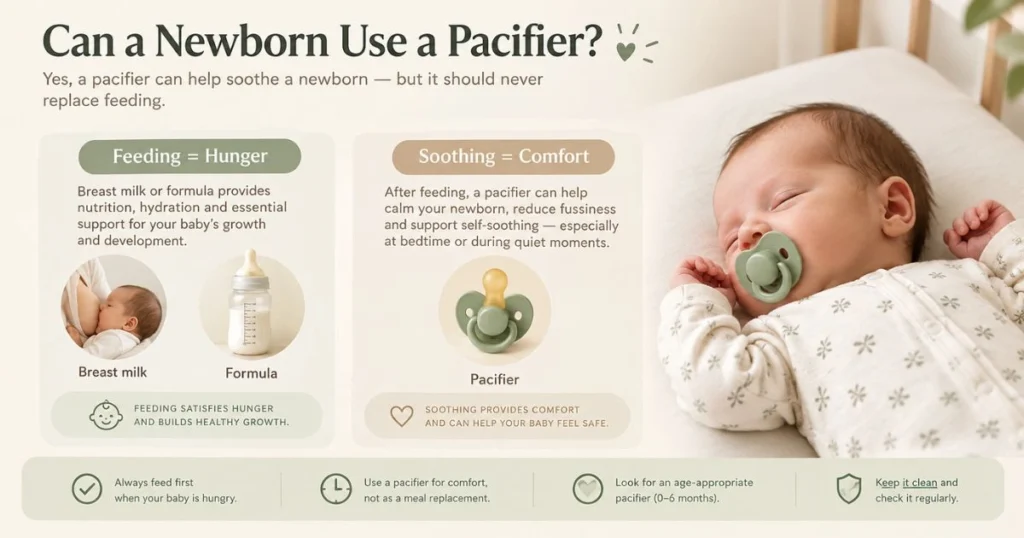
Yes. A healthy newborn can use a pacifier, but the right time to introduce one may depend on how your baby is feeding.
Babies are born with a strong sucking reflex. Sucking is essential for feeding, but it can also have a calming effect. Some babies naturally want to suck even after they’ve finished eating. That’s where a newborn pacifier may become useful.
The important distinction is this:
A pacifier is for soothing. It should not replace feeding.
If your newborn is hungry, offer breast milk or formula rather than trying to settle hunger with a pacifier.
When Can a Newborn Start Using a Pacifier?
If you’re breastfeeding, the AAP recommends waiting until breastfeeding is going well before introducing a pacifier. HealthyChildren.org notThis commonly takes around 3 to 4 weeks, although every baby and breastfeeding experience is different.
Signs that breastfeeding is becoming well established can include:
- Your baby latches effectively.
- Feeding feels comfortable and consistent.
- Your milk supply is well established.
- Your baby is gaining weight appropriately.
- Your baby is transferring milk effectively.
If you’re not breastfeeding, the AAP says you can introduce a newborn pacifier whenever you choose.
If your baby was premature, has feeding difficulties, is not gaining weight well, or has another medical concern, talk with your baby’s healthcare professional about when a pacifier may be appropriate.
“If you are trying to understand how feeding and sleep fit together during the early months, our Newborn Sleep Schedule guide can help.”
Should You Give a Pacifier to a Hungry Newborn?
No. A newborn pacifier shouldn’t be used to routinely postpone a feeding.
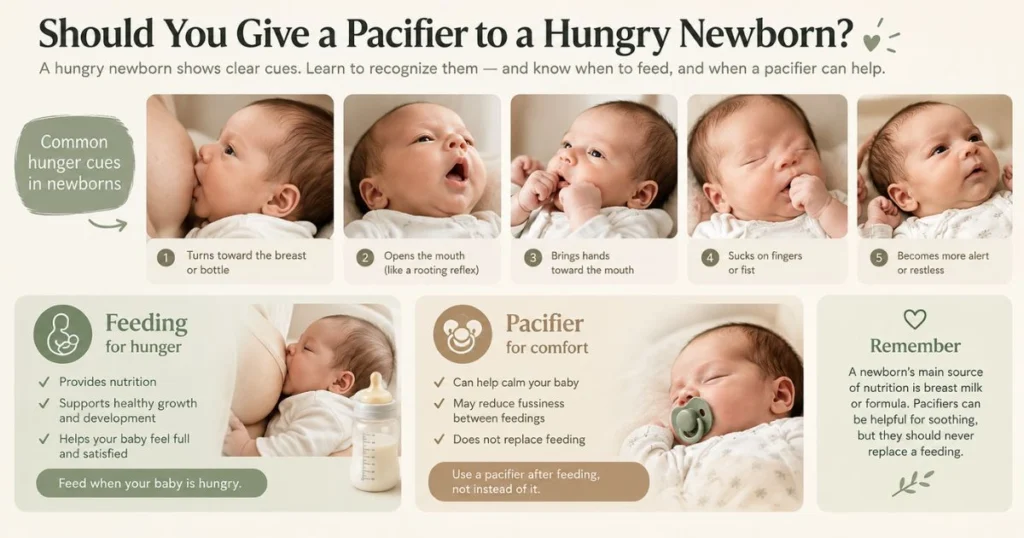
Newborns need frequent nutrition, and crying isn’t the only sign that your baby is hungry. You may notice earlier hunger cues such as:
- Turning toward the breast or bottle
- Opening the mouth
- Bringing hands toward the mouth
- Sucking on fingers
- Becoming increasingly alert or restless
If your baby seems hungry, offer a feeding first rather than using a pacifier to delay it.
The AAP advises parents not to use a pacifier as a way to replace or postpone meals.
“Understanding your baby’s hunger cues is also an important part of establishing a healthy Baby Feeding Schedule by Age.”
What Are the Benefits of a Newborn Pacifier?
A pacifier isn’t essential for every baby. Some newborns take to them easily, while others simply keep pushing them away.
Even so, many parents choose to use a newborn pacifier for several practical reasons.
A Newborn Pacifier Can Provide Comfort
Sucking can have a calming effect for some babies.
After you’ve made sure your baby isn’t hungry, a clean newborn pacifier may help them settle during a cuddle, before a nap, or as part of a bedtime routine.
That doesn’t mean a pacifier will calm every cry. Your baby may simply need:
- A feeding
- A diaper change
- Burping
- Physical contact
- A quieter environment
- Help settling when overtired
Think of a pacifier as one way to soothe your baby, rather than a solution for every bout of fussiness.
Pacifier Use May Help During Sleep
One of the main reasons pacifiers are included in newborn sleep guidance is their connection with SIDS.
The AAP recommends offering a newborn pacifier at naps and bedtime because pacifier use has been linked to a lower risk of SIDS. If it falls out after your baby falls asleep, there’s no need to put it back.
However, using a pacifier does not make every sleep situation safe.
Your baby still needs a safe sleep environment.
A Pacifier Is Not a Substitute for Safe Sleep
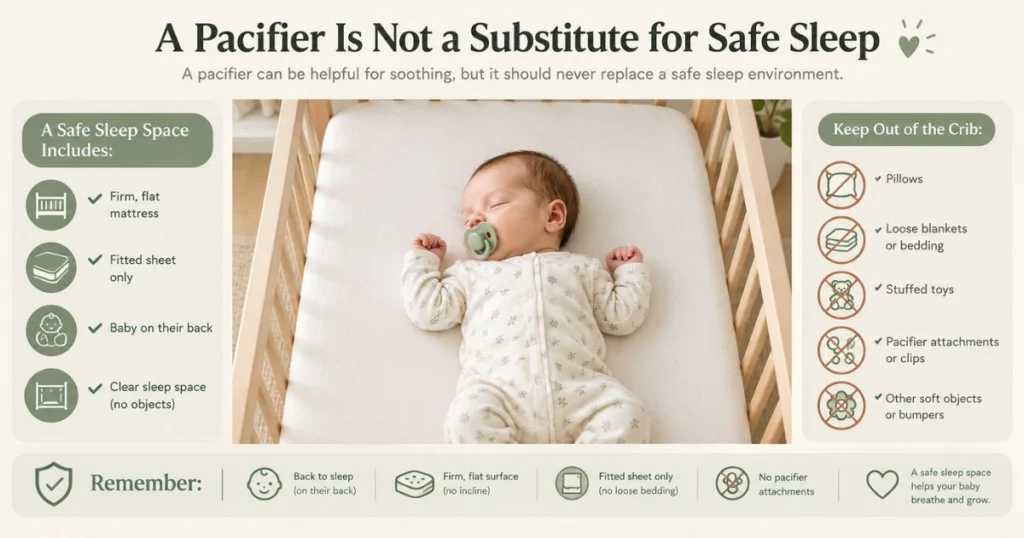
A newborn pacifier should be used together with safe-sleep practices, never as a replacement for them.
For every sleep:
- Place your baby on their back.
- Use a firm, flat sleep surface.
- Keep loose bedding and soft objects out of the sleep area.
- Remove anything that could increase the risk of suffocation or entrapment.
- Never attach a pacifier to your baby’s neck or clothing during sleep.
The AAP notes that no method can completely prevent SIDS, which is why it is important to follow multiple safe-sleep practices together.
“For more guidance on creating a safe and predictable sleep routine, see our Baby Bedtime Routine guide.”
Newborn Pacifier Safety: Choosing the Right One
Once you’ve decided that you’d like to offer a pacifier, your next question may be: Which type should you buy?
You don’t need the most expensive pacifier or the one with the longest list of marketing claims. Start with basic safety and age appropriateness.
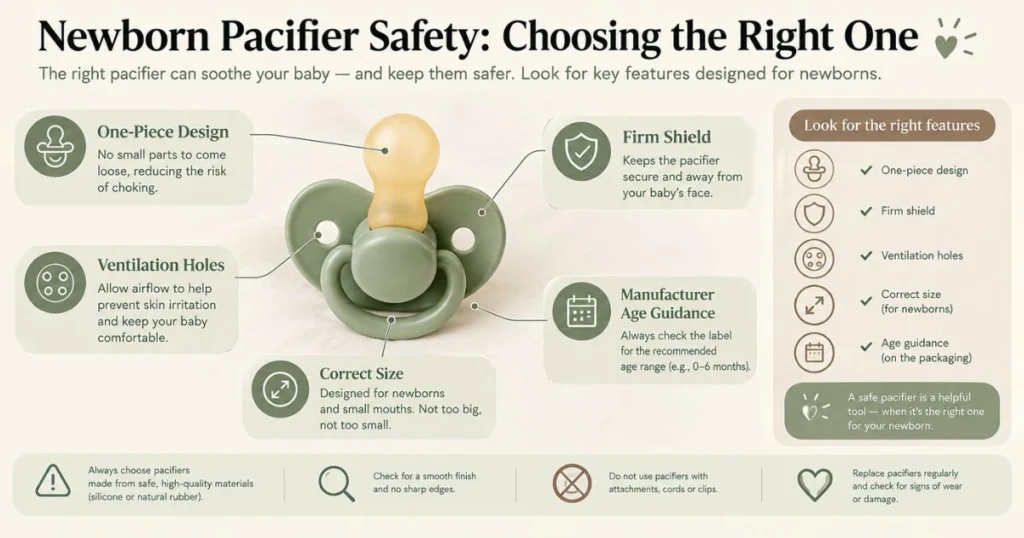
Look for a One-Piece Pacifier
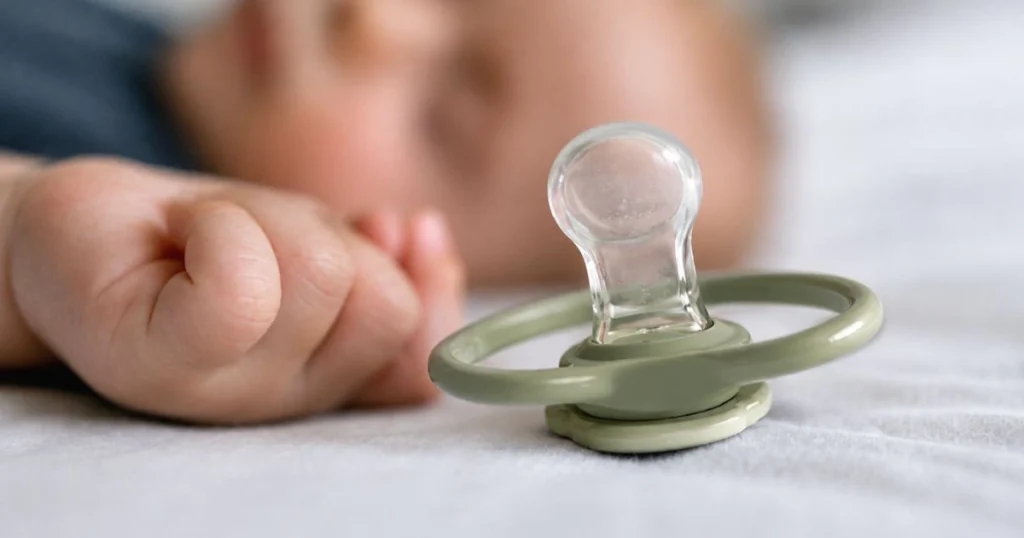
The American Academy of Pediatric Dentistry (AAPD) recommends single-piece pacifiers because they are less likely to break apart and create a choking hazard.
When shopping, look for a product specifically designed for your baby’s age.
Check the Pacifier Shield
The shield should be firm and include ventilation holes.
AAPD guidance recommends a shield measuring at least 1.5 inches (3.8 cm) across to help prevent the entire pacifier from entering your baby’s mouth.
Choose a newborn pacifier that is designed for safe use rather than modifying one yourself.
Follow the Manufacturer’s Age Guidance
Pacifiers come in a variety of sizes and shapes, so check the following before choosing a newborn pacifier:
- Recommended age range
- Cleaning instructions
- Replacement guidance
- Material information
- Product-specific warnings
A pacifier designed for a newborn may not remain suitable as your child gets older.
Never Make a Homemade Pacifier
Don’t improvise by using a bottle nipple and ring as a pacifier.
The AAP warns that a makeshift pacifier can separate and create a choking hazard.
A homemade solution may seem convenient for a moment, but it isn’t worth creating an avoidable safety risk.
How to Use a Newborn Pacifier Safely
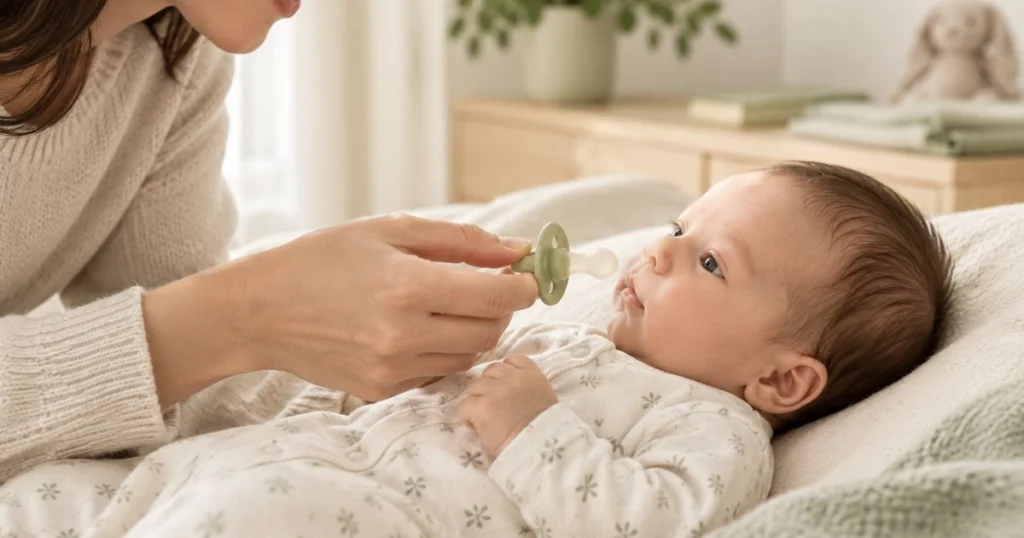
Choosing an appropriate pacifier is only the first step. How you use it matters just as much.
1. Check the Pacifier Before Every Use
Before giving your baby a newborn pacifier, inspect it carefully for any signs of damage or wear.
Look for:
- Cracks
- Tears
- Loose pieces
- Changes in shape
- Unusual stickiness
- Signs of deterioration
- Damage from chewing
If you notice any damage, replace the pacifier rather than trying to repair it with glue, tape, thread, or another material.
Regularly checking the pacifier can help you spot wear before it becomes a safety concern.
2. Keep the Pacifier Clean
Follow the manufacturer’s instructions for cleaning the newborn pacifier carefully.
Keeping feeding and soothing items clean is especially important during the newborn stage. Simply wiping a pacifier on your clothes does not make it clean.
Also, avoid putting the pacifier in your own mouth before giving it back to your baby. This can transfer bacteria from your mouth to your baby’s mouth, including bacteria linked to tooth decay.
3. Never Put Honey on a Newborn Pacifier
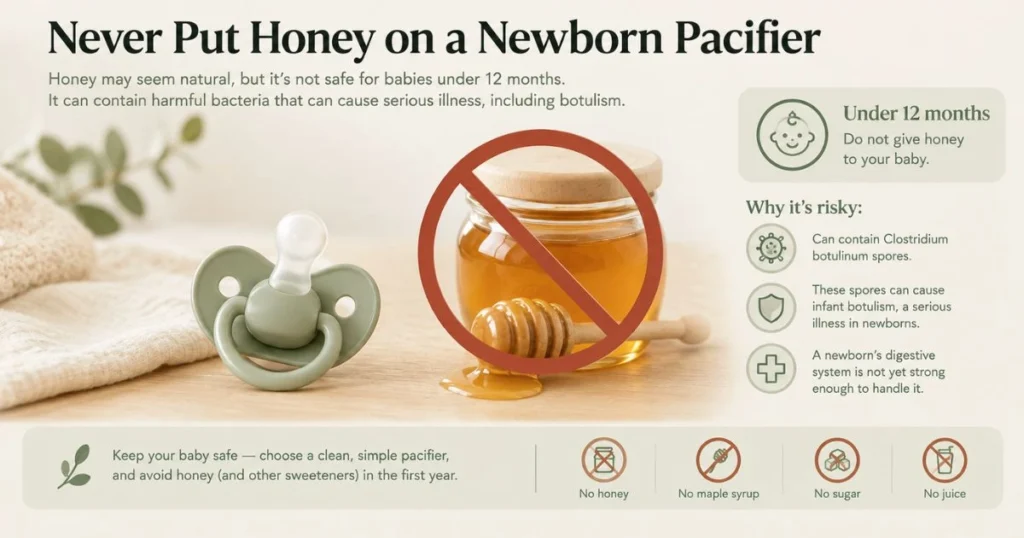
This deserves a very clear answer:
Never put honey on a pacifier for a baby under 12 months.
Honey should never be given to babies under 12 months because it can contain bacteria that cause infant botulism. (cdc.gov)
Its current guidance specifically says not to add honey to a baby’s pacifier.
That means no:
- Honey
- Honey-water
- Honey-based mixtures
- Sweet syrups
Your newborn does not need a sweet coating to accept a pacifier.
4. Don’t Dip the Pacifier in Sugary Foods or Drinks
You may occasionally hear advice about dipping a pacifier in something sweet to encourage a baby to take it.
Don’t.
Infants should not be given added sugars, and sweet substances can also create unnecessary dental concerns as teeth develop.
If your baby doesn’t want the pacifier, let your baby refuse it.
Can a Newborn Sleep With a Pacifier?
Yes. According to the AAP, you can offer a pacifier at nap time and bedtime.
In fact, pacifier use during sleep is part of the AAP’s recommendations for reducing SIDS risk.
There are, however, a few details that matter.
“If you are working on a consistent bedtime pattern, you may also find our guide to Baby Sleep Schedule by Age helpful.”
Can a Newborn Sleep With a Pacifier at Night?
You can offer the pacifier when placing your baby down for nighttime sleep.
If your baby is breastfeeding, wait until breastfeeding is established before introducing it.
If your baby is formula-fed, the AAP says you can introduce a pacifier whenever you choose.
What If the Pacifier Falls Out While Your Newborn Sleeps?
You don’t need to replace it.
This can be a relief during those exhausting newborn nights.
Once your baby is asleep and the pacifier falls out, leave it out. The AAP specifically says you do not need to put it back.
You may still find that your baby wakes later because they have learned to associate falling asleep with sucking. That’s different from a safety requirement.
Never Attach a Pacifier During Sleep
Do not attach a pacifier to:
- Your baby’s neck
- A necklace
- Clothing
- A blanket
- A stuffed animal
- The crib
- A long cord or string
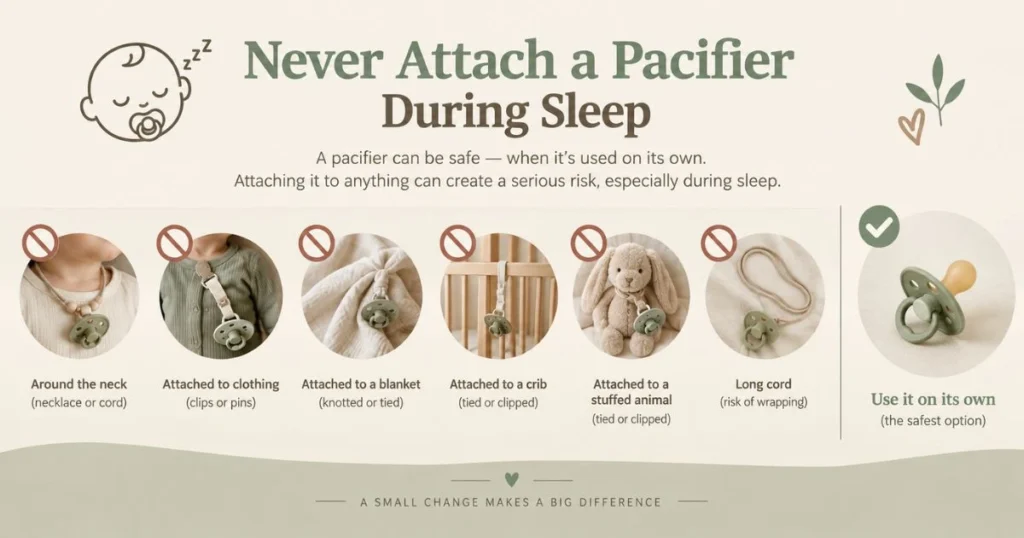
The AAP warns against attaching pacifiers to clothing or around a baby’s neck during sleep because of choking, suffocation, and strangulation risks.
A pacifier should remain separate from other objects in the sleep space.
Newborn Pacifier Safety and the Sleep Environment
It’s easy to focus so much on the pacifier that you forget the bigger picture.
Safe sleep involves the entire environment.
Place Your Baby on Their Back
Always place your baby on their back for sleep.
Don’t put your newborn on their stomach because you think the position will help them sleep longer.
Use a Firm, Flat Sleep Surface
Your baby should sleep on a firm, flat surface designed for infant sleep.
Avoid:
- Sofas
- Armchairs
- Adult beds
- Inclined sleep products
- Soft surfaces
- Padded nests or loungers not intended for sleep
Keep the Sleep Space Clear
Your baby’s sleep area should not contain loose blankets, pillows, stuffed toys, or other soft objects.
A pacifier does not make a cluttered sleep space safe.
The AAP’s safe-sleep recommendations emphasize a clear sleep environment alongside offering a pacifier.
“A consistent sleep environment works best alongside a flexible Newborn Sleep Schedule during the first few months.”
How to Introduce a Pacifier to Your Newborn
You don’t need to turn pacifier introduction into a battle.
Your baby may accept it immediately—or reject it repeatedly.
Try these steps.
1. Choose a Calm Moment
Don’t wait until your baby is extremely hungry and crying hard.
Instead, offer the pacifier after feeding when your baby is calm and seems interested in sucking for comfort.
2. Touch It Gently to Your Baby’s Lips
Let your baby open their mouth and accept the pacifier.
You don’t need to push it in.
3. Make Sure Your Baby Has Been Fed
If your baby is hungry, respond to the hunger.
A pacifier should not become a way of stretching the time between feeds.
4. Let Your Baby Decide
Some babies simply don’t like pacifiers.
Your baby may:
- Spit it out immediately.
- Push it away with the tongue.
- Accept it only when sleepy.
- Prefer a finger or hand.
- Take several attempts before accepting it.
The AAP says it’s fine if your baby doesn’t want a pacifier. You can try again later, but there is no need to force one.
“If your baby is still struggling to settle at night, a simple Baby Bedtime Routine can provide familiar cues before sleep.”
Breastfeeding and Newborn Pacifier Use
If you’re breastfeeding, pacifier timing can feel particularly confusing.
You may have heard that pacifiers cause “nipple confusion,” while someone else tells you that you can use one immediately.
The reality is more nuanced.
Can a Pacifier Interfere With Breastfeeding?
The AAP recommends waiting until breastfeeding is well established before introducing a newborn pacifier. This gives you time to make sure your baby is feeding well and gaining weight appropriately before using a pacifier for soothing.
At the same time, research cited by the AAPD suggests that, among healthy full-term infants, introducing a pacifier does not necessarily shorten the duration of breastfeeding or reduce breastfeeding rates.
Rather than assuming a pacifier will interfere with breastfeeding, look at the bigger picture.
Ask yourself:
- Is your baby latching well?
- Is feeding comfortable?
- Is your baby gaining weight appropriately?
- Does your baby seem satisfied after feeds?
- Are you able to recognize and respond to hunger cues?
If breastfeeding has been difficult, consider getting support before using a pacifier to manage frequent feeding or fussiness.
When Should You Ask for Breastfeeding Support?
Reach out to your pediatrician or a qualified lactation professional if you’re concerned about:
- Persistent latch problems
- Significant nipple pain
- Poor milk transfer
- Poor weight gain
- Very long or exhausting feeds
- Your baby consistently falling asleep before feeding effectively
You don’t need to figure this out alone.
“Because feeding needs change quickly during the first year, our Baby Feeding Schedule by Age guide explains how feeding patterns evolve month by month.”
Bottle-Feeding and Newborn Pacifiers
If you’re formula-feeding or combining breast milk and formula, a pacifier can still be part of your baby’s soothing routine.
The same basic rule applies:
Feed your baby when your baby is hungry. Use the pacifier to soothe your baby rather than replacing or delaying a feeding.
Once you’ve finished an appropriate feed and your baby still wants to suck, a pacifier may help provide that additional non-nutritive sucking.
If you’re concerned that your baby wants to eat constantly, seems unusually difficult to satisfy, or isn’t gaining weight as expected, talk with your pediatrician rather than trying to manage the situation by offering a pacifier more often.
Newborn Pacifier Safety Mistakes to Avoid
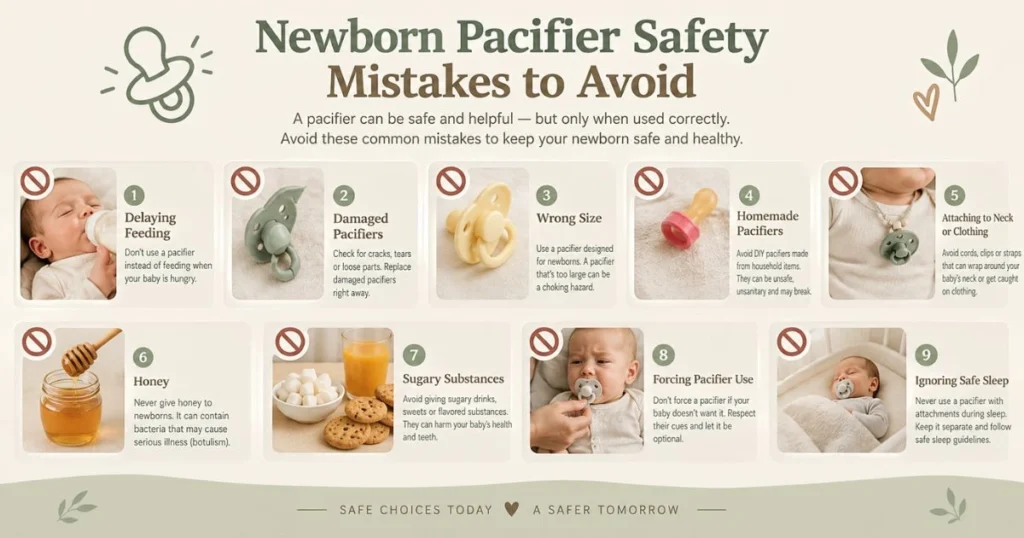
Most pacifier-related issues can often be avoided by knowing the important safety precautions.
Here are the habits worth avoiding.
- Using a pacifier to delay a feeding
- Giving your baby a damaged pacifier
- Choosing an inappropriate size
- Using a homemade pacifier
- Attaching a pacifier to your baby’s neck
- Attaching it to clothing during sleep
- Putting honey on the pacifier
- Dipping it in sugary substances
- Forcing your baby to accept it
- Assuming the pacifier replaces safe-sleep practices
The AAP, CDC, and AAPD all provide guidance that supports these precautions.
How Often Should You Replace a Newborn Pacifier?
There isn’t one universal replacement schedule that applies to every pacifier.
Instead, follow the manufacturer’s instructions and inspect the pacifier regularly.
Replace It Immediately If You Notice:
- A tear
- A crack
- A loose component
- A change in shape
- Material deterioration
- Any sign that the nipple or shield is separating
Don’t wait for the pacifier to break completely.
AAPD recommends regular inspection of pacifiers for structural wear that could create a safety concern.
What If Your Newborn Refuses a Pacifier?
You don’t need to convince your baby.
Some newborns simply don’t enjoy pacifiers, and that’s okay.
You can try again:
- After a feed
- During a calm cuddle
- Before a nap
- During your bedtime routine
But if your baby repeatedly turns away, spits it out, or becomes upset, stop trying.
A newborn doesn’t need a pacifier in order to sleep safely.
In fact, the AAP specifically says that some babies simply don’t like pacifiers.
“If your baby refuses a pacifier, you can still build calming sleep habits with a simple Baby Bedtime Routine.”
Newborn Pacifier vs. Thumb Sucking
Both pacifiers and thumb sucking can satisfy a baby’s natural desire to suck.
The biggest practical difference is control.
| Newborn Pacifier | Thumb or Finger Sucking |
| You can decide when to offer it | Your baby has constant access |
| It can be removed later | The finger is always available |
| It can be misplaced | The thumb can’t be lost |
| You can gradually limit use | Limiting access can be harder |
| It can be discontinued intentionally | The habit may continue without your involvement |
Neither option needs to become a source of guilt.
The bigger concern is prolonged nonnutritive sucking as your child grows.
Why Does Prolonged Pacifier Use Matter?
According to the AAPD, pacifier use after 12 months can increase the risk of acute otitis media, while use beyond 18 months can influence the developing orofacial structures and contribute to problems such as anterior open bite and posterior crossbite.
That doesn’t mean you need to worry about dental effects during your newborn’s first weeks.
It simply means you may want to reconsider pacifier use as your child grows older.
When Should You Stop Using a Pacifier?
You don’t need to start weaning a newborn from a pacifier immediately.
During the first months, the focus is on feeding, safe sleep, comfort, and healthy development.
As your baby grows, you can gradually reduce dependence.
One practical approach is to:
- Allow the pacifier mainly during sleep.
- Reduce daytime use first.
- Introduce other calming routines.
- Give your child plenty of physical reassurance.
- Make the transition gradual rather than turning it into a daily struggle.
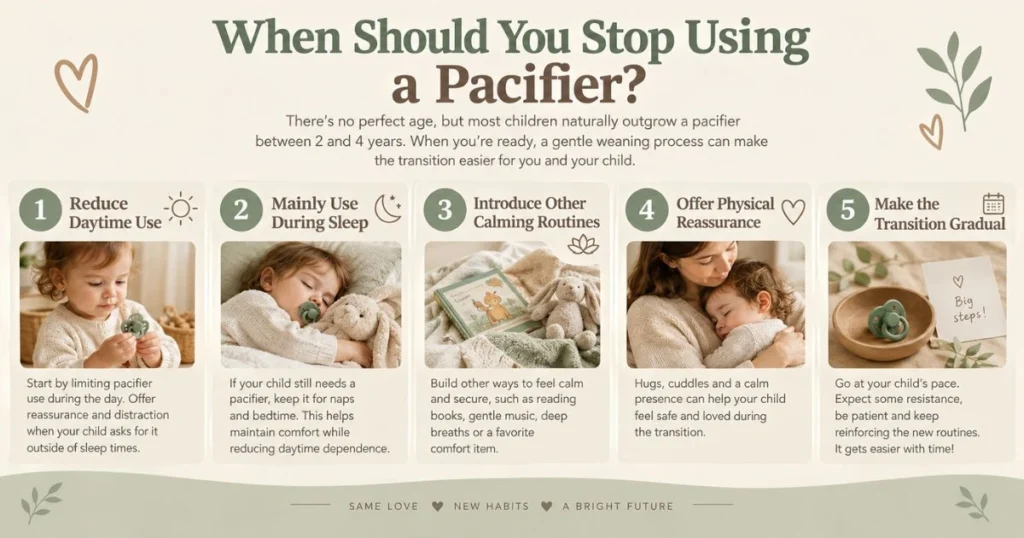
The AAPD encourages discontinuing nonnutritive sucking habits by around 36 months and highlights increasing concerns with prolonged use after infancy.
Your child’s pediatrician and dentist can help you decide what makes sense as your child gets older.
“As your baby grows and sleep patterns change, our Baby Sleep Schedule by Age guide can help you understand changing naps and nighttime sleep.”
When Should You Talk to Your Baby’s Healthcare Professional?
Most questions about pacifiers can be handled during routine pediatric care, but some situations deserve individualized guidance.
Talk with your baby’s healthcare professional if you have concerns about:
- Poor feeding
- Poor weight gain
- Difficulty latching
- Persistent feeding problems
- Your premature baby’s sucking or feeding ability
- A medically complex newborn
- Whether pacifier use is appropriate for your baby’s situation
- Any unusual reaction to the pacifier
If you’re unsure whether your baby’s fussiness is hunger, discomfort, or a desire to suck, don’t feel pressured to solve the mystery by yourself.
Your baby’s healthcare professional can look at the whole picture.
Newborn Pacifier Safety Checklist
Before offering a pacifier, run through this quick checklist.
Before You Give Your Baby the Pacifier
- Choose an age-appropriate product.
- Look for a one-piece design.
- Check the shield and ventilation holes.
- Inspect the pacifier for damage.
- Follow the manufacturer’s cleaning instructions.
- Make sure your baby isn’t showing hunger cues.
During Sleep
- Place your baby on their back.
- Use a firm, flat sleep surface.
- Keep the sleep space clear.
- You may offer the pacifier at naps and bedtime.
- Never attach it to clothing, bedding, or the baby’s neck.
- If it falls out after your baby falls asleep, you don’t need to replace it.
Never Do These Things
- Don’t put honey on a newborn pacifier.
- Don’t coat it with sugar.
- Don’t use a damaged pacifier.
- Don’t make a homemade pacifier.
- Don’t use the pacifier to routinely delay feeding.
- Don’t force your baby to take it.
These simple habits cover many of the most important newborn pacifier safety concerns.
Frequently Asked Questions About Newborn Pacifiers
Is a newborn pacifier safe?
A newborn pacifier can be used safely when you choose an age-appropriate product, inspect it regularly, keep it clean, and use it according to safe-sleep guidance. It should never replace feeding or be attached to your baby’s neck or clothing during sleep.
When can a newborn use a pacifier?
If you’re breastfeeding, the AAP recommends waiting until breastfeeding is established, which commonly takes about 3 to 4 weeks. If you’re not breastfeeding, you can introduce a pacifier whenever you choose.
Can a newborn sleep with a pacifier?
Yes. The AAP recommends offering a pacifier at nap time and bedtime because pacifier use is associated with a lower risk of SIDS. If the pacifier falls out after your baby falls asleep, you don’t need to put it back.
Does a newborn pacifier reduce the risk of SIDS?
Pacifier use during naps and nighttime sleep is associated with a reduced risk of SIDS, which is why the AAP recommends offering one at sleep times. However, a pacifier is only one part of a safe-sleep strategy and does not eliminate SIDS risk.
Can a newborn use a pacifier while breastfeeding?
Yes, but the AAP recommends waiting until breastfeeding is going well before introducing one. This allows you to establish effective feeding and make sure your baby is gaining weight appropriately.
How do you introduce a newborn pacifier?
Offer it after you’ve addressed your baby’s feeding needs, preferably when your baby is calm. Touch the pacifier gently to your baby’s lips and allow your baby to accept it. Don’t force it if your baby refuses.
What if my newborn spits out the pacifier?
That’s normal. Some babies simply don’t like pacifiers. You can try again later, but you don’t need to force your baby to use one.
Should you replace a newborn pacifier when it falls out during sleep?
No. If your baby falls asleep and the pacifier later falls out, the AAP says you don’t need to replace it.
Can you put honey on a newborn pacifier?
No. Babies younger than 12 months should not have honey because of the risk of infant botulism. The CDC specifically says not to add honey to a baby’s pacifier.
What is the safest type of newborn pacifier?
Look for an age-appropriate, single-piece pacifier with a firm shield and ventilation holes. AAPD guidance says the shield should be at least 1.5 inches across to help prevent the pacifier from entering the mouth completely. Always follow the manufacturer’s instructions as well.
Conclusion: Using a Newborn Pacifier With Confidence
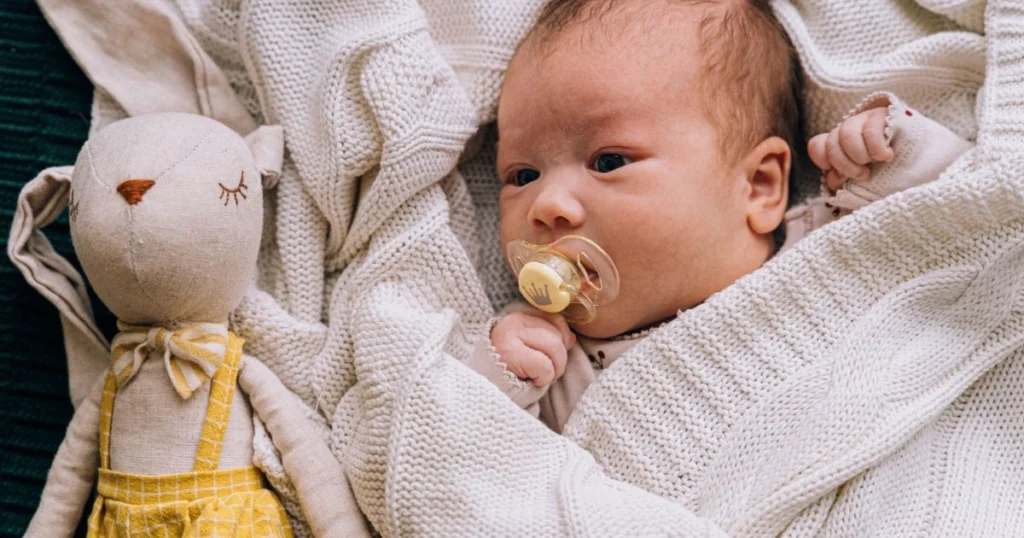
A newborn pacifier doesn’t need to become another source of anxiety during an already demanding stage of parenting.
When used appropriately, it can be a simple way to meet your baby’s need to suck and may be especially helpful around naps and bedtime. The AAP recommends offering a pacifier during sleep because its use has been associated with a lower risk of SIDS.
At the same time, a few important boundaries are worth keeping in mind.
Feed your baby when they’re hungry. If you’re breastfeeding, allow time for feeding to become well established before introducing a pacifier. Choose a safe, age-appropriate product and check it regularly for damage. Never coat it with honey or sugary substances, and never attach it to your baby’s neck, clothing, or sleep space.
Most importantly, remember that your baby doesn’t have to use a pacifier.
If your newborn refuses one, you haven’t missed an important parenting milestone. There are plenty of other ways to soothe your baby, and you can always try again later.
Parenting a newborn involves countless small decisions. You don’t have to make every choice perfectly. What matters most is having reliable information, following safe practices, and staying flexible enough to learn what works best for your baby.
“For more practical guidance on newborn sleep, feeding, and routines, explore our Newborn Sleep Schedule and Baby Feeding Schedule by Age guides.”
Parenting Whisper Reminder
Where parents feel supported, not judged.
Whether your newborn loves a pacifier, refuses it, or uses one only occasionally, you’re still learning your baby’s unique way of communicating. Focus on feeding, safety, comfort, and connection—and give yourself permission to learn as you go.
If this guide helped you feel more confident about newborn pacifier safety, save it for those late-night questions and share it with another new parent who may be wondering the same thing.