There are days when your toddler seems more interested in the kitchen cupboard than the toys you carefully chose for them. They want to splash in water, empty a container, squeeze something soft, touch every texture they can find, or turn a spoon and bowl into their own little science experiment.
That curiosity is worth encouraging.
You don’t need an expensive activity table or a playroom filled with specialized toys to create meaningful Sensory Activities for Toddlers. A bowl of water, a sponge, some homemade dough, or a few safe household objects can give your toddler plenty to explore.
Sensory play allows your child to experience different textures, temperatures, sounds, movements, colors, and other sensations while they play. It can also give you natural opportunities to talk, describe what your toddler is doing, and let them take the lead.
The best part? Many of these Sensory Activities for Toddlers take only a few minutes to prepare.
Whether you need an indoor activity for a rainy afternoon, a low-mess idea while you make dinner, or a playful way to get your toddler moving outdoors, you’ll find plenty of options here.
“Sensory play can also be combined with other indoor activities for toddlers when you want simple ways to keep your child engaged at home.”
What Are Sensory Activities for Toddlers?
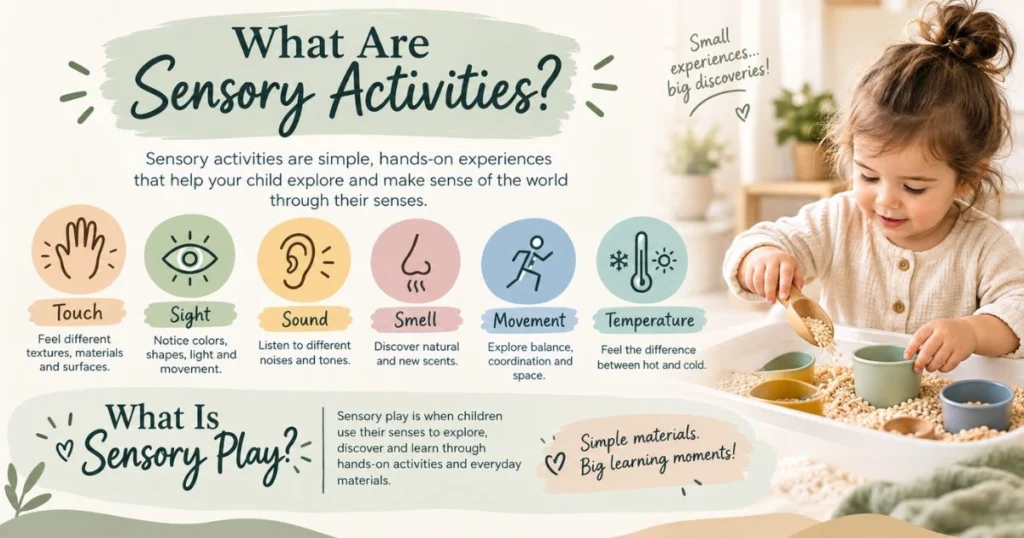
Sensory Activities for Toddlers are play experiences that encourage your child to explore the world through their senses.
Your toddler may:
- Touch different textures.
- Pour and splash water.
- Listen to different sounds.
- Explore colors.
- Notice temperature.
- Smell familiar foods or natural materials.
- Move their body through different spaces.
- Squeeze, pinch, scoop, stir, or transfer objects.
Sensory Activities for Toddlers don’t have to be complicated. In fact, some of the simplest ideas can keep a curious toddler engaged for surprisingly long stretches.
During the second year of life, toddlers become increasingly mobile and curious. They explore objects, imitate adults, try new things, and become more independent. Providing safe opportunities for sensory play allows them to investigate their surroundings in a way that naturally fits this stage of development.
What Does Sensory Play Mean?
Think of sensory pThink of Sensory Activities for Toddlers as an invitation to investigate.
Instead of simply looking at a toy, your toddler might squeeze it, shake it, move it, smell it, stack it, or place it inside another object.
For example, a cup of water can turn into several different sensory experiences:
- Pour water into another cup.
- Stir it with a spoon.
- Squeeze a sponge into it.
- Drop a safe object into it.
- Watch water drip from a container.
One simple material can therefore create several different Sensory Activities for Toddlers, giving your child new ways to explore, experiment, and play.
Sensory Play Isn’t the Same as Therapy
Sensory Activities for Toddlers Are Not Therapy
It’s important to keep your expectations realistic. Sensory Activities for Toddlers are a form of play and exploration, but they should not be viewed as a treatment for sensory processing difficulties, developmental delays, autism, or other conditions.
If you have concerns about your toddler’s development, speak with their healthcare professional rather than relying on sensory play alone. The CDC recommends monitoring developmental milestones and talking with your child’s doctor if you notice concerns about their progress.
Benefits of Sensory Activities for Toddlers
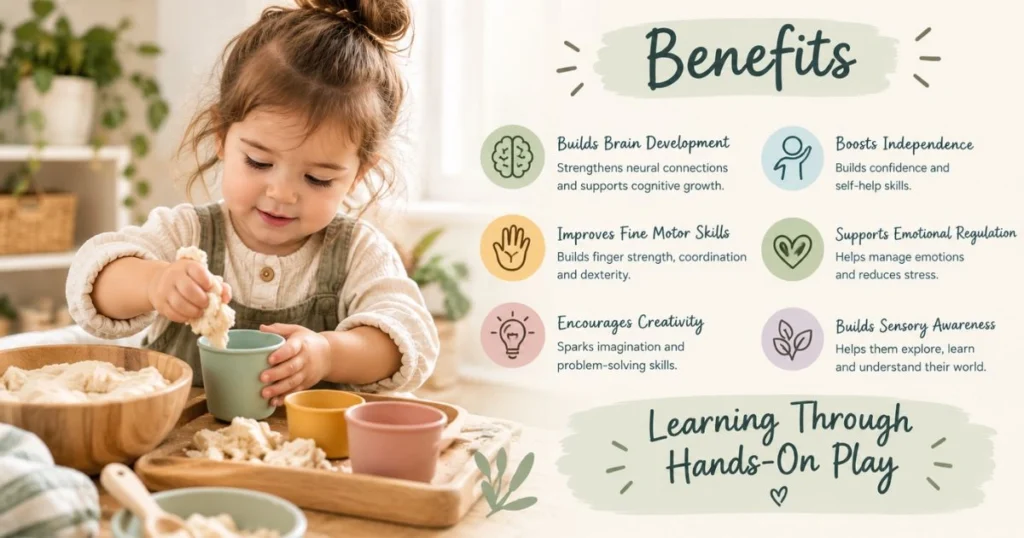
You don’t need to turn every play session into a lesson. Your toddler can simply enjoy exploring and discovering things at their own pace.
Still, Sensory Activities for Toddlers can provide natural opportunities to practice important developing skills through hands-on play.
Fine Motor Practice
Activities such as squeezing, scooping, pinching, pouring, and transferring objects encourage your toddler to use small, controlled hand movements. These Sensory Activities for Toddlers can support hands-on practice while keeping play simple and engaging.
Try:
- Sponge squeezing.
- Homemade dough.
- Scooping water.
- Moving large objects between containers.
- Finger painting.
Hand-Eye Coordination
When your toddler tries to pour water into a cup or place an object inside a container, they are coordinating what they see with how they move their hands.
Language Development
Sensory Activities for Toddlers give you plenty of natural opportunities to introduce descriptive words as your child explores.
You can say:
- “The ice feels cold.”
- “The sponge is wet.”
- “This feels soft.”
- “That one feels rough.”
- “The water is dripping.”
- “That sound is loud.”
As you play together, talk about what your toddler sees, touches, and hears. Naming objects and describing what your child is doing can help build vocabulary through everyday interactions.
Early Problem-Solving
Your toddler can discover simple cause-and-effect relationships through Sensory Activities for Toddlers.
What happens when:
- You pour water into a full cup?
- You squeeze a wet sponge?
- You press and shape dough?
- You shake a container?
- You place a large object into a smaller container?
You don’t need to explain every result. Give your child time to experiment, observe what happens, and discover the answers through play.
Focus and Attention
Playful interaction through Sensory Activities for Toddlers can give your child opportunities to practice attention, working memory, and simple self-control. Harvard’s Center on the Developing Child also encourages you to follow your toddler’s lead and let them decide when they are ready to move on to something else.
35 Sensory Activities for Toddlers
Before you begin, remember that every toddler responds differently to sensory experiences. Sensory Activities for Toddlers should be flexible enough to match your child’s individual preferences.
One child may happily plunge both hands into a bowl of foam, while another may quickly pull their hands away.
That’s completely okay.
Your goal isn’t to make your toddler enjoy every activity. Instead, offer safe opportunities to explore, observe their reactions, and follow the sensations that naturally capture their interest.
1. Water Pouring Station
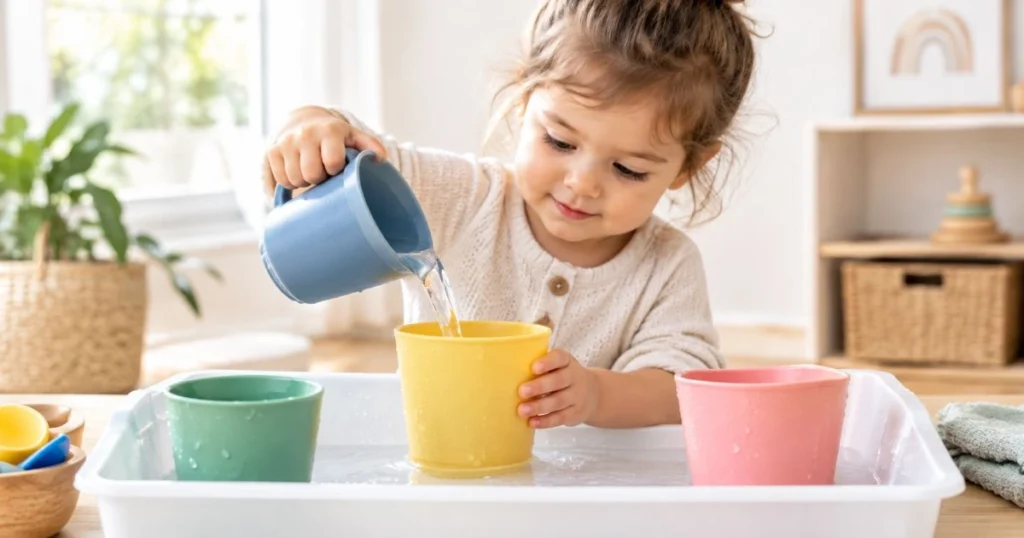
A water pouring station is one of the easiest sensory activities at home.
What You’ll Need
- Small plastic cups
- A shallow bowl
- Spoon
- Small pitcher
- Towel
How to Play
Place a small amount of water in a bowl and give your toddler several containers.
Let them:
- Pour.
- Scoop.
- Stir.
- Transfer.
- Splash.
Talk about what they’re doing without taking over.
“Your cup is full.”
“Now you’re pouring it into the bowl.”
Sensory focus: Wetness, temperature, movement, and sound.
Safety: Keep the amount of water shallow and supervise continuously.
Pouring, scooping, and transferring also give toddlers simple opportunities to practice fine motor skills.
2. Edible Finger Paint
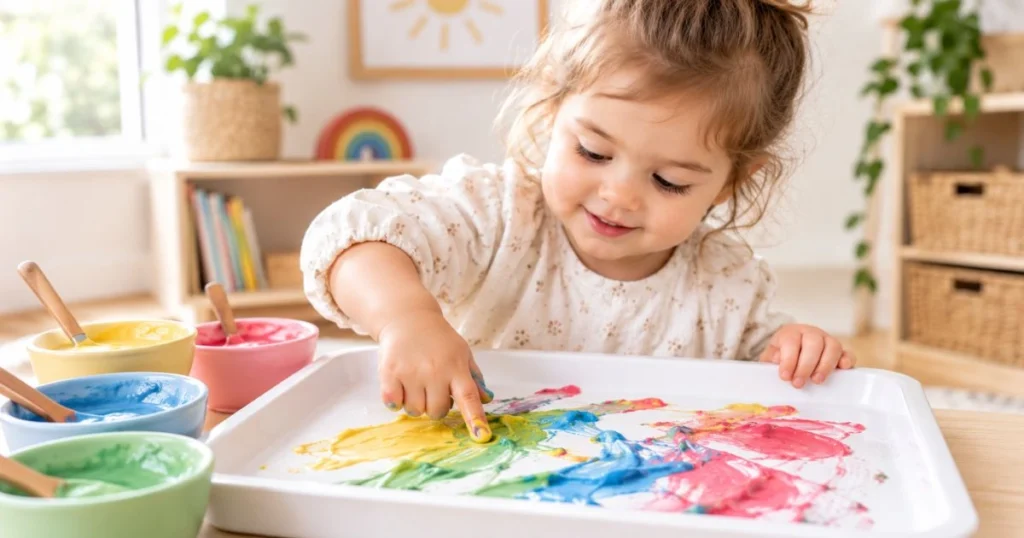
For a toddler who enjoys messy textures, edible finger painting can be a fun way to explore Sensory Activities for Toddlers.
Prepare a simple food-based mixture using ingredients suitable for your child. Then let them spread, swirl, tap, and smear it across a washable surface while they explore the different textures.
Encourage Exploration
Try saying:
- “You made a big circle.”
- “That feels smooth.”
- “You mixed the colors together.”
- “Your fingers are covered in paint.”
Keep in mind that edible sensory activities for toddlers are not automatically safe for every child. Check the ingredients for possible allergies and choose foods that are appropriate for your toddler’s age and abilities.
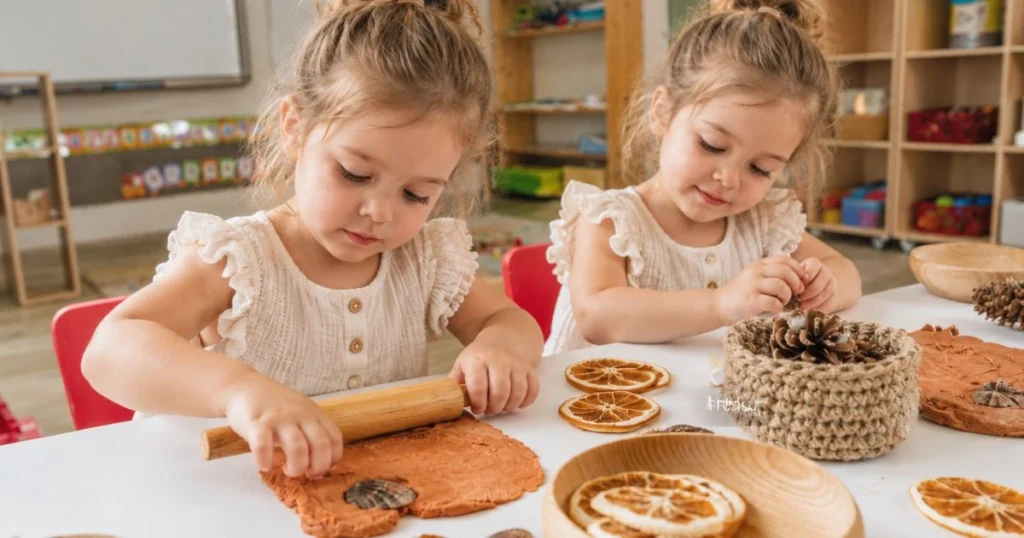
3. Homemade Sensory Dough
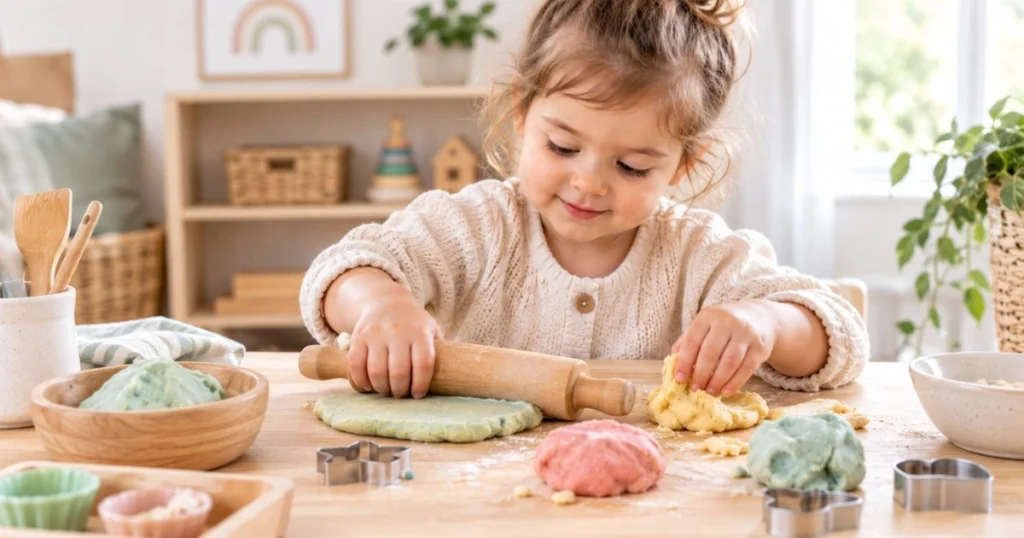
Soft dough is a simple choice for Sensory Activities for Toddlers because your child can explore it in many different ways.
They can:
- Roll it.
- Flatten it.
- Pinch it.
- Poke it.
- Squish it.
- Pull it apart.
These simple movements can also complement other fine motor activities for toddlers.
Simple Sensory Dough Recipe
| Ingredient | Amount | Purpose |
| All-purpose flour | 2 cups | Base |
| Salt | ½ cup | Texture |
| Water | About ¾ cup | Binding |
| Vegetable oil | 1 tablespoon | Softer texture |
| Food coloring | Optional | Color |
Mix the dry ingredients first. Add the oil and gradually add water until you have a workable dough.
Important: This is a play material, not a snack. Supervise your toddler and don’t allow them to eat it.
4. Dry Pasta Sensory Bin
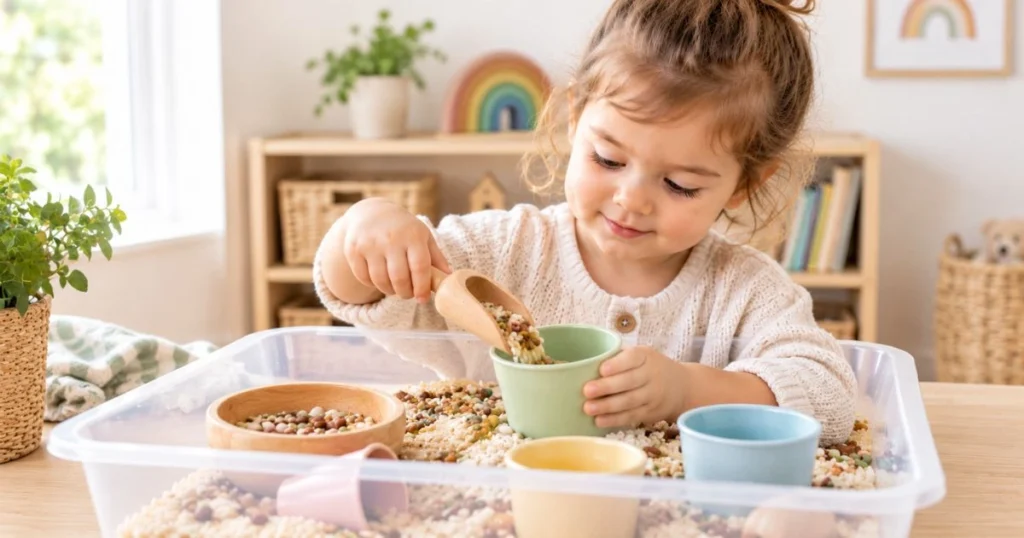
Place an appropriate amount of dry pasta in a shallow container to create one of these Sensory Activities for Toddlers.
Add:
- Large cups.
- Scoops.
- Spoons.
- Large containers.
Let your toddler scoop the pasta, pour it, listen to it tumble, and move it from one container to another.
Safety: Dry pasta and other loose materials can be choking hazards. Choose materials that are suitable for your child’s developmental stage and supervise them closely during play.
5. Rice Sensory Bin
A rice sensory bin offers an easy way to combine texture, sound, and movement in Sensory Activities for Toddlers.
Add large scoops and containers so your toddler can practice transferring the rice from one container to another.
If your toddler still frequently puts objects in their mouth, choose a safer activity instead of depending on supervision alone.
6. Oat Sensory Bin
Dry oats offer a different texture and sensory experience compared with rice or pasta, making them a simple option for Sensory Activities for Toddlers.
Give your toddler:
- Oats.
- Large cups.
- A scoop.
- A shallow container.
Let them explore the texture, scoop the oats, and transfer them between containers.
Keep the materials away from your child’s mouth, and choose a different activity if the ingredients are not appropriate for your toddler’s developmental stage.
7. Pom-Pom Transfer Activity
Place large, developmentally appropriate pom-poms in one container and set another container nearby for transferring. This simple setup works well for Sensory Activities for Toddlers.
Invite your toddler to move the pom-poms from one container to the other.
Turn it into a fun color-learning activity by saying:
“Can you find a blue one?”
This activity combines sensory exploration with grasping, releasing, and early color sorting.
Safety: Avoid small objects if your toddler still puts materials in their mouth, as they can pose a choking hazard.
8. Ice Cube Exploration
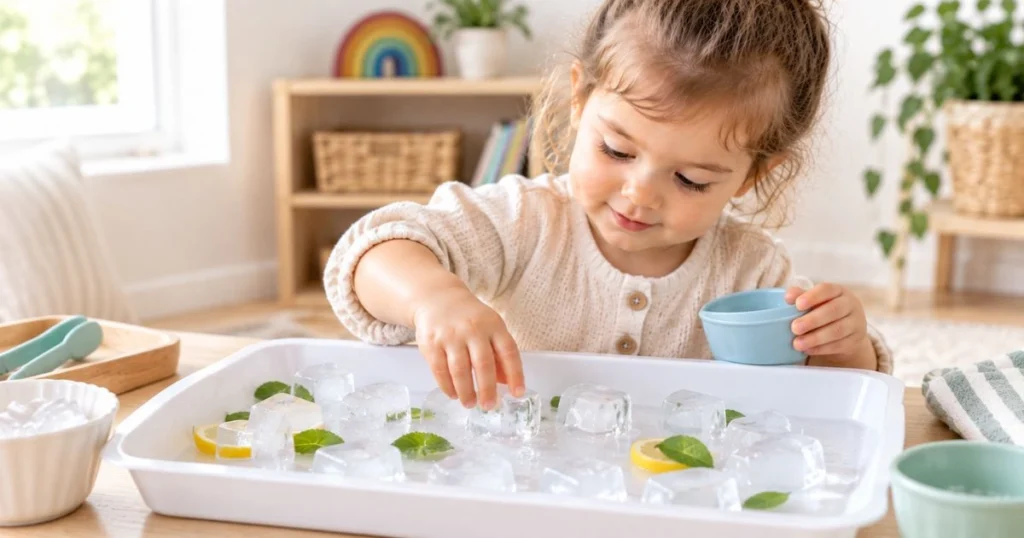
Place a few ice cubes in a shallow container to create a simple Sensory Activity for Toddlers.
Let your toddler touch and move the ice cubes while exploring how they feel.
Ask:
- “Is it cold?”
- “Is it slippery?”
- “What happens when it melts?”
You can also encourage your toddler to watch as an ice cube slowly melts into water.
This easy activity gives your child a hands-on way to explore temperature, texture, and change.
9. Bubble Play
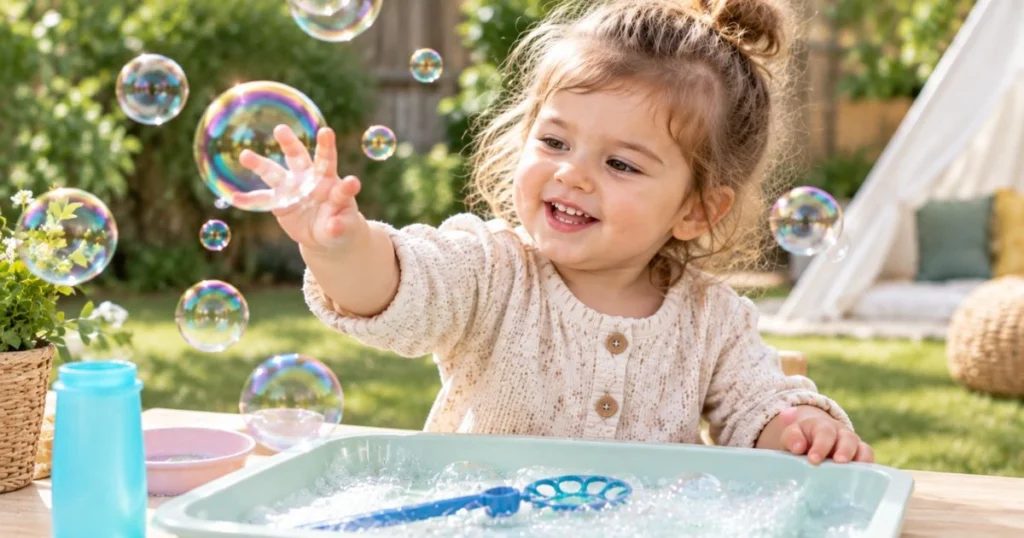
Bubbles bring movement and visual stimulation to Sensory Activities for Toddlers.
Blow bubbles and encourage your toddler to:
- Watch them float.
- Reach for them.
- Pop them.
- Chase them.
For an active toddler, bubble play can also encourage movement while adding a playful sensory experience.
Safety: Keep bubble solution away from your child’s eyes and mouth..
For toddlers who need more opportunities to move, you can also try simple gross motor activities.
10. Sensory Soup
Fill a shallow container with water and add toddler-safe cups, spoons, and utensils for a simple Sensory Activity for Toddlers.
Encourage your child to pretend they’re preparing a bowl of soup.
They can:
- Stir.
- Scoop.
- Pour.
- Mix.
- Serve.
You can also add large pretend ingredients that are appropriate for your child’s age and developmental stage.
11. Texture Treasure Basket
Create a small basket of safe objects with noticeably different textures.
| Object | Texture to Explore |
| Wooden spoon | Hard and smooth |
| Soft cloth | Soft |
| Silicone cup | Flexible |
| Large sponge | Soft and porous |
| Large plastic container | Smooth |
Sit nearby and allow your toddler to investigate.
Rather than asking question after question, describe what they are touching.
The CDC recommends imitation and description during child-led play because these approaches show your child that you’re interested in what they’re doing.
12. Nature Sensory Bin
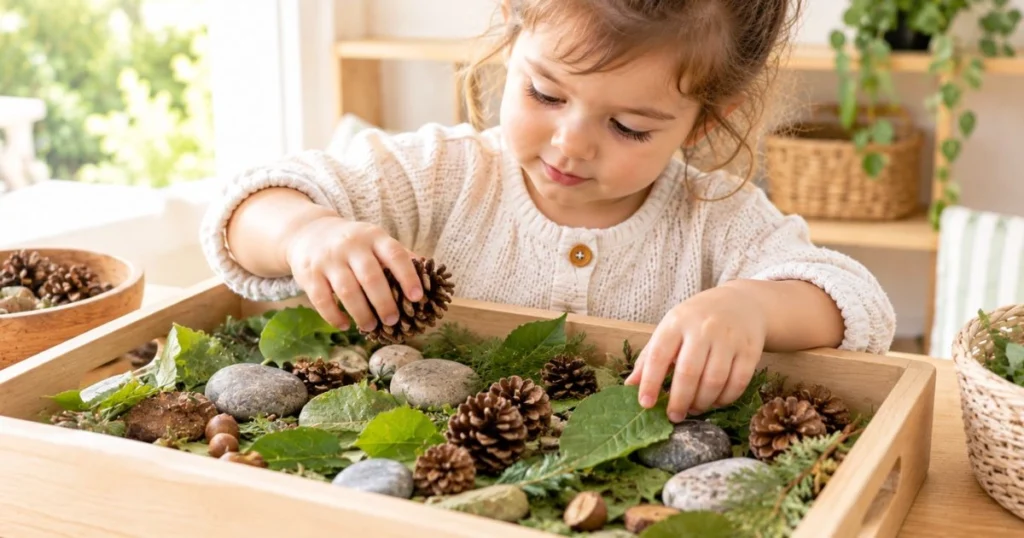
Bring a little of the outdoors into a controlled play space with this simple Sensory Activity for Toddlers.
Depending on your surroundings, you might use:
- Large leaves.
- Large pinecones.
- Smooth, large stones.
- Sticks.
Let your toddler touch, examine, and compare each item while you describe what they notice.
Make It a Language Activity
Talk about:
- Rough bark.
- Smooth stone.
- Dry leaf.
- Green leaf.
- Long stick.
Inspect everything carefully before giving it to your toddler.
13. Mud Kitchen Play
Take sensory play outside and let your toddler create pretend recipes from:
- Soil.
- Water.
- Leaves.
- Sticks.
- Cups.
- Spoons.
They might make “soup,” “cake,” or “tea.”
The objective isn’t the finished product. It’s the process of mixing, scooping, pouring, pretending, and experimenting.
14. Sand Scooping Station
Give your toddler a container of appropriate sand with:
- Scoops.
- Cups.
- Containers.
- A funnel.
Let them fill and empty containers.
This type of open-ended activity fits well with toddler exploration. CDC guidance for 2-year-olds includes opportunities to explore with sand toys, containers, spoons, and funnels.
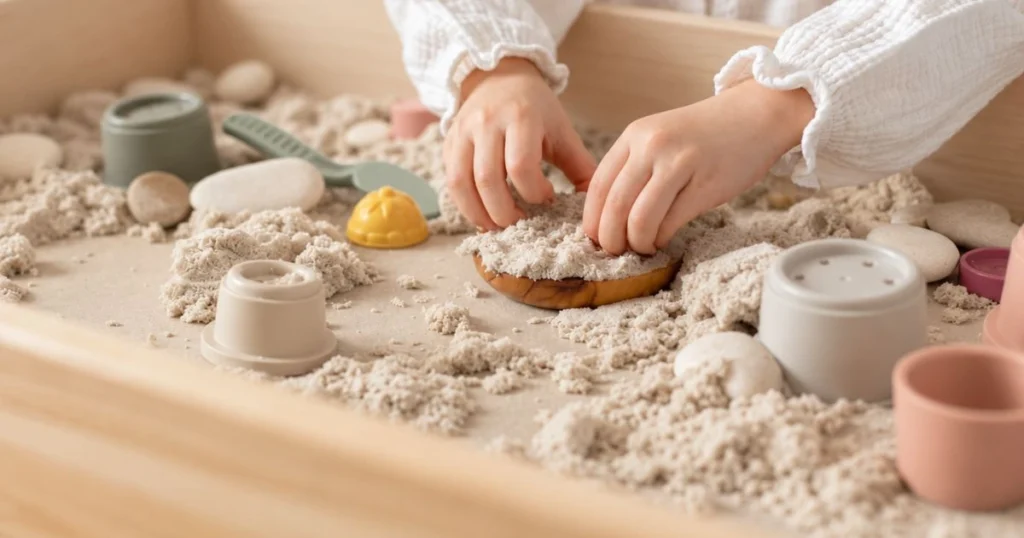
15. Cloud Dough Sensory Play
Cloud dough offers a soft, crumbly texture that can be squeezed and shaped.
Put it in a shallow container and add a few scoops.
Your toddler can:
- Crumble it.
- Scoop it.
- Press it.
- Fill containers.
- Empty them.
As always, use ingredients appropriate for your child’s age and supervise closely.
16. Shaving Cream Sensory Play
This is best reserved for toddlers who are comfortable with messy textures.
Put a small amount on an easy-to-clean surface and allow your toddler to spread and swirl it.
Safety reminders:
- Keep it away from the eyes.
- Don’t allow eating.
- Wash hands afterward.
- Stop if your child’s skin becomes irritated.
If you’re unsure whether a product is appropriate, choose a simpler sensory material instead.
17. Sponge Squeezing Activity
This activity requires only a sponge, two containers, and water.
Fill one container with water and keep the other empty.
Your toddler soaks the sponge, lifts it, and squeezes it over the empty container.
It’s simple, repetitive, and satisfying.
It also creates a natural opportunity to practice hand movements and coordination.
It also creates a natural opportunity to practice hand movements and coordination, similar to other fine motor activities for toddlers.
18. Large Pasta Threading
Use large pasta pieces and an appropriate thick threading material.
Your toddler can practice placing one piece after another.
Make It Easier
Start with just a few pieces.
You can say:
“One.”
“Two.”
“Another one.”
Never leave your child alone with loose pieces.
19. Sealed Sensory Bag
Fill a sturdy sensory bag with an appropriate gel-like material and a few large visual objects.
Seal it securely.
Your toddler can press, push, flatten, and move the objects around.
Before Every Use
Check:
- The seal.
- The bag for tears.
- Whether anything has leaked.
- Whether your toddler can open it.
Discard it immediately if damaged.
20. Safe Food Texture Exploration
Food can naturally provide sensory experiences during mealtimes.
Age-appropriate examples may include:
- Mashed avocado.
- Soft banana.
- Yogurt.
- Soft cooked vegetables.
Instead of turning mealtime into a structured “activity,” simply allow your toddler appropriate opportunities to notice different textures while eating.
This is also a natural place to explore your existing toddler feeding content.
21. Frozen Fruit Exploration
Frozen food introduces a different temperature and texture.
If you use frozen fruit, prepare it in a form appropriate for your child’s age and eating abilities.
Don’t assume that a food is safe simply because it is fruit. Shape, size, texture, and preparation all matter.
For a purely non-food sensory experience, ice cubes may be simpler.
22. Texture Painting
You don’t need to use a traditional paintbrush.
Try:
- Sponges.
- Large brushes.
- Silicone tools.
- Washable cloth.
- Other age-appropriate painting tools.
Your toddler can compare the marks each tool creates.
“Look! The sponge made dots.”
“The brush made a long line.”
23. Toddler Finger Painting
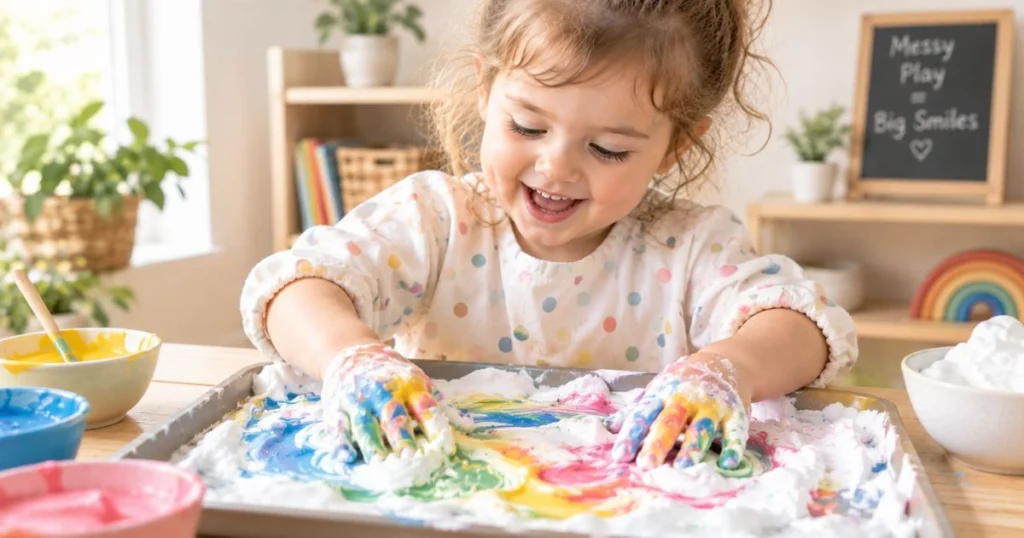
Finger painting lets your toddler explore paint directly with their hands.
Encourage them to make:
- Dots.
- Lines.
- Swirls.
- Handprints.
- Large circles.
CDC guidance for young children includes simple art and creative activities as opportunities for exploration and learning.
You don’t need to correct the artwork.
Let your toddler decide what it becomes.
24. Foamy Water Play
Add bubbles to a shallow container of water.
Your toddler can:
- Scoop foam.
- Stir water.
- Squeeze a sponge.
- Transfer water.
- Watch bubbles disappear.
This can be particularly useful when your toddler wants to splash but you’re looking for a more contained activity.
For more age-appropriate toddler food ideas, see our guide to healthy toddler snacks.
25. Sound Shaker Bottles
Fill a sturdy container with an appropriate material that creates sound when shaken.
Seal it securely.
Your toddler can experiment with:
- Shaking.
- Tapping.
- Moving quickly.
- Moving slowly.
Talk about the sound:
“That was loud.”
“Now you’re shaking softly.”
Make sure your toddler cannot open the container.
26. Homemade Musical Sensory Play
You can explore sound without buying musical toys.
Try safe household objects such as:
- A wooden spoon and sturdy container.
- A plastic container.
- A toddler-safe shaker.
Explore the difference between:
- Loud and quiet.
- Fast and slow.
- Tap and shake.
Keep the volume comfortable for your child.
If you’re looking for more ideas involving age-appropriate foods, you can also explore our toddler meal ideas.
27. Sensory Obstacle Course
Sensory play doesn’t always have to involve a bin.
Create a simple indoor obstacle course with safe items such as:
- Cushions.
- Mats.
- Pillows.
- A play tunnel.
Your toddler can crawl, step, climb over, and move around.
This combines movement with exploration.
28. Barefoot Texture Walk
Create a safe path featuring several different surfaces.
For example:
- A soft towel.
- A smooth mat.
- A textured play mat.
- Grass outdoors.
Let your toddler decide whether they want to step on each surface.
Use words such as:
“Soft.”
“Bumpy.”
“Smooth.”
“Cold.”
Never force a child to touch a texture they dislike.
Creative activities like this can also be combined with other indoor activities for toddlers on rainy or quiet days.
29. Outdoor Water Painting
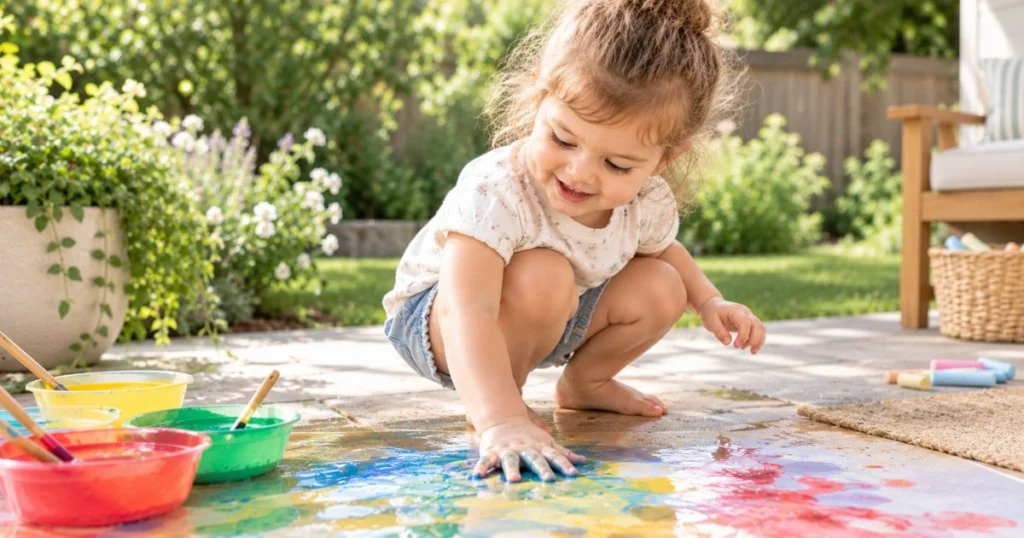
This might be one of the easiest low-mess sensory activities you’ll ever try.
Give your toddler:
- A cup of water.
- A large paintbrush.
Let them “paint” a sidewalk, fence, patio, or other suitable outdoor surface.
Then watch the marks disappear as the water dries.
No paint. Almost no cleanup.
30. Ice Painting
Use colored ice to create temporary artwork on a suitable surface.
Your toddler can watch the color move as the ice melts.
Talk about:
- Cold.
- Wet.
- Blue.
- Red.
- Melting.
- Dripping.
Choose food-safe coloring if the activity involves materials that could contact your child’s mouth, and supervise closely.
31. Scent Discovery
Smell can become part of sensory exploration too.
Use familiar, toddler-safe food aromas such as:
- Orange peel.
- Fresh herbs.
- Food with a mild cinnamon aroma.
You can ask:
“Do you smell it?”
“Does it smell familiar?”
Avoid strong fragrances, essential oils, or substances that aren’t appropriate for young children.
32. Color Sorting Sensory Bin
Combine sensory exploration with early sorting.
Place several large, safe objects in a container.
Ask your toddler to find objects of a particular color.
For example:
“Can you find something yellow?”
Then let them place similar colors together.
Children between 2 and 3 years are developing skills such as sorting objects by shape and color, according to CDC developmental guidance.
For more ways to encourage movement at this age, explore these gross motor activities for toddlers and preschoolers.
33. Scooping and Transferring Station
If you need a quick activity, this is an excellent place to start.
Give your toddler:
- Two bowls.
- A large spoon or scoop.
- An appropriate sensory material.
They transfer the material from one bowl to another.
You can change the material depending on your child’s age and safety needs.
The same basic setup can become water play, sand play, or another supervised sensory activity.
34. “What’s Inside?” Sensory Bag
Hide a few large, safe objects inside a securely sealed sensory bag.
Your toddler presses the material to locate an object.
Try:
“Can you find the spoon?”
“What did you find?”
“Is it hard or soft?”
This combines tactile exploration with language.
35. Toddler Sensory Bath
Bath time already offers a natural sensory experience.
Add simple bath-safe items such as:
- Cups.
- Sponges.
- Small pitchers.
- Bath-safe toys.
Let your toddler pour, squeeze, splash, and transfer water.
The Most Important Bath Rule
Never leave your toddler alone around water.
Keep your attention on your child rather than your phone, chores, or another task.
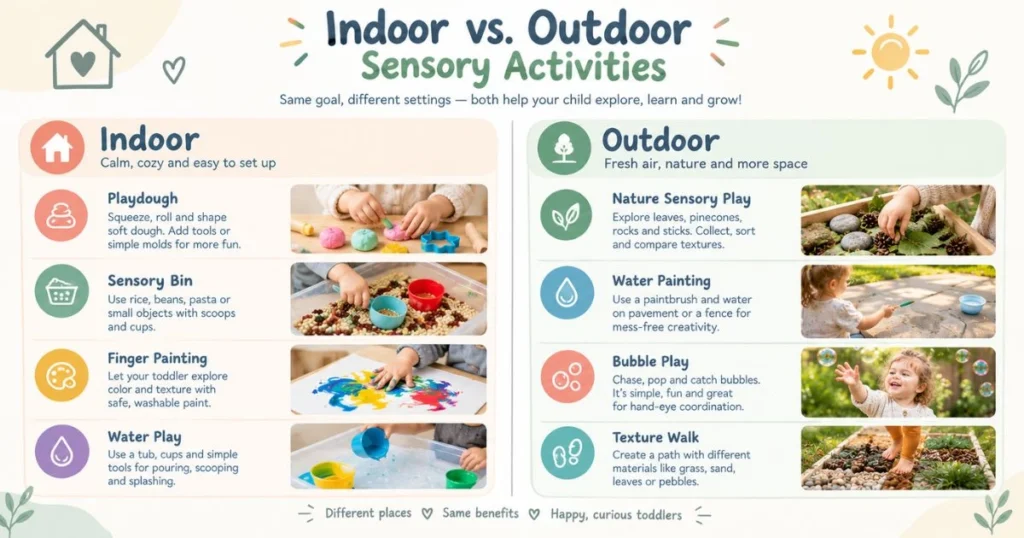
Easy Sensory Activities for Toddlers When You Have 5 Minutes
You don’t need an elaborate setup every time your toddler says, “Play!”
Here are several quick options:
| Activity | Approx. Setup | Mess Level |
| Water pouring | 1–2 minutes | Low |
| Bubble popping | 1 minute | Low |
| Water painting | 1 minute | Very low |
| Sponge squeezing | 2 minutes | Low |
| Texture basket | 2 minutes | Very low |
| Ice exploration | 1 minute | Low |
The CDC recommends beginning with at least five minutes of child-led play and gradually building the practice as it becomes easier.
That means you don’t need to wait until you have an entire free afternoon.
Five focused minutes can be a perfectly reasonable starting point.
Low-Mess Sensory Activities for Toddlers
If the idea of rice scattered across your entire floor makes you hesitate about trying Sensory Activities for Toddlers, start with low-mess options.
Try:
- Water painting.
- Bubble play.
- Texture baskets.
- Sealed sensory bags.
- Ice exploration.
- Shaker bottles.
- Sponge transfers.
Place a towel underneath water activities and keep your materials together in one tray to make cleanup easier.
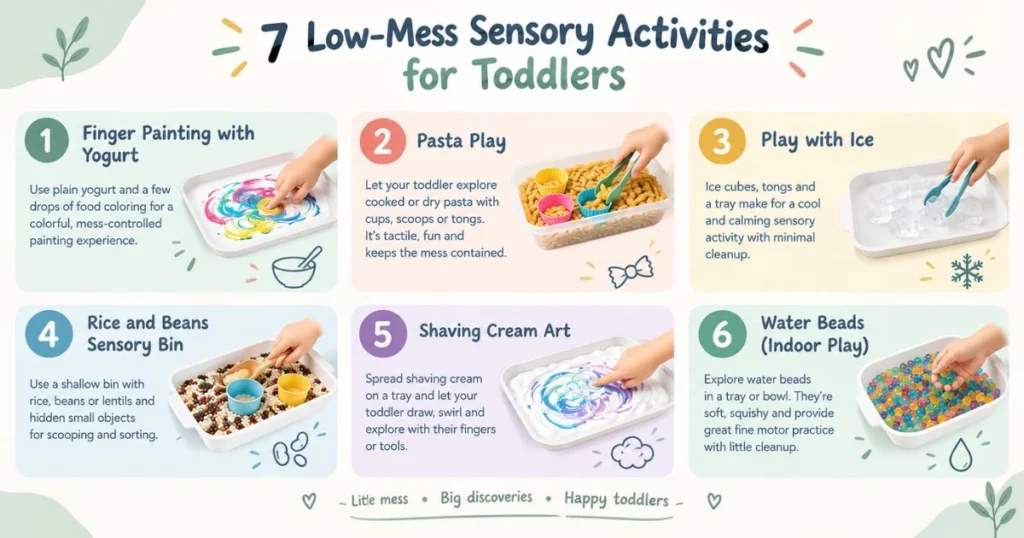
A simple setup can make Sensory Activities for Toddlers much easier to enjoy without creating a big mess.
Messy Sensory Activities for Toddlers
Sometimes making a mess is exactly what your toddler needs. These Sensory Activities for Toddlers are great choices when your child enjoys hands-on exploration.
Good options include:
- Finger painting.
- Mud kitchens.
- Sand play.
- Sensory dough.
- Foam play.
- Water play.
How to Make Cleanup Easier
Before starting your Sensory Activities for Toddlers, make the play area easier to manage:
- Put down a washable mat.
- Keep towels within reach.
- Use shallow containers.
- Start with a small amount of material.
- Have clean clothes ready.
- Move particularly messy activities outdoors when possible.
You don’t have to avoid every little mess. The goal is simply to make cleanup easier and the experience more enjoyable for both you and your toddler.
Indoor Sensory Activities for Toddlers
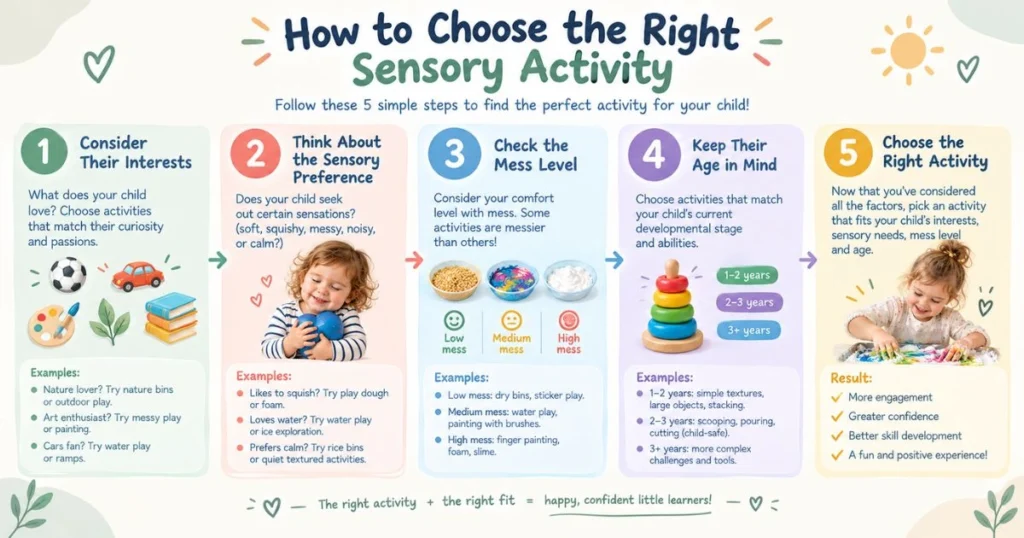
Rainy days and restless afternoons are perfect opportunities for indoor sensory play.
In the Kitchen
Try:
- Water pouring.
- Sponge squeezing.
- Scooping.
- Texture baskets.
In the Playroom
Try:
- Dough.
- Sealed sensory bags.
- Sorting activities.
- Finger painting.
In the Bathroom
Try:
- Water transfers.
- Sponge play.
- Bath sensory activities.
Keep the activity simple enough that you can supervise while still managing your other responsibilities.
Outdoor Sensory Activities for Toddlers
Outdoor environments naturally offer changing sounds, textures, movement, and plenty of space, making them ideal for Sensory Activities for Toddlers.
Try:
- Mud kitchens.
- Sand play.
- Nature exploration.
- Water painting.
- Texture walks.
- Bubble chasing.
- Ice painting.
Outdoor Sensory Activities for Toddlers also give your child more room to move, explore, and stay active. CDC guidance notes that outdoor play can support physical activity and movement development, while also emphasizing the importance of managing potential outdoor risks.
Sensory Activities for Toddlers by Skill
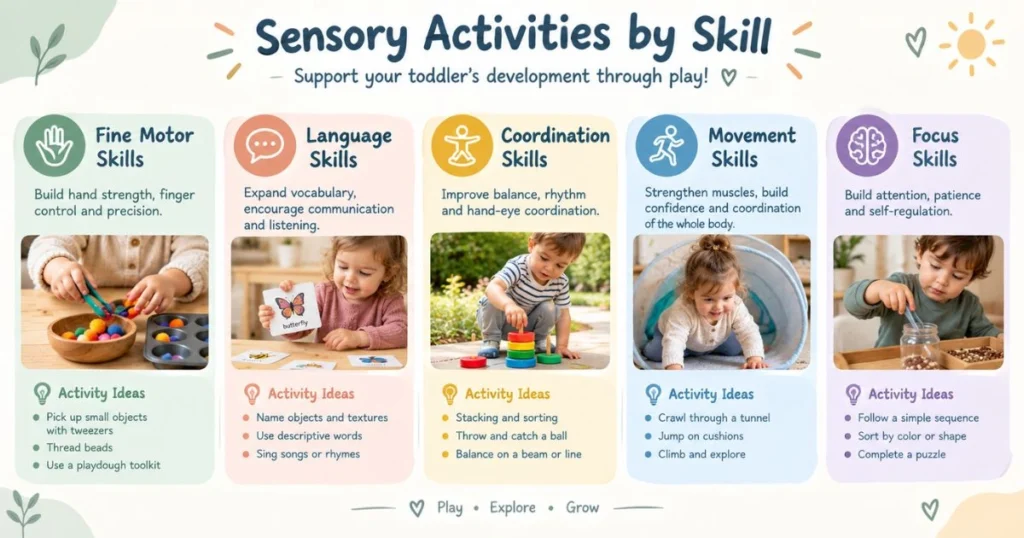
You don’t have to choose Sensory Activities for Toddlers based on a specific skill you think your child needs to develop. Instead, use these categories to discover activities that naturally encourage a variety of movements and abilities.
Sensory Activities for Fine Motor Skills
Choose:
- Sensory dough.
- Sponge squeezing.
- Scooping.
- Transferring.
- Large pasta threading.
Sensory Activities for Gross Motor Skills
Choose:
- Obstacle courses.
- Bubble chasing.
- Texture walks.
- Outdoor movement games.
Sensory Activities for Language Development
Choose activities that give you plenty to describe.
Talk about:
- Colors.
- Textures.
- Sounds.
- Temperatures.
- Sizes.
- Actions.
Sensory Activities for Early Problem-Solving
Try:
- Hidden objects.
- Sorting.
- Pouring.
- Container activities.
- Cause-and-effect play.
Remember, these activities provide opportunities for practice. They shouldn’t be presented as guaranteed ways to produce a particular developmental outcome.
How to Choose the Right Sensory Activities for Your Toddler
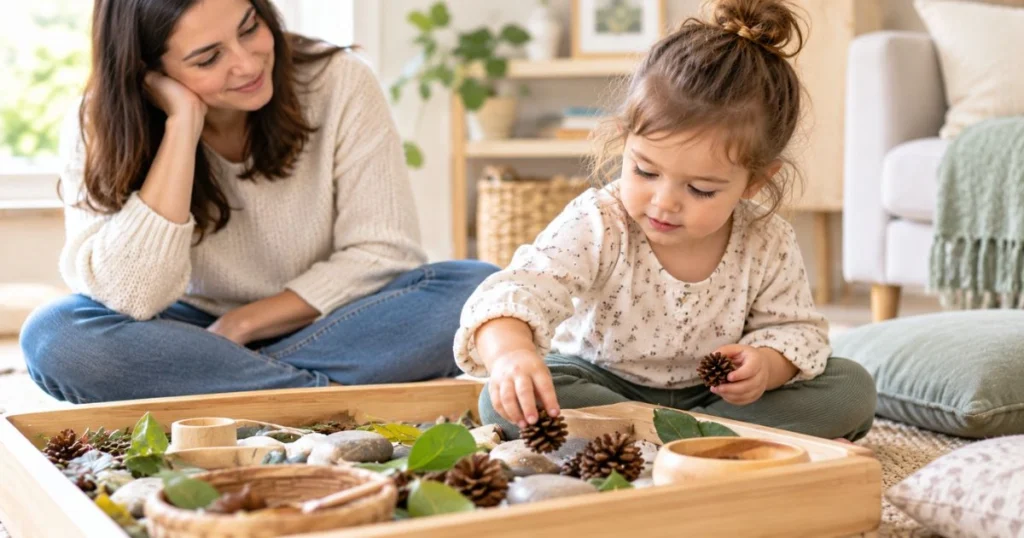
Your toddler’s individual preferences matter when choosing Sensory Activities for Toddlers.
One child may love playing with water, while another may dislike the feeling of wet hands.
One toddler might enjoy loud musical play, while another may cover their ears when the noise becomes too much.
Pay attention to your child’s reactions and let their comfort and interests guide the activities you offer.
Follow Your Toddler’s Interests
If yoIf your child loves water, start with Sensory Activities for Toddlers such as:
- Pouring.
- Sponge play.
- Bath activities.
If your toddler enjoys movement, try:
- Bubbles.
- Obstacle courses.
- Outdoor games.
If your child likes art, try:
- Finger painting.
- Ice painting.
- Texture painting.
Following your toddler’s lead can make Sensory Activities for Toddlers more enjoyable and engaging. It also aligns with CDC guidance on child-led play and Harvard’s recommendation to let toddlers help guide the direction and duration of play.
Respect Sensory Preferences
Don’t force your toddler to participate in Sensory Activities for Toddlers that make them uncomfortable. Instead, adjust the activity or offer a different way to explore.
If they dislike sticky dough, try:
- Water.
- Ice.
- A dry texture basket.
If they are sensitive to loud sounds, choose quieter options such as:
- Water painting.
- Quiet sorting.
- Dough.
Sensory Activities for Toddlers should provide opportunities for curiosity and exploration—not turn playtime into a struggle.
How to Make Sensory Activities More Educational
You don’t need worksheets or flashcards to make Sensory Activities for Toddlers educational. Simple conversations during everyday play can turn an ordinary activity into a meaningful learning experience.
Describe What Your Toddler Is Doing
Instead of asking your toddler question after question, try narrating what they are doing during Sensory Activities for Toddlers.
“You’re pouring the water.”
“You squeezed the sponge.”
“The ice has melted.”
“The ball is inside the cup.”
The CDC recommends describing your child’s actions and using imitation during child-led play to show that you’re engaged and paying attention.
Introduce Sensory Vocabulary
| Experience | Words You Can Use |
| Texture | soft, rough, smooth |
| Temperature | cold, warm |
| Water | wet, splash, drip |
| Sound | loud, quiet |
| Size | big, small |
| Movement | fast, slow |
Don’t worry if your toddler doesn’t repeat the words immediately.
They’re listening.
Let Your Toddler Lead
You might prepare a carefully planned Sensory Activity for Toddlers, only to find that your child would rather spend ten minutes exploring the empty bowl.
That’s not a failure.
Follow your toddler’s curiosity and let them decide what interests them. Sensory Activities for Toddlers don’t have to unfold exactly as you imagined for your child to learn and enjoy the experience.
Sensory Activity Safety Tips for Toddlers
Safety is important when setting up Sensory Activities for Toddlers, especially when they involve loose materials, water, food, or household items.
Watch for Choking Hazards
Be especially cautious with:
- Rice.
- Dry beans.
- Pasta.
- Small beads.
- Small pom-poms.
- Tiny craft materials.
- Small stones.
The CDC emphasizes choosing activities and toys appropriate for a child’s skill level and avoiding small detachable parts for very young children.
Supervise Water Play
Never leave your toddler unattended around water.
This includes:
- Baths.
- Buckets.
- Water tables.
- Basins.
- Outdoor water play.
Consider Allergies and Skin Sensitivities
Check every ingredient before using homemade sensory recipes.
If your toddler has sensitive skin, introduce new materials cautiously.
Avoid Irritating or Unsafe Materials
Don’t assume something is appropriate just because it appears frequently in online sensory-play ideas.
When in doubt, choose a simpler material.
Stop When Your Toddler Is Uncomfortable
Your child doesn’t need to participate in every activity.
If they pull away, become upset, or clearly dislike a sensation, give them another option.
Frequently Asked Questions About Sensory Activities
What are sensory activities for toddlers?
Sensory activities for toddlers are play experiences that allow children to explore sensations such as texture, temperature, sound, movement, color, and sometimes smell. They can be as simple as water pouring, dough play, bubble popping, or exploring a texture basket.
What are the best sensory activities for toddlers?
Some easy choices include:
- Water play.
- Sensory dough.
- Finger painting.
- Bubble play.
- Sponge squeezing.
- Sensory bins.
- Texture baskets.
The best activity is usually one that is safe, age-appropriate, and interesting to your particular child.
What are easy sensory activities to do at home?
Try water painting, bubble play, sponge squeezing, a texture basket, ice exploration, or scooping and transferring.
Most require very little preparation.
What can I put in a sensory bin for a toddler?
ThThe materials you choose should depend on your child’s age and whether they still tend to put objects in their mouth.
For Sensory Activities for Toddlers, you can use age-appropriate materials along with:
- Cups.
- Scoops.
- Spoons.
- Large containers.
- Large, safe objects.
Avoid small loose materials when they could create a choking hazard, and always choose items that are appropriate for your toddler’s developmental stage.
Are sensory activities good for toddlers?
Sensory activities can provide enjoyable opportunities for toddlers to explore, move, communicate, manipulate objects, and experiment. They are one type of play and should complement everyday talking, reading, movement, social interaction, and exploration.
What are good sensory activities for a 2-year-old?
Good options include:
- Finger painting.
- Sand play.
- Water play.
- Scooping.
- Simple sorting.
- Texture exploration.
- Outdoor nature play.
CDC guidance for 2-year-olds encourages exploration, matching and sorting activities, creative play, and opportunities to try new things.
How long should a sensory activity last?
There isn’t one perfect length.
Your toddler might enjoy an activity for five minutes today and twenty minutes another day.
Follow their attention and interest.
The CDC recommends beginning with short periods of child-led play and building from there.
What if my toddler doesn’t like sensory activities?
Try something different.
Some children dislike wet or sticky textures but enjoy:
- Bubbles.
- Music.
- Movement.
- Water painting.
- Sorting.
- Texture baskets.
Don’t force your child to interact with a material they clearly dislike.
Conclusion: Sensory Play Doesn’t Have to Be Complicated
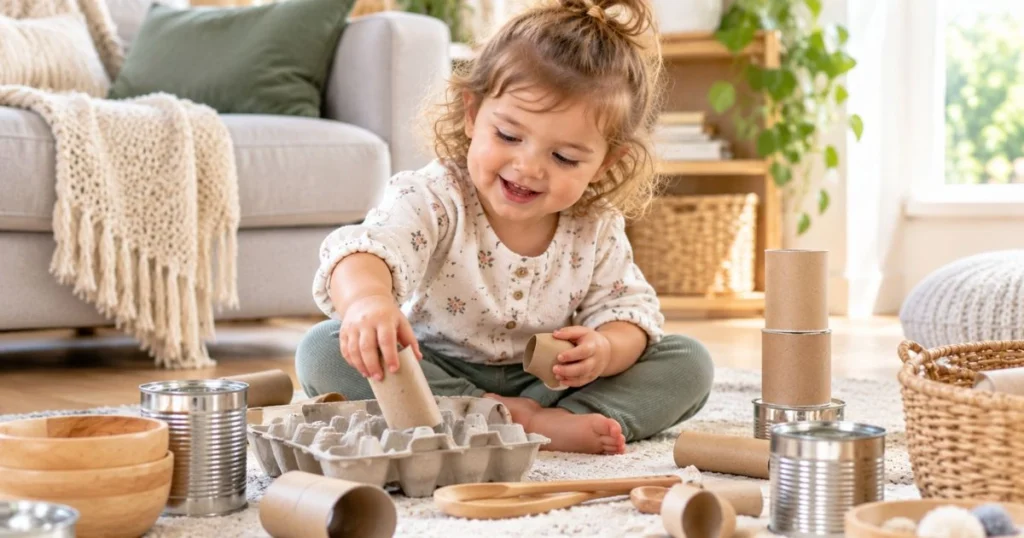
You don’t need a cupboard full of sensory toys to give your toddler interesting ways to explore. Sensory Activities for Toddlers can be as simple as using everyday items you already have at home.
Sometimes the simplest activities are enough.
A cup of water can become a pouring game. A sponge can become a hand-strength activity. A cardboard container can become part of an imaginative game. A few safe textures can turn an ordinary afternoon into something your toddler wants to investigate.
What matters most isn’t creating a Pinterest-perfect setup.
It’s giving your toddler room to explore while you stay nearby, notice what captures their attention, and join them when they invite you in.
Child-led play can also strengthen the connection between you and your toddler. The CDC recommends giving children opportunities to lead, while parents can imitate, describe, praise, and actively listen during play.
So don’t wait for the perfect day.
Choose one of these Sensory Activities for Toddlers, gather what you already have at home, and give your toddler a few minutes to investigate.
You may be surprised by how little you actually need to create a moment of curiosity, learning, and connection.
Save this list for your next rainy afternoon, restless morning, or “Mom, I’m bored!” moment—and try one activity today.