
If you’re reading this at 2 a.m. with a toddler screaming from the next room, here’s the short version: 2 year old sleep regression can be exhausting, but you’re not doing anything wrong, and this phase has an end date.
Toddler sleep regression is the term parents use when a child who used to sleep through the night — or at least sleep reasonably well — suddenly starts fighting bedtime, waking up repeatedly, or refusing naps altogether. It feels like a step backward. In most cases, it isn’t. Pediatric sleep specialists tend to describe it differently: not a regression at all, but a byproduct of forward motion. Your toddler’s brain is busy rewiring itself around new language, new mobility, new independence, and new emotions, and sleep is often the first system to show the strain. Circadian rhythms and sleep drive are recalibrating in real time to keep pace with everything else that’s changing.
Knowing how much sleep your child actually needs helps put a 2 year old sleep regression in context. Kids between one and two years old typically need somewhere between 11 and 14 hours of sleep across a 24-hour period — roughly 10 to 12 hours overnight plus a nap or two totaling 1.5 to 3 hours. By age three, that total drops slightly, to somewhere in the 10-to-13-hour range. The encouraging part: most regressions, however brutal they feel in the moment, tend to resolve within two to six weeks once a family sticks with consistent routines. That window matters. It means the goal isn’t to “fix” the regression overnight — it’s to hold steady through it.
If you’re trying to understand where this phase fits into the bigger picture, our guide to sleep regression ages breaks down common sleep changes from infancy through toddlerhood.
What’s Driving the 2 Year Old Sleep Regression, Age by Age
The causes shift as your child grows, and knowing which stage you’re in can take some of the mystery out of the 3 a.m. wake-ups. The 2 year old sleep regression is one of the most common periods parents notice, but sleep disruptions can also happen around 18 months and age three.
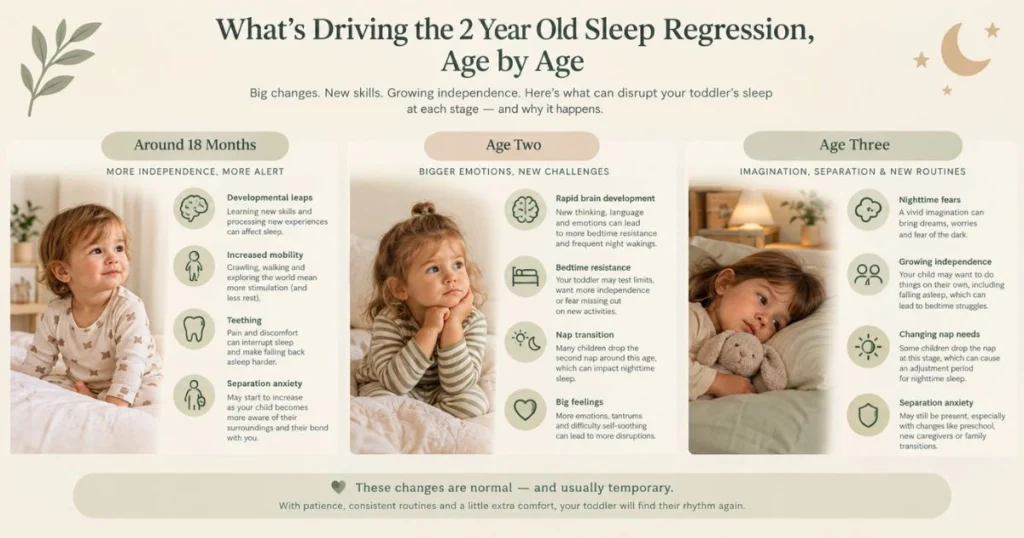
Around 18 months (give or take a month or two either direction). This is a crowded developmental intersection. Separation anxiety tends to peak somewhere between 15 and 18 months, right as language is exploding and first molars are cutting through — a genuinely painful process. Toddlers at this age are also often walking confidently, climbing everything in sight, and transitioning from two naps down to one, which throws off the internal clock they’d gotten used to. If your child is going through this at 19, 20, or 21 months instead of exactly 18, that’s not a delay or an outlier — it’s simply where that individual toddler lands within a normal, fairly wide window. The result usually looks like clinging or crying when placed in the crib, waking one to three times overnight, taking half an hour to an hour to actually fall asleep, and either fighting naps or skipping them entirely.
Around age two, stretching into two and a half. This is the stage most parents mean when they talk about the 2 year old sleep regression. It’s less about physical discomfort and more about a newly discovered sense of power. Somewhere in this window, toddlers realize their voice can change what happens around them — which is a wonderful cognitive leap and an exhausting one to parent through at bedtime. Sleep researchers sometimes call the result “limit-setting insomnia,” which is a clinical way of saying your toddler has figured out that asking for one more story works. Layer on second-year molars (which typically erupt between 23 and 33 months), a budding fear of the dark, and any major household shift — a new sibling, potty training, dropping the pacifier, or an early move out of the crib — and you get bedtime battles that drag on for 30 to 60 minutes or longer. Expect stalling tactics (“water,” “one more book,” “I have to potty”), attempts to climb out of the crib, wakings in the middle of the night, and mornings that start earlier than anyone would like.
Around age three. By now, imagination has really kicked in, and that’s a double-edged development. The same creativity that makes pretend play so fun also manufactures very real fears — shadows on the wall, monsters under the bed, things that go bump. Nightmares tend to peak somewhere between ages three and twelve, so this age often marks the beginning of that stretch. Starting preschool or daycare adds another layer of stimulation and separation stress, and many kids are also giving up their daytime nap right around now, which leaves them running on emptier reserves by evening. The telltale signs: repeated trips out of the bedroom (sometimes called “curtain calls”), long stalling routines, nightmares or the more intense night terrors, a refusal to sleep alone, and dramatic late-afternoon meltdowns that are really just overtiredness in disguise. Understanding these age-related changes can help you tell whether you’re dealing with lingering effects of a 2 year old sleep regression or another temporary sleep disruption.
If your child is closer to 18 months, you may also be dealing with an 18 month sleep regression, which can look similar but often has different developmental triggers.
For a more detailed look at this stage, see our guide to the 18 month sleep regression and the signs parents commonly notice.
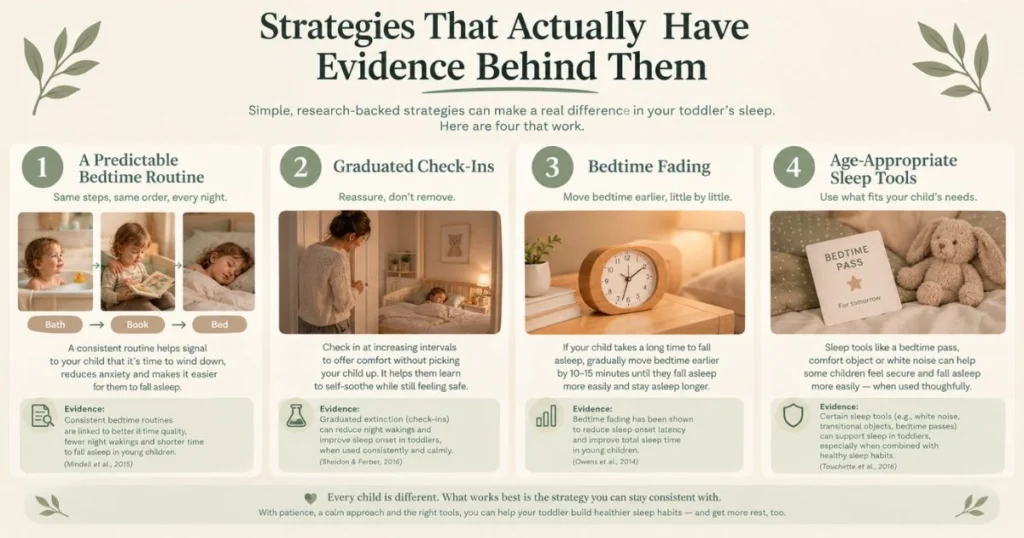
Strategies That Actually Have Evidence Behind Them
Build a short, boring, predictable routine. The “4 B’s” — bath, brush, book, bed — done in roughly the same 20-to-30-minute sequence every single night, gives your toddler’s body a reliable signal that sleep is coming. Predictability, not novelty, is the point here. During a 2 year old sleep regression, keeping this routine consistent can help your child know what to expect even when bedtime suddenly becomes more challenging.
Try graduated check-ins. This approach, sometimes called check-and-console, can be useful during a 2 year old sleep regression. It comes out of clinical research, including a well-known 2016 study led by researcher Michael Gradisar. You complete the bedtime routine, leave the room, and if your child protests, you return briefly — after about five minutes the first time — to offer calm, low-key reassurance without picking them up. Each following check-in stretches a bit longer: ten minutes, then fifteen, then twenty. The goal isn’t to ignore distress; it’s to gradually build your child’s confidence that they can settle themselves, with you nearby but not hovering.
Consider bedtime fading. If your toddler is lying awake fighting sleep for an hour, moving bedtime later — to match when they’re actually getting drowsy — and then walking it back earlier in small, 15-minute steps every few days, often works better than forcing an earlier bedtime that isn’t matching their biology yet. This can be particularly useful when a 2 year old sleep regression includes prolonged bedtime resistance or your toddler simply isn’t tired at their usual bedtime.
Use targeted tools for the right age. For three-year-olds, a bedtime pass — a single physical card they can trade in for one exit from the room, whether that’s for water or a hug — has been shown in research to meaningfully cut down on bedtime negotiations, mostly because it gives the child a concrete sense of control. During a 2 year old sleep regression, toddler clocks that visually distinguish “still sleep time” from “okay to get up” can work well for the same reason. A dim nightlight or a comfort object can ease nighttime fears without creating new dependencies. And it’s worth being consistent about screens: cutting them off at least an hour before bed can support healthy sleep habits, since evening screen use and light exposure may make it harder for some children to wind down.
Before adjusting bedtime, it can help to understand your child’s toddler nap schedule and how daytime sleep affects nighttime sleep.
Hacks From Parents Who’ve Been There
Beyond the clinical playbook, a few low-tech tricks show up again and again from families in the trenches. During a 2 year old sleep regression, getting your toddler moving — outdoor play or an after-dinner walk — helps build up enough sleep pressure that bedtime doesn’t feel like such a fight. The chair method, sometimes called gradual disengagement, has you sitting beside the crib or bed and inching your chair a little farther away every few nights until you’re eventually out of the room altogether. Some families switch to a floor mattress during a rough patch, simply because it lets a parent lie down next to a distressed toddler without wrecking their back leaning over a crib rail. And if your child has started climbing out of the crib or has moved to a bed, a safety gate at the bedroom door is a simple way to prevent unsupervised wandering while everyone works through the transition.
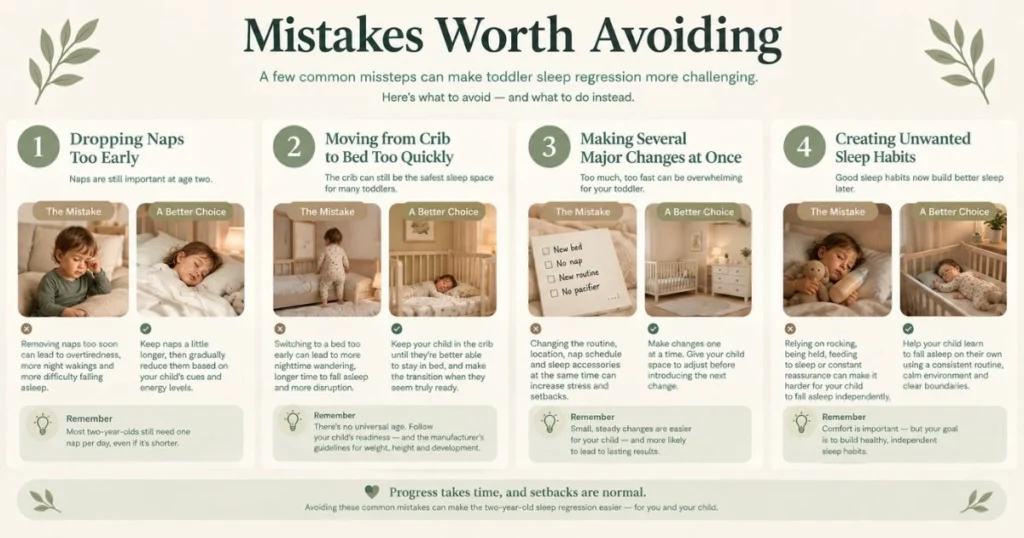
Mistakes Worth Avoiding
A few missteps tend to make regressions last longer than they need to. Dropping the nap the moment your toddler starts resisting it is usually premature — most kids still need that nap until closer to age four, and refusal at two is often just a symptom of the 2 year old sleep regression, not a sign of true readiness to drop it. Similarly, rushing the move from crib to bed can backfire; keeping the crib boundary in place until closer to age three often prevents sleep struggles from getting worse. It also helps to avoid stacking changes — don’t wean the pacifier, start potty training, and welcome a new baby all in the same month as a 2 year old sleep regression if you can help it. And be cautious about any new habit you adopt purely to survive a hard night, like co-sleeping, if it’s not something you actually want to keep doing long-term. Regressions are temporary; some of the workarounds we reach for during them are not.
If nap resistance is becoming a major part of the problem, our guide When Do Kids Stop Taking Naps? can help you recognize signs that your child may actually be ready for a transition.
When It’s Worth Calling the Pediatrician
Most 2 year old sleep regression symptoms are just that — temporary sleep disruptions, not necessarily signs of something more serious. But a few signs are worth flagging to your child’s doctor. Disruptions that drag on past six weeks may point to something called Behavioral Insomnia of Childhood, which is thought to affect somewhere between 10 and 30 percent of young children. Loud snoring, gasping, or noticeable pauses in breathing during sleep can be signs of pediatric sleep apnea and shouldn’t be brushed off. And if you notice severe daytime sleepiness, behavioral shifts, developmental setbacks, or involuntary movements like leg jerking or head banging during sleep, that’s worth a conversation too.
During a 2 year old sleep regression, it’s easy to worry that every difficult night means something is wrong. The reassuring truth underneath all of this is that toddler sleep regressions are often linked with normal developmental changes. Stay consistent, protect the routine, and give it time — for many families, sleep gradually settles again.
If nighttime waking is accompanied by other unusual symptoms, our guide on sleep regression vs. teething can help you think through some common reasons babies and toddlers may wake more often.
If you’re still trying to understand how sleep changes fit together across childhood, our Sleep Regression Ages guide walks through common regressions from 4 months through 2 years.