

Pregnancy can feel like one long journey toward a moment you’ve been waiting for. But when your baby arrives, the journey doesn’t suddenly become simple. Your body is recovering, your baby needs you, feeding may take time to figure out, and your emotions can shift from one day to the next.
The transition from pregnancy to postpartum is a major change, but you don’t have to have everything figured out before your baby arrives.
Knowing what to expect at each stage can help you prepare practically and emotionally while leaving room for the reality that every pregnancy, birth, and postpartum experience is different.

What Does the Journey From Pregnancy to Postpartum Look Like?
The Pregnancy to Postpartum transition includes much more than giving birth.
It can involve:
- Physical changes throughout pregnancy
- Preparing for labor and birth
- Creating a postpartum plan
- Recovering after delivery
- Learning how to feed your baby
- Adjusting to interrupted sleep
- Managing emotional changes
- Building a support system
- Navigating your changing identity
- Gradually returning to everyday activities and work
There isn’t one perfect way to experience these stages. Your healthcare needs, feeding choices, recovery, support system, and family circumstances all influence your experience.
The goal isn’t to prepare for every possible situation. It’s to understand the basics and know where to turn when you need additional support.
Pregnancy: Preparing for the Months Ahead
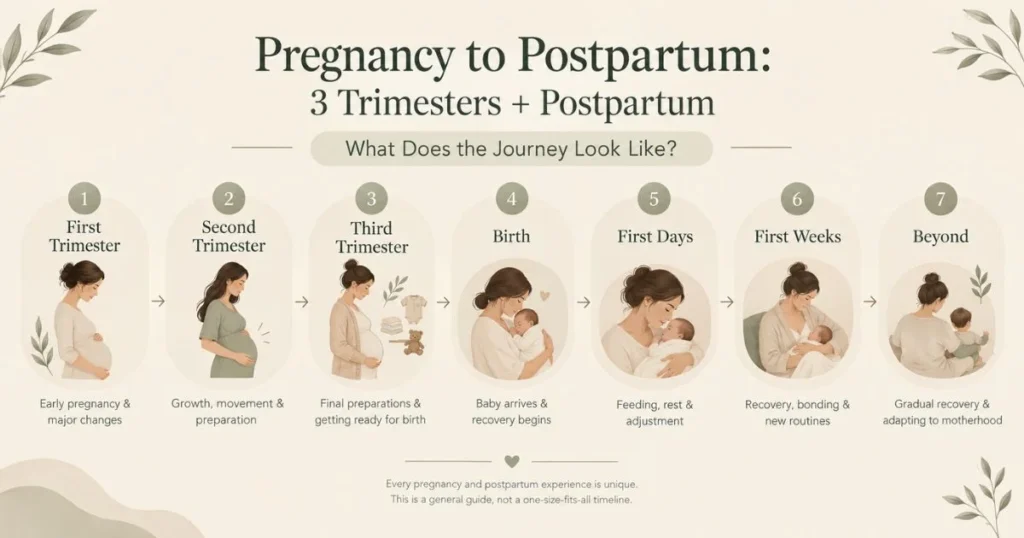
During the Pregnancy to Postpartum journey, pregnancy is commonly divided into three trimesters. Each brings its own physical and emotional changes, and preparation can look different from one stage to another.
First Trimester: Adjusting to Pregnancy
The first trimester can be a time of major change in your Pregnancy to Postpartum journey, even when your pregnancy isn’t visible yet.
You may experience:
- Fatigue
- Nausea or vomiting
- Breast tenderness
- Increased urination
- Food or smell sensitivities
- Mood changes
- Excitement, uncertainty, or a mixture of emotions
Early pregnancy is also a good time to establish prenatal care and discuss your health history, medications, nutrition, supplements, and any concerns with your healthcare professional.
You don’t need to accomplish everything immediately.
Helpful priorities during the first trimester:
- Establish prenatal care.
- Take recommended prenatal vitamins or supplements as advised.
- Prioritize rest when possible.
- Eat what you can tolerate while aiming for a varied diet.
- Ask questions rather than relying on conflicting advice online.
- Give yourself time to emotionally adjust.
Second Trimester: Preparing and Planning
For many people, the second trimester of the Pregnancy to Postpartum journey brings changes in energy and symptoms, although experiences vary.
This can be a useful time to begin thinking about:
- Birth preferences
- Childbirth education
- Baby supplies
- Feeding preferences
- Maternity clothing
- Childcare
- Work plans
- Postpartum support
- Practical help after birth
This is also a good time to think beyond the birth itself.
Ask yourself:
Who will help me when I’m tired, recovering, or simply need a break?
Your postpartum support plan can be just as important as your birth plan.
Third Trimester: Preparing for Birth and Postpartum
As your due date approaches, preparation for the Pregnancy to Postpartum transition often becomes more practical.
You might:
- Pack a hospital or birth-center bag.
- Wash and organize baby clothes.
- Prepare a safe sleep space.
- Discuss your birth preferences with your healthcare team.
- Arrange transportation.
- Plan for meals after birth.
- Identify people who can help with household tasks.
- Learn about newborn feeding and safe sleep.
- Make a plan for contacting your healthcare team if concerns arise.
Try not to treat your checklist as a test you can fail.
You don’t need a perfectly prepared nursery or every baby product before your baby arrives.
Preparing for Birth and Postpartum
As part of your Pregnancy to Postpartum preparation, a birth plan can help you communicate your preferences, but birth doesn’t always follow a script.
Your plan might include preferences around:
- Support people
- Pain-management options
- Mobility during labor
- Immediate newborn care
- Feeding
- Cord-related decisions
- Communication preferences
It’s helpful to think of a birth plan as a conversation starter, rather than a guarantee.
Create a Postpartum Plan Too
Planning for rest and sleep can also help you adjust to the demands of caring for a newborn.
Consider writing down:
| Area | Questions to Consider |
| Meals | Who can prepare or bring food? |
| Household tasks | What can wait or be delegated? |
| Baby care | Who can help when you’re resting? |
| Feeding | Who can support you with your chosen feeding method? |
| Appointments | How will you get to postpartum and pediatric visits? |
| Sleep | When can you rest, and who can help? |
| Emotional support | Who can you contact when you’re struggling? |
| Work | What will your return-to-work plan look like? |
The most useful postpartum plan is usually the one that is realistic rather than perfect.
The First Days After Birth
The first days after birth are an important part of the Pregnancy to Postpartum journey and can feel intense.
You’re recovering physically while learning your baby’s cues, feeding patterns, sleep patterns, and needs.
You may also experience several emotions in a single day.
One moment you may feel deeply connected to your baby, while another moment you may feel exhausted, overwhelmed, or unsure of yourself.
That doesn’t mean you’re doing something wrong.
Your Body Needs Time to Recover
During the Pregnancy to Postpartum transition, postpartum recovery can vary depending on factors such as:
- Type of birth
- Pregnancy and delivery complications
- Sleep
- Nutrition
- Feeding
- Existing health conditions
- Emotional wellbeing
- Available support
Your healthcare professional can give you individualized guidance about activity, wound or incision care when relevant, bleeding, pain, medications, and follow-up care.
Don’t compare your recovery with another mother’s timeline.
Breastfeeding and Infant Feeding
Feeding is one of the biggest parts of the transition from Pregnancy to Postpartum.
If you plan to breastfeed, the early days can involve a learning curve for both you and your baby.
You may need support with:
- Positioning
- Latch
- Feeding cues
- Frequent feeding
- Breast or nipple discomfort
- Pumping
- Building confidence
- Knowing when to seek additional help
A lactation consultant or another qualified healthcare professional can provide individualized support when needed.
And breastfeeding is not the only way to feed a baby.
Some families use formula, some breastfeed, and some combine breast milk and formula. Feeding decisions can also change over time.
The important thing is that you have reliable information and appropriate support.
Returning to Work While Breastfeeding
If you plan to return to work while breastfeeding, start thinking about your routine ahead of time as you move through the Pregnancy to Postpartum transition.
Depending on your circumstances, planning may involve:
- Pumping arrangements
- Milk storage
- Feeding schedules
- Childcare communication
- A backup feeding plan
- Understanding your workplace options
- Emotional preparation for separation
Your plan may need to change once you know what your baby actually needs.
That’s normal.
Postpartum Recovery: The First Six Weeks and Beyond
The first six weeks are often discussed as an important postpartum period, but recovery doesn’t necessarily end at six weeks.
Healing, sleep disruption, feeding, hormonal changes, emotional adjustment, and the demands of caring for a newborn can continue well beyond that point.
Physical Recovery
As part of the Pregnancy to Postpartum transition, you may be recovering from:
- Vaginal soreness or tearing
- A cesarean incision
- Uterine changes
- Breast changes
- Muscle and pelvic-floor changes
- General fatigue
Follow your healthcare professional’s instructions and attend recommended postpartum appointments.
If something feels concerning or different from what you were told to expect, ask.
You don’t have to wait until a scheduled appointment to raise a concern.
Rest and Sleep
Newborn sleep can make uninterrupted rest difficult.
During the Pregnancy to Postpartum transition, instead of expecting yourself to maintain your pre-baby sleep routine, think about how you can create opportunities for rest.
That may mean:
- Sharing nighttime responsibilities when possible
- Accepting help during the day
- Limiting unnecessary household tasks
- Resting when circumstances allow
- Preparing simple meals
- Asking someone you trust to hold the baby while you sleep
You don’t have to earn rest by finishing your to-do list.
As your baby grows, understanding age-appropriate sleep patterns can help you create realistic expectations.
Postpartum Nutrition and Hydration
Your nutritional needs don’t disappear after pregnancy.
Eating regularly can be challenging when you’re caring for a newborn, so simple meals can be useful.
Having simple, nutritious meals available can make eating regularly easier during the early postpartum weeks.
Easy Postpartum Meal Ideas
| Meal | Ingredients | Simple Preparation |
| Overnight oats | Oats, milk or yogurt, banana, chia seeds | Combine and refrigerate overnight |
| Egg toast | Whole-grain bread, eggs, avocado | Cook eggs and serve over toast |
| Yogurt bowl | Plain yogurt, berries, oats, nut or seed butter | Combine in a bowl |
| Chicken grain bowl | Cooked chicken, rice or quinoa, vegetables, olive oil | Assemble ingredients together |
| Lentil soup | Lentils, carrots, onion, tomatoes, broth | Simmer until tender |
| Smoothie | Milk or yogurt, banana, berries, nut or seed butter | Blend until smooth |
Keep easy foods within reach so that eating doesn’t require a complicated routine.
If you’re breastfeeding, hydration is also important. Rather than forcing yourself to drink a specific amount, keep water nearby and drink regularly according to thirst and your healthcare professional’s advice.
Your Emotional Journey From Pregnancy to Postpartum
The emotional side of the Pregnancy to Postpartum journey can be just as significant as the physical one.
You may feel:
- Excited
- Proud
- Vulnerable
- Irritable
- Tearful
- Overwhelmed
- Grateful
- Anxious
- Uncertain
- Completely exhausted
Sometimes several of these feelings appear on the same day.
It can help to remember that motherhood can be challenging, and feeling overwhelmed does not mean you’re failing.
Feeling Overwhelmed Doesn’t Mean You’re Failing
The Pregnancy to Postpartum journey and new motherhood can come with an enormous number of small decisions.
When did the baby last eat?
Did the baby sleep enough?
Is this cry normal?
When can I shower?
When will I feel like myself again?
You don’t have to answer every question perfectly.
Take the next manageable step.
The mental load of caring for a baby can feel overwhelming, especially when you’re trying to manage many small decisions at once.
If motherhood feels overwhelming at times, practical strategies for finding calm and regaining balance can help.
Pay Attention to Your Mental Health

Short-term emotional changes can occur after birth, but persistent, severe, or worsening symptoms during the Pregnancy to Postpartum transition deserve attention.
Reach out to a healthcare professional if you’re experiencing concerning changes in mood. If you or someone close to you is in immediate danger, or if you’re experiencing thoughts of hurting yourself or your baby, seek professional help immediately.
Asking for support is an important part of looking after your own well-being and your family’s needs.
Building Your Postpartum Support System
During the Pregnancy to Postpartum journey, consider identifying the people and resources you can turn to for support before you need their help.
Your support system might include:
- Your partner
- Parents or relatives
- Close friends
- Neighbors
- Your obstetric or maternity care team
- Your baby’s healthcare professional
- Lactation support
- Mental-health professionals
- Local or online parent communities
Be Specific When Asking for Help
Instead of:
“Let me know if you need anything.”
Ask for something concrete.
For example:
- “Could you bring dinner on Tuesday?”
- “Could you watch the baby while I shower?”
- “Could you pick up groceries?”
- “Could you help with laundry?”
- “Could you come with me to the appointment?”
Having practical help during the early Pregnancy to Postpartum transition can make this period easier to handle.
Your Changing Body: Comfort Over Perfection
The Pregnancy to Postpartum journey can change how your body feels and how your clothes fit.
During pregnancy, comfortable clothing may become more important than following trends.
Look for pieces that allow room for your changing body and that you can continue wearing comfortably.
After birth, you may also appreciate clothing that makes feeding, resting, and movement easier.
You don’t need to feel pressured to return to your pre-pregnancy body.
Your body has experienced pregnancy and childbirth, and healing takes time rather than following a specific deadline.
Returning to Everyday Life and Work
The transition back to your previous routine rarely happens all at once.
Instead, you may gradually return to:
- Household responsibilities
- Social activities
- Exercise
- Personal interests
- Work
- Errands
- Family routines
If you’re returning to work, consider preparing for both the practical and emotional sides of the transition.
You may need to arrange childcare, feeding or pumping logistics, transportation, schedules, and backup plans.
You may also simply miss your baby.
Those feelings can coexist with enjoying your work.
As you gradually return to family routines, a realistic daily routine can help you balance your responsibilities.
You Don’t Have to Do Motherhood Alone
The pregnancy-to-postpartum transition can make you realize how much support matters.
During pregnancy, people often focus heavily on preparing for the baby’s arrival.
But preparing for your life after the baby arrives deserves just as much attention.
Think about:
- Who can help you?
- What tasks can you simplify?
- What information do you want before birth?
- Which healthcare professionals can you contact?
- What can you prepare now?
- What can wait?
You don’t need to predict everything.
You just need enough support and information to take the next step, and making time for yourself is also part of adjusting to life after having a baby.
Pregnancy to Postpartum Checklist
Use this as a flexible guide rather than a list you must complete perfectly.
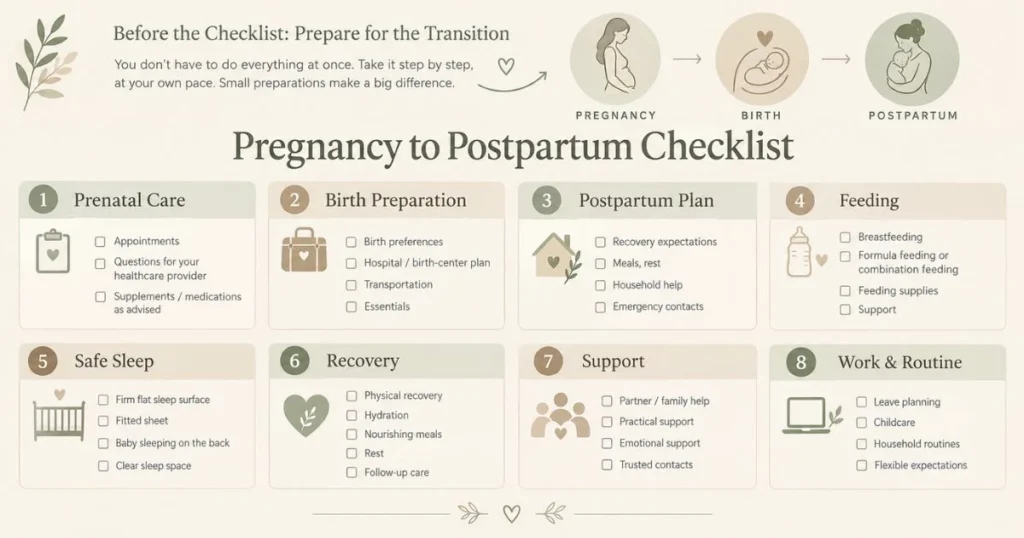
| Stage | Key Priorities |
| First trimester | Prenatal care, rest, nutrition, questions |
| Second trimester | Birth education, baby preparation, support planning |
| Third trimester | Birth preferences, postpartum plan, practical preparation |
| Before birth | Feeding information, safe sleep preparation, hospital/birth bag |
| First days | Recovery, feeding support, rest, newborn care |
| First weeks | Postpartum follow-up, nutrition, emotional support |
| Beyond the early weeks | Routine adjustments, work planning, ongoing recovery |
Frequently Asked Questions About Pregnancy to Postpartum
What does pregnancy to postpartum mean?
Pregnancy to postpartum describes the transition from pregnancy through childbirth and into the period after birth when the mother is recovering and adjusting to life with her baby.
How can I prepare for the transition from pregnancy to postpartum?
Start by preparing both practical and emotional support. Discuss birth and postpartum expectations with your healthcare team, arrange help with meals and household tasks, learn about infant feeding and safe sleep, and identify people you can contact when you need support.
What should I include in a postpartum plan?
Consider your recovery, meals, household responsibilities, baby care, feeding support, sleep opportunities, appointments, emotional support, childcare, and eventual return-to-work arrangements.
How long does postpartum recovery take?
There is no single recovery timeline that applies to everyone. Some aspects of recovery may improve during the first several weeks, while other physical and emotional changes can take longer. Your healthcare professional can help you understand what is appropriate for your individual situation.
What should I know about breastfeeding before giving birth?
It can help to learn about newborn feeding cues, common early challenges, and where to find lactation support. Breastfeeding can take practice, and getting help early can be useful when you’re experiencing difficulties.
Can feeling overwhelmed be a normal part of the postpartum experience?
Feeling overwhelmed can happen during the postpartum transition, particularly with sleep disruption and the demands of newborn care. However, persistent or severe emotional symptoms should be discussed with a healthcare professional.
When should I ask for postpartum help?
Ask for help whenever you need it.You can ask for support before you reach the point of complete exhaustion. Practical assistance with meals, cleaning, errands, childcare, or appointments can make a meaningful difference.
Final Thoughts: Take the Journey One Stage at a Time

The journey from pregnancy to postpartum is not a straight line.
You may have a detailed plan and still need to change it. You might feel confident and ready one day, then find yourself feeling overwhelmed the next. You may discover that feeding, sleep, recovery, or motherhood itself looks different from what you imagined.
That’s okay.
You don’t have to become an expert before your baby arrives.
Prepare where you can, ask questions, accept support, and give yourself permission to learn as you go.
Motherhood isn’t about doing every stage perfectly.
It’s about moving through each stage with information, support, and compassion for yourself.
For reliable guidance on pregnancy care, prenatal visits, and preparing for birth, you can explore the American College of Obstetricians and Gynecologists (ACOG) pregnancy resources.