
Your newborn finishes feeding, and you find yourself wondering whether it was enough. Then the baby wants to eat again an hour later. Or perhaps your baby takes only a small amount from the bottle and falls asleep.
If you’re asking, “How much milk does a newborn drink?”, you’re not alone. Feeding a newborn can be difficult to judge, especially during the first few days when everything seems to change from one feeding to the next.
The important thing to know is that there isn’t one exact amount every newborn should drink. Your baby’s age, size, feeding method, appetite, and health all matter. Breastfed babies also can’t usually be measured in ounces during a direct breastfeeding session.
Instead of focusing on one number, you’ll get a much clearer picture by looking at how often your baby feeds, whether your baby is swallowing effectively, diaper output, hunger and fullness cues, and weight gain.
How Much Milk Does a Newborn Drink?
How Much Milk Does a Newborn Drink can vary during the first days and weeks. A newborn’s milk intake is usually quite small at first because your baby’s stomach is tiny, and their feeding needs can change quickly as they grow.
If you’re formula feeding, you can measure the amount in ounces or milliliters. If you’re breastfeeding directly, you generally won’t know the exact volume your baby consumed during each feeding session.
As a general guide:
| Baby’s age | Breastfed baby | Formula-fed baby |
| First 24 hours | Small amounts of colostrum | Small amounts, often around 1–2 oz (30–60 mL) |
| Days 2–3 | Frequent feeds as milk intake increases | Often around 1–2 oz (30–60 mL) per feeding |
| First week | Frequent feeding according to hunger cues | Gradually increasing amounts |
| Weeks 2–4 | Often 8–12 feeds in 24 hours | Amounts gradually increase |
| Around 1 month | Intake varies from baby to baby | Often around 3–4 oz (90–120 mL) per feeding |
When considering How Much Milk Does a Newborn Drink, remember that these figures are general reference points, not strict targets. A healthy newborn may take different amounts at different feeds.
The CDC recommends offering formula-fed newborns about 1–2 ounces every 2–3 hours during the first days while responding to hunger cues. The American Academy of Pediatrics also describes small early feeds that gradually increase during the first month.
Why Do Newborns Drink Such Small Amounts?
When you wonder How Much Milk Does a Newborn Drink, the amount may seem surprisingly small compared with what an older baby consumes. However, your newborn’s feeding pattern makes sense when you consider how quickly they are growing and how little space their stomach has.
Your Newborn’s Stomach Is Small
When thinking about How Much Milk Does a Newborn Drink, remember that during the first days of life, your baby does not need a large bottle or a long, measured feeding to feel satisfied.
Instead, newborns generally:
- Take small amounts at each feeding.
- Feed frequently during both the day and night.
- Gradually take larger amounts as they grow.
- Go through periods when they want to feed more often.
This is one reason How Much Milk Does a Newborn Drink may not be exactly the same at every feeding.
One feeding may be brief, while another may last much longer. Your baby may also show hunger cues and want to feed again sooner than you expected.
Colostrum Comes First
If you’re breastfeeding, your first milk is called colostrum.
Colostrum is thick and concentrated, and your breasts produce it in relatively small quantities. This is normal and does not mean your baby is not getting enough nourishment.
When considering How Much Milk Does a Newborn Drink, the NHS notes that a newborn may need only about a teaspoonful of colostrum at each feed during the first few days.
As your milk supply increases, usually around 2–4 days after birth, your baby can gradually take larger amounts.
Why frequent breastfeeding matters
Frequent sucking does more than provide nourishment. It also signals your body to produce more milk.
When you’re wondering How Much Milk Does a Newborn Drink, keep in mind that your baby may want to breastfeed very often during the first few days. This can be tiring, but frequent feeding does not necessarily mean there is a problem or that your baby isn’t getting enough milk.
How Much Milk Does a Newborn Drink in the First Few Days?
The first week is a time of rapid change. When considering How Much Milk Does a Newborn Drink, remember that comparing what your baby takes on the first day with their intake by the end of the first month can create unnecessary worry.
How Much Milk Does a Newborn Drink on Day 1?
During the first 24 hours, breastfed babies receive colostrum rather than mature milk. When thinking about How Much Milk Does a Newborn Drink, it’s important to remember that early intake is naturally small.
You may notice that your baby:
- Feeds frequently.
- Takes relatively small amounts.
- Becomes sleepy during feeds.
- Wants to nurse again sooner than expected.
For formula-fed babies, the amount is also relatively small. The CDC recommends starting with about 1–2 ounces (30–60 mL) every 2–3 hours when formula is the baby’s only source of milk during the first days.
Some babies may take less at one feeding, while others may show signs that they are ready for a little more.
How Much Milk Does a Newborn Drink on Days 2–3?
By the second and third days, your baby’s feeding pattern often begins to change. When considering How Much Milk Does a Newborn Drink, it’s normal for intake to vary as your baby adjusts during these early days.
If you’re breastfeeding, your milk production is increasing, and your baby is learning to feed more effectively.
If you’re formula feeding, your baby may gradually start taking more than they did during the first day.
Don’t worry if the amount doesn’t increase in a perfectly predictable pattern. Babies do not necessarily take the same amount at every feeding.
How Much Milk Does a Newborn Drink During the First Week?
By the end of the first week, your baby may be drinking noticeably more milk than they did immediately after birth. When thinking about How Much Milk Does a Newborn Drink, it’s more helpful to look at your baby’s overall feeding pattern rather than focusing on one specific amount.
Your focus should be on these signs:
- Is your baby feeding regularly?
- Are you seeing or hearing swallowing?
- Are wet diapers increasing?
- Does your baby appear satisfied after at least some feeds?
- Is your baby’s weight being monitored?
These clues can be much more useful than trying to make every feeding match a particular number.
How Much Breast Milk Does a Newborn Drink?
If you’re breastfeeding directly, one of the most challenging parts of understanding How Much Milk Does a Newborn Drink is not being able to measure the exact number of ounces your baby takes.
You can see how long your baby nurses, but feeding duration does not necessarily tell you how much milk your baby consumed.
For example, one baby may nurse for 10 minutes and take a different amount of milk than another baby who feeds for the same length of time.
How Much Breast Milk Should a Newborn Drink Per Feeding?
There isn’t a reliable universal ounce measurement for every direct breastfeeding session. When considering How Much Milk Does a Newborn Drink, it’s more helpful to focus on your baby’s feeding cues rather than trying to measure an exact volume.
You may notice:
- Rhythmic sucking.
- Deeper sucking once milk begins flowing.
- Audible or visible swallowing.
- Your baby’s hands and body becoming more relaxed.
- Your baby releasing the breast when satisfied.
A baby may also have a shorter feed when they are less hungry and then take a longer feed later.
How Often Should a Newborn Breastfeed?
When considering How Much Milk Does a Newborn Drink, keep in mind that most breastfed newborns feed about 8–12 times in 24 hours, although some babies may nurse more often.
The CDC notes that newborns may want to feed every 1–3 hours during the early days. Cluster feeding can also occur, with some babies wanting to breastfeed several times within a shorter period.
If your newborn wants to breastfeed again shortly after finishing a feed, that does not automatically mean your milk supply is too low.
What matters more than counting minutes?
Instead of asking yourself, “Has my baby been nursing for enough time?” focus on the signs that can help you understand How Much Milk Does a Newborn Drink and whether your baby is feeding effectively:
- Did I hear swallowing?
- Does my baby seem satisfied after some feeds?
- Are wet diapers increasing?
- Is my baby gaining weight appropriately?
- Does feeding seem effective rather than consistently difficult?
If you’re concerned about milk transfer or your milk supply, a lactation professional or your baby’s healthcare provider can assess your baby’s feeding and provide personalized guidance.
How Much Formula Does a Newborn Drink?
Formula feeding gives you one practical advantage: you can easily see how many ounces or milliliters of milk are in the bottle. This can make it easier to track How Much Milk Does a Newborn Drink at each feeding.
However, you shouldn’t expect your baby to consume exactly the same amount every time. Their intake can naturally vary from one feeding to another.
How Much Formula Does a Newborn Need in the First Days?
When considering How Much Milk Does a Newborn Drink, the CDC recommends offering a formula-fed newborn about 1–2 ounces (30–60 mL) every 2–3 hours during the first few days.
Many formula-fed newborns feed around 8–12 times over 24 hours.
Your baby may sometimes take less or more than this amount. Pay attention to hunger and fullness cues instead of encouraging your baby to finish a specific volume.
How Much Formula Does a Newborn Drink by the End of the First Month?
During the first month, formula intake typically increases. When considering How Much Milk Does a Newborn Drink, the American Academy of Pediatrics describes a gradual increase from small early feeds to approximately 3–4 ounces (90–120 mL) per feeding by the end of the first month for many babies.
Remember, this is not a strict rule your baby needs to follow.
A healthy newborn may take different amounts based on factors such as:
- Body size
- Appetite
- Growth
- Time of day
- Whether they’re experiencing a growth spurt
Should You Make Your Baby Finish the Bottle?
No, you don’t need to encourage your newborn to finish every bottle. When considering How Much Milk Does a Newborn Drink, it’s important to pay attention to your baby’s fullness cues rather than focusing only on how much remains in the bottle.
Look for signs that your baby is satisfied and no longer wants to feed:
- Sucking becomes slower.
- Your baby turns their head away.
- Your baby’s hands become more relaxed.
- Your baby stops sucking.
- Your baby loses interest in the bottle.
- Your baby pushes the bottle away.
Responsive bottle feeding gives your baby a chance to communicate when they’ve had enough and helps them take part in deciding when the feeding is over.
How Often Should a Newborn Drink Milk?
When considering How Much Milk Does a Newborn Drink, remember that the amount your baby takes and how often they feed are related, but they are not the same thing.
A baby who takes a smaller amount may become hungry again sooner, while a baby who drinks more at one feeding may go a little longer before wanting to eat again.
How Often Should a Breastfed Newborn Eat?
When considering How Much Milk Does a Newborn Drink, remember that breastfeeding commonly occurs 8–12 times in 24 hours during the first few weeks.
Some babies may feed even more frequently, especially during periods of cluster feeding.
You may notice patterns such as:
- Several feeds close together in the evening.
- Shorter feeds when your baby is sleepy.
- Longer feeds at other times of the day.
- More frequent feeding during growth periods.
This type of variation can be normal for newborns.
For a more detailed look at feeding patterns throughout the first year, see our baby feeding schedule by age.
How Often Should a Formula-Fed Newborn Eat?
When thinking about How Much Milk Does a Newborn Drink, remember that formula-fed newborns commonly feed every 2–3 hours during the first few days.
As your baby grows, the time between feeds may gradually increase, and many formula-fed infants eventually feed about every 3–4 hours.
However, don’t try to lengthen the time between feeds just to create a more predictable schedule if your newborn is clearly showing signs of hunger.
Should You Wake Your Newborn to Feed?
When considering How Much Milk Does a Newborn Drink, keep in mind that some newborns may need to be awakened for feedings.
Whether you should wake your baby can depend on factors such as:
- Your baby’s age.
- Birth weight.
- Current weight.
- Whether your baby has regained their birth weight.
- Whether your baby was born prematurely.
- Any medical conditions.
- Your pediatrician’s instructions.
If your newborn is unusually difficult to wake or repeatedly misses feeds, contact a healthcare professional for guidance.
How Much Milk Does a Newborn Drink in 24 Hours?
When considering How Much Milk Does a Newborn Drink, there is no exact daily amount that applies to every baby. Each newborn has individual feeding needs, so the amount of milk they need can vary from one baby to another.
Breastfed Newborns
If your baby nurses directly, you usually cannot measure the exact number of ounces consumed during each feeding. When considering How Much Milk Does a Newborn Drink, it’s more useful to look at the overall signs that your baby is feeding well, including:
- Feeding frequency.
- Swallowing.
- Wet diapers.
- Stool changes.
- Weight.
- Overall behavior.
Trying to calculate an exact daily ounce total from direct breastfeeding may create a false sense of precision, since the amount transferred can vary from one feeding to another.
Formula-Fed Newborns
Formula can be measured, making it easier to estimate How Much Milk Does a Newborn Drink over the course of a day.
The American Academy of Pediatrics notes that, on average, babies may consume around 2½ ounces (75 mL) of formula per pound of body weight per day, although individual needs can vary.
This amount is an average, not a target that you should try to make your baby reach.
If your baby consistently appears to need substantially more or less than expected, discuss their feeding pattern with your pediatrician.
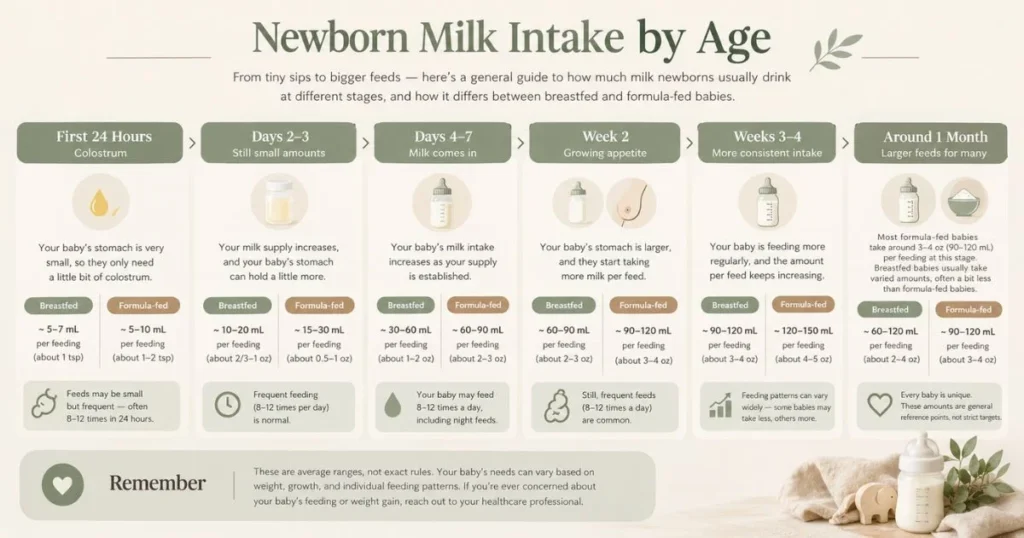
Newborn Milk Intake by Age
Here’s a simple way to visualize how feeding changes:
| Age | What you may notice |
| First 24 hours | Very small, frequent feeds; breastfed babies receive colostrum |
| Days 2–3 | Feeding begins increasing; formula amounts often around 1–2 oz |
| Days 4–7 | Milk intake continues to rise; frequent feeding remains normal |
| Week 2 | Feeding becomes more established, although patterns still vary |
| Weeks 3–4 | Babies generally take more at each feeding |
| Around 1 month | Many formula-fed babies take around 3–4 oz per feeding |
Use this table as a road map, not a timetable.
Your baby doesn’t have to match every number for feeding to be going well.
You can also use our baby feeding chart by age as a general reference for how feeding patterns change as your baby grows.
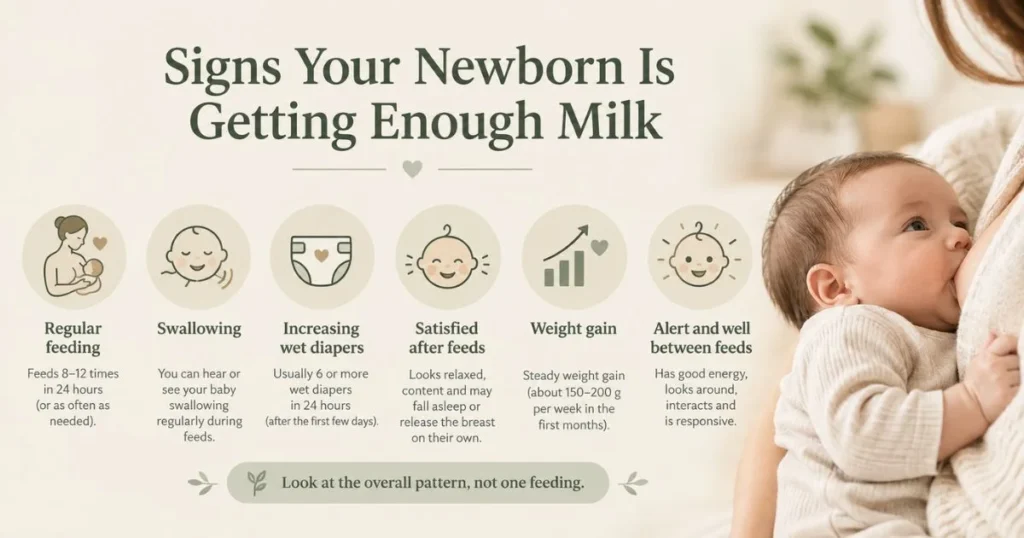
How Do You Know Your Newborn Is Getting Enough Milk?
When wondering How Much Milk Does a Newborn Drink, the bigger question may actually be whether your baby is getting enough milk.
If you find yourself constantly calculating ounces, you may simply be looking for reassurance that your baby’s nutritional needs are being met.
Several signs can help you assess whether your baby is feeding well.
Your Baby Is Feeding Regularly
When considering How Much Milk Does a Newborn Drink, regular waking and feeding can be an important sign that your baby is taking in milk.
For breastfed babies, around 8–12 feeds per day is common.
For formula-fed babies, frequent feeding is also normal during the newborn period.
You Can Hear or See Swallowing
When thinking about How Much Milk Does a Newborn Drink, hearing or seeing your baby swallow during breastfeeding can indicate that milk is being transferred from the breast.
If your baby spends most of a feeding sucking without noticeable swallowing, consider discussing it with a lactation professional, especially if you also notice other signs that your baby may not be getting enough milk.
Wet Diapers Increase
When considering How Much Milk Does a Newborn Drink, remember that diaper output typically changes during the first few days as your baby’s milk intake increases.
Rather than judging hydration from a single diaper, pay attention to the overall pattern of wet diapers over time.
Your Baby’s Weight Is Being Monitored
When you’re trying to understand How Much Milk Does a Newborn Drink, your baby’s weight is one of the most useful indicators of whether they are receiving enough nutrition.
Some weight loss after birth is normal, but healthcare professionals monitor your baby’s weight closely and continue checking for appropriate weight gain.
If your baby is not gaining weight as expected, your pediatrician can help identify whether feeding volume, milk transfer, or another factor may be contributing.
How Many Wet Diapers Should a Newborn Have?
When considering How Much Milk Does a Newborn Drink, diaper output can offer another helpful clue, especially when you look at it together with feeding patterns and weight changes.
During the first few days, the number of wet diapers generally increases as your baby’s milk intake rises.
After several days, your baby will typically have noticeably more wet diapers than they did on the first day of life.
The NHS notes that around six wet nappies a day can be used as a general guide once breastfeeding is well established.
However, diaper counts should not be used on their own to determine whether your baby is getting enough milk. Your baby’s healthcare provider will consider diaper output alongside feeding and growth.
Newborn Hunger and Fullness Cues
You don’t have to wait until your newborn cries before offering milk.
Early Hunger Cues
Your baby may:
- Stir or wake.
- Open their mouth.
- Turn toward your breast or the bottle.
- Root.
- Bring their hands toward their mouth.
- Suck their fingers.
- Become increasingly restless.
Crying is a later hunger signal, and a very upset newborn may be harder to feed.
Signs Your Newborn Is Full
Your baby may:
- Stop sucking.
- Slow down considerably.
- Turn away.
- Relax their hands and body.
- Release the breast.
- Lose interest in the bottle.
- Become calm or sleepy.
Learning these signals can make feeding feel much less like a numbers exercise.
Can You Overfeed a Newborn?
It’s understandable to worry about giving your baby too much milk, especially when you’re measuring bottles.
Can You Overfeed a Breastfed Newborn?
When considering How Much Milk Does a Newborn Drink, responsive breastfeeding allows your baby to follow their own hunger and fullness cues and help regulate how much they take.
If your baby wants to breastfeed frequently, that does not automatically mean they are being overfed.
The NHS advises feeding a breastfed baby according to their individual needs rather than trying to follow a strict volume at each feeding.
Can You Overfeed a Bottle-Fed Newborn?
When thinking about How Much Milk Does a Newborn Drink, bottle feeding requires close attention to your baby’s fullness cues because milk may flow more quickly from a bottle.
Avoid:
- Encouraging your baby to finish the entire bottle.
- Automatically offering additional milk simply because your baby finished the first portion quickly.
- Assuming every period of fussiness means your baby is hungry.
If your baby consistently appears hungry after finishing their usual feeds, talk with your healthcare provider before regularly increasing the amount you offer.
If you are wondering whether feeding-related spit-up or vomiting is normal, see our guide to newborn baby vomiting milk after feeding.
What If Your Newborn Wants to Eat Constantly?
You may have a newborn who seems to want milk every hour.
That can be exhausting.
It can also be normal.
Why Frequent Feeding Happens
There are several possible reasons why a newborn may want to feed frequently when you’re wondering How Much Milk Does a Newborn Drink, including:
- Your newborn’s stomach is still small.
- Your baby is going through a period of rapid growth.
- Frequent breastfeeding is helping establish your milk supply.
- Your baby is experiencing cluster feeding.
- Your baby naturally has a higher appetite.
The CDC notes that some breastfed babies may want to feed as often as every hour at certain times.
When Frequent Feeding Should Be Discussed
Talk with your baby’s healthcare provider or a lactation professional if your baby:
- Never seems satisfied.
- Rarely swallows during breastfeeding.
- Has difficulty latching.
- Has very low diaper output.
- Is unusually sleepy.
- Is not gaining weight appropriately.
- Seems weak during feeds.
What If Your Newborn Is Drinking Less Than Expected?
One smaller feeding does not necessarily indicate a problem. When considering How Much Milk Does a Newborn Drink, remember that babies do not necessarily take the same amount at every feeding.
Instead of focusing on one feed, look at your baby’s overall feeding pattern throughout the day.
Pay closer attention if your newborn repeatedly:
- Refuses to feed.
- Is unusually difficult to wake.
- Has a weak sucking pattern.
- Shows little or no noticeable swallowing.
- Has significantly fewer wet diapers.
- Vomits repeatedly.
- Shows possible signs of dehydration.
- Is not gaining weight as expected.
If your newborn is consistently having difficulty feeding, don’t rely on an online feeding chart to determine what to do. Contact your baby’s healthcare professional for personalized guidance.
If your baby repeatedly vomits after feeding, you can learn more about possible causes and warning signs in our guide to newborn baby vomiting milk after feeding.
How Much Pumped Breast Milk Should You Give a Newborn?
If you’re pumping breast milk and offering it in a bottle, you have the advantage of being able to measure the amount your baby receives.
That can provide reassurance, but it may also leave you wondering, How Much Milk Does a Newborn Drink at each bottle feeding?
There isn’t one exact amount that every newborn needs. The amount your baby takes can vary depending on their age, body size, feeding pattern, and individual needs.
Begin with an appropriate amount and pay attention to your baby’s hunger and fullness cues as they feed.
Look for fullness cues
When considering How Much Milk Does a Newborn Drink, watch for signs that your baby has had enough. Your baby may stop sucking, turn their head away, relax their body, or lose interest in the bottle when they are satisfied.
You don’t need to encourage your baby to finish the entire bottle simply because you measured a specific amount beforehand.
Keep in mind that the amount your baby drinks from a bottle of expressed breast milk does not necessarily show how much milk they would transfer during a direct breastfeeding session.
If your baby also has frequent hiccups after feeds, see our guide on how to stop baby hiccups after feeding.

Common Mistakes Parents Make When Measuring Newborn Milk Intake
Expecting every feeding to be identical
Newborns are not machines. Feeding amounts naturally fluctuate.
Measuring breastfeeding by minutes
Ten minutes at the breast does not automatically equal a specific number of ounces.
Comparing your baby with another newborn
Two healthy newborns can have different feeding patterns.
Assuming frequent feeding means low milk supply
Frequent feeding can be completely normal, particularly during cluster feeding.
Forcing a bottle
If your baby is showing fullness cues, you don’t need to persuade them to finish.
Focusing on one diaper
Look at the overall pattern of wet diapers, feeding, behavior, and weight.
When to Call Your Baby’s Healthcare Provider
When considering How Much Milk Does a Newborn Drink, contact your baby’s doctor, nurse, midwife, or another qualified healthcare professional if you have concerns about feeding.
Pay particular attention if your newborn:
- Repeatedly refuses to feed.
- Is unusually difficult to wake for a feeding.
- Has a weak or ineffective sucking pattern.
- Has noticeably fewer wet diapers.
- Does not appear to swallow during feeds.
- Vomits repeatedly.
- Shows possible signs of dehydration.
- Is not gaining weight as expected.
- Seems unusually weak or lethargic.
- Has difficulty breathing while feeding.
A newborn who is difficult to wake, appears seriously unwell, has breathing difficulties, or shows significant signs of dehydration should receive prompt medical evaluation.
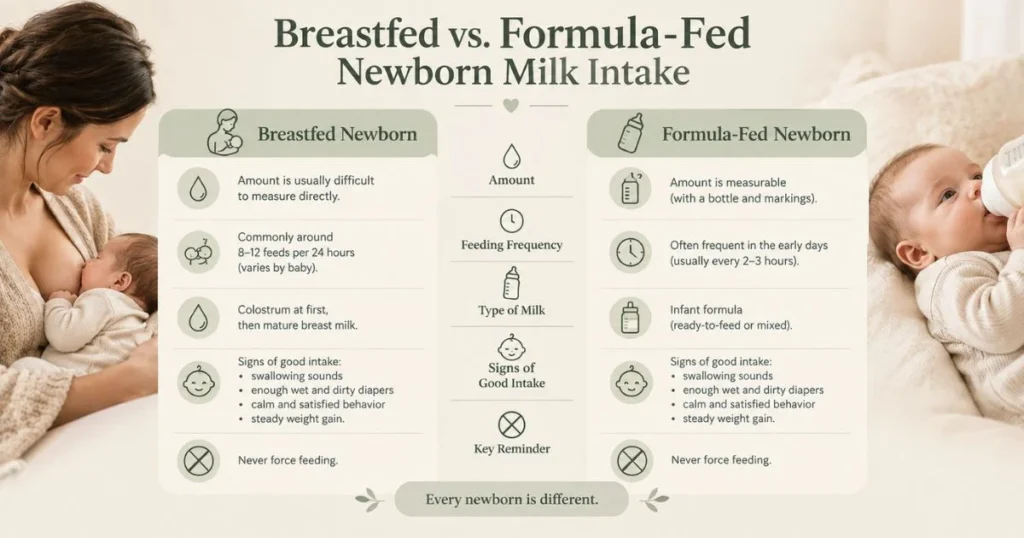
Breastfed vs. Formula-Fed Newborn Milk Intake
| Question | Breastfed newborn | Formula-fed newborn |
| Can you measure every feeding? | Usually not directly | Yes |
| Typical frequency | Often 8–12 feeds/24 hours | Often frequent feeds, especially early on |
| Early milk | Colostrum | Infant formula |
| Early amount | Small and difficult to measure | Often 1–2 oz per feed |
| How do you assess intake? | Swallowing, diapers, behavior, weight | Amount taken, diapers, behavior, weight |
| Should you force feeding? | No | No |
| Can feeding patterns vary? | Yes | Yes |
The biggest difference is that formula gives you a visible number, while direct breastfeeding requires you to look at several signs together.
Frequently Asked Questions About How Much Milk Does a Newborn Drink
How much milk does a newborn typically take at each feeding?
A formula-fed newborn commonly starts with around 1–2 ounces (30–60 mL) per feeding during the first days. Breastfed newborns usually take small amounts of colostrum initially, but you generally cannot measure the exact volume during direct breastfeeding.
How Much Milk Does a Newborn Drink in 24 Hours?
Newborns have different feeding requirements, so the amount of milk they take throughout a full day can vary considerably between babies. Breastfed babies are usually assessed by feeding frequency, swallowing, diaper output, and weight rather than an exact ounce total. Formula-fed babies can be measured more directly, but their intake still varies.
How much breast milk should a newborn drink?
A breastfed newborn commonly feeds 8–12 times in 24 hours, and sometimes more frequently. Instead of trying to measure ounces at the breast, watch for swallowing, adequate diaper output, satisfaction after feeds, and appropriate weight gain.
How much formula does a newborn need?
During the first days, the CDC recommends offering about 1–2 ounces (30–60 mL) every 2–3 hours when formula is the baby’s only source of milk. Your baby’s milk needs can vary based on their individual feeding requirements.
How often should a newborn eat?
Newborns who breastfeed typically nurse about 8 to 12 times over a 24-hour period. Formula-fed newborns often feed every 2–3 hours initially. Your baby’s hunger cues should also guide feeding.
Can a newborn drink too much milk?
Bottle-fed babies can sometimes take more milk than they need if they’re encouraged to keep drinking. Pay attention to signs that your baby is satisfied, and never pressure them to finish the entire bottle.
How Can I Tell Whether My Newborn Is Getting Enough Milk?
Look at the whole picture: regular feeding, swallowing, increasing wet diapers, expected stool changes, periods of contentment, and appropriate weight gain.
Should I wake my newborn to feed?
Some newborns may need to be gently woken for feedings, especially during the first few days or if there are concerns about their weight gain.Follow the feeding instructions and recommendations provided by your baby’s healthcare professional.
Why Does My Newborn Want to Feed Every Hour?
Frequent feeding can happen because newborns have small stomachs and may cluster feed. This may also happen when your baby is going through a growth spurt. If your baby is constantly feeding but isn’t swallowing well, has poor diaper output, or isn’t gaining weight, seek professional advice.
Is 2 ounces enough for a newborn?
Two ounces can be a reasonable formula feeding amount for many newborns, particularly after the earliest day or two. However, you shouldn’t assume that every newborn must drink exactly 2 ounces at every feeding. Hunger and fullness cues matter.
Conclusion: Focus on Your Baby, Not a Perfect Number
So, how much milk does a newborn drink?

The honest answer is that it changes quickly.
During the first days, your newborn may take very small amounts. Breastfed babies receive colostrum and usually feed frequently, while formula-fed newborns commonly begin with around 1–2 ounces per feeding. As the weeks pass, your baby’s stomach grows, milk intake increases, and feeding patterns gradually change.
Rather than trying to make every feeding fit a perfect number, look at the bigger picture.
Ask yourself:
- Is your baby feeding regularly?
- Are you seeing or hearing swallowing?
- Are wet diapers increasing?
- Does your baby show signs of being satisfied?
- Is your baby’s weight being monitored?
- Does your baby seem alert and well between feeds?
Those signs tell you much more than a single bottle or breastfeeding session.
And if something doesn’t seem right, you don’t have to figure it out alone. Your baby’s pediatrician, nurse, midwife, or lactation professional can help you understand your baby’s individual feeding needs.
Your newborn doesn’t need to eat exactly like another baby. What matters is that your baby is getting enough nutrition, staying hydrated, and growing well.
If you’re worried about your baby’s feeding, keep a simple record of feeds, wet diapers, and concerns to bring to your next appointment. Having those details can make it much easier for your healthcare professional to see the full picture.
For a broader overview of feeding patterns during the first year, see our baby feeding schedule by age guide.