
If your child seems to have a running list of everyone else’s mistakes, you’re not alone. One minute they’re happily playing; the next, they rush over with an urgent announcement: “He took my toy!” “She didn’t clean up!” “He got two cookies!”
After the tenth report, it can be tempting to say, “Stop tattling.”
But there is an important reason to pause before you do.
Your child is still learning how to understand rules, fairness, conflict, safety, and other people’s behavior. Sometimes they are looking for attention or hoping another child will get in trouble. Other times, they genuinely need your help.
So the goal isn’t to teach your child never to tell. It’s to help them learn when to speak up, when to solve a problem themselves, and when to let a minor problem go.
That distinction can turn frustrating tattling moments into opportunities to build communication, problem-solving, and emotional skills.

What Is Tattling?
Tattling is generally when a child reports another person’s behavior to an adult when the situation is relatively minor and safe, often because they want the other person to get in trouble, want adult attention, or expect the adult to enforce a rule.
But the behavior alone doesn’t tell you whether something is tattling.
For example, your child saying, “He pushed me,” isn’t something you should automatically dismiss as tattling. Your first job is to understand what happened and determine whether your child needs help.
A better way to think about tattling is to consider three things:
- What happened?
- Why is your child telling you?
- Does your child need an adult to intervene?
Children can have several reasons for reporting another child’s behavior, including wanting attention, taking rules very seriously, seeking adult approval, or wanting another child to get in trouble. (NAEYC)
Why Do Kids Tattle?
Tattling can serve different purposes for different children and in different situations.
Your child may tattle because:
- They believe every rule must be enforced immediately.
- They want your attention.
- They think something is unfair.
- They are frustrated with another child.
- They want the other child to face consequences for what happened.
- They may not know how to handle or resolve the conflict on their own.
- They may be seeking reassurance that they made the right choice by telling an adult.
- They have discovered that reporting problems reliably brings an adult into the situation.
This is why simply telling your child to “stop tattling” doesn’t necessarily solve the underlying problem.
If your child hasn’t learned another way to respond yet, they may continue using the same behavior.
Tattling vs. Telling: How Can You Tell the Difference?
One of the most useful skills you can teach your child is the difference between tattling and telling.

A simple distinction is:
Tattling is usually about getting someone in trouble. Telling is about getting help with a serious or unsafe problem.
The distinction isn’t always perfect, especially for young children. That’s why you should consider the circumstances rather than expecting your child to make an adult-level judgment.
What Counts as Tattling?
A situation is more likely to be tattling when:
- Everyone is physically safe.
- Nobody is being threatened.
- The problem is relatively minor.
- Your child could reasonably try to solve it with words.
- Your child mainly wants the other person to get in trouble.
- An adult doesn’t need to intervene immediately.
For example:
“Mom, Emma took my blue crayon!”
You might respond by helping your child think about what they can say rather than immediately confronting Emma.
What Counts as Telling?
Your child should know that coming to an adult is appropriate when:
- Someone is being hurt.
- Someone is threatening them or another child.
- There is dangerous behavior.
- Bullying is occurring.
- Someone cannot safely get away from the situation.
- Your child has tried to handle a problem but still needs help.
- The situation feels unsafe or overwhelming.
The American Academy of Pediatrics specifically encourages children to get help from a trusted adult when bullying occurs and notes that seeking help for someone who is being bullied is not tattling. (HealthyChildren.org)
Tattling vs. Telling Examples
| What your child says | What it may mean | Your response |
| “She took my toy.” | Minor conflict | Help your child use words or find a solution |
| “He won’t give me a turn.” | Sharing/turn-taking problem | Coach your child through the disagreement |
| “She didn’t follow the rule.” | Rule concern | Ask whether anyone is unsafe |
| “He pushed me.” | Possible aggression | Find out what happened and make sure your child is safe |
| “They’re threatening to hurt someone.” | Safety concern | Get involved |
| “They’re bullying another child.” | Serious concern | Encourage your child to get a trusted adult |
| “I tried to solve it, but I can’t.” | Child needs support | Step in and help |
The important lesson is that getting help isn’t something your child should feel ashamed of.
When Should Your Child Always Tell an Adult?
Children need a clear message:
You can always tell a trusted adult when you don’t feel safe.
That includes situations involving physical harm, threats, dangerous behavior, bullying, or other serious concerns.
HealthyChildren.org recommends a “stop, walk, talk” approach for bullying: when it is safe to do so, children can firmly tell the person to stop, walk away, and then talk to a trusted adult who can help. (HealthyChildren.org)
You can make this even simpler for younger children:
“If someone could get hurt, come get me.”
You can also tell your child:
“You can always come to me if you or someone else is unsafe. You won’t be in trouble for telling me.”
That reassurance matters.
You don’t want your child to become so worried about being labeled a tattletale that they stay quiet about something serious.
Why Is My Child Tattling So Much?
When tattling seems constant, it’s easy to focus on stopping the behavior. Before you do, take a moment to consider what your child may be trying to accomplish.

Your Child May Take Rules Very Seriously
Young children often have a strong interest in rules and fairness.
If you’ve taught your child that hitting isn’t okay, for example, they may believe that any instance of another child breaking a rule needs to be reported immediately.
From your perspective, it may be a minor issue.
From your child’s perspective, they may be thinking:
“Mom said this isn’t allowed, so someone needs to know.”
That doesn’t mean you need to enforce every minor rule violation. It means your child may need help understanding which problems require adult involvement.
Your Child May Want Your Attention
Sometimes the real message behind a complaint is:
“Look at me.”
If your child has discovered that reporting other people’s behavior produces a long conversation with you, they may keep doing it.
This doesn’t mean your child is deliberately manipulating you.
Children naturally repeat behaviors that reliably produce a response.
You can meet the need for connection while still setting a boundary around unnecessary reporting.
Try giving your child positive attention at other times:
- “Tell me about what you built.”
- “I noticed how patiently you waited.”
- “Come sit with me for a minute.”
- “I’d love to hear about your day.”
Your Child May Have a Strong Sense of Fairness
Some children notice every difference:
“She got the bigger piece.”
“He had three turns and I only had two.”
“You let him stay up later.”
Fairness matters to children, but equality and fairness aren’t always identical.
You can acknowledge the feeling without promising to correct every perceived injustice.
Try:
“It feels unfair when you want something to be the same and it isn’t.”
Then help your child decide whether anything actually needs to be done.
Your Child May Not Know How to Solve Conflict
This is one of the most important reasons to teach an alternative to tattling.
Your child might know:
“I don’t like what happened.”
but not know how to continue with:
“Here’s what I can do about it.”
Conflict resolution is a skill. It develops through practice.
NAEYC describes guidance as helping children learn what to do differently rather than simply punishing them for mistakes. Its examples emphasize helping children describe what happened, calm down, consider each person’s perspective, and work toward a solution. (NAEYC)
How to Respond to Tattling Without Shaming Your Child
Your response matters.
If you repeatedly say, “Stop tattling,” your child may learn that bringing problems to you is annoying or unacceptable.
Instead, use the moment to teach.
1. Listen Before You Label It Tattling
When your child comes running to you, don’t immediately decide what the behavior means.
Start with:
“Tell me what happened.”
You don’t need to launch a full investigation every time.
A few calm questions may be enough to determine whether this is a minor conflict or something more serious.
2. Check Whether Anyone Is Unsafe
This should come before everything else.
Ask:
- “Is anyone hurt?”
- “Is anyone unsafe?”
- “Did someone threaten you?”
- “Do you need my help?”
If the answer is yes, take the concern seriously.
If everyone is safe, you can move toward coaching.
3. Acknowledge Your Child’s Feelings
You don’t have to agree with your child’s interpretation to recognize their emotion.
Try:
“That bothered you.”
“You thought that was unfair.”
“You really wanted another turn.”
This can help your child feel heard without turning every complaint into an adult-managed conflict.
4. Ask What Happened
Keep your questions neutral.
Instead of:
“What did your brother do this time?”
try:
“What happened?”
This gives you a better chance of hearing the situation without encouraging your child to build a case against someone else.
5. Ask What Your Child Has Tried
If everyone is safe, ask:
“What have you tried?”
or:
“What could you say to them?”
This is where tattling can become a lesson in problem-solving.
6. Help Your Child Choose the Next Step
Depending on the situation, your child might:
- Ask for a turn.
- Say “Please stop.”
- Move away.
- Offer a compromise.
- Ask the other child a question.
- Let the minor issue go.
- Ask an adult for help.
You don’t have to solve every conflict for your child.
Sometimes the most helpful thing you can do is stay nearby while they practice handling it.
What to Say When Your Child Tattles
Knowing what to say can make these situations much easier.
When Your Child Says, “He Took My Toy”
Try:
“You wanted the toy back. Is anyone unsafe? If not, what could you say to him?”
If your child is too young to handle it alone, you can help them practice:
“You can say, ‘I was playing with that. Can I have it back when you’re finished?’”
When Your Child Says, “She Didn’t Follow the Rules”
Try:
“You noticed she didn’t follow the rule. Does anyone need help, or is this something you can let the grown-up in charge handle?”
This teaches your child that they don’t have to become the rule enforcer.
When Your Child Says, “He Hit Me”
Don’t respond with:
“Don’t tattle.”
Instead:
“Thank you for telling me. Are you hurt? I’m going to help you.”
Physical aggression requires a different response from a disagreement over a toy.
When Your Child Says, “She Won’t Share”
Try:
“You both want the same thing. What could you ask her?”
You might help your child practice:
“Can I have a turn when you’re finished?”
When Your Child Reports Every Little Thing
If you’ve already established that everyone is safe, you can use the same calm response each time:
“I hear you. Everyone is safe. What do you think you can do next?”
Consistency is useful because your child learns what to expect from you.
How to Teach Your Child to Handle Minor Conflicts
The long-term goal isn’t simply fewer tattling episodes.
It’s a child who gradually becomes more capable of handling ordinary social problems.
Teach Simple Boundary-Setting Words
Give your child short phrases they can actually remember.
- “Please stop.”
- “I don’t like that.”
- “That’s my turn.”
- “Please give it back.”
- “I was using that.”
- “Can I have a turn?”
- “I need some space.”
You can practice these phrases when everyone is calm.
Teach Your Child a Problem-Solving Sequence
When a minor conflict happens, walk through these questions:
1. What happened?
Encourage your child to describe the situation without insults or exaggeration.
2. What do you want?
Maybe they want their toy returned, a turn, an apology, or some space.
3. What could you say?
Help them choose words that are clear rather than aggressive.
4. What could you try?
Let them think of a solution.
5. Do you still need help?
If the answer is yes, step in.
This approach doesn’t require your child to solve everything independently.
It teaches them to try when it is safe and ask for help when they need it.
Practice Through Role-Play
Don’t wait for a sibling argument to teach conflict resolution.
Use pretend situations during calm moments:
“Imagine your friend takes your favorite truck. What could you say?”
Or:
“Imagine someone keeps cutting in front of you. What could you do?”
Role-play gives children a chance to practice the words before emotions make those words harder to find.
How to Stop Tattling Without Discouraging Your Child From Speaking Up
If your goal is to reduce tattling, focus on teaching—not simply suppressing—the behavior.
Don’t Call Your Child a “Tattletale”
Labels can become part of how children see themselves.
Instead of:
“You’re being a tattletale.”
try:
“You came to me with a problem. Let’s figure out whether you need my help.”
This separates the behavior from the child.
NAEYC recommends guidance approaches that help children learn from mistakes rather than using shame or punishment as the primary response. (NAEYC)
Don’t Punish Your Child for Speaking Up
You want your child to know that serious concerns are welcome.
A child shouldn’t have to wonder:
“Will Mom be angry if I tell her someone hurt me?”
Instead:
“You can always tell me when you need help. I’ll help you figure out what to do.”
Don’t Solve Every Minor Conflict
If you immediately run over and settle every disagreement, your child has less opportunity to practice.
When it’s safe, step back.
Ask:
“What could you try?”
You can remain available without becoming the referee.
Don’t Ignore Every Report
The opposite extreme can be just as unhelpful.
If your child has been tattling frequently, it’s tempting to stop listening altogether.
Don’t.
Listen enough to determine whether something serious is happening.
HealthyChildren.org encourages parents to remain available to children who need to talk about bullying and other concerns and to help them identify trusted adults who can support them. (HealthyChildren.org)
Praise Good Judgment
Instead of praising your child simply for not tattling, notice when they make a thoughtful decision.
Try:
“You handled that calmly.”
“You knew when you needed help.”
“You used your words first.”
“You came to me because someone wasn’t safe. That was the right choice.”
This teaches the skill you’re actually trying to build: good judgment.
When Tattling Is Actually a Sign Your Child Needs Help
Frequent tattling isn’t automatically a problem.
But sometimes what looks like tattling is actually your child’s attempt to tell you that something isn’t working.
Your Child Is Being Bullied
Pay attention when your child repeatedly reports the same child or the same type of behavior.
Look for patterns rather than dismissing each report individually.
Bullying should not be reduced to ordinary childhood conflict. The AAP recommends taking bullying seriously and involving trusted adults when needed. (HealthyChildren.org)
Your Child Is Being Hurt or Threatened
Physical aggression, threats, or dangerous situations deserve adult attention.
Don’t tell your child to “work it out” when they aren’t safe.
The Problem Keeps Happening
One argument over a toy is different from the same child repeatedly targeting your child.
Ask:
- “Has this happened before?”
- “How often?”
- “Where does it happen?”
- “Who is usually involved?”
- “What happens before it starts?”
Patterns can tell you much more than one isolated complaint.
Your Child Doesn’t Feel Safe
Take your child’s sense of safety seriously even if you aren’t sure what happened yet.
You can investigate without dismissing them.
Try:
“I’m glad you told me. Let’s figure out what happened.”
Your Child Can’t Handle the Situation Alone
Sometimes the right answer isn’t “solve it yourself.”
A child may genuinely need an adult to step in because of their age, the power difference between children, the seriousness of the situation, or the child’s emotional state.
Getting help is a skill—not a failure.
Tattling and Bullying: When Parents Should Step In
It’s helpful to distinguish ordinary conflict from situations requiring adult involvement.
Ordinary Conflict
Examples include:
- Arguing over a toy
- Disagreeing about turns
- Wanting the same seat
- Complaining about a minor rule violation
- Being annoyed by a sibling
When everyone is safe, you can often coach your child through the problem.
More Serious Concerns
Pay closer attention when behavior involves:
- Repeated targeting
- Threats
- Physical aggression
- Significant intimidation
- Dangerous behavior
- Bullying
- A child who feels unable to get away
- A child repeatedly asking for adult help
The AAP recommends involving trusted adults when bullying or safety concerns are present, and specifically encourages children to seek help for another child who is being bullied. (HealthyChildren.org)
A Simple 3-Step Tattling Response for Parents
When you aren’t sure how to respond, remember three words:
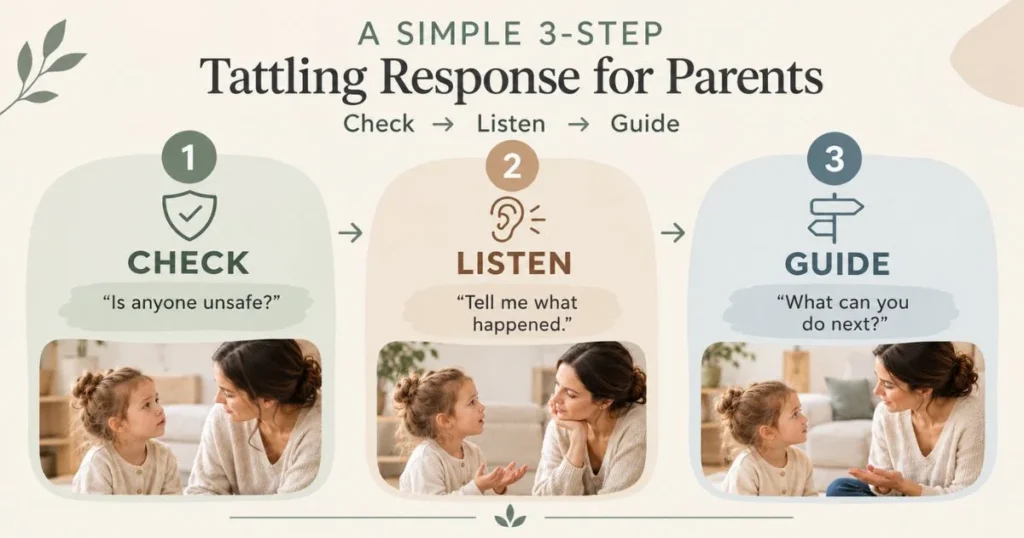
Step 1: Check
Ask:
“Is anyone unsafe?”
If yes, step in.
Step 2: Listen
Ask:
“Tell me what happened.”
Give your child enough space to explain.
Step 3: Guide
If everyone is safe, ask:
“What can you do next?”
Then help if necessary.
You can remember it this way:
Unsafe → Get help.
Safe but difficult → Try to solve it.
Minor problem → Let it go when appropriate.
This isn’t a rigid formula. Your child’s age, development, the circumstances, and the seriousness of the situation all matter.
The purpose is simply to give you a starting point.
Frequently Asked Questions About Tattling
Why do kids tattle?
Kids may tattle because they’re learning rules, seeking attention or reassurance, reacting to perceived unfairness, wanting another child to get in trouble, or not yet knowing how to solve a conflict independently.
Is tattling normal?
Tattling can be part of children’s developing social and problem-solving skills. What matters is the pattern, the child’s age, the circumstances, and whether the reports involve genuine safety concerns.
What is the difference between tattling and telling?
Tattling generally involves reporting a minor, safe problem, often with the goal of getting another child in trouble. Telling means seeking help because someone is hurt, unsafe, threatened, bullied, or unable to handle the situation alone.
How do I stop my child from tattling?
Instead of focusing only on stopping tattling, teach your child what to do instead. Help them distinguish safety problems from minor conflicts, practice useful phrases, encourage problem-solving, and consistently check whether they actually need adult help.
Should I ignore tattling?
Not automatically. First make sure your child isn’t reporting something involving harm, bullying, threats, or safety. If everyone is safe, you can acknowledge the concern and redirect your child toward solving the problem.
What should I say when my child tattles?
Try:
“I hear you. Is anyone unsafe? If everyone is safe, let’s think about what you can do next.”
This acknowledges your child without automatically taking over the conflict.
When should a child tell an adult?
Your child should seek help when someone is hurt, threatened, bullied, in danger, or unable to safely handle the situation. They should also tell a trusted adult when they have tried to solve a problem and still need help.
Is telling an adult about bullying tattling?
No. Seeking help for someone who is being bullied is not tattling. The American Academy of Pediatrics explicitly encourages children to get a trusted adult involved when bullying occurs. (HealthyChildren.org)
Conclusion: Teach Your Child When to Speak Up
Tattling can test your patience, especially when your child seems determined to report every little thing another person does.

But you don’t have to choose between listening to your child and teaching them independence.
You can do both.
Start by checking for safety. Listen to what happened. Acknowledge your child’s feelings. Then, when the situation is safe, give them a chance to think about what they can do themselves.
Over time, your child can learn an important distinction:
“I can solve some problems myself, and I can always ask for help when something isn’t safe.”
That’s much more valuable than simply teaching your child not to tattle.
The next time your child runs to you with a complaint, pause before saying, “Stop tattling.” Instead, ask:
“Is anyone unsafe, or do you need help solving a problem?”
That simple question can open the door to a much deeper lesson about communication, empathy, personal boundaries, and making thoughtful choices.
Parenting Whisper Reminder: Your child doesn’t need to learn “Don’t tell.” They need to learn when to speak up, when to solve a problem, and when to come to you for help.
If this approach fits your family, save the 3-step Tattling Response—Check, Listen, Guide and practice it during calm moments. The goal isn’t perfect conflict resolution. It’s helping your child become a little more confident handling everyday problems, one situation at a time.