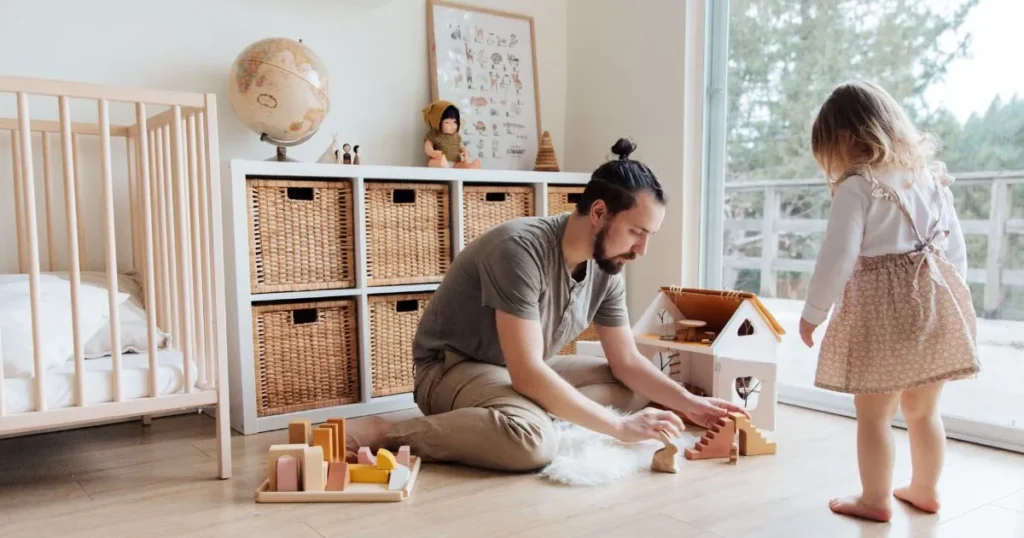

There are days when it feels as though your child has decided to disagree with everything you say.
“Put your shoes on.”
“No.”
“Time to leave the playground.”
“I don’t want to!”
“Let’s get ready for bed.”
“No! I’m not tired!”
After enough of these moments, you may start wondering what is happening. Is your child becoming defiant? Are they deliberately challenging you? Have you been too strict—or perhaps not strict enough?
If your child is rebelling, it can be frustrating, especially when an ordinary request suddenly turns into an argument.
But challenging behavior does not always mean your child is trying to disrespect you or make your day harder. Children naturally test limits, seek independence, experience powerful emotions, and learn how much control they have over their world. The American Academy of Pediatrics notes that occasional defiance is part of growing up and can help children explore individuality, autonomy, and boundaries.
That does not mean you have to say yes to everything.
You can understand your child’s feelings while maintaining a firm boundary. You can stay connected without giving in. And you can respond calmly without becoming permissive.
The first step is understanding what may be underneath your child’s resistance.

What Does Rebelling Mean in Children?
When you describe a child as rebelling, you are usually talking about repeated resistance to something you have asked them to do or a boundary you have established.
It might look like:
- Saying “no” repeatedly
- Refusing everyday requests
- Arguing about household rules
- Ignoring instructions
- Testing limits
- Insisting on doing everything independently
- Becoming upset when you say no
- Delaying routines
- Negotiating after you have already given an answer
- Talking back or challenging an instruction
However, not every disagreement is rebellious behavior.
A two-year-old who says, “I do it!” when you try to help them put on their shoes may be showing a growing desire for independence. A preschooler who protests when playtime ends may be struggling with a transition. A tired child who melts down over getting dressed may simply have very little emotional capacity left.
The CDC explains that toddlers become increasingly independent and may show defiant behavior as they develop.
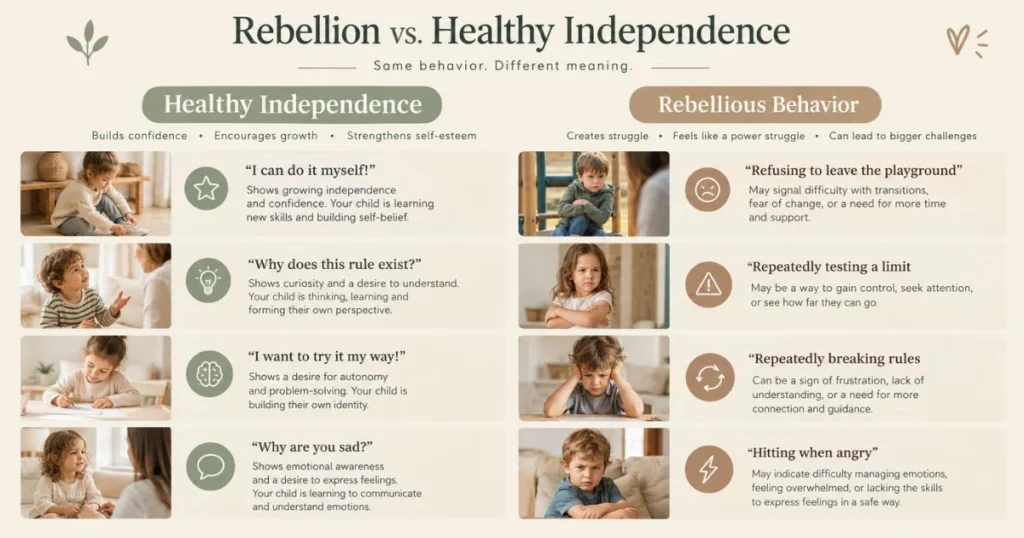
Rebelling vs. healthy independence
It helps to look at what is happening rather than immediately assigning a label.
| What you see | What may be happening |
| “I can do it myself!” | Growing independence |
| Refusing to leave the playground | Difficulty with transitions |
| Asking why a rule exists | Curiosity and developing reasoning |
| Repeatedly testing an established limit | Boundary testing |
| Hitting when angry | Difficulty managing emotions and unsafe behavior |
The goal is not to stop your child from having opinions.
Your goal is to help your child learn that they can have strong feelings, disagree with you, and still behave safely within reasonable boundaries.
Why Are Kids Rebelling? 7 Common Reasons
Before you decide how to respond, it helps to ask a different question:
What is my child’s behavior trying to tell me?
There is rarely one explanation for every episode of resistance. Your child’s age, temperament, environment, emotional state, expectations, and family routines can all play a role.
1. Your Child Wants More Independence
One of the biggest reasons kids start rebelling is simple: they want more control over their lives.
As children grow, they become increasingly aware that they are separate people with their own preferences.
They want to choose:
- What to wear
- What to eat
- Which toy to play with
- How to complete a task
- When to stop playing
- Whether they need help
For you, putting on shoes may be a two-minute task.
For your child, it may represent a chance to prove, “I can do this myself.”
The CDC recommends encouraging young children’s growing independence by allowing them to participate in age-appropriate tasks such as dressing and feeding themselves.
This is where small choices can help.
Instead of:
“Put your shoes on now.”
You might say:
“Do you want to put your shoes on yourself, or would you like me to help?”
The boundary remains. Your child simply gets some control over how they meet it.
2. Your Child Is Testing Boundaries
Children learn about rules partly by testing them.
Your child may be wondering:
Does this rule still apply if I complain?
What happens if I refuse?
Will Mom change her mind if I keep asking?
This does not necessarily mean your child is being manipulative.
Children need predictable limits to understand how their environment works. The CDC recommends making family rules clear, realistic, consistent, and predictable, with caregivers following through on expectations.
If bedtime is 8:00 p.m. one night, 9:30 the next night, and 8:00 again after an argument, your child may have difficulty understanding where the actual boundary is.
Consistency does not mean being rigid about every little thing.
It means that important limits are clear and predictable, even when your child pushes back.
3. Your Child Is Still Learning Emotional Regulation
Your child may know the rule and still struggle to follow it when emotions become intense.
Think about the difference between:
“I know I’m angry.”
and:
“I know I’m angry, but I can control what I do next.”
That second skill develops gradually.
Young children often need adults to help them recognize, name, and manage strong emotions. The CDC recommends emotion coaching that includes noticing, connecting, listening, naming the emotion, and then helping the child find an appropriate response.
So when your child screams because you said no, the behavior may be communicating:
“This disappointment feels enormous to me right now.”
You can respond without changing the boundary.
“You’re really angry because you wanted another turn. It’s okay to be angry. I won’t let you hit.”
That sentence does two things at once:
It accepts the feeling while limiting the behavior.
4. Your Child May Feel Unheard
Sometimes resistance grows when children feel that every interaction consists of instructions.
“Get dressed.”
“Eat your breakfast.”
“Stop that.”
“Come here.”
“Put that away.”
“Let’s go.”
Even when all those requests are reasonable, your child may begin pushing back simply because they want some connection or involvement.
Listening does not mean allowing your child to make every decision.
You can pause and acknowledge what they are saying:
“You really wanted to keep playing.”
Then continue:
“It’s still time to go home.”
Your child learns that being heard does not automatically mean getting their way.
5. Your Child Is Tired, Hungry, or Overwhelmed
A child with plenty of emotional energy may handle a limit reasonably well.
That same child after a long day, skipped snack, poor sleep, or too much stimulation may react very differently.
Before deciding that your child is deliberately rebelling, consider:
- Did they sleep enough?
- Have they eaten recently?
- Has the day been unusually busy?
- Are there too many transitions?
- Have they had enough quiet time?
- Are they overwhelmed by noise or activity?
This does not excuse unsafe behavior.
It gives you useful information.
If your child is exhausted, you may need fewer words, fewer demands, and more support.
6. Transitions Are Hard
Your child may not actually be rebelling against the activity you are asking them to do.
They may be resisting the transition.
Stopping a favorite game means losing something enjoyable. Leaving the park means giving up freedom. Turning off a screen means ending something highly engaging.
A warning can make these moments easier:
“Five more minutes, then we’ll clean up.”
Then:
“Five minutes are finished. It’s time to go.”
Predictability can reduce the surprise of the transition.
7. You May Be Caught in a Power Struggle
This is one of the easiest patterns to fall into when your child is rebelling.
You ask.
Your child refuses.
You repeat yourself.
Your child argues.
You become firmer.
Your child becomes louder.
You raise your voice.
Your child escalates.
Now the original issue—putting on shoes—has become a battle over who is going to win.
The AAP notes that a parent’s reaction matters and recommends remaining calm, cooperative, and consistent when dealing with disobedient behavior.
Sometimes the most powerful response is not another argument.
It is a calm boundary followed by action.
Is Rebelling Normal for Kids?
Some resistance is a normal part of childhood.
Children are learning:
- Independence
- Self-control
- Social expectations
- Emotional regulation
- Problem-solving
- How rules work
- How to express disagreement
The CDC notes that children test limits as part of healthy development, and testing limits alone does not mean a child has a behavioral disorder.
The important question is not simply:
“Does my child rebel?”
Ask instead:
“How frequent, intense, and disruptive is the behavior?”
Occasional resistance is different from behavior that is persistent, severe, occurs across settings, or significantly interferes with family, school, or peer relationships.
If you are concerned about the pattern, discuss it with your child’s pediatrician or another qualified professional.
How to Respond When Your Child Is Rebelling
Understanding why your child is rebelling is useful, but you also need something practical to do in the moment.
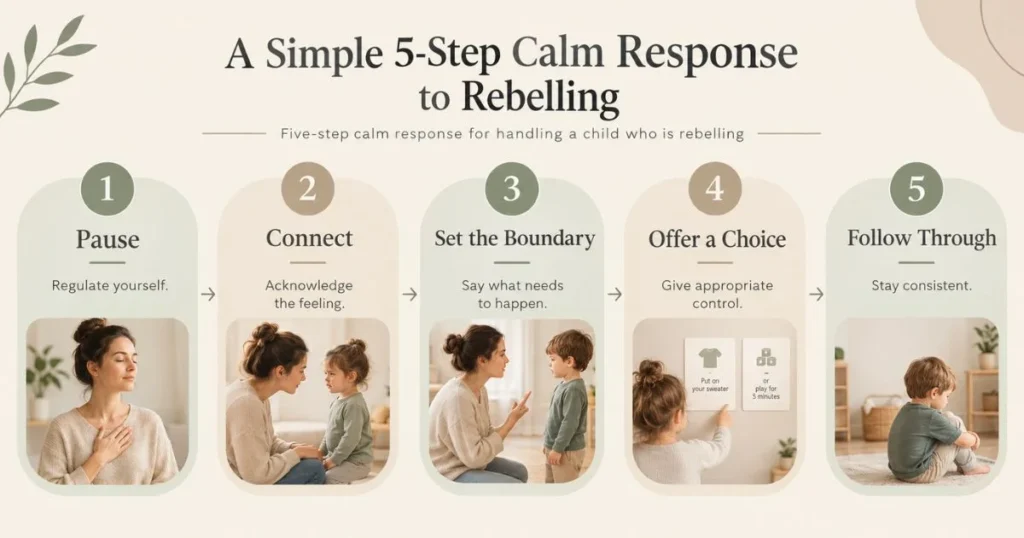
A calm response can follow five simple steps.
Step 1: Pause Before You React
When your child pushes back, your own emotions may rise quickly.
You may feel:
- Irritated
- Embarrassed
- Exhausted
- Disrespected
- Rushed
Before responding, take a breath if the situation is safe.
You do not have to match your child’s intensity.
The CDC specifically recommends that parents pause and regulate their own emotions before trying to coach a child through intense feelings.
Step 2: Acknowledge the Feeling
You can recognize the emotion without agreeing to the demand.
Try:
“You really don’t want to leave.”
“You’re disappointed that screen time is over.”
“You wanted to do it yourself.”
This tells your child:
“I hear you.”
It does not say:
“You get to decide everything.”
Step 3: State the Boundary Clearly
Keep your words short.
Instead of:
“How many times do I have to remind you that we’re short on time? You always do this when we’re getting ready to leave.”
Try:
“It’s time to leave.”
Clear directions are easier for young children to understand and act on. CDC guidance recommends giving simple, specific directions that tell children what to do rather than only what not to do.
Step 4: Offer a Choice When One Exists
Choices are especially useful when your child is rebelling because they want more independence.
For example:
“Do you want to walk to the car or hold my hand?”
“Do you want to brush your teeth before the story or after?”
“Do you want to put your pajamas on yourself, or would you like help?”
The choice should not remove a necessary boundary.
If bedtime is happening, you are not asking:
“Do you want to go to bed?”
You are giving your child control over something smaller:
“Do you want to choose the book or the pajamas first?”
Step 5: Follow Through Calmly
A boundary only becomes meaningful when you follow through.
The CDC emphasizes consistency, predictability, and follow-through when establishing family rules.
You do not need to threaten, lecture, or become angry.
You simply do what you said you would do.
How to Give Your Child Choices Without Giving Up the Boundary
Giving choices can be helpful, but too many choices can create another problem.
Offer two realistic options.
| Situation | Instead of | Try |
| Getting dressed | “Get dressed!” | “Blue shirt or green shirt?” |
| Leaving the park | “Do you want to leave?” | “Walk to the car or hold my hand?” |
| Cleaning up | “Clean everything now!” | “Cars first or blocks first?” |
| Bedtime | “Go to bed.” | “Story first or pajamas first?” |
The AAP also recommends offering children small, directed choices during challenging moments.
The important part is that both options must be acceptable to you.
What to Say When Your Child Is Rebelling
When you’re exhausted, finding the right words can be hard. Having a few simple phrases ready can help you stay calm when your child is rebelling and avoid a long argument.
When your child says, “No!”
Try:
“You don’t want to. I hear you. It’s still time to get dressed.”
When your child says, “You can’t make me!”
Try:
“You don’t have to like the rule. I’m going to help you follow it.”
When your child keeps arguing
Try:
“I’ve answered you. I’m not going to keep arguing about it.”
When your child screams
Try:
“You’re very angry. I’m here. I won’t let you hurt anyone.”
When your child wants something you have already refused
Try:
“I know you want it. The answer is still no.”
When your child is rebelling, you don’t need a different explanation every time they ask.
Sometimes calm repetition is more effective than another five-minute discussion.
What Not to Do When Kids Are Rebelling
Your response can either calm the situation or add fuel to it.
That does not mean you will always respond perfectly. Parenting is demanding, and everyone loses patience sometimes.
Still, some patterns are worth noticing when your child is rebelling, because they can make challenging behavior harder to manage.
Avoid turning every disagreement into a battle
Not every “no” needs an immediate correction.
When your child is rebelling, ask yourself:
Is this a safety issue, an important family rule, or simply something I prefer to happen differently?
You can be flexible about small things while remaining firm about important boundaries.
Avoid long lectures
A child who is already overwhelmed may not absorb a lengthy explanation.
When your child is rebelling, use fewer words.
Instead of:
“I have told you a hundred times that you cannot throw toys because toys are not for throwing and someone could get hurt and you need to listen when I tell you something…”
Try:
“Toys are not for throwing. I’m putting it away for now.”
Avoid labels
CaCalling your child:
- “Bad”
- “Difficult”
- “Rebellious”
- “Disrespectful”
can turn a behavior into an identity.
When your child is rebelling, describe what happened instead:
“You are having a hard time following the rule.”
That leaves room for your child to learn a different response.
Avoid empty threats
If you say something will happen, make sure you are prepared to follow through.
Children learn from consistency.
The CDC recommends clear consequences and follow-through rather than constantly changing responses.
How to Handle Rebellious Behavior Without Becoming Permissive
If you are interested in gentle parenting, you may worry that staying calm means your child will learn they can do whatever they want.
It doesn’t.
Gentle parenting is not the absence of boundaries.
You can be warm and firm at the same time.
For example:
“I know you’re angry. I won’t let you hit.”
That is both compassionate and firm.
| Your child’s feeling | Your boundary |
| “You’re angry.” | “I won’t let you hit.” |
| “You wanted more screen time.” | “Screen time is finished.” |
| “You don’t want to leave.” | “It’s time to go.” |
| “You wanted the toy.” | “We’re not buying it today.” |
The message is:
All feelings are allowed. Not every behavior is allowed.
The CDC’s emotion-coaching guidance similarly recommends validating children’s emotions while setting limits on hurtful or unsafe behavior.
How to Prevent Repeated Power Struggles
You do not have to wait until your child is already screaming to respond differently to rebelling.
Small changes throughout the day can make cooperation easier and reduce the chance of power struggles.
Create predictable routines
Children often do better when they know what comes next, especially when they are rebelling against a transition.
A simple routine might be:
Dinner → Bath → Pajamas → Story → Bed
You don’t need a complicated schedule.
The important part is predictability.
CDC guidance explains that routines and rules can help children know what to expect and can make daily life smoother.
Prepare for transitions
Give your child advance notice when possible.
“Five minutes until cleanup.”
Then:
“Two more minutes.”
Then:
“It’s time to clean up.”
This gives your child a chance to mentally prepare and shift from one activity to another, which can make transitions easier when they are rebelling.
Give attention to cooperation
It is easy to notice every time your child refuses and overlook the moments when they cooperate.
Try to catch those moments.
“You came when I called you. Thank you.”
“You were disappointed, but you kept your hands gentle.”
“You put your shoes on without arguing. That helped us get ready.”
Specific praise tells your child exactly what behavior you want to see again. The CDC recommends positive attention and labeled praise to encourage desired behaviors.
Keep expectations realistic
A tired toddler may not be able to calmly manage six instructions at once.
Break tasks into small steps.
Instead of:
“Go upstairs, put your pajamas on, brush your teeth, put your clothes away, and get into bed.”
Try:
“Let’s go upstairs.”
Then:
“Now let’s put on your pajamas.”
Simple directions can reduce unnecessary friction, especially when your child is rebelling because they feel overwhelmed.
A Simple 5-Step Calm Response to Rebelling
When your child is pushing back, remember this sequence:
1. Pause
Regulate yourself before trying to regulate your child.
2. Connect
Show your child that you understand the feeling.
3. Set the boundary
State what needs to happen.
4. Offer a choice
Give your child control where you genuinely can.
5. Follow through
Stay consistent without turning the situation into a contest.
A real-life example
Imagine your child refuses to leave the playground.
You could say:
“You really want to keep playing.”
Pause.
“It’s time to go home.”
Then offer:
“Do you want to walk to the car or hold my hand?”
If your child cries:
“You’re disappointed. I know. I’m going to help you leave safely.”
You have not ignored the emotion.
You have not removed the boundary.
And you have not turned the moment into a battle over who has more power.
What If Your Child Keeps Rebelling No Matter What You Do?
Sometimes the behavior continues even after you become more consistent and calm.
Instead of immediately deciding that your child is simply “rebellious,” look for patterns.
Ask yourself:
| Question | What it may reveal |
| When does it happen? | Certain routines or transitions may be difficult |
| What happens immediately before? | A specific trigger may be present |
| What happens afterward? | Your response may unintentionally reinforce the behavior |
| Is my expectation realistic? | The task may be too difficult for your child’s age |
| Does it happen everywhere? | The issue may extend beyond one family routine |
| Does it happen mainly when tired? | Fatigue may be contributing |
You can also use a simple ABC approach:
A — Antecedent: What happened before the behavior?
B — Behavior: What exactly did your child do?
C — Consequence: What happened immediately afterward?
The purpose is not to blame your child.
It is to notice patterns.
For example, you may discover that your child rarely resists getting dressed in the morning but regularly melts down when asked to stop playing in the evening.
That gives you a different problem to solve.
When Should You Seek Help for Rebellious Behavior?
Not every child who argues or refuses instructions needs professional intervention.
However, it is worth talking with your child’s pediatrician or another qualified professional if the behavior is:
- Persistent and unusually intense
- Happening across multiple settings
- Seriously affecting family relationships
- Interfering with school
- Affecting friendships
- Creating frequent safety concerns
- Accompanied by significant emotional distress
- Becoming increasingly difficult to manage
The CDC explains that all children test limits sometimes, but persistent oppositional behavior that causes serious problems in daily functioning or relationships can be different from typical limit-testing.
The AAP likewise recommends looking at possible underlying contributors when disobedience becomes chronic, including temperament, family stress, school problems, and unrealistic expectations.
Seeking help does not mean you have failed.
Sometimes another perspective helps you see a pattern that is difficult to recognize when you are living through it every day.
Frequently Asked Questions About Kids Rebelling
Why are kids rebelling against their parents?
Kids may rebel because they are developing independence, testing boundaries, struggling with strong emotions, resisting transitions, or seeking more control. Tiredness, hunger, stress, and family interaction patterns can also affect behavior.
Occasional defiance can be part of normal development, particularly as children become more independent.
Is rebelling normal for kids?
Some rebelling and limit-testing can be normal, especially during periods of growing independence. What matters is the frequency, intensity, context, and impact of the behavior.
Persistent behavior that seriously interferes with daily life deserves closer attention.
Why is my child rebelling and saying no to everything?
Repeated “no” may reflect a strong desire for autonomy, difficulty with transitions, frustration, tiredness, or a pattern that has developed around parent-child interactions.
Look at when the “no” happens rather than only focusing on the word itself.
How should you respond when your child is rebelling?
Try this sequence:
- Stay calm.
- Acknowledge the feeling.
- State the boundary.
- Offer an appropriate choice.
- Follow through consistently.
Keep your language short and avoid turning the moment into a prolonged argument.
Does gentle parenting work when kids are rebelling?
Gentle parenting can include clear boundaries, consistent expectations, and consequences. Being respectful does not mean allowing unsafe or inappropriate behavior.
You can say:
“I know you’re angry. I won’t let you hit.”
That is both emotionally supportive and firm.
Should you punish a child for rebelling?
Rather than focusing only on punishment, focus on teaching the behavior you want to see.
Clear rules, predictable consequences, positive attention, and consistent follow-through can help children understand expectations. The CDC recommends using positive attention and clear, consistent responses to behavior.
How can I stop power struggles with my child?
Start by reducing unnecessary battles.
Give choices when possible, prepare your child for transitions, keep directions short, maintain predictable routines, and avoid arguing back and forth.
You do not need to win every disagreement.
What is the difference between independence and rebellious behavior?
Independence involves a child’s growing ability and desire to make appropriate choices and do things for themselves.
Rebellious behavior generally refers to repeated resistance to expectations or boundaries.
Sometimes the two overlap. A child may resist because they are trying to gain independence, which means the most helpful response may be to give them more appropriate control rather than simply demanding more obedience.
Conclusion: Your Child Can Be Rebelling Without Being “A Rebellious Child”
When your child is rebelling, it is easy to focus on stopping the behavior as quickly as possible.
But behavior is often more useful when you treat it as information.
Your child may be asking for independence. They may be overwhelmed. They may be struggling with disappointment, tiredness, or a transition. They may be testing a boundary simply because they are learning how boundaries work.
Understanding the reason does not mean removing the limit.
You can say no.
You can expect respectful behavior.
You can stop hitting, throwing, or unsafe actions.
And you can still acknowledge that your child is having a hard time.
The most useful goal is not to raise a child who never disagrees with you. It is to help your child gradually learn how to handle disagreement, frustration, disappointment, boundaries, and strong emotions.
Some days you will handle it calmly.
Other days you may lose your patience and need to repair the moment afterward.
That’s parenting.
So the next time your child says “no” for the tenth time, take a breath before deciding what the behavior means. Look underneath the resistance. Hold the boundary that matters. Give your child appropriate control where you can.
You don’t have to choose between connection and boundaries. You can understand your child’s feelings, stay calm, and still hold the limit.
Parenting Whisper Reminder
Your child’s resistance does not mean you’re failing as a parent. Sometimes the behavior that tests your patience most is also showing you where your child needs the most guidance, connection, and support.
If this article helped you understand your child’s behavior differently, save it for the next difficult moment and share it with another parent who may need a calmer way through the power struggles.