

Parenting can sometimes feel like a constant balancing act.
You want your child to feel loved, heard, and emotionally safe. At the same time, you need them to learn that some behaviors are acceptable and others are not. They need boundaries, routines, responsibilities, and guidance—but they also need room to develop independence and express themselves.
This is where authoritative parenting comes in.
The authoritative parenting style combines two things that are sometimes mistakenly treated as opposites: warmth and structure. An authoritative parent can be affectionate and responsive while still saying no. They can listen to a child’s feelings without allowing every feeling to determine what happens next. They can establish firm expectations without relying on fear, humiliation, or harsh punishment.
Research on parenting styles has associated authoritative parenting with a range of positive developmental outcomes, including social competence, self-regulation, and academic functioning. However, it is important to remember that parenting style is not a guarantee of a particular outcome. Children have different temperaments, families live in different cultural contexts, and parents naturally adjust their behavior depending on circumstances.
So what does authoritative parenting actually look like in everyday life?
What Is Authoritative Parenting?
Authoritative parenting is a parenting approach characterized by high expectations combined with high responsiveness.

In simple terms, authoritative parents provide clear boundaries while remaining warm, responsive, and willing to listen.
The concept is strongly associated with developmental psychologist Diana Baumrind, whose research distinguished different patterns of parental control and responsiveness. Later work by researchers including Maccoby and Martin expanded the framework and helped establish the commonly discussed four-style model of authoritative, authoritarian, permissive, and uninvolved parenting.
The key distinction is that authoritative parents do not believe they must choose between being loving and being firm.
They can be both.
For example, imagine a toddler refuses to leave the playground.
An authoritarian response might sound like:
“Stop crying. We’re leaving because I said so.”
A permissive response might be:
“Okay, you can play a little longer.”
An authoritative response might sound more like:
“I know you want to keep playing. It’s hard to leave when you’re having fun. It’s time to go now. Do you want to walk to the car or should I carry you?”
The boundary remains.
The child’s feelings are also acknowledged.
That combination is at the heart of authoritative parenting.
The Core Characteristics of Authoritative Parents
Authoritative parenting is more than simply having rules. It involves how those rules are communicated and enforced.

1. Clear Expectations and Consistent Boundaries
Children need to know what is expected of them.
Authoritative parents establish rules that are understandable and appropriate for the child’s developmental level. They do not need hundreds of rules. Instead, they focus on meaningful boundaries around safety, respect, responsibilities, and family routines.
For a toddler, a boundary might be:
“We don’t hit.”
For a preschooler:
“Toys need to be cleaned up before we start another activity.”
For an older child:
“Homework needs to be finished before recreational screen time.”
The exact expectation changes as the child grows.
What stays consistent is the parent’s role in providing structure.
Consistency does not mean responding identically every single time. Real families have busy mornings, difficult days, travel, illness, and unexpected events. Authoritative parenting allows room for context.
A child who breaks a rule deliberately may need a different response from a child who makes the same mistake because they are overtired, overwhelmed, or still learning the skill.
2. Warmth, Responsiveness, and Empathy
Rules are only one side of authoritative parenting.
The other side is connection.
Authoritative parents generally make an effort to understand their child’s experience. They listen, respond to emotional needs, show affection, and communicate that mistakes do not threaten the parent-child relationship.
That might sound like:
“You’re really frustrated.”
“You didn’t want your sister to touch your toy.”
“I know you’re disappointed.”
These statements do not mean the parent agrees with inappropriate behavior.
You can validate an emotion while maintaining a boundary.
A child may feel angry, but that doesn’t make hitting acceptable.
A child may feel disappointed, yet the time to leave the playground can still remain.
A child can disagree with a rule and still have to follow it.
One of the key principles of authoritative parenting is recognizing a child’s feelings while still setting clear limits on inappropriate behavior.
3. Flexibility and Developmental Awareness
Authoritative parenting is not about demanding adult-level self-control from children.
A two-year-old and a ten-year-old should not be expected to manage frustration in exactly the same way.
Young children are still developing language, impulse control, emotional regulation, and executive functioning. A boundary that is appropriate for one age may be unrealistic for another.
For example, expecting a toddler to sit quietly for an extended period may be very different from expecting an older child to remain seated during a family meal.
Authoritative parents consider the child’s developmental abilities when setting expectations.
They also recognize context.
A child who normally follows bedtime routines may struggle after an unusually stimulating day. A child who is usually patient may become irritable when hungry or exhausted.
Flexibility does not mean abandoning boundaries.
It means recognizing that effective discipline requires understanding the child and the situation rather than responding mechanically.
4. Autonomy Support and Open Dialogue
Authoritative parents provide children with opportunities to develop independence.
That can begin with very small choices.
“Do you want the red shirt or the green one?”
“Would you like to brush your teeth before your pajamas or after?”
“Do you want to clean up the blocks first or the books?”
As children become older, the choices can become more meaningful.
Parents may ask for their child’s perspective, discuss family rules, or involve them in solving problems.
This does not mean children become equal decision-makers in every situation.
Parents remain responsible for important decisions involving safety, health, and family functioning.
Instead, autonomy support communicates:
“Your perspective matters, even when the final decision is mine.”
Research examining parenting across cultures also suggests that autonomy, warmth, control, and family relationships can be expressed differently depending on cultural values.
Authoritative vs. Authoritarian Parenting
The names sound similar, but authoritative and authoritarian parenting are quite different.
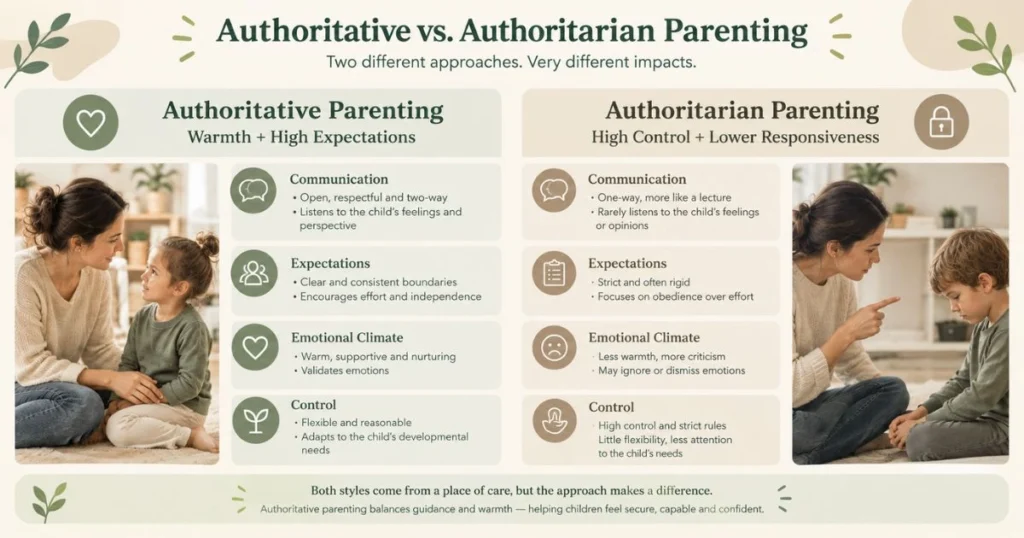
The simplest distinction is:
Authoritative parenting = high warmth + high expectations.
Authoritarian parenting = high control + lower responsiveness.
Authoritarian parenting tends to emphasize obedience, strict rules, and parental authority. Discipline may involve harsh verbal responses, coercion, or punishment.
Authoritative parenting also expects children to behave appropriately, but the parent generally uses explanation, reasoning, encouragement, and appropriate consequences alongside warmth.
Consider a child who refuses to put away their toys.
An authoritarian approach might focus on:
“Do it now. Don’t argue with me.”
An authoritative approach could be:
“It’s time to clean up. You can put away the blocks while I collect the books. If the toys aren’t put away, we’ll need to stop playing with them for the rest of the afternoon.”
The second response still contains a limit.
The difference is that the parent is not trying to frighten or humiliate the child into obedience.
The goal is to help the child understand expectations and gradually develop responsibility.
Authoritative vs. Permissive Parenting
Authoritative and permissive parenting can both involve warmth and affection, but they differ substantially in their approach to limits.
Permissive parents may be highly nurturing but provide fewer rules or expectations. They may give children considerable freedom even when the child has not yet developed the skills necessary to manage that freedom.
Authoritative parents also value independence, but they recognize that children need structure while learning how to use it.
For example, a permissive parent might allow a child to repeatedly interrupt others because they do not want to upset them.
An authoritative parent might say:
“I know you have something important to say. Please wait until Grandma finishes talking, and then it’s your turn.”
The child does not need to suppress their opinion.
They simply need to learn an appropriate way to participate.
Authoritative vs. Uninvolved Parenting
Uninvolved parenting is characterized by relatively low levels of both responsiveness and demandingness.
The child may receive limited emotional support, supervision, guidance, or consistent boundaries.
This is fundamentally different from authoritative parenting.
An authoritative parent is actively involved in the child’s development. They monitor, guide, teach, listen, and provide structure.
The goal is not constant control.
It is dependable support.
Does Authoritative Parenting Look the Same in Every Culture?
Not necessarily.
One important limitation of parenting-style research is that parenting practices do not exist outside culture.
Ideas about independence, obedience, family responsibility, communication, respect, and appropriate parental authority differ around the world.
In many Western settings, autonomy and children’s individual opinions are emphasized. In other cultural contexts, interdependence, family harmony, respect for elders, and collective responsibility may receive greater emphasis.
Research comparing Chinese and U.S. families, for example, has found meaningful differences in cultural values and parental beliefs, while also showing that the relationship between culture and actual parenting behavior is complex.
This matters because authoritative parenting should not be reduced to a Western checklist such as:
“Let your child make every decision.”
That is not the core idea.
A parent can maintain strong family authority while still being warm, responsive, explanatory, and respectful toward a child’s perspective.
Some Chinese American families, for instance, have been described as combining autonomy-supportive practices associated with U.S. parenting with values emphasizing interdependence and family responsibility.
The broader principle is more useful than a rigid cultural formula:
Children can be guided firmly without being treated harshly.
Inductive Discipline: Teaching Instead of Simply Punishing
One of the most important mechanisms associated with authoritative parenting is inductive reasoning.
Instead of focusing exclusively on whether a child obeyed, the parent explains why the behavior matters.
Imagine a child grabs a toy from another child.
Rather than simply saying:
“Give it back!”
the parent might say:
“You wanted the truck, but taking it from him made him upset. Let’s give it back and ask if you can have a turn.”
The child learns more than obedience.
They begin to understand another person’s experience.
This type of discipline can help children gradually develop moral reasoning, empathy, and responsibility.
The goal is not to deliver a long lecture every time a child misbehaves.
In fact, lengthy explanations are often unnecessary, especially with young children.
A short explanation is usually enough:
“I won’t let you hit. Hitting hurts. You can tell me you’re angry.”
Then the parent helps the child move toward an appropriate alternative.
Emotion Coaching: Helping Children Handle Big Feelings
Authoritative parenting also creates room for children to experience emotions without being shamed for having them.

Children do not automatically know what to do with anger, jealousy, fear, disappointment, or frustration.
They have to learn.
Emotion coaching involves noticing emotional moments, listening, helping children identify feelings, validating their experience, and supporting them in finding appropriate ways to respond. Research reviews have linked supportive emotion socialization and emotion coaching with children’s emotion regulation and adjustment, although the strength of effects varies across studies.
For example:
“You’re angry because your brother took your truck.”
“It’s okay to be angry. I won’t let you hit him.”
“You can tell him that you were still playing with it and weren’t ready to give it up yet.”
This teaches three things at once:
- Feelings are understandable.
- Certain behaviors still have limits.
- Children can learn alternative ways to respond.
With repeated practice and guidance, children gradually learn how to manage and regulate their emotions.
What Are the Potential Benefits of Authoritative Parenting?
Research has generally associated authoritative parenting with positive developmental outcomes across childhood and adolescence.
However, these findings should be interpreted carefully.
Parenting style is not the only factor influencing a child’s development. Genetics, temperament, socioeconomic circumstances, school experiences, peer relationships, community conditions, and broader family stress all matter.
Still, several patterns have appeared repeatedly in the research literature.
Emotional Well-Being
Warmth and supportive parenting can provide children with a sense of security while appropriate behavioral expectations give them predictable structure.
Recent meta-analytic research examining parenting dimensions found positive associations between parental support and self-esteem, as well as between authoritative control and self-esteem.
This does not mean authoritative parenting prevents anxiety or depression.
Rather, supportive and appropriately structured parenting may contribute to developmental environments that help children build emotional and interpersonal resources.
Self-Regulation and Emotional Skills
Children gradually learn self-control through repeated experiences with boundaries, guidance, and emotional support.
An authoritative parent might help a child move from:
“I’M MAD!”
to:
“I’m mad because you took my toy.”
and eventually toward:
“I’m upset. Can I have it when you’re finished?”
That progression takes time.
The parent’s role is not to eliminate difficult emotions but to help the child develop increasingly effective ways of managing them.
Social Development
Authoritative parenting emphasizes both personal boundaries and consideration for others.
Children are encouraged to express their own needs while learning that other people have needs too.
A parent might say:
“You wanted the last cookie. Your sister wanted one too. We need to find a fair solution.”
This creates opportunities to practice cooperation, perspective-taking, negotiation, and empathy.
Research has generally associated authoritative parenting with positive social and developmental outcomes, although effect sizes tend to be modest and vary across populations and studies.
Academic Development
Authoritative parenting has also been associated with academic functioning.
There are several possible pathways.
Children may benefit from parents who provide routines, monitor responsibilities, encourage persistence, and communicate confidence in their ability to learn.
At the same time, warmth may make it easier for children to seek help when something is difficult.
Instead of:
“You should know this already.”
the authoritative parent might say:
“This is difficult right now. Let’s figure out which part is confusing.”
The message is both demanding and supportive:
“I’d like you to keep trying, and I’ll support you while you work through it.”
The Child Also Influences the Parent
Parenting does not happen in only one direction.
Children influence parents too.
A calm and easygoing child may make it easier for a parent to respond with patience, consistency, and understanding. A child with a highly reactive temperament or frequent challenging behavior may increase parental stress and make consistent discipline more difficult.
This is one reason researchers caution against assuming that parenting style alone determines children’s behavior.
The relationship is dynamic.
A difficult behavior can increase parental stress.
Parental stress can then affect how the parent responds.
The child’s reaction to that response can influence what happens next.
Understanding this cycle can help parents replace self-blame with curiosity.
Instead of thinking:
“I’m failing because my child is difficult.”
you can ask:
“What is happening between us, and what support would help both of us?”
This is particularly important because authoritative parenting should not become another impossible standard that makes parents feel guilty whenever they lose patience.
No parent responds perfectly every time.
Repair matters too.
How to Practice Authoritative Parenting at Home
You do not need to transform your entire parenting approach overnight.

Start with a few practical changes.
1. Keep Rules Simple
Choose a small number of important family rules.
For example:
- We keep bodies safe.
- We speak respectfully.
- We take care of our belongings.
- We help clean up.
- We follow safety instructions.
Young children especially benefit from simple, concrete expectations.
2. Explain the Reason Behind Important Limits
You don’t need to explain every instruction.
But when appropriate, give children a brief reason.
Instead of:
“Don’t run!”
try:
“Walking feet inside because someone could get hurt.”
The explanation helps connect the rule with its purpose.
3. Use Logical or Related Consequences
Whenever possible, consequences should have a clear connection to the child’s behavior.
If a child repeatedly throws a toy, the toy may need to be put away temporarily.
If a child spills something deliberately, they can help clean it up.
The purpose is not revenge.
It is learning.
4. Validate Feelings Without Changing Every Boundary
Learning to do this consistently can be one of the more challenging parenting skills.
Try:
“You really wanted another cookie. I know you’re disappointed. The answer is still no.”
You don’t have to make the disappointment disappear.
Your child can be unhappy with the boundary while you remain calm and connected.
5. Offer Choices Within the Boundary
Choices can provide children with appropriate autonomy.
Instead of:
“Get dressed.”
try:
“Which would you prefer to put on first, your shirt or your pants?”
The larger expectation stays intact.
The child has some freedom to decide how they want to complete the task.
6. Encourage Effort and Progress
Instead of focusing only on the final result, recognize the effort your child makes and the responsible choices they show.
“You stayed with the puzzle and kept trying, even when it became difficult.”
“You remembered to put your shoes away.”
“You were upset, but instead of hitting, you expressed your feelings with words.”
Specific encouragement helps children understand exactly what they are learning.
7. Model the Behavior You Expect
Children often learn more from their parents’ actions than from their words alone.
If you want respectful communication, practice respectful communication.
If you want your child to apologize after hurting someone, demonstrate repair yourself.
You might say:
“I spoke too sharply earlier. I’m sorry. I was feeling frustrated, but I should have responded in a calmer way.”
This does not weaken parental authority.
It demonstrates accountability.
What Authoritative Parenting Is Not
Authoritative parenting does not mean:
- letting your child decide everything
- avoiding consequences
- never saying no
- allowing disrespect
- explaining every rule for ten minutes
- staying perfectly calm every second
- preventing your child from experiencing disappointment
- using positive parenting as an excuse to avoid boundaries
It also does not require perfection.
There will be mornings when you are tired.
There may be situations when your response doesn’t come out the way you intended.
At times, you may react in a way that differs from how you wanted to respond.
What matters is the overall relationship and the willingness to repair, reflect, and try again.
A Simple Authoritative Parenting Formula
When you’re unsure how to respond to challenging behavior, try this sequence:
Connect → Set the boundary → Explain briefly → Offer support → Follow through.
For example:
“I know you really want to keep playing. It’s hard to stop when you’re having fun. It’s time to leave now. You can walk to the car or I can carry you. You choose.”
If the child screams:
“You’re upset. I hear you. I’m still going to help you leave.”
This approach does not guarantee cooperation.
That’s important.
Authoritative parenting is not a technique for making children obey instantly.
Instead, it is a way of creating a relationship in which warmth and authority coexist.
The Bottom Line
Authoritative parenting offers a middle path between excessive control and a lack of boundaries.
It asks parents to hold two ideas at the same time:
“I understand your feelings.”
and
“I am still responsible for setting appropriate limits.”
That balance can be challenging, especially during tantrums, sibling conflict, bedtime struggles, or moments when everyone is exhausted.
Being gentle doesn’t mean you have to give up being firm.
You can comfort your child and maintain the boundary.
You can listen without agreeing.
You can give choices without giving away your responsibility as the parent.
You can correct behavior without shaming the child.
And you can expect your child to grow while remembering that development takes time.
The goal of authoritative parenting isn’t to raise a child who never argues, never gets upset, or always follows directions.
It is to provide a relationship where children experience both security and structure—a place where they are loved unconditionally while learning that their choices have consequences, other people matter, and difficult emotions can be handled without losing connection.
For many parents, that is the real balance: not control versus freedom, but connection with guidance.