Hearing your child suddenly scream in the middle of the night can stop you in your tracks.
You may rush into the bedroom expecting a nightmare, only to find your child sitting upright, staring into the room, crying or shouting. You try to pick them up. You call their name. You tell them that everything is okay.
But something feels strange.
Your child may not seem to recognize you. They might push you away, kick, sweat, breathe heavily, or look completely terrified. Then, just as suddenly, the episode passes. Your child settles back down and goes to sleep.
The next morning, they may have no idea anything happened.
If this sounds familiar, you may be dealing with night terrors, also called sleep terrors.
Night terrors can look dramatic, but they are different from nightmares. They usually happen while your child is still partly asleep during deep non-REM sleep. Most children eventually outgrow them, and occasional episodes are generally not a reason for alarm.
Still, knowing what you are seeing can make a huge difference.
In this guide, you’ll learn what night terrors are, what causes them, how to recognize the signs, how night terrors differ from nightmares, what you should do during an episode, and when it makes sense to talk with your child’s healthcare professional.
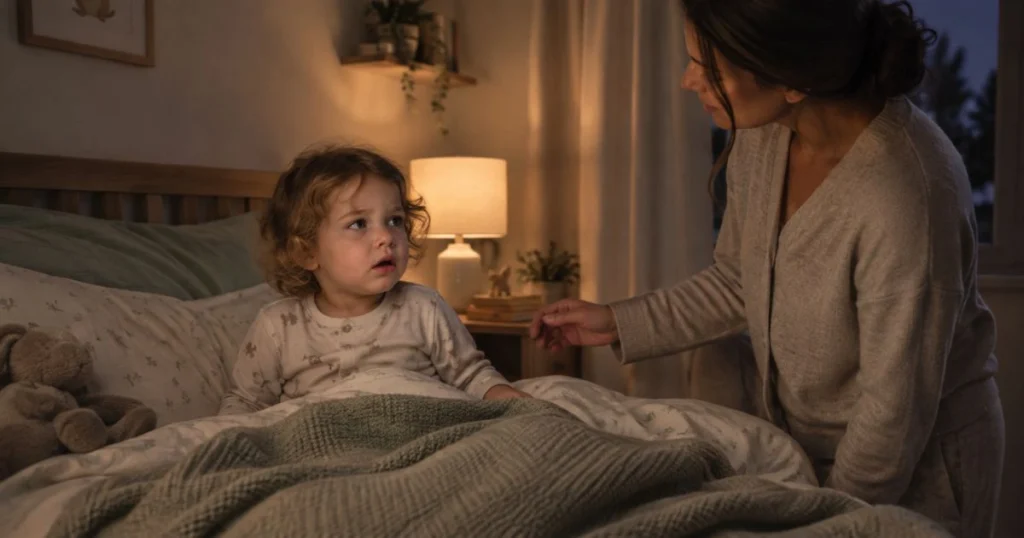
What Are Night Terrors?
Night terrors are episodes of intense fear, crying, screaming, or unusual movement that happen while a child is not completely awake. They are a type of parasomnia, which is a group of unusual behaviors or experiences that occur during sleep.
Unlike a nightmare, your child usually isn’t awake enough to understand what is happening.
A child having a night terror may:
- Suddenly scream or cry
- Sit upright in bed
- Stare with wide-open eyes
- Look frightened
- Sweat
- Breathe heavily
- Have a fast heartbeat
- Kick or thrash
- Talk or make unclear sounds
- Seem confused
- Be difficult to wake
- Resist attempts to comfort them
- Return to sleep afterward
- Usually don’t remember the episode the next morning.
The fact that your child’s eyes are open can make the experience particularly confusing. You may naturally assume that your child is awake because they look awake.
They may not be.
During a night terror, your child remains partly asleep. Their behavior can resemble wakefulness even though they are not fully conscious of you or their surroundings.
Are night terrors the same as nightmares?
No.
A nightmare is a frightening dream that wakes your child. After a nightmare, your child is generally awake, can recognize you, and may be able to describe what frightened them.
A night terror is different. Your child may scream, cry, or appear terrified without fully waking. They often cannot be comforted in the usual way and generally don’t remember the event the next morning.
That distinction is important because the best way to respond is different.
What Do Night Terrors Look Like?
The first step in helping your child is recognizing what a night terror actually looks like.
Common signs of night terrors
During an episode, your child may:
- Suddenly scream, shout, or cry.
- Sit up or move around in bed.
- Have a frightened or confused expression.
- Stare with wide eyes.
- Sweat or breathe heavily.
- Have a racing heartbeat.
- Kick, thrash, or wave their arms.
- Seem difficult to wake.
- Push you away when you try to comfort them.
- Appear confused if you speak to them.
- Return to sleep after the episode.
- Remember little or nothing about it the following morning.
Mayo Clinic notes that a child may also get out of bed and move around during a sleep terror. That creates an important safety concern because a frightened, partially awake child may not recognize hazards around them.
Why doesn’t your child respond to you?
This is often the hardest part for parents to understand.
You may be standing right beside your child, saying their name and trying to reassure them, yet they seem completely unreachable.
It doesn’t necessarily mean your child is ignoring you.
They are still asleep.
Because night terrors occur during deep non-REM sleep, your child’s brain is not fully in an alert, waking state. Their eyes may be open, but their awareness can remain limited.
That is why repeatedly asking, “What’s wrong?” or “Can you see Mommy?” may not get the response you expect.
When Do Night Terrors Usually Happen?
Timing can give you another clue.
Night terrors generally occur during the first part of the night, when children spend more time in deeper non-REM sleep. They are much less typical during naps.
For example, your child might go to bed at 8:00 p.m. and have an episode around 9:30 or 10:00 p.m.
A nightmare, on the other hand, is more likely to occur later in the night because nightmares are associated with REM sleep, which becomes more prominent during the second half of the sleep period.
How long do night terrors last?
A night terror may last anywhere from several seconds to a few minutes, although some episodes can last longer.
When you’re standing beside your screaming child, even a few minutes can feel much longer.
Try to focus on what your child needs most in that moment: a safe environment and a calm adult nearby.
What Causes Night Terrors in Children?
There isn’t always one obvious cause.
Sometimes a child has night terrors despite having a stable routine and no apparent problem. In other cases, something has disrupted their sleep.
Night terrors can be triggered by several different factors, including:
- Not getting enough sleep
- Extreme tiredness
- An irregular sleep schedule
- Sudden changes in bedtime
- Travel
- Sleeping in a new environment
- Interrupted sleep
- Fever or illness
- Stress
- Certain medications
- Other conditions that disturb sleep
Mayo Clinic identifies sleep deprivation, stress, schedule changes, travel, sleep interruptions, and fever among factors that can contribute to sleep terrors. Conditions that interfere with sleep, including sleep-disordered breathing, may also play a role.
If your child’s night terrors seem to happen after late bedtimes, missed naps, or several nights of poor sleep, reviewing their overall sleep pattern may help; see our Baby Sleep Schedule by Age guide for practical examples.
Can being overtired cause night terrors?
Being overtired is one of the most useful clues to pay attention to.
When your child isn’t getting enough sleep, their normal sleep pattern can become disrupted. That doesn’t mean every overtired child will develop night terrors, but significant sleep deprivation is a recognized contributor.
If episodes seem to follow late bedtimes, missed naps, travel, or several nights of poor sleep, look for a pattern rather than blaming yourself or your child.
Sometimes a modest adjustment to the sleep schedule can make a difference.
Understanding your child’s age-appropriate awake periods can also help you recognize when they may be becoming overtired, so take a look at our guide to Baby Wake Windows by Age.
Can stress cause night terrors?
Stress can contribute to disrupted sleep, and it may play a role in night terrors.
Your child might be going through a major change such as:
- Starting daycare
- Starting school
- Moving house
- Traveling
- Adjusting to a new caregiver
- Welcoming a new sibling
- Experiencing changes to their usual routine
However, don’t assume that a night terror means your child has an anxiety problem or has experienced trauma.
Night terrors can happen in otherwise normally developing children. The Cleveland Clinic specifically notes that sleep terrors in children are not, by themselves, a sign of an underlying psychological problem.
Are Night Terrors Common in Toddlers and Children?
Night terrors are primarily a childhood sleep phenomenon.
Mayo Clinic reports that they may occur in children between approximately 1 and 12 years of age and are much less common in adults. Cleveland Clinic notes that children are particularly susceptible, with episodes often seen around ages 3 to 7.
One cited estimate places the prevalence of sleep terrors at roughly 1% to 6.5% among children ages 1 through 12. Estimates can vary depending on the population and how sleep terrors are defined or measured.
So if your toddler occasionally has a night terror, you are not dealing with an exceptionally unusual situation.
When do children outgrow night terrors?
Many children gradually stop having night terrors as they mature.
Mayo Clinic says most children outgrow sleep terrors by their teenage years.
You therefore don’t need to assume that your child’s current episodes will continue indefinitely.
If episodes are occasional, your child remains safe, and there are no other concerning symptoms, your main job may simply be to keep the sleep environment safe and protect healthy sleep.
Night Terrors vs. Nightmares: What’s the Difference?
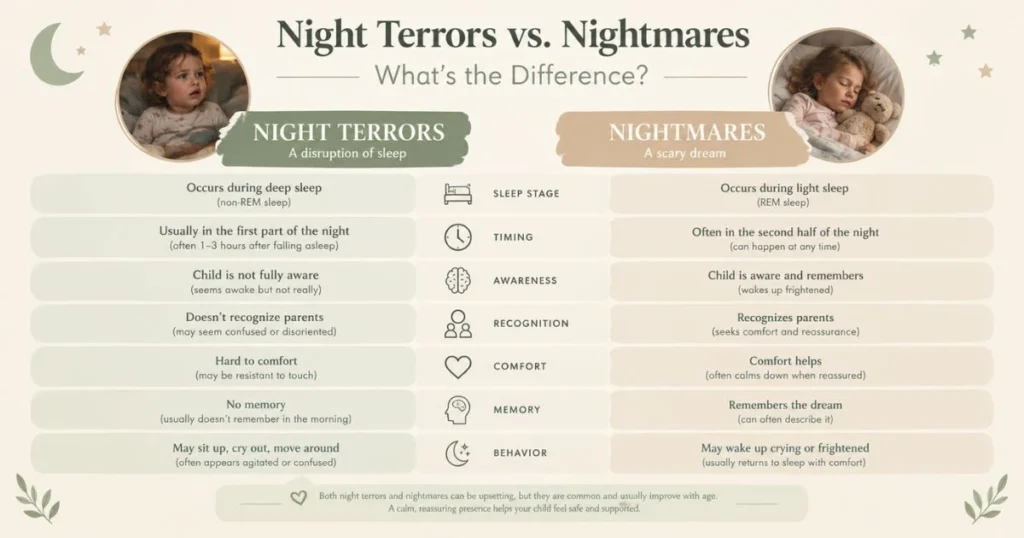
This is one of the most important distinctions for parents.
Both can involve crying and fear, but they happen in different sleep states.
| Feature | Night Terrors | Nightmares |
| Sleep stage | Usually non-REM sleep | Usually REM sleep |
| Typical timing | Earlier in the night | More often later in the night |
| Is your child fully awake? | Usually no | Usually yes |
| Recognition | May not recognize you | Usually recognizes you |
| Comfort | Often difficult to comfort | Usually wants reassurance |
| Memory | Usually little or none | Often remembers the dream |
| Behavior | Screaming, sitting up, thrashing | Waking, crying, fear |
| Returning to sleep | Often happens after the episode | May have trouble returning to sleep |
Mayo Clinic and HealthyChildren.org both distinguish sleep terrors from nightmares based on sleep stage, timing, awareness, and memory.
How can you tell which one your child had?
Ask yourself three questions:
1. Did your child fully wake up?
If your child was difficult to wake and seemed unaware of you, a night terror is more likely.
2. Could your child recognize and respond to you?
A child who wakes from a nightmare can usually interact with you.
3. Did your child remember it the next morning?
Children generally remember nightmares but often don’t remember night terrors.
These clues aren’t meant to replace professional evaluation, but they can help you understand what you’re seeing.
What Should You Do During a Night Terror?
Watching your child scream while apparently unable to hear you can make you want to do something immediately.
The most helpful response is usually surprisingly simple.
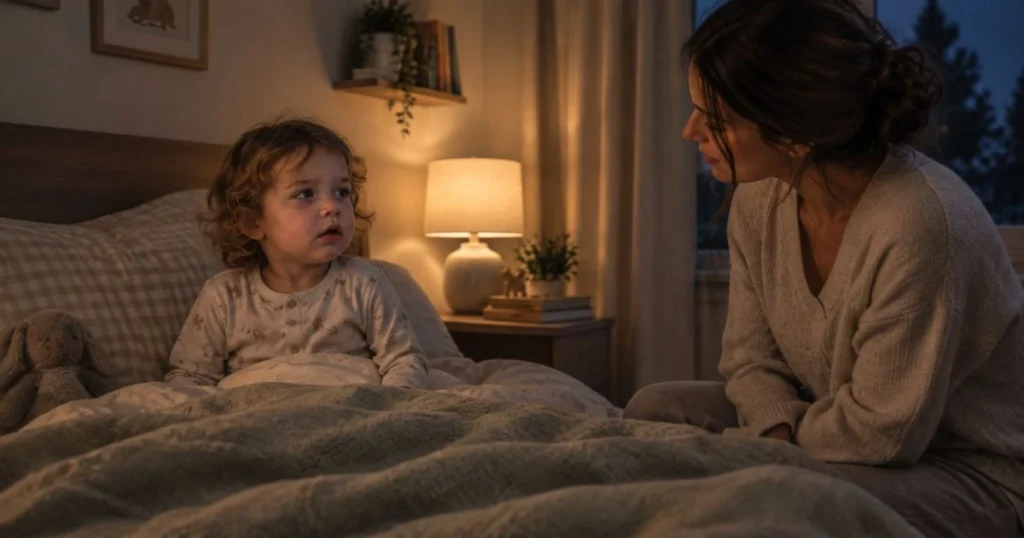
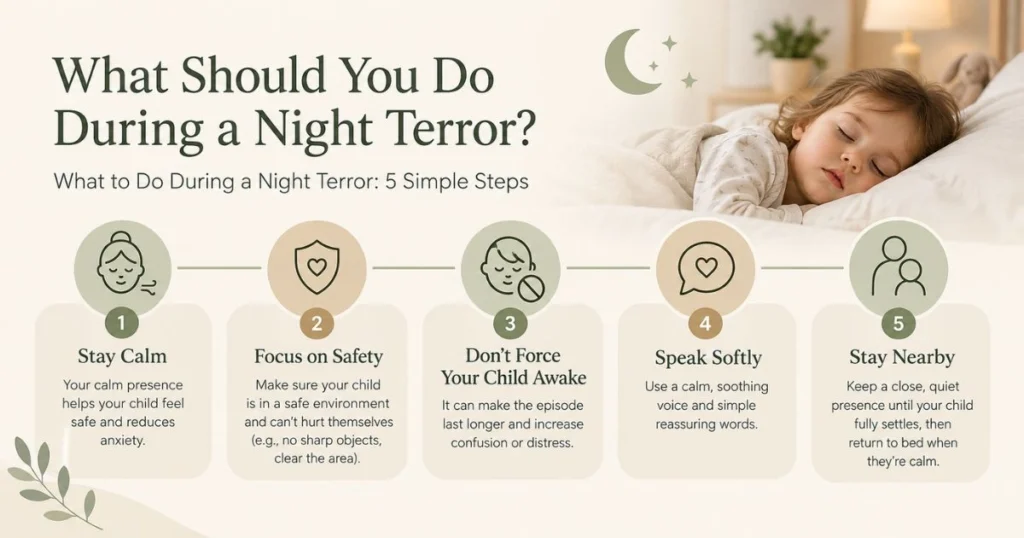
1. Stay calm
Your child may look terrified, but a night terror does not necessarily mean they are consciously experiencing a frightening dream.
Take a breath.
Keep your voice low and your movements slow.
2. Focus on safety
Your priority is preventing injury.
Check the immediate environment for:
- Stairs
- Windows
- Sharp objects
- Heavy objects
- Fragile items
- Electrical cords
- Furniture that could cause injury
If your child gets out of bed, calmly guide them toward a safe area.
3. Don’t force your child awake
Trying to wake your child during a typical night terror may not help.
Because they are still in deep sleep, they may not respond normally. Mayo Clinic recommends allowing the episode to run its course and notes that attempts to wake the child or prevent movement can make the situation worse.
4. Speak softly
If you need to guide your child, use a calm voice.
You might say:
“You’re safe. I’m right here.”
You don’t need to ask a long series of questions.
5. Stay nearby
Most episodes stop on their own.
Remain close enough to protect your child until they settle.
Mayo Clinic recommends staying calm, offering gentle reassurance, and allowing the episode to pass rather than trying to force the child awake.
What Should You Do After a Night Terror?
Once the episode ends, let your child return to sleep.
You don’t need to turn the event into a major conversation in the middle of the night.
If your child wakes completely, offer reassurance and help them settle.
Should you tell your child about the night terror?
That depends on the situation.
If your child doesn’t remember anything, repeatedly telling them how frightening they looked may make bedtime feel more intimidating.
Instead, if they ask about it, keep your explanation simple:
- “You had a sleep episode.”
- “You were safe.”
- “I stayed with you.”
- “You’re okay now.”
Avoid punishment, embarrassment, or threats.
A child doesn’t choose to have a night terror.
How to Prevent or Reduce Night Terrors
You cannot always prevent night terrors, but improving your child’s sleep habits can reduce some of the factors associated with them.
Make sure your child gets enough sleep
This is a good place to start.
Look at your child’s:
- Bedtime
- Morning wake time
- Nap schedule
- Total sleep opportunity
- Weekend schedule
If your child regularly falls asleep exhausted, consider whether bedtime needs to move earlier.
Mayo Clinic recommends getting enough sleep and maintaining a consistent sleep schedule when sleep terrors occur.
Create a predictable bedtime routine
A simple routine might look like:
- Bath or wash-up
- Pajamas
- Brush teeth
- Dim the lights
- Read a story
- Quiet cuddles
- Bed
Consistency matters more than having a perfectly timed routine.
A predictable sequence gives your child a familiar transition from daytime activity to sleep.
HealthyChildren.org also emphasizes the importance of healthy sleep routines and notes that irregular schedules and insufficient sleep can contribute to sleep problems.
A predictable bedtime routine can make the transition into nighttime sleep calmer; for more practical ideas, read our Toddler Bedtime Routine: How to Help Your Child Sleep Better guide.
If you are trying to adjust naps and bedtime to protect your child’s total sleep, our Toddler Nap Schedule guide can help you understand how daytime sleep changes as children grow.
Keep bedtime calm
Try to avoid turning the last part of the evening into a second daytime.
Instead of energetic play right before bed, choose quieter activities such as:
- Reading
- Drawing
- Puzzles
- Gentle conversation
- Quiet play
Reduce unnecessary sleep interruptions
Look at anything that repeatedly wakes your child:
- Noise
- Bright light
- An uncomfortable room
- An inconsistent schedule
- Travel
- Household activity
You don’t need a perfectly silent home. The goal is simply to protect your child’s normal sleep as much as reasonably possible.
Keeping a consistent overall sleep rhythm can also help protect nighttime sleep, and our Baby Sleep Schedule by Age guide explains how daily sleep patterns change as children grow.
Keep a Night Terror Sleep Diary
If episodes keep happening, tracking them can reveal a pattern.
You don’t need complicated equipment. A notebook or phone note is enough.
| What to Track | Example |
| Bedtime | 8:00 p.m. |
| Wake time | 7:00 a.m. |
| Nap | 1:00–2:30 p.m. |
| Episode | 10:05 p.m. |
| Illness | None |
| Schedule change | Late bedtime |
| Possible trigger | Very tired |
| Duration | About 3 minutes |
After a couple of weeks, you may notice that episodes happen after particularly short nights or at almost the same time after bedtime.
Mayo Clinic recommends keeping a sleep diary for several weeks when preparing for an evaluation. The information can help a healthcare professional understand your child’s sleep schedule and identify possible patterns.
Can Other Sleep Problems Trigger Night Terrors?
Sometimes, a problem that interferes with normal sleep can contribute to sleep terrors.
Night terrors and sleep-disordered breathing
Mayo Clinic lists sleep-disordered breathing among conditions that may contribute to sleep terrors.
Pay attention if your child regularly has:
- Loud snoring
- Gasping during sleep
- Pauses in breathing
- Unusual breathing patterns
- Very restless sleep
- Significant daytime sleepiness
These symptoms don’t mean your child definitely has sleep apnea or another sleep disorder.
They are simply worth mentioning to your child’s healthcare professional.
Night terrors and sleepwalking
Night terrors and sleepwalking are both parasomnias.
A child experiencing a night terror may get out of bed and move around without being fully awake.
If this happens, bedroom safety becomes particularly important.
If your child frequently snores, breathes through their mouth, or seems to have unusual breathing during sleep, our guide to mouth breathing in children explains some possible causes and when it may be worth discussing with a healthcare professional.
Are Night Terrors Dangerous?
The appearance of a night terror can be much more frightening than the event itself.
Occasional night terrors are generally not considered harmful.
The greater concern is accidental injury.
A child who gets out of bed while partially asleep could fall, hit furniture, approach stairs, or reach an unsafe area.
Make your child’s sleep environment safer

Consider:
- Locking or securing windows.
- Keeping doors safely secured.
- Using gates near stairs when appropriate.
- Removing sharp objects from the bedroom.
- Moving fragile or heavy items out of reach.
- Keeping the floor free from tripping hazards.
- Avoiding a top bunk for a child who has frequent night terrors or sleepwalking.
Mayo Clinic specifically recommends making the sleeping area safe to reduce the risk of injury.
You don’t need to redesign your entire home after one episode.
Think about your child’s actual behavior and whether they leave the bed or move around during episodes.
When Should You Call the Doctor About Night Terrors?
Most occasional episodes don’t require urgent medical treatment.
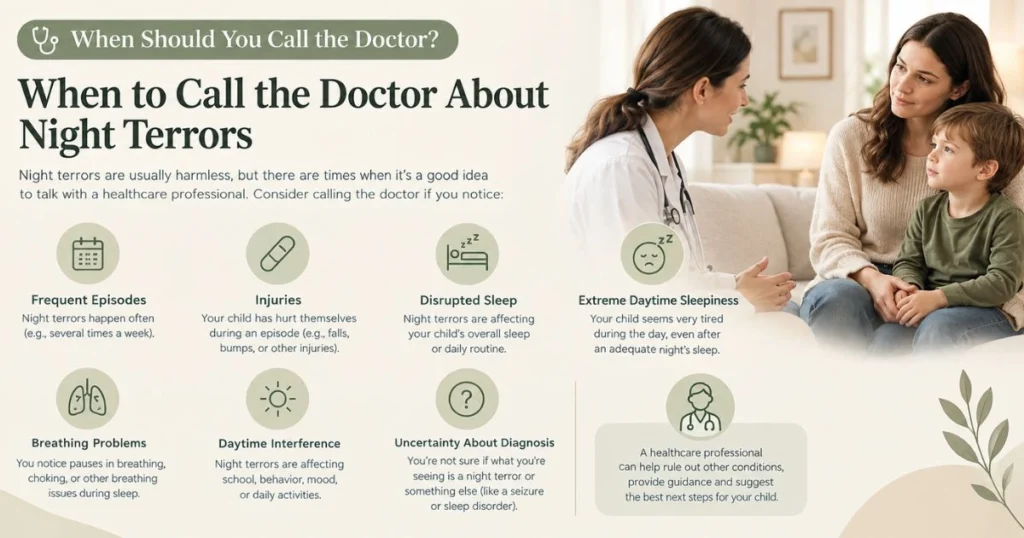
Still, you should talk with your child’s healthcare professional if the episodes become frequent, disruptive, dangerous, or unusual.
Contact your child’s healthcare professional if:
- Night terrors happen frequently.
- Episodes are becoming more intense.
- Your child gets injured.
- Your child’s sleep is repeatedly disrupted.
- Other family members are regularly losing sleep.
- Your child is extremely sleepy during the day.
- You notice concerning breathing problems.
- The episodes interfere with normal daytime activities.
- You aren’t sure whether the episodes are actually night terrors.
Mayo Clinic advises seeking medical evaluation if sleep terrors are frequent, disrupt sleep, cause injuries or safety concerns, or result in significant daytime problems.
What might your doctor ask?
Before the appointment, it may be helpful to write down:
- When your child goes to bed
- When they wake up
- When naps occur
- When episodes happen
- How long episodes seem to last
- What your child does during them
- Whether they remember anything afterward
- Whether your child snores
- Whether there are breathing pauses
- Any recent illness or fever
- Any major schedule changes
- Any medications
- Family history of sleep terrors or sleepwalking
A short video of an episode can sometimes be useful if it can be recorded safely without disturbing or delaying care. Mayo Clinic notes that a video may help a healthcare professional understand the events.
Could your child need a sleep study?
Not usually for a straightforward, occasional night terror.
Sleep terrors are commonly identified from the child’s history and description of the episodes. In some cases, however, a healthcare professional may recommend an overnight sleep study to investigate another sleep disorder or an unusual presentation.
A sleep study can monitor things such as brain activity, oxygen levels, heart rate, breathing, eye movements, leg movements, and nighttime behavior.
Frequently Asked Questions About Night Terrors
What Are Night Terrors?
Night terrors are episodes of intense fear, screaming, crying, or movement that occur while a child remains partly asleep. They usually happen during deep non-REM sleep, often early in the night. Your child may appear awake but remain difficult to comfort and usually has little or no memory of the episode the following morning.
What Causes Night Terrors in Children?
Night terrors can be associated with insufficient sleep, extreme tiredness, irregular sleep schedules, stress, fever, travel, sleep interruptions, and other conditions that interfere with sleep. A family history of sleep terrors or sleepwalking can also increase risk.
What Are the Signs of Night Terrors?
Common signs include sudden screaming or crying, sitting upright, staring with wide eyes, sweating, rapid breathing, kicking or thrashing, confusion, difficulty waking, and little or no memory of the episode the next morning.
Are Night Terrors the Same as Nightmares?
No. Night terrors usually happen during non-REM sleep and involve partial arousal. Nightmares happen during REM sleep, often waking the child and leaving them able to remember the frightening dream.
How Long Do Night Terrors Last?
Many night terrors last from seconds to several minutes, although some can last longer.The length of each episode can vary from one child to another.
Should You Wake Your Child During a Night Terror?
Generally, you should not force your child awake during a typical night terror. Instead, stay nearby, keep them safe, speak calmly, and allow the episode to pass. Attempts to wake them may increase confusion or agitation.
How Can You Stop Night Terrors?
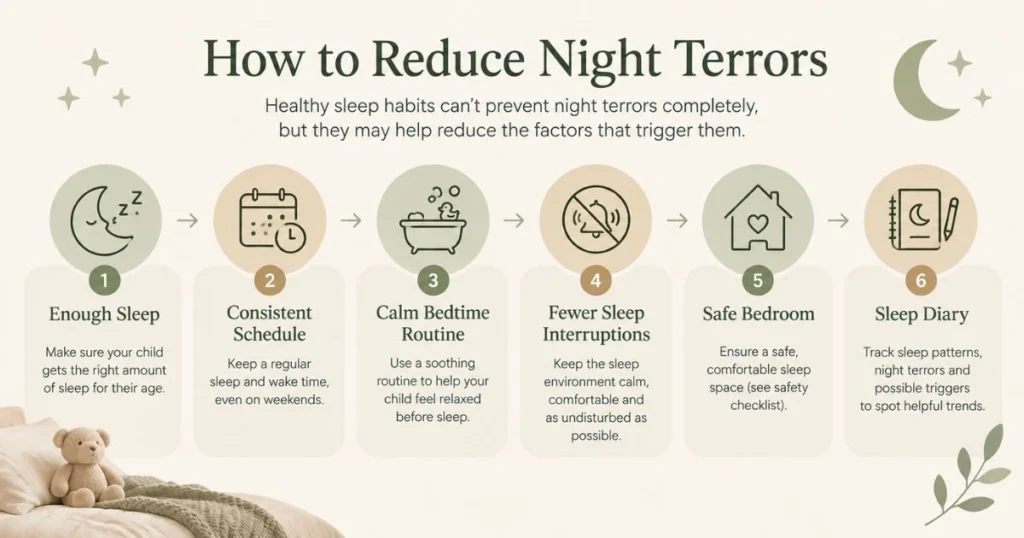
You may not be able to stop an episode once it begins. Instead, focus on reducing factors that can contribute to night terrors. Make sure your child gets enough sleep, maintain a regular schedule, create a calming bedtime routine, reduce unnecessary sleep disruptions, and keep the bedroom safe.
Can Being Overtired Cause Night Terrors?
Significant sleep deprivation and extreme tiredness are recognized contributors to sleep terrors. If episodes appear after missed naps, late bedtimes, travel, or several nights of poor sleep, improving your child’s sleep schedule may help.
Can Stress Cause Night Terrors?
Stress can contribute to night terrors, but having them does not automatically mean your child has an anxiety disorder or psychological problem. Look at stress alongside other factors such as sleep deprivation, illness, and changes in routine.
When Do Children Outgrow Night Terrors?
Many children outgrow night terrors as they get older. Mayo Clinic says most children outgrow them by their teenage years.
When Should I Worry About Night Terrors?
Talk with your child’s healthcare professional if episodes become frequent, cause injuries or safety concerns, regularly disrupt sleep, lead to significant daytime sleepiness, or occur alongside other concerning symptoms such as unusual breathing during sleep.
Night Terrors Can Be Scary, but You Can Help Your Child.

A child screaming in the middle of the night can make you feel helpless.
Your first instinct may be to wake them, hold them tightly, ask what’s wrong, or try everything you can think of to make the fear disappear.
But once you understand what night terrors are, the situation becomes easier to navigate.
Night terrors are different from nightmares. Your child is usually not fully awake, may not recognize you during the episode, and often won’t remember what happened the next morning. They commonly occur early in the night during deep non-REM sleep.
Your role is not to force the episode to stop.
Your priorities are simpler:
- Keep your child safe.
- Stay calm.
- Avoid forcing them awake.
- Protect a consistent sleep schedule.
- Make sure they are getting enough sleep.
- Look for patterns or possible triggers.
- Speak with a healthcare professional if episodes become frequent, disruptive, or dangerous.
And remember: one frightening night does not mean something is wrong with your child.
Parenting Whisper Reminder:
Your child’s night terror may look frightening, but your calm presence can help you get through the moment safely. You don’t have to understand everything at 2 a.m.—you just need to know what your child needs right now.
If night terrors are becoming a regular part of your family’s nights, start by keeping a simple sleep diary for a couple of weeks. Look for patterns in bedtime, naps, illness, schedule changes, and the timing of episodes. That information can help you make practical changes and gives your child’s healthcare professional a clearer picture if you decide to seek advice.