

You may notice it first when you wake up with a dry mouth. Maybe your lips feel parched, your throat is scratchy, or you find yourself reaching for water before you’ve even gotten out of bed.
Then you notice something else: you often sleep with your mouth open.
If you’re a parent, you may have noticed the same pattern in your child. Perhaps your toddler snores, drools on the pillow, or seems to breathe through their mouth most nights. It’s easy to assume it’s simply a habit.
Sometimes it is related to a habit. But mouth breathing can also happen because your nose isn’t allowing air to pass comfortably. Colds, allergies, chronic congestion, enlarged adenoids or tonsils, a deviated septum, and sleep-related breathing problems can all play a role.
That distinction matters.
Instead of simply trying to keep your mouth closed, the more useful question is:
Why are you mouth breathing in the first place?
Once you understand the possible cause, you can choose safer and more appropriate ways to support comfortable nasal breathing.
In this guide, you’ll learn what mouth breathing is, what causes it, how to recognize the signs, what you can try at home, how nighttime mouth breathing differs, and when it’s time to talk with a healthcare professional.

What Is Mouth Breathing?
Mouth breathing means regularly taking air in through your mouth rather than primarily breathing through your nose.
Your nose isn’t simply an opening for air. Nasal passages help warm, humidify and filter the air you breathe before it travels farther into your respiratory system. When your nose is blocked or airflow is restricted, your body may naturally switch to breathing through your mouth.
Occasional mouth breathing isn’t necessarily concerning.
For example, you may breathe through your mouth temporarily when:
- You have a cold.
- Your nose is congested.
- You’re exercising intensely.
- Allergies make your nose feel blocked.
- You’re temporarily unable to breathe comfortably through your nose.
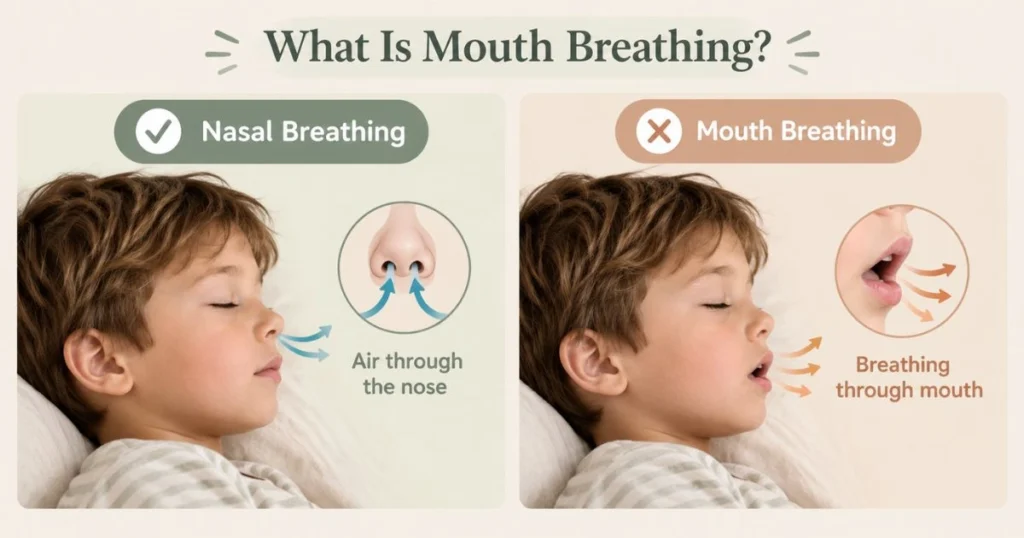
The bigger concern is persistent mouth breathing, particularly when it happens during sleep or becomes your usual way of breathing at rest.
Mouth Breathing vs. Nasal Breathing
| Feature | Nasal breathing | Mouth breathing |
| Main route for air | Nose | Mouth |
| Air conditioning | Warms and humidifies incoming air | Less nasal conditioning |
| Filtration | Nasal structures help filter particles | Less filtration through the mouth |
| Dry mouth | Less likely | More likely |
| Common during nasal congestion | More difficult | More likely |
| During sleep | Usually preferred when nasal airflow is comfortable | May occur when nasal airflow is restricted |
The important point is that mouth breathing isn’t necessarily a problem by itself. It can be your body’s response to restricted nasal airflow.
Is Mouth Breathing Always a Problem?
No.
If you’re breathing through your mouth because your nose is temporarily blocked during a cold, the pattern may disappear once the congestion settles.
Persistent mouth breathing is different.
If you regularly breathe through your mouth during the day or sleep with your mouth open most nights, it is worth considering what is making nasal breathing difficult.
What Causes Mouth Breathing?
There isn’t one single cause of mouth breathing.
In many cases, the underlying issue is restricted nasal airflow. The restriction may be temporary, related to inflammation or allergies, or caused by an anatomical difference.
Here are some of the more common possibilities.
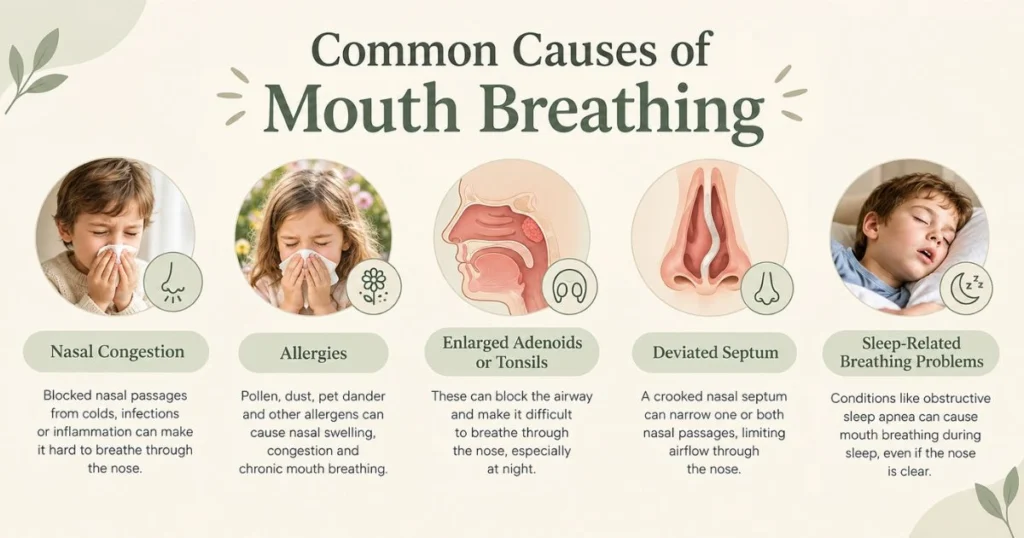
Nasal Congestion
A stuffy nose can make nasal breathing uncomfortable or difficult.

You may experience congestion because of:
- A common cold
- A respiratory infection
- Allergies
- Sinus inflammation
- Irritants in the air
- Chronic nasal inflammation
When your nasal passages feel blocked, breathing through your mouth may become the easiest way to get air.
If the congestion disappears and your normal breathing pattern returns, there may be little reason to worry. If your nose remains blocked for weeks or keeps becoming congested, however, the underlying cause deserves attention.
Allergies
Allergies are another common reason for persistent nasal congestion.
If you’re sensitive to pollen, dust mites, pet allergens or other triggers, inflammation inside the nose can make it harder for air to move freely.
You may notice a combination of:
- Stuffy nose
- Runny nose
- Sneezing
- Itchy eyes
- Mouth breathing
- Snoring
- Trouble sleeping comfortably
If allergies are driving the problem, simply reminding yourself to breathe through your nose may not solve it. Improving control of the nasal symptoms is more useful.
Enlarged Adenoids or Tonsils
This is particularly important when you’re thinking about mouth breathing in children.
Adenoids sit behind the nose, near the upper part of the throat. When they become enlarged, they can narrow the airway and make nasal breathing more difficult.
Children with enlarged adenoids may develop an open-mouth posture, noisy breathing or nighttime mouth breathing.
Enlarged tonsils can also contribute to airway obstruction during sleep.
Why This Matters for Parents
If your child consistently sleeps with their mouth open, snores loudly, or seems to struggle to breathe comfortably through their nose, don’t assume they’re simply refusing to keep their mouth closed.
There may be a physical reason.
Deviated Septum and Other Nasal Obstructions
A deviated septum occurs when the structure separating the two sides of the nose isn’t centered.
Other possible causes of nasal obstruction include:
- Enlarged turbinates
- Nasal polyps
- Nasal valve problems
- Previous nasal injury
- Chronic inflammation
- Less common structural conditions
These problems cannot necessarily be corrected with breathing exercises or home remedies. If one side of your nose is consistently difficult to breathe through, a healthcare professional can help determine whether a structural issue is involved.
Sleep-Related Breathing Problems
Mouth breathing during sleep deserves extra attention when it occurs with other symptoms.
Watch for:
- Frequent or loud snoring
- Pauses in breathing
- Gasping or choking
- Restless sleep
- Unusual sleeping positions
- Morning headaches
- Daytime tiredness
- Difficulty concentrating
In children, mouth breathing, loud breathing or snoring can occur among the symptoms of obstructive sleep apnea. The American Academy of Pediatrics recommends evaluation when children have habitual snoring or symptoms suggesting obstructive sleep apnea.
Mouth breathing alone does not mean you or your child has sleep apnea. The combination of symptoms is what makes an evaluation important.
Signs You May Be Mouth Breathing
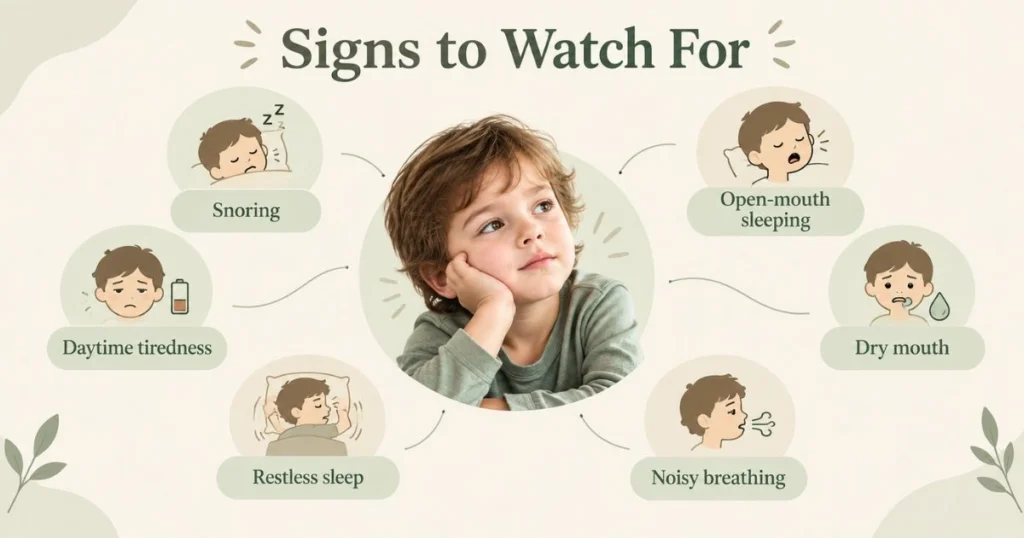
You may not realize you’re mouth breathing, particularly while asleep.
Some clues become noticeable only after you wake up.
Common Signs of Mouth Breathing
You may notice:
- Dry mouth in the morning
- Dry or cracked lips
- Bad breath
- Drooling during sleep
- A scratchy or dry throat
- Hoarseness
- Snoring
- Sleeping with your mouth open
- Daytime tiredness
These symptoms are commonly associated with mouth breathing, although none of them proves that mouth breathing is the cause.
Signs of Mouth Breathing in Children
Parents may notice things such as:
- Sleeping with the mouth open
- Frequent snoring
- Drooling on the pillow
- Noisy breathing
- Persistent nasal congestion
- Restless sleep
- Breathing through the mouth during the day
- Difficulty breathing comfortably through the nose
If several of these signs occur regularly, especially during sleep, bring them up with your child’s pediatrician.
How to Stop Mouth Breathing Naturally
If you’re looking for how to stop mouth breathing naturally, start by identifying the reason it is happening.
Natural strategies can sometimes make nasal breathing more comfortable, particularly when temporary congestion or environmental irritation is involved.
However, they cannot correct every cause.
For example, a breathing exercise cannot remove enlarged adenoids, straighten a deviated septum or diagnose sleep apnea.
The safest approach is to use simple measures that support comfortable nasal breathing while paying attention to persistent symptoms.
1. Keep Your Nose Comfortable and Clear
If your nose is congested, breathing through it can become frustrating.
Depending on the cause and your age, simple nasal-care measures may help you feel more comfortable.
For congestion, saline nasal drops or spray may be useful. If you’re caring for a baby, use only age-appropriate products and follow pediatric guidance.
For infants with stuffy noses, the American Academy of Pediatrics emphasizes safe sleep: babies should continue to sleep flat on their backs on a firm, even sleep surface rather than being propped up with pillows or other devices.
If nasal congestion keeps returning, don’t simply keep treating the symptom indefinitely. Find out why your nose remains blocked.
2. Manage Your Known Allergy Triggers
If allergies are contributing to mouth breathing, reducing exposure to your known triggers may make nasal breathing easier.
Depending on your situation, this may include:
- Keeping bedding clean.
- Reducing exposure to known indoor allergens.
- Keeping pets away from the bedroom if you’re allergic to them.
- Avoiding smoke.
- Limiting exposure to strong fragrances that irritate your nose.
- Discussing persistent allergy symptoms with a healthcare professional.
You don’t need to turn your home into a sterile environment. Focus on the triggers you already know cause problems.
3. Avoid Smoke and Airway Irritants
Smoke can irritate the nose and respiratory tract.
Try to keep your child’s environment free from:
- Cigarette smoke
- Secondhand smoke
- Vaping aerosols
- Strong fragrances
- Other known respiratory irritants
This is especially important if your child already has allergies, asthma or chronic nasal symptoms.
4. Practice Gentle Nasal-Breathing Awareness
If your nose is comfortably clear, you can become more aware of how you breathe during the day.
Try this simple exercise:
- Sit somewhere comfortable.
- Relax your shoulders and jaw.
- Let your lips rest together gently.
- Take an easy breath through your nose.
- Keep your breathing natural instead of taking deeper breaths than usual.
- Practice this for a few minutes, as long as breathing through your nose remains easy and comfortable.
The goal isn’t to force your nose to work when it is blocked.
If you feel uncomfortable, short of breath or unable to breathe easily through your nose, stop.
This type of awareness may help you notice a habitual open-mouth posture, but it should not replace evaluation when nasal airflow is genuinely restricted.
5. Stay Hydrated
Drinking enough fluid won’t cure the reason you mouth breathe, but it can help you manage the uncomfortable sensation of dry mouth.
If you frequently wake with a very dry mouth despite drinking normally, however, consider the bigger picture.
Dry mouth may be one clue that you’re breathing through your mouth during sleep.
How to Stop Mouth Breathing at Night
Nighttime is different because you’re not consciously controlling your breathing.
You can’t simply remind yourself to close your mouth while you’re asleep.
That’s why the better question is:
What is making nasal breathing difficult during sleep?

Why Do You Mouth Breathe While Sleeping?
Possible contributors include:
- Nasal congestion
- Allergies
- Enlarged adenoids
- Enlarged tonsils
- Structural nasal obstruction
- Snoring
- Sleep-disordered breathing
If the problem occurs every night, it deserves more attention than an occasional night during a cold.
Natural Ways to Support Better Nasal Breathing at Night
Before bed, you can focus on simple measures that support comfortable breathing:
- Keep your nose comfortably clear.
- Manage known allergy triggers.
- Avoid smoke and strong irritants.
- Keep your bedroom comfortable.
- Maintain a consistent sleep routine.
- Pay attention to frequent snoring.
- Don’t ignore repeated breathing pauses or gasping.
These steps aren’t a cure for sleep apnea or structural obstruction. Their purpose is to create conditions in which nasal breathing is easier when the underlying problem is minor or temporary.
Should You Tape Your Mouth Shut While Sleeping?
You may have seen mouth taping promoted online as a quick way to stop mouth breathing.
It is not a universal solution.
If your nose is blocked, taping your mouth doesn’t remove the obstruction. And if nighttime mouth breathing is occurring alongside snoring, gasping or breathing pauses, covering the mouth could distract you from the more important question of why you’re having trouble breathing normally during sleep.
This is especially important for children.
Don’t use mouth tape as a DIY treatment for a child who regularly mouth-breathes during sleep.
Instead, discuss persistent symptoms with your child’s pediatrician.
How to Stop Mouth Breathing in Children
When your child breathes through their mouth, it’s natural to want to tell them to close it.
But before you do, pause.
If their nose is blocked, they may not be choosing mouth breathing. They may simply be trying to get enough air comfortably.
Why Does My Child Breathe Through Their Mouth Instead of Their Nose?
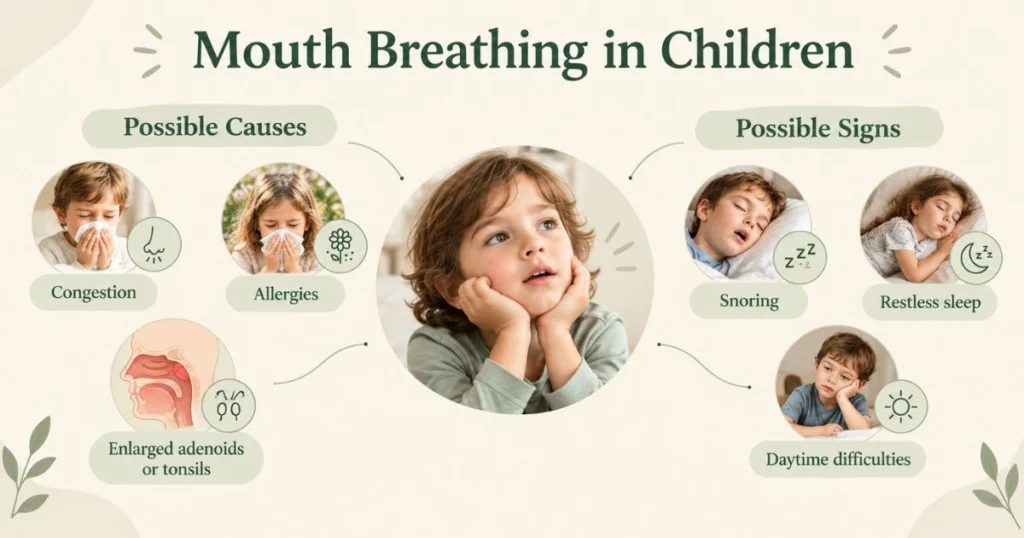
Common possibilities include:
- A cold
- Allergies
- Chronic nasal congestion
- Enlarged adenoids
- Enlarged tonsils
- Nasal obstruction
- Sleep-related breathing problems
Nasal obstruction in children has several possible causes, including inflammation, allergies and enlarged adenoids. Enlarged adenoids are particularly common as a cause of nasal obstruction in children.
What Can Parents Do at Home?
Start with observation.

Ask yourself:
- Does my child mouth-breathe only when sick?
- Does it happen every night?
- Does my child snore?
- Is their nose frequently blocked?
- Do they wake frequently?
- Do they seem tired or irritable during the day?
- Do I ever notice pauses in their breathing?
Keeping notes for a week or two can make your conversation with the pediatrician much more useful.
Don’t Simply Tell Your Child to “Close Their Mouth”
For parents, this is one of the most important things to understand.
If your child’s nasal airway is blocked, telling them to close their mouth doesn’t solve the underlying problem.
Instead, try to understand what’s preventing comfortable nasal breathing.
Your child shouldn’t have to feel that they’re doing something wrong simply because they’re breathing in the way that feels easiest.
Can Mouth Breathing Affect Sleep?
Mouth breathing can occur alongside symptoms that interfere with good-quality sleep.
You may notice:
- Snoring
- Restless sleep
- Dry mouth
- Drooling
- Noisy breathing
- Frequent nighttime waking
In children, persistent snoring deserves particular attention.
The American Academy of Pediatrics explains that childhood sleep apnea can involve frequent snoring, nighttime breathing problems, daytime sleepiness and attention or behavior difficulties.
The AAP’s clinical guideline also recommends screening children and adolescents for snoring and further evaluation when snoring occurs with signs or symptoms of obstructive sleep apnea.
That doesn’t mean every child who snores has sleep apnea.
It means frequent snoring shouldn’t automatically be dismissed as harmless.
Can Mouth Breathing Affect Your Oral Health and Teeth?
One of the immediate problems associated with mouth breathing is dryness.
When your mouth remains open for long periods, saliva evaporates more quickly, which can leave you waking with a dry mouth or unpleasant breath.
Dry Mouth and Bad Breath
You may notice:
- A sticky feeling in your mouth
- Dry lips
- Morning breath
- A dry throat
- Increased thirst after waking
Good oral hygiene remains important, but if mouth dryness keeps returning every morning, it is worth considering whether nighttime mouth breathing is contributing.
Mouth Breathing and Dental Health
Persistent mouth breathing may be associated with oral-health concerns, particularly in children.
For example, chronic mouth breathing can occur alongside dry mouth and changes in oral posture. Enlarged adenoids and long-term mouth breathing may also be associated with dental and facial-development concerns.
That doesn’t mean mouth breathing automatically causes dental problems.
Genetics, oral hygiene, diet, anatomy and many other factors matter.
If your child regularly mouth-breathes, regular dental and pediatric care can help identify concerns early.
What About Facial Development?
You may have heard claims that mouth breathing will permanently change a child’s face.
The reality is more nuanced.
Research has reported associations between chronic mouth breathing and certain dentofacial characteristics, but mouth breathing isn’t the only factor influencing facial growth. Nasal obstruction, genetics, jaw structure and other developmental factors all matter.
So avoid frightening yourself—or your child—with simplistic claims.
The useful takeaway is this:
Persistent mouth breathing deserves investigation, particularly when nasal obstruction or sleep problems are also present.
When Should You See a Doctor About Mouth Breathing?
You don’t need to panic over an occasional open mouth during sleep.
However, persistent symptoms are worth discussing with a healthcare professional.
Make an Appointment If You Notice:
- Your child regularly breathes through their mouth.
- Mouth breathing continues after a cold has cleared.
- Your nose remains chronically congested.
- You or your child snores frequently.
- Your child sleeps with their mouth open most nights.
- There is gasping or choking during sleep.
- You notice pauses in breathing.
- Sleep appears unusually restless.
- Daytime tiredness is persistent.
- Your child has difficulty breathing comfortably through the nose.
Cleveland Clinic recommends evaluation when mouth-breathing symptoms persist, particularly in children.
For children with symptoms suggesting sleep apnea, HealthyChildren.org advises parents to contact their pediatrician.
Get Immediate Medical Help If You Have Difficulty Breathing
Mouth breathing is different from an acute breathing emergency.
Seek urgent medical care if you or your child develops significant difficulty breathing, severe breathing distress, blue or gray lips or skin, or another obvious emergency breathing symptom.
When breathing is seriously impaired, don’t rely on home remedies.
Can You Stop Mouth Breathing Without Medical Treatment?
Sometimes.
But it depends entirely on the cause.
| Possible cause | Can home measures help? | When professional care matters |
| Temporary cold | Often, as congestion improves | If symptoms persist or worsen |
| Temporary nasal congestion | Nasal care may improve comfort | If congestion becomes chronic |
| Allergies | Trigger management may help | If symptoms remain difficult to control |
| Habitual open-mouth posture | Awareness may help | If the pattern persists |
| Enlarged adenoids | Home measures won’t remove the enlargement | Medical assessment may be needed |
| Enlarged tonsils | Home measures won’t remove the enlargement | Evaluation is important when sleep symptoms occur |
| Deviated septum | Home care cannot straighten the septum | Medical evaluation can identify structural obstruction |
| Sleep-related breathing disorder | Home remedies aren’t a substitute for evaluation | Professional assessment is important |
The central idea is simple:
Treat the cause, not just the open mouth.
If something is preventing air from moving comfortably through your nose, closing your mouth doesn’t solve the problem.
What Not to Do When Trying to Stop Mouth Breathing
Trying to improve your breathing is reasonable. Trying to force a solution without understanding the cause isn’t.
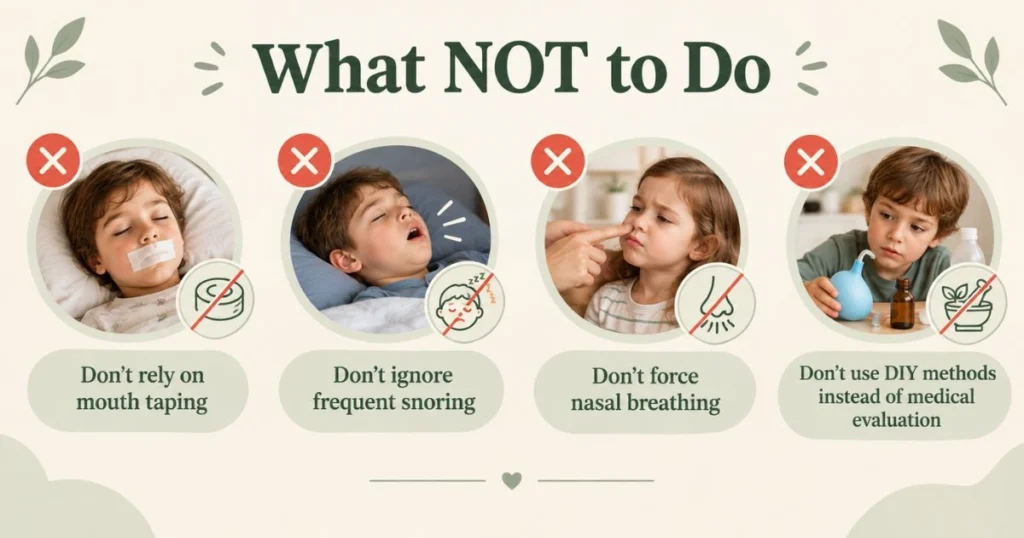
Don’t Force Nasal Breathing
If your nose is blocked, don’t force yourself or your child to breathe through it.
Find out why the nose is blocked.
Don’t Treat Mouth Tape as a Cure
Mouth taping is not a replacement for diagnosing nasal obstruction or sleep-related breathing problems.
This is particularly important for children.
Don’t Ignore Persistent Snoring
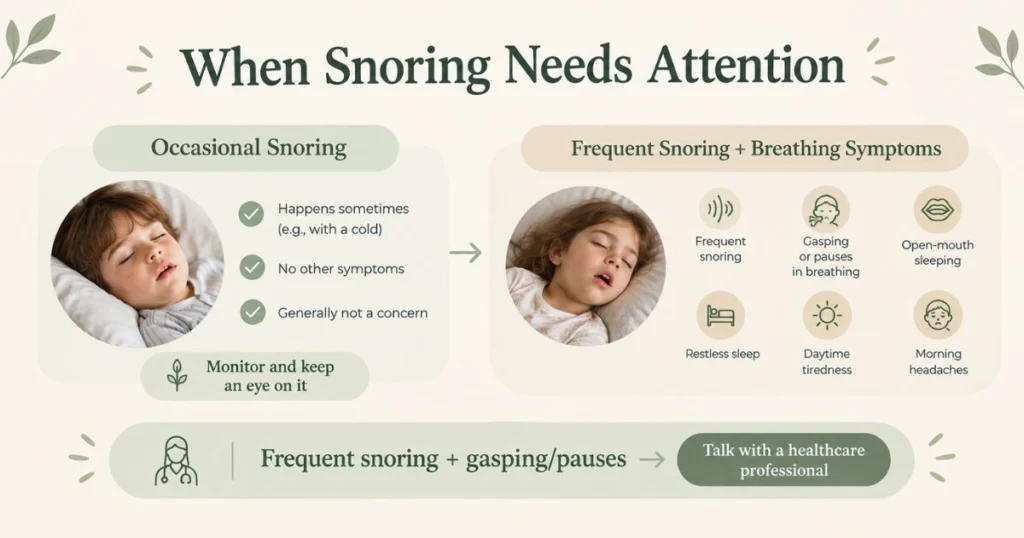
Occasional snoring during a cold is different from frequent snoring.
If your child snores regularly or you notice pauses, gasping or difficult breathing during sleep, talk with their pediatrician.
Don’t Assume It’s Just a Habit
Sometimes it is a habit.
But sometimes the “habit” developed because nasal breathing was difficult in the first place.
That distinction can change what treatment is appropriate.
A Simple Daily Routine to Encourage Comfortable Nasal Breathing
You don’t need an elaborate routine.
The goal is simply to notice your breathing, reduce obvious irritants and respond to congestion appropriately.

Morning
When you wake:
- Notice whether your mouth is unusually dry.
- Check whether your nose feels blocked.
- Drink water normally.
- Notice whether you woke with a sore throat.
- Pay attention to snoring or restless sleep.
If you wake with a dry mouth every morning, consider whether you may be mouth breathing during sleep.
During the Day
When your nose is clear:
- Notice whether your lips naturally remain apart.
- Relax your jaw.
- Allow comfortable nasal breathing.
- Avoid forcing deep breaths.
- Pay attention to recurring nasal congestion.
The purpose isn’t to monitor every breath you take.
You simply want to become aware of a pattern that you may not have noticed before.
Before Bed
Create a comfortable breathing environment:
- Address known allergy triggers.
- Avoid smoke and strong fragrances.
- Keep the nose comfortably clear.
- Follow your usual sleep routine.
- Notice whether snoring happens regularly.
- Don’t use mouth tape as a substitute for evaluation.
If you’re concerned about your child, watch for repeated symptoms rather than focusing on one unusual night.
● Follow your usual sleep routine.
Frequently Asked Questions About Mouth Breathing
How to Stop Mouth Breathing Naturally?
To stop mouth breathing naturally, first consider why you’re doing it. If temporary congestion or allergies are making nasal breathing difficult, addressing those issues may help. Gentle nasal-breathing awareness can also help when your nose is comfortably clear.
However, persistent mouth breathing may be caused by enlarged adenoids or tonsils, structural nasal obstruction or a sleep-related breathing problem. In those cases, home strategies alone may not solve the problem.
How to Stop Mouth Breathing at Night?
Start by looking for the reason it happens during sleep.
Nasal congestion, allergies, enlarged adenoids or tonsils and sleep-related breathing problems can all contribute. If nighttime mouth breathing occurs with frequent snoring, gasping or pauses in breathing, talk with a healthcare professional rather than relying on mouth taping or other DIY solutions.
How to Stop Mouth Breathing in Children?
Don’t begin by telling your child to keep their mouth closed.
First look for signs of nasal congestion, allergies, enlarged adenoids or tonsils, snoring or sleep-related breathing problems. If mouth breathing happens regularly, discuss it with your child’s pediatrician.
Why Do I Breathe Through My Mouth When I Sleep?
Your body may switch to mouth breathing when nasal airflow is restricted. Common contributors include congestion, allergies, enlarged tissues, structural nasal problems and sleep-related breathing disorders.
Is Mouth Breathing Bad for You?
Occasional mouth breathing isn’t necessarily a problem.
Persistent mouth breathing can be a sign that something is interfering with nasal breathing. It may also contribute to symptoms such as dry mouth, bad breath and disrupted sleep. The significance depends on the cause and how frequently it happens.
Can Allergies Cause Mouth Breathing?
Yes.
Allergic inflammation can make your nose congested, which can make nasal breathing more difficult. When the nose feels blocked, you may naturally switch to breathing through your mouth.
Can Enlarged Adenoids Cause Mouth Breathing?
Yes.
Enlarged adenoids can narrow the airway behind the nose and make nasal breathing difficult. This is particularly relevant in children, where enlarged adenoids are a common cause of nasal obstruction.
Is Mouth Taping Safe for Mouth Breathing?
Mouth taping should not be treated as a universal solution for mouth breathing.
If your nose is obstructed, taping the mouth doesn’t address the underlying problem. For a child with persistent nighttime mouth breathing, snoring or other breathing symptoms, discuss the situation with a pediatrician instead of trying to force the mouth closed.
When Should I See a Doctor About Mouth Breathing?
Consider an evaluation if mouth breathing is persistent, occurs most nights, or is accompanied by chronic congestion, frequent snoring, gasping, pauses in breathing, restless sleep or daytime problems.
For children, the American Academy of Pediatrics recommends evaluation when habitual snoring occurs with symptoms or signs of obstructive sleep apnea.
Conclusion: Focus on Why You’re Mouth Breathing

If you’re trying to figure out how to stop mouth breathing naturally, the most important step isn’t finding the quickest trick.
It’s finding the reason.
A blocked nose from a cold may cause temporary mouth breathing. Allergies may keep the nasal passages inflamed. Enlarged adenoids or tonsils may interfere with a child’s airway. A structural nasal problem may make breathing through the nose difficult. And nighttime mouth breathing combined with loud snoring, gasping or pauses in breathing can be a reason to investigate sleep-related breathing problems.
Simple habits can still have a place.
You can keep your environment free from smoke and irritating fragrances, manage known allergy triggers, take appropriate steps for temporary congestion and practice relaxed nasal breathing when your nose is comfortably clear.
But you don’t need to force yourself—or your child—to breathe through a blocked nose.
And you don’t need to feel guilty if your child sleeps with their mouth open.
The goal isn’t simply to keep the mouth closed. The goal is to make comfortable, healthy breathing possible.
Parenting Whisper Reminder
Your child’s breathing is worth noticing, not worrying about alone. If mouth breathing keeps happening, especially during sleep, focus less on correcting the habit and more on understanding what may be making nasal breathing difficult.
If this article helped you recognize a pattern in yourself or your child, consider saving it for later and sharing it with another parent who may be wondering the same thing.