
Few parenting moments feel as uncomfortable as watching your toddler raise a hand and hit you, a sibling, or another child. Toddler hitting can leave you feeling angry, embarrassed, confused, or even wondering whether you’re somehow failing as a parent.
Then comes the question: How do you stop toddler hitting without punishment?
The good news is that you don’t have to choose between being gentle and setting firm limits. You can make it very clear that toddler hitting is not acceptable while still helping your child understand the feelings underneath the behavior.
During the toddler years, children are still developing impulse control, emotional regulation, communication, and social skills. A 2-year-old, for example, may understand a rule but still struggle to control a strong impulse when frustrated. The American Academy of Pediatrics notes that toddlers may hit, bite, or kick when anger and frustration overwhelm their developing ability to control impulses.
Your goal isn’t simply to make the hitting stop in that moment. With toddler hitting, you want to teach your child what to do instead.

Why Is My Toddler Hitting?
Before you can address Toddler Hitting, it helps to understand what may be driving the behavior.
Hitting doesn’t have one single cause. Your toddler may hit because they are angry, frustrated, tired, overwhelmed, unable to communicate what they want, or struggling with a situation that feels too difficult. Understanding these triggers can help you respond more effectively when Toddler Hitting occurs.

Toddler Hitting Can Be a Way of Expressing Big Feelings
Your toddler can experience an enormous emotion without having the emotional skills to handle it.
They may feel:
- Angry because you said no
- Frustrated because a toy isn’t working
- Upset because another child took something
- Jealous when you give attention to a sibling
- Overwhelmed by noise or activity
- Disappointed when you end an enjoyable activity
- Excited and unable to control their body
The feeling itself isn’t the problem. Hitting is the behavior that needs a boundary.
ZERO TO THREE explains that toddlers who become physically aggressive often need help calming down and learning safer ways to express strong feelings.

Limited Language Can Lead to Hitting
Imagine wanting something urgently but not having the words to explain it.
Your toddler may want to say:
- “Give it back!”
- “My turn!”
- “Help me!”
- “Stop!”
- “I don’t like that!”
Instead, their body reacts before their language can catch up.
This is particularly common when a toddler is already upset. Teaching simple replacement phrases can gradually give your child another route for expressing frustration.

Hunger, Tiredness, and Overstimulation Can Make Hitting More Likely
Pay attention to when the hitting happens.
Does it usually occur:
- Before meals?
- Near bedtime?
- After skipping a nap?
- During busy outings?
- When your toddler has been playing for a long time?
- During transitions?
- When siblings compete for the same toy?
The AAP recommends anticipating common tantrum triggers such as hunger and tiredness and helping toddlers avoid becoming overwhelmed.
This doesn’t mean hunger or tiredness causes every incident. Instead, these factors can make it harder for your toddler to manage frustration.
Toddlers Are Still Learning Self-Control
One of the most important things to remember about Toddler Hitting is that knowing a rule isn’t the same as being able to follow it perfectly.
Your toddler may know that hitting is not allowed and still hit when overwhelmed.
ZERO TO THREE describes self-control as a skill that is still developing during the toddler years.
That is why your response to Toddler Hitting needs to combine a firm limit with teaching and practice.
What to Do When Your Toddler Hits

When your toddler hits, you don’t need a complicated speech. A simple sequence can help you respond consistently:
Stop → Set the boundary → Name the feeling → Teach an alternative → Reconnect
Let’s look at each step.
1. Stop the Hitting Immediately
Your first responsibility is safety.
If your toddler tries to hit you:
- Gently block the hand.
- Move slightly out of reach if necessary.
- Keep your voice calm.
- Avoid hitting or grabbing your child angrily.
If another child is involved, calmly separate the children.
You don’t need to wait for your toddler to calm down before stopping the behavior. The AAP recommends stopping aggressive behavior such as hitting rather than ignoring it.
You might say:
“I won’t let you hit.”
That’s enough.
2. Set a Clear Boundary

Your toddler needs to know exactly what isn’t allowed.
Try:
“No hitting. Hitting hurts.”
Or:
“You’re angry, and I won’t let you hurt anyone.”
Keep your message short, especially if your toddler is in the middle of a tantrum.
ZERO TO THREE recommends calmly acknowledging the child’s feelings while clearly stating that hitting isn’t acceptable.
3. Name the Feeling
Once you’ve stopped the immediate behavior, help your toddler connect the feeling with the situation.
For example:
“You’re frustrated because I took the cup away.”
“You really wanted that truck.”
“You’re upset because your sister is playing with the toy.”
You’re not saying that hitting is okay just because your toddler is angry.
You’re saying:
“Your feeling makes sense. Hitting is still not okay.”
That distinction is at the heart of gentle discipline.

4. Teach What to Do Instead
If you only tell your toddler what not to do, they may still not know what to do.
Give them a replacement.
Teach simple phrases such as:
- “Stop!”
- “My turn!”
- “Help me!”
- “No!”
- “I don’t like it!”
- “Mommy, help!”
You can also teach safe ways to move away from frustration:
- Come to you for help
- Take a short break
- Move away from the conflict
- Stomp their feet
- Ask for a turn
- Use words to express anger
ZERO TO THREE recommends helping toddlers identify their feelings and teaching acceptable ways to express frustration instead of hitting.
5. Reconnect After Your Toddler Calms Down
Once the intense moment has passed, reconnect.
You might say:
“You were really angry. You wanted the toy. Next time, say, ‘My turn,’ and I’ll help you.”
Keep it brief.
Your toddler doesn’t need a lecture about morality. They need repeated practice with the skill they’re still learning.

How to Stop Toddler Hitting Without Punishment
Stopping Toddler Hitting without punishment doesn’t mean allowing the behavior.
It means using discipline as teaching rather than using fear, pain, shame, or humiliation.
The American Academy of Pediatrics recommends positive discipline strategies such as setting limits, redirecting behavior, reinforcing appropriate behavior, and modeling nonviolent behavior. It recommends against spanking, hitting, slapping, threatening, insulting, humiliating, or shaming children when addressing Toddler Hitting.
Discipline Teaches; Punishment Doesn’t Teach the Missing Skill

When your toddler hits, punishment might focus on:
- Making them feel bad
- Frightening them
- Taking something away simply to make them suffer
- Shaming them
- Physically hurting them
A teaching-based response focuses on:
- Stopping the behavior
- Protecting everyone
- Naming the emotion
- Holding the boundary
- Teaching another response
- Practicing that response
- Noticing when your child uses it
This approach still has limits. You’re not saying, “Anything goes.”
You’re saying:
“I love you, and I won’t let you hurt anyone.”
Why You Shouldn’t Hit Your Toddler Back
Hitting your child to teach them not to hit sends a confusing message.
You’re essentially saying:
“Hitting is wrong, except when an adult does it.”
The American Academy of Pediatrics recommends avoiding physical punishment because it is not an effective way to guide behavior and may be linked to more aggressive responses. Instead, the AAP supports calm, nonphysical discipline strategies that teach children appropriate behavior.
Your toddler learns more from what you model than from what you say.
If you want your child to manage anger without violence, your response becomes part of that lesson.
Avoid Shame and Harsh Labels
Try not to say:
- “You’re a bad kid.”
- “What’s wrong with you?”
- “You’re such a bully.”
- “I’m ashamed of you.”
- “Good children don’t hit.”
Instead, separate your child from the behavior:
“Hitting isn’t okay.”
That leaves room for your toddler to learn without turning one behavior into an identity.
ZERO TO THREE specifically recommends separating feelings about a child from the child’s behavior and maintaining warmth while enforcing limits.
What to Do When Your Toddler Hits You
Being hit by your own child can feel especially personal.
You may instinctively want to shout, pull your hand away sharply, or retaliate. Take a breath before responding.
Use This Simple Response
- Block the hit.
- Move away if needed.
- Say, “I won’t let you hit me.”
- Name the emotion.
- Offer a replacement.
For example:
“You’re angry because I said no. I understand you’re mad. I won’t let you hit me. You can say, ‘I’m mad!’”
You don’t need to convince your toddler that your decision was correct while they’re overwhelmed.
First, help them regulate. The teaching can come later.
What to Do When Your Toddler Hits Another Child

Toddler hitting can become particularly stressful at the playground, daycare, or during sibling conflicts.
Separate the Children Calmly
If your toddler hits another child:
- Move them apart.
- Check whether the other child is hurt.
- Keep your response calm.
- State the boundary.
- Help your toddler understand what happened.
If you’re dealing with a baby sibling, be especially vigilant. ZERO TO THREE advises never leaving a baby alone with an older sibling who has been physically aggressive toward them.
Don’t Force an Instant Apology
A forced “sorry” may end the social moment, but it doesn’t necessarily teach empathy.
Instead, guide your toddler toward repair.
You might say:
“Let’s see if she’s okay.”
Or:
“He is crying because hitting hurts. Let’s give him some space.”
Later, you can practice:
“Next time, say ‘my turn’ instead of hitting.”
Toddler Hitting During Tantrums: What Should You Do?

Tantrums are common during the toddler years, particularly from about ages 1 to 3.
When hitting happens during a tantrum, don’t expect your toddler to calmly discuss their emotions while they’re overwhelmed.
During the Tantrum
Focus on three things:
- Safety
- Calmness
- The boundary
You can say:
“You’re very angry. I won’t let you hit.”
Then stay close enough to maintain safety while giving your toddler space if they don’t want physical comfort.
Avoid a long explanation.
After the Tantrum
When your toddler is calm:
“You were angry when we had to leave. Hitting isn’t okay. Next time, you can say, ‘No, I want to stay,’ and I’ll help you.”
The goal is to practice the skill, not make your child feel guilty about losing control.
How to Prevent Toddler Hitting Before It Happens
Responding well matters, but prevention can make a major difference.
Start looking for patterns.
| Common Trigger | What You May Notice | What You Can Try |
| Hunger | Irritability, crying, grabbing | Keep meals and snacks predictable |
| Tiredness | Meltdowns, whining, hitting | Protect naps and bedtime |
| Transitions | Resistance when stopping play | Give advance warnings |
| Sharing | Grabbing or hitting | Coach turn-taking |
| Frustration | Throwing or hitting | Teach “help me” |
| Overstimulation | Crying, clinging, aggression | Move somewhere quieter |
| Sibling conflict | Fighting over toys | Stay nearby and coach |
| Waiting | Impatience and grabbing | Use short turns and simple expectations |
The AAP recommends anticipating triggers such as hunger and fatigue and helping toddlers succeed by adjusting routines when possible.
Give Transition Warnings
Instead of suddenly announcing:
“We’re leaving now!”
Try:
“Five more minutes, then we’re going home.”
Then:
“Two more minutes.”
Your toddler may still protest, but the transition won’t feel quite as abrupt.
Offer Small Choices

When appropriate, give your toddler two acceptable options:
“Would you like to put your shoes on first or your jacket?”
Choices can give toddlers an appropriate sense of control without changing the boundary.
Protect Sleep and Meals
You can’t prevent every episode of toddler hitting, but you can reduce predictable triggers.
A hungry or exhausted toddler often has fewer resources available for handling frustration.
Teach Your Toddler Emotional Regulation Before They Hit

Don’t wait for a meltdown to teach emotional skills.
Practice when your toddler is happy and calm.
Teach Simple Feeling Words
Start with everyday emotions:
- Mad
- Sad
- Happy
- Scared
- Frustrated
- Tired
- Excited
During ordinary moments, say:
“You’re frustrated because the block fell.”
This helps your toddler connect experiences with words.
Practice Replacement Phrases
Role-play situations with toys.
Pretend one toy takes another toy’s car.
Then model:
“My turn!”
Or:
“Stop!”
Or:
“Help me!”
Repeat these phrases regularly. Your toddler may not use them immediately, but you’re building a language pathway for future conflicts.
ZERO TO THREE recommends identifying feelings, connecting feelings with actions, and helping toddlers learn appropriate ways to express themselves.
Praise Your Toddler When They Don’t Hit

Parents naturally notice hitting because it’s disruptive.
But your toddler also needs you to notice the moments when they handle frustration successfully.
Instead of only correcting:
“Don’t hit.”
Look for opportunities to say:
“You were upset, and you told me how you felt instead of hitting.”
“You waited for your turn!”
“You came to me for help instead of hitting. That was a smart choice.”
“You told him, ‘Stop.’ You used your words to solve the problem.”
Specific praise tells your toddler exactly which behavior you want repeated. The AAP recommends paying attention to and praising behaviors you want to encourage.
Common Mistakes Parents Make When Toddler Hitting Happens
Hitting Back
This models the behavior you’re trying to eliminate.
Giving In After Hitting
If hitting immediately results in getting the desired toy, snack, screen, or activity, your toddler may learn that hitting changes the outcome.
You can acknowledge the emotion without changing a necessary boundary.
Giving a Long Lecture
During a meltdown, your toddler isn’t ready for a 10-minute explanation.
Keep it simple:
“I won’t let you hit.”
Teach more after they are calm.
Labeling Your Toddler
Avoid turning behavior into identity.
Your toddler hit someone.
That doesn’t mean your toddler is a bad or aggressive child.
Expecting Immediate Change
Toddlers learn through repetition.
You may need to use the same calm response dozens of times before your child consistently replaces hitting with words.
Progress may look like:
- Hitting less often
- Recovering faster
- Asking for help
- Using “stop”
- Waiting briefly
- Coming to you when frustrated
Those small changes matter.
A Simple Toddler Hitting Response Plan
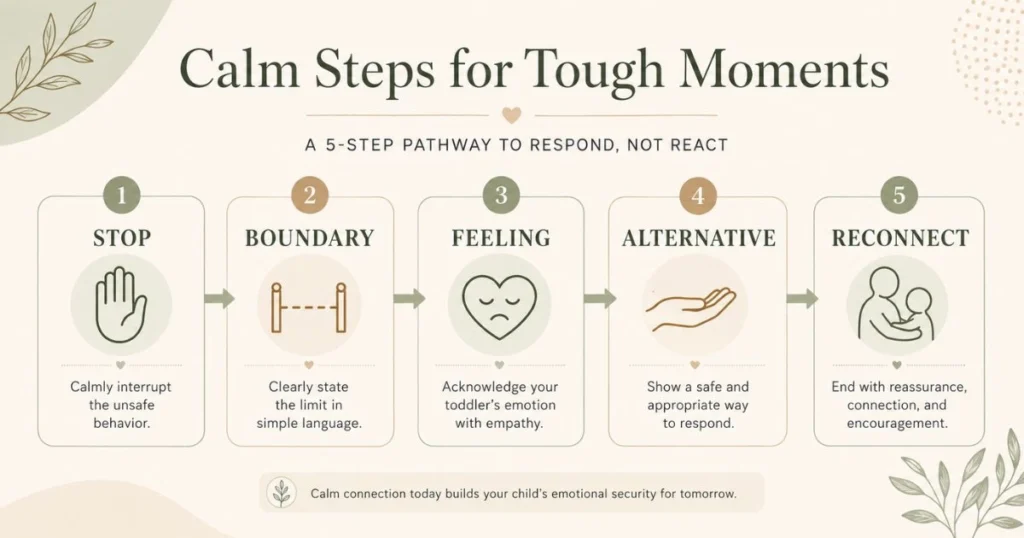
When you’re unsure how to respond, keep this simple approach in mind:
1. Stop
Prevent the hit or separate the children.
2. Set the Boundary
“I won’t let you hit.”
3. Name the Feeling
“You’re angry because you wanted the toy.”
4. Teach an Alternative
“Say, ‘My turn.’”
5. Reconnect
Help your toddler calm down and practice again later.
You can remember the entire approach as:
Stop → Boundary → Feeling → Alternative → Reconnect.
How Long Does It Take to Stop Toddler Hitting?
There isn’t a universal timeline.
Your toddler’s progress can depend on:
- Age
- Temperament
- Communication skills
- Frequency of triggers
- Sleep and routine
- Family consistency
- Developmental stage
- Environment
Rather than wondering, “Why is the hitting still happening?” look for direction.
Is your toddler hitting less often?
Are they recovering faster?
Are they beginning to use words?
Are they coming to you for help?
Those are meaningful signs that the new skill is developing.
When Should You Worry About Toddler Hitting?
Occasional hitting can occur during early childhood, but persistent or severe aggression deserves attention.
Consider speaking with your child’s pediatrician if:
- Hitting is frequent and persistent.
- Your child regularly causes injuries.
- Aggression is becoming more severe.
- Your toddler frequently hurts themselves.
- The behavior occurs across many environments.
- Hitting significantly interferes with family, daycare, or peer relationships.
- You notice possible concerns with your child’s communication or overall development.
- You feel unable to keep your child or other people safe.
You don’t need to wait until the situation becomes extreme before asking for guidance.
A pediatrician can help you consider your child’s overall development, behavior, communication, and circumstances.
Toddler Hitting FAQ
Is Toddler Hitting Normal?
Toddler hitting can be a common behavior during a period when children are still developing impulse control, emotional regulation, and communication. That doesn’t mean you should ignore it. You should calmly stop the behavior and teach a safer alternative.
How Do I Stop Toddler Hitting Without Punishment?
Stop the behavior immediately, set a firm boundary, acknowledge the emotion, teach an alternative behavior, and practice that response consistently. You don’t need to hit, shame, or frighten your child to establish a clear limit.
Why Is My Toddler Hitting Me?
Your toddler may be expressing frustration, anger, disappointment, jealousy, overstimulation, or a desire for something they don’t yet know how to communicate. Hitting can also happen when a toddler is tired or hungry.
Should I Ignore Toddler Hitting?
No. Hitting should not simply be ignored. The AAP recommends stopping behaviors such as hitting and biting, particularly when someone could be hurt.
Should I Hit My Toddler Back to Teach Them Not to Hit?
No. The AAP recommends against spanking, hitting, slapping, and other physical punishment. Physical punishment can increase aggression rather than teaching effective self-control.
What Should I Say When My Toddler Hits?
Keep your words short and calm:
- “I won’t let you hit.”
- “Hitting hurts.”
- “You’re angry. It’s okay to be angry, but it’s not okay to hit.”
- “Use your words.”
- “Say, ‘Stop!’”
How Do I Stop Toddler Hitting Siblings?
Separate the children immediately when necessary, protect the child who was hit, set the boundary with your toddler, and teach an alternative such as asking for a turn or getting an adult’s help. Never leave a baby alone with a sibling who has been physically aggressive toward them.
How Do I Stop Toddler Hitting During Tantrums?
Focus on safety and a simple boundary while the tantrum is happening. Don’t give a long lecture. Once your toddler is calm, talk briefly about the emotion and practice what they can do next time.
Is Toddler Hitting a Sign of Aggression?
Hitting can be part of normal toddler behavior, particularly when children are still learning emotional and impulse control. Persistent, severe, or escalating aggression is different and may warrant discussion with your pediatrician.
When Should I Talk to a Pediatrician About Toddler Hitting?
Talk with your pediatrician if the behavior is severe, persistent, causes injuries, occurs across settings, is getting worse, or occurs alongside concerns about development, communication, or your child’s ability to stay safe.
Conclusion: You Can Be Gentle and Still Set a Firm Boundary

When your toddler hits, you don’t have to become harsher to become more effective.
You can stop the hand.
You can protect the other child.
You can say no.
You can acknowledge the anger.
And you can stay connected.
That’s not permissive parenting. It’s teaching.
The next time your toddler hits, try to remember five words:
Stop. Boundary. Feeling. Alternative. Reconnect.
Your toddler may not master the new response after one conversation. That’s okay. They’re learning a skill that takes time, repetition, and your steady guidance.
You don’t need to punish your toddler for having a big emotion. You need to help them learn what to do with it.
If this guide helped you, save it for the next difficult moment and share it with another parent who is dealing with toddler hitting. Sometimes knowing what to say before the next meltdown is exactly what helps you stay calm when it happens.