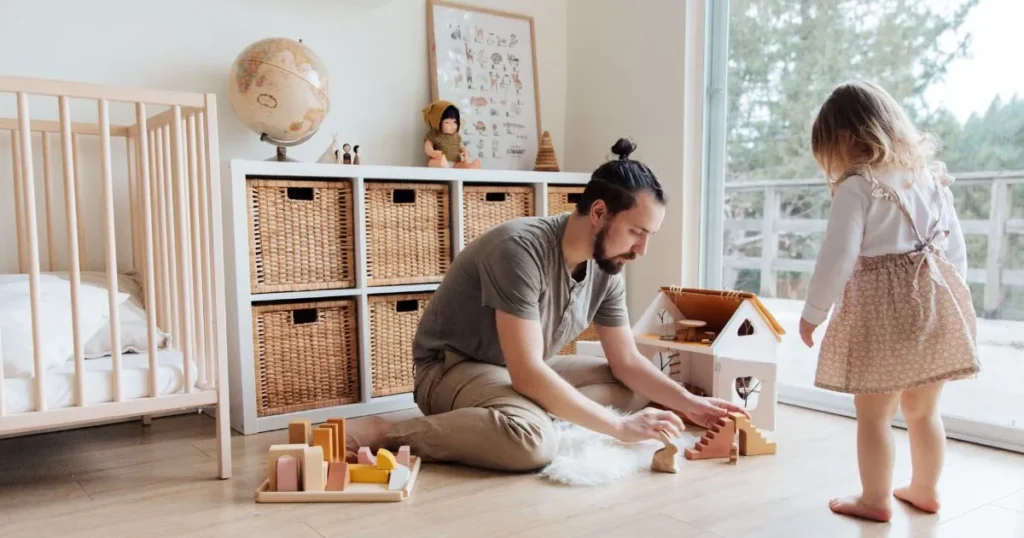

Toddlers can seem perfectly happy one minute and completely overwhelmed the next. A spilled cup, a broken cracker, leaving the playground, getting dressed, or hearing the word “no” can suddenly lead to crying, screaming, hitting, or a full-blown tantrum. These everyday moments are often closely connected to Toddler Emotions, which are still developing at this age.
If you have ever wondered, “Why does my toddler have such big emotions?”, you are not alone.
Toddler Emotions can feel intense because young children are still developing the language, impulse control, problem-solving skills, and emotional regulation abilities they need to manage strong feelings. They may know what they want very clearly, but they often do not yet have the skills to express disappointment, frustration, anger, fear, or sadness calmly.
This does not mean your toddler is being “bad.” It means they are still learning how to understand and manage their feelings.
The goal is not to prevent your toddler from experiencing difficult Toddler Emotions. Instead, the goal is to help your child recognize feelings, feel safe expressing them, learn appropriate boundaries, and gradually develop the ability to regulate emotions.
“This approach is at the heart of gentle parenting, where connection and boundaries work together.”
The American Academy of Pediatrics recommends approaches such as noticing, naming, and acknowledging children’s emotions while helping them meet the underlying need.

Toddler Emotions: What Parents Need to Know
Toddlerhood is a period of enormous emotional development, and Toddler Emotions can change quickly as your child learns how to understand and express feelings.
Your child may experience happiness, excitement, frustration, anger, jealousy, fear, sadness, embarrassment, disappointment, and affection—sometimes all within the same hour.
The emotional experience is real, but your toddler’s ability to manage Toddler Emotions is still developing.
A toddler might understand:
“I want that toy.”
But they may not yet be able to think:
“I’m disappointed that you said no. I can take a breath, explain how I feel, and choose another activity.”
That second response requires emotional regulation, communication, impulse control, and flexible thinking.
Those skills take time, especially when your child is dealing with strong Toddler Emotions.
Healthy emotional development begins early and continues throughout childhood. Young children develop emotional regulation through relationships, experiences, play, and repeated interactions with responsive caregivers.
This is why your response matters—but it also does not mean you need to respond perfectly every time.
You are helping your toddler practice understanding Toddler Emotions and gradually learning what to do with them.
Why Do Toddlers Have Such Big Feelings?

There are several reasons toddler emotions can seem much bigger than the situation itself.
Their brains are still developing
Toddlers are still learning how to control impulses and respond to frustrating situations, so their ability to manage Toddler Emotions is not yet the same as that of an older child or adult.
When a toddler becomes overwhelmed, strong Toddler Emotions can make it difficult for them to think clearly or calmly work through what is happening.
This is why your child might scream because a banana was broken in half, even though they were the one who asked for it.
The real issue is not necessarily the banana.
Instead, your toddler may be experiencing a feeling that is much bigger than their current ability to understand, express, and manage it.
Their language skills are still developing
Toddlers often understand more than they can express.
They may know:
- “I don’t like this.”
- “I wanted that.”
- “I’m scared.”
- “I want Mommy.”
- “Don’t touch it.”
But they may not have enough words to communicate those thoughts.
When words fail, behavior can become the communication.
Crying, pushing, throwing, screaming, or dropping to the floor may communicate something your toddler cannot yet explain verbally.
They want independence
Toddlers are discovering that they are separate people with their own preferences.
They want to:
- choose what to wear
- decide what to eat
- walk instead of being carried
- choose the book
- pour the water
- push the stroller
- say “no”
- do things independently
That growing independence is healthy, but it naturally creates conflict when your toddler’s wishes collide with safety, schedules, or family boundaries.
They are still learning to tolerate frustration
Adults have years of experience recognizing that disappointment is temporary, but toddlers are still learning this important lesson. When Toddler Emotions become intense, your child may experience disappointment as something much bigger than it actually is.
When something doesn’t go as expected, your toddler may not yet have the perspective to think, “This is frustrating, but I’ll be okay.”
Developing that ability takes time and comes through repeated everyday experiences, supportive guidance, and learning how to manage Toddler Emotions.
Toddler Emotions vs. Toddler Behavior

One of the most valuable things you can learn as a parent is the difference between your child’s emotions and their behavior.
Your toddler is allowed to feel angry.
Your toddler is not allowed to hurt someone because they are angry.
Your toddler is allowed to feel disappointed.
Your toddler is not allowed to throw a toy at another person’s head.
Your toddler is allowed to cry.
They do not need to stop crying simply because their emotions make you uncomfortable.
A simple rule to remember is:
Every feeling is okay, but not every behavior is okay.
Understanding this difference allows you to acknowledge Toddler Emotions while still maintaining safe and appropriate boundaries.
For example:
“You’re really angry because I turned off the TV. It’s okay to feel angry, but I won’t let you hit me.”
This response provides both connection and a clear boundary, helping your toddler learn how to handle strong emotions safely.
The American Academy of Pediatrics also recommends consistent limits and teaching toddlers acceptable behavior while avoiding physical punishment.
What Is Emotional Regulation for Toddlers?
Emotional regulation is the developing ability to recognize feelings, manage them, and respond to them in appropriate ways. For toddlers, learning to manage Toddler Emotions is a gradual process rather than a skill they can master immediately.
For a young child, emotional regulation does not mean sitting quietly or controlling every feeling. Instead, it may look like:
- accepting comfort after becoming upset
- using words instead of hitting
- asking for help
- calming down with a parent’s support
- waiting briefly for something they want
- recovering after disappointment
- moving from crying back to play
- beginning to recognize emotions in themselves and others
A toddler will not master these skills overnight.
In fact, young children often need adults to help them manage strong Toddler Emotions before they can consistently regulate their feelings on their own.
This process is often called co-regulation.
Your calm presence can become an important part of helping your toddler feel safe, settle their body, and gradually learn how to manage Toddler Emotions independently.atching the adults around them, while calm support, emotional language, and co-regulation help build healthy emotional development.
ZERO TO THREE explains that co-regulation involves responsive adult support that helps young children manage strong emotions while gradually developing their own regulation skills.
10 Gentle Ways to Help Your Toddler Handle Big Emotions
1. Name Your Toddler’s Emotion

One of the simplest ways to support toddler emotions is to put feelings into words.
When your toddler is upset, calmly describe what you see.
You might say:
“You’re frustrated.”
Or:
“You really wanted that toy.”
Or:
“You’re sad because Grandma left.”
Why it helps
Your toddler may experience an emotion without understanding what it is called.
By repeatedly connecting feelings with words, you help build an emotional vocabulary.
Over time, your child can begin moving from:
“AAAAHHH!”
toward:
“Mad!”
and eventually:
“I’m mad because you took my truck.”
That is meaningful progress.
What to say
Try:
- “You look frustrated.”
- “You’re feeling disappointed.”
- “That scared you.”
- “You really wanted to keep playing.”
- “You’re angry that I said no.”
- “You’re sad that Daddy left.”
You do not have to be certain about the emotion.
You can say:
“I wonder if you’re feeling frustrated?”
That gives your toddler room to correct you.
2. Validate the Feeling Without Giving In

Validation does not mean saying yes.
It means communicating:
“I understand that this feeling is real.”
Suppose your toddler wants cookies before dinner.
You can say:
“You really want a cookie. You’re disappointed that we’re not having one right now. Dinner comes first.”
You have validated the emotion while maintaining the boundary.
Avoid saying:
“Stop crying. It’s not a big deal.”
What feels minor to you may feel much more important to your toddler.
To your toddler, it may be.
The goal is not to make every disappointment disappear. It is to teach your child that disappointment can be experienced and survived.
3. Stay Calm When Your Toddler Is Not Calm
This can be one of the most challenging approaches to put into practice.
When your toddler is screaming, it can trigger your own frustration.
You may feel like yelling:
“STOP!”
But a loud adult often creates an even more emotionally intense environment.
Instead, try lowering your voice.
Take a breath.
Slow down your movements.
Use fewer words.
You might say:
“I’m here. You’re having a hard time.”
You don’t have to appear completely calm all the time.
You are human.
But whenever possible, try to regulate yourself before trying to regulate your toddler.
Children learn from observing adults, including how adults respond to frustration.
4. Set Clear and Simple Boundaries
Gentle parenting doesn’t mean letting go of rules or boundaries.
Toddlers need boundaries because boundaries help keep them safe and make the world more predictable.
The trick is to make boundaries:
- clear
- consistent
- simple
- age-appropriate
- calm
Instead of giving a long explanation during a tantrum, say:
“I won’t let you hit.”
Then gently block the hit if necessary.
You can add:
“You can stomp your feet.”
The message is:
“Your anger is okay. Hitting is not.”
5. Give Small Choices
Toddlers often become upset when they feel powerless.
Giving limited choices can provide a sense of independence without giving your child control over everything.
For example:
“Would you rather wear the red shirt or the green one?”
Instead of:
“What do you want to wear?”
Or:
“Would you rather walk to the bathroom or hop there together?”
Instead of:
“Come on. We’re going.”
The choices should be genuine but limited.
This approach can be particularly useful during everyday routines like getting dressed, heading out, or settling down for bedtime.
6. Prepare Your Toddler for Transitions
Transitions are a common trigger for toddler emotions.
Stopping something enjoyable can feel extremely difficult.
Instead of suddenly saying:
“We’re leaving now.”
Try giving your toddler preparation.
“Five more minutes at the playground.”
Then:
“Two more minutes.”
Then:
“One more slide, and then we go.”
Your toddler may still protest.
That is okay.
Preparation does not guarantee cooperation.
It simply makes the transition more predictable.
Visual timers, countdowns, and consistent transition routines can also help some toddlers understand that an activity is coming to an end. ZERO TO THREE notes that simple timing tools can help young children develop a better sense of when transitions will happen.
7. Help Your Toddler Calm Their Body

When emotions become intense, talking may not work very well.
Your toddler may need help calming their body first.
Depending on your child, you might try:
- a hug
- sitting quietly together
- rocking
- slow breathing
- drinking water
- looking at a book
- going somewhere quieter
- squeezing a soft toy
- stomping feet safely
- blowing imaginary candles
- listening to calming music
Do not turn calming strategies into another demand.
Instead of:
“Calm down right now.”
Try:
“Let’s help your body feel safe.”
The American Academy of Pediatrics also describes play-based strategies, emotional labeling, and calming techniques as ways children can practice managing emotions.
8. Teach Emotional Skills When Your Toddler Is Calm
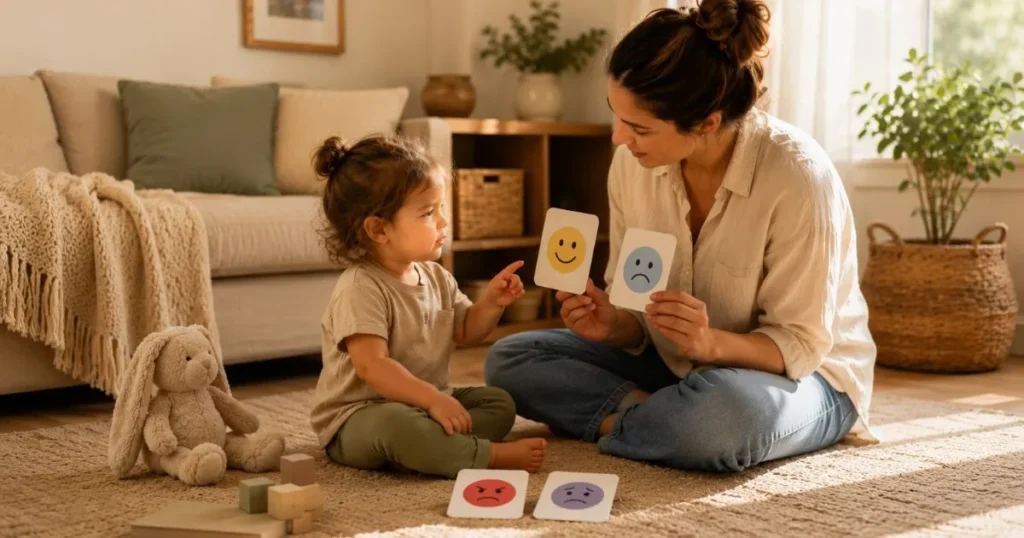
A tantrum is usually not the right moment to give your toddler a long lesson about Toddler Emotions. When feelings are intense, your child may not be ready to listen or absorb new information.
Instead, practice emotional skills during calm, everyday moments.
For example, while reading a book, point to a character and ask:
“How do you think she feels?”
During play, you might say:
“Look at your tower! You look happy.”
You can also model healthy ways of handling your own emotions:
“I couldn’t find my keys. I felt frustrated, so I took a breath and looked again.”
This helps your toddler understand that adults experience difficult Toddler Emotions too—and that strong feelings can be managed.
Books, pretend play, dolls, stuffed animals, and ordinary conversations can all give your child opportunities to recognize, name, and talk about different emotions.
9. Notice and Praise Emotional Skills
Parents often notice challenging behavior immediately.
Try noticing the positive moments too.
If your toddler hands back a toy instead of grabbing it, say:
“You waited for your turn. That was kind.”
If your toddler says:
“Mad!”
instead of hitting, say:
“You told me you were mad. You used your words.”
Specific praise helps your toddler understand exactly what behavior you want to encourage.
10. Repair After Difficult Moments
You will lose your patience sometimes.
Your toddler will have difficult moments.
That does not mean you have failed.
Repair matters.
If you yelled, you can say:
“I yelled because I was frustrated. I’m sorry. I could have responded with a calmer tone.”
You are not weakening your authority.
You are modeling accountability.
Your toddler learns:
- adults make mistakes
- mistakes can be repaired
- apologies matter
- relationships can recover
- Strong emotions don’t have to weaken the connection between you and your child.
Toddler Emotions by Age
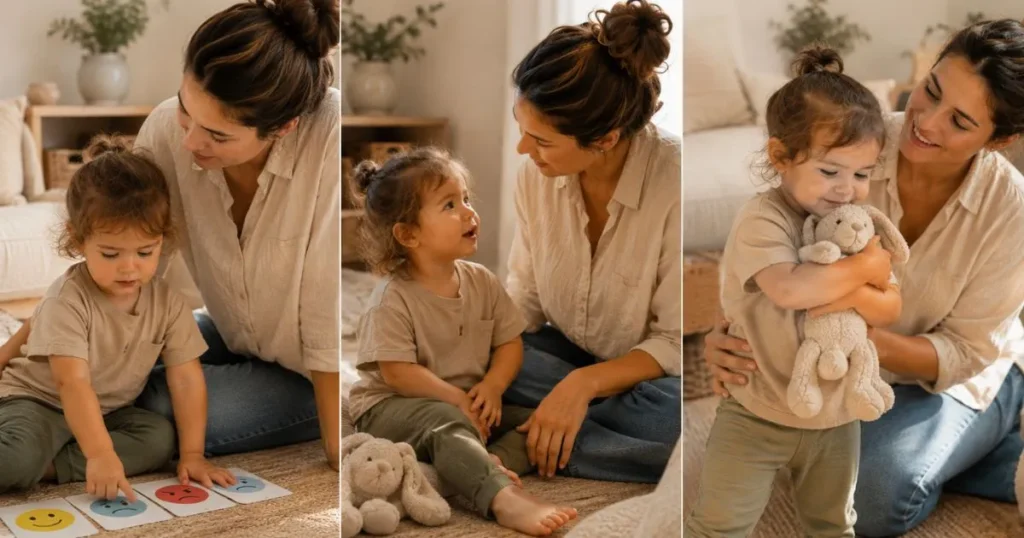
Every child develops at their own pace, so age ranges should be viewed as general patterns rather than strict deadlines.
Around 12–18 Months
Toddlers may:
- show strong preferences
- become frustrated when they cannot communicate
- cling to caregivers
- protest separation
- express affection
- cry when routines change
- have early tantrums
At this age, your child may understand simple emotional words but still rely heavily on adults for regulation.
Simple phrases work best:
“You’re upset.”
“You want Mommy.”
“I’m here.”
Around 18–24 Months
Emotions can become more intense as independence grows.
Your toddler may:
- say “no” frequently
- insist on doing things independently
- become frustrated easily
- struggle with sharing
- experience tantrums
- show jealousy
- become upset when limits are set
This is also a period when children may begin using more words for emotions.
ZERO TO THREE notes that two-year-olds may begin labeling feelings such as happy, sad, or mad while still needing substantial help managing those feelings.
Around 2–3 Years
Children typically become increasingly capable of talking about feelings, recognizing emotions in others, and using simple coping strategies.
They may begin saying:
“I’m mad.”
“I’m scared.”
“I don’t like it.”
“I need Mommy.”
But emotional control can still be inconsistent.
A toddler may explain an emotion beautifully one moment and throw themselves on the floor the next.
That is normal development.
The American Academy of Pediatrics notes that tantrums are a normal part of development and are especially common during the toddler years.
Common Toddler Emotions and How to Respond
Toddler Anger
Anger often appears when toddlers encounter limits, frustration, or blocked goals.
Try:
“You’re angry because I stopped you.”
Then maintain the boundary:
“I won’t let you hit.”
Your job is not to eliminate anger.
Your job is to teach your toddler what they can do with anger.
Toddler Frustration

Frustration is extremely common when toddlers want to do something independently but cannot yet complete the task.
You can say:
“That zipper is tricky.”
Then:
“You can try again, or I can help.”
Try not to immediately solve every problem for your toddler.
A little frustration can become an opportunity to practice persistence—with appropriate support.
Toddler Sadness
When your child is sad, connection often matters more than fixing.
You do not always need to say:
“Don’t be sad.”
Try:
“You’re sad. Come here.”
A hug, quiet presence, or simply sitting nearby can communicate safety.
Toddler Fear
Fear can appear around strangers, animals, loud sounds, darkness, separation, or unfamiliar environments.
Instead of:
“There’s nothing to be scared of.”
Try:
“That sound surprised you. You’re safe with me.”
This acknowledges the fear without reinforcing danger.
Toddler Jealousy
Jealousy can appear when attention shifts to a sibling, friend, or another adult.
You might say:
“You wanted Mommy to hold you too.”
Then provide connection when possible.
You can also involve your toddler in simple ways:
“Can you bring me the diaper?”
But do not make your toddler responsible for taking care of a baby or suppressing their feelings.
Toddler Disappointment
Disappointment is one of the most valuable emotions for children to learn to tolerate.
You cannot prevent every disappointment.
Instead:
“You wanted to stay at the park. Leaving is difficult when you’re enjoying yourself.”
Then hold the boundary.
Your toddler may cry.
You can stay nearby without changing your decision.
That is emotional support—not emotional avoidance.
Toddler Emotions and Tantrums
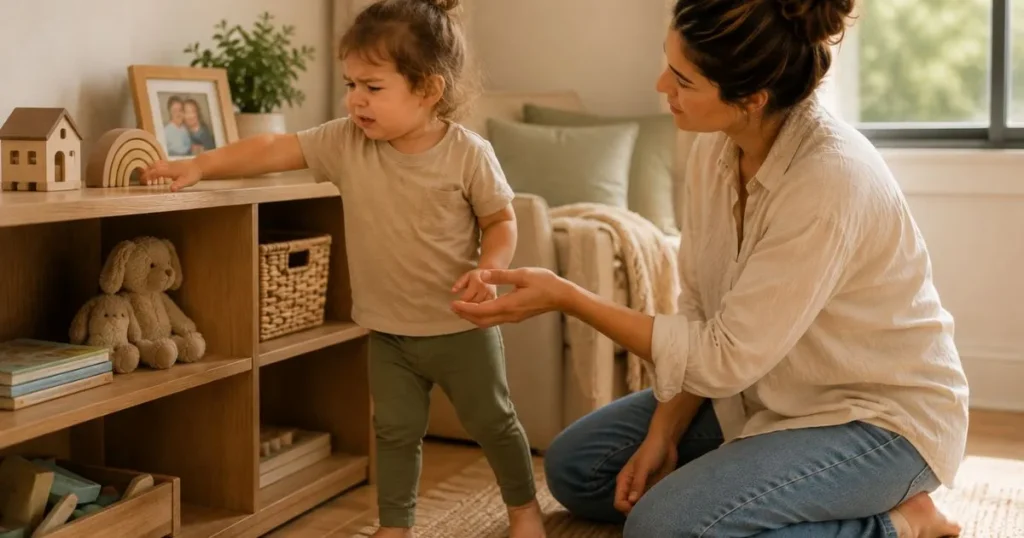
Tantrums are one of the most visible expressions of toddler emotions.
They can include:
- crying
- screaming
- dropping to the floor
- kicking
- throwing objects
- hitting
- refusing
- running away
- clinging
- repeatedly saying “no”
Tantrums are especially common between approximately ages 1 and 3.
A tantrum does not automatically mean your child is spoiled, manipulative, or poorly parented.
Often, your toddler is overwhelmed.
During a tantrum, try this sequence:
1. Stay close if your child wants you nearby.
2. Keep everyone safe.
3. Use very few words.
4. Name the emotion.
5. Hold the boundary.
6. Offer comfort when your child is ready.
For example:
“You’re very angry. You wanted the toy. I won’t let you hit. I’m right here.”
You do not need to give a ten-minute explanation.
Your toddler may not be able to process it while highly upset.
What About Hitting, Biting, or Kicking?
Aggressive behavior can occur during intense toddler emotions.
The response should be calm and immediate.
If your toddler hits:
“I won’t let you hit.”
Block the hit if necessary.
If your toddler bites:
“Biting hurts. I won’t let you bite.”
Then help your child move toward a safer behavior.
You can acknowledge the emotion:
“You were angry.”
But do not excuse the behavior:
“It’s okay to be angry. It’s not okay to hurt someone.”
Two-year-olds may still have limited control over emotional impulses, which is one reason hitting, biting, and kicking can appear during intense frustration.
If tantrums are becoming a frequent challenge, learn more about [toddler tantrums] and what you can do during these difficult moments.”
How to Handle Toddler Emotions in Real-Life Situations
When Your Toddler Refuses to Get Dressed
Instead of:
“Stop being difficult.”
Try:
“You don’t want to get dressed.”
Then give a choice:
“Do you want the striped shirt or the yellow shirt?”
If your toddler still refuses:
“You don’t have to like getting dressed. We still need to get dressed.”
Connection and boundaries can coexist.
When It’s Time for Your Toddler to Leave the Playground
Try:
“You’re having so much fun.”
Then:
“It’s time to leave.”
If your toddler cries:
“You’re sad that playtime is finished. I know.”
You can remain compassionate without returning to the playground.
When Your Toddler Refuses Food
Try not to turn every food refusal into a battle over Toddler Emotions.
You can respond calmly:
“You don’t want the broccoli right now. That’s okay. Your meal is here whenever you’re hungry.”
Keeping mealtimes relaxed, predictable, and pressure-free can help reduce unnecessary conflict and give your toddler space to manage their feelings around food.
“Offering a variety of simple [toddler meal ideas] can help keep mealtimes positive without turning food into a power struggle.”
When Your Toddler Wants Something You Said No To
Your toddler may cry because they do not like the answer.
You can say:
“You really wanted it. The answer is still no.”
This teaches an important lesson:
Feeling disappointed does not mean the boundary disappears.
When Bedtime Causes Big Emotions
Toddlers often struggle with transitions at bedtime.
Try keeping the routine predictable:
- Bath or wash-up
- Pajamas
- Dim lights
- Book
- Cuddle
- Sleep
Use the same simple language each night.
“First pajamas, then book, then bed.”
Predictability can help children feel more secure and understand what comes next.
“A predictable [toddler bedtime routine] can also make this transition easier for your child.”
What to Say—and What Not to Say
Instead of:
“Stop crying.”
Try:
“You’re having a hard time. I’m here.”
Instead of:
“It’s not a big deal.”
Try:
“It seemed very important to you in that moment.”
Instead of:
“You’re being bad.”
Try:
“You’re having a hard time. I won’t let you hit.”
Instead of:
“Why are you acting like this?”
Try:
“Something feels hard right now.”
Instead of:
“Calm down.”
Try:
“Let’s help your body calm down.”
Instead of:
“You have nothing to be upset about.”
Try:
“You’re disappointed. I understand.”
The goal is not to use perfect words every time.
The goal is to communicate:
“You can express your feelings with me, and I’ll help you learn how to handle them.”
Toddler Emotional Regulation Activities
Emotional regulation can be practiced through play—not only during difficult moments.
1. Feelings Faces
Make happy, sad, angry, surprised, and scared faces.
Ask:
“Can you make a happy face?”
Then:
“Can you make a surprised face?”
Keep it playful.
2. Feelings Books
While reading, point to characters and ask:
“How does she feel?”
You can also say:
“I think he looks worried.”
Books create a low-pressure way to talk about emotions.
3. Stuffed Animal Comfort Game
Pretend a stuffed animal is upset.
Say:
“Bear is sad. What can we do?”
Your toddler might suggest:
- hug Bear
- give Bear a blanket
- get Bear a drink
- sit beside Bear
This teaches emotional responses through pretend play.
4. Blow the Candles
Pretend there are birthday candles in front of you.
Take a slow breath and blow them out.
This simple activity can help your toddler practice managing toddler emotions and calming their body.
Do not expect a toddler to master formal breathing techniques during a meltdown.
Practice when your child is calm so the activity becomes familiar.
5. Emotion Sorting
Use simple pictures or drawings.
Sort them into:
- happy
- sad
- angry
- scared
- calm
For younger toddlers, start with just two or three emotions.
Daily Habits That Support Healthy Toddler Emotions
Emotional regulation does not happen only during tantrums.
Your toddler’s everyday environment matters too.
Prioritize sleep
An overtired toddler may have much less capacity to handle frustration.
Offer regular meals and snacks
Hunger can make difficult moments harder.
Build predictable routines
Knowing what happens next can make transitions easier.
Give plenty of active play
Movement gives toddlers opportunities to explore, practice, and release energy.
Spend one-on-one time together
Connection strengthens the relationship your child relies on for security.
Allow appropriate independence
Let your toddler try safe tasks independently.
Model emotional regulation
Let your child hear you use healthy coping strategies.
For example:
“I’m frustrated. I’m going to take a breath.”
These everyday experiences build emotional skills gradually.
“Having [healthy toddler snacks] available can also help when hunger makes your toddler more irritable.”
A Simple 5-Step Response to Toddler Big Feelings
When you do not know what to say, remember this five-step formula:
1. Notice
“You’re crying.”
2. Name
“You’re frustrated.”
3. Validate
“You really wanted that toy.”
4. Set the boundary
“I won’t let you hit.”
5. Connect
“I’m here. We can calm down together.”
This simple sequence can work in many situations.
You don’t need to have the perfect words or response every time.
You need connection, consistency, and boundaries.
Toddler Emotions Cheat Sheet
| Your Toddler Feels | You Can Say | Boundary or Support |
| Angry | “You’re really angry.” | “I won’t let you hit.” |
| Sad | “You’re feeling sad.” | Offer comfort |
| Frustrated | “That was hard.” | Offer help or another attempt |
| Scared | “That surprised you.” | Provide reassurance |
| Jealous | “You wanted me too.” | Offer connection |
| Disappointed | “You wanted to keep playing.” | Hold the limit |
| Excited | “You’re so excited!” | Help channel the energy |
| Overwhelmed | “This feels like a lot.” | Reduce stimulation |
When Should You Talk to Your Pediatrician About Toddler Emotions?

Toddlers are still developing impulse control and learning how to cope when things don’t go according to plan. As a result, their ability to manage Toddler Emotions is not yet comparable to that of an older child or adult.
When your toddler feels overwhelmed, intense Toddler Emotions can make it difficult to think clearly or respond calmly.
For instance, your child might suddenly cry because you broke a banana in half—even though they were the one who asked you to do it.
The banana itself may not be the real issue.
Your toddler may simply be experiencing Toddler Emotions that feel much bigger than their current ability to understand, express, and manage them.
Frequently Asked Questions About Toddler Emotions
Why are my toddler’s emotions so intense?
Toddlers are still building the skills they need for Toddler Emotions, including emotional regulation, impulse control, communication, and problem-solving. They can feel emotions very deeply while still lacking the ability to manage those feelings independently.
How do I teach my toddler about emotions?
Help your toddler understand Toddler Emotions by naming feelings during ordinary moments. You might say, “You’re frustrated,” “You look happy,” or “That sound scared you.” Reading books, using pretend play, looking at emotion pictures, and talking about your own feelings can also help your child recognize and understand different emotions.
Should I ignore my toddler’s tantrums?
You don’t have to ignore your toddler during difficult Toddler Emotions. Stay calm, make sure your child is safe, maintain clear boundaries, and offer reassurance. Some toddlers may need a little space, while others feel better when a calm adult stays close.
Should I comfort my toddler during a tantrum?
Yes. Comforting your toddler does not mean rewarding the tantrum. You can acknowledge the emotion while maintaining the boundary.
“You’re upset. I’m here. We’re still going home.”
How do I stop my toddler from hitting when angry?
Stay calm, block the hit if necessary, and clearly state the boundary:
“I won’t let you hit.”
Then help your child express the emotion in a safer way. Repeated practice is usually more useful than punishment alone.
When do toddlers learn emotional regulation?
Emotional regulation develops little by little. Toddlers are not expected to manage intense Toddler Emotions on their own all the time. At first, they depend heavily on adults for co-regulation and gradually build the skills they need to handle their feelings more independently as they grow.
Can toddlers understand feelings?
Yes. Toddlers can gradually learn to recognize and name their emotions, although this ability develops at a different pace for every child. Around age two, many children are beginning to identify feelings in themselves and others while still needing plenty of adult support to understand and manage Toddler Emotions.
Is it okay for my toddler to cry?
Yes. Crying is a natural way for young children to express their feelings. You don’t need to stop every tear; instead, reassure your child, help them feel safe, and continue to maintain clear and appropriate boundaries.
The Most Important Thing to Remember About Toddler Emotions
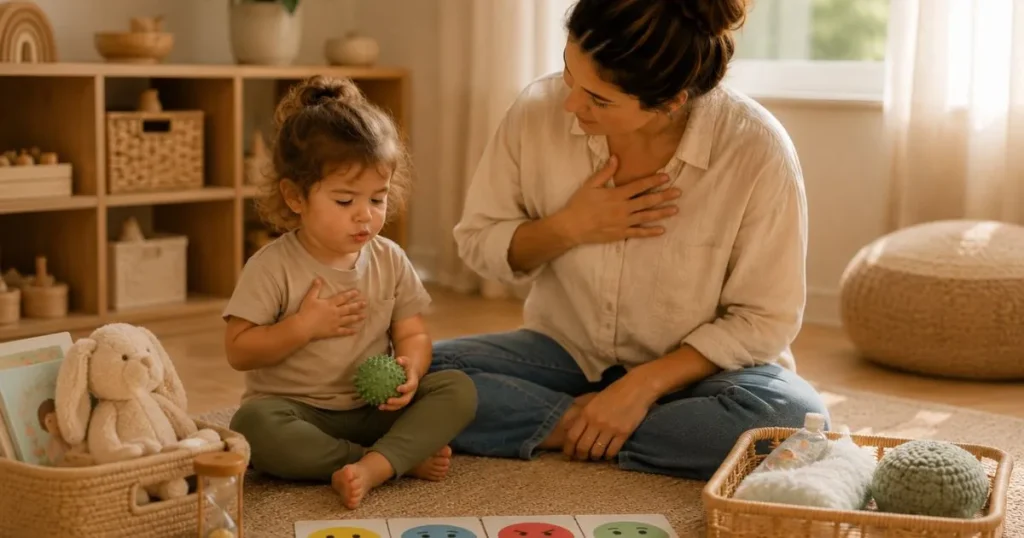
Your toddler does not need you to make every difficult feeling disappear. Instead, they need you to help them learn how to experience and express those feelings safely.
Toddler Emotions will include anger, disappointment, sadness, frustration, and many other feelings as your child grows.
Your child will feel angry.
They will feel disappointed.
They may cry when something doesn’t go their way.
They may scream when playtime comes to an end.
They may even hit when frustration becomes overwhelming.
These moments can be exhausting, but they also provide valuable opportunities to teach your toddler about Toddler Emotions and healthy ways to respond to them.
You can say:
“You’re angry. I’m here.”
“You’re disappointed. I understand.”
“It’s okay to cry.”
“I won’t let you hurt anyone.”
“Let’s calm your body together.”
Through hundreds of ordinary moments, these responses teach your toddler an important lesson:
Feelings aren’t dangerous. They can be expressed safely, boundaries provide security, and when emotions become overwhelming, a trusted adult can help.
That is an important foundation for emotional regulation.
You don’t have to be a perfectly calm parent every time. What matters is continuing to practice, repairing when necessary, and showing your toddler again and again that they are safe, loved, and supported as they learn to manage their big feelings.