
There is something exhausting about bedtime when you have a baby.
You have changed the diaper, offered a feed, dimmed the lights, and tried your favorite lullaby.Your baby may still seem fully awake, even once the bedtime steps are complete. Maybe they cry the moment you put them down. Maybe they fall asleep in your arms but wake as soon as you move. Or perhaps bedtime works beautifully for a few nights and then suddenly falls apart.
That situation can be frustrating, but it doesn’t mean you’re doing anything wrong.
A baby bedtime routine is not supposed to be a magic formula that makes every baby sleep through the night. Instead, it gives your baby a familiar sequence of signals that says, “The busy part of the day is over. It is time to slow down.”
The reassuring part is that you can keep your baby’s bedtime routine simple and manageable. A few repeatable steps—such as changing into pajamas, feeding, reading, cuddling, and turning down the lights—can create a gentle transition toward sleep.
The key is finding a routine that fits your baby, your schedule, and your family, then repeating it often enough for those familiar cues to become meaningful.
What Is a Baby Bedtime Routine?
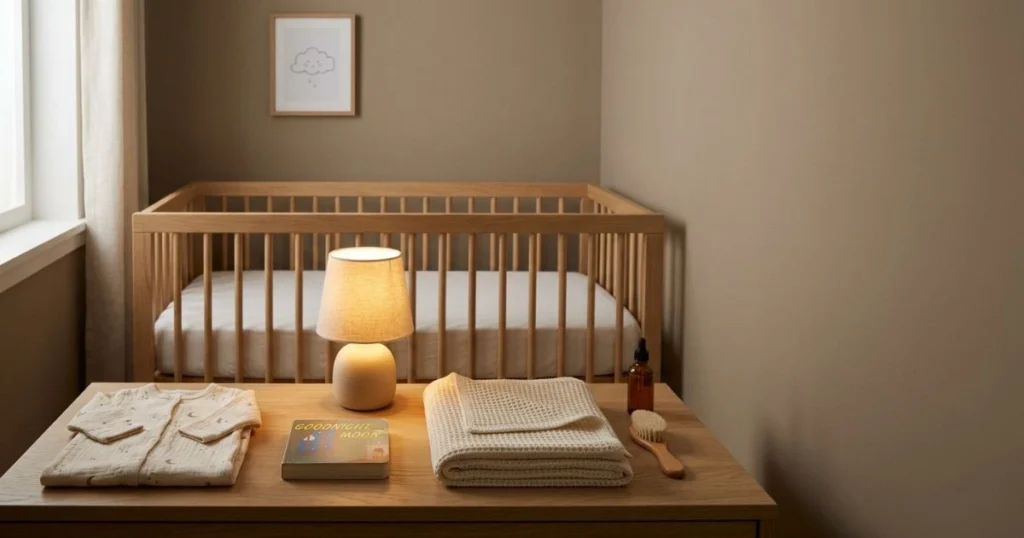
A Baby Bedtime Routine is a predictable series of calming activities you do before your baby goes to sleep.
It is different from a sleep schedule.
A sleep schedule focuses on when your baby sleeps, while a Baby Bedtime Routine focuses on what happens before sleep.
For example, your baby’s routine might look like this:
- Calm play
- Diaper change
- Pajamas
- Feeding
- Short book
- Lullaby
- Cuddles
- Into the sleep space
There’s no need to stick to these steps in precisely this order. The most important part is that the sequence feels familiar and manageable.
The American Academy of Pediatrics explains that predictable nighttime routines can help children understand what comes next and may reduce some of the stress surrounding bedtime. Its Brush, Book, Bed program also encourages a simple, repeatable nighttime ritual.
Why Does a Baby Bedtime Routine Matter?

Babies are constantly learning what different experiences mean.
When you repeatedly dim the lights, put on pajamas, read a familiar book, and sing the same lullaby, these activities can gradually become recognizable cues within your Baby Bedtime Routine.
A consistent routine can help you:
- Create a predictable transition from daytime to nighttime.
- Reduce stimulating activities before sleep.
- Give your baby familiar cues.
- Make bedtime easier for other caregivers to follow.
- Create a calm moment of connection at the end of the day.
It is worth remembering that consistency does not mean perfection. Your baby’s bedtime will sometimes be messy. You may have a late appointment, a difficult nap day, or an evening when your baby simply needs more comfort.
You don’t need every evening to follow the exact same pattern. The goal is to make the overall Baby Bedtime Routine familiar and reassuring.
When Is the Right Time to Begin a Baby Bedtime Routine?
You can begin introducing simple cues as part of a Baby Bedtime Routine during the newborn stage, but you should keep things flexible at first.
Newborns do not yet have the same established sleep patterns as older babies. The AAP notes that newborns may sleep around 16–17 hours over a 24-hour period, often in short stretches of one or two hours. Their sleep patterns gradually become more organized as they grow, while individual sleep needs can still vary.
This means your newborn may not be ready for a strict 7:00 p.m. bedtime every night.
Instead, think of a newborn Baby Bedtime Routine as a familiar sequence rather than a fixed schedule.
You might:
- Lower the lights.
- Change your baby’s diaper.
- Put on sleepwear.
- Feed your baby.
- Swaddle if appropriate and safe.
- Sing quietly.
- Set your baby down in a safe, prepared sleep environment.
“As your baby grows, understanding age-appropriate wake periods can also help you recognize when they may be ready for sleep.”
How Much Sleep Does Your Baby Need?
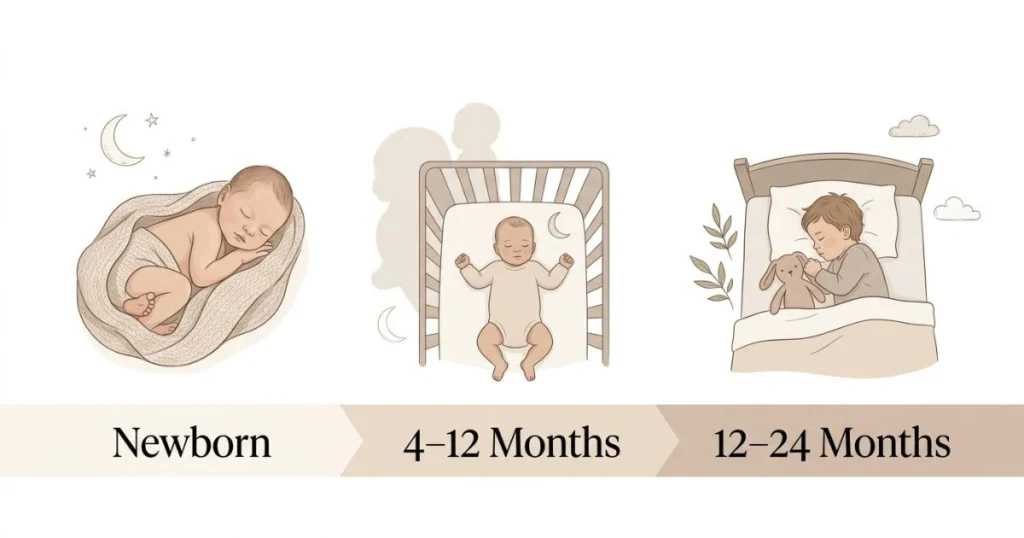
Before changing bedtime, look at your baby’s total sleep over 24 hours.
Sleep recommendations are based on age and include naps where applicable.
| Age | Recommended Total Sleep | What This Means for Bedtime |
| Newborn | Around 16–17 hours can be typical | Expect frequent waking and flexible timing |
| 4–12 months | 12–16 hours, including naps | Bedtime often becomes more predictable |
| 12–24 months | 11–14 hours, including naps | A consistent evening routine becomes increasingly useful |
The CDC recommends 12–16 hours of sleep per 24 hours, including naps, for infants ages 4–12 months. Sleep needs still vary from one baby to another.
This is why you should avoid choosing a bedtime simply because another baby goes to bed at that hour.
“Your baby’s total sleep also includes naps, so it can help to look at an age-appropriate sleep pattern rather than bedtime alone.”
How to Build a Baby Bedtime Routine That Fits Your Baby and Really Works
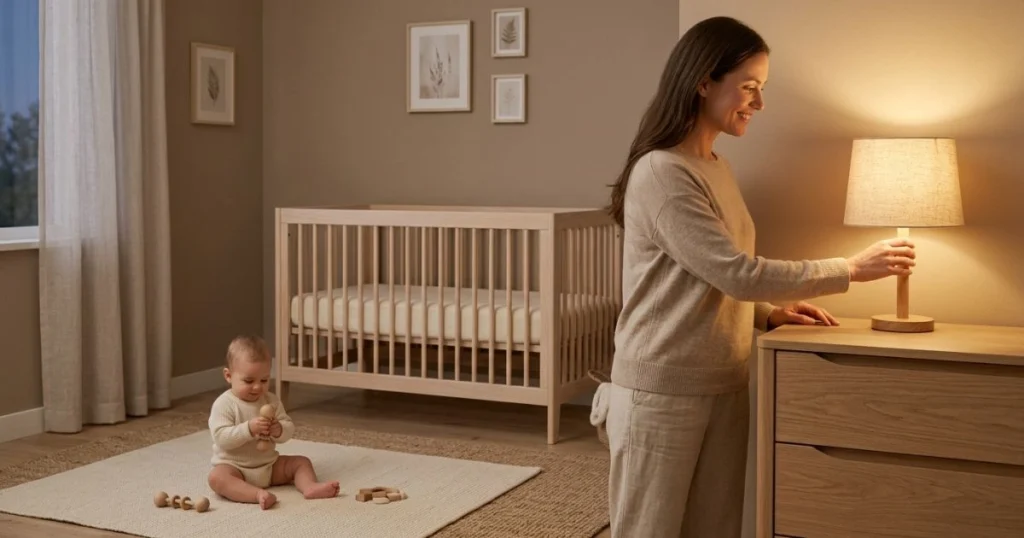
You do not need a dozen bedtime steps. Begin with a few simple steps that you can comfortably repeat each night.
Step 1: Choose a Realistic Bedtime
Start by observing your baby’s natural rhythm.
Ask yourself:
- When does your baby usually become sleepy?
- When does the final nap end?
- Is your baby cheerful at bedtime or already exhausted?
- Does bedtime usually involve a long struggle?
- Is your current bedtime realistic for your household?
Try to choose a bedtime that works with your baby’s sleep needs rather than forcing your baby to stay awake simply to reach a particular time.
A regular bedtime can be helpful, but flexibility is still important during infancy.
Step 2: Start Winding Down Before Bed

Don’t wait until the exact moment you want your baby asleep to begin calming the environment.
Start slowing things down beforehand.
You can:
- Put away noisy toys.
- Lower the lights.
- Turn off stimulating entertainment.
- Speak more quietly.
- Move toward the bedroom.
- Keep interactions gentle and predictable.
This creates a bridge between daytime activity and nighttime sleep.
If your home is usually lively in the evening, you do not have to suddenly make everything silent. Simply reduce stimulation gradually.
Step 3: Change the Diaper and Put on Sleepwear

A clean diaper and comfortable sleepwear can become another familiar bedtime signal.
Keep this step simple.
Choose clothing that is appropriate for the room temperature and baby’s age. Avoid using loose blankets or other loose items as part of an infant’s sleep environment.
The AAP recommends a firm, flat sleep surface with a fitted sheet and keeping loose bedding and soft objects out of the baby’s sleep area.
Step 4: Offer a Bedtime Feed

For many families, feeding naturally belongs near the end of the bedtime routine.
Depending on your baby’s age and feeding pattern, this may be breastfeeding or bottle-feeding.
A bedtime feed can provide nourishment and comfort, but it should not be presented as a guarantee that your baby will sleep through the night.
Newborns, in particular, still need nighttime feeds.
You also do not need to remove feeding from your routine simply because you are trying to encourage healthier sleep habits. Instead, consider how feeding fits into the overall sequence.
For example:
Pajamas → Feeding → Storytime → Lullaby → Sleep
can work beautifully for one family, while another may prefer:
Pajamas → Book → Feed → Cuddle → Bed.
Choose the sequence that feels calm and sustainable.
Step 5: Read a Short Book
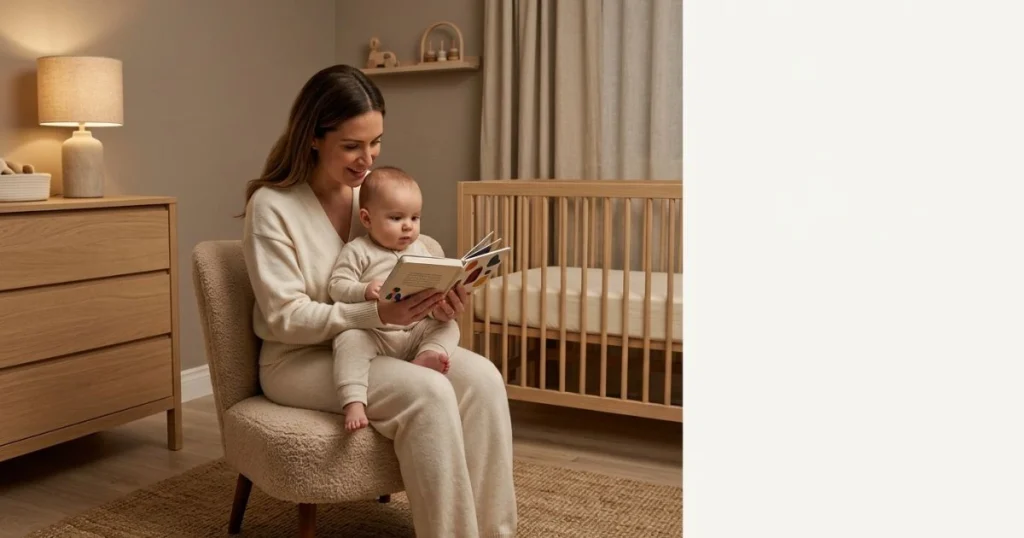
A short story can become one of the most recognizable parts of your baby’s bedtime routine.
Your baby doesn’t need to follow the story or understand its meaning for reading to become part of the bedtime routine.
They benefit from hearing your voice, seeing the same book repeatedly, and experiencing a quiet activity at the end of the day.
Try:
- A short board book.
- A familiar nursery rhyme.
- A simple picture book.
- A book with repetitive sounds.
The AAP’s Brush, Book, Bed program specifically recommends reading as part of a predictable nighttime routine.
Step 6: Sing a Lullaby or Use the Same Goodnight Phrase
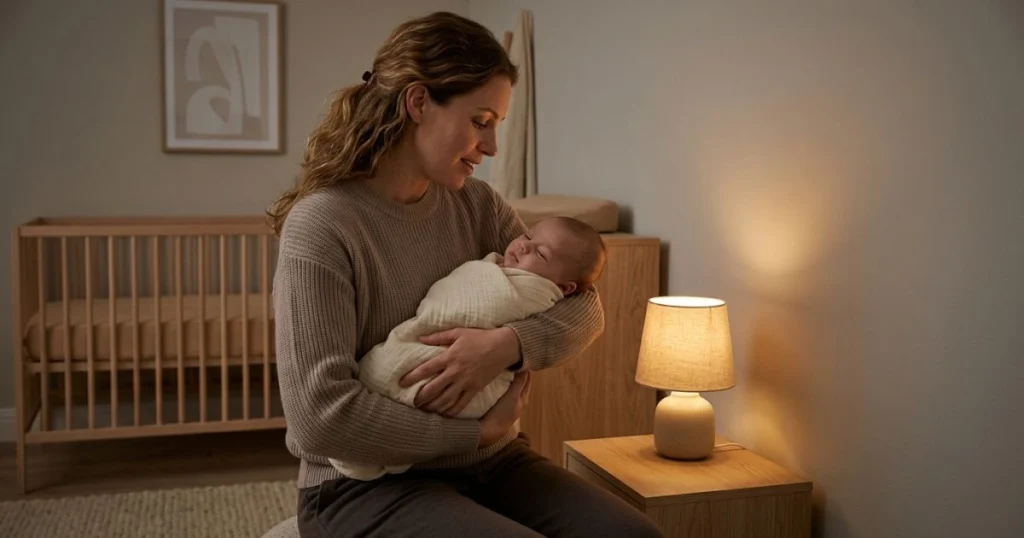
This is one of the easiest ways to create a personal sleep cue.
You might sing the same lullaby every night or use a simple phrase such as:
“It’s bedtime. You’re safe. I love you. It’s time to sleep.”
You don’t need a beautiful singing voice.Your baby isn’t concerned with whether you sing perfectly or not.
The repetition is what matters.
Step 7: Give Your Baby a Moment of Connection

Before you end the routine, give yourself a few quiet moments with your baby.
You can:
- Cuddle.
- Hold your baby’s hand.
- Rock gently if that works for you.
- Give a kiss.
- Whisper a goodnight phrase.
This part of the routine matters because bedtime is not only about sleep. It is also about helping your baby transition away from the stimulation and interaction of the day.
Step 8: Put Your Baby Down for Sleep

For babies around 4 months and older, the AAP suggests putting babies down when they are drowsy rather than waiting until they are completely asleep, as this can help them learn to fall asleep in their own sleep space.
However, don’t turn “drowsy but awake” into a test you feel you must pass.
Some babies settle easily this way. Others need more support.
Your goal is to create a calm, safe, repeatable ending to the routine—not to achieve a perfect bedtime technique every night.
How Much Time Should You Allow for Your Baby’s Bedtime Routine?
A bedtime routine does not need to take an hour.
For many families, around 20–30 minutes is a practical starting point.
The exact length can change with your baby’s age and needs.
Example 20–30 Minute Baby Bedtime Routine
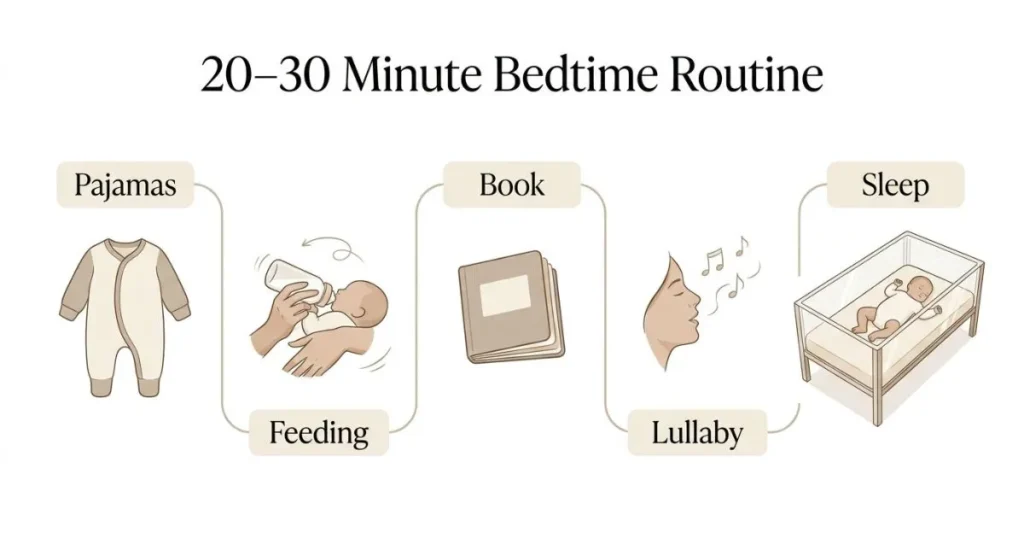
| Approximate Time | Activity |
| 0–5 minutes | Calm the environment |
| 5–10 minutes | Diaper change and pajamas |
| 10–20 minutes | Feeding |
| 20–25 minutes | Book |
| 25–30 minutes | Lullaby, cuddles, and bed |
These times are only an example. Your baby’s feeding may take longer, or you may need fewer steps.
The purpose is not to watch the clock.
The idea is to establish a familiar, calming pattern that your baby can recognize.
Baby Bedtime Routine by Age

Your baby’s routine should evolve as their sleep patterns and abilities change.
Newborn Bedtime Routine
For a newborn, flexibility is more important than following a strict bedtime.
A simple Baby Bedtime Routine might look like this:
- Lower the lights.
- Change your baby’s diaper.
- Put on comfortable, appropriate sleepwear.
- Offer a feed.
- Swaddle your baby if it is appropriate and safe.
- Spend a few quiet moments cuddling or soothing.
- Lay your baby on their back in a safe sleep environment.
Frequent waking during the night is common in the newborn stage, in part because newborns need regular feeding. The AAP notes that some newborns may wake every one or two hours.
Rather than judging the routine by how long your newborn sleeps afterward, focus on creating a calm and familiar transition toward sleep.
2–4 Month Baby Bedtime Routine
As your baby’s sleep patterns begin changing, you can make the sequence more consistent.
For example:
Diaper → Pajamas → Feed → Song → Cuddle → Bed
At this age, your baby may still have unpredictable nights. That’s normal.
Focus on repeating the same cues rather than demanding a perfectly timed bedtime.
4–6 Month Baby Bedtime Routine
This can be a good stage for a more recognizable routine.
Try:
Bath or wash → Pajamas → Feed → Book → Lullaby → Bed
The AAP notes that babies’ sleep cycles become more established around this developmental period, although individual sleep patterns still differ.
6–9 Month Baby Bedtime Routine
Your baby may now be much more aware of what happens around bedtime.
A familiar routine might be:
- Quiet play.
- Diaper.
- Pajamas.
- Feeding.
- Book.
- Song.
- Cuddle.
- Bed.
Developmental changes can temporarily disrupt sleep. Your baby may also become more aware when you leave the room.
Keep the routine familiar even when bedtime becomes challenging.
9–12 Month Baby Bedtime Routine
By this stage, your baby may be crawling, pulling up, babbling, and becoming increasingly curious.
That makes a calm transition especially useful.
Try to avoid turning bedtime into another opportunity for active play.
Your sequence could remain:
Pajamas → Feed → Book → Song → Cuddle → Goodnight → Bed
The routine doesn’t need to become longer just because your baby is older.
12-Month-Plus Baby Bedtime Routine
Once your baby reaches toddlerhood, you can gradually include activities such as brushing teeth.
A simple routine might be:
- Bath.
- Pajamas.
- Brush teeth.
- Book.
- Cuddle.
- Goodnight phrase.
- Bed.
The AAP recommends predictable routines and emphasizes keeping bedtime manageable rather than allowing it to become an endless series of activities.
“As your baby moves into toddlerhood, bedtime may need to change along with their nap and sleep needs.”
How Do You Know When Your Baby Is Getting Ready for Sleep?
Your baby’s behavior can proPaying attention to your baby’s behavior can give you useful clues about when it’s time to begin the Baby Bedtime Routine.
Common Sleepy Cues
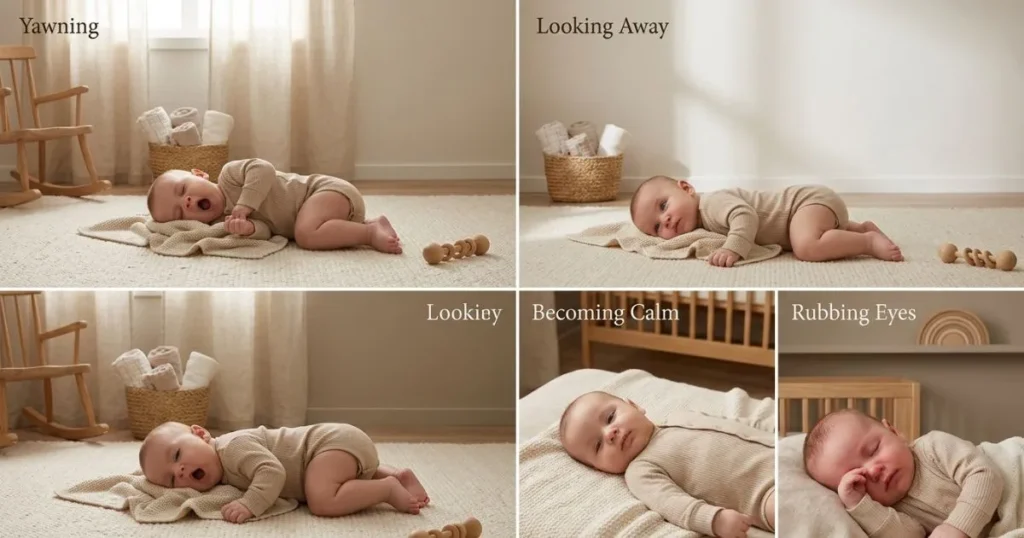
Your baby may show signs such as:
- Yawning.
- Turning away from stimulation.
- Becoming quieter.
- Losing interest in toys.
- Rubbing their eyes.
- Moving less.
- Becoming fussy.
You don’t have to wait until your baby is yawning repeatedly or crying intensely before starting the bedtime process.
If your baby regularly becomes very upset by the time you begin bedtime, it may be worth trying an earlier start to the routine.
The AAP encourages parents to watch for their baby’s sleep signals and explains that obvious signs such as yawning or eye rubbing can indicate that a baby is already ready for sleep.
What If Your Baby Fights Bedtime?
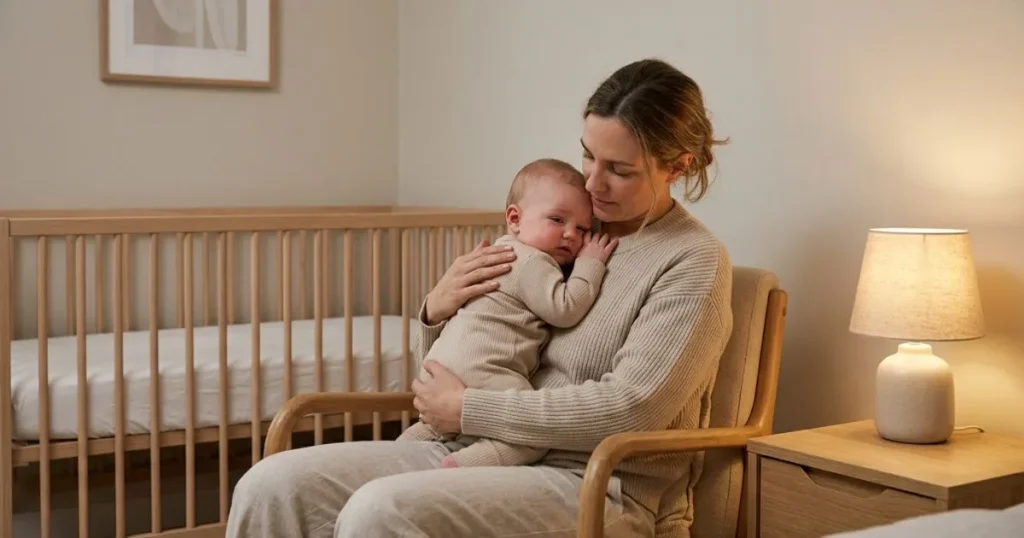
A baby who resists sleep isn’t necessarily telling you that your routine is bad.
There can be many reasons for bedtime resistance.
Your Baby May Be:
- Hungry.
- Overtired.
- Not tired enough.
- Overstimulated.
- Uncomfortable.
- Experiencing a developmental change.
- Dealing with teething discomfort.
- Sick.
- Adjusting to a nap change.
- Seeking extra reassurance.
Before changing your entire routine, check the basics.
Ask:
Has my baby eaten?
Is the diaper clean?
Is the room comfortable?
Was the last nap too late or too long?
Did bedtime begin after my baby was already overtired?
Has something changed recently?
Often, a straightforward explanation may be all you need to consider first.
If your baby suddenly starts waking more often or resisting sleep, a developmental sleep change may be part of the picture. Teething can also affect nighttime sleep, so it is useful to know the signs that distinguish teething-related waking from a sleep regression. Separation anxiety can also make bedtime more challenging as your baby becomes increasingly aware of when you leave the room.
Common Baby Bedtime Routine Mistakes to Avoid
Making the Routine Too Complicated
You don’t need bath, massage, three books, two songs, rocking, feeding, another book, and a 20-minute cuddle every night.
Choose a few steps you can repeat.
Starting Bedtime Too Late
A baby who is already exhausted may not necessarily settle more easily.
If bedtime regularly ends in intense crying or prolonged resistance, experiment with beginning the wind-down earlier.
Changing Everything After One Bad Night
Babies have difficult nights.
One poor night doesn’t mean your entire routine has failed.
Look for patterns over several days rather than reacting to one evening.
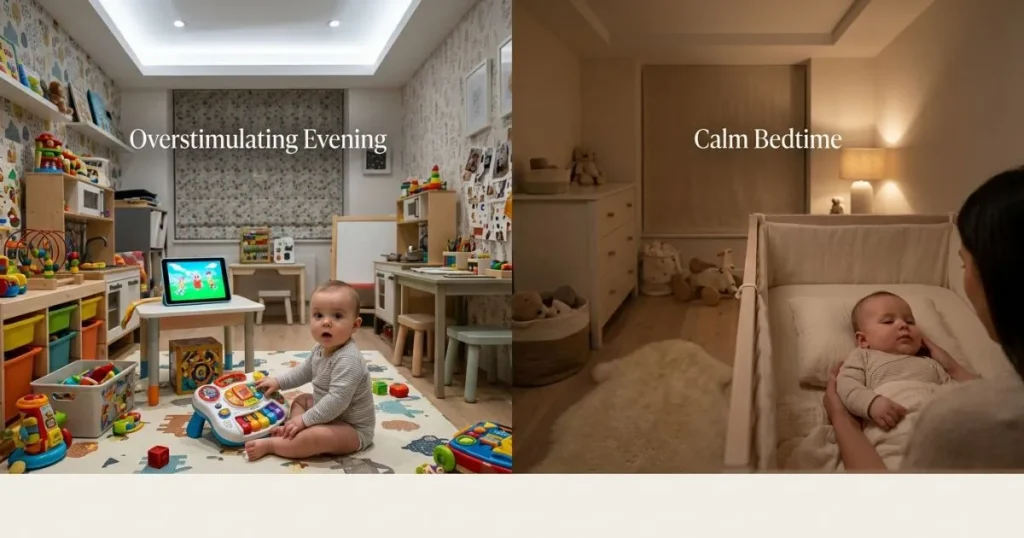
Turning Bedtime Into Playtime
Keep exciting games earlier in the evening.
Once your bedtime routine begins, gradually reduce stimulation.
Assuming Every Baby Should Follow the Same Sleep Schedule
Your friend’s baby may sleep at 7:00 p.m. while yours naturally settles later.
Comparing the two can create unnecessary anxiety.
Use general sleep guidance as a framework, then pay attention to your own baby’s needs.
“If your baby is struggling with daytime sleep as well as bedtime, reviewing an age-appropriate nap schedule may help you identify a pattern.”
How to Make a Baby Bedtime Routine Work When You’re Exhausted
Some nights you simply don’t have the energy for an elaborate routine.
That’s okay.
Create a minimum bedtime routine for difficult evenings.
The 10-Minute Version
Diaper → Pajamas → Feed → Song → Cuddle → Bed
That’s enough.
A routine doesn’t become ineffective because you skipped the bath or didn’t read three books.
The most important elements are familiarity, calmness, and repetition.
You can also make the routine easier for other caregivers to follow by writing down the sequence.
For example:
Our bedtime routine
- Diaper.
- Pajamas.
- Feed.
- One book.
- Same lullaby.
- Cuddle.
- Safe sleep space.
A straightforward routine is usually easier to follow consistently than a complicated one.
What to Do When Your Baby’s Bedtime Routine Stops Working
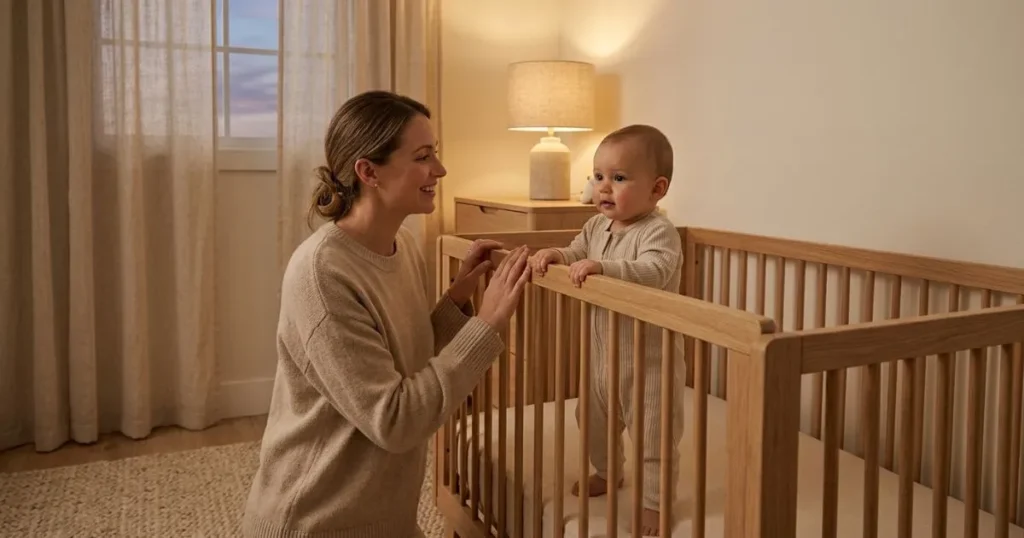
It can be frustrating when something that worked for weeks suddenly stops working.
Before assuming you need an entirely new routine, look for what has changed.
Possible reasons include:
- A new nap pattern.
- Developmental milestones.
- Increased mobility.
- Separation anxiety.
- Teething.
- Illness.
- Travel.
- A change in household schedule.
- A change in feeding needs.
When bedtime becomes difficult, return to the basics.
“If your baby’s sleep suddenly changes, learning how long common sleep regressions last can help you understand what may be happening.”
Try This Reset
- Simplify the routine.
- Keep the same order each night.
- Watch your baby’s sleepy cues.
- Review the timing of the final nap.
- Reduce evening stimulation.
- Keep the sleep environment consistent.
- Give the routine time to become familiar again.
You don’t have to reinvent bedtime every time your baby’s sleep changes.
Baby Bedtime Routine and Safe Sleep: What You Need to Know

A Baby Bedtime Routine can encourage healthy sleep habits, but safe sleep practices should always take priority.
For healthy infants, the AAP recommends placing your baby on their back for every sleep and using a firm, flat, non-inclined sleep surface. The sleep area should also remain free of loose bedding and soft objects.
“For detailed recommendations on creating a safe sleep environment, the American Academy of Pediatrics provides guidance on infant sleep position, sleep surfaces, bedding, and room-sharing.”
Keep Your Baby’s Sleep Space Simple
Your baby’s sleep area should have:
- A firm, flat mattress.
- A properly fitted sheet.
- An appropriate crib, bassinet, or play yard.
- No pillows.
- No loose blankets.
- No stuffed toys.
- No crib bumpers.
- No other items that could increase the risk of suffocation or entrapment.
The AAP also recommends sharing a room with your baby without sharing the same bed, ideally for at least the first six months and preferably through the first year.
If you are wondering when blankets become appropriate, learn more about the recommended age and potential risks before adding one to your baby’s sleep space.
What About Swaddling?
If you swaddle your baby, follow current safe-sleep guidance and stop once your baby begins trying to roll. Weighted swaddles should not be used.
If your baby has a medical condition or your pediatrician has given you different sleep instructions, follow your healthcare professional’s advice.
Baby Bedtime Routine FAQs
What Is a Good Baby Bedtime Routine?
A good baby bedtime routine is a short, predictable sequence of calming activities that you can repeat most nights. For example, you might use diaper change, pajamas, feeding, a short book, a lullaby, cuddles, and then bed.
When Is the Best Time to Begin a Baby Bedtime Routine?
You can introduce simple bedtime cues during the newborn period. However, newborns naturally have irregular sleep patterns, so their routine should remain flexible. As your baby grows, you can gradually make the sequence more predictable.
How Much Time Should You Set Aside for a Baby Bedtime Routine?
Around 20–30 minutes can be a practical starting point for many families. The exact length is less important than keeping the routine calm and predictable.
What Time Should My Baby Go to Bed?
Every baby has different sleep needs, so there isn’t one bedtime that suits them all. Consider your baby’s age, total daily sleep, naps, sleepy cues, and usual pattern. A regular bedtime can be helpful, but you don’t need to force an exact clock time.
How Do I Get My Baby Into a Bedtime Routine?
Start with three to five simple steps and repeat them in roughly the same order every night. For example:
Pajamas → Feeding → Storytime → Lullaby → Sleep
Keep the environment calm and gradually reduce stimulation as bedtime approaches.
Why Is My Baby Fighting the Bedtime Routine?
Your baby may be overtired, not tired enough, hungry, uncomfortable, overstimulated, or going through a developmental change. Before changing the entire routine, first consider your baby’s needs and whether the timing of bedtime is appropriate.
Should Feeding Be Part of a Baby Bedtime Routine?
It can be. Including a feed is a common part of many babies’ evening routines. However, your baby’s feeding needs depend on their age and individual needs, and feeding before bed does not necessarily mean they will sleep uninterrupted throughout the night.
Is It Better to Put Your Baby Down Drowsy but Still Awake?
For babies around 4 months and older, the AAP suggests putting babies down when they are drowsy rather than waiting until they are completely asleep. However, babies differ, and you should not feel that there is only one acceptable way to settle your baby.
Can a Baby Bedtime Routine Help My Baby Sleep Through the Night?
A consistent routine can support healthy sleep habits, but it cannot guarantee uninterrupted nighttime sleep. Babies naturally wake during the night, particularly during early infancy.
Your Baby Bedtime Routine Checklist
Keep this checklist handy and use it as a simple starting guide for your baby’s bedtime routine:
Before Bed
- ☐ Finish active play.
- ☐ Dim the lights.
- ☐ Reduce noise.
- ☐ Prepare the sleep space.
- ☐ Change the diaper.
- ☐ Put on sleepwear.
During the Routine
- ☐ Feed your baby.
- ☐ Read a short book.
- ☐ Sing a lullaby.
- ☐ Cuddle.
- ☐ Use the same goodnight phrase.
- ☐ Place your baby in a safe sleep space.
Every Night
- ☐ Keep the sequence familiar.
- ☐ Follow your baby’s cues.
- ☐ Keep nighttime calm.
- ☐ Adjust the routine as your baby grows.
- ☐ Follow safe-sleep recommendations.
Conclusion: Your Baby Doesn’t Need a Perfect Bedtime
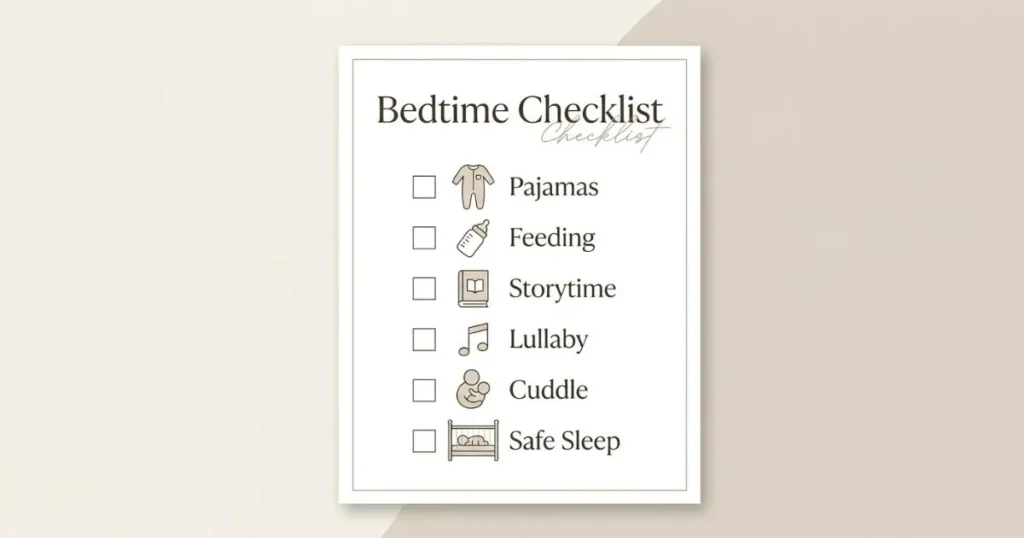
Creating a Baby Bedtime Routine that actually works isn’t about discovering a perfect formula that guarantees uninterrupted sleep. Instead, it’s about establishing a calming pattern your baby can gradually recognize.
Your routine might include a bath, pajamas, feeding, a short story, and a song. With a newborn, you may keep things even simpler with a diaper change, feeding, cuddles, and soft lighting. As your baby grows, they may need additional reassurance at bedtime.
That’s completely normal.
Start with a few calming activities and repeat them in a familiar order. Pay attention to your baby’s sleep cues, and adjust the timing as their needs change.
Remember, a difficult night doesn’t mean you’ve failed. Babies grow, nap patterns shift, developmental milestones appear, and sleep can become unpredictable again. Your Baby Bedtime Routine can evolve right alongside your baby.
What matters most is creating a familiar end to the day—a safe sleep environment, a calming rhythm, and the reassurance that your baby is loved and cared for.
Ready to make tonight’s bedtime easier? Start with three simple steps: pajamas, feeding, and a quiet cuddle. Repeat the same sequence tomorrow, then gradually add other calming activities if needed.
If this guide has been helpful, save the Baby Bedtime Routine Checklist and share it with another parent looking for a simpler, more predictable bedtime.