

The 4 month sleep regression can seem to appear overnight. One week your baby is sleeping longer stretches, and the next you’re pacing the nursery at 2 a.m., wondering what changed.
If your once-content sleeper has suddenly started waking every hour, taking short naps, or fighting bedtime, it’s easy to feel like all your hard work has disappeared overnight. You may even wonder if you’ve created a bad sleep habit or if something is wrong with your baby.
The truth is, this sudden shift is often a normal part of your baby’s development.
The 4 month sleep regression is one of the biggest milestones in your baby’s first year. While it can be exhausting, it also marks an important change in how your baby’s brain organizes sleep. In other words, your baby’s sleep isn’t getting worse—it is becoming more mature.
Understanding why this happens can help you respond with confidence instead of frustration.
In this guide, you’ll discover what causes the 4 month sleep regression, the signs to watch for, how long it usually lasts, and practical, gentle strategies that can help your baby—and your whole family—sleep better again.

At a Glance: 4-Month Sleep Regression
If you’re short on time, here’s a quick overview.
| Question | Quick Answer |
| What is the 4-month sleep regression? | A normal developmental stage where your baby’s sleep cycles mature, often causing temporary sleep disruptions. |
| When does it start? | Most babies experience it between 3 and 5 months of age. |
| How long does it last? | For many babies, the most intense phase lasts about 2 to 6 weeks, although every baby is different. |
| Common signs | Frequent night wakings, short naps, bedtime resistance, fussiness, and early morning waking. |
| Can you prevent it? | No. It’s a normal developmental milestone, but healthy sleep habits can make the transition easier. |
| Will my baby sleep normally again? | Yes. As your baby learns to connect sleep cycles, sleep often becomes more predictable. |
This overview answers the most common questions parents have, but there’s much more to know about why this stage happens and how you can support your baby through it.
What Is the 4-Month Sleep Regression?
The 4 month sleep regression is a normal developmental milestone that changes the way your baby sleeps. Around this age, your baby’s brain begins transitioning from the simple sleep patterns of a newborn to the more structured sleep cycles seen in older children and adults.
This change means your baby spends more time in lighter stages of sleep and briefly wakes between sleep cycles. While adults usually drift back to sleep without noticing, young babies are still learning this skill. As a result, one of the most common 4 month sleep regression signs is frequent night waking, along with shorter naps and difficulty settling back to sleep independently.
Although the word “regression” suggests that your baby’s sleep is moving backward, that’s not what’s happening. These 4 month sleep regression symptoms are actually signs of healthy neurological development. Once these mature sleep cycles appear, they become a permanent part of how your baby sleeps.
That’s why many sleep experts describe this phase as a sleep progression rather than a regression. Your baby’s sleep is evolving, even if it feels more challenging for a while. Understanding the 4 month sleep regression can help you respond with confidence and choose gentle 4 month sleep regression tips that support your baby’s developing sleep skills.
The CDC recommends following safe sleep practices while recognizing that sleep patterns naturally change during infancy.
When Does the 4-Month Sleep Regression Start?
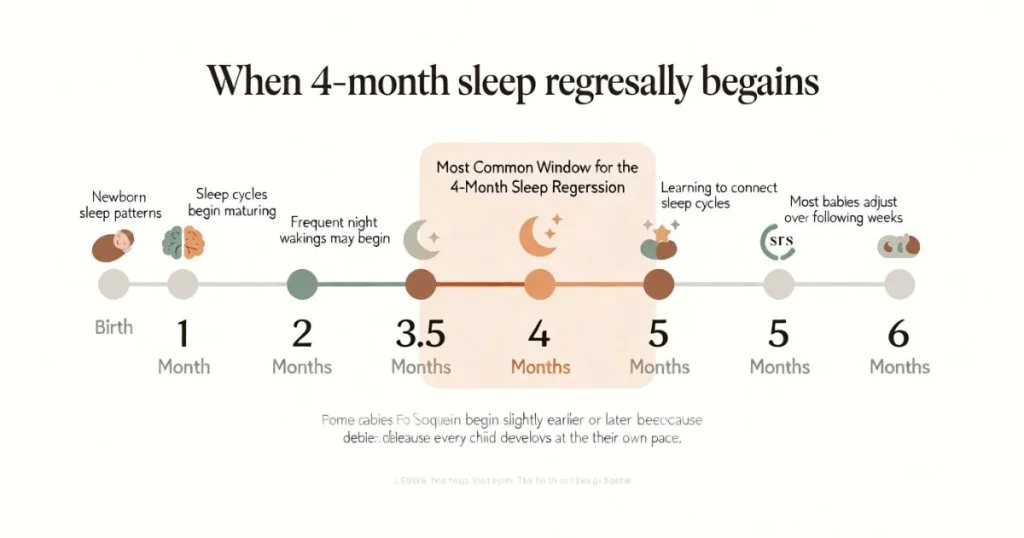
Despite its name, the 4 month sleep regression doesn’t begin on a specific birthday. Every baby develops at a different pace, so the timing can vary.
Most babies experience the 4 month sleep regression between 3 and 5 months of age, with many parents noticing the first 4 month sleep regression signs shortly before or after their baby turns four months old. These early changes may include more frequent night wakings, shorter naps, increased fussiness at bedtime, and other 4 month sleep regression symptoms.
Here’s a general timeline:
| Baby’s Age | What You Might Notice |
| 3 Months | Early sleep changes may begin as sleep cycles mature. |
| 4 Months | The most common time for frequent night wakings and shorter naps. |
| 5 Months | Some babies experience a later transition or continue adjusting to their new sleep patterns. |
If your baby was born prematurely, your pediatrician may recommend using their adjusted age when considering developmental milestones.
Why Is the 4-Month Sleep Regression Different From Every Other Sleep Regression?
This is the section that most articles skip—but it’s one of the most important things to understand about the 4 month sleep regression.
Unlike later sleep regressions, which are often linked to temporary developmental leaps or changes in routine, the 4 month sleep regression is caused by a permanent change in your baby’s sleep architecture.
Before this stage, newborns have relatively simple sleep patterns. Around four months, however, their brains begin organizing sleep into predictable cycles that include both light and deep sleep. From this point forward, your baby will continue sleeping in these more mature cycles throughout childhood and adulthood.
This permanent change explains why the 4 month sleep regression symptoms often feel more intense than those seen during later sleep regressions. Frequent night wakings, short naps, and difficulty settling are common 4 month sleep regression signs as your baby learns to move between sleep cycles.
The good news is that, once your baby adapts to these mature sleep cycles, many families notice sleep gradually becoming more predictable again. Following gentle 4 month sleep regression tips, such as maintaining a consistent bedtime routine and responding to your baby’s needs with patience, can make this transition easier for everyone.
The table below provides an at-a-glance overview of the 4 month sleep regression, helping you quickly understand what to expect before exploring each topic in more detail.
What Causes the 4-Month Sleep Regression?
According to the Raising Children Network, changes in sleep are common as babies develop more mature sleep cycles and learn new skills.
If you’re wondering why your baby’s sleep changed so suddenly, the answer isn’t just one thing.
The 4 month sleep regression happens because several major developmental changes occur at the same time. Around four months of age, your baby’s brain, body, and sleep patterns are all maturing rapidly. These exciting milestones support healthy growth and learning, but they can also trigger common 4 month sleep regression symptoms, such as frequent night wakings, shorter naps, and increased fussiness at bedtime.
Understanding what causes the 4 month sleep regression can help you recognize that these changes are a normal part of development—not a sign that you’ve done anything wrong. Knowing the reasons behind these 4 month sleep regression signs can also make it easier to choose gentle 4 month sleep regression tips that support your baby’s changing sleep needs.
Now, let’s explore what’s happening beneath the surface.
Your Baby’s Sleep Cycles Become More Mature
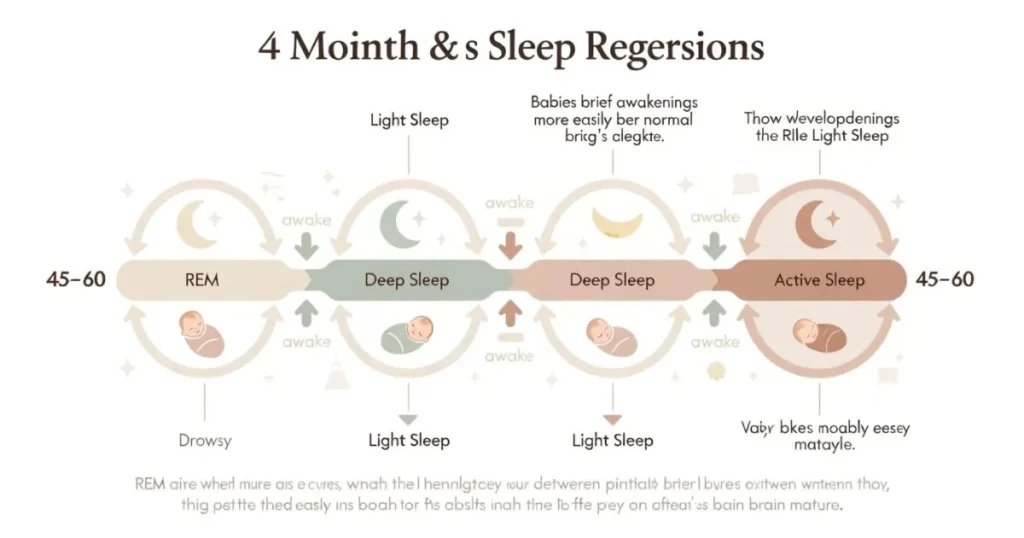
The biggest reason for the 4 month sleep regression is a permanent change in how your baby sleeps.
During the newborn stage, sleep is relatively simple. Babies spend much of their time in deep sleep and move through fewer sleep stages than older children and adults.
Around four months, that begins to change.
Your baby’s brain starts organizing sleep into predictable cycles that include both light sleep and deep sleep. Each cycle typically lasts about 45 to 60 minutes, and between cycles your baby briefly enters a lighter stage of sleep.
This natural change is responsible for many 4 month sleep regression symptoms, including frequent night wakings, shorter naps, and difficulty falling back asleep without help.
Adults experience these brief awakenings every night too. The difference is that most adults roll over and fall back asleep without remembering it.
Your baby is still learning how to do that.
Until they develop this skill, they may wake fully at the end of each sleep cycle and need help settling back to sleep. These are some of the most common 4 month sleep regression signs, and they’re a normal part of your baby’s developing sleep patterns rather than a cause for concern.
Why This Matters
Understanding this change can completely shift your perspective on the 4 month sleep regression.
Your baby isn’t waking because they’re stubborn or because you’ve done something wrong. They’re waking because their brain is learning a new way to sleep. Recognizing these normal 4 month sleep regression symptoms can help you respond with more confidence and less frustration.
This is why the 4 month sleep regression is considered a developmental milestone rather than a sleep problem. Once you understand what’s happening behind the scenes, the common 4 month sleep regression signs become much easier to recognize as a healthy part of your baby’s growth and development.
Rapid Brain Development
Your baby’s first year is a remarkable period of rapid brain development, and this growth plays a major role in the 4 month sleep regression.
Around four months, your baby’s brain is rapidly forming new neural pathways that support learning, memory, movement, and early communication. This exciting development can also contribute to common 4 month sleep regression symptoms, as your baby’s busy brain continues processing new skills even during sleep.
Every day, your baby is learning to:
- Recognize familiar faces
- Respond to voices
- Track moving objects with their eyes
- Reach for toys
- Understand cause and effect
- Show more social smiles and expressions
As these abilities develop, you may notice some 4 month sleep regression signs, including more frequent night wakings or shorter naps. Although these changes can be tiring, they’re often a reassuring sign that your baby’s brain is growing and developing exactly as expected.
All of this learning requires energy—and sleep plays an important role in helping the brain organize and strengthen these new connections.
As your baby’s brain develops, it’s normal for sleep to become lighter and less predictable for a period.
Your Baby Is Exploring the World With Growing Curiosity
Do you remember when your newborn could nap through almost any noise?
Those days often disappear during the 4 month sleep regression.
Your baby is becoming much more aware of what’s happening around them. As their senses develop, they may become more easily distracted at bedtime and during naps—a common part of the 4 month sleep regression. Increased awareness of their surroundings is one reason some babies experience 4 month sleep regression symptoms, such as fighting sleep or waking more easily.
Your baby may notice:
- Bright lights
- New sounds
- Conversations
- Movement across the room
- Familiar faces
- Interesting objects
This growing curiosity is a healthy developmental milestone, but it can also contribute to common 4 month sleep regression signs by making it harder for your baby to settle and stay asleep in stimulating environments.
While this growing curiosity is an exciting sign of development, it also means your baby is more easily distracted at bedtime and more likely to wake during lighter stages of sleep.
You might even notice your baby stopping in the middle of a feeding because something across the room has caught their attention.
That’s completely normal.
Physical Milestones Keep Their Brain Busy
Sleep isn’t the only thing changing during the 4 month sleep regression.
Around this age, many babies are developing exciting new motor skills. While these milestones are a sign of healthy growth, they can also contribute to common 4 month sleep regression symptoms, as babies often practice their new abilities during naps and even in the middle of the night.
Your baby may be learning to:
- Roll from tummy to back
- Roll from back to tummy
- Hold their head steady
- Push up during tummy time
- Grab toys with more control
- Bring hands and objects to their mouth
As these skills improve, you may notice additional 4 month sleep regression signs, such as your baby rolling in the crib, waking after practicing a new movement, or struggling to settle back to sleep. Although these changes can temporarily disrupt sleep, they’re an exciting indication that your baby is reaching important developmental milestones.
These milestones require plenty of practice.
Sometimes babies are so excited about their new skills that they even try practicing them in the crib instead of sleeping.
If you’ve ever walked into your baby’s room to find them happily attempting to roll over at 2 a.m., you’re not alone.
Growth Spurts Can Increase Night Wakings

Many babies experience a noticeable growth spurt during the 4 month sleep regression.
As they grow, they may temporarily need more calories than usual. Increased hunger is one factor that can contribute to 4 month sleep regression symptoms, especially if your baby has been sleeping for longer stretches and suddenly begins waking to feed again.
As your baby adjusts, you may notice signs like:
- Wants to feed more frequently
- Wakes hungry overnight
- Finishes feedings more quickly
- Seems hungrier during the day
These changes can sometimes overlap with common 4 month sleep regression signs, making it difficult to tell whether your baby is waking because of hunger, changing sleep cycles, or both.
Not every night waking during the 4 month sleep regression is caused by hunger, but growth spurts can certainly contribute to more frequent feeding during this stage.
If you’re unsure whether your baby still needs nighttime feeds, your pediatrician can help you determine what’s appropriate based on your baby’s age, growth, and feeding needs. Understanding the difference between hunger and normal sleep changes is one of the most helpful 4 month sleep regression tips for responding to your baby’s nighttime wakings with confidence.
Your Baby’s Internal Clock Is Developing

Another important milestone during the 4 month sleep regression is the development of your baby’s circadian rhythm.
Your body’s internal clock, known as the circadian rhythm, helps regulate:
- Sleep
- Wakefulness
- Hormone release
- Body temperature
As this internal clock matures, your baby’s body begins producing more melatonin in the evening and becomes better at distinguishing between daytime and nighttime. This biological change is an important part of healthy sleep development, but it can also contribute to temporary 4 month sleep regression symptoms as your baby adapts to a more mature sleep-wake cycle.
Although this transition eventually leads to more predictable sleep patterns, the adjustment period can make sleep feel less consistent. During this time, you may notice common 4 month sleep regression signs, such as frequent night wakings or changes in nap length. Following age-appropriate 4 month sleep regression tips, including a consistent bedtime routine and regular sleep environment, can help support your baby’s developing circadian rhythm.
Temperament Also Plays a Role

No two babies experience the 4 month sleep regression in exactly the same way. Some babies show only mild 4 month sleep regression symptoms, while others experience frequent night wakings, shorter naps, or increased difficulty settling to sleep.
Part of this difference comes down to temperament.
Babies who are naturally more sensitive to changes in their environment may notice sleep transitions more than babies who are easygoing sleepers. As a result, the 4 month sleep regression signs can vary widely from one baby to another, even though the underlying developmental changes are the same.
That doesn’t mean one baby is “better” at sleeping than another.
It simply means every child adjusts at their own pace. Understanding these individual differences can help you set realistic expectations and choose 4 month sleep regression tips that match your baby’s unique temperament and sleep needs.
Is It Really the 4-Month Sleep Regression?
Not every change in sleep is caused by a sleep regression.
Sometimes other factors can disrupt your baby’s sleep around the same time.
| Possible Cause | Typical Signs | Usually Temporary? |
| 4-Month Sleep Regression | Frequent night wakings, short naps, bedtime resistance | ✅ Yes |
| Growth Spurt | Increased hunger, more frequent feeding | ✅ Yes |
| Illness | Fever, congestion, coughing, poor feeding | ✅ Yes (requires medical care if concerning) |
| Teething | Sore gums, increased drooling, chewing on hands | ✅ Yes |
| Environmental Changes | Travel, new childcare, unfamiliar surroundings | ✅ Yes |
Looking at the bigger picture can help you decide whether your baby’s sleep changes are most likely related to normal development or whether another factor might be contributing.
Key Takeaway
The 4-month sleep regression isn’t caused by a single event. Instead, it’s the result of several healthy developmental changes happening at once:
- More mature sleep cycles
- Rapid brain development
- Increased awareness of the environment
- Exciting physical milestones
- Growth spurts
- A developing body clock
While these changes can make sleep more challenging for a few weeks, they also represent important progress in your baby’s development.
10 Common Signs of the 4-Month Sleep Regression
Every baby goes through the 4 month sleep regression a little differently.
Some babies have only a few extra night wakings, while others seem to resist every nap and bedtime for several weeks. Your baby may show one 4 month sleep regression symptom, several 4 month sleep regression symptoms, or nearly all of them.
One key thing to keep in mind is that these changes often happen quite suddenly. One week your baby seems to be settling into a predictable routine, and the next, sleep feels completely different. These sudden changes are among the most recognizable 4 month sleep regression signs and are a normal part of your baby’s sleep development.
Here are the most common 4 month sleep regression signs parents notice during the 4 month sleep regression.
1. Frequent Night Wakings

One of the most common 4 month sleep regression signs is waking much more often during the night.
During the 4 month sleep regression, your baby may go from sleeping long stretches to suddenly waking every hour or every couple of hours. These frequent night wakings are among the most noticeable 4 month sleep regression symptoms and can leave both babies and parents feeling exhausted.
This happens because your baby’s sleep has become more mature. Instead of staying in deep sleep for long stretches, they now move through lighter and deeper sleep stages throughout the night.
Every time they reach a lighter stage of sleep, they briefly wake.
If they haven’t yet learned to connect sleep cycles on their own, they’ll often call for you to help them settle back to sleep. Although these frequent awakenings can be frustrating, they’re a normal part of the 4 month sleep regression and usually improve as your baby develops the ability to fall asleep independently between sleep cycles.
What You Can Do
- Pause for a moment before responding to see if your baby settles independently.
- Keep nighttime interactions quiet and calm.
- Avoid turning on bright lights.
- Help your baby fall back asleep with the same soothing bedtime routine each night.
- Always place your baby on their back to sleep and follow safe sleep guidelines recommended by the American Academy of Pediatrics (AAP).
- The NHS recommends a calming bedtime routine and realistic expectations, as babies often wake during the night while their sleep patterns mature.
2. Short Naps That End After 30–45 Minutes
Has your baby’s one-and-a-half-hour nap suddenly become a 35-minute nap?
You’re not imagining it.
Around four months, many babies begin waking after exactly one sleep cycle, which usually lasts about 30 to 45 minutes during the day.
Until they learn how to transition smoothly into another sleep cycle, naps often become shorter.
Signs Your Baby Is Taking Catnaps
- Wakes after 30–45 minutes almost every time
- Still seems tired after waking
- Becomes fussy before the next nap
- Needs more naps throughout the day
Although these short naps can be frustrating, they’re one of the most common signs of the 4-month sleep regression.
3. Fighting Bedtime

If bedtime suddenly turns into a battle, the sleep regression may be part of the reason.
Rather than settling to sleep easily, your baby may:
- Cry when placed in the crib
- Become more alert just before bedtime
- Need extra rocking or feeding
- Wake shortly after being put down
This doesn’t necessarily mean your bedtime routine has stopped working. Your baby is simply adjusting to a new stage of sleep development.
4. Taking Longer to Fall Asleep
Many parents find that bedtime suddenly takes much longer than it used to.
As your baby’s brain becomes more aware of the world around them, it’s easier for them to become distracted or overstimulated.
You may notice your baby:
- Looking around the room instead of settling
- Smiling or babbling when they should be sleeping
- Becoming fussy just before falling asleep
- Waking shortly after drifting off
A calm bedtime routine and a quiet sleep environment can help make the transition to sleep smoother.
5. Increased Fussiness Throughout the Day
Interrupted sleep affects babies just as it affects adults.
When your baby isn’t getting enough restorative sleep, you may notice they’re:
- Easier to upset
- More clingy
- Harder to soothe
- Less patient during playtime
It’s important to remember that fussiness alone doesn’t confirm a sleep regression. Hunger, illness, or discomfort can cause similar behavior.
6. More Night Feedings
Many parents wonder:
“Are these night wakings a sign of hunger, or are they part of the 4-month sleep regression?”
The answer is sometimes both.
Around four months, some babies experience growth spurts that increase their appetite. Some babies wake more frequently as they adjust between sleep cycles.
Whether breastfed or formula-fed, every baby’s feeding needs are unique.
If your baby is feeding well, growing appropriately, and your pediatrician has no concerns, occasional extra night feeds can be a normal part of this stage.
7. Early Morning Wake-Ups

Has your baby started waking happily at 5:00 a.m. instead of 7:00 a.m.?
Early rising is one of the most common 4 month sleep regression signs and a frequent 4 month sleep regression symptom that surprises many parents.
Morning sleep is naturally lighter than sleep earlier in the night, making it easier for babies to wake fully. During the 4 month sleep regression, your baby’s developing sleep cycles can make these early morning awakenings even more noticeable.
Other factors may also contribute, including:
- A room that becomes bright at sunrise
- Overtiredness from the previous day
- Hunger
- Noise in the home
Using blackout curtains, maintaining a consistent bedtime routine, and following an age-appropriate 4 month sleep regression schedule may help reduce early morning waking for some babies. These gentle 4 month sleep regression tips won’t stop the developmental changes, but they can support healthier sleep habits while your baby adjusts to more mature sleep patterns.
8. Trouble Falling Back Asleep Without Help
During the newborn stage, your baby may have drifted back to sleep easily after a quick feeding or cuddle.
They may now seek extra comfort each time they wake.
You might notice that your baby:
- Falls asleep during a feeding but wakes when placed in the crib.
- Needs rocking after every wake-up
- Cries whenever they’re placed on the mattress
- Sleeps only while being held
This doesn’t mean you’ve created “bad habits.” It simply reflects the fact that your baby is still learning to settle between sleep cycles.
9. More Restless Sleep
Some babies appear much busier while sleeping during this stage.
You may hear:
- Grunting
- Soft cries
- Babbling
- Leg kicking
- Rolling attempts
- Frequent movement
These brief movements are often part of lighter sleep and aren’t necessarily a sign that something is wrong.
Unless your baby is distressed or unsafe, they don’t always need intervention.
10. Your Baby Suddenly Stops Sleeping Well
Perhaps the most frustrating symptom isn’t a specific behavior—it’s how quickly everything changes.
Many parents describe it like this:
“Only a few days ago, my baby slept for long stretches. Now they’re waking constantly.”
That sudden shift is one of the biggest clues that you’re dealing with the 4-month sleep regression rather than a gradual change in sleep habits.
Although it may be challenging, this phase doesn’t last forever. As your baby learns to connect sleep cycles more independently, sleep often becomes more predictable again.
Quick Symptom Checklist
Use this checklist to compare what you’re seeing at home.
| Symptom | Common During the 4-Month Sleep Regression? |
| Frequent night wakings | ✅ |
| Waking every sleep cycle | ✅ |
| Short naps (30–45 minutes) | ✅ |
| Fighting bedtime | ✅ |
| Increased fussiness | ✅ |
| Early morning waking | ✅ |
| More night feeding | ✅ |
| Restless sleep | ✅ |
| Fever | ❌ |
| Difficulty breathing | ❌ |
| Persistent vomiting | ❌ |
If your baby develops a fever, has trouble breathing, vomits repeatedly, shows signs of dehydration, or refuses multiple feeds, don’t assume the 4-month sleep regression is the only cause. Contact your pediatrician promptly for advice.
Key Takeaway
The 4-month sleep regression often feels overwhelming because it can change your baby’s sleep almost overnight. Frequent night wakings, shorter naps, difficulty settling at bedtime, and increased fussiness are all common during this stage of development.
The reassuring news is that these symptoms usually improve as your baby becomes more comfortable with their new sleep cycles.
How Long Should You Expect the 4-Month Sleep Regression to Last?
If you’re reading this after another sleepless night, you’re probably asking the same question almost every parent asks:
“When will my baby finally sleep better again?”
The good news is that, for most babies, the 4 month sleep regression is temporary—even if it feels endless while you’re going through it.
For many families, the most challenging phase lasts between 2 and 6 weeks. Some babies adjust more quickly, while others take a little longer to become comfortable with their new sleep patterns. How long the 4 month sleep regression lasts can vary depending on your baby’s temperament, development, and sleep habits.
Unlike a cold or a growth spurt, there isn’t a specific day when the regression suddenly ends. Instead, sleep often improves gradually as your baby learns to move from one sleep cycle to the next without fully waking. As these 4 month sleep regression symptoms begin to fade, you’ll likely notice fewer night wakings, longer naps, and a more predictable sleep routine.
Continuing with consistent bedtime habits and gentle 4 month sleep regression tips can help your baby build healthy sleep skills during this important developmental stage.
Every Baby Has Their Own Timeline
Your baby’s experience with the 4 month sleep regression won’t necessarily look like someone else’s.
Some babies continue sleeping fairly well with only a few extra wake-ups, while others experience more noticeable 4 month sleep regression symptoms, including frequent night wakings, short naps, and difficulty settling back to sleep for several weeks.
That’s because every baby develops at their own pace.
Factors such as temperament, feeding patterns, overall health, and daily routines can all influence how smoothly your baby adapts to this developmental milestone. These differences also affect which 4 month sleep regression signs your baby experiences and how long they last. Understanding that every baby is unique is one of the most reassuring 4 month sleep regression tips for parents navigating this stage with confidence.
Typical Timeline
| Timeline | What You Might Notice |
| Week 1 | Sudden increase in night wakings and shorter naps |
| Weeks 2–3 | Baby begins adjusting to mature sleep cycles |
| Weeks 4–6 | Sleep often becomes more predictable with consistent routines |
| Beyond 6 Weeks | Some babies continue waking frequently as they develop new sleep skills |
Think of these timeframes as general guidelines rather than strict milestones.
Why Some Babies Adjust Faster Than Others
You may know another parent whose baby “got through it in a week,” while your little one still wakes several times a night.
That doesn’t mean you’re doing anything wrong.
Several factors can influence how quickly babies adapt, including:
- Their natural temperament
- Whether they were already developing consistent sleep habits
- Daytime sleep quality
- Feeding needs
- Development of self-soothing skills
- Changes in routine, travel, or illness
Some babies naturally adapt to new sleep cycles with very little support, while others need more time and reassurance.
When Does Sleep Usually Improve?
While your baby’s sleep cycles have matured permanently, the frequent night wakings are usually temporary.
As your baby gains experience moving through light and deep sleep, they’ll gradually become better at connecting sleep cycles without fully waking.
Many parents notice improvements when their baby begins:
- Falling asleep more easily at bedtime
- Sleeping longer stretches overnight
- Taking longer naps
- Settling back to sleep with less assistance
Progress often happens little by little rather than all at once.
You may have one great night followed by two difficult ones before you notice a consistent pattern.
That’s completely normal.
Can the 4-Month Sleep Regression Last Longer Than 6 Weeks?
Sometimes, yes.
If your baby’s sleep continues to be disrupted well beyond six weeks, it doesn’t always mean the sleep regression itself is continuing.
Instead, other factors may be contributing.
These can include:
- A growth spurt
- Illness
- Teething discomfort
- Travel or changes in routine
- An inconsistent sleep schedule
- A sleep environment that makes it harder for your baby to rest well.
In some cases, ongoing night wakings may be linked to an underlying health issue, so it’s a good idea to speak with your pediatrician if your baby’s sleep problems continue or concern you.
What If My Baby Never Went Through the 4-Month Sleep Regression?
Not every baby experiences a dramatic change in sleep.
Some babies adjust to mature sleep patterns with very little disruption.
Others may experience only:
- Slightly shorter naps
- One additional night waking
- A few fussy evenings
This is completely normal.
Every baby’s sleep journey is unique, and a mild regression doesn’t mean your baby is missing an important developmental milestone.
Can You Prevent the 4-Month Sleep Regression?
Many parents wonder about this, and in most cases, the answer is no.
Because the 4-month sleep regression is driven by normal brain development and permanent changes in sleep cycles, it can’t be prevented.
In many ways, asking how to prevent it is like asking whether you can prevent your baby from learning to roll over or smile. It’s a natural part of development.
What you can do is make the transition smoother.
Healthy sleep habits won’t stop the regression from happening, but they may help your baby adjust more comfortably.
A few simple strategies can help, including:
- Following a consistent bedtime routine
- Responding to your baby’s sleepy cues before they become overtired.
- Offering regular daytime feeds
- Creating a dark, quiet sleep environment
- Maintaining a consistent bedtime and morning wake-up schedule.
These habits support healthy sleep long after the regression has passed.
A Gentle Reminder for Parents
It’s easy to feel discouraged when your baby suddenly stops sleeping well.
You might find yourself wondering:
- “Am I doing something wrong?”
- “Did I create bad sleep habits?”
- “Why does my baby seem to wake up so much more often than others?”
The truth is that the 4-month sleep regression is a reflection of your baby’s development—not your parenting.
Your baby isn’t intentionally making bedtime harder.
They’re learning an entirely new way to sleep.
With patience, consistency, and time, this phase will pass, and the healthy sleep habits you’re building now can continue to support your child as they grow.
Ways to Support Better Sleep During the 4-Month Sleep Regression
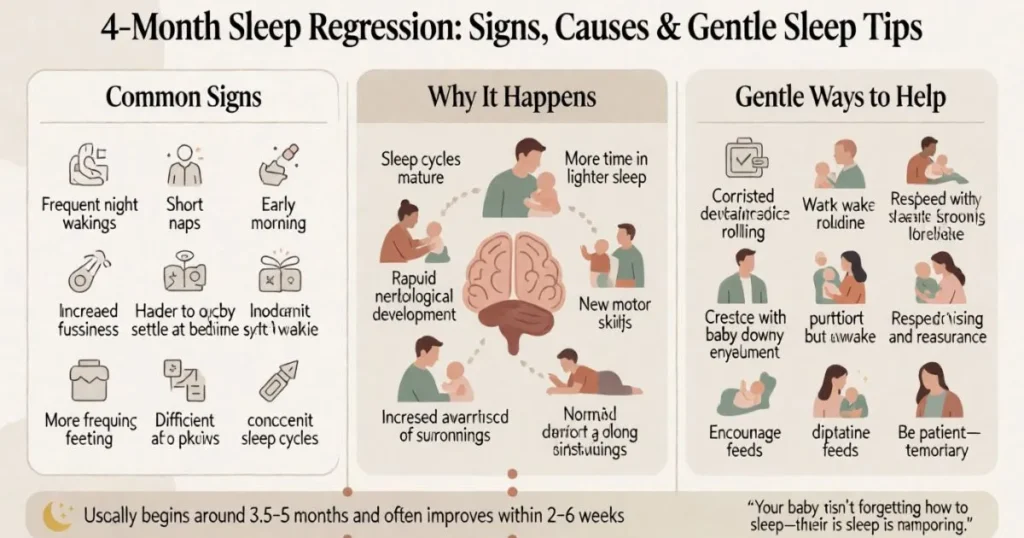
You can’t stop the 4-month sleep regression from happening, but you can support your baby through it with healthy sleep habits and realistic expectations.
The goal isn’t to eliminate every night waking overnight. Instead, you’re helping your baby gradually adjust to their new sleep cycles while creating a foundation for healthy sleep in the months ahead.
The following tips have helped many families navigate this stage.
1. Stick to a Consistent Bedtime Routine
One of the best things you can do during the 4-month sleep regression is follow the same calming routine every evening.
Babies thrive on repetition. A consistent bedtime routine helps your baby recognize that it’s time to wind down and prepare for sleep.
A gentle and consistent routine can help your baby feel prepared for bedtime. Even 20 to 30 minutes of calm, consistent activities can help signal that it’s time to wind down.
Example Bedtime Routine
| Step | Activity |
| 1 | Warm bath (optional) |
| 2 | Fresh diaper and pajamas |
| 3 | Dim the lights |
| 4 | Feed your baby |
| 5 | Share a short story or gently sing a calming lullaby |
| 6 | Gentle cuddles |
| 7 | Place your baby in the crib when calm and sleepy |
The key is consistency rather than perfection.
2. Watch Wake Windows Instead of the Clock Alone
Many sleep struggles begin before bedtime.
If your baby stays awake too long, they can become overtired, making it harder to fall asleep and stay asleep.
Most 4-month-old babies do well with wake windows of approximately 1½ to 2½ hours, although individual needs vary.
Typical Wake Windows for a 4-Month-Old
| Time of Day | Suggested Wake Window |
| Morning | 1½–2 hours |
| Midday | 1¾–2¼ hours |
| Afternoon | 2–2½ hours |
| Before Bed | 2–2½ hours |
Rather than following the clock exactly, combine wake windows with your baby’s sleepy cues.
3. Learn Your Baby’s Sleepy Cues
Noticing your baby’s early sleep cues can help bedtime go more smoothly.
Common sleepy cues include:
- Yawning
- Looking away from people or toys
- Rubbing eyes
- Slower movements
- Quiet staring
- Becoming less interested in play
By the time your baby is crying, they may already be more tired than is ideal for settling to sleep.
Responding to early cues often leads to an easier transition to sleep.
4. Create a Sleep-Friendly Environment
As babies become more aware of their surroundings, the sleep environment matters more than it did during the newborn stage.
A calm, consistent sleep space can reduce unnecessary disruptions.
Sleep Environment Checklist
- ✔ Dark room
- ✔ Comfortable temperature
- ✔ Firm mattress with a fitted sheet
- ✔ White noise if it helps your baby
- ✔ Comfortable sleep clothing
- ✔ No pillows, blankets, bumpers, or stuffed animals in the crib
Always follow safe sleep guidelines by placing your baby on their back to sleep on a firm, flat surface.
5. Encourage Full Feedings During the Day
Around four months, babies often become fascinated by everything happening around them.
During daytime feedings, your baby may stop often to watch what’s happening around them, smile, or explore their surroundings.
Feeding your baby in a calm, low-distraction setting may encourage fuller daytime feeds and help reduce hunger-related night wakings.
If you’re breastfeeding, continue feeding on demand unless your healthcare provider recommends otherwise.
6. Give Your Baby a Chance to Resettle
Not every movement or sound means your baby is fully awake.
Between sleep cycles, babies often:
- Stretch
- Wiggle
- Grunt
- Open their eyes briefly
- Make small noises
If your baby isn’t crying or distressed, pause for a moment before picking them up.
Sometimes your baby will settle back to sleep without help.
This small pause isn’t about ignoring your baby—it’s about giving them an opportunity to practice connecting sleep cycles.
7. Help Your Baby Practice Falling Asleep in the Crib
Many babies naturally fall asleep while feeding, rocking, or cuddling. There’s nothing wrong with comforting your baby, especially during a challenging developmental stage.
When possible, lay your baby down in the crib while they are relaxed and sleepy but not fully asleep.
This helps your baby gradually become comfortable falling asleep in their own sleep space.
Don’t worry if it doesn’t work every single time. Think of it as practice, not a test.
8. Keep Naps Flexible
Brief daytime naps are a normal part of the 4-month sleep regression.
If one nap is only 35 minutes, it doesn’t mean the rest of the day is ruined.
Instead of chasing the “perfect” nap schedule:
- Focus on your baby’s total daytime sleep.
- Offer another nap if needed.
- Move bedtime slightly earlier after a day of poor naps.
- Remember that tomorrow may look completely different.
Flexibility often reduces stress for both you and your baby.
9. Share the Load if You Can
Interrupted sleep affects the entire family.
If you have a partner, consider taking turns with nighttime care when possible.
Family members or trusted friends may also be able to help during the day so you can rest.
Looking after yourself isn’t selfish—it’s an important part of caring for your baby.
10. Be Patient With the Process
The 4-month sleep regression isn’t something you “fix.”
It’s something your baby grows through.
Some nights will be better than others.
You may see progress for several days followed by another difficult night.
That doesn’t mean you’ve gone backward.
Developing healthy sleep habits takes time, and small improvements often show that your baby is adjusting well.
Mistakes to Avoid During the 4-Month Sleep Regression
When everyone is exhausted, it’s natural to try anything that promises more sleep.
However, some well-intentioned habits can make this stage more stressful.
Being aware of these common mistakes can help make this stage a little easier.
Changing the Routine Every Night
Trying a different bedtime strategy every evening can make it harder for your baby to know what to expect.
Instead, choose a simple routine and stay consistent for at least a couple of weeks before deciding whether it needs adjusting.
Keeping Your Baby Awake Longer
Many parents assume that skipping naps or extending wake windows will help their baby sleep longer at night.
In reality, an overtired baby often:
- Has more difficulty falling asleep
- Wakes more frequently
- Takes shorter naps
- Becomes fussier during the day
Well-timed naps usually support better nighttime sleep.
Assuming Every Wake-Up Means Hunger
At four months, some babies still wake because they need a feed, while others wake as they move between sleep cycles.
Before offering a feed, consider whether your baby may simply need a moment to resettle.
If you’re unsure about your baby’s nutritional needs, talk with your pediatrician.
Comparing Your Baby With Others
One friend may tell you their baby sleeps 10 hours straight.
Another family may barely notice any changes in their baby’s sleep.
Try not to compare.
Sleep is influenced by many factors, including temperament, feeding, health, and development.
Your baby’s journey is unique.
Expecting Immediate Results
Healthy sleep habits take time to work.
It’s normal to see gradual progress rather than dramatic overnight improvements.
Celebrate small wins, such as:
- One longer nap
- An easier bedtime
- One fewer night waking
These little improvements often add up over time.
Key Takeaway
Supporting your baby through the 4-month sleep regression isn’t about finding a perfect trick or quick fix.
Instead, focus on creating a calm bedtime routine, responding consistently, watching your baby’s sleep cues, and remembering that this stage is temporary.
The healthy habits you build now can continue to benefit your child long after the sleep regression has passed.
Sample 4-Month-Old Sleep Schedule
Every baby has different sleep needs, so there’s no single schedule that works for everyone. Think of this example as a flexible guide rather than a strict timetable.
At around four months, many babies sleep 12 to 16 hours over a 24-hour period, including nighttime sleep and daytime naps. Some babies take three naps, while others still need a short fourth catnap.
If your baby’s schedule looks a little different, that’s perfectly normal.
Example Daily Sleep Schedule
| Time | Activity |
| 7:00 a.m. | Wake up and feed |
| 8:45 a.m. | Morning nap |
| 10:00 a.m. | Feed and play |
| 11:45 a.m. | Second nap |
| 1:15 p.m. | Feed and play |
| 3:00 p.m. | Third nap |
| 4:00 p.m. | Feed and quiet play |
| 5:30 p.m. | Optional short catnap if needed |
| 7:00 p.m. | Begin bedtime routine |
| 7:30 p.m. | Bedtime |
As your baby approaches five or six months, their schedule may gradually shift, and many babies naturally begin dropping the late-afternoon catnap.
Remember
A predictable routine is helpful, but your baby’s cues matter more than the clock. Some days they’ll need an earlier bedtime after short naps, while other days they’ll stay awake a little longer.
Flexibility is part of healthy sleep during infancy.
Is Sleep Training a Good Idea During the 4-Month Sleep Regression?
One of the most common questions parents ask is whether they should begin sleep training during the 4-month sleep regression.
The answer isn’t the same for every family.
Some babies are developmentally ready for gentle sleep-learning approaches around four months, while others benefit from waiting until they’re a little older. Readiness depends on factors such as your baby’s age, growth, overall health, and feeding needs.
If you’re considering sleep training, talk with your pediatrician first. They can help you decide whether it’s appropriate for your baby and discuss approaches that fit your family’s needs.
Whether or not you choose formal sleep training, you can begin building healthy sleep habits now by:
- Following a consistent bedtime routine
- Watching for sleepy cues
- Creating a safe, calm sleep environment
- Giving your baby opportunities to practice settling between sleep cycles
- Keeping expectations realistic
These habits support healthy sleep regardless of the sleep-training method you choose later.
When Should You Call Your Pediatrician?
The 4-month sleep regression is a normal developmental stage, but not every sleep problem is caused by a sleep regression.
Contact your pediatrician if your baby:
- Has a fever.
- Has difficulty breathing or persistent coughing.
- Refuses several feedings in a row.
- Has fewer wet diapers than normal, which may be a sign of dehydration.
- Is unusually difficult to wake.
- Isn’t gaining weight as expected.
- Cries inconsolably for long periods.
- Continues having severe sleep difficulties well beyond the expected adjustment period or develops other concerning symptoms.
You know your baby better than anyone, so trust your instincts when making decisions about their sleep If something feels unusual or you’re worried about your baby’s health, don’t hesitate to seek medical advice.
FAQ
Is the 4-month sleep regression real?
Yes. The 4-month sleep regression is a well-recognized developmental stage during which your baby’s sleep cycles become more mature. Although some experts prefer the term sleep progression, the sleep changes parents notice are very real.
When does the 4-month sleep regression start?
Most babies experience it between 3 and 5 months of age, although some show signs a little earlier or later depending on their development.
How Long Does the 4-Month Sleep Regression Usually Continue?
For many babies, the most challenging period lasts 2 to 6 weeks. However, every baby is different, and sleep often improves gradually rather than all at once.
Can the 4-Month Sleep Regression Begin Earlier Than Expected?
Yes. Some babies begin transitioning to mature sleep cycles before they reach four months, so it’s possible to notice sleep changes around three months of age.
Why is my 4-month-old waking every hour?
Frequent waking often happens because your baby is moving through lighter sleep cycles and hasn’t yet learned to connect them without fully waking. Hunger, growth spurts, or illness may also contribute.
Why are my baby’s naps only 30 to 45 minutes long?
Around four months, many babies wake after one daytime sleep cycle, which typically lasts about 30 to 45 minutes. As your baby grows, they often become better at connecting sleep cycles, which can lead to longer daytime naps.
Can teething cause the 4-month sleep regression?
Teething and the 4-month sleep regression often occur around the same age, but they’re separate developmental changes. If your baby seems unusually uncomfortable or has swollen gums along with sleep changes, teething may be contributing.
Does Every Night Waking Mean Your Baby Needs a Feed?
Not always. Some nighttime wakings are caused by hunger—especially during periods of rapid growth—while others happen because your baby is moving between sleep cycles. If you’re unsure whether your baby still needs overnight feeds, speak with your pediatrician. They can help determine what’s appropriate based on your baby’s age, growth, and feeding patterns.
Can the 4-month sleep regression be prevented?
No. Because it’s caused by normal brain development and changes in sleep cycles, it can’t be prevented. However, a consistent bedtime routine and healthy sleep habits can make the transition smoother.
Does every baby go through the 4-month sleep regression?
No. Some babies experience significant sleep disruptions, while others transition with only mild changes. Both experiences are completely normal.
Conclusion

The 4-month sleep regression can feel like one of the biggest challenges of early parenthood. One day your baby seems to be settling into a predictable routine, and the next you’re facing frequent night wakings, short naps, and bedtime struggles.
As exhausting as this stage can be, it’s also a sign of healthy development. Your baby’s brain is learning to sleep in a more mature way—a skill they’ll continue using throughout childhood and beyond.
Although you can’t prevent the 4-month sleep regression, you can support your baby by creating consistent routines, responding with patience, and remembering that progress often happens gradually.
If tonight feels difficult, know that this stage won’t last forever. With time, practice, and plenty of reassurance, many babies learn to connect their sleep cycles and begin sleeping more predictably again.
Most importantly, be kind to yourself. You’re not failing, and you’re certainly not alone. Like so many parenting challenges, this phase is temporary, and brighter, more restful nights are ahead.
Continue Your Baby Sleep Journey
The 4-month sleep regression is only the first major sleep milestone your baby is likely to experience. As they grow, new developmental changes may bring temporary sleep disruptions at different ages.
To stay one step ahead, explore these helpful guides:
- Sleep Regression Ages: Complete Guide from 4 Months to 2 Years
- Toddler Nap Schedule: Easy Complete Daily Sleep Plan by Age
- Dream Feed: The Complete Guide to What It Is and How It Works
- When Can Babies Sleep on Their Stomach? Safe Sleep Guidelines for Parents
- When Can Baby Sleep With a Blanket? Safe Age, Risks & Expert Tips
At Parenting Whisper, our goal is to give you clear, evidence-informed guidance that helps you navigate every stage of your baby’s sleep journey with confidence—because every parent deserves support, not judgment.