

You ask your child to put their shoes on.
Once.
Twice.
Then again.
They’re still playing, you’re already late, and you can feel your patience disappearing. Before you know it, you hear yourself say, “If you don’t put those shoes on right now, we’re not going anywhere.”
Maybe you’ve said something similar.
“If you do that again, you’ll be in serious trouble.”
“Stop crying, or I’ll give you something else to cry about.”
“If you don’t clean this up, I’ll throw everything away.”
These moments can leave you feeling guilty afterward, especially when you’re trying to practice gentle or respectful parenting. Using threats during a stressful moment doesn’t mean you don’t love your child or care about how you parent.
It usually means you’re overwhelmed and reaching for the fastest way to regain control.
The good news is that you don’t have to choose between being permissive and threatening your child. You can set firm limits, follow through with consequences, and expect cooperation without relying on threats, fear, or intimidation.
The American Academy of Pediatrics recommends positive discipline approaches such as setting clear limits, using appropriate consequences, modeling behavior, redirecting children, and reinforcing positive behavior. It also advises parents to avoid threatening, insulting, humiliating, or shaming children as discipline strategies.
So what can you do instead?
Here are 10 practical ways to replace threats with clearer, calmer guidance.

What Are Threats in Parenting?
A parenting threat usually means telling your child that something unpleasant, frightening, or punitive will happen if they don’t do what you expect.
Some common examples include:
- “If you don’t stop, you’re going to regret it.”
- “If you hit your brother again, you’ll be in serious trouble.”
- “Clean your room, or I’ll throw everything away.”
- “If you don’t listen, you’ll lose everything.”
- “Stop crying, or I’ll give you a reason to cry.”
Threats can be obvious, but they can also be hidden in everyday phrases you’ve heard or used for years.
The important question isn’t simply whether you’ve mentioned a consequence. What matters is how you communicate it and whether your goal is to guide your child’s behavior or control it through fear.
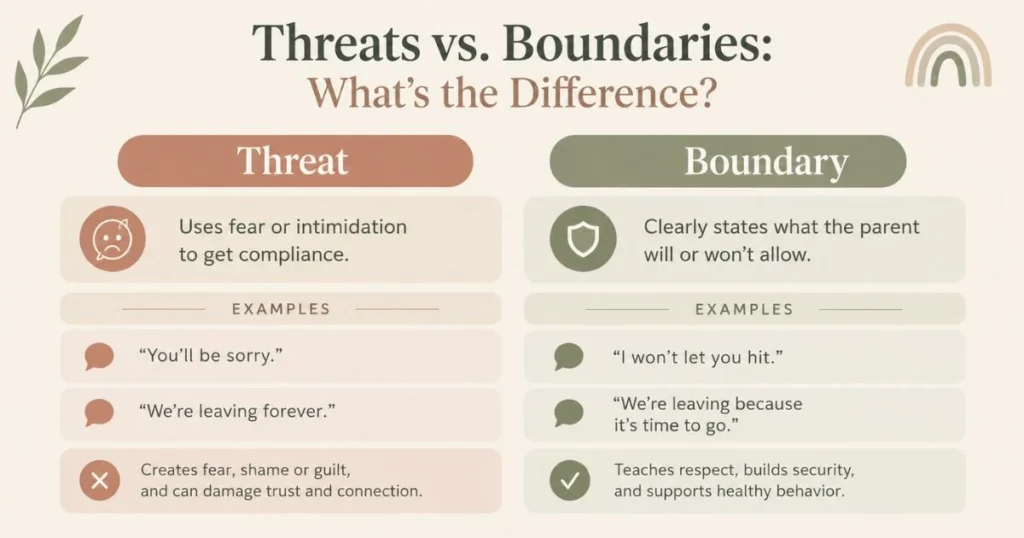
Threats vs. Boundaries
A boundary tells your child what you will or won’t allow. A threat attempts to create fear about what will happen if your child doesn’t comply.
| Threat | Boundary |
| “If you hit again, you’ll be sorry.” | “I won’t let you hit.” |
| “Stop screaming or we’re leaving forever.” | “We’re leaving because it’s time to go.” |
| “Clean this up or I’ll throw it away.” | “Let’s put the toys away before we move on to the next activity.” |
| “If you don’t listen, you’re in trouble.” | “I’m going to help you follow the rule.” |
A boundary can be firm without being frightening.
Threats, Warnings, and Consequences Are Not the Same
These terms may sound alike and are sometimes used as if they mean the same thing, but they serve different purposes.
A threat uses fear or intimidation to try to control a child’s behavior.
A warning lets your child know what is likely to happen next.
A consequence explains what naturally or logically follows from an action.
A boundary makes clear what you will or will not allow.
For example:
“If you throw the blocks again, you’ll be sorry.”
is very different from:
“If you continue throwing the blocks, I’ll put them away because they aren’t being used safely.”
The second statement gives your child clear information rather than relying on threats. It explains the boundary and tells your child what you will do next.
Why Do Parents Use Threats?
If threats aren’t the parenting approach you want to rely on, you may wonder why these words can come out so quickly.
Often, it isn’t because you don’t know a better approach. It’s because you’re stressed, overwhelmed, or under pressure.
Stress and Overwhelm
Parenting can bring dozens of small demands throughout the day.
You may be:
- Running behind schedule.
- Completely exhausted.
- Managing a tantrum.
- Breaking up an argument between siblings.
- Repeating the same direction over and over.
- Trying to get everyone out the door.
- Responding to unsafe behavior.
- Feeling embarrassed while you’re in public.
As your stress increases, it can become harder to pause and respond thoughtfully.
Threats can feel like a quick solution because they may lead to immediate compliance.
Learned Parenting Patterns
Some of the phrases you use with your child may come from the way you were raised.
You may have heard things like:
“Because I said so.”
or:
“If you don’t behave, you’ll regret it.”
When a response is familiar, it can become automatic, especially when you’re exhausted or stressed. This can make threats feel like an instinctive response in difficult moments.
Recognizing this pattern isn’t about blaming your parents or criticizing yourself. It’s about becoming aware of what you want to pass on to your child and what you would prefer to do differently.
When You Feel Like Nothing Else Works
This can be one of the most difficult and frustrating parts of parenting.
You’ve already asked.
You’ve explained.
You’ve reminded.
You’ve waited.
Yet your child still hasn’t cooperated.
Eventually, you may find yourself thinking:
“What am I supposed to do now?”
This is where having a few practical alternatives ready can make a difference.
Instead of responding with a stronger threat, you can rely on a small set of effective tools: clear limits, choices, appropriate consequences, connection, and calm follow-through.
Do Threats Work With Children?
Threats can sometimes lead to immediate compliance.
A child may stop what they’re doing because they want to avoid the unpleasant outcome you’ve described.
However, stopping a behavior in the moment doesn’t necessarily mean the child has learned the skill they need to manage the situation.
For example, a child who stops hitting because they’re afraid of punishment may still need to learn how to manage anger, ask for space, or work through a disagreement.
That’s why the goal of discipline isn’t simply:
“How can I make my child stop?”
A more helpful question is:
“What does my child need to learn or practice in this situation?”
What Threat-Based Discipline Can Miss
When the main goal is getting your child to obey immediately, you may miss valuable opportunities to teach important skills such as:
- Emotional regulation.
- Communication.
- Problem-solving.
- Impulse control.
- Empathy.
- Cooperation.
- Healthy ways to express frustration.
The American Academy of Pediatrics supports positive discipline strategies such as setting clear limits, using appropriate consequences, redirecting behavior, modeling appropriate actions, listening to children, and reinforcing positive behavior. It also recommends avoiding threats, insults, humiliation, and shame when disciplining children.
That doesn’t mean you should never be firm.
It means you can set firm boundaries without using threats or fear to get your child to cooperate.
Threats and Parenting: 10 Better Ways to Guide Your Child
If you want to stop relying on threats, it helps to have practical alternatives you can use even when you’re exhausted, rushed, or dealing with a difficult situation.
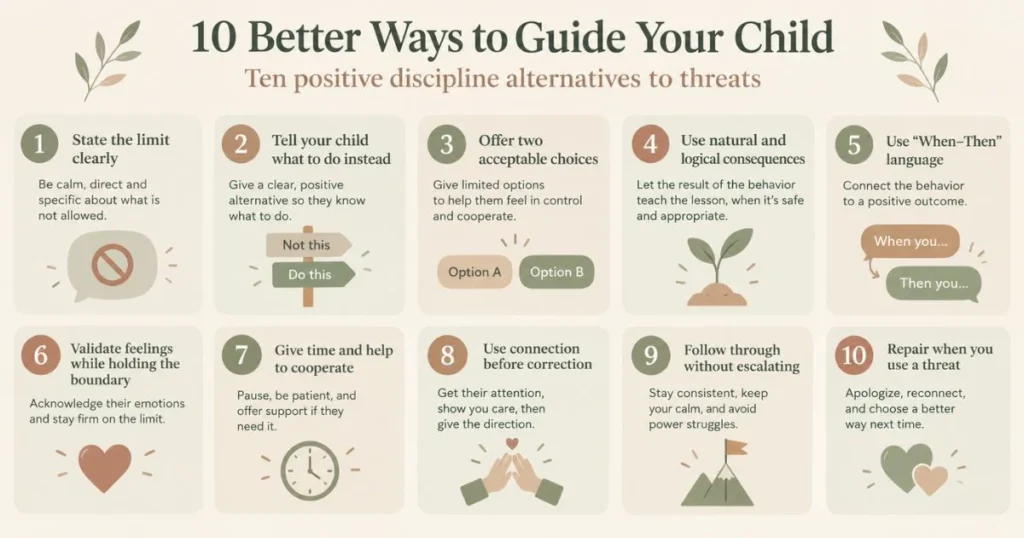
1. State the Limit Clearly
A clear boundary helps your child understand which behaviors are acceptable and which are not.
Instead of:
“If you hit your brother again, you’ll get into serious trouble.”
Try:
“I won’t let you hit. I’m going to move you away from your brother.”
Notice the difference.
The second approach avoids threats and frightening predictions. Instead, you calmly explain the boundary and what you will do to keep everyone safe.
What Makes a Good Limit?
An effective limit is usually:
- Brief.
- Clear.
- Specific.
- Suitable for your child’s age.
- Consistent.
- Something you can realistically follow through on.
You don’t need to give a long explanation while your child is already upset.
In many situations, one calm sentence can be enough, especially when you are trying to avoid relying on threats.
2. Tell Your Child What to Do Instead
Young children are often told what they shouldn’t do.
“Don’t run.”
“Don’t yell.”
“Don’t grab.”
“Don’t hit.”
But what can they do instead?
Try giving your child a clear replacement behavior:
- “Walk beside me.”
- “Use gentle hands.”
- “Keep the blocks on the floor.”
- “Use your inside voice.”
- “Tell me when you’re angry.”
- “Ask before you take the toy.”
Specific directions give your child something concrete to practice. Instead of relying on threats or simply stopping unwanted behavior, you’re teaching an appropriate response that can gradually replace it.
3. Offer Two Acceptable Choices
Offering choices can give your child a sense of control while allowing you to maintain the boundary.
For example:
“Would you like to put your shoes on yourself, or would you like me to help you?”
Or:
“Would you rather brush your teeth before putting on your pajamas or afterward?”
Or:
“Would you like to walk to the car, or would you prefer to hold my hand?”
The important thing is that both options need to be acceptable to you.
You don’t want to ask:
“Do you want to go to bed?”
when bedtime isn’t actually a choice.
Instead, try:
“It’s bedtime. Would you like one book or two?”
The limit remains in place while your child gets a small amount of control over how they follow it, reducing the need to rely on threats.
4. Use Natural and Logical Consequences
Consequences can help children understand what may happen when a behavior continues, without relying on fear or intimidation.
Consider a child who repeatedly throws a toy.
Instead of:
“If you throw it again, I’ll put all your toys away.”
you could say:
“The toy isn’t being used safely, so I’m going to put it away for now.”
The consequence is directly connected to the behavior rather than using threats.
Other examples might include:
- Water is repeatedly splashed outside the agreed play area → water play ends.
- A toy is used to hit someone → the toy is temporarily put away.
- Toys aren’t cleaned up before the next activity → cleanup happens before moving on.
The goal isn’t to choose the biggest punishment.
The goal is to respond in a way that is predictable, reasonable, and directly related to what happened.
5. Use “When–Then” Language
“When–then” language can help you communicate expectations without escalating.
For example:
“When your shoes are on, we’ll go outside.”
“When the toys are away, we’ll choose a book.”
“Once you’re calm, we can talk about what happened.”
This works best when you’re describing a genuine sequence rather than disguising a threat.
Compare:
“When you stop whining, I’ll finally give you what you want.”
with:
“I’ll listen when you’re ready to speak calmly.”
The second statement shows your child what they can do to help move the conversation forward.
6. Validate Feelings While Holding the Boundary
You don’t need to change a boundary just because your child is upset about it.
“Your child may be angry about leaving the park, but you can still leave.”
“Your child may feel disappointed when you say no, but you can still maintain the boundary.”
You can still say no.
Try:
“You really wanted to keep playing. It’s hard to stop. It’s still time to go.”
Or:
“You’re angry that I said no. You can be angry. I won’t let you hit.”
This approach separates the feeling from the behavior.
Your child’s emotion doesn’t have to become an emergency that you immediately fix.
At the same time, you don’t have to ignore the emotion.
Responsive caregiving means recognizing your child’s cues and responding in ways that meet their needs. That doesn’t mean saying yes to everything. It means staying connected while maintaining appropriate boundaries.
7. Give Your Child Time and Help to Cooperate
Sometimes what looks like defiance is a child who needs more support with a transition.
Instead of repeating the same instruction louder and louder, try this sequence:
- Move closer.
- Get your child’s attention.
- Give one clear instruction.
- Pause.
- Give them a moment to respond.
- Help if needed.
For example:
“It’s time to get dressed.”
Pause.
If your child doesn’t move:
“You can get dressed on your own, or I can help you.”
If they still need help, you can assist.
Helping your child doesn’t mean you’re giving in.
You’re teaching them how to complete a task they may not yet manage independently.
8. Use Connection Before Correction
When your child is overwhelmed, a long explanation may not be very useful.
Imagine your child is crying because you turned off the television.
You could lecture:
“I’ve told you a hundred times that you need to listen to me. If you don’t stop crying, you’re going to lose television for a whole week.”
Or you could keep it simple:
“You really wanted to keep watching. You’re upset. The TV is still off.”
Then stay nearby and help your child through the feeling.
Connection doesn’t mean surrendering the boundary.
It means recognizing that your child is having a difficult moment while you remain responsible for the limit.
9. Follow Through Without Escalating
One of the biggest changes you can make is learning to follow through without making your language increasingly severe.
You might begin with:
“Please stop throwing the blocks.”
Then:
“Stop throwing the blocks.”
Then:
“If you throw those blocks again, you’ll get into serious trouble.”
Instead, try calm follow-through.
“The blocks are being thrown. I’m putting them away for now.”
Then do it.
You don’t need to add another threat.
You don’t need to explain it five times.
“You don’t have to prove that you’re the one in control.”
Your calm action communicates the boundary.
10. Repair When You Use a Threat
This is important because you’re bound to make mistakes along the way.
You may truly want to stop relying on threats, yet one might still slip out when you’re completely exhausted.
“What matters most is how you handle things after you make a mistake.”
“The most important thing is how you respond once you realize you’ve made a mistake
Try this four-step repair:
- Acknowledge what happened.
- Apologize for your words.
- Restate the boundary.
- Move forward.
For example:
“I was really frustrated, and I said I would take all your toys away. That wasn’t a helpful or respectful way for me to speak to you. We still need to clean up, and I’ll help you get started.”
You don’t need to pretend you handled the situation perfectly.
You can show your child what accountability looks like.
What to Say Instead of Threatening Your Child
When you’re in the middle of a difficult moment, coming up with new language can be surprisingly hard.
Having a few phrases ready can help.
| Instead of saying… | Try saying… |
| “If you don’t stop, you’ll be sorry.” | “I’m going to help you stop.” |
| “Do it or else.” | “It’s time to do this. I’ll help you.” |
| “I’ll throw all your toys away.” | “The toys aren’t being used safely, so I’m putting them away.” |
| “Stop crying.” | “You’re upset. I’m here.” |
| “If you hit again, you’re in trouble.” | “I won’t let you hit.” |
| “If you don’t listen, we’re leaving.” | “It’s time to leave. I’ll help you get ready.” |
| “You’ll lose everything.” | “This behavior tells us that we need to stop the activity for the time being.” |
You don’t have to memorize all of these.
Choose two or three phrases that feel natural to you, and practice them before you need to use them.
How to Set Firm Boundaries Without Threats
One common fear is that if you stop threatening your child, you’ll become too permissive.
You don’t have to.
Gentle parenting isn’t the absence of boundaries.
You can say no.
You can stop unsafe behavior.
You can end an activity.
You can enforce a family rule.
You can expect your child to participate in routines.
The difference is that you’re communicating the limit without relying on fear, humiliation, or intimidation.
Be Clear About Non-Negotiable Boundaries
Some boundaries should be especially firm because they involve safety.
Examples include:
- Hitting.
- Biting.
- Running into traffic.
- Unsafe climbing.
- Touching dangerous objects.
- Unsafe behavior in a car.
You don’t need to negotiate these limits.
You can calmly say:
“I won’t let you run into the street.”
Then physically keep your child safe.
Use Fewer Words
When your child is already upset, more words don’t necessarily produce more cooperation.
Try:
“I won’t let you hit.”
rather than delivering a long lecture about why hitting is wrong.
Stay Calm and Firm
Calm doesn’t mean uncertain.
You can say:
“I know you don’t like this. The answer is still no.”
That is both compassionate and clear.
Follow Through Consistently
If you say the toys are being put away because they are being thrown, follow through.
Avoid announcing consequences you don’t intend to use.
Consistency makes your limits more predictable.
What If Your Child Keeps Ignoring You?
This is where many parents become tempted to use threats.
Before assuming your child is simply being defiant, consider what may be happening.
Is the Expectation Age-Appropriate?
Young children are still developing:
- Impulse control.
- Attention.
- Emotional regulation.
- Communication.
- Transition skills.
Your child may understand your instruction and still struggle to act on it immediately.
Get Closer Instead of Louder
If you’ve been calling from another room several times, walk over.
Get close.
Give one instruction.
Then pause.
Look at the Timing
Children may have a harder time cooperating when they’re:
- Hungry.
- Tired.
- Overstimulated.
- Deeply involved in play.
- Transitioning suddenly.
This doesn’t mean you should remove every expectation.
It means you can sometimes make cooperation easier by changing how you approach the situation.
Ask What Skill Your Child Needs
Instead of asking:
“How do I make my child obey?”
try asking:
“What skill is my child having difficulty with right now?”
Maybe your child needs help transitioning.
“Maybe they need to practice expressing themselves with words instead of hitting.”
Maybe they need help breaking a task into smaller steps.
That question can change the entire interaction.
Threats, Tantrums, and Big Feelings
Tantrums are one of the moments when threats can come out most quickly.
Your child is screaming.
You’re frustrated.
Everyone is watching.
Your instinct may be to make the behavior stop immediately.
Start with safety.
Then keep your response simple.
During a Tantrum
- Keep everyone safe.
- Stay as calm as you can.
- Acknowledge the emotion.
- Maintain the boundary.
- Use fewer words.
- Wait for the intensity to decrease.
- Talk about what happened later.
For example:
Child:
“I DON’T WANT TO LEAVE!”
Parent:
“You really want to stay. You’re angry. It’s time to go. I’ll help you.”
Compare that with:
“Stop crying right now or we’re never coming here again!”
The first response doesn’t reward the tantrum by changing the boundary, but it also doesn’t add another layer of fear.
Are Warnings the Same as Threats?
Not necessarily.
A warning can help a child understand what is about to happen.
For example:
“If you continue throwing the blocks, I’ll put them away because they’re not being used safely.”
That’s different from:
“Keep throwing them and you’ll be sorry.”
The first statement identifies the behavior, establishes the limit, and tells the child what the parent will do next.
The second relies on the child imagining an unpleasant outcome.
A useful question is:
Am I informing my child about what will happen, or am I trying to frighten them into obeying?
That distinction can help you change your language in the moment.
How to Stop Using Threats When You’re Frustrated
Changing a parenting habit takes more than knowing what you should say.
You also need to notice the moments when you’re most likely to lose patience.
Identify Your Triggers
Ask yourself:
- Am I rushing?
- Am I exhausted?
- Have I repeated myself too many times?
- Am I embarrassed by my child’s behavior?
- Am I trying to control something that isn’t urgent?
- Have I had enough quiet time today?
You may notice a pattern.
Have a Replacement Phrase Ready
When you feel yourself about to threaten, pause and use a phrase you’ve already chosen.
For example:
“I’m getting frustrated. I’m going to slow down.”
Or:
“I’m not going to threaten you. I’m going to explain what needs to happen next.”
Or simply:
“Let me take a breath.”
Taking a brief pause can give you the space you need to decide how to respond.
Choose Three Go-To Scripts
You could start with:
- “I won’t let you hit.”
- “It’s time to go. I’ll help you.”
- “You’re upset. The limit is still the same.”
These are easier to remember than a complicated parenting philosophy when you’re standing in the middle of a tantrum.
Threats and Parenting in Everyday Situations
Real parenting doesn’t happen in a textbook.
It happens when you’re trying to get out the door, finish dinner, leave the park, or get everyone into bed.
Here’s how you can apply this approach to common everyday situations.
| Situation | Threat-based response | Better response |
| Leaving the park | “We’re never coming back!” | “It’s time to leave. I’ll help you.” |
| Hitting a sibling | “Do that again and see what happens.” | “I won’t let you hit.” |
| Refusing bedtime | “Go to bed or you’ll lose everything.” | “It’s bedtime. One book or two?” |
| Throwing food | “You’ll get nothing to eat.” | “Food stays on the table. If you’re finished, I’ll help you clean up.” |
| Refusing cleanup | “I’m throwing everything away.” | “The toys need to be put away. I’ll help you start.” |
| Screaming | “Stop screaming or else.” | “I hear you’re upset. I’ll listen when your voice is calmer.” |
The goal isn’t to find a magical sentence that makes your child cooperate every time.
The goal is to have a response that teaches, protects, and guides even when cooperation doesn’t happen immediately.
What About Threats Related to Safety?
Safety situations are different.
If your child is about to run into the street, you don’t need to pause for a lengthy explanation.
You may need to say:
“Stop!”
or:
“Freeze!”
or:
“Come here now!”
Then physically keep your child safe.
An urgent safety instruction isn’t the same as an everyday threat used to intimidate a child into obedience.
Once the immediate danger has passed, you can explain the rule more calmly.
For example:
“Cars can hurt you. When we’re near the road, you have to stay beside me.”
Safety comes first. Teaching comes next.
When Parenting Threats Need More Support
Sometimes the issue goes beyond finding better words.
If you frequently feel unable to control your anger, if conflict at home is constant, or if discipline is escalating toward physical punishment, getting additional support can be worthwhile.
Consider speaking with your child’s pediatrician or a qualified child-development or parenting professional if:
- Your child’s behavior repeatedly creates safety concerns.
- Aggression is frequent or severe.
- You feel overwhelmed by parenting most days.
- You are worried about your own reactions.
- Discipline conflicts are becoming difficult to manage.
- You feel that you need help changing your parenting responses.
Seeking support isn’t a sign that you’ve failed.
Parenting programs can provide practical strategies for positive, non-violent discipline and strengthen parent-child relationships.
Frequently Asked Questions About Threats and Parenting
Are threats bad for children?
Threatening language is not recommended as a routine discipline strategy. 7. The American Academy of Pediatrics recommends avoiding threats, insults, humiliation, and shame when disciplining children. Instead, parents are encouraged to use positive approaches such as setting clear limits, using appropriate consequences, redirecting behavior, and reinforcing positive actions.
The impact of a particular statement can vary depending on the situation, how often it is used, how severe it is, and the child’s individual circumstances. For this reason, it is best not to assume that every threat will have the same effect.
What are examples of threats in parenting?
Examples include:
- “If you don’t stop, you’ll regret it.”
- “If you hit again, you’ll be in big trouble.”
- “I’ll throw all your toys away.”
- “Stop crying or I’ll give you something to cry about.”
- “If you don’t listen, you’ll lose everything.”
A clear boundary such as “I won’t let you hit” is different because it communicates what the parent will do to keep the child or others safe.
How can I discipline my child without threats?
You can use:
- Clear boundaries.
- Specific instructions.
- Limited choices.
- Natural or logical consequences.
- Redirection.
- Positive attention.
- Calm follow-through.
- Emotional support.
- Repair after mistakes.
The goal is not to eliminate authority. It’s to use authority without relying on fear.
What can I say instead of threatening my child?
Try short phrases such as:
“I won’t let you hit.”
“It’s time to leave. I’ll help you.”
“You’re upset. I’m here.”
“The toy isn’t being used safely, so I’m going to put it away.”
“I’ll listen when you’re ready to speak calmly.”
Do threats work with toddlers?
Threats may sometimes produce immediate compliance, particularly when a child wants to avoid an unpleasant consequence. But immediate compliance doesn’t necessarily teach the underlying skill.
Toddlers are still developing impulse control, communication, emotional regulation, and the ability to understand complex consequences.
Simple limits, predictable routines, choices, redirection, and hands-on support are often more appropriate ways to guide young children.
How do I stop using threats when I’m angry?
Start by identifying the situations that trigger you.
Then prepare a few replacement phrases before you need them.
When you feel yourself escalating:
- Pause.
- Take a breath.
- Lower your voice.
- State the limit.
- Follow through calmly.
If you still use a threat, repair afterward rather than letting guilt keep you stuck.
Are consequences better than threats?
A consequence and a threat serve different purposes.
A reasonable consequence can help a child understand what follows a behavior. A threat often focuses on making the child fear what the parent might do.
For example:
“The blocks are being thrown, so I’m putting them away.”
is a clear consequence.
“Throw those again and you’ll be sorry.”
is a threat.
AAP guidance supports calm, consistent consequences as part of positive discipline.
Can gentle parenting include firm boundaries?
Yes.
Gentle parenting does not require you to say yes to everything or allow unsafe behavior.
You can be compassionate and firm at the same time.
You can say:
“I know you’re angry. I won’t let you hit.”
The feeling is accepted.
The unsafe behavior is stopped.
What should I do if I already threatened my child?
Repair.
You can say:
“I was frustrated, and I threatened you. That wasn’t a good way for me to speak to you. I’m sorry. We still need to clean up, and I’ll help you.”
Then return to the boundary.
You don’t have to erase the limit just because you regret how you communicated it.
Conclusion: You Can Be Firm Without Using Threats

PParenting will give you plenty of moments when your patience wears thin.
Your child will refuse.
They’ll scream.
They’ll push against a boundary you’ve already explained.
And sometimes, despite your best intentions, a threat may slip out.
That doesn’t mean you have to continue using that pattern.
You can gradually replace threats with more helpful tools:
- Clear limits.
- Specific instructions.
- Small choices.
- Logical consequences.
- Calm follow-through.
- Emotional validation.
- Connection.
- Repair.
You don’t need to frighten your child to be a confident, firm parent.
You can say no.
You can stop unsafe behavior.
You can maintain a boundary even when your child is upset about it.
And you can do all of this while teaching your child that difficult emotions, mistakes, and conflict can be handled without fear or intimidation.
The next time you feel a threat about to come out, pause and choose a simple response instead:
“I won’t let you do that. I’ll help you.”
That small change can turn a difficult moment into an opportunity for learning.
Parenting Whisper Reminder
You don’t have to be a perfect parent. You just need to keep practicing the kind of guidance you want your child to learn from.
If this article helped you rethink threats and discipline, save it for the next challenging parenting moment and share it with another parent who may appreciate having a gentler alternative.