
Your child runs over with a picture they have just finished. You look at it, smile, and say the words that come naturally:
“Good job!”
Maybe your child has just completed a puzzle, put on their shoes independently, learned a new word, or kept trying after something didn’t work. Again, you want to celebrate the moment.
There is nothing wrong with wanting your child to feel proud.
But as you learn more about parenting, you may start wondering whether there is a difference between praise and encouragement. Does telling your child, “You’re so smart,” affect them in the same way as saying, “You worked really hard on that”? And how can you encourage your child without making them feel like they constantly need to impress you?
The answer lies in what your words draw your child’s attention toward.
Praise often evaluates the child or the result: You’re smart. That’s beautiful. Good job.
Encouragement can help your child notice the process: You kept trying. You found another way. You worked carefully.
Neither approach needs to become another parenting rule you have to follow perfectly. Instead, understanding the difference gives you more ways to support your child as they learn, struggle, practice, and grow.

What Is Encouragement?
Encouragement supports your child by drawing attention to their effort, progress, choices, strategies, and persistence.
Instead of labeling your child’s actions as good or bad, explain what you noticed and allow them to recognize their own accomplishment.
For example, imagine your child is building a tower that keeps falling.
You could say:
“You’re so good at building!”
Or you could say:
“You tried different ways to build it until you discovered what helped the blocks stay upright.
The second response gives your child information about what actually happened. They tried, adjusted their approach, and solved a problem.
Encouragement can focus on:
- Effort
- Persistence
- Practice
- Problem-solving
- Strategy
- Progress
- Decision-making
- Independence
- Emotional awareness
The goal isn’t to praise effort automatically. It means recognizing something genuine and meaningful in what your child is doing.
The American Psychological Association recommends specific positive feedback that tells children what they did well and identifies the learning processes or skills involved.
What Encouragement Sounds Like
You might say:
- “You kept trying even when that was difficult.”
- “You found a new way to make it work.”
- “You practiced that several times.”
- “You noticed that piece didn’t fit, so you tried another one instead.”
- “You look really proud of what you made.”
- “You found another way to make it work.”
Notice that these statements don’t require you to judge your child’s entire performance.
You’re simply helping your child see something that happened.
What Is Praise?
Praise is positive feedback that communicates approval, admiration, or appreciation.
It can be as simple as:
- “Good job!”
- “That’s beautiful!”
- “You’re so smart!”
- “You’re such a good girl.”
- “I’m proud of you.”
- “You’re an amazing artist.”
Praise is a normal part of warm relationships. You don’t need to become afraid of praising your child, and you certainly don’t need to eliminate every “good job” from your vocabulary.
The more useful question is what kind of praise you’re giving and what it asks your child to focus on.
Person Praise vs. Process Praise
One of the most important distinctions in the research is between person praise and process praise.
| Type of feedback | Example | Main focus |
| Person praise | “You’re so smart.” | A personal quality or ability |
| Process praise | “You worked really hard.” | Effort or process |
| Strategy feedback | “You tried another way.” | Problem-solving |
| Specific feedback | “You put those pieces together carefully.” | Observable behavior |
| Outcome praise | “You finished the puzzle!” | Result |
Research by Carol Dweck and Claudia Mueller found important differences between praising children’s intelligence and praising their effort. Children who received intelligence-focused praise were more likely to respond differently to later challenges than children who received process-focused praise.
That doesn’t mean every compliment about ability is harmful. It means the message behind your feedback matters.
Encouragement vs. Praise: What’s the Difference?
A simple way to understand the difference is to look at it this way:
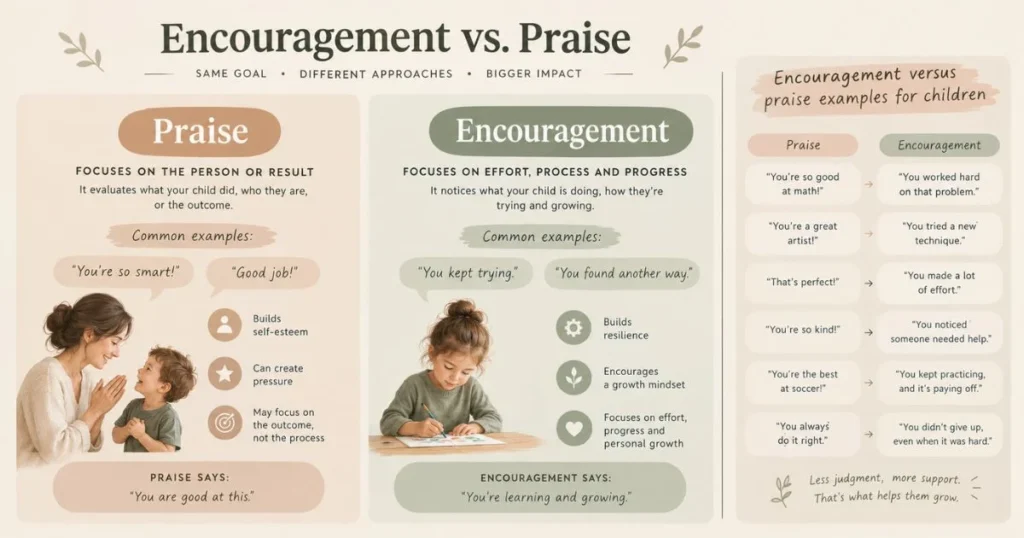
Praise often tells your child how you evaluate what they did. Encouragement helps your child recognize and reflect on what they have accomplished.
For example:
“You’re such a good artist.”
puts the emphasis on a quality of the child.
Compare that with:
“You added so many details to your drawing.”
Now the attention moves toward the child’s actions.
Here’s another example.
Praise:
“You’re so smart. You solved that puzzle!”
Encouragement:
“You tried a few different pieces until you found the one that fit.”
The second statement doesn’t tell your child, “You are smart.” It gives them something more concrete to recognize: I tried different things until I solved it.
A Quick Comparison
| Encouragement | Praise |
| “You kept trying.” | “Good job!” |
| “You found another strategy.” | “You’re so smart.” |
| “You worked carefully.” | “That’s perfect.” |
| “You seem proud of yourself.” | “I’m so proud of you.” |
| “You made progress.” | “You’re really talented.” |
| Often highlights process | Can evaluate the person or result |
Importantly, the two categories aren’t completely separate.
A phrase like, “You did really well because you kept practicing,” combines praise with a clear observation about the effort and process involved.
That’s why you don’t need to analyze every sentence you say.
Why the Way You Encourage Kids Matters
Children gradually develop ideas about what success means.
If they repeatedly hear that they are “smart,” “talented,” or “naturally good” at something, they may begin to connect success with an identity.
That can feel wonderful when things go well.
But what happens when something becomes difficult?
Children Learn What You Pay Attention To
Your feedback can draw attention toward different things.
You might emphasize:
- Being the best
- Getting the right answer
- Finishing quickly
- Looking talented
- Avoiding mistakes
Or you might emphasize:
- Learning
- Practice
- Persistence
- Problem-solving
- Improvement
- Trying another approach
The APA’s guidance recommends focusing feedback on effort and effective strategies rather than treating ability or intelligence as fixed qualities.
Process-Focused Feedback Can Support Persistence
Research on praise has found that feedback about effort and process can be more helpful for maintaining engagement with challenging tasks than feedback that emphasizes fixed ability.
In the well-known Mueller and Dweck research, children praised for intelligence were more likely to choose easier tasks after the praise, while children praised for effort were more willing to choose challenging tasks that offered an opportunity to learn.
This doesn’t mean that one compliment determines how your child will approach challenges for years to come.
Children are influenced by many factors, including temperament, relationships, experiences, classroom environments, expectations, and opportunities to practice.
The takeaway is much simpler:
When you can, help your child notice the process rather than making ability the entire story.
Person Praise Can Make Failure Feel More Personal
Another study examined how children responded to person praise compared with process praise.
Among children with lower self-esteem, person praise was associated with greater shame following failure, whereas process praise did not show the same pattern. The study involved 313 children with an average age of about 10 years.
That finding is valuable, but it should be considered with caution.
It does not mean that saying “You’re amazing” will automatically damage your child’s self-esteem.
It suggests that repeatedly tying a child’s worth to a positive personal quality can create a different psychological message from praising a specific behavior or process.
How Encouragement Can Help Kids Build Confidence
Confidence isn’t simply telling your child that they are wonderful.
A child can also develop confidence by experiencing:
“I tried something difficult, and I learned how to handle it.”
That’s a very different kind of confidence.
Help Your Child Notice Their Own Progress
Instead of:
“You’re a great reader.”
Try:
“That word was challenging for you last week, but today you were able to read it on your own.”
You’re giving your child evidence of progress.
Help Your Child Recognize Their Effort
Instead of:
“You’re naturally good at drawing.”
Try:
“You put a lot of time and attention into those details.”
Help Your Child Recognize Their Strategies
Instead of:
“You’re so clever!”
Try:
“You realized the first approach wasn’t working, so you tried a different one.”
Give Your Child Room to Feel Proud
You don’t always need to tell your child how they should feel.
If your child finishes a project, try:
“You finished it.”
Then wait.
They may say:
“I really like it!”
Now their satisfaction is coming from their own experience rather than from your evaluation.
How to Encourage Kids Without Creating Pressure
There is an important trap here.
You can become so focused on praising effort that your encouragement starts to feel like another expectation for your child.
You don’t want your child to hear:
“You should always try harder.”
Children get tired. They become frustrated. Sometimes they need a break. Sometimes they genuinely don’t want to continue.
Encouragement should support your child, not turn every activity into a lesson about perseverance.
Don’t Turn Every Moment Into a Performance
You don’t need to comment on everything your child does.
If your child is playing happily, you can simply let them play.
Don’t Praise Every Tiny Action
Constant praise can become background noise.
Instead of:
“Good job!”
for every small action, save specific feedback for moments when it adds something useful.
Don’t Use Encouragement to Control Your Child
Avoid turning encouragement into a subtle reward system:
“If you just try harder, you’ll succeed.”
Instead, acknowledge reality:
“This is hard. We can figure out what might help.”
Match Your Response to the Moment
Sometimes your child needs encouragement.
Sometimes they need:
- Comfort
- Help
- Connection
- A break
- Reassurance
- Space
- A practical solution
If your child is upset because a tower fell down, they may not need a speech about persistence.
They might simply need:
“You worked hard on that. It fell, and you’re disappointed.”
That is support too.
What to Say Instead of “Good Job”
You don’t have to ban “good job.”
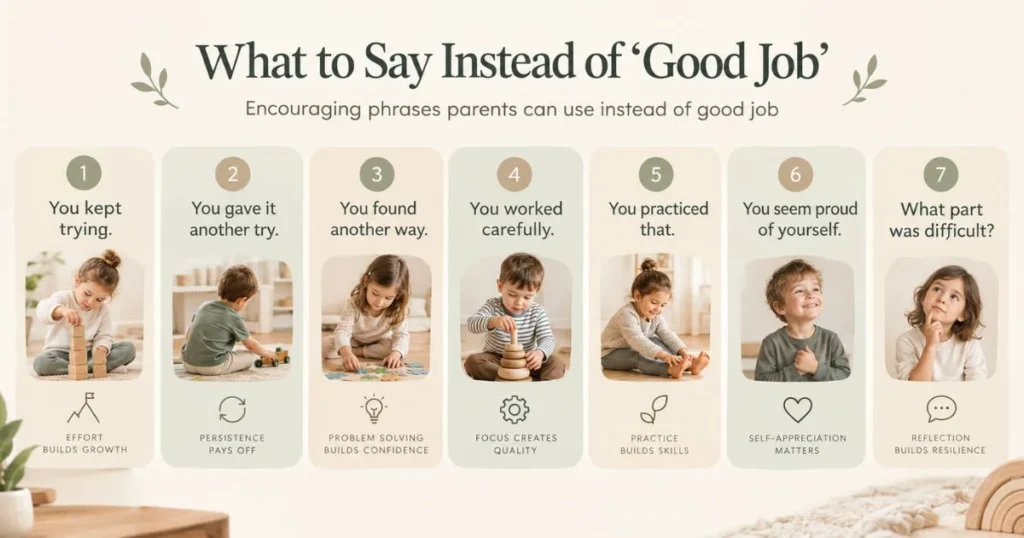
But having a few alternatives makes it easier to give more specific feedback.
When Your Child Is Trying
- “You kept working on it.”
- “You gave it another try.”
- “I noticed you stayed with it.”
When Your Child Solves a Problem
- “You found another way.”
- “You figured out what wasn’t working.”
- “What made that strategy work?”
When Your Child Improves
- “You can do that part by yourself now.”
- “That’s different from the last time you tried.”
- “You remembered what you practiced.”
When Your Child Is Proud
- “You look really proud of yourself.”
- “What do you like most about it?”
- “What was your favorite part?”
When Your Child Makes a Mistake
- “That didn’t work the way you expected.”
- “What could you try differently?”
- “Would you like some help, or do you want to try it one more time on your own?”
Encouragement Examples for Everyday Parenting
Knowing the theory is helpful. Knowing what to say at 7:30 in the morning when everyone is rushing out the door is even more useful.
When Your Child Is Drawing
Instead of:
“You’re such a talented artist!”
Try:
“You included lots of different shapes in your picture.”
You’re describing something you can actually see.
When Your Child Is Doing a Puzzle
Instead of:
“You’re so smart!”
Try:
“You checked several pieces before you found the one that matched.”
When Your Child Is Learning to Read
Instead of:
“You’re a great reader!”
Try:
“You sounded that word out carefully.”
When Your Child Is Learning a Physical Skill
Instead of:
“You’re such a good climber!”
Try:
“You held on firmly as you lifted your foot up.”
When Your Child Is Cleaning Up
Instead of:
“Good girl!”
Try:
“You gathered all your toys and put them back in the basket.”
The second response is specific. Your child can understand exactly what you noticed.
Encouragement for Toddlers, Preschoolers, and Older Children
The basic principle stays the same, but the language can change as your child’s abilities develop.
Encouragement for Toddlers
With toddlers, keep your words short and concrete.
You might say:
- “You put your shoe on.”
- “You tried again.”
- “You carried that carefully.”
- “You did that by yourself.”
Toddlers are still developing language and self-awareness, so simple observations often work beautifully.
Encouragement for Preschoolers
Preschoolers can handle more reflection.
Try:
- “What part was tricky?”
- “How did you figure that out?”
- “What could you try next?”
- “Which part do you like?”
You can also begin helping them notice emotions:
“You looked frustrated when it fell, but you decided to try again.”
Encouragement for School-Age Children
Older children can think more deliberately about strategies and progress.
You might ask:
- “What helped you solve it?”
- “What would you change next time?”
- “Which part took the most practice?”
- “What are you most proud of?”
The APA recommends giving children opportunities for meaningful choices, self-monitoring, and recognizing their own progress, alongside specific feedback about effort and learning processes.
How to Encourage Kids Without Comparing Them
Comparison can easily turn encouragement into pressure.
Imagine two siblings.
One finishes a puzzle quickly.
You say to the other:
“Look how fast your brother did it. You can do it too.”
Your intention may be motivational.
Your child may hear something different:
“I’m behind.”
Instead, keep the focus on the child’s own experience.
Try:
“Which part is giving you trouble?”
or:
“Do you want to try another piece?”
Avoid Comparing Siblings
Instead of:
“Your sister is already doing this.”
Try:
“Let’s see what works for you.”
Avoid Comparing Friends
Instead of:
“Your friend can already read this.”
Try:
“This word is tricky. Let’s look at it together.”
Focus on Individual Progress
The APA advises against comparing individual learners based on how quickly or how well they learn because learning is an individual process.
Your child’s progress doesn’t have to match another child’s timeline to be meaningful.
How Encouragement Fits Into Gentle Parenting
Encouragement can fit naturally into gentle parenting because it allows you to support your child without making every interaction about control.
Encouragement Respects Developing Autonomy
You can give your child opportunities to:
- Make appropriate choices
- Solve problems
- Decide how to approach a task
- Ask for help
- Try again
- Reflect on what happened
Encouragement Makes Room for Mistakes
Your child doesn’t have to get everything right for you to remain supportive.
You can say:
“That didn’t work.”
without adding:
“But you’re still the best!”
Sometimes a mistake can simply be a mistake.
Encouragement Supports Connection Without Controlling
Instead of asking:
“How can I make my child perform better?”
you can ask:
“How can I support my child while they’re learning?”
That shift can make everyday interactions feel less like evaluation and more like connection.
Common Mistakes Parents Make When Using Encouragement
Even well-intentioned encouragement can become unhelpful when it is overused or disconnected from what is actually happening.
Replacing Every “Good Job” With a Script
You don’t need to become a parenting robot.
If you naturally say “Good job!” occasionally, that’s okay.
You can simply add more specific feedback when it makes sense.
Praising Effort That Wasn’t Really There
If your child barely attempted something, telling them:
“You worked so hard!”
may not feel genuine.
Specific, honest feedback is more useful.
Turning Effort Into Pressure
Avoid:
“You just need to try harder.”
Sometimes a child is already trying hard.
They may need instruction, rest, support, or a different strategy.
Ignoring the Result Completely
Process matters, but outcomes matter too.
You can acknowledge both:
“You practiced a lot, and you finally got the pieces to fit.”
Asking Too Many Questions
Not every interaction needs to end with:
“How did that make you feel?”
Sometimes a simple observation is enough:
“You worked on that for a long time.”
The APA similarly emphasizes specific, genuine feedback rather than vague or excessive praise.
A Simple Encouragement Formula Parents Can Remember
When you’re not sure what to say, try:
Notice → Describe → Reflect
1. Notice
Pay attention to what your child actually did.
2. Describe
Put the observable behavior into words.
3. Reflect
Give your child room to think about their own experience.
For example:
““You experimented with three different ways to build that tower. Which one worked best?”
You noticed the behavior.
You described the process.
Then you gave your child an opportunity to reflect.
Another Simple Formula: Effort + Strategy + Progress
You can also keep three key areas in mind.
Effort
“You kept trying.”
Strategy
“You tried a different way of putting the pieces together.”
Progress
“You can do that part independently now.”
You don’t need to use all three approaches every time.
Encouragement vs. Praise: Quick Reference
| Situation | Instead of | Try |
| Drawing | “You’re a great artist.” | “You added lots of details.” |
| Puzzle | “You’re so smart.” | “You tried several pieces before finding the match.” |
| Reading | “You’re a great reader.” | “You sounded that word out carefully.” |
| Building | “That’s perfect!” | “You adjusted the blocks until they balanced.” |
| Cleaning | “Good girl!” | “You put your toys back in the basket.” |
| Difficult task | “Don’t give up!” | “This is hard. What could you try next?” |
| Mistake | “You’re still the best.” | “That didn’t work. What could you try next?” |
Frequently Asked Questions About Encouragement

What Is Encouragement for Kids?
Encouragement for kids is supportive feedback that helps children notice their effort, progress, strategies, choices, or persistence. Instead of simply evaluating whether something was good or bad, encouragement can help children understand what they did and what they learned.
What Is the Difference Between Encouragement and Praise?
Praise often communicates positive evaluation, such as “Good job” or “You’re so smart.” Encouragement can focus more specifically on what a child did, such as “You kept trying” or “You found another way.”
The distinction is not that praise is always harmful and encouragement is always beneficial. The content and context of feedback matter.
Is Praise Bad for Kids?
No. Praise is not inherently bad for children.
Research suggests that different forms of praise can have different effects. In particular, research has distinguished person praise, such as “You’re smart,” from process-focused feedback about effort or strategies.
You don’t need to feel guilty about praising your child. Instead, consider balancing general praise with specific, genuine observations.
How Can I Encourage My Child Without Pressure?
Focus on what your child can control rather than making success the expectation.
You can:
- Notice genuine effort.
- Describe specific actions.
- Recognize progress.
- Talk about strategies.
- Allow mistakes.
- Give your child appropriate choices.
- Offer help without taking over.
Most importantly, remember that encouragement isn’t supposed to make your child perform.
What Can I Say Instead of “Good Job”?
You can say:
- “You kept trying.”
- “You figured that out.”
- “You found another way.”
- “You worked carefully.”
- “You practiced that.”
- “You seem proud of yourself.”
- “What part was easiest?”
- “What was difficult?”
Choose the phrase that actually fits the situation.
Does Encouragement Build Confidence in Children?
Encouragement can help children notice their own progress, effort, and developing skills. That can contribute to a more realistic sense of competence.
However, encouragement isn’t a magic formula for confidence.
Children develop confidence through many experiences, including opportunities to practice skills, solve problems, make choices, receive useful feedback, and recover from mistakes.
Should I Stop Saying “I’m Proud of You”?
Not necessarily.
“I’m proud of you” can communicate warmth, love, and connection. You don’t need to stop using it altogether. Instead, balance it with statements that encourage your child to recognize their own experience:
“I’m proud of the way you handled that, and you seem proud of yourself too.”
This communicates connection while also giving your child space to recognize and reflect on their own accomplishment.
What Is the Best Way to Encourage a Child Who Gives Up Easily?
Start by understanding why your child is stopping.
They may be:
- Frustrated
- Tired
- Confused
- Overwhelmed
- Afraid of making a mistake
- Unsure what to do next
Instead of immediately saying:
“Don’t give up!”
try:
“This is frustrating. “Would you like some help, a little break, or would you rather try another approach?”
Sometimes the most helpful encouragement is not more motivation. It is helping your child find a manageable next step.
Conclusion: Encouragement Is About More Than Saying the Right Words
You don’t have to eliminate “Good job.”
You don’t have to turn every conversation with your child into a lesson about effort.
And you certainly don’t need to worry that one compliment will determine how your child develops.
What matters is the larger pattern.
When you regularly help your child notice their effort, strategies, progress, choices, and persistence, you give them more information than simple approval can provide.
Instead of only hearing:
“Mom thinks I did a good job.”
your child can gradually learn to think:
“I kept trying.”
“I figured something out.”
“I know what helped me.”
“I can learn from that mistake.”
“I’m proud of what I did.”
That’s the real value of encouragement for kids.
You’re not trying to make your child independent of you overnight. You’re giving them small opportunities to develop an internal sense of competence while still knowing that you’re there to support them.
So, the next time your child excitedly shows you something they created, you don’t need to find the perfect parenting words.
Pause.
Look at what they actually did.
Notice the effort.
And if it feels natural, simply share what you noticed.
Sometimes a simple:
“You worked really hard on that.”
is enough.
Parenting Whisper Reminder

Your child doesn’t need constant approval to feel valued. Sometimes, the most meaningful encouragement is simply letting your child know that you noticed their effort, trusted how they approached the task, and believe they are capable of continuing to grow.
The next time you’re about to say, “Good job,” take a moment to pause and ask yourself:
“What did my child actually do that I want them to recognize?”
Then put that observation into words.
It may take only a few extra words, but over time, these small moments can create richer conversations about learning, persistence, mistakes, and growth.
If this approach feels helpful, save this article to revisit when you need encouragement phrases for kids, and share it with another parent who may appreciate having more ways to respond than simply saying, “Good job!”