There are parenting moments when you know what you should do, but doing it feels completely different.
Your toddler is screaming because you said no. Your child hits when a toy is taken away. You ask for shoes, pajamas, or cleanup for what feels like the tenth time, and suddenly your own patience is disappearing.
You may want to stay calm. You may even know that yelling will probably make things harder. But knowing how you want to respond and actually responding that way are two different things.
This is where Conscious Discipline takes an unusual approach.
Instead of beginning with, “How can I make my child behave?” the framework begins with the adult. It asks parents and educators to look at their own emotional state, develop self-regulation, create safety and connection, and then help children learn the skills they need to manage emotions and behavior.
That adult-first emphasis is one of the defining features of Conscious Discipline. The official framework describes adult self-regulation as a foundation for helping children develop social-emotional skills.
But Conscious Discipline is more than a collection of calming phrases or strategies for stopping tantrums. It is a broader framework that brings together brain-state awareness, adult self-regulation, connection, social-emotional learning, and skill-building.
So what exactly is Conscious Discipline, and what could it look like in everyday parenting?

What Is Conscious Discipline?
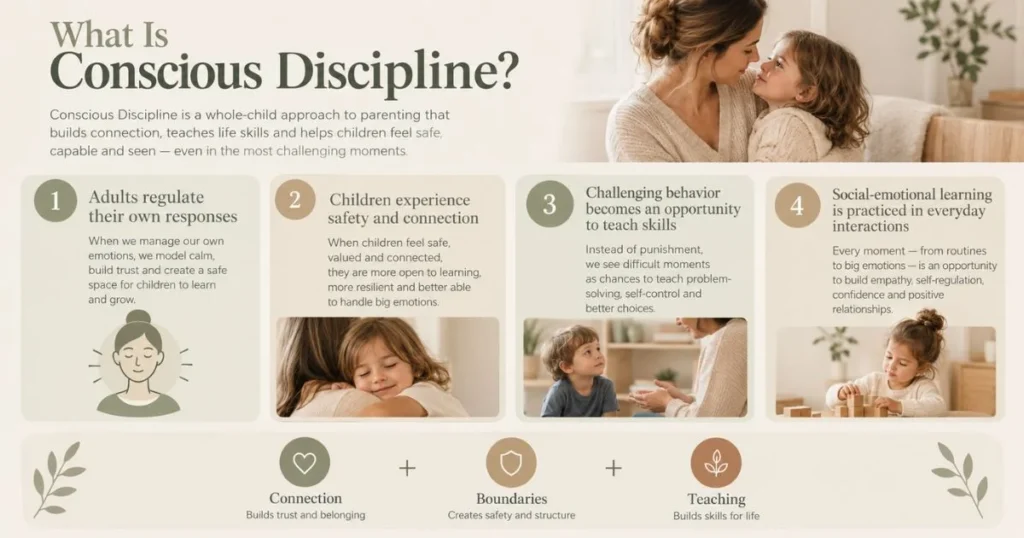
Conscious Discipline is a brain-based, adult-first framework developed by Dr. Becky Bailey. Its central idea is that adults play an important role in creating the emotional conditions in which children can learn, regulate themselves, connect with others, and solve problems.
The framework is designed primarily for educational settings, including schools and early childhood programs, but Conscious Discipline also provides resources specifically for parents and families.
At its heart, Conscious Discipline focuses on four broad ideas:
- Adults learn to regulate their own responses.
- Children experience safety and connection.
- Challenging behavior becomes an opportunity to teach skills.
- Social-emotional learning is practiced in everyday interactions.
This changes the meaning of discipline.
Instead of viewing discipline only as something used after a child misbehaves, Conscious Discipline treats everyday conflict as an opportunity to teach emotional and social skills.
That does not mean children should have unlimited freedom.
A child can be deeply upset while the parent still holds a firm boundary. You can acknowledge anger without allowing hitting. You can understand frustration without allowing unsafe behavior.
In fact, this combination of connection and boundaries is important to the approach.
The American Academy of Pediatrics similarly describes effective discipline as teaching children acceptable behavior, protecting them from harm, and supporting the development of self-regulation and social-emotional skills.
Why Does Conscious Discipline Start With the Adult?
The adult-first idea can feel strange at first.
If your toddler is the one screaming, hitting, or throwing toys, why should you be the first person to change?
Because children are still developing the skills needed to manage strong emotions, impulses, attention, and behavior.
Harvard’s Center on the Developing Child explains that executive-function and self-regulation skills are not fully formed at birth. Children have the potential to develop these abilities through relationships, practice, and experience.
These skills include things such as:
- controlling impulses
- focusing attention
- remembering expectations
- shifting from one activity to another
- managing emotions
- adapting to changing situations
- pausing before acting
Adults are developing and using these skills too.
That means the parent who is trying to help a child calm down may also need to manage their own stress at the same time.
Adult Regulation and Co-Regulation
Co-regulation is the process through which a supportive adult helps a child manage overwhelming emotions while the child gradually develops more independent regulation skills.
Harvard Health describes co-regulation as a supportive and interactive process in which adults help children navigate big emotions and build the ability to regulate themselves.
In practical terms, this might mean:
- You notice that your child is becoming overwhelmed.
- You notice your own frustration rising.
- You pause instead of immediately reacting.
- You help create physical and emotional safety.
- You acknowledge your child’s feelings.
- You maintain the necessary boundary.
- You teach or practice the missing skill when your child is ready.
The goal isn’t to make yourself emotionless.
It is to create enough space between feeling something and acting on it that you can choose your response.
The Brain-Based Foundation of Conscious Discipline
One reason Conscious Discipline is often described as brain-based is its focus on what happens to behavior when people are under stress.
When children become highly distressed, they may temporarily have less access to the skills they normally use when calm.
A toddler who can happily take turns at breakfast may suddenly scream, grab, or hit when exhausted or overwhelmed.
That doesn’t mean the behavior should be ignored. It means the adult may need to approach the situation differently.
Executive Function and Self-Regulation
Harvard’s Center on the Developing Child compares executive-function skills to an air-traffic-control system. These skills help us manage information, focus, make decisions, remember goals, and control impulses.
Young children are still developing these abilities.
This is why “Just calm down” is rarely enough.
A child needs opportunities to practice calming, waiting, communicating, problem-solving, and recovering from frustration.
Conscious Discipline therefore places considerable emphasis on teaching skills instead of assuming that children simply need stronger consequences.
The Brain State Model
Conscious Discipline describes three broad brain/body states:
- Survival State: focused on safety and protection.
- Emotional State: focused on connection and belonging.
- Executive State: the state associated with higher-level thinking, problem-solving, and learning.
The framework uses these states as a practical way for adults to consider what a child may need in the moment.
The important parenting takeaway is simple:
A child who is overwhelmed may need regulation and connection before they are ready for a lesson.
That does not mean waiting forever to address behavior. It means choosing the right moment to teach.
The Seven Powers for Conscious Adults

A distinctive part of Conscious Discipline is its Seven Powers for Conscious Adults. The official framework describes these powers as ways adults can shift how they perceive conflict and maintain composure during difficult situations.
The seven powers are:
- Perception
- Unity
- Attention
- Free Will
- Acceptance
- Love
- Intention
Perception
Perception asks you to examine the meaning you are giving to a situation.
Instead of immediately thinking:
“My child is being difficult on purpose.”
you might pause and ask:
What do I observe, and what else might be happening?
That small shift can change how you respond.
Unity
Unity focuses on the relationship between people rather than creating an “us versus them” dynamic.
With a child, this can sound like:
“We are going to figure this out together.”
Attention
Attention reminds adults that what they focus on influences what they notice.
If every interaction becomes a search for misbehavior, it can become difficult to notice cooperation, effort, curiosity, and progress.
Free Will
Children cannot be controlled into developing genuine self-regulation.
Parents can set boundaries and create structure, but children still have their own choices and responses.
Acceptance
Acceptance does not mean approving of every behavior.
It means recognizing what is happening before deciding how to respond.
You can accept:
“My child is extremely angry right now.”
while still saying:
“I won’t let you hit.”
Love
In Conscious Discipline, love is not simply affection. It is part of maintaining connection while guiding behavior.
A child can understand a firm boundary without feeling rejected.
Intention
Intention asks:
“What do I want to teach here?”
That question can be especially useful during challenging moments.
Instead of focusing only on stopping the behavior, you can consider the skill you want your child to practice.
The Seven Skills of Conscious Discipline
Conscious Discipline also identifies seven skills that turn everyday discipline situations into opportunities for learning. The framework describes these skills as tools for helping children develop social-emotional and communication abilities.
1. Composure
Composure is about managing your own emotional response.
You might pause, breathe, lower your voice, or give yourself a moment before speaking.
2. Encouragement
Encouragement helps children recognize effort, participation, and progress.
Rather than simply saying “Good job,” you can describe the specific effort or behavior you noticed:
“You kept working on the puzzle even though it was challenging.”
3. Assertiveness
Assertiveness means communicating clear expectations without aggression.
For example:
“I won’t let you hit.”
That is firm without being threatening.
4. Choices
Appropriate choices can give children a sense of control within a boundary.
For example:
“Would you like to put your shoes on by yourself, or do you want me to help?”
Choices are not necessary for every situation. A safety issue may require a direct instruction instead.
5. Positive Intent
Positive intent means looking beyond the behavior and considering what the child may be trying to communicate or accomplish.
It does not mean assuming harmful behavior is acceptable.
You can hold both ideas:
“You are having a hard time.”
and:
“I won’t let you hit.”
6. Empathy
Empathy means acknowledging another person’s emotional experience.
For a frustrated toddler:
“You really wanted to keep playing. You’re upset that it’s time to leave.”
You are not promising to change the boundary. You are showing that the feeling has been heard.
7. Consequences
Conscious Discipline does not mean that children are never held accountable for their actions.
The framework prioritizes safety, connection, and teaching before expecting children to learn from consequences. Its official resources specifically discuss consequences as part of the approach.
The key question becomes:
“What can this situation teach?”
rather than simply:
“How can I help my child understand and take responsibility for what happened?”
The S.A.F.E. Conscious Discipline Framework
Conscious Discipline’s current S.A.F.E. framework is particularly focused on whole-school implementation. It stands for:
- S — Sustained Leadership
- A — Adult Self-Regulation
- F — Foster Community
- E — Engage Classrooms
The official framework describes S.A.F.E. as a way to align leadership, adult practices, relationships, and classroom environments rather than treating behavior management as an isolated classroom technique.
Sustained Leadership
Schools need consistent leadership and support for a framework to become part of everyday practice.
Adult Self-Regulation
Educators need opportunities to recognize stress, regulate themselves, and respond intentionally.
Foster Community
Connection and belonging are deliberately built into the environment.
Engage Classrooms
Classrooms become places where children practice regulation, communication, cooperation, and problem-solving.
For parents, the most transferable lesson is the second component:
The environment children experience is influenced by the adults caring for them.
That does not mean parents are responsible for every emotion or behavior their child has. It simply recognizes that adult responses are part of the interaction.
Conscious Discipline and Social-Emotional Learning

Social-emotional learning involves developing skills that help children understand emotions, manage behavior, build relationships, and make thoughtful decisions.
Conscious Discipline connects with these goals through everyday interactions.
Social-emotional skill
What it can look like at home
Self-awareness
“I feel angry.”
Self-regulation
Taking a calming breath or pausing
Relationship skills
Asking for help instead of grabbing
Social awareness
Noticing how another person feels
Problem-solving
Finding another way to share a toy
Responsible decision-making
Considering what might happen next
These skills do not appear simply because a parent explains them once.
Children need repeated opportunities to practice.
Harvard’s research-based resources similarly emphasize that executive-function and self-regulation skills develop through practice and feedback.
What Does Conscious Discipline Look Like at Home?
This is where an abstract framework becomes useful.
When Your Toddler Hits
Start with safety.
- Stop the hitting.
- Keep your voice calm and firm.
- Name the feeling if appropriate.
- Set the boundary.
- Offer another way to communicate.
- Practice the skill later.
You might say:
“I won’t let you hit. You’re angry. You can say, ‘I’m mad,’ or you can stomp your feet.”
The goal isn’t to give a long lecture while your child is overwhelmed.
When Your Toddler Screams
You don’t have to scream louder to prove that you are in charge.
Try:
“You’re really upset. I’m listening. I’m going to help you.”
Once your child is calmer, you can discuss what happened and what they can do next time.
When Your Child Says “No!”
A child’s refusal does not automatically require a power struggle.
Try:
“You don’t want to stop playing. It’s hard to leave when you’re having fun. It’s time to go.”
Then follow through with the boundary.
When Your Child Throws Something
If the object is unsafe, stop the behavior immediately.
Then teach:
“I won’t let you throw that. If you’re angry, you can throw this soft ball.”
The exact alternative depends on the child’s age and the situation.
When Siblings Fight
Your first responsibility is safety.
Then, when everyone is sufficiently calm:
- listen to each child
- describe the problem
- acknowledge emotions
- help identify possible solutions
- practice the skill
You don’t always have to determine who is “the bad one.”
Sometimes the more useful question is:
“What do both children need to learn from this?”
The American Academy of Pediatrics recommends discipline strategies such as positive reinforcement, setting limits, redirecting behavior, and setting future expectations.
Conscious Discipline Scripts Parents Can Use
Scripts can help when your brain is overloaded, but they are not magic phrases.
When Your Child Is Angry
“You’re angry. I’m here with you.”
When Your Child Hits
“I won’t let you hit. You can tell me you’re angry.”
When Your Child Refuses
“You don’t want to stop. I understand. It’s still time to go.”
When You Need to Set a Boundary
“I won’t let you throw that. You can put it down, or I can help you.”
When You Are Losing Your Patience
“I need a moment to calm my body. Then I can help you.”
The words matter, but so does what happens behind them.
A calm sentence delivered with an angry, threatening tone may not feel calm to a child.
Conscious Discipline vs. Gentle Parenting
Conscious Discipline and gentle parenting can overlap, but they are not identical terms.
Gentle parenting is generally used as a broader description of a respectful, responsive approach to raising children.
Conscious Discipline is a specific framework with defined components, including the Brain State Model, Seven Powers, School Family, and Seven Skills.
Both may emphasize:
- connection
- empathy
- emotional regulation
- respectful communication
- boundaries
- avoiding harsh punishment
But Conscious Discipline provides a more structured framework for adult self-regulation and teaching social-emotional skills.
Does Conscious Discipline Mean There Are No Consequences?
No.
Conscious Discipline is not the same as allowing every behavior.
Children still need boundaries around:
- hitting
- biting
- unsafe climbing
- throwing dangerous objects
- hurting others
- damaging property
The difference is in the purpose of the response.
The American Academy of Pediatrics recommends discipline strategies such as positive reinforcement, setting limits, redirecting behavior, and setting future expectations. It recommends against spanking, hitting, threatening, insulting, humiliating, or shaming children.
A consequence can therefore be part of teaching without becoming an act of humiliation or retaliation.
How Parents Can Start Using Conscious Discipline Today
You don’t need to transform your entire parenting style overnight.
Start with one recurring situation.
Step 1: Notice Your Trigger
Ask yourself:
“What happens inside me when my child does this?”
Step 2: Regulate Yourself
Take a breath. Slow down. Relax your shoulders. Lower your voice.
Step 3: Connect
Acknowledge what your child is experiencing.
Step 4: Set the Boundary
Be clear about what you will and will not allow.
Step 5: Teach the Missing Skill
Ask:
“What does my child need to learn here?”
Step 6: Practice
Children learn through repetition.
Step 7: Repair
If you yell, lose your patience, or respond in a way you regret, repair.
You might say:
“I got very frustrated and yelled. I don’t want to talk to you that way. I’m sorry. I’m going to try again.”
Repair does not erase the boundary.
It models accountability.
Common Conscious Discipline Mistakes
Thinking You Must Always Be Calm
You are human.
Conscious Discipline does not require you to experience zero frustration. The practice is about becoming more aware of your response and building the capacity to choose what you do next.
Confusing Empathy With Permissiveness
Empathy does not mean:
“You can hit because you’re angry.”
It can mean:
“I understand that you’re angry, and I won’t let you hit.”
Talking Too Much During a Meltdown
A distressed toddler may not be ready for a five-minute explanation.
Keep the immediate response simple.
Expecting Instant Self-Regulation
A child may understand a skill and still need years of practice before using it consistently.
Treating Scripts as Magic
There is no sentence that can guarantee cooperation.
The relationship, the child’s developmental stage, the situation, your consistency, and the environment all matter.
Does Conscious Discipline Actually Work?
This question deserves a careful answer.
There is evidence supporting several principles that overlap with Conscious Discipline, including the importance of self-regulation, supportive adult-child relationships, teaching appropriate behavior, and avoiding harsh physical or humiliating discipline.
Harvard’s Center on the Developing Child explains that self-regulation and executive-function skills develop through practice and supportive experiences.
The American Academy of Pediatrics also recommends positive discipline approaches that teach acceptable behavior, establish limits, redirect children, and support healthy development.
Conscious Discipline itself reports school-based outcomes from implementations, including improvements in staff confidence, retention, discipline referrals, classroom engagement, and student self-regulation. However, these figures are reported by the organization and should be understood as program implementation outcomes rather than proof that every Conscious Discipline practice will produce the same result in every family.
That distinction matters.
A research-informed parenting article should separate:
- evidence about child development and self-regulation
- evidence about positive discipline generally
- research specifically evaluating Conscious Discipline
- outcomes reported by the program itself
That gives parents a clearer picture without overselling what the research can establish.
Is Conscious Discipline Right for Your Family?
There is no single parenting framework that needs to fit every family perfectly.
You might find the approach useful if you want to:
- understand your own reactions better
- reduce reactive responses
- teach emotional skills explicitly
- maintain boundaries without humiliation
- help your child practice problem-solving
- create more predictable responses to challenging behavior
You can also adapt individual ideas without adopting every element of the full framework.
For families, the most useful starting point may be surprisingly simple:
Notice yourself first.
Before asking, “How do I stop this behavior?” try asking:
“What is my child going through right now, what am I feeling in this situation, and what skill can we practice together at this moment?”
Key Takeaways About Conscious Discipline
The entire framework can be distilled into a few ideas:
- The adult matters. Your regulation influences the interaction.
- Children are still developing self-regulation.
- Connection and boundaries can exist together.
- Feelings can be accepted without accepting unsafe behavior.
- Discipline can be an opportunity to teach.
- Children need repetition and practice.
- Consequences do not have to involve shame or humiliation.
- Parents can repair when they get it wrong.
Frequently Asked Questions About Conscious Discipline
What is Conscious Discipline?
Conscious Discipline is a brain-based, adult-first framework developed by Dr. Becky Bailey that focuses on adult self-regulation, connection, emotional safety, and teaching children social-emotional and behavioral skills. Its core framework includes the Brain State Model, Seven Powers, School Family, and Seven Skills.
What are the seven skills of Conscious Discipline?
The seven core skills include Composure, Encouragement, Assertiveness, Choices, Positive Intent, Empathy, and Consequences. They are intended to help adults turn everyday behavior challenges into opportunities for teaching social-emotional and communication skills.
What are the seven powers of Conscious Discipline?
The seven powers consist of Perception, Unity, Attention, Free Will, Acceptance, Love, and Intention. The framework uses these as adult mindsets for responding more consciously during conflict.
What are the four components of Conscious Discipline?
The current Conscious Discipline model identifies four core elements: the Brain State Model, Seven Powers for Adults, School Family, and Seven Skills of Discipline.
Is Conscious Discipline the same as gentle parenting?
No. They can overlap in their emphasis on connection, empathy, respectful communication, and non-harsh discipline, but Conscious Discipline is a specific framework with defined skills and components, while gentle parenting is a broader parenting approach.
Is Conscious Discipline permissive parenting?
No. Conscious Discipline includes boundaries, assertiveness, safety, and consequences. A parent can acknowledge a child’s feelings while still stopping unsafe or unacceptable behavior.
How does Conscious Discipline work with toddlers?
With toddlers, the approach can involve regulating yourself first, keeping the child safe, acknowledging the emotion, setting a clear boundary, and teaching an appropriate alternative. Because toddlers are still developing self-regulation, they often need repeated practice and adult support.
Does Conscious Discipline allow consequences?
Yes. Consequences can be part of Conscious Discipline when they are used within a foundation of safety, connection, and teaching. The goal is to help children learn rather than shame or humiliate them.
Does Conscious Discipline mean parents should never get angry?
No. Parents are human and will experience anger and frustration. The adult-first principle focuses on becoming more aware of your emotional response and developing ways to respond intentionally rather than automatically.
How can I start using Conscious Discipline at home?
Start with one recurring challenge. Notice your own trigger, regulate yourself, connect with your child, set a clear boundary, teach the missing skill, and practice again when everyone is calm.
Conclusion: Discipline Begins With the Adult

There will still be hard mornings.
Your toddler will still say no.
Someone will still cry when the playground visit ends. A sibling will grab a toy. A child will sometimes hit, scream, throw, refuse, or melt down over something that seems impossibly small to an adult.
Conscious Discipline does not promise to remove those moments.
Instead, it offers a different way of looking at them.
The question becomes less about “How do I make my child stop?” and more about “What is happening here, and what can we teach?”
Sometimes the lesson is emotional vocabulary.
Sometimes it is waiting.
Sometimes it is asking for help.
Sometimes it is learning how to handle disappointment.
And sometimes the lesson is for the adult: pause, breathe, repair, and try again.
Children are developing self-regulation through experience and practice, and supportive adults are an important part of the environment in which those skills grow.
You do not have to respond perfectly every time.
You are learning too.
That may be one of the most reassuring ideas within an adult-first approach to discipline: the goal isn’t perfect parenting. It’s creating more opportunities for safety, connection, learning, and repair—one ordinary moment at a time.