

How to burp a baby may seem like a simple question, but feeding a newborn can feel surprisingly complicated at first. You may have figured out how to latch your baby, prepare a bottle, or recognize those early hunger cues—and then comes another question: What should you do to help your baby release swallowed air?
If your baby becomes fussy halfway through a feed, squirms, pulls away, or seems uncomfortable afterward, you may wonder whether trapped air is the problem. Burping may help your baby release some of the air swallowed during feeding, although some babies do not need to burp after every feed.
The reassuring part is that no complicated technique is necessary. A comfortable position, good head and neck support, and a gentle pat or rub are usually all you need.
Learn how to burp your baby safely, when it may be helpful, what to do if your baby does not burp, and when fussiness or vomiting may warrant further attention.

Why Do Babies Need to Burp?
Babies may take in some air while nursing at the breast or feeding from a bottle. Understanding how to burp a baby can be helpful when that swallowed air seems to make your baby uncomfortable. Some babies swallow more air than others, particularly when they are feeding quickly, crying while feeding, or having difficulty coordinating sucking, swallowing, and breathing.
That swallowed air can leave your baby feeling uncomfortable or full before they have finished feeding. You may notice your baby squirming, pulling away from the breast or bottle, or becoming fussy. Knowing how to burp a baby after feeding can give you a simple way to respond when these signs appear.
Burping can help release some of the air your baby has swallowed during feeding.
Still, burping isn’t a test you have to pass after every meal. The American Academy of Pediatrics notes that burping is optional, and some breastfed babies simply don’t swallow enough air to need it.
So if your baby finishes a feed peacefully and doesn’t produce a dramatic little burp, there’s no need to assume something went wrong. When learning how to burp a baby, remember that the goal is to help your baby feel comfortable, not to force a burp every time.
“If your baby seems uncomfortable during or after feeds, following a consistent baby feeding schedule by age can also help you understand your baby’s typical feeding pattern.”
How Can You Tell If Your Baby Needs to Burp?
Your baby can’t tell you, “I have some air trapped in my tummy.” Instead, you’ll need to watch for changes in their behavior and comfort. Knowing how to burp a baby can be useful when these signs appear during or after a feed.
Some babies may show signs such as:
- Fussing or crying during or shortly after feeding
- Pulling away from the breast or bottle
- Squirming or wriggling
- Arching their back
- Drawing their legs toward their tummy
- Clenching their fists
- Pausing frequently during a feed
These signs can occur with trapped wind, but they aren’t proof that gas is the cause. Babies cry and move around for many reasons, including hunger, tiredness, needing a diaper change, or simply wanting to be held.
If your baby is feeding comfortably, swallowing normally, and seems satisfied afterward, you don’t necessarily need to interrupt the feed just to produce a burp. When considering how to burp a baby, focus on your baby’s comfort rather than trying to make a burp happen every time.
When Should You Burp a Baby?
There isn’t one perfect time to burp every baby. Knowing how to burp a baby also means learning to respond to your baby’s individual cues rather than following a strict routine.
The NHS recommends watching your baby’s cues instead of following a fixed schedule. If your baby seems uncomfortable during a feed, take a short break and see if burping helps. If your baby is content, you can continue the feed and try burping afterward.
During breastfeeding
If you’re breastfeeding, knowing how to burp a baby can be helpful when your baby seems uncomfortable during or after a feed. You can try burping when:
- Your baby becomes fussy at the breast
- Your baby pauses and seems uncomfortable
- You switch from one breast to the other
- Your baby finishes the feed
Some breastfed babies take in very little air during feeding, so they may not burp very often. That’s completely fine, and you don’t need to force a burp if your baby seems comfortable.
During bottle feeding
Bottle-fed babies may swallow more air, so taking short burping breaks can sometimes be helpful. If you’re learning how to burp a baby during bottle-feeding, brief pauses may give your baby an opportunity to release swallowed air.
The AAP recommends trying to burp bottle-fed babies after they have taken in about 2 to 3 ounces (60 to 90 mL). For breastfed babies, you can try burping when you switch from one breast to the other. These are practical guidelines, not requirements that every baby must follow.
The most important thing is to watch your baby’s cues rather than forcing a pause when they are feeding comfortably.
“For parents who are trying to understand how much and how often a baby typically feeds, a baby feeding chart by age can provide a useful reference.”
How Long Should You Burp a Baby?
There is no need to spend a long time trying to make your baby burp. When learning how to burp a baby, remember that the process does not need to take a long time.
A couple of minutes is generally enough. The NHS specifically advises that parents don’t need to spend ages burping their baby.
If your baby does not burp after a brief attempt and appears comfortable, you can stop trying. Knowing how to burp a baby is not about getting a burp every time; it’s about helping your baby feel comfortable.
There is no prize for the loudest burp, either. A tiny sound—or no sound at all—doesn’t necessarily mean the technique failed.
“If your baby falls asleep after feeding, you can focus on safe sleep practices rather than continuing to burp them, including guidance on newborn sleep schedule expectations.”
How to Burp a Baby: 3 Simple Positions
There are several gentle, comfortable positions you can use when learning how to burp a baby. You may find that one method works better for your baby than the others.
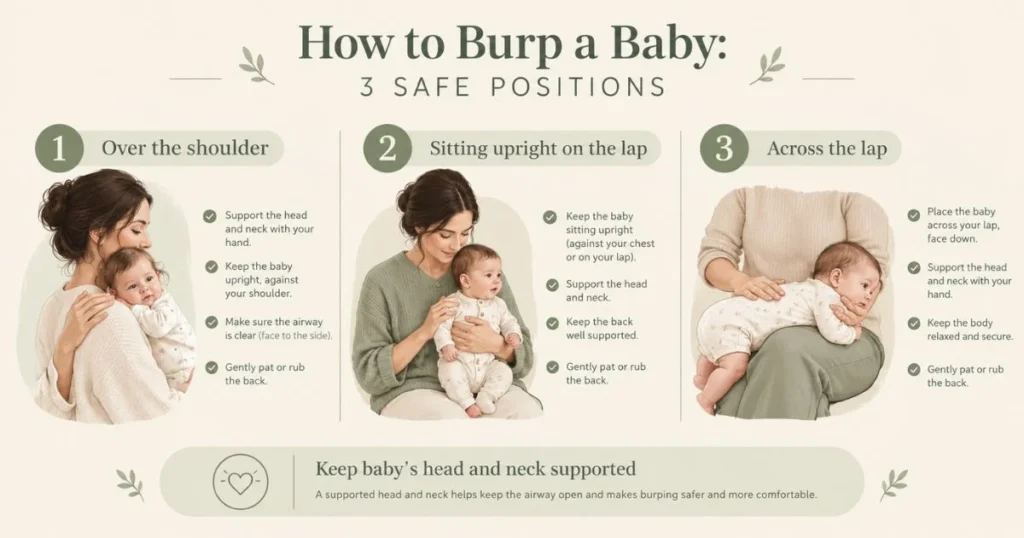
Whichever position you choose, remember the basics:
- Support your baby’s head and neck.
- Keep your baby’s airway clear.
- Keep their tummy and back comfortably supported.
- Use gentle rubbing or patting rather than hard tapping.
- Never press on your baby’s throat.
The NHS recommends three commonly used positions for how to burp a baby: holding your baby over your shoulder, sitting them upright on your lap, or placing them across your lap.
1. Over-the-Shoulder Burping
This is probably the position most parents picture when they think about how to burp a baby, especially a newborn.
How to do it:
- Hold your baby upright against your chest.
- Keep one hand supporting your baby’s head and upper body.
- With your other hand, gently pat or rub their back.
- Continue for a few minutes, or stop sooner if your baby appears comfortable.
If you feel steady and comfortable doing so, you can slowly walk while holding your baby. The gentle movement may help some babies relax.
Keep your baby’s face clear and ensure their head and neck are properly supported at all times.
Don’t be discouraged if you don’t hear a burp immediately. Your baby may simply not need to burp, and how to burp a baby isn’t about getting a burp every single time.
2. Sitting on Your Lap
This position gives you a little more control over your baby’s posture and can work well when the shoulder position isn’t comfortable for either oSitting on Your Lap
If you’re learning how to burp a baby while keeping your baby upright, the sitting-on-your-lap position is another gentle option.
How to do it:
- Sit your baby upright on your lap with their back facing you.
- Support your baby’s chest with one hand while gently holding their chin and jaw.
- Keep your hand away from the throat.
- Lean your baby slightly forward.
- Use your free hand to gently pat or rub your baby’s back.
Your baby’s head should remain supported rather than being allowed to flop forward.
The goal isn’t to bend your baby tightly over your hand. Keep the position gentle and comfortable while maintaining good head and neck support.
3. Lying Across Your Lap
Some babies respond well to this position because it gives you a stable way to support their body while gently working on the back. When learning how to burp a baby, this can be another option to try while your baby is awake and supervised.
How to do it:
- Place your baby face down across your lap.
- Keep their head supported and positioned higher than their chest.
- Ensure that you are not putting any pressure on your baby’s throat.
- Gently rub or pat their back.
- Continue for a short time and stop if your baby becomes distressed.
Always keep a close eye on your baby’s face and breathing.
This position should only be used for burping while your baby is awake and supervised—not as a sleeping position.
What If Your Baby Doesn’t Burp?
This is one of the most common worries for new parents when learning how to burp a baby.
You try one position. Nothing happens.
You switch positions. Still nothing.
You gently pat your baby’s back for another minute, but they still do not burp.
That’s okay.
Not every baby burps every time. The AAP specifically notes that it isn’t harmful if a baby doesn’t burp.
If your baby seems comfortable, you can simply stop trying. How to burp a baby isn’t about getting a burp after every feed.
If your baby still appears uncomfortable, you can:
- Change their position
- Hold them upright for a little while
- Try another gentle burping position
- Give them a short break before continuing the feed
- Try gentle tummy massage when appropriate
- Move their legs slowly in a bicycle motion
Avoid shaking, bouncing forcefully, or vigorously patting your baby’s back.
If your baby repeatedly seems uncomfortable during feeds or has ongoing feeding difficulties, talk with your baby’s healthcare professional rather than assuming gas is always the explanation.
“If your baby regularly brings up milk after feeding, it can help to understand the difference between ordinary spit-up and newborn baby vomiting after feeding.”
What If Your Baby Spits Up While Burping?
Don’t be surprised if a little milk comes up while you’re learning how to burp a baby.
A small amount of milk coming out with a burp is common during infancy. The NHS recommends keeping a burp cloth or muslin square nearby because babies may bring up some milk while being burped.
This is usually called spit-up rather than vomiting.
Spit-up generally flows easily from the mouth and may happen alongside a burp. Vomiting is different: it is usually more forceful and involves stronger contractions.
What should you do if your baby spits up?
Stay calm and gently clean your baby after feeding. Knowing how to burp a baby can help, but you don’t need to rush or use force if a little milk comes up.
You can keep your baby upright while they’re awake and supervised. Avoid immediately bouncing them, pressing on their tummy, or engaging in active play after feeding.
And remember an important safe-sleep point: even babies who spit up should be placed on their backs on a firm, flat sleep surface. Raising the mattress or putting a baby to sleep on their stomach is not a safe solution for ordinary spit-up.
How to Help a Gassy Baby After Burping
Sometimes your baby may still seem uncomfortable even after you’ve tried how to burp a baby techniques.
If your baby is awake and you’re supervising them, gentle movement may help them relax.
Try gentle tummy massage
As part of learning how to burp a baby, you can also try gentle tummy massage if your baby still seems uncomfortable.
Place your baby on their back and gently massage their tummy with soft, slow movements.
Avoid applying firm pressure. Your baby’s abdomen is delicate, so the aim is to encourage relaxation rather than force gas to pass.
Try bicycle legs
As you learn how to burp a baby, gentle movement can be another option if your baby still seems gassy after feeding.
With your baby lying on their back, gently move their legs in an alternating motion, similar to pedaling a bicycle.
This can be a simple way to encourage movement when your baby seems uncomfortable from gas.
The NHS recommends gentle tummy massage and bicycle-leg movements when a baby continues to show signs of trapped wind after ordinary burping techniques haven’t worked.
If your baby becomes upset, stop. You don’t need to keep trying different techniques when your baby is clearly telling you they’ve had enough.
Burping Breastfed vs. Bottle-Fed Babies
The basic principles are the same for both feeding methods, but the amount of swallowed air can vary.
| Breastfed babies | Bottle-fed babies |
| Some babies swallow very little air | Some babies may swallow more air while drinking |
| Try burping when switching breasts or if baby becomes uncomfortable | A burping break may help during the feed |
| Some babies rarely burp | Some babies may benefit from more regular burping breaks |
| Pay Attention to Your Baby’s Cues Instead of Forcing a Burp | Pause if your baby seems uncomfortable or is gulping |
When learning how to burp a baby, it’s important to remember that feeding method can affect how often your baby needs to burp.
The AAP notes that some breastfed babies may not need to burp, while practical bottle-feeding guidance often recommends burping after a few ounces.
Neither feeding method means you have to produce a burp after every single feed.
Common Burping Mistakes to Avoid
Learning how to burp a baby is usually simple, but new parents can easily feel that they need to do more.
Here are some common mistakes to avoid.
Trying too hard to produce a burp
A burp doesn’t have to happen every time.
If your baby is comfortable, stop after a short attempt.
Patting too firmly
More force does not mean a better burp.
Use gentle pats or rubs. Your baby doesn’t need vigorous pounding on the back.
Forgetting head and neck support
Young babies don’t yet have the head and neck control needed to support themselves.
Always keep their head and neck supported during burping.
Pressing against the throat
When using the sitting position, support your baby’s chest, chin, and jaw without putting pressure on the throat.
Interrupting a comfortable feed unnecessarily
If your baby is feeding calmly, you don’t always need to stop just because you think they should burp.
Watch your baby instead.
Treating every cry as trapped gas
Crying doesn’t automatically mean your baby needs to burp.
Hunger, tiredness, overheating, a wet diaper, overstimulation, and many other things can make babies fussy.
Burping is one possible tool—not an explanation for every episode of crying.
When Should You Call Your Baby’s Doctor?
Learning how to burp a baby can help with ordinary feeding discomfort, but burping isn’t the answer to every feeding-related problem.
Most ordinary burping and small amounts of spit-up aren’t reasons for concern.
However, some symptoms deserve medical attention.
Contact your baby’s healthcare professional if your baby:
- Repeatedly vomits forcefully or projectile-vomits
- Has blood in their vomit
- Has green or yellow-green vomit
- Struggles to feed
- Isn’t gaining weight as expected
- Shows signs of dehydration
- Has breathing difficulties
- Becomes unusually sleepy, weak, or difficult to wake
- Continues to have significant feeding-related discomfort
Forceful vomiting, blood in vomit, feeding problems, and poor weight gain can require medical evaluation rather than simply trying different ways to burp your baby.
If you’re worried that something isn’t right with your baby, trust your instincts and seek professional advice.
Frequently Asked Questions
How to burp a baby correctly?
When learning how to burp a baby, keep your baby upright while supporting their head and neck, then gently pat or rub their back. You can use an over-the-shoulder, seated-on-your-lap, or across-the-lap position. If your baby remains comfortable, there is no need to force a burp.
How long should you burp a baby?
A couple of minutes is usually enough. If your baby doesn’t burp after a short attempt and seems comfortable, you can stop.
How do you burp a newborn?
When learning how to burp a baby, keep your newborn’s head and neck well supported, hold them in a comfortable upright or supported position, and gently pat or rub their back. Avoid putting pressure on the throat, and never shake or handle your baby roughly.
Do breastfed babies need to burp?
Not necessarily. Some breastfed babies swallow very little air while feeding, so they may not need to burp at all. When learning how to burp a baby, you can try burping when you switch from one breast to the other or whenever your baby seems uncomfortable during or after a feed.
What if my newborn won’t burp?
Don’t panic. Your baby doesn’t have to burp after every feeding. Try another position briefly, but stop if your baby appears comfortable. If your baby remains persistently uncomfortable during feeds, discuss it with their healthcare professional.
Can you burp a sleeping baby?
If your baby falls asleep after feeding, there is no need to keep trying to make them burp. Handle your baby gently and prioritize safe sleep afterward: place them on their back on a firm, flat sleep surface.
“Once feeding is finished, remember that safe sleep means placing your baby on their back on a firm, flat sleep surface, without adding loose bedding such as a blanket; see when can a baby sleep with a blanket for more guidance.”
The Bottom Line
Learning how to burp a baby doesn’t need to add more stress to those already demanding newborn days.
Keep things simple: support your baby’s head and neck, choose a comfortable position, and gently pat or rub their back. You can try burping during a feed if your baby seems unsettled, or wait until the feeding is finished if that feels more comfortable.
Most importantly, remember that not every baby burps after every feed.
If your baby finishes eating calmly without burping, there’s no reason to assume you’ve done something wrong. Some babies simply don’t need to release much swallowed air.
Keep a burp cloth close by, pay attention to your baby’s cues, and give yourself time to learn what works for them. You don’t need to force a burp. With experience, you’ll become more familiar with the difference between a baby who needs help releasing air and one who simply wants to be held, cuddled, and allowed to settle.