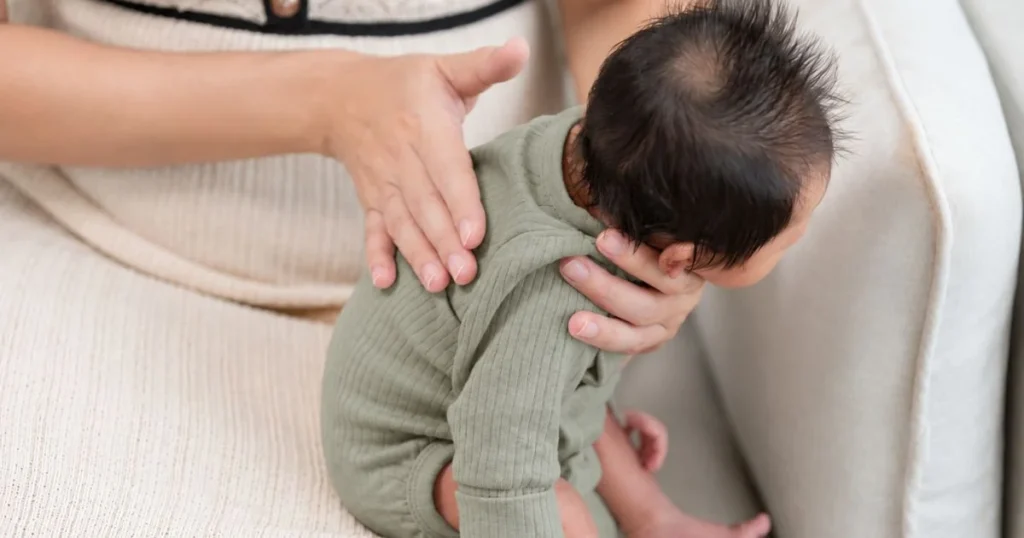
You have just finished feeding your baby, and now you are waiting for that little burp.
You hold your baby upright, gently rub their back, and wait. Nothing happens.
So you start wondering: When do you stop burping a baby? Do you really need to keep trying after every feed? What if your baby falls asleep without burping? And is there a certain age when you can simply stop?
The good news is that you do not have to follow a strict birthday or month to stop burping your baby. If you are wondering when do you stop burping a baby, there is no universal age when every baby suddenly stops needing help. Some babies need frequent burping when they are young, while others rarely burp and remain perfectly comfortable.
The American Academy of Pediatrics (AAP) notes that burping is optional and that some babies do not need to burp. NHS guidance also says there are no fixed rules about when a baby should be burped. Instead, you can pay attention to your baby’s comfort and feeding cues.
When Do You Stop Burping a Baby?
There is no exact age when you have to stop burping a baby. If you’re wondering when do you stop burping a baby, the answer depends more on your baby’s individual needs than on a specific age.
As your baby grows, you may notice that they naturally need less help releasing swallowed air. You might find that your baby stops getting fussy during feeds, rarely produces a burp when you try, or simply settles comfortably without one.
Those changes are more useful than an arbitrary age cutoff.
There Is No Universal Burping Deadline
You may hear advice such as “stop burping at 3 months” or “you can stop at 6 months.” Treat these statements cautiously.
Babies develop at different rates, and their feeding patterns are different too. One baby may still appreciate a burping break while another baby the same age may have no trouble without one.
Rather than asking only, “When do you stop burping a baby?”, ask:
- Does my baby seem comfortable after feeding?
- Does my baby become fussy or squirmy?
- Does my baby regularly need help releasing gas?
- Does my baby settle normally after eating?
- Does my baby feed well and continue to grow normally?
If your baby is comfortable, you do not need to keep trying to produce a burp simply because you think one must be there.
When Do Babies Usually Need Less Help?
Babies gradually become more independent with feeding as they grow. This is one reason when do you stop burping a baby is not determined by a specific age or milestone.
You may notice changes such as:
- better control of their head and upper body
- more coordinated feeding
- fewer interruptions during feeds
- less fussiness after eating
- less obvious discomfort from swallowed air
- greater ability to release gas without your help
These changes happen gradually rather than on one specific day.
Is 3 Months Too Early to Stop Burping?
Not necessarily.
Some babies around this age may already need much less help, while others may still become uncomfortable if they swallow air during a feed.
If your 3-month-old consistently finishes feeds comfortably and does not seem bothered when you skip a burping attempt, you may not need to make burping a strict part of every feed. When you stop burping a baby can depend on how comfortably your baby feeds and settles rather than simply reaching 3 months.
Do You Need to Stop Burping at 6 Months?
By around 6 months, some babies may need much less routine burping than they did as newborns. This is why parents often ask when do you stop burping a baby as their baby’s feeding becomes more independent.
However, 6 months should not be treated as a universal stopping point. Your baby’s individual feeding behavior still matters more than the number on the calendar.
How Do You Know Your Baby Is Ready to Stop Burping?
Instead of looking for one specific age, ask when do you stop burping a baby based on patterns in your baby’s behavior and how comfortably they feed and settle.
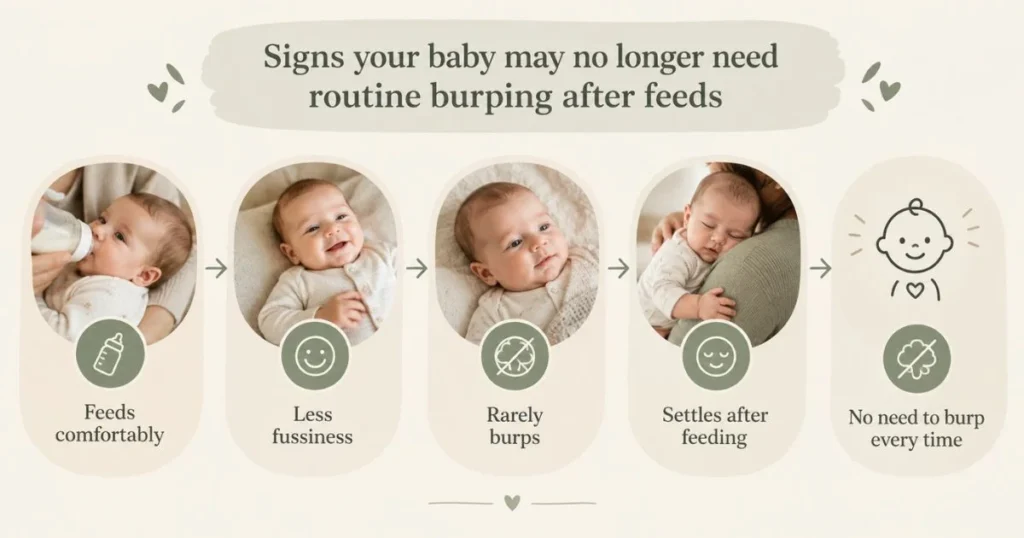
Your Baby Stays Comfortable After Feeding
This is one of the most useful signs to consider when deciding when to stop burping your baby.
After feeding, your baby may simply:
- relax
- look content
- settle normally
- stop fussing
- show no obvious signs of trapped gas
If your baby is comfortable without producing a burp, there may be no reason to keep trying.
Your Baby Rarely Burps When You Try
You may notice that you spend a minute or two gently rubbing your baby’s back and nothing happens.
That does not necessarily mean you have done something wrong. In fact, when do you stop burping a baby can sometimes be answered simply by noticing that your baby does not need to burp after a short attempt.
The AAP states that not every baby burps every time. Its symptom guidance also says burping is optional and that it can be stopped if a baby does not burp after a short attempt.
Your Baby Stops Getting Fussy During Feeds
Young babies can become uncomfortable when they swallow air. If your baby used to need frequent burping breaks but now feeds calmly, that may be a sign that routine burping is becoming less important and that when do you stop burping a baby may depend on your baby’s changing feeding needs.
Your Baby Can Feed Without Frequent Breaks
You may also notice that your baby no longer needs to pause frequently during feeding. These changes can help you understand when to stop burping your baby and whether your baby still benefits from regular burping breaks.
For bottle-fed babies, NHS guidance recommends watching for cues such as stopping sucking, turning away, spilling milk, or pushing the bottle away rather than forcing the feed to continue.
Your Baby Releases Gas Naturally
A burp does not have to come out every time you feed your baby.
Some swallowed air can pass naturally, and some babies simply do not swallow much air during a particular feed. This is important to remember when considering when do you stop burping a baby, because not every feeding requires a burping attempt.
The goal is not to hear a burp after every meal. The goal is a comfortable, well-fed baby.
How to Stop Burping Your Baby Gradually
If you are wondering when do you stop burping a baby and how to move away from routine burping, you do not have to stop suddenly.
Try a gradual approach.
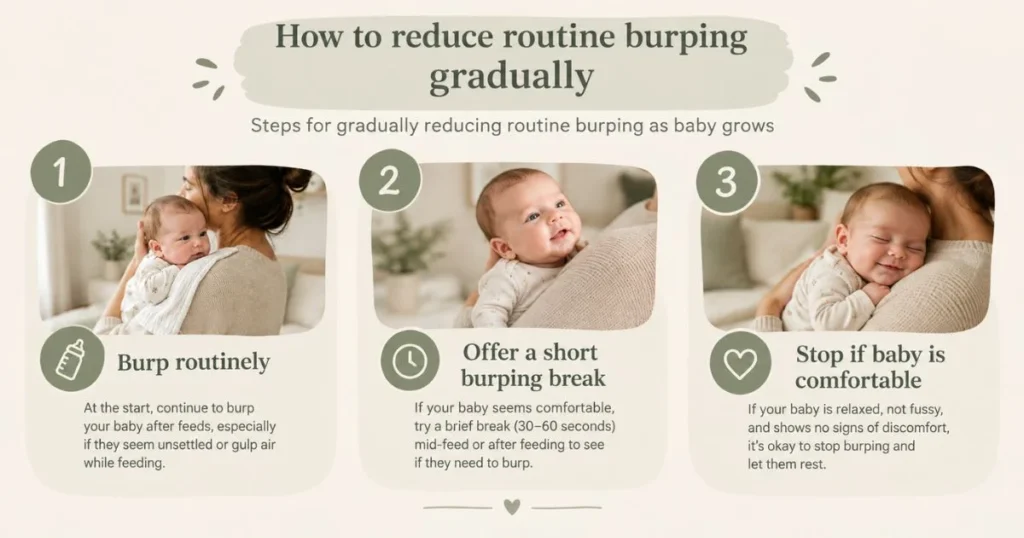
Step 1: Stop Treating Every Feed as a Burping Requirement
Instead of automatically thinking, “My baby has finished eating, so I must get a burp,” observe your baby first. This can help you recognize when to stop burping your baby based on their comfort rather than following a fixed routine.
If your baby seems relaxed, you can give them a brief opportunity to burp without turning it into a long routine.
Step 2: Give Your Baby a Short Opportunity to Burp
After feeding, if you are wondering when do you stop burping a baby, you can follow a simple routine:
- Hold your baby upright.
- Support your baby’s head and neck appropriately.
- Gently rub or pat their back.
- Give them a short opportunity to release air.
- Stop if they remain comfortable.
NHS guidance says you do not need to spend a long time burping your baby; a couple of minutes should be enough.
Step 3: Gradually Reduce Routine Burping
You might begin by skipping a burping attempt after feeds when your baby is clearly comfortable. This can help you recognize when do you stop burping a baby based on your baby’s behavior rather than a specific age.
If things are going smoothly, you may eventually find that your baby no longer needs to be burped after every feeding.
Step 4: Watch What Happens
Your baby’s response will tell you whether the change is working. Paying attention to these cues can help you decide when to stop burping your baby and when to continue offering a burping break.
If your baby remains calm and comfortable, you can continue with less routine burping.
If your baby becomes noticeably uncomfortable, you can simply offer another burping break.
You don’t have to make the change all at once or treat it as an all-or-nothing decision.
Should You Still Burp Your Baby Sometimes?
Yes.
Stopping routine burping does not mean you can never burp your baby again. Even after you’ve decided when do you stop burping a baby, you can still offer a burping break when your baby seems to need one.
There may be feeds when your baby swallows more air than usual or becomes uncomfortable afterward.
If Your Baby Seems Uncomfortable
Possible signs of trapped wind can include:
- crying
- fussiness
- squirming
- arching the back
- drawing the legs toward the tummy
- clenched fists
NHS guidance lists these as possible signs of trapped wind and suggests trying gentle burping techniques and, when appropriate, gentle tummy massage or bicycle-leg movements. These signs can also help you decide when to stop burping your baby and when your baby may benefit from another short burping attempt.
Keep in mind that these behaviors do not prove that gas is the cause. Babies can become unsettled for many different reasons.
If Your Baby Swallows More Air Than Usual
A particularly fast or unsettled feed may lead to more swallowed air.
If your baby becomes uncomfortable, a short pause and burping attempt may help. In these situations, knowing when to stop burping your baby can help you avoid turning a brief burping break into a long routine.
During Bottle Feeding
Some babies may swallow more air while bottle feeding than while breastfeeding. The AAP notes that fussiness associated with swallowed air can occur with both feeding methods but is more common with bottle feeding. Understanding when to stop burping your baby can be especially helpful if your baby tends to swallow more air during bottle feeds.
During Breastfeeding
Some breastfed babies swallow very little air and may not need to burp after every feed. This can make it easier to recognize when to stop burping your baby based on their comfort and feeding behavior.
The AAP specifically notes that some breastfed babies may not need to burp.
When Do You Stop Burping a Breastfed Baby?
Breastfeeding parents often wonder when to stop burping their baby once their baby has stopped being a newborn.
The answer depends on your baby’s individual feeding patterns, comfort, and need for help releasing swallowed air.
Do Breastfed Babies Need to Burp?
Some breastfed babies burp easily. Others rarely do.
If your baby is feeding comfortably and does not seem bothered after nursing, there is no need to force a burp. This can be a useful sign when deciding when to stop burping your baby.
Should You Burp Between Breasts?
Some parents offer a short burping break when switching breasts.
This can be useful if your baby seems uncomfortable or has swallowed air, but it does not need to become a mandatory step for every breastfeeding session. As your baby grows, you may naturally learn when to stop burping your baby based on their comfort and feeding cues.
What If Your Breastfed Baby Never Burps?
If your baby feeds well, seems comfortable, and is growing normally, not producing a burp is not automatically a concern. These signs can help you understand when to stop burping your baby without worrying that every feed must end with a burp.
The AAP’s guidance emphasizes that some breastfed babies do not need to burp.
When Do You Stop Burping a Bottle-Fed Baby?
Bottle-fed babies may have different burping needs because they can swallow air while drinking. Paying attention to your baby’s comfort can help you determine when to stop burping your baby and whether they still benefit from a short burping break after feeds.
Why Might Bottle-Fed Babies Swallow More Air?
The AAP notes that swallowed-air fussiness occurs in both breastfed and bottle-fed babies but is seen more often with bottle feeding.
How your baby feeds matters too. A baby who drinks very quickly may behave differently from one who takes frequent pauses, so recognizing when to stop burping your baby should be based on your baby’s comfort and feeding pattern rather than a fixed rule.
Does Every Bottle Feed Need a Burp?
Not necessarily.
NHS guidance says there are no fixed rules about when to burp. Some babies need to burp during a bottle, while others may burp afterward.
You can use your baby’s behavior as your guide when deciding when to stop burping your baby and whether another short burping break is needed.
Watch for Feeding Break Cues
During a bottle feed, your baby may benefit from a short pause if they:
- stop sucking
- turn their head away
- push the bottle away
- spill milk
- become fussy
- splay their fingers or toes
The NHS recommends responding to your baby’s individual cues instead of encouraging them to keep feeding when they have had enough. These cues can also help you decide when to stop burping your baby and when a short pause may be useful.
What If Your Baby Doesn’t Burp?
This is a common concern among new parents.
You may spend several minutes trying different positions, only to hear nothing.
That is usually not a reason to panic. Knowing when to stop burping your baby can be as simple as recognizing that your baby remains comfortable even without producing a burp.
Don’t Keep Trying Indefinitely
You do not need to keep patting your baby’s back until you hear a burp.
If you are wondering when do you stop burping a baby, the AAP guidance says burping is optional and that if a baby does not burp after a short attempt, you can stop.
Keep Your Baby Comfortable
If your baby is relaxed, breathing normally, and otherwise comfortable, you can simply move on from the burping attempt. If you’re wondering when do you stop burping a baby, this kind of calm response is a useful sign that your baby may no longer need routine burping after every feed.
Try Another Position If Your Baby Seems Gassy
If your baby is clearly uncomfortable, you can try another gentle burping position. Knowing when do you stop burping a baby also means recognizing when your baby may still need help releasing swallowed air.
For detailed instructions on different burping positions, see:
How to Burp a Baby: Step-by-Step Guide for Parents
Try Gentle Movement for Trapped Wind
If your baby appears to have trapped wind and burping does not help, NHS guidance suggests gentle tummy massage and moving the legs back and forth in a bicycle motion.
If you’re wondering when do you stop burping a baby, increased distress is a good reason to stop the attempt rather than continuing to burp. Speak with your healthcare professional if your baby’s discomfort continues.
If your baby continues to seem uncomfortable after feeding, you may also want to learn about how to stop baby hiccups after feeding.
Do You Need to Burp a Sleeping Baby?
This is especially important during nighttime feeds, when knowing when do you stop burping a baby can help you avoid unnecessary stimulation and keep the feeding routine calm.
What to Do If Your Baby Falls Asleep While Feeding?
You may be tempted to wake your baby simply because you have not heard a burp.
But a missing burp does not automatically mean your baby needs to be awakened. If you’re wondering when do you stop burping a baby, your baby’s comfort after feeding is more useful than waiting for a burp every time.
If your baby is comfortable and has finished feeding, there may be no reason to spend a long time trying to produce a burp.
What If Your Baby Falls Asleep Without Burping?
You do not need to panic.
AAP guidance states that burping is optional and that it is not harmful if a baby does not burp. This is helpful to remember when deciding when do you stop burping a baby, especially if your baby remains comfortable after feeding.
If you are also trying to understand your baby’s sleep patterns, our guide to baby wake windows by age can help.
Safe Sleep Still Comes First
Once you put your baby down to sleep, follow safe-sleep recommendations. If you’re wondering when do you stop burping a baby, remember that you should not change your baby’s safe sleep position simply because they did not burp.
The AAP advises putting babies to sleep on their backs on a firm, flat sleep surface. Even babies who spit up should not be placed on their side or stomach or on an inclined sleep surface.
Do not prop your baby up with pillows or raise the mattress to try to prevent spit-up.
Does Stopping Burping Cause More Spit-Up?
You may worry that skipping a burp will automatically cause your baby to spit up more.
It is not that simple. When considering when do you stop burping a baby, your baby’s comfort and feeding behavior are more useful guides than assuming every missed burp will lead to spit-up.
Burping and Spit-Up Are Different
Burping releases swallowed air.
Spit-up is the effortless return of some stomach contents into the mouth. Understanding this difference can help when deciding when do you stop burping a baby, because a baby does not necessarily need to burp simply because they sometimes spit up.
Babies commonly spit up during infancy, and it does not necessarily mean that something is wrong.
If you are unsure whether your baby is experiencing normal spit-up or something more concerning, learn more about newborn baby vomiting milk after feeding.
Can Burping Reduce Spit-Up?
Burping may help some babies, particularly when swallowed air contributes to discomfort.
However, it is not a guarantee that your baby will stop spitting up. If you’re considering when do you stop burping a baby, remember that burping can be helpful for some babies without being necessary after every feeding.
AAP guidance notes that burping can help with spit-up, but its symptom guidance also emphasizes that burping is optional.
When Spit-Up Is Usually Not Concerning
Small amounts of milk coming back up during or shortly after a feed are common in young babies.
If your baby:
- feeds well
- seems comfortable
- continues gaining weight
- has normal wet diapers
- is otherwise acting normally
occasional spit-up is usually not a reason to assume your baby needs more burping. When deciding when do you stop burping a baby, these signs of overall comfort and well-being are more important than whether your baby spits up occasionally.
NHS notes that reflux is very common in babies and usually improves as they get older.
Burping vs. Vomiting: What Parents Should Know
It helps to know the difference between ordinary spit-up and vomiting.
| Feature | Spit-up | Vomiting |
| How it comes out | Usually flows or dribbles out easily | Usually more forceful |
| Effort | Often little effort | May involve stronger contractions |
| Common in babies | Very common | Has many possible causes |
| What matters most | Baby’s overall health and growth | Force, frequency, color, and other symptoms |
A forceful or projectile episode is different from ordinary spit-up and deserves more attention, especially if it repeats.
Common Mistakes When Stopping Burping
You do not have to make burping complicated. Knowing when do you stop burping a baby can be as simple as paying attention to your baby’s comfort and stopping when they no longer seem to need help.
Using a Strict Age Cutoff
Your baby does not have to stop burping on a particular birthday. If you’re wondering when do you stop burping a baby, focus on your baby’s feeding cues, comfort, and ability to settle rather than a specific age.
Forcing a Burp
A burp cannot always be produced on demand.
If your baby is comfortable, continuing to pat their back for a long time is unnecessary. This is an important part of understanding when do you stop burping a baby: once your baby remains calm and comfortable after a brief attempt, you can stop.
Patting Too Hard
Burping should always be gentle and comfortable for your baby.
Support your baby’s head and neck securely, and avoid putting pressure on their throat. If your baby remains comfortable without producing a burp, you can stop rather than continuing for a long time. This can help you recognize when do you stop burping a baby based on your baby’s comfort and cues.
Assuming Every Cry Means Gas
Crying can happen for many reasons, including hunger, tiredness, overstimulation, discomfort, or needing a diaper change.
Not every unsettled moment means your baby needs to burp. When considering when do you stop burping a baby, look at the bigger picture, including your baby’s feeding cues, body language, and overall comfort, rather than assuming that fussiness always means trapped air.
Ignoring Feeding Technique
How your baby feeds can affect how much air they swallow during a feed.
For bottle feeding, NHS guidance recommends keeping the bottle roughly horizontal and responding to your baby’s feeding cues rather than encouraging them to finish the entire bottle. Paying attention to these cues can also help you understand when do you stop burping a baby and when your baby may simply need a pause rather than another burping attempt.
When to Call Your Baby’s Doctor
Burping is a normal part of feeding, but ongoing feeding problems should not automatically be blamed on trapped gas. If you are wondering when do you stop burping a baby, remember that persistent symptoms may need attention beyond burping.
Speak with your baby’s healthcare professional if you are concerned about:
- repeated or forceful vomiting
- difficulty keeping feeds down
- poor weight gain
- significant feeding difficulties
- persistent distress during or after feeds
- signs of dehydration
- breathing problems
- symptoms that are becoming worse
NHS guidance recommends medical evaluation for concerning reflux symptoms, including poor weight gain and projectile vomiting. AAP information also notes that more significant reflux-related problems may be associated with feeding difficulties, respiratory symptoms, and poor weight gain.
Don’t Assume Everything Is “Just Gas”
If your baby is consistently uncomfortable, it is better to look at the bigger picture rather than simply trying to burp more often. When considering when do you stop burping a baby, your baby’s overall comfort and feeding pattern are more useful guides than repeatedly attempting to produce a burp.
Your healthcare professional can help determine whether feeding technique, reflux, an illness, or another issue may be contributing to your baby’s symptoms.
When Do You Stop Burping a Baby? Quick Guide by Age
The following table is a general guide, not a strict developmental schedule.
| Baby’s stage | What you may notice | What you can do |
| Newborn | May swallow air easily and become uncomfortable during feeds | Offer burping opportunities |
| 1–3 months | Burping needs can still vary considerably | Follow your baby’s comfort cues |
| 3–6 months | Some babies begin needing less routine burping | Gradually reduce unnecessary burping attempts |
| Around 6 months and beyond | Many babies may need less help | Burp when your baby appears to need it |
| Older infant | Routine burping may become unnecessary | Focus on feeding comfort rather than a schedule |
There is no evidence-based rule that says every baby must stop burping at one particular age. AAP and NHS guidance both emphasize individual variation and following your baby’s cues.
Your baby’s overall feeding pattern can also be helpful when following a baby feeding schedule by age.
As your baby’s feeding needs change, you may also find our baby feeding chart by age helpful.
Breastfed vs. Bottle-Fed Babies: Does Burping Differ?
| Feeding type | What may happen | What to remember |
| Breastfeeding | Some babies swallow little air | Your baby may not need to burp every time |
| Bottle feeding | Some babies may swallow more air | Offer a break if your baby becomes uncomfortable |
| Mixed feeding | Needs may vary from feed to feed | Watch how your baby responds |
The AAP notes that swallowed-air fussiness can occur with both breastfeeding and bottle feeding, although it is seen more often with bottle feeding.
Frequently Asked Questions
When do you stop burping a baby?
There is no single age when you have to stop burping your baby. If you’re wondering when do you stop burping a baby, you can gradually reduce routine burping when your baby consistently feeds well, remains comfortable, and settles without needing help.
When do you stop burping a baby after breastfeeding?
You can gradually stop routine burping when your breastfed baby consistently remains comfortable after feeds. Some breastfed babies naturally swallow very little air and may need little or no burping. If you’re wondering when do you stop burping a baby, your baby’s comfort after feeding is a more useful guide than a specific age.
When do you stop burping a baby after bottle feeding?
There is no fixed age when every bottle-fed baby should stop burping. If you’re wondering when do you stop burping a baby, you can gradually reduce routine burping as your baby becomes more comfortable feeding without it. Some bottle-fed babies may still benefit from an occasional burping break, particularly if they swallow more air or become uncomfortable during feeds.
Can I stop burping my baby at 3 months?
You can consider reducing routine burping if your 3-month-old consistently remains comfortable after feeds without it. If you’re wondering when do you stop burping a baby, remember that age alone should not determine when you stop. Your baby’s feeding patterns, comfort, and need for help releasing swallowed air are more useful guides.
Do you need to burp a 6-month-old?
Not necessarily. Many babies need less routine burping as they get older, but some may still benefit from an occasional burping break. If you’re wondering when do you stop burping a baby, focus on how comfortably your baby feeds and settles rather than assuming there is a specific age when burping must stop.
“As your baby becomes more independent with feeding, you can also follow their changing baby feeding schedule.”
What happens if you don’t burp your baby?
Nothing necessarily happens if your baby does not burp. A comfortable baby does not have to produce a burp after every feed. If you’re wondering when do you stop burping a baby, it can be reassuring to know that AAP guidance considers burping optional and states that it is not harmful if a baby does not burp.
Should I wake my baby if they fall asleep without burping?
If your baby is comfortable and has finished feeding, you do not necessarily need to wake them simply to produce a burp. If you’re wondering when do you stop burping a baby, your baby’s comfort is a more useful guide than waiting for a burp every time. When it is time to put your baby down to sleep, follow safe-sleep recommendations and place them on their back on a firm, flat sleep surface.
How do I know if my baby still needs to burp?
Watch for possible signs of discomfort, such as fussiness, squirming, arching the back, or drawing the legs toward the tummy. These behaviors can have many different causes, so consider your baby’s overall feeding pattern and comfort rather than assuming trapped gas is always responsible. If you’re wondering when do you stop burping a baby, these cues can help you decide whether your baby may need another brief burping attempt or whether it is better to stop.
Is it bad if my baby never burps?
Not necessarily. Some babies simply do not burp after every feed, while others may rarely need help releasing swallowed air. If you’re wondering when do you stop burping a baby, a missing burp by itself is usually not a concern when your baby feeds comfortably, grows normally, and has no other concerning symptoms.
Conclusion: You Don’t Have to Follow a Burping Deadline
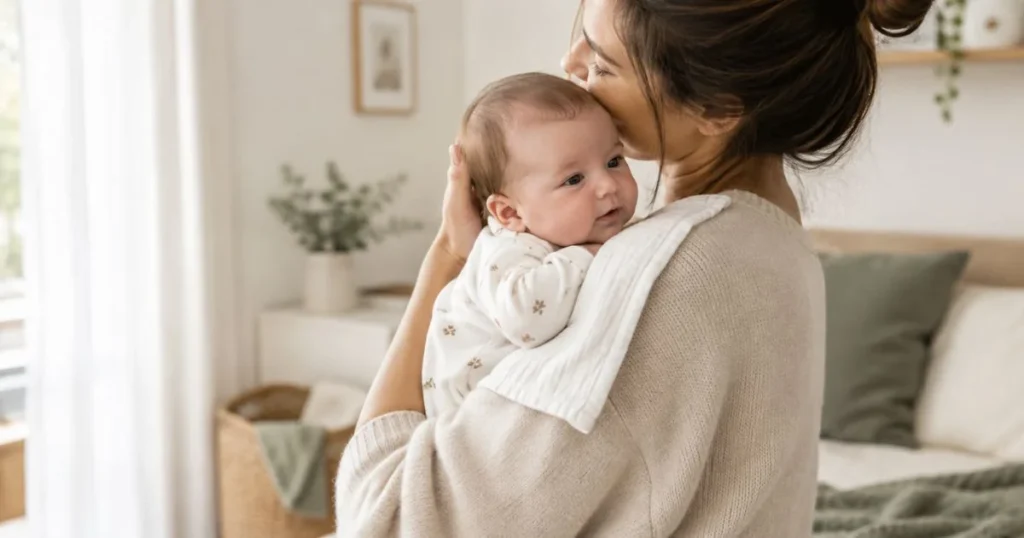
So, when do you stop burping a baby?
There is no single age that works for every baby.
Instead of watching the calendar, watch your baby. As your baby grows, you may notice that they need fewer burping breaks, rarely burp when you try, and settle comfortably after feeding without your help. When this happens, you can gradually reduce routine burping rather than trying to force a burp after every feed.
And if your baby occasionally needs help again, that’s okay too. Burping is something you can offer when your baby seems to need it, rather than a task you must complete after every feed.
If you’re still wondering when do you stop burping a baby, your baby’s comfort, feeding behavior, and ability to settle are more useful guides than a specific age.
If your baby has persistent feeding difficulties, repeated forceful vomiting, poor weight gain, signs of dehydration, breathing problems, or significant distress, contact your baby’s healthcare professional rather than assuming the problem is simply trapped gas.
Ready to make burping easier?
If you are still figuring out the best burping positions, read our complete guide:
How to Burp a Baby: Step-by-Step Guide for Parents
It walks you through practical burping positions and what to do when your baby does not burp.