Parenting can feel like a constant balancing act. Your child may be happily playing one minute, then suddenly refuse to get dressed, argue with a sibling, or have a tantrum while you’re shopping for groceries. In those stressful moments, it’s natural to feel frustrated and wonder whether stricter discipline would make things easier.
If you’ve ever raised your voice and regretted it a few minutes later, you’re not alone.
The good news is that effective discipline doesn’t have to rely on fear, threats, or punishment. Instead, it focuses on teaching, guiding, and helping children develop self-control and responsibility. In fact, research shows that children learn best when they feel safe, respected, and connected to the adults guiding them. That’s exactly what Positive Discipline is designed to achieve.
Rather than focusing on controlling behavior through punishment, positive discipline helps you teach important life skills like responsibility, emotional regulation, empathy, and problem-solving. It encourages cooperation instead of power struggles and strengthens the relationship you share with your child.
In this guide, you’ll discover practical strategies you can use every day to encourage better behavior without yelling or harsh consequences. Whether you’re parenting a toddler testing boundaries or an older child learning independence, these techniques can help you create a calmer, more connected home.
According to the CDC Positive Parenting Tips, positive parenting helps children develop healthy emotional, social, and behavioral skills through guidance, consistency, and supportive relationships rather than fear or punishment.
What Is Positive Discipline?
Positive Discipline is a parenting approach that teaches children how to make better choices through guidance, respect, and consistent boundaries rather than punishment.
Instead of wondering, “How can I get this behavior to end?” positive discipline encourages you to ask a more meaningful question:
“What skill does my child need to build so they can respond more effectively in this situation?”
That small shift changes everything.
Children aren’t born knowing how to share, manage frustration, wait patiently, or solve conflicts. Those skills develop gradually through patient guidance, consistent practice, and positive encouragement. When you focus on teaching instead of punishing, your child learns not only what to do but also why their actions matter.
The Meaning Behind Discipline
The word discipline comes from the Latin disciplina, which originally meant teaching, instruction, and learning rather than punishment. This reminds us that the true purpose of discipline is to guide children, help them develop self-control, and teach lifelong skills—not to make them afraid of making mistakes.
Over time, many people began to associate discipline with punishment. Yet true discipline is about helping children develop self-control so they can make thoughtful decisions even when you’re not there to remind them.
Positive Discipline aims to build lifelong habits rather than temporary obedience.
The Five Core Principles of Positive Discipline
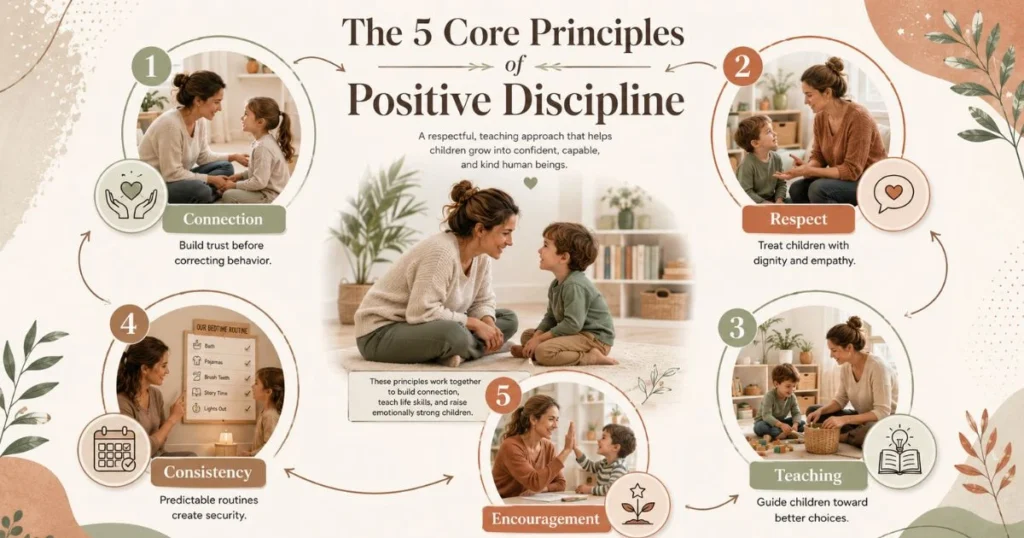
Every positive discipline approach is grounded in a set of core principles that guide how you respond to your child’s behavior.
1. Be Kind and Firm
Children need warmth and clear expectations at the same time.
Being kind doesn’t mean giving in to every request or saying “yes” all the time. Being firm doesn’t require yelling or harsh punishments.
For example:
Instead of shouting,
“Clean your room right now!”
you could say,
“Your toys need to be put away before we start our bedtime story.”
The expectation remains clear, but it is communicated with respect and understanding.
2. Focus on Long-Term Learning
Punishment often stops behavior for the moment.
Positive discipline teaches children skills they’ll use throughout life, including:
- Self-control
- Responsibility
- Respect
- Emotional awareness
- Problem-solving
These lessons take time, but they last much longer than fear-based obedience.
3. Build Mutual Respect
Children deserve respect just as adults do.
When you listen calmly, acknowledge their feelings, and speak respectfully, you show them how healthy relationships work.
Respect becomes something they experience—not just something they’re expected to give.
4. Encourage Independence
Positive discipline gives children opportunities to make choices and solve problems.
Instead of solving every problem for your child, you guide, encourage, and support them as they learn to handle challenges on their own.
For example:
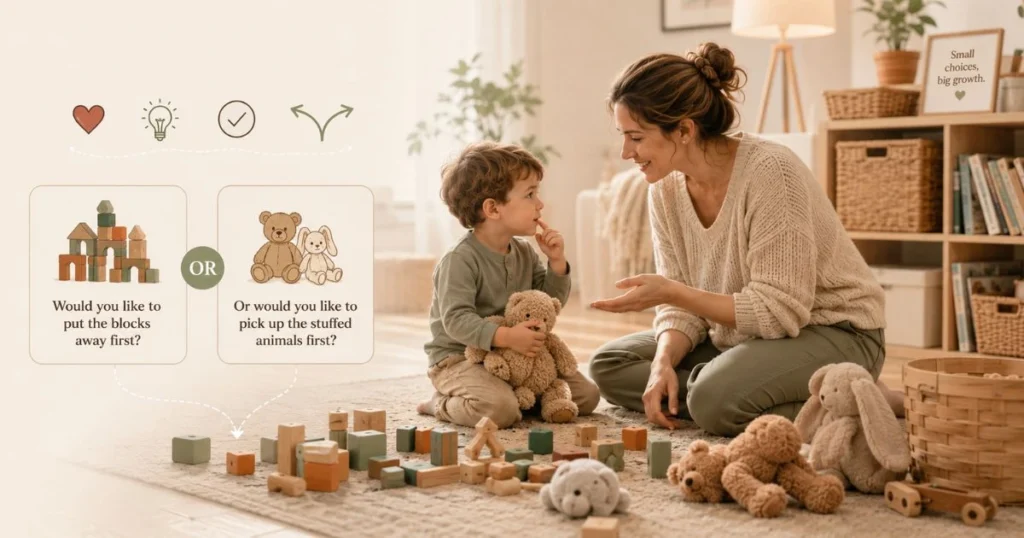
- “Would you like to brush your teeth before or after putting on your pajamas?”
- “What do you think you could do to help yourself remember your backpack tomorrow?”
Small decisions help children develop confidence and responsibility.
5. Encourage Instead of Shame
Children thrive when they believe they can improve.
Rather than saying,
“You’re always making a mess.”
Try,
“Let’s figure out how to keep your art supplies organized.”
Encouragement motivates children to keep trying, even after mistakes.
Positive Discipline vs. Punishment
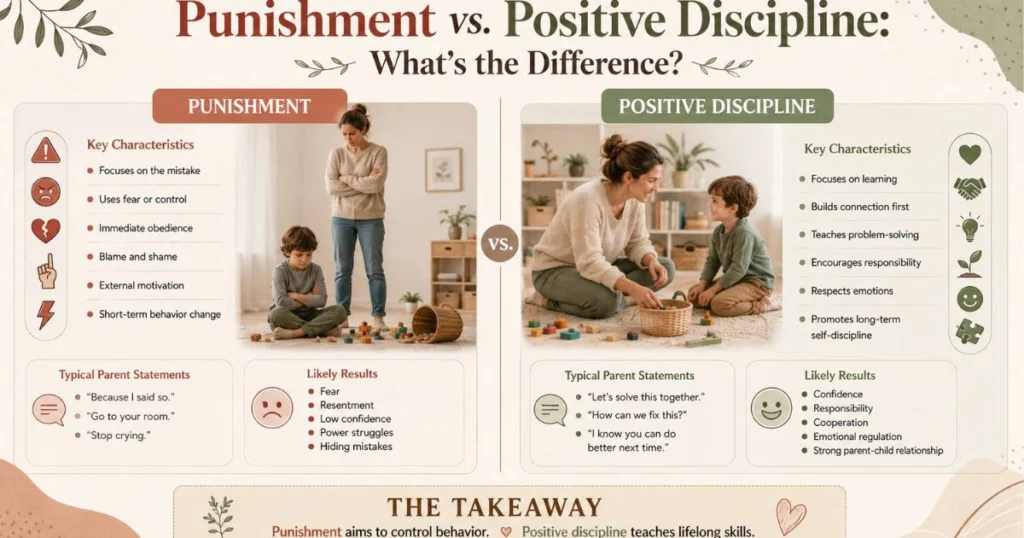
Many parents confuse these two approaches, but they have very different goals.
| Positive Discipline | Punishment |
| Teaches appropriate behavior | Stops behavior temporarily |
| Builds trust | Creates fear |
| Encourages responsibility | Encourages compliance |
| Focuses on learning | Focuses on consequences |
| Strengthens relationships | May damage relationships |
The goal isn’t to eliminate consequences. Instead, consequences become opportunities to learn rather than reasons to feel ashamed.
Why Punishment Often Doesn’t Work
Punishment may produce immediate results, but those results rarely last.
Imagine a child who hits a sibling and is immediately sent to their room.
The hitting may stop for the moment.
But has the child learned how to:
- Express anger appropriately?
- Solve conflicts peacefully?
- Calm down when frustrated?
- Repair the relationship?
Probably not.
Without teaching replacement skills, the same behavior often returns.
The American Academy of Pediatrics (HealthyChildren.org) recommends teaching children with calm, consistent discipline instead of harsh punishment because it promotes healthy development and long-term self-control.
Short-Term Obedience vs. Long-Term Growth
Children may obey because they’re afraid of punishment.
Once that fear disappears, the unwanted behavior often comes back because the underlying skill was never learned.
Positive discipline focuses on helping children understand:
- Why a behavior is harmful
- What they should do instead
- How to make better choices next time
That’s a much stronger foundation for lifelong behavior.
What Happens in a Child’s Brain?
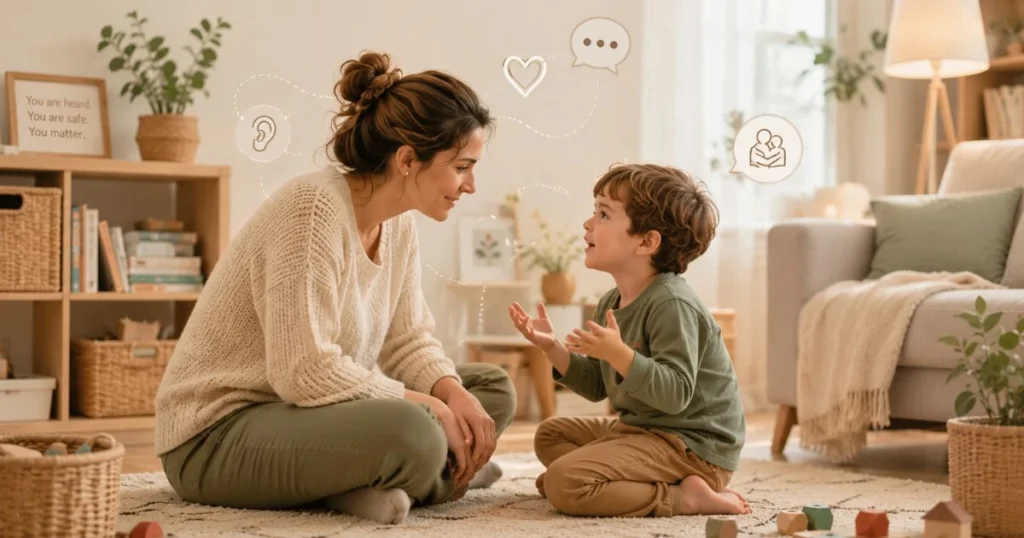
When children feel threatened or frightened, their brains shift into survival mode.
In that state, it’s harder to:
- Think clearly
- Solve problems
- Listen carefully
- Remember lessons
- Control emotions
Calm conversations activate the parts of the brain responsible for reasoning and self-control, making learning far more effective than punishment delivered in anger.
The Hidden Costs of Harsh Punishment
Frequent yelling or harsh discipline can unintentionally lead to:
- Increased anxiety
- Lower self-confidence
- More secrecy
- Greater aggression
- Weaker parent-child trust
Children may begin avoiding punishment instead of understanding why their behavior needs to change.
That’s a very different lesson.
Benefits of Positive Discipline
Positive Discipline isn’t only about reducing challenging behaviors. It also helps children build the emotional and social skills they’ll use throughout life.
Now, let’s explore some of the most valuable benefits of this approach.
Children Learn Self-Control
Rather than relying on adults to control every situation, children gradually develop the skills to regulate their own behavior and make responsible choices.
They begin asking:
- “Was that a good choice?”
- “How can I fix this?”
- “What should I do differently?”
That’s genuine self-discipline.
Stronger Parent-Child Relationships

When children know they’re safe coming to you—even after making mistakes—they’re more likely to:
- Tell the truth
- Ask for help
- Share worries
- Accept guidance
Trust becomes stronger over time.
Better Emotional Regulation
Positive discipline teaches children to identify and manage emotions instead of acting on impulse.
They gradually learn to:
- Name their feelings
- Calm themselves
- Express frustration respectfully
- Recover from disappointment
These are essential life skills that benefit them well beyond childhood.
Increased Confidence
Children who receive encouragement instead of constant criticism are often more confident about trying new experiences and learning new skills.
They understand that mistakes are part of learning, not proof that they’ve failed.
That mindset builds resilience.
More Cooperation
Ironically, children often become more cooperative when they feel respected.
Instead of constant power struggles, everyday routines become smoother because children understand expectations and feel included in the process.
Lifelong Problem-Solving Skills
Positive discipline encourages children to think instead of simply obeying.
Rather than stepping in to solve every problem, you help your child think through challenges and come up with their own solutions.
Over time, they become more independent and capable of handling challenges with confidence.
12 Proven Positive Discipline Strategies
1. Connect Before You Correct
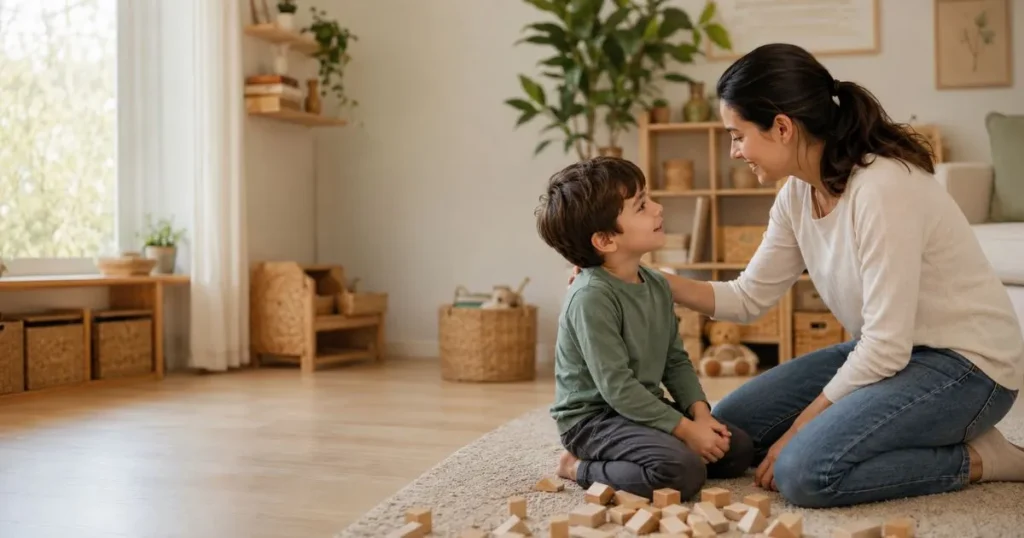
Connection is the foundation of effective discipline.
When your child feels heard and understood, they are more likely to respond positively to your guidance.
Before correcting behavior, pause and connect.
That might mean:
- Making eye contact
- Getting down to your child’s level
- Using a calm voice
- Gently placing a hand on their shoulder (if they’re comfortable with touch)
- Acknowledging their feelings before addressing the behavior
For example:
Instead of saying,
“Stop yelling!”
Try:
“I can see you’re really upset. Let’s pause for a moment, and then we’ll work through this together.”
Healthy boundaries don’t limit your child’s independence; they create a safe environment where they can explore, learn, and grow with confidence.
Why Connection Works
Connection reduces defensiveness and creates emotional safety, making children more open to learning.
2. Set Clear and Consistent Boundaries
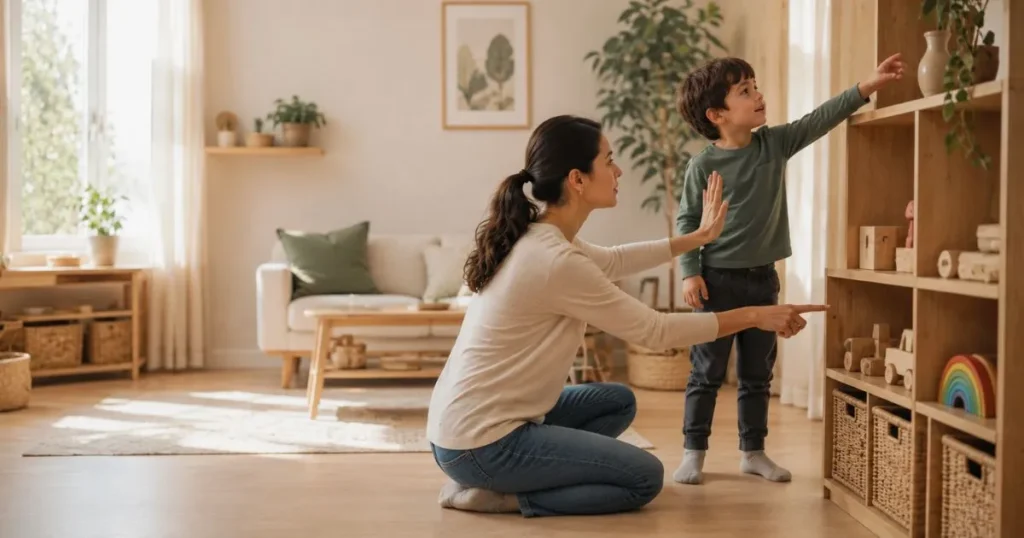
Children feel safest and most confident when they understand what to expect. While they may occasionally test limits, predictable rules help them feel secure and understand what is expected of them.
Positive Discipline isn’t about eliminating boundaries—it’s about setting them with kindness, respect, and consistency.
Imagine boundaries as the protective rails along a bridge, keeping children safe while giving them the confidence to move forward.
Healthy boundaries don’t limit your child’s independence; they create a safe environment where they can explore, learn, and grow with confidence.
Why Consistency Matters
Imagine if bedtime changed every night or screen time rules depended on your mood. Your child would naturally test those limits because they wouldn’t know what to expect.
Consistent boundaries help children:
- Feel safe and secure
- Understand expectations
- Build self-discipline
- Reduce power struggles
- Learn responsibility
Consistency doesn’t mean perfection. Every parent has difficult days. What matters is returning to the same expectations over time.
How to Set Effective Boundaries
Keep family rules:
- Simple
- Age-appropriate
- Positive whenever possible
- Easy to remember
- Consistently enforced
For example, instead of saying:
❌ “Don’t make a mess.”
Try:
✅ “Before bedtime, all toys are put back in the basket.”
Instead of:
❌ “Stop yelling.”
Say:
✅ “We use calm voices indoors.”
Children respond better when you tell them what to do, not only what not to do.
Example Family Rules
- We speak respectfully.
- We use gentle hands.
- We clean up after ourselves.
- We tell the truth.
- We help each other.
- We take care of our belongings.
These rules are easy to understand and encourage positive behavior rather than focusing only on mistakes.
3. Use Natural Consequences
One of the most powerful Positive Discipline strategies is allowing children to experience the natural results of their choices whenever it’s safe to do so.
Natural consequences teach lessons that parents often cannot.
For example, if your child refuses to wear a jacket on a cool day, they may feel chilly outside. That uncomfortable feeling teaches the importance of wearing appropriate clothing much more effectively than an argument.
The key is allowing learning to happen without saying, “I told you so.”
Natural Consequences vs. Logical Consequences
Although people often use these terms as if they mean the same thing, they describe different approaches.
| Situation | Natural Consequence | Logical Consequence |
| Leaves bike outside | Bike gets wet | Child helps dry and store it |
| Forgets lunch | Feels hungry until lunch is available | Helps prepare lunch the next day |
| Doesn’t complete homework | Teacher addresses missing work | Creates homework plan together |
| Spills juice | Floor becomes sticky | Child helps clean the spill |
Natural consequences happen on their own.
Logical consequences are created by adults but remain directly related, respectful, and reasonable.
When Natural Consequences Should Not Be Used
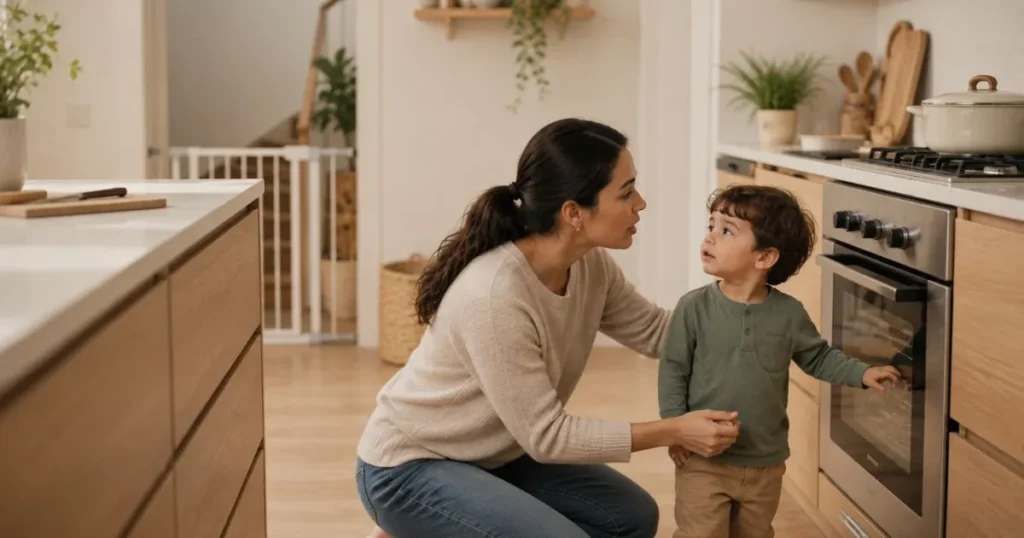
Safety always comes first.
Do not rely on natural consequences when your child could be harmed.
Examples include:
- Running into traffic
- Riding a bicycle without a helmet
- Playing with electrical outlets
- Touching a hot stove
In these situations, immediate intervention is essential.
4. Offer Choices Instead of Commands
Nobody enjoys feeling controlled—including children.
Offering limited choices gives your child a sense of independence while allowing you to maintain appropriate boundaries.
Instead of creating a power struggle, choices encourage cooperation.
For example:
Instead of saying:
“Put your shoes on now.”
Try:
“Would you rather wear your sneakers or your sandals today?”
The goal isn’t to let your child decide whether to wear shoes—only which shoes to wear.
Why Choices Work
Choices help children:
- Feel respected
- Develop decision-making skills
- Build confidence
- Reduce resistance
- Learn responsibility
Children are often more willing to cooperate when they feel included in the decision-making process.
Everyday Choice Examples
Morning
- “Blue shirt or green shirt?”
Meals
- “Would you like apple slices or bananas?”
Homework
- “Would you rather start with math or reading?”
Bedtime
- “Brush teeth before pajamas or after?”
Keep Choices Limited
Too many options can overwhelm young children.
For toddlers and preschoolers, two choices are usually enough.
5. Focus on Teaching Instead of Blaming
Every mistake is an opportunity to teach.
Unfortunately, many discipline conversations begin with blame.
“You never listen.”
“What’s wrong with you?”
“Why would you do that?”
Statements like these often make children defensive instead of reflective.
Positive Discipline encourages curiosity instead.
Ask yourself:
“What can my child learn from this experience?”
That question transforms discipline into teaching.
Turn Mistakes Into Lessons
Imagine your child accidentally breaks a favorite mug while running indoors.
Instead of saying:
“Look what you did!”
Try asking:
- “Is anyone hurt?”
- “What happened?”
- “How can we clean this safely?”
- “What can we do differently next time?”
The broken mug becomes a lesson about safety rather than a reason for shame.
Replace Blame With Coaching
Instead of:
❌ “You’re so careless.”
Try:
✅ “Let’s think of a better way to carry these so everyone stays safe.”
Children are more likely to build confidence and resilience when they understand that mistakes are a normal and valuable part of learning.
6. Encourage Rather Than Praise
Many parents are surprised to learn that encouragement is often more powerful than praise.
While praise often highlights the outcome, encouragement recognizes the effort, perseverance, and progress that lead to growth.
That difference helps children develop motivation from within.
Praise vs. Encouragement
| Praise | Encouragement |
| “You’re so smart.” | “I noticed you didn’t give up, even when it was challenging.” |
| “You’re the best.” | “I noticed how hard you worked on this, and your effort really stands out.” |
| Focuses on talent | Focuses on growth |
| Can create pressure | Builds resilience |
Children who are supported with encouragement instead of criticism are more likely to take on new challenges because they understand that mistakes help them learn and grow rather than define who they are.
Encouraging Phrases to Use
Instead of relying on “Good job!” every time, try saying:
- “You worked really hard.”
- “I noticed how patient you were.”
- “You didn’t give up.”
- “That took a lot of determination.”
- “You solved that problem yourself.”
- “How do you feel about what you accomplished?”
These comments help children recognize their own progress rather than depending on outside approval.
7. Stay Calm During Difficult Moments
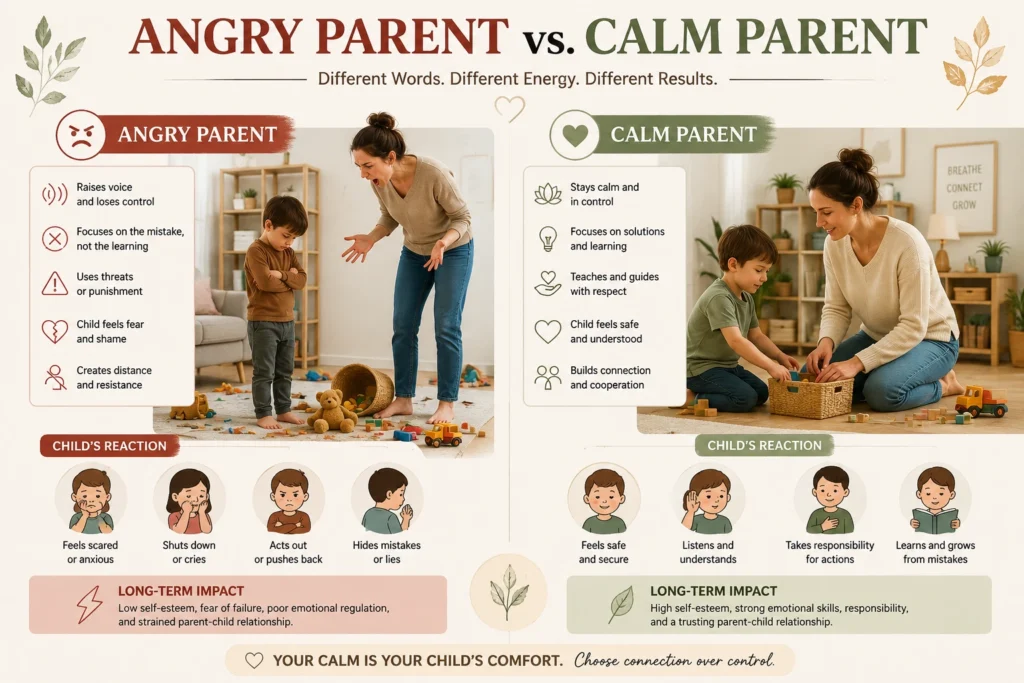
Children learn emotional regulation by watching you.
If you respond to every challenge with yelling or frustration, your child may learn to react the same way.
Remaining calm doesn’t mean ignoring inappropriate behavior. It means responding with patience and intention instead of reacting based on strong emotions.
Why Your Calm Matters
When you’re calm:
- Your child feels safer.
- Communication improves.
- Problem-solving becomes easier.
- Power struggles decrease.
- Children are more likely to cooperate.
Remember, your nervous system influences your child’s nervous system.
Simple Ways to Stay Calm
When emotions begin to rise:
- Pause before responding.
- Take a slow, deep breath.
- Lower your voice instead of raising it.
- Count to five silently.
- Remind yourself that your child is still learning.
You don’t have to respond immediately. A calm, thoughtful response is usually far more effective than reacting impulsively.
8. Create Predictable Daily Routines
Children tend to feel more confident and secure when they know what to expect next. A predictable routine reduces uncertainty, minimizes power struggles, and helps your child become more independent.
Think about how much more smoothly your day goes when you know what to expect and have a clear plan. Children benefit from that same sense of structure.
Routines don’t have to be rigid. Instead, they provide a dependable rhythm that helps your child transition smoothly from one activity to another.
Why Routines Support Positive Discipline
Daily routines can:
- Reduce arguments and resistance
- Encourage independence
- Lower stress for the whole family
- Improve cooperation
- Help children feel secure
- Build healthy habits
Instead of reminding your child ten times to brush their teeth, the routine becomes the reminder.
Example Morning Routine
| Time | Activity |
| 7:00 AM | Wake up and make the bed |
| 7:10 AM | Get dressed |
| 7:20 AM | Brush teeth and wash face |
| 7:30 AM | Eat breakfast |
| 7:50 AM | Pack backpack |
| 8:00 AM | Leave for school |
For younger children, try using a picture-based routine chart instead of one that relies only on written words.
9. Use Time-In Instead of Time-Out
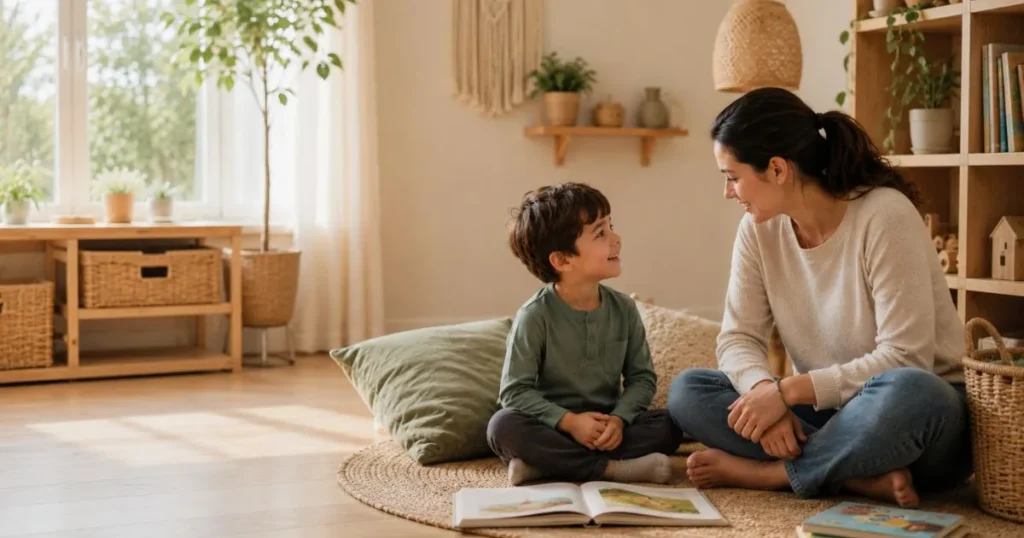
Traditional time-outs often separate children from their caregivers during moments when they need guidance the most.
A time-in takes a different approach.
Instead of sending your child away, you stay close, help them calm down, and teach them how to manage big emotions.
This doesn’t mean overlooking inappropriate behavior. Instead, it encourages you to view challenging moments as valuable opportunities to teach, guide, and help your child grow.
What Happens During a Time-In?
A time-in may include:
- Sitting quietly together
- Taking slow breaths
- Naming emotions
- Offering reassurance
- Talking about better choices once everyone is calm
Children have a harder time learning new skills when strong emotions overwhelm them. Helping them regulate first makes problem-solving much easier.
Time-In vs. Time-Out
| Time-In | Time-Out |
| Parent stays present | Child is isolated |
| Focuses on emotional regulation | Focuses on separation |
| Builds connection | May increase frustration for some children |
| Teaches coping skills | May only stop behavior temporarily |
| Encourages discussion afterward | Discussion may not happen |
Remember, the goal isn’t simply to stop unwanted behavior. The goal is to help your child learn what to do instead.
10. Solve Problems Together
Positive Discipline teaches children that they are capable of solving problems—not just following orders.
When children participate in finding solutions, they are more likely to follow through because they helped create the plan.
A Simple Five-Step Problem-Solving Process
Step 1: Identify the Problem
Ask:
“What happened?”
Allow your child to explain without interrupting.
Step 2: Listen Carefully
Sometimes children simply want to feel heard.
You might say:
“It sounds like you were upset because your brother took your toy.”
Feeling understood often reduces defensiveness.
Step 3: Brainstorm Solutions
Invite your child to suggest ideas.
Questions like these encourage critical thinking:
- “What could we do differently next time?”
- “How can we solve this together?”
Avoid judging ideas too quickly.
Step 4: Choose a Solution
Select one realistic option together.
For example:
- Set a timer for sharing.
- Take turns choosing games.
- Ask before borrowing toys.
Step 5: Review the Outcome
Later, ask:
- “Did our plan work?”
- “Should we try something different tomorrow?”
This teaches flexibility and continuous learning.
11. Model the Behavior You Want to See
Children learn much more from watching your actions than from simply listening to your words.
If you expect honesty, kindness, patience, and respect, they need to see those qualities demonstrated at home.
You are your child’s earliest and most powerful role model.
Everyday Ways to Model Positive Behavior
Show your child how to:
- Speak respectfully
- Apologize sincerely
- Stay calm during disagreements
- Express gratitude
- Admit mistakes
- Help others
- Solve problems peacefully
For example, if you accidentally interrupt your child, you might say:
“I’m sorry for interrupting you. Please finish what you were saying.”
Moments like these teach humility and respect more effectively than any lecture.
12. Repair the Relationship After Conflict
Even the calmest and most patient parents have moments when they lose their composure.
Positive Discipline doesn’t require perfection.
It encourages repair.
Repairing the relationship shows your child that mistakes—whether made by children or adults—can be acknowledged and corrected.
Why Repair Matters
When you take time to reconnect after a conflict, your child learns valuable lessons, such as:
- Relationships can recover.
- Apologies have meaning.
- Everyone makes mistakes.
- Love isn’t conditional.
This creates emotional safety and strengthens trust.
How to Repair After an Argument
A simple apology might sound like this:
“I was frustrated, and I raised my voice. I’m sorry. You didn’t deserve to be spoken to that way. Let’s talk about what happened together.”
Notice that this apology doesn’t excuse the behavior. It takes responsibility while opening the door for problem-solving.
Repair teaches accountability far more effectively than pretending nothing happened.
Positive Discipline by Age

Every stage of childhood brings new challenges. While the principles of Positive Discipline stay the same, the way you apply them should match your child’s developmental stage.
Babies (0–12 Months)
At this age, babies aren’t being “naughty.” They’re communicating needs.
Focus on:
- Responsive caregiving
- Predictable routines
- Comfort and reassurance
- Safe exploration
- Secure attachment
Your loving responses help build trust and emotional security.
Toddlers (1–3 Years)
Toddlers are discovering independence but still have limited self-control.
Helpful strategies include:
- Offering two simple choices
- Redirecting attention
- Keeping instructions short
- Using visual cues
- Remaining calm during tantrums
Patience is essential during this stage.
Preschoolers (3–5 Years)
Preschoolers can begin understanding consequences and solving simple problems.
Try:
- Logical consequences
- Emotion coaching
- Role-playing social situations
- Visual schedules
- Encouraging independence
School-Age Children (6–12 Years)
As your child gets older, give them more opportunities to participate in making decisions and solving problems.
Encourage:
- Family meetings
- Chore responsibilities
- Homework planning
- Collaborative problem-solving
- Goal setting
Teenagers
Positive Discipline remains effective during adolescence.
Focus on:
- Mutual respect
- Active listening
- Negotiation
- Natural consequences
- Independence balanced with accountability
Strong relationships matter more than strict control.
Parents of toddlers and preschoolers can explore the CDC Essentials for Parenting, which includes age-specific strategies for setting limits, encouraging cooperation, and teaching positive behavior.
Common Positive Discipline Mistakes to Avoid
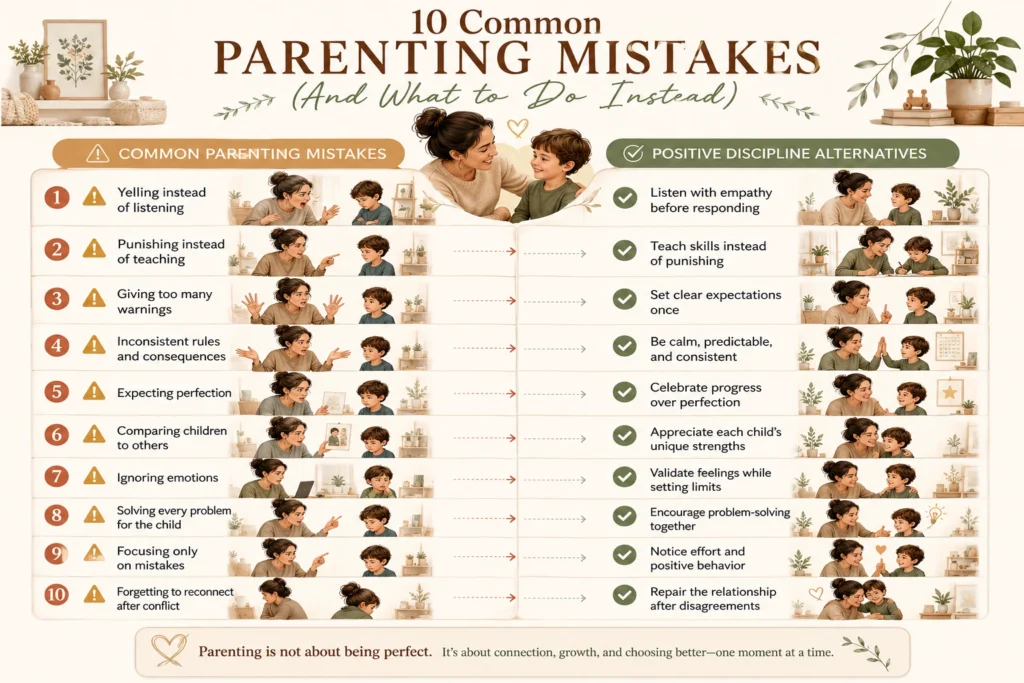
Even with the best intentions, it’s easy to fall into habits that make discipline less effective.
Avoid these common mistakes:
- Being inconsistent with rules.
- Giving too many warnings.
- Expecting immediate results.
- Confusing kindness with permissiveness.
- Solving every problem for your child.
- Using shame or embarrassment.
- Comparing siblings.
- Forgetting to acknowledge positive behavior.
- Reacting in anger instead of responding calmly.
- Expecting perfection from yourself or your child.
Remember, progress—not perfection—is the goal.
Positive Discipline vs. Gentle Parenting
Although these approaches share many similarities, they are not identical.
| Positive Discipline | Gentle Parenting |
| Teaches life skills | Prioritizes emotional connection |
| Uses logical consequences | Emphasizes empathy and validation |
| Encourages responsibility | Focuses on secure attachment |
| Combines kindness with firmness | Often places greater emphasis on relationship-building |
Many families successfully blend ideas from both approaches.
The common goal is raising emotionally healthy, respectful, and responsible children.
Frequently Asked Questions About Positive Discipline
What is Positive Discipline?
Positive Discipline is a parenting approach that teaches children appropriate behavior through guidance, encouragement, and respectful boundaries instead of punishment.
Does Positive Discipline really work?
Yes. Research consistently shows that warm, responsive parenting combined with consistent expectations supports children’s emotional development, self-regulation, and long-term cooperation.
At what age should Positive Discipline start?
Positive Discipline can begin from infancy by building secure attachment, responding consistently to your baby’s needs, and gradually introducing age-appropriate expectations as your child grows.
Is Positive Discipline the same as permissive parenting?
No. Positive Discipline includes clear rules and boundaries. The difference is that those limits are taught with respect and consistency rather than fear or harsh punishment.
Can Positive Discipline reduce tantrums?
While no approach can eliminate tantrums completely, Positive Discipline often reduces their frequency and intensity by helping children develop emotional regulation and communication skills.
How long does Positive Discipline take to work?
Every child is different. Some improvements appear within days, while lasting changes usually develop over weeks or months through consistent practice.
Conclusion
Positive Discipline isn’t about raising perfectly behaved children—it’s about raising capable, compassionate, and resilient human beings.
Every calm conversation, every respectful boundary, and every opportunity to teach instead of punish helps your child develop skills that will last a lifetime. While progress may feel slow at times, the small choices you make each day create the foundation for trust, confidence, and emotional well-being.
There will still be challenging moments. Your child will make mistakes, and so will you. That’s part of parenting. What matters most is how you respond afterward. By choosing connection over control and guidance over punishment, you’re showing your child that mistakes are opportunities to learn, relationships can be repaired, and respect goes both ways.
Positive Discipline is a journey, not a destination. Stay patient, remain consistent, celebrate small victories, and remember that every positive interaction strengthens the bond you share with your child.
Ready to Transform Your Parenting?
Start with one Positive Discipline strategy this week. Whether you start by offering more choices, allowing natural consequences, or connecting before correcting, these small, consistent changes can have a lasting positive impact over time.