

Just when you thought sleep was finally becoming predictable, your little one starts waking at night again, refusing naps, or protesting bedtime.
If your baby has recently celebrated their first birthday, you may be wondering whether you’re dealing with the 12 month sleep regression.
Perhaps your 12 month-old was sleeping through the night, following a reliable nap schedule, and settling easily at bedtime. Then, almost overnight, everything changed.
Your child may suddenly:
- Wake more often during the night
- Fight naps they once enjoyed
- Cry when it’s time for bed
- Want to practice walking instead of sleeping
- Seem more determined to do everything on their own
If this sounds familiar, you’re not alone.
Many families experience the 12 month sleep regression, a temporary period when sleep becomes more challenging as babies reach important developmental milestones.
Unlike earlier sleep regressions, this stage isn’t mainly about changes in sleep cycles or learning to crawl. Around your child’s first birthday, they’re becoming more independent, more curious, and more aware of the world around them.
During this 12 month sleep regression, toddlers are learning to walk, understand more words, imitate everyday actions, and communicate their preferences in new ways. At the same time, their sleep needs are beginning to change, and some families start wondering whether it’s time to transition from two naps to one.
These exciting milestones can temporarily disrupt your toddler’s sleep, leading to more night wakings, bedtime resistance, and nap struggles.
The good news is that the 12 month sleep regression is usually a normal part of healthy development. With patience, consistent routines, and age-appropriate sleep habits, most toddlers gradually return to more restful nights.
In this guide, you’ll learn what causes the 12 month sleep regression, how long it typically lasts, the most common signs to watch for, and practical, expert-backed strategies to help your toddler sleep better again., the most common signs to watch for, how long it typically lasts, and practical strategies to help your toddler sleep better again.

12 Month Sleep Regression at a Glance
If you’re looking for quick answers, this table highlights the essentials.
| Question | Quick Answer |
| What is the 12 month sleep regression? | A temporary period of disrupted sleep that often occurs around your child’s first birthday due to rapid developmental changes and evolving sleep needs. |
| When does it start? | Most commonly between 11 and 13 months, although every child develops at their own pace. |
| How long does it last? | Many toddlers adjust within 2 to 6 weeks, but the timeline varies. |
| Common signs | Night wakings, bedtime resistance, nap refusal, early morning waking, increased independence, and fussiness around sleep. |
| Main causes | Learning to walk, language development, changing nap needs, growing independence, separation anxiety, teething, and routine changes. |
| Can you prevent it? | No, but consistent routines and age-appropriate sleep habits can make this stage easier to manage. |
| Will my toddler sleep normally again? | Yes. Most children gradually return to more predictable sleep as they adjust to these developmental milestones. |
Although the 12 month sleep regression can feel frustrating, it’s often a sign that your child is making remarkable progress in many areas of development.
What Is the 12 Month Sleep Regression?

The 12 month sleep regression is a temporary stage when your child’s sleep suddenly becomes less predictable around their first birthday.
You may notice that a toddler who previously slept well now wakes more often at night, refuses naps, or protests bedtime.
While the word “regression” suggests that sleep is moving backward, your child’s development is actually moving forward.
Around 12 months, several important milestones often happen at the same time.
Your child may be:
- Taking their first independent steps
- Learning new words every week
- Following simple instructions
- Exploring their environment with growing confidence
- Showing stronger preferences and a desire for independence
- Beginning to outgrow their previous sleep routine
These exciting changes keep your toddler’s brain and body busy throughout the day—and sometimes make it harder to settle down at night.
Unlike the 4-month sleep regression, which is driven by changes in sleep cycles, or the 8–10 month sleep regression, which is closely linked to separation anxiety and rapid mobility, the 12 month sleep regression is often shaped by the transition toward toddlerhood.
Your child isn’t just learning new skills.
They’re beginning to develop their own personality, preferences, and routines.
That growing independence is wonderful—but it can also lead to temporary sleep challenges.
When Does the 12-Month Sleep Regression Start?
Despite its name, the 12 month sleep regression doesn’t always begin exactly on your child’s first birthday.
Some toddlers show signs a little earlier, while others don’t experience noticeable sleep changes until several weeks later.
A general timeline looks like this.
| Age | What You Might Notice |
| 11 Months | More active at bedtime, occasional nap resistance, practicing walking or standing for longer periods |
| 12 Months | The most common time for bedtime struggles, frequent night wakings, and changing nap patterns |
| 13 Months | Continued adjustment as walking, communication, and independence develop rapidly |
If your child was born prematurely, your pediatrician may recommend considering their adjusted age when evaluating developmental milestones.
It’s also important to remember that not every toddler experiences a noticeable sleep regression.
Some children continue sleeping well throughout this stage, while others have only mild disruptions that resolve quickly.
Why the 12 Month Sleep Regression Feels Different

Parents often say the 12 month sleep regression feels completely different from earlier sleep regressions—and they’re right.
This stage isn’t simply about disrupted sleep.
It’s about a child who is becoming more independent every day.
During the 12 month sleep regression, many toddlers begin to realize they can make choices, express preferences, and actively participate in daily routines.
Around the first birthday, rapid physical, emotional, and cognitive development can make it harder for toddlers to settle down, even when they’re tired.
They may:
- Protest when bedtime interrupts play.
- Want to keep practicing walking instead of lying down.
- Refuse naps because they’re afraid of missing out on the fun.
- Use new sounds, gestures, or words to let you know exactly what they want.
- Test familiar routines to see what happens.
These behaviors are common during the 12 month sleep regression and are usually signs of healthy development rather than a sleep problem.
Your toddler isn’t trying to make bedtime difficult.
They’re discovering that they have their own ideas, curiosity, and growing sense of independence.
The reassuring news is that, with consistent routines and supportive responses, most children gradually adapt—and sleep becomes more settled again.
What Causes the 12-Month Sleep Regression?
If your toddler’s sleep has suddenly become unpredictable, it’s natural to wonder what changed.
The 12 month sleep regression isn’t usually caused by a single factor. Instead, it’s often the result of several exciting developmental milestones happening around the same time.
Around your child’s first birthday, their brain is processing an incredible amount of new information every day. They’re learning new motor, language, and social skills, and this rapid development can temporarily make it harder to settle into restful sleep.
As a result, many toddlers experience more night wakings, bedtime resistance, shorter naps, or difficulty falling asleep during the 12 month sleep regression.
Let’s explore the key reasons behind the 12 month sleep regression and better understand what your toddler is experiencing.
Learning to Walk

Learning to walk is a major step in your toddler’s development, and their excitement to practice this new ability can sometimes continue right into bedtime.
You may notice your child:
- Pulling up and cruising along the rails
- Taking practice steps before bedtime
- Becoming excited instead of sleepy
Walking requires balance, coordination, and confidence.
Providing plenty of supervised opportunities to walk and explore throughout the day may help reduce the urge to practice at bedtime.
A Language Explosion
Your toddler’s communication skills are developing rapidly.
Around 12 months, many children begin to:
- Say their first words
- Understand simple instructions
- Recognize familiar names
- Point to objects they want
- Copy sounds and gestures
- Respond to simple questions
Although these milestones are exciting, they’re also mentally demanding.
Your child’s brain is constantly making new connections, organizing information, and learning how language works. This rapid cognitive growth can temporarily make sleep less predictable.
Growing Independence
You may notice them wanting to:
- Feed themselves
- Hold the spoon
- Choose a toy
- Walk without assistance
- Explore every room
- Do things “their way”
That same independence often appears at bedtime. These bedtime protests aren’t signs of bad behavior.
Changing Sleep Needs
Around 12 months, many parents start wondering whether it’s time to drop from two naps to one.
This transition doesn’t happen at exactly the same age for every child.
Trying to transition too early can sometimes lead to:
- Overtiredness
- Short naps
- Bedtime struggles
- Frequent night wakings
- Early morning waking
For many families, the sleep regression isn’t caused by the nap schedule itself—but by changing it before the child is truly ready.
Separation Anxiety

Although separation anxiety is often strongest between 8 and 10 months, many toddlers continue experiencing it after their first birthday.
At bedtime, your child may:
- Cry when you leave the room
- Ask to be picked up
- Want extra cuddles
- Wake during the night looking for reassurance
Consistent bedtime routines can help build confidence over time.
Teething
Some children continue cutting teeth around their first birthday.
Sore gums can make it more difficult to fall asleep or stay asleep.
Common signs include:
- Drooling
- Chewing on toys or fingers
- Swollen gums
- Mild irritability
Keep in mind that teething alone doesn’t explain every sleep disruption.
Changes in Routine
Even positive life events can temporarily affect sleep.
Examples include:
- Birthday celebrations
- Family vacations
- Starting daycare
- Visiting relatives
- Changes in childcare
- Moving to a new home
- Recovering from illness
Toddlers thrive on predictable routines.
Returning to familiar sleep habits often helps them feel secure again.
Is It Really the 12 Month Sleep Regression?
Not every sleep challenge around your child’s first birthday is caused by a sleep regression.
| Possible Cause | Typical Signs | Usually Temporary? |
| 12 Month Sleep Regression | Night waking, nap resistance, bedtime protests, increased independence | ✅ Yes |
| Changing Nap Needs | Fighting one nap while still needing sleep | ✅ Yes |
| Teething | Swollen gums, chewing, drooling | ✅ Yes |
| Routine Changes | Sleep disruption after travel, daycare, illness, or schedule changes | ✅ Yes |
| Illness | Fever, persistent cough, poor feeding, unusual tiredness | ✅ Yes (medical evaluation may be needed) |
Key Takeaway
The 12 month sleep regression is usually the result of several developmental changes happening together—not a sign that your toddler has forgotten how to sleep.
During this stage, your child may be:
- Learning to walk
- Experiencing a language explosion
- Becoming more independent
- Adjusting to changing sleep needs
- Still working through mild separation anxiety
- Cutting new teeth
- Adapting to changes in routine
10 Common Signs of the 12 Month Sleep Regression

Every toddler experiences the 12 month sleep regression differently, with sleep patterns and symptoms varying from one child to another.
Some toddlers mainly wake more often during the night, while others suddenly refuse naps, fight bedtime, wake earlier than usual, or seem determined to keep practicing new skills instead of sleeping.
Because so many developmental changes happen around the first birthday, it isn’t always easy to tell whether these sleep challenges are part of the 12 month sleep regression or simply a reflection of your toddler’s growing independence.
The good news is that these behaviors are usually temporary and closely linked to healthy physical, cognitive, and emotional development. With consistent routines and patience, most toddlers gradually return to more predictable sleep.
Here are the most common signs of the 12 month sleep regression that parents notice during this developmental stage.
1. Frequent Night Wakings
A consistent bedtime routine is one of the best ways to encourage healthy sleep habits and help toddlers settle more easily at night.
A toddler who previously slept through the night may suddenly begin waking again.
Some children wake once or twice, while others wake more frequently looking for comfort, reassurance, or simply because they’re processing everything they’ve learned during the day.
Night wakings may be related to:
- Learning to walk
- Language development
- Changing sleep needs
- Mild separation anxiety
- Temporary schedule changes
What You Can Do
- Keep nighttime interactions calm and quiet.
- Use a consistent response each time your toddler wakes.
- Avoid turning nighttime into playtime.
2. Fighting Bedtime
Bedtime may suddenly become a negotiation.
Your toddler may:
- Cry when it’s time for bed.
- Want “one more” story or cuddle.
- Stand in the crib instead of lying down.
- Keep pointing toward the door.
- Protest when the bedtime routine begins.
3. Refusing Naps

Nap resistance becomes especially common around the first birthday.
Your toddler may:
- Take much longer to fall asleep.
- Skip one nap occasionally.
- Wake shortly after falling asleep.
- Cry when it’s time for a nap.
Many parents assume it’s time to switch to one nap, but this isn’t always the case.
We’ll cover how to know when your toddler is truly ready later in this guide.
4. Practicing Walking Instead of Sleeping
Instead of settling down, your toddler may be far more interested in practicing their newest skill.
You might notice them:
- Walking around the crib
- Cruising along the rails
- Squatting and standing repeatedly
- Clapping after taking a few steps
- Smiling proudly instead of lying down
As exciting as this milestone is, it can temporarily delay sleep.
5. Early Morning Wake-Ups
Your child may suddenly start waking much earlier than usual.
Possible reasons include:
- Changing sleep needs
- Too much daytime sleep
- Overtiredness
- Excitement to begin the day
- Light entering the bedroom
Keeping the room dark and maintaining a consistent bedtime may help reduce early waking.
6. Increased Independence at Bedtime
Around the first birthday, toddlers often begin expressing strong opinions.
You may notice your child:
- Wanting to hold their own cup or bottle
- Refusing help with simple tasks
- Wanting to choose a favorite stuffed animal
- Resisting parts of the bedtime routine
These behaviors reflect growing confidence and a desire to do more independently.
7. More Talking, Babbling, or Singing Before Sleep
As language develops, many toddlers become surprisingly chatty at bedtime.
You may hear your child:
- Babbling happily
- Repeating familiar sounds
- Saying a few simple words
- Singing parts of songs
- Talking to stuffed animals
Although it may delay sleep slightly, this is often a positive sign of healthy language development.
8. Shorter or Less Predictable Naps
Some toddlers continue napping but sleep for shorter periods than before.
Others alternate between long naps one day and short naps the next.
Temporary inconsistency is common while sleep needs continue evolving.
9. Increased Clinginess
Although separation anxiety often peaks earlier, many one-year-olds still seek extra reassurance.
Your toddler may:
- Want longer cuddles before bed
- Cry when you leave the room
- Follow you around the house
- Ask to be picked up more often
This need for comfort usually becomes easier to manage with consistent routines and predictable responses.
10. More Active Sleep
Many toddlers become surprisingly active while sleeping.
You may notice them:
- Rolling around the crib
- Sitting up briefly
- Changing positions frequently
- Talking in their sleep
- Settling again without fully waking
Not every movement requires intervention.
If your toddler is safe and calm, giving them a brief opportunity to resettle on their own may help them connect sleep cycles naturally.
Quick Symptom Checklist
Use this checklist to compare your toddler’s sleep changes with the common signs of the 12 month sleep regression.
| Symptom | Common During the 12 Month Sleep Regression? |
| Frequent night wakings | ✅ |
| Bedtime resistance | ✅ |
| Nap refusal | ✅ |
| Practicing walking at bedtime | ✅ |
| Early morning waking | ✅ |
| Increased independence | ✅ |
| More talking before sleep | ✅ |
| Short naps | ✅ |
| Mild clinginess | ✅ |
| Restless sleep | ✅ |
| Fever | ❌ |
| Difficulty breathing | ❌ |
| Persistent vomiting | ❌ |
If your toddler develops a fever, has trouble breathing, shows signs of dehydration, refuses to eat or drink, seems unusually drowsy, or has any other concerning symptoms, don’t assume the sleep changes are caused solely by the 12 month sleep regression. While the 12 month sleep regression is a normal developmental stage, illness and other medical conditions can also disrupt your toddler’s sleep. If you’re concerned, contact your pediatrician promptly to rule out any underlying health issue and receive appropriate medical advice.If your toddler develops a fever, has trouble breathing, shows signs of dehydration, refuses to eat or drink, seems unusually drowsy, or has any other worrying symptoms, don’t assume the sleep changes are only due to the 12-month sleep regression. Reach out to your pediatrician to rule out any underlying medical condition and get appropriate advice.
Could It Be Something Else?
During the 12 month sleep regression, several challenges can sometimes happen at once, making sleep more difficult than usual.
For example:
- A toddler learning to walk may also be teething.
- A child transitioning to daycare may become overtired.
- Birthday celebrations, travel, or family visits can temporarily disrupt routines.
- A premature switch from two naps to one may lead to overtiredness and more frequent night waking.
Looking at your toddler’s overall routine—not just nighttime sleep—can often provide the clearest explanation.
Key Takeaway
The 12 month sleep regression often involves much more than frequent nighttime wakings.
Many toddlers also resist naps, practice walking at bedtime, become more independent, wake earlier in the morning, and use their growing communication skills to express exactly how they feel about sleep.
Although these changes can be exhausting for parents, they’re usually positive signs of healthy physical, emotional, cognitive, and language development. As your toddler reaches new milestones, temporary sleep disruptions are a common part of the 12 month sleep regression.
With consistent bedtime routines, patience, reassurance, and age-appropriate expectations, most toddlers gradually move through the 12 month sleep regression and return to more restful, predictable sleep.
How Long Does the 12 Month Sleep Regression Typically Last?
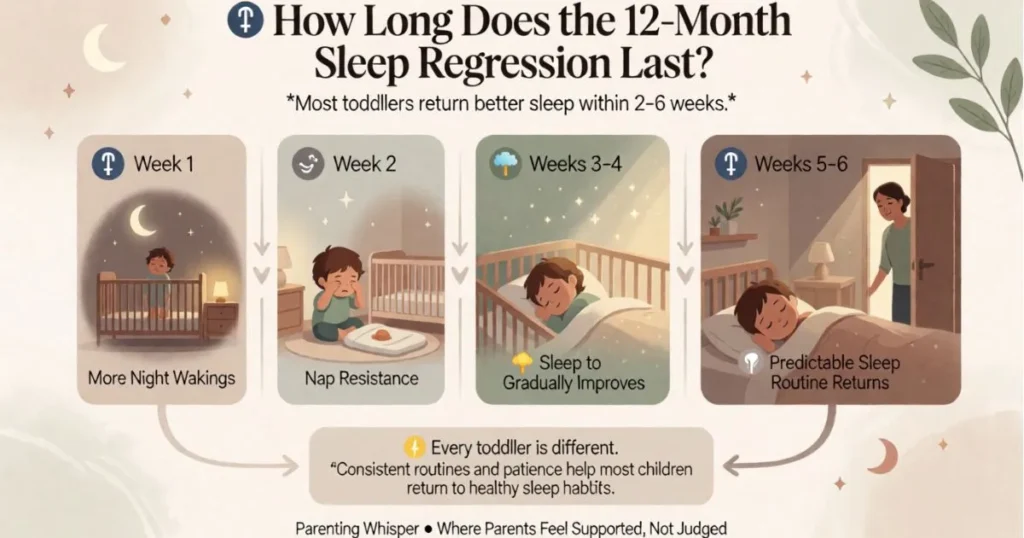
When your toddler suddenly begins waking during the night or resisting naps, it’s natural to wonder how long the 12-month sleep regression will last.
The reassuring news is that the 12 month sleep regression is usually a temporary stage and, for most toddlers, a normal part of healthy development.
For many toddlers, the most noticeable sleep disruptions last 2 to 6 weeks. As they become more comfortable with new developmental milestones and settle into a consistent bedtime routine, sleep often becomes more predictable again.
Unlike earlier sleep regressions, the 12 month sleep regression isn’t just about changes in sleep patterns. It’s also about your child’s transition from babyhood to toddlerhood.
Learning to walk, communicating with words, exploring independence, and adjusting to changing sleep needs all take time. These exciting milestones can temporarily affect both naps and nighttime sleep, leading to bedtime resistance, night wakings, and shorter naps during the 12 month sleep regression.
Every toddler develops at their own pace, so some children move through the 12 month sleep regression more quickly than others. With patience, reassurance, and consistent sleep habits, this phase usually passes, and your toddler’s sleep gradually improves.
Every Toddler Has Their Own Timeline
Some children move through the 12 month sleep regression quickly, while others take a little longer.
Several factors can affect how long the 12 month sleep regression continues, such as:
- Learning to walk
- Language development
- Nap transitions
- Separation anxiety
- Teething
- Routine changes
- Your toddler’s temperament
Some toddlers seem to adjust within a couple of weeks, while others need more time before sleep becomes consistent again.
Both experiences can be completely normal.
Typical Timeline
| Timeline | What You Might Notice |
| Week 1 | Bedtime resistance, occasional nap refusal, more frequent waking |
| Weeks 2–3 | Walking practice, increased independence, changing nap patterns |
| Weeks 4–6 | Many toddlers gradually settle into a more predictable routine |
| Beyond 6 Weeks | If your toddler continues to have sleep difficulties for several weeks or you notice other concerning symptoms, consult your pediatrician to find out whether an underlying condition could be contributing to the problem. |
Keep in mind that these timeframes are general estimates, and every toddler develops at their own pace.
Why Sleep Usually Improves
Sleep often becomes easier once your toddler feels more confident with their new skills.
Over time:
- Walking becomes easier.
- New words become part of everyday communication.
- Bedtime routines feel more familiar.
- Emotional regulation gradually improves.
- Sleep schedules become more consistent.
Most parents notice gradual improvements rather than one dramatic change overnight.
Should You Drop to One Nap?
This is one of the biggest questions parents ask during the 12 month sleep regression.
If your toddler suddenly begins refusing naps, you may wonder whether they’re ready to switch to just one nap each day.
In many cases, nap resistance is a temporary symptom of the 12 month sleep regression, not a sign that your toddler is ready to drop a nap. Most 12-month-olds still benefit from two naps, even if they occasionally refuse one.
Transitioning to one nap too soon can lead to overtiredness, which may make the 12 month sleep regression feel even more challenging by increasing bedtime resistance, night wakings, and early morning waking.
Rather than focusing on a single difficult day, look for consistent sleep patterns over several weeks. If your toddler regularly refuses one nap while remaining happy, well-rested, and sleeping well at night, they may be ready for the transition. Otherwise, continuing with two naps is often the best approach until they’re developmentally ready for a more predictable one-nap schedule.
How to Tell If Your Toddler Is Ready for One Nap a Day
Your child may be approaching the transition if they consistently:
- Skip one nap for several weeks without becoming overtired.
- Stay happy and alert through longer wake windows.
- Continue sleeping well at night.
- Wake refreshed after one longer midday nap.
- Consistently resist one of their daily naps, even when following a regular sleep schedule.
Most toddlers will experience only some of these signs, and they may not appear all at once. During the 12 month sleep regression, sleep changes and nap resistance can sometimes make this transition harder to recognize. The transition usually happens gradually.
Signs It’s Probably Too Soon
Many toddlers refuse a nap occasionally because of excitement, teething, travel, or a temporary 12 month sleep regression.
Your toddler may still benefit from two naps each day if they:
- Become very cranky by late afternoon.
- Fall asleep immediately in the car after skipping a nap.
- Wake frequently overnight after dropping a nap.
- Wake unusually early in the morning.
- Struggle to stay awake until lunchtime.
- Sleep much better on days with two naps.
These signs often suggest that your toddler still needs more daytime sleep.
Two Naps vs. One Nap
| Two Naps May Be Better If… | One Nap May Be Better If… |
| Your toddler becomes noticeably overtired when they skip their morning nap. | Your toddler consistently refuses one nap for several weeks. |
| Nighttime sleep worsens after skipping naps. | One midday nap lasts 2–3 hours and your toddler wakes refreshed. |
| They struggle to stay awake until lunch. | They stay happy and alert with longer wake windows. |
| For many toddlers, following a consistent nap routine can make the transition easier and support a return to more predictable sleep once the regression has passed. | Two naps regularly delay bedtime or cause long periods of wakefulness before sleep. |
Rather than rushing the transition, let your toddler’s overall sleep patterns guide your decision.
Why Is My 12-Month-Old Suddenly Refusing Naps?
NaNap refusal doesn’t always mean your toddler no longer needs daytime sleep.
Around their first birthday, many toddlers begin resisting naps because they’re eager to keep exploring, playing, and engaging with the world around them.
They may want to:
- Practice walking
- Explore new toys
- Interact with family members
- Keep playing
- Test their independence
This doesn’t necessarily mean they’re ready to stay awake all day.
For many toddlers, keeping a consistent nap schedule supports healthier sleep and helps bedtime return to normal as the 12 month sleep regression gradually comes to an end.
What You Can Do
If your toddler suddenly refuses naps during the 12 month sleep regression:
- Keep offering naps at the usual times.
- Follow the same calming pre-nap routine each day.
- Make the bedroom dark and quiet.
- Avoid replacing naps with stimulating activities.
- Consider an earlier bedtime after a poor nap day.
Even if your toddler doesn’t sleep every time, the opportunity to rest is still valuable.
My Toddler Wants to Walk Instead of Sleep
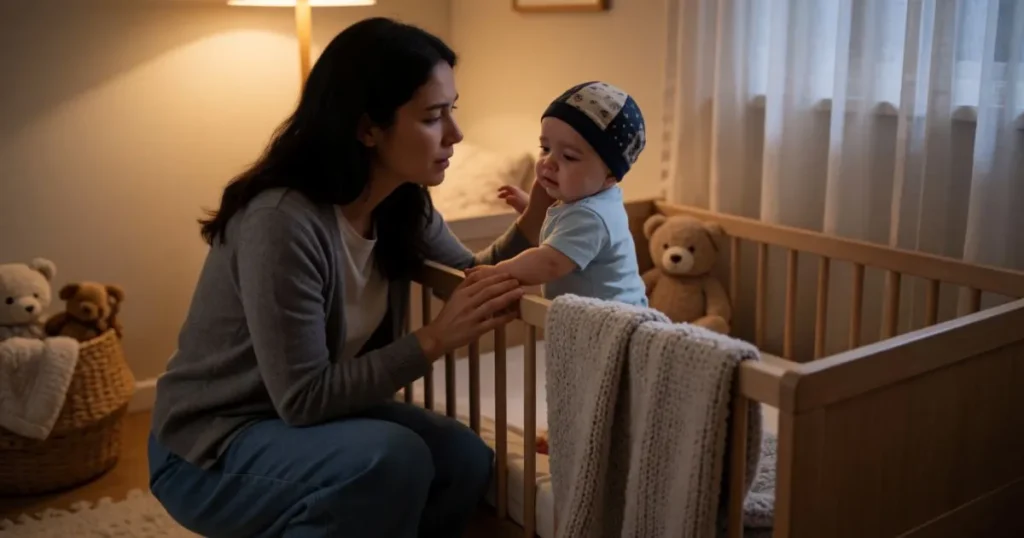
Many parents laugh the first time they see it.
Instead of settling down to sleep, your toddler may walk around the crib, squat, stand back up, or repeatedly practice the new movements they’ve recently mastered. During the 12 month sleep regression, these new physical skills can make it harder for your toddler to settle at bedtime.
As frustrating as this can be, it’s actually a sign of healthy development.
Walking is exciting.
Your toddler has discovered a whole new way to explore the world, and they naturally want to practice as much as possible.
In most cases, the most effective approach is not to prevent the behavior but to respond to it with patience and consistency.
Instead:
- Give your toddler plenty of supervised walking practice during the day.
- Spend time outdoors or in safe play spaces where they can move freely.
- Keep the bedtime routine calm to help them shift from active play to rest.
As walking becomes more familiar, bedtime often becomes easier again.
Key Takeaway
The 12 month sleep regression usually lasts 2 to 6 weeks, but every toddler develops at their own pace. While this stage can feel overwhelming, it’s a temporary part of healthy development for most children.
One of the biggest challenges during the 12 month sleep regression is recognizing that nap resistance doesn’t always mean your toddler is ready to transition to one nap. Many 12-month-olds still need two naps, even if they occasionally refuse one because they’re busy practicing new skills or exploring their surroundings.
By looking at your toddler’s overall sleep patterns instead of reacting to a few difficult days, you can make more confident decisions about their nap schedule and bedtime routine. With patience, consistency, and realistic expectations, most families successfully navigate the 12 month sleep regression while supporting healthy sleep habits and their toddler’s important developmental milestones.
How to Help Your Toddler Sleep Better During the 12-Month Sleep Regression
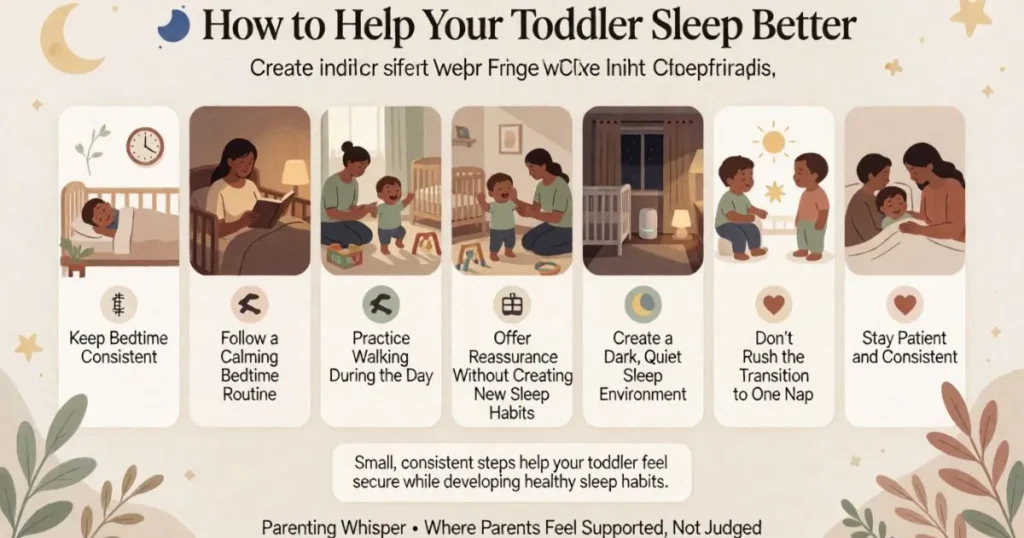
Although you can’t prevent the 12 month sleep regression, you can make this developmental stage easier by creating a predictable routine that supports your toddler’s growing independence while protecting healthy sleep habits.
The 12 month sleep regression is a normal part of development, not something you need to “fix.” Rather than trying to stop your toddler from reaching new milestones, focus on helping them feel safe, supported, and confident as they adapt to each new stage.
Simple, consistent habits—such as maintaining a calming bedtime routine, following an age-appropriate nap schedule, and responding with patience and reassurance—can make the 12 month sleep regression easier for both you and your toddler.
The following practical, evidence-based strategies can help reduce sleep disruptions and encourage more restful nights during the 12 month sleep regression.
1. Keep a Consistent Bedtime Routine
Consistent routines can be especially helpful during the 12 month sleep regression, helping toddlers feel safe and secure by giving them a clear sense of what will happen next.
A calm, predictable bedtime routine sends clear signals that it’s time to wind down and prepare for sleep.
Your routine might include:
| Step | Activity |
| 1 | Warm bath (optional) |
| 2 | Fresh diaper or pajamas |
| 3 | Brush teeth (if applicable) |
| 4 | Milk feed or small bedtime snack if appropriate |
| 5 | Read one or two short books |
| 6 | Quiet cuddles and a goodnight phrase |
| 7 | Put your toddler in the crib when they’re calm, relaxed, and showing signs of sleepiness. |
Keeping the same sequence each night helps bedtime feel familiar and reassuring.
2. Encourage Plenty of Walking and Active Play During the Day
During the 12 month sleep regression, your toddler may seem to have endless energy because they’re learning an exciting new skill.
Give them plenty of supervised opportunities to:
- Walk
- Push walking toys
- Climb safely
- Explore different surfaces
- Practice balance
When toddlers have opportunities to move throughout the day, they’re often less likely to spend bedtime practicing new skills.
3. Protect the Nap Schedule
One difficult nap doesn’t necessarily mean your toddler is ready for a new schedule.
Continue offering naps at consistent times unless you’ve seen clear signs over several weeks that your child is ready to transition.
If naps are short or skipped:
- Keep the rest of the day’s routine predictable.
- Consider an earlier bedtime to prevent overtiredness.
- Return to the usual nap schedule the following day.
Consistency often works better than making frequent schedule changes.
4. Support Growing Independence Within Clear Boundaries
Around 12 months, toddlers love doing things by themselves, especially during the 12 month sleep regression when increased independence can sometimes make bedtime more challenging.
You can support this stage of development while still creating a calm and relaxing bedtime routine.
Offer simple choices to help your toddler feel more involved at bedtime, such as:
- “Would you like to wear your teddy bear pajamas or your rocket pajamas tonight?”
- “Would you like to read the bunny book or the truck book before bed?”
- “Would you like to snuggle with your favorite blanket while we read a bedtime story?”
Offering a few simple choices helps your toddler feel more independent while keeping the bedtime routine peaceful and preventing unnecessary bedtime battles.
5. Create a Calm Sleep Environment

As toddlers become more curious, reducing distractions becomes even more important.
Aim for:
- A dark bedroom
- A comfortable room temperature
- White noise if it helps your child settle
- A firm sleep surface
- A safe crib free of unnecessary items
If your child has transitioned to using a comfort object, make sure it is age-appropriate and follows your pediatrician’s safety guidance.
6. Respond Calmly to Night Wakings
If your toddler wakes during the night:
- Keep lights dim.
- Speak softly.
- Offer brief reassurance.
- Avoid stimulating play or lengthy conversations.
- Return to the same bedtime expectations each time.
A calm, predictable response helps your toddler understand that nighttime is for sleeping.
7. Give Your Toddler Time to Settle
It’s normal for toddlers to move around, babble, practice new skills, or quietly play with their hands for a few minutes before falling asleep during the 12 month sleep regression.
If your child is calm, comfortable, and safe, giving them a short opportunity to settle independently may help them connect sleep cycles, develop self-soothing skills, and build confidence at bedtime. This gentle approach can make the 12 month sleep regression easier to manage while supporting healthy, independent sleep habits.
8. Keep Language and Playtime Active During the Day

Around their first birthday, toddlers reach several important developmental milestones that can temporarily affect sleep.
Talking, reading, singing, and playing throughout the day support healthy language development and provide valuable mental stimulation.
Try activities such as:
- Naming everyday objects
- Singing nursery rhymes
- Looking at picture books
- Playing simple imitation games
- Encouraging gestures like waving or pointing
Rich daytime interaction often makes it easier for toddlers to relax when bedtime arrives.
Common Mistakes Parents Make During the 12 Month Sleep Regression
When sleep suddenly changes, it’s understandable to look for quick solutions.
However, some well-meaning changes can accidentally make sleep more difficult.
Dropping to One Nap Too Soon
This is one of the most common mistakes around the first birthday.
A few days of nap refusal doesn’t necessarily mean your toddler is ready for one nap.
Transitioning too early can lead to:
- Overtiredness
- More frequent night wakings
- Early morning waking
- Increased bedtime resistance
Look for consistent readiness signs over several weeks before making major schedule changes.
Keeping Your Toddler Awake Longer to “Sleep Better”
Many parents hope that skipping naps or delaying bedtime will make their toddler sleep longer at night.
In reality, overtired toddlers often:
- Take longer to fall asleep.
- Wake more frequently.
- Sleep more restlessly.
- Wake earlier in the morning.
Protecting daytime sleep usually supports better nighttime sleep.
Turning Bedtime Into a Negotiation
As toddlers become more independent, they naturally begin testing limits.
If bedtime rules change every night, your child may become confused about what to expect.
Instead:
- Keep routines simple.
- Stay calm and consistent.
- Offer limited choices rather than open-ended questions.
Predictability helps toddlers feel secure.
Overlooking the Need for Daytime Activity
Toddlers are designed to move.
A child who hasn’t had enough opportunities to walk, climb, explore, and play may still have extra energy at bedtime.
Regular active play each day helps support your toddler’s physical development and encourages healthier, more restful sleep.
Comparing Your Toddler With Other Children
Some one-year-olds still need two naps.
Others are transitioning toward one.
Some sleep through the night, while others continue waking occasionally.
Your toddler’s sleep is influenced by temperament, development, daily routine, and individual sleep needs.
Comparing your child to others often creates unnecessary worry.
Key Takeaway
The 12 month sleep regression isn’t about teaching your toddler to sleep perfectly.
It’s about helping them navigate one of the biggest developmental transitions of early childhood.
By maintaining consistent routines, protecting naps, encouraging daytime movement, supporting independence with clear boundaries, and responding calmly to night wakings, you’re helping your toddler build healthy sleep habits that can last well beyond the first birthday.
Sample 12-Month Sleep Schedule
Around your child’s first birthday, sleep needs begin to change. Most 12-month-olds still need 11 to 14 hours of total sleep within a 24-hour period, including nighttime sleep and daytime naps.
While some toddlers begin transitioning to one nap, many still benefit from two naps. The right schedule depends on your child’s individual sleep patterns rather than their age alone.
Below are examples of both routines.
Example Two-Nap Schedule
Many 12-month-olds continue sleeping well with two naps.
| Time | Activity |
| 7:00 a.m. | Wake up and milk feed or breakfast |
| 9:30–10:45 a.m. | Morning nap |
| 12:00 p.m. | Lunch |
| 2:00–3:15 p.m. | Afternoon nap |
| 5:30 p.m. | Dinner |
| 6:45 p.m. | Begin bedtime routine |
| 7:15–7:30 p.m. | Bedtime |
Example One-Nap Schedule
If your toddler consistently shows signs of being ready, a one-nap routine may gradually become appropriate.
| Time | Activity |
| 7:00 a.m. | Wake up |
| 8:00 a.m. | Breakfast |
| 12:00–2:00 p.m. | Midday nap |
| 2:30 p.m. | Snack and play |
| 5:30 p.m. | Dinner |
| 6:45 p.m. | Bedtime routine |
| 7:15 p.m. | Bedtime |
Remember that many toddlers don’t transition to one nap until between 13 and 18 months, so don’t feel pressured to make the change simply because your child has turned one.
Can You Sleep Train During the 12-Month Sleep Regression?
Many parents wonder whether this is the right time to begin—or continue—sleep training.
No single approach works well for every family, since each toddler and situation is unique.
Some toddlers are ready for gentle sleep-learning strategies, while others need extra reassurance as they adjust to walking, changing nap needs, and growing independence.
Before starting any sleep-training method, speak with your pediatrician to make sure it’s appropriate for your child.
Whatever approach you choose, the most helpful foundations remain the same:
- Follow a predictable bedtime routine.
- Keep sleep and wake times consistent.
- Protect age-appropriate naps.
- Respond calmly and consistently to bedtime protests.
- Encourage your toddler to practice new physical skills throughout the day so they’re less likely to focus on them at bedtime.
Sleep training is only one tool. Maintaining consistent sleep habits and having realistic expectations can make this stage much easier for both you and your toddler.
When Should You Call Your Pediatrician?

Although the 12-month sleep regression is a normal developmental stage, some sleep changes deserve medical attention.
Contact your pediatrician if your toddler:
- Has a fever or appears unusually ill.
- Has difficulty breathing during sleep or while awake.
- Refuses fluids or shows signs of dehydration.
- Isn’t gaining weight or feeding well.
- Snores loudly, pauses in breathing, or has other concerning sleep-related symptoms.
- Cries inconsolably for long periods or seems unusually difficult to comfort.
- Continues to experience significant sleep difficulties for several weeks despite a consistent routine, or begins showing other symptoms that concern you.
If you’re uncertain whether your child’s sleep changes are part of a sleep regression or another medical issue, seeking professional advice is always appropriate.
FAQ
Is the 12 month sleep regression real?
Yes. Many toddlers experience temporary sleep disruptions around their first birthday as they develop new motor, cognitive, emotional, and language skills. While not every child goes through a noticeable regression, it’s a common developmental stage.
Is there a one-year sleep regression?
Yes. The terms 12 month sleep regression and one-year sleep regression are often used interchangeably to describe this period of temporary sleep disruption around a child’s first birthday.
How Long Can the 12 Month Sleep Regression Last?
For many toddlers, the most noticeable sleep changes last 2 to 6 weeks. However, every child develops at their own pace, so some adjust more quickly while others need a little longer.
Should my 12-month-old drop to one nap?
Not necessarily.
At 12 months, many toddlers continue to benefit from taking two naps each day. Rather than making the change based on age alone, look for consistent readiness signs such as regularly refusing one nap for several weeks while staying happy, alert, and sleeping well at night.
Why is my 12-month-old suddenly refusing naps?
Nap refusal can happen because your toddler is learning to walk, becoming more independent, developing language skills, or experiencing temporary changes in sleep needs.
A toddler who resists naps isn’t automatically ready to move to a single daily nap.
Why Does My Toddler Keep Walking Around the Crib Instead of Sleeping?
Learning to walk is one of the most exciting developmental milestones of early childhood.
Many toddlers naturally want to practice this new skill at bedtime because they’re proud of what they’ve learned. Plenty of supervised walking during the day often helps reduce the urge to practice before sleep.
Why is my 12-month-old waking up at night again?
Night wakings may be linked to developmental milestones, changing nap schedules, separation anxiety, teething, or routine changes.
Looking at your toddler’s overall sleep pattern often provides a clearer explanation than focusing on nighttime alone.
Can teething cause the 12-month sleep regression?
Teething can make sleep more difficult, but it’s usually only one piece of the puzzle.
Walking, language development, growing independence, and changing sleep needs often play a much larger role around the first birthday.
Can I prevent the 12 month sleep regression?
You can’t prevent normal development, but you can support healthy sleep by:
- Keeping routines consistent
- Protecting naps
- Encouraging active daytime play
- Offering plenty of opportunities to practice walking
- Responding calmly and predictably at bedtime
Will my toddler sleep well again?
Yes.
For most families, sleep gradually becomes more consistent as toddlers adapt to their new developmental milestones and settle into updated daily routines.
Patience, consistency, and realistic expectations go a long way during this stage.
Conclusion

The 12 month sleep regression can feel like an unexpected setback, especially if your child had finally settled into a reliable sleep routine.
But beneath the bedtime protests, nap refusals, and nighttime wake-ups is something remarkable: your baby is becoming a toddler.
They’re taking first steps, saying first words, exploring the world with greater confidence, and discovering that they can make choices of their own.
These milestones are exciting, but they can temporarily make sleep more challenging.
By staying consistent with routines, protecting age-appropriate naps, encouraging plenty of daytime movement, and responding with patience and reassurance, you’re helping your toddler build healthy sleep habits that support this next stage of development.
Like every sleep regression, this phase is temporary.
With time, understanding, and a little flexibility, most toddlers return to more restful nights—ready to tackle their next adventure.
Continue Your Sleep Journey
As your child grows, every stage brings new milestones and new sleep challenges. Continue exploring our complete sleep regression series:
- Sleep Regression Ages: Complete Guide from 4 Months to 2 Years
- 4 Month Sleep Regression: Signs, Causes, How Long It Lasts & How to Help Your Baby Sleep Again
- 6 Month Sleep Regression : Signs, Causes, How Long It Lasts & How to Help Your Baby Sleep Again
- 8–10 Month Sleep Regression: Signs, Causes, How Long It Lasts & How to Help Your Baby Sleep Again
- Toddler Nap Schedule: Easy Complete Daily Sleep Plan by Age
With patience, consistent routines, and plenty of reassurance, most toddlers gradually return to restful, predictable sleep. Remember, you’re not just helping your child sleep better—you’re supporting skills that will benefit them for years to come.
At Parenting Whisper, we believe every stage of childhood is easier when parents feel informed, supported, and confident. No matter where you are on your sleep journey, you’re not alone—and brighter, more restful nights are ahead.