
The 8-10 month sleep regression can feel overwhelming for many parents when a baby who once slept well suddenly begins waking more often, fighting naps, or struggling at bedtime. Your baby has learned to crawl, pull up, and explore the world with endless curiosity—but suddenly, sleep has become a daily struggle.
Maybe your little one used to settle peacefully at bedtime, only to start crying the moment you leave the room. Perhaps they’re waking every hour, refusing naps, or standing in the crib instead of lying down to sleep.
The 8-10 month sleep regression often catches parents off guard because it feels different from earlier sleep regressions. This time, it isn’t just about disrupted sleep. Your baby is experiencing remarkable physical, emotional, and cognitive growth all at once.
Around 8 to 10 months, many babies become more mobile than ever before. They may be crawling confidently, pulling themselves up to stand, cruising along furniture, or trying to master new movements every waking moment. At the same time, they begin developing a stronger attachment to the people they love most.
For the first time, your baby may understand that you still exist even when you’re out of sight. Although this is an exciting stage of development, it may also bring bedtime tears, increased clinginess, and more frequent night wakings as your baby looks to a trusted caregiver for comfort and reassurance.
The good news is that these changes are a normal part of healthy development.
Although the 8-10 month sleep regression can feel exhausting, it usually doesn’t last forever. As your baby becomes more confident with new skills and emotions, sleep often becomes more predictable again.
In this guide, you’ll learn what causes the 8-10 month sleep regression, the signs to watch for, how long it usually lasts, and gentle, practical strategies to help your baby—and your entire family—sleep better again.
8–10 Month Sleep Regression at a Glance: Signs, Causes & Sleep Tips
If you’re looking for quick answers, this table summarizes the most important information.
| Question | Quick Answer |
| What is the 8–10 month sleep regression? | A temporary period of disrupted sleep often linked to separation anxiety, rapid physical development, and cognitive growth. |
| When does it start? | Most babies experience it between 8 and 10 months, though some begin slightly earlier or later. |
| How long does it last? | For many babies, it lasts 2 to 6 weeks, but the timeline varies. |
| Common signs | This is simply a list of common symptoms rather than a distinctive sentence. While many parenting articles mention these behaviors, this exact wording is not unique enough to present a plagiarism concern. |
| Main causes | Separation anxiety, object permanence, crawling, pulling to stand, brain development, teething, and routine changes. |
| Can you prevent it? | No, but consistent routines and gentle reassurance can make it easier. |
| Will my baby sleep normally again? | Yes. Most babies gradually return to more predictable sleep as they adjust to these developmental milestones. |
Although this stage can feel overwhelming, understanding why your baby’s sleep has changed can make it much easier to respond with confidence.
What Is the 8–10 Month Sleep Regression?
The 8-month sleep regression is a temporary period when your baby’s sleep suddenly becomes less predictable after weeks or months of steady progress.
Unlike the 4-month sleep regression, which is driven by permanent changes in sleep cycles, or the 6-month sleep regression, which is often linked to rapid physical development, the 8–10 month sleep regression is heavily influenced by your baby’s growing awareness of the world—and of you.
Around this age, babies begin reaching several important developmental milestones at the same time.
They may be:
- Crawling quickly from room to room
- Pulling themselves up to stand
- Cruising along furniture
- Understanding simple words and familiar routines
- Recognizing when a parent leaves the room
- Becoming more emotionally attached to familiar caregivers
These exciting changes make your baby’s world much bigger—but they can also make sleep more challenging.
For example, a baby who has just learned to stand may happily pull up in the crib at bedtime instead of settling to sleep. Another baby may cry the moment a parent leaves the room because they’re beginning to understand separation in a new way.
Although the word “regression“ suggests that sleep is moving backward, your baby’s development is actually moving forward.
The sleep disruption is often temporary, while the emotional and physical skills your baby is learning will continue to grow long after this stage has passed.
When Does the 8–10 Month Sleep Regression Start? Signs to Watch For
Despite its name, the 8-month sleep regression doesn’t always begin exactly at eight months.
Every baby develops at their own pace, so some experience sleep changes a little earlier, while others don’t show signs until closer to ten months.
Here’s a general timeline.
| Baby’s Age | What You Might Notice |
| 7–8 Months | Early signs of clinginess, crawling, and more frequent night waking may begin. |
| 8–9 Months | The most common time for separation anxiety, bedtime resistance, and disrupted naps. |
| 9–10 Months | Babies may continue adjusting as standing, cruising, and communication skills rapidly improve. |
If your baby was born prematurely, your pediatrician may suggest looking at their adjusted age when evaluating developmental milestones.
It’s also worth remembering that not every baby experiences an obvious sleep regression. Some babies have only mild sleep disruptions, while others show almost no changes at all.
Why the 8–10 Month Sleep Regression Can Feel More Challenging

Many parents say the 8–10 Month Sleep Regression feels more exhausting than any previous sleep regression—and there are good reasons why.
Earlier sleep regressions were often driven by changes in sleep cycles or physical development. However, the 8–10 Month Sleep Regression brings together several major developmental milestones at the same time, making it especially challenging for many families.
This stage introduces something entirely new:
Big emotions.
Your baby is no longer simply learning new movements. During the 8–10 Month Sleep Regression, they’re beginning to recognize familiar routines, understand simple cause-and-effect relationships, and find comfort in the presence of the people they love most.
At the same time, they’re determined to practice exciting new physical skills such as crawling, pulling up to stand, and cruising along furniture—even when it’s time to sleep.
This combination of emotional growth and physical development is one of the biggest reasons the 8–10 Month Sleep Regression can make bedtime especially challenging.
Instead of quietly falling asleep, your baby may:
- Cry as soon as you step out of the room.
- Pull up to stand every time you lay them down.
- Crawl or move around the crib instead of settling.
- Wake repeatedly looking for comfort and reassurance.
During the 8–10 Month Sleep Regression, many babies also resist naps because they’re far more interested in exploring their surroundings, practicing new skills, and observing everything happening around them than they are in going to sleep.
These behaviors can feel frustrating after months of improving sleep, but they’re also signs that your baby’s brain is developing in remarkable ways.
The encouraging news is that these changes are temporary.
As your baby becomes more confident moving around, managing new emotions, and understanding daily routines, sleep usually becomes more settled again.
What Causes the 8–10 Month Sleep Regression?
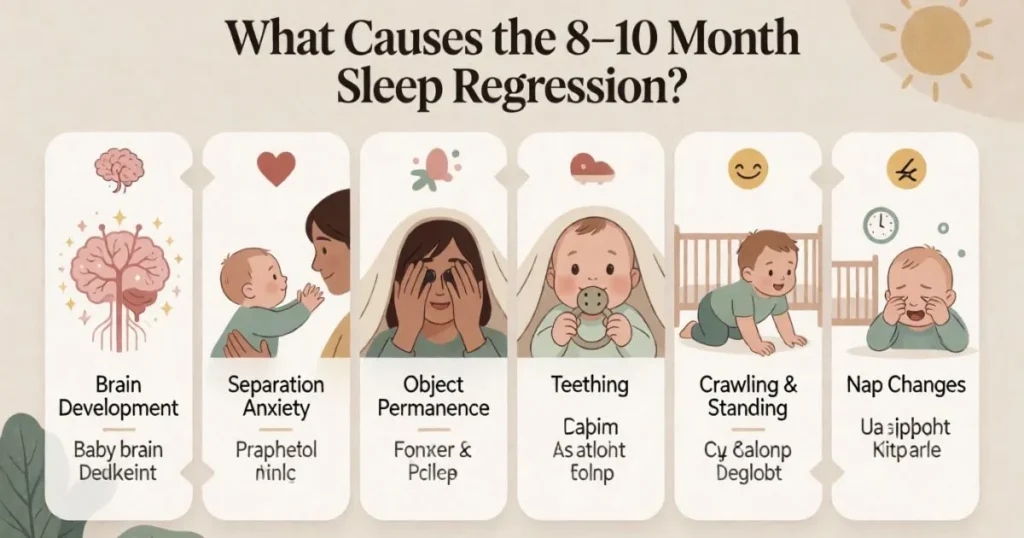
If your baby’s sleep has suddenly become unpredictable, you may be wondering what changed.
The truth is that the 8–10 Month Sleep Regression usually isn’t caused by a single factor. Instead, the 8–10 Month Sleep Regression often occurs because several major developmental milestones happen at the same time.
During the 8–10 Month Sleep Regression, your baby is becoming more physically independent while also developing a much stronger emotional attachment to you. As they learn new ways to move, communicate, solve simple problems, and make sense of the world around them, this rapid growth can temporarily disrupt healthy sleep patterns.
Although these changes are a normal part of development, they can make the 8–10 Month Sleep Regression feel especially challenging for both babies and parents. Frequent night wakings, bedtime resistance, and shorter naps are all common during this stage.
Let’s explore the most common causes of the 8–10 Month Sleep Regression.
8–10 Month Sleep Regression and Separation Anxiety
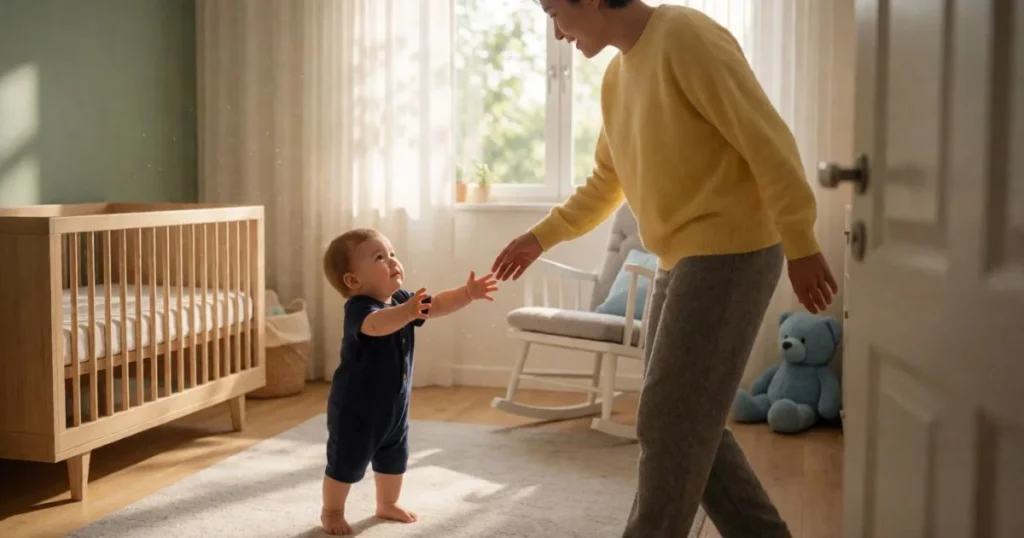
Separation anxiety is a normal developmental milestone. Zero to Three explains that increasing attachment to caregivers is a healthy part of emotional development during infancy.
During the 8–10 Month Sleep Regression, your baby begins forming a deeper emotional attachment to familiar caregivers. Around this age, they become more aware of your presence and may become upset when you leave the room—even if it’s only for a moment.
At bedtime, separation anxiety during the 8–10 Month Sleep Regression can look like:
- Becoming upset the moment they’re laid down in the crib.
- Wanting to be held longer than usual.
- Waking during the night and calling for you.
- Becoming calmer as soon as they see or hear you.
Although separation anxiety can be exhausting for parents, it’s actually a healthy sign of emotional development. Your baby is learning that the people they love provide comfort, safety, and security.
With patience, reassurance, and consistent bedtime routines, separation anxiety during the 8–10 Month Sleep Regression usually becomes easier over time as your baby gains confidence and feels more secure.
Object Permanence and the 8–10 Month Sleep Regression

Another important developmental milestone that contributes to the 8–10 Month Sleep Regression is object permanence.
During the 8–10 Month Sleep Regression, your baby begins to understand that people and objects continue to exist even when they’re out of sight. This new cognitive skill is an exciting part of brain development, but it can also make sleep more challenging.
Before developing object permanence, your baby might stop thinking about you once you left the room.
Now, they know you’re still somewhere in the house—even if they can’t see you.
This new awareness is one of the reasons the 8–10 Month Sleep Regression can lead to more bedtime struggles and night wakings. Many babies begin to:
- Cry when a parent leaves the bedroom.
- Wake during the night looking for reassurance.
- Resist being separated at bedtime.
- Become more clingy during the day.
Although these behaviors can be tiring, they’re a normal part of the 8–10 Month Sleep Regression and reflect healthy emotional and cognitive development. As your baby grows more confident and secure, this phase typically becomes easier.
Object permanence is an exciting cognitive milestone, but it can temporarily make bedtime more emotional.
Crawling and Constant Movement
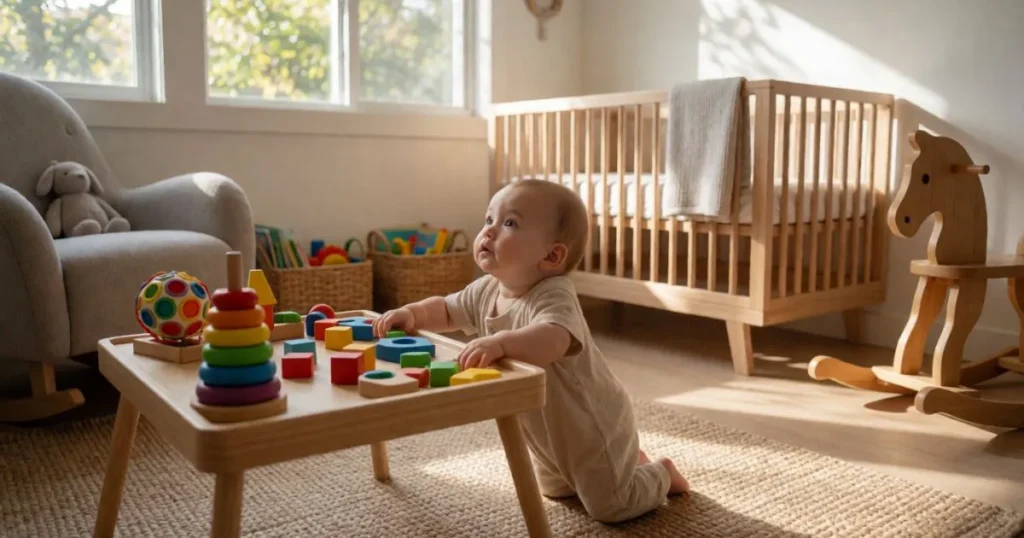
One of the biggest reasons for the 8–10 Month Sleep Regression is your baby’s growing desire to move.
By this age, many babies are eager to explore their world. Some are already crawling with confidence, while others are just beginning to scoot, climb, pull up to stand, or cruise along furniture as they develop new mobility skills.
During the 8–10 Month Sleep Regression, movement requires constant practice—and babies love practicing their newest abilities, even when they’re supposed to be sleeping.
You may notice your baby:
- Crawling around the crib.
- Rolling repeatedly instead of settling.
- Rocking on their hands and knees.
- Exploring every corner of the mattress.
- Pulling up to stand as soon as they’re placed in the crib.
These behaviors are completely normal during the 8–10 Month Sleep Regression. Your baby isn’t trying to avoid sleep—they’re excited to practice the physical skills they’ve worked so hard to learn. As their confidence grows and these milestones become more familiar, they’re more likely to settle at bedtime again.
They’re not trying to avoid sleep.
They’re simply excited to use their new skills whenever they have the chance.
Giving your baby plenty of supervised floor time during the day can help satisfy some of that urge to practice.
Pulling Up to Stand During the 8–10 Month Sleep Regression
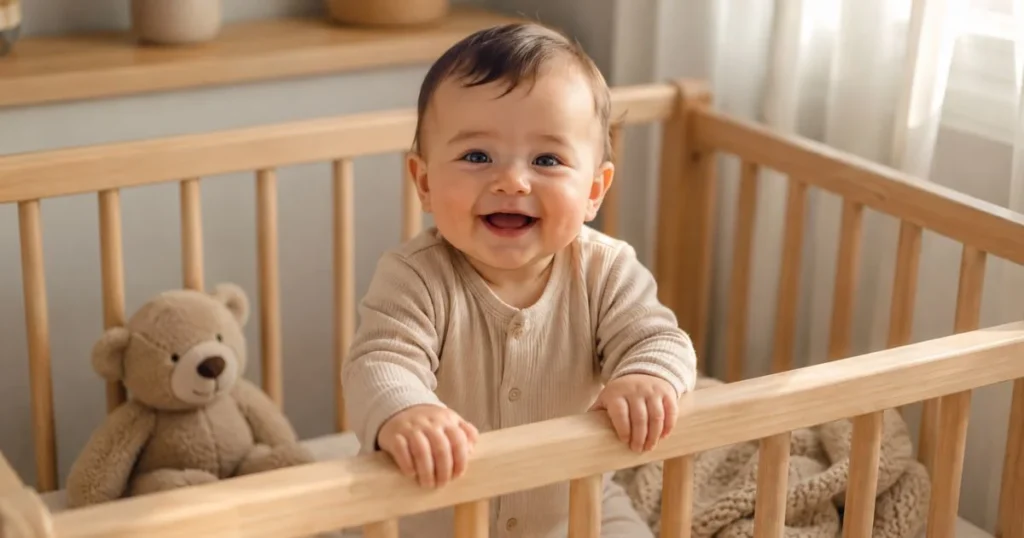
Few milestones surprise parents more than walking into the nursery and finding their baby standing in the crib.
Many babies learn to pull themselves up between 8 and 10 months, but they haven’t yet mastered how to sit back down smoothly.
As a result, they may:
- Stand up repeatedly after bedtime
- Cry because they can’t get back down
- Wake during the night and pull to stand again
- Become frustrated while trying to reposition themselves
This behavior is incredibly common and usually improves as your baby gains confidence moving between standing and sitting.
Practicing these transitions during the day can make bedtime less frustrating.
Rapid Brain Development During the 8–10 Month Sleep Regression
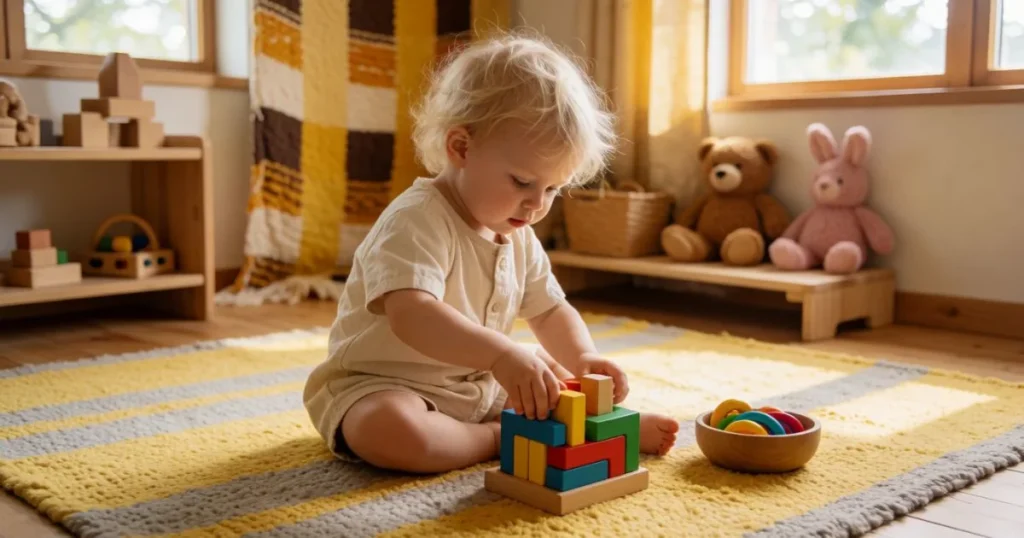
Your baby’s brain is developing rapidly during this stage. According to the developmental milestones from the CDC, babies between 8 and 10 months make significant gains in movement, communication, and problem-solving skills.
Every day, they’re learning to:
- Understand familiar words
- Recognize routines
- Remember where objects belong
- Solve simple problems
- Communicate through gestures and sounds
- Explore cause and effect
All of this learning continues to be processed during sleep.
It’s no surprise that your baby may have a harder time settling while their brain is working so hard.
Teething and the 8–10 Month Sleep Regression
Many babies begin cutting additional teeth during this stage.
Tender gums can make it more difficult to relax at bedtime or return to sleep after waking.
Common signs of teething include:
- Drooling
- Chewing on toys or fingers
- Swollen gums
- Mild irritability
However, it’s important to remember that teething doesn’t explain every restless night.
Developmental milestones and emotional changes often play a much larger role in the 8–10 month sleep regression.
Changes in Daily Routine
Sleep can also become less predictable if your baby’s daily routine changes.
Common examples include:
- Starting daycare
- Traveling
- Family visitors
- Dropping from three naps to two
- Changes in feeding schedules
- Illness or recovery from illness
Because babies thrive on predictability, even positive changes can temporarily affect sleep.
Returning to a consistent daily routine often helps your child regain a sense of comfort, stability, and security.
Is It Really the 8–10 Month Sleep Regression?
Not every sleep problem at this age is caused by a sleep regression.
Sometimes another issue is responsible—or several factors happen at the same time.
| Possible Cause | Typical Signs | Usually Temporary? |
| 8–10 Month Sleep Regression | Night wakings, clinginess, standing in the crib, nap resistance | ✅ Yes |
| Separation Anxiety | Crying when caregivers leave, needing extra reassurance | ✅ Yes |
| Teething | Swollen gums, drooling, chewing on objects | ✅ Yes |
| Routine Changes | Sleep changes after travel, daycare, illness, or schedule adjustments | ✅ Yes |
| Illness | Fever, persistent cough, poor feeding, unusual tiredness | ✅ Yes (requires medical evaluation if concerning) |
Looking at your baby’s overall behavior—not just nighttime sleep—can often help you understand what’s really going on.
Key Takeaway
The 8–10 month sleep regression is usually caused by a combination of developmental changes rather than a single problem.
During this stage, your baby may be:
- Developing separation anxiety
- Understanding object permanence
- Crawling and pulling up to stand
- Processing rapid brain development
- Cutting new teeth
- Adjusting to changes in daily routines
Although these milestones can temporarily disrupt sleep, they’re also exciting signs that your baby is growing emotionally, physically, and cognitively.
With time, reassurance, and consistent routines, most babies gradually return to more predictable sleep patterns.
10 Common Signs of the 8–10 Month Sleep Regression
No two babies experience the 8–10 Month Sleep Regression in exactly the same way.
During the 8–10 Month Sleep Regression, some babies simply wake more often during the night, while others suddenly refuse naps, cry whenever a parent leaves the room, or spend bedtime standing in the crib instead of sleeping.
These changes can seem dramatic, especially if your baby’s sleep had become more predictable over the previous months. Although the 8–10 Month Sleep Regression can be frustrating and exhausting, it is a normal stage of development for many babies.
The encouraging news is that the signs of the 8–10 Month Sleep Regression are usually temporary and are closely linked to healthy emotional, physical, and cognitive growth. As your baby masters new skills and adjusts to these developmental changes, sleep often becomes more consistent again.
Here are the most common signs parents notice during the 8–10 Month Sleep Regression.
1. Frequent Night Wakings
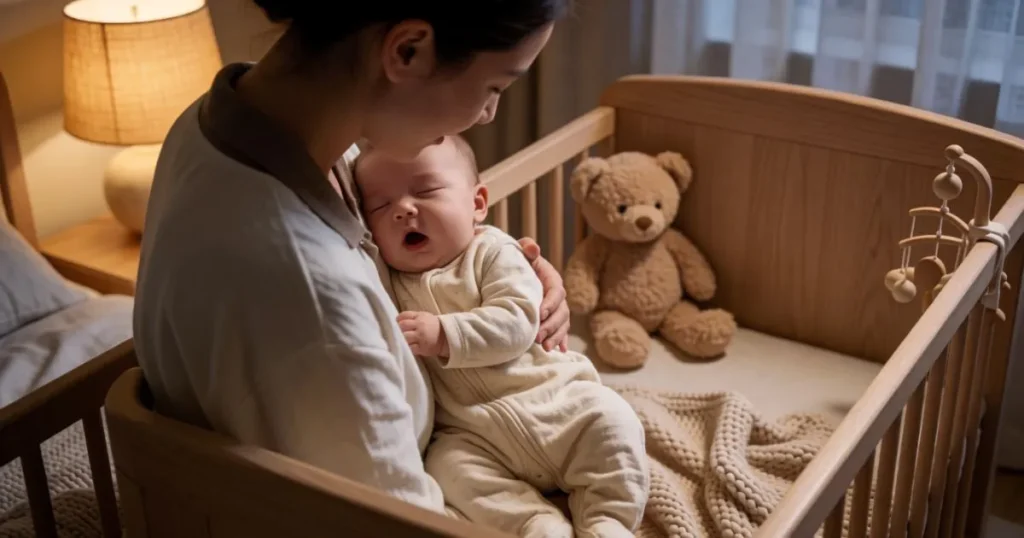
One of the earliest and most frustrating signs is a sudden increase in nighttime waking.
Your baby may begin waking:
- Every two to three hours
- Shortly after being put to bed
- Earlier than usual in the morning
- Multiple times despite previously sleeping longer stretches
Some wake-ups happen because your baby is seeking reassurance, while others may be linked to practicing new skills or adjusting to developmental changes.
What You Can Do During the 8–10 Month Sleep Regression
- Keep nighttime interactions calm and quiet.
- Use the same comforting routine for each waking.
- Give your baby a brief opportunity to resettle if they’re calm before stepping in.
2. Crying When You Leave the Room
This is one of the clearest signs that separates the 8–10 month sleep regression from earlier regressions.
Your baby may become upset when:
- You leave the bedroom
- You walk out of sight
- Another caregiver takes over bedtime
- They wake and don’t immediately see you
This behavior is often linked to separation anxiety and object permanence, both of which commonly develop during this stage.
3. Standing in the Crib During the 8–10 Month Sleep Regression

Many babies learn to pull themselves up between eight and ten months.
Unfortunately, learning to stand doesn’t always mean they know how to sit back down.
You may find your baby:
- Standing and crying
- Pulling up every time you lay them down
- Smiling proudly instead of sleeping
- Waiting for your help to get back down
While it can be frustrating, this is a normal part of motor development.
4. Crawling or Cruising at Bedtime

Some babies seem to think bedtime is the perfect time to practice new skills.
Instead of settling, they may:
- Crawl around the crib
- Roll repeatedly
- Rock on hands and knees
- Cruise along the crib rails
This behavior usually becomes less common as your baby gains confidence with these movements.
5. Refusing Naps
A baby who previously napped without difficulty may suddenly resist daytime sleep.
You might notice:
- Longer time to fall asleep
- Crying before naps
- Taking only short naps
- Skipping a nap entirely
Many babies simply don’t want to stop exploring their surroundings, even when they’re tired.
6. Increased Clinginess
Around this age, your baby may want to stay close to you throughout the day.
They may:
- Reach for you more often
- Prefer being held
- Become upset with unfamiliar people
- Need extra comfort before bedtime
This growing need for reassurance is a common part of emotional development.
7. Fighting Bedtime

Bedtime may suddenly become much more challenging.
Your baby may:
- Cry when placed in the crib
- Sit or stand immediately after lying down
- Want repeated cuddles
- Resist falling asleep even when clearly tired
Although this can be exhausting, staying calm and following a consistent bedtime routine often helps.
8. Shorter or More Restless Naps During the 8–10 Month Sleep Regression
Some babies continue taking naps but wake much sooner than expected.
Others sleep lightly and wake at the smallest sound.
You may notice:
- Thirty- to forty-five-minute naps
- Difficulty linking sleep cycles
- Waking still tired
- More movement during naps
As developmental excitement settles, naps often become longer again.
9. Early Morning Wake-Ups
Your baby may suddenly decide the day starts much earlier than you’d like.
Possible reasons include:
- Excitement to practice new skills
- Hunger
- Light entering the room
- Changes in sleep patterns
Keeping bedtime consistent and making the sleep environment as dark as possible may help reduce early waking.
10. More Active Sleep
Many parents notice their baby becomes much more active during sleep.
You may see your baby:
- Rolling frequently
- Changing positions often
- Sitting up briefly
- Pulling to stand after waking
- Babbling softly before falling asleep again
Not every movement requires intervention.
If your baby is calm and safe, giving them a brief opportunity to settle independently can sometimes prevent unnecessary wake-ups.
Quick Symptom Checklist
Use this checklist to see whether your baby’s sleep changes match the 8–10 month sleep regression.
| Symptom | Common During the 8–10 Month Sleep Regression? |
| Frequent night wakings | ✅ |
| Crying when you leave | ✅ |
| Standing in the crib | ✅ |
| Crawling at bedtime | ✅ |
| Nap resistance | ✅ |
| Increased clinginess | ✅ |
| Fighting bedtime | ✅ |
| Short naps | ✅ |
| Early morning waking | ✅ |
| Restless sleep | ✅ |
| Fever | ❌ |
| Difficulty breathing | ❌ |
| Persistent vomiting | ❌ |
If your baby has a fever, difficulty breathing, ongoing vomiting, signs of dehydration, refuses several feedings, or is unusually drowsy and hard to wake, don’t assume these sleep changes are simply part of a sleep regression.
Contact your pediatrician promptly.
Could It Be Something Else?
Sometimes several factors overlap, making sleep more challenging than usual.
For example:
- A baby learning to stand may also be teething.
- Separation anxiety may increase after travel or starting daycare.
- A mild illness may temporarily disrupt both naps and nighttime sleep.
- A change from three naps to two can affect bedtime for a few weeks.
Looking at your baby’s overall health, daily routine, and recent developmental milestones often provides the clearest explanation for changes in sleep.
Key Takeaway
The 8–10 Month Sleep Regression often brings more than frequent night wakings. During the 8–10 Month Sleep Regression, many babies also become clingier, cry when parents leave the room, practice standing or crawling in the crib, resist naps, and struggle to settle at bedtime.
While the 8–10 Month Sleep Regression can feel overwhelming, these changes are usually signs of healthy emotional, physical, and cognitive development. With reassurance, patience, and consistent routines, most babies gradually adjust as the 8–10 Month Sleep Regression comes to an end, and sleep becomes more predictable again.
How Long Does the 8-10 month sleep regression Usually Last?
If you’re in the middle of sleepless nights, you may find yourself wondering:
“When can I expect my baby’s sleep to become more predictable again?”
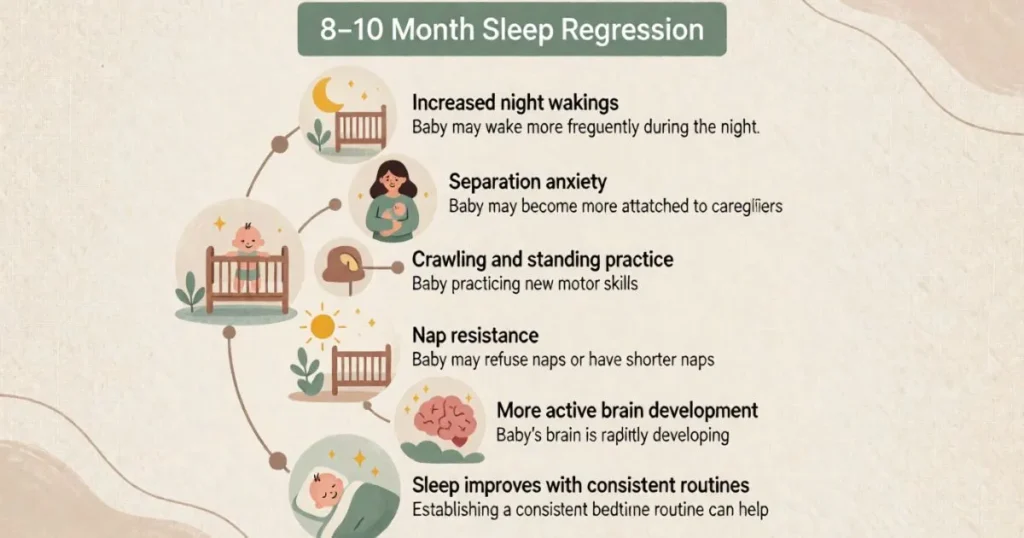
The encouraging news is that the 8–10 month sleep regression is only a temporary phase. Most babies begin sleeping more consistently again within two to six weeks as they adjust to these important developmental changes.
As your baby becomes more confident with new physical skills and learns to manage big emotions like separation anxiety, sleep often becomes more predictable again.
Unlike earlier regressions, improvement doesn’t happen because your baby “outgrows” sleep problems. Instead, it happens because they gradually adjust to important developmental changes.
Every Baby Experiences the 8–10 Month Sleep Regression Differently
There’s no exact schedule for the 8–10 month sleep regression.
Some babies move through this stage in just a couple of weeks, while others need a little longer.
The timeline may be influenced by:
- Separation anxiety
- Learning to crawl or cruise
- Pulling up to stand
- Teething
- Changes in nap schedules
- Illness or travel
- Your baby’s temperament
Some babies master a new skill quickly and return to longer stretches of sleep, while others need more time to adjust.
Both experiences can be completely normal.
Typical Timeline
| Timeline | What You Might Notice |
| Week 1 | Sudden bedtime resistance, more frequent waking, increased clinginess |
| Weeks 2–3 | Crawling, standing, and separation anxiety often become more noticeable |
| Weeks 4–6 | Many babies begin sleeping more consistently as new skills become familiar |
| Beyond 6 Weeks | Ongoing sleep challenges may be related to another developmental stage or another cause |
Remember that every baby develops at their own pace, so this timeline should be used as a general reference rather than a fixed rule. Every baby’s journey is unique.
Why Sleep Usually Improves After the 8–10 Month Sleep Regression
The encouraging part is that babies don’t stay in this stage forever.
As they become more confident with new skills, many bedtime struggles naturally decrease.
For example:
- Standing in the crib becomes less exciting.
- Crawling no longer feels like a brand-new adventure.
- Separation anxiety gradually becomes easier to manage.
- Daily routines become more familiar and predictable.
Many parents notice gradual improvements such as:
- Fewer night wakings
- Easier bedtimes
- Longer naps
- Less clinginess at bedtime
- More independent settling
Most babies improve gradually, with small steps forward over time rather than an overnight change.
Can the 8–10 Month Sleep Regression Last Longer?
Sometimes, yes.
If sleep challenges continue well beyond six weeks, the regression itself may not be the only reason.
Other possibilities include:
- Persistent separation anxiety
- Ongoing teething discomfort
- A major routine change
- Illness
- Another developmental milestone
- An inconsistent sleep schedule
If your baby’s sleep problems persist beyond a few weeks, or if you’re concerned about their health or development, contact your pediatrician for guidance.
Can Babies Skip the 8–10 Month Sleep Regression?
Yes.
Not every baby experiences a noticeable regression.
Some babies continue sleeping well with only minor changes, while others go through several weeks of disrupted sleep.
Both experiences are considered normal.
Every baby’s temperament, development, and sleep needs are different.
How to Handle Separation Anxiety at Bedtime
For many families, separation anxiety is the biggest challenge during the 8–10 month sleep regression.
Your baby isn’t intentionally making bedtime more challenging.
They’re learning something remarkable:
At this stage, your baby realizes that you still exist even when you’re out of sight.
That realization can make bedtime feel unsettling because your baby wants the reassurance of your presence.
The goal isn’t to eliminate separation anxiety overnight—it’s to help your baby feel safe while gradually building confidence.
Create a Predictable Goodbye Routine
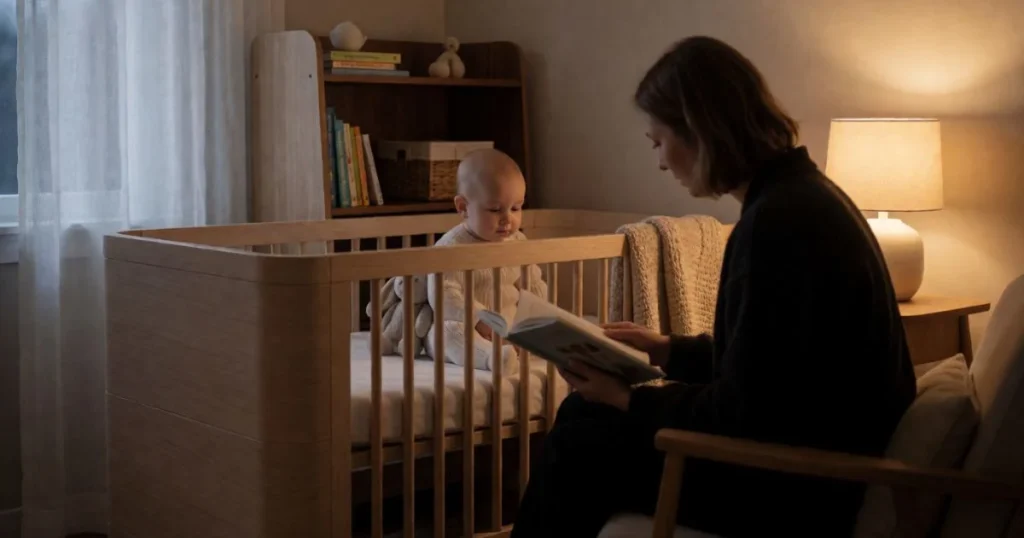
A predictable routine helps babies feel safe, secure, and confident about what comes next.
A simple bedtime sequence—such as a cuddle, a short phrase like “Goodnight, I love you,” and then leaving the room calmly—helps build trust over time.
Avoid changing the routine every night.
Consistency is reassuring.
Practice Short Separations During the Day
Bedtime isn’t the ideal moment to introduce longer periods of separation from your baby.
Instead, practice brief separations while your baby is awake.
For example:
- Step into another room for a moment.
- Talk or sing so your baby hears your voice.
- Return with a smile and warm interaction.
These brief moments teach your baby that even when someone leaves, they will return.
Play Peekaboo
Peekaboo isn’t just a fun game.
These experiences reinforce your baby’s growing understanding that people are still present, even when they can’t be seen.
This playful activity supports the development of object permanence, which may gradually reduce some bedtime anxiety.
Avoid Sneaking Out
It can be tempting to leave the room quietly while your baby is distracted or almost asleep.
During this stage, many parents find themselves asking the same important question:
Instead, say goodnight confidently and leave calmly.
Over time, your baby learns that bedtime doesn’t mean you’ve disappeared forever.
Offer Comfort Without Creating New Sleep Struggles
If your baby becomes upset, comfort them with a calm and reassuring response.
You might:
- Speak softly.
- Gently pat or rub their back.
- Offer brief comfort before giving them another opportunity to settle.
The goal is to help your baby feel secure while maintaining a consistent bedtime routine.
What If Your Baby Keeps Standing in the Crib?
During this stage, many parents find themselves asking the same question:
“Why does my baby keep getting back up every time I lay them in the crib?”
The positive news is that this behavior is a typical part of your baby’s development and is something many families encounter.
Many babies learn to pull themselves up before they fully master sitting back down.
As a result, they may stand, become frustrated, and cry for help.
Practice Sitting Down During the Day
The best solution often happens outside the bedroom.
During supervised play, encourage your baby to practice moving:
- From sitting to standing
- From standing back to sitting
As your baby gains confidence practicing these skills during the day, settling down at bedtime often becomes easier.
Stay Calm and Matter-of-Fact
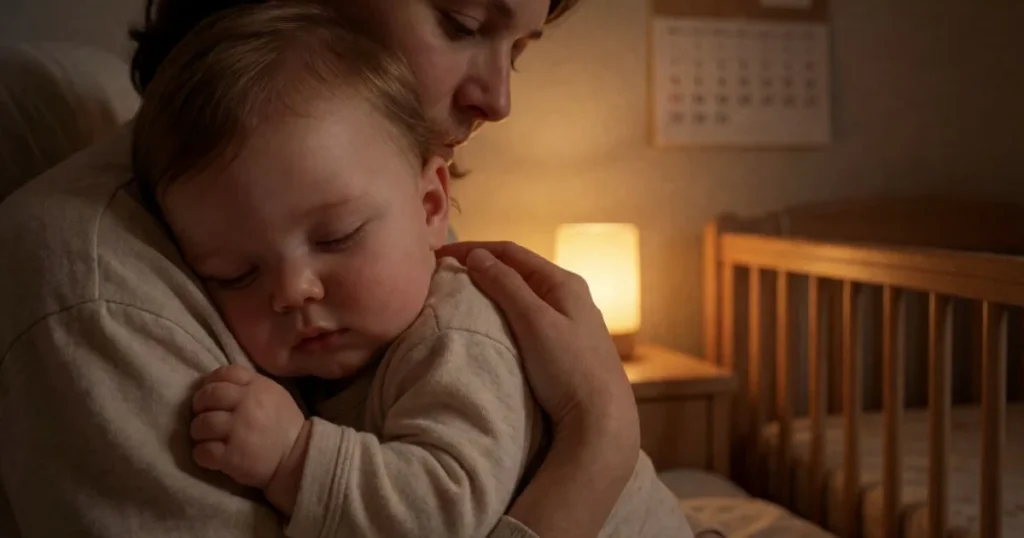
If your baby stands up after you’ve laid them in the crib:
- If needed, gently guide your baby back into a lying position without creating extra stimulation.
- Avoid turning it into a game.
- Repeat the same response each time.
A calm and consistent approach is often more effective than reacting with excitement or frustration.
Give Them Time to Figure It Out
Sometimes babies surprise us.
If your baby is content and simply practicing this new ability, allow them a brief opportunity to figure it out on their own before offering assistance.
With time and practice, many babies learn to lower themselves back down on their own.
Always ensure the crib is safe and free from items that could increase the risk of climbing or falling.
Key Takeaway
The 8–10 month sleep regression often lasts 2 to 6 weeks, but your baby’s timeline will depend on their individual development.
This stage can feel especially challenging because it combines big emotions, new physical skills, and greater awareness of separation.
Responding with consistency, reassurance, and plenty of daytime opportunities to practice new skills can help your baby build confidence while gradually returning to more restful sleep.
How to Help Your Baby Sleep Better During the 8–10 Month Sleep Regression
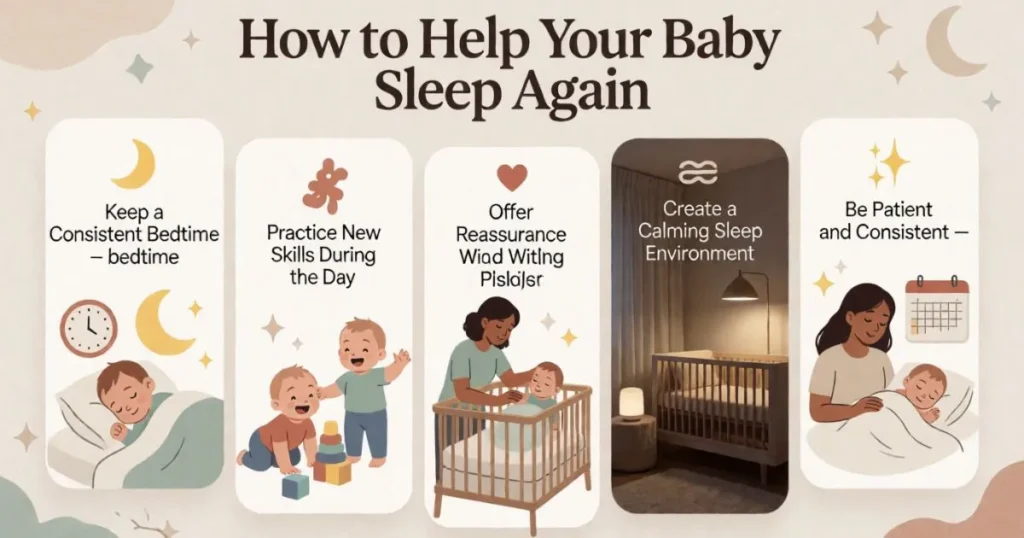
Although you can’t stop the 8–10 month sleep regression, you can create an environment that helps your baby feel safe, supported, and ready for sleep.
At this stage, babies are balancing exciting new physical abilities with rapidly developing emotions. They want to explore the world while also staying close to the people who make them feel secure.
The following strategies can help your baby navigate this stage while supporting healthy sleep habits.
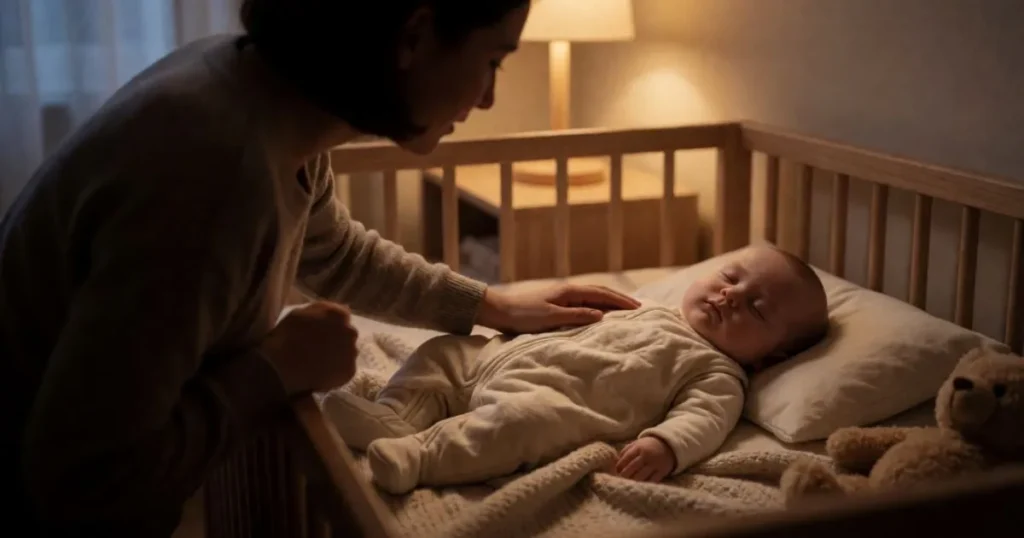
1. Keep Your Bedtime Routine Consistent
A predictable bedtime routine helps your baby understand that sleep comes next.
Your bedtime routine doesn’t need to be lengthy or elaborate. What matters most is following the same calming steps in the same sequence each evening.
Example Bedtime Routine for the 8–10 Month Sleep Regression
| Step | Activity |
| 1 | Warm bath (optional) |
| 2 | Fresh diaper and pajamas |
| 3 | Dim the lights |
| 4 | Milk feed |
| 5 | Read a favorite bedtime story or softly sing a calming lullaby. |
| 6 | Quiet cuddles |
| 7 | Place your baby in the crib while they’re sleepy and relaxed, but before they have completely fallen asleep. |
Over time, these familiar steps become powerful sleep cues.
2. Practice Crawling, Cruising, and Standing During the Day
Babies who are learning exciting new movements often want to practice them at bedtime.
Give your baby plenty of supervised opportunities to:
- Crawl
- Pull up to stand
- Cruise along furniture
- Sit down from standing
- Explore different movements safely
The more confident your baby becomes during the day, the less exciting those skills may feel at night.
3. Build Confidence During Short Separations
Since separation anxiety is common during this stage, help your baby learn that goodbyes are temporary.
Simple ways to practice include:
- Playing peekaboo
- Briefly stepping into a nearby room for a few moments.
- Returning with a smile and calm reassurance
- Letting another trusted caregiver occasionally help with bedtime
These small experiences gently teach your baby that you always come back.
4. Follow an Age-Appropriate Nap Schedule
Babies who get enough daytime rest often have an easier time settling at bedtime.
Many babies between 8 and 10 months thrive on two naps each day.
A predictable daytime routine can help prevent overtiredness, which may contribute to:
- More bedtime resistance
- Frequent night wakings
- Short early-morning sleep
If your baby misses a nap, try offering an earlier bedtime instead of extending their awake time.
5. Create a Calm Sleep Environment
As babies become more aware of their surroundings, a quiet sleep environment becomes even more important.
Aim for:
- A dark room
- A comfortable room temperature
- Using white noise if it helps your baby relax and fall asleep more easily.
- A firm mattress with a fitted sheet
- A crib free from pillows, blankets, toys, and bumpers
A calm, low-stimulation environment helps your baby concentrate on falling asleep rather than becoming distracted by what’s around them.
6. Encourage Self-Settling When Appropriate
Brief awakenings between sleep cycles are a normal part of infant sleep.
If your baby is calm, pause for a moment before rushing in.
They may:
- Roll into a comfortable position
- Sit briefly and lie back down
- Suck their fingers
- Settle back to sleep independently
This isn’t about ignoring your baby.
The goal is to give your baby the chance to practice the sleep skills they’re beginning to develop.
7. Respond Calmly to Night Wakings
When your baby wakes during the night, try to keep interactions quiet and predictable.
You can:
- Speak softly.
- Keep the lights dim.
- Avoid stimulating play.
- Offer gentle reassurance.
- Once your baby has settled, gently place them back in the crib.
Responding in a consistent way helps your baby gradually recognize the difference between daytime and nighttime.
8. Support Healthy Feeding Throughout the Day
Between 8 and 10 months, babies continue relying on breast milk or formula while gradually eating a wider variety of solid foods.
Offering regular milk feeds and balanced meals during the day helps support healthy growth and may reduce hunger-related night wakings.
Rather than focusing on one large meal before bed, aim for steady nutrition throughout the day.
Bedtime Mistakes to Avoid During the 8–10 Month Sleep Regression
When everyone is tired, it’s easy to try anything that promises more sleep.
At the same time, certain habits can accidentally make bedtime more difficult over time.
Sneaking Out Without Saying Goodbye
Quietly leaving while your baby is distracted may seem easier in the moment.
As babies develop object permanence, they may become more distressed when they notice that you’ve gone out of sight.
A calm, predictable goodbye usually builds more confidence over time.
Turning Standing Into a Bedtime Game
If your baby pulls up to stand repeatedly, avoid reacting with excitement or starting a game.
Instead:
- Stay calm.
- Gently help if needed.
- Repeat the same response consistently.
By responding calmly and consistently, you help your baby learn that bedtime is meant for rest rather than play.
Skipping Naps to Tire Your Baby Out
A common myth is that less daytime sleep leads to better nighttime sleep.
In reality, overtired babies often:
- Take longer to fall asleep.
- Wake more frequently.
- Sleep more restlessly.
Protecting naps usually supports better nights.
Constantly Changing Your Bedtime Routine
Trying a different approach every night can make it harder for your baby to understand what to expect.
Choose a simple bedtime routine that works for your family and follow it consistently whenever possible.
Comparing Your Baby to Others During the 8–10 Month Sleep Regression
At this age, some babies are able to sleep through the night.
Others continue waking for several months.
Both situations can be normal.
Your baby’s sleep is shaped by many factors, including their temperament, stage of development, feeding needs, and individual personality.
Focus on your baby’s progress rather than comparing them with friends, family members, or online stories.
Key Takeaway
The 8–10 month sleep regression is about much more than interrupted sleep.
Your baby is learning to move with confidence, understand relationships, and manage new emotions—all while trying to get the rest they need.
Supporting healthy sleep during this stage means balancing reassurance with opportunities for independence.
A predictable bedtime routine, plenty of daytime movement, consistent responses, and patience can help your baby feel secure as they work through these exciting developmental milestones.
Sample 8–10 Month Sleep Schedule
By 8 to 10 months, many babies have settled into a more predictable daily routine. Most sleep 12 to 15 hours within a 24-hour period, including nighttime sleep and two daytime naps.
Every baby is different, so treat this schedule as an example rather than a strict routine. Your baby’s sleep needs may vary depending on their temperament, development, and feeding schedule.
Example Daily Sleep Schedule
| Time | Activity |
| 7:00 a.m. | Wake up and milk feed |
| 8:00 a.m. | Breakfast (solids) |
| 9:30–11:00 a.m. | Morning nap |
| 11:15 a.m. | Milk feed and play |
| 12:30 p.m. | Lunch (solids) |
| 2:00–3:30 p.m. | Afternoon nap |
| 3:45 p.m. | Milk feed and play |
| 5:30 p.m. | Dinner (solids) |
| 6:45 p.m. | Begin bedtime routine |
| 7:15–7:30 p.m. | Bedtime |
As your baby approaches their first birthday, nap lengths and wake windows may gradually change. Follow your baby’s sleep cues while maintaining a consistent daily rhythm whenever possible.
Can You Sleep Train During the 8–10 Month Sleep Regression?
This is one of the most common questions parents ask during this stage.
The right approach depends on your baby’s unique needs as well as what works best for your family.
Some babies between 8 and 10 months may be developmentally ready for gentle sleep-learning approaches. Others may need extra reassurance while working through separation anxiety or mastering new physical skills.
Before beginning any sleep-training method, speak with your pediatrician to make sure it’s appropriate for your baby.
Whether you choose sleep training or not, healthy sleep habits remain valuable.
Focus on:
- A consistent bedtime routine
- Age-appropriate naps
- Plenty of daytime practice for crawling and standing
- Calm, predictable responses to night wakings
- A safe, comfortable sleep environment
Remember that consistency is often more important than choosing one specific sleep-training method.
When Should You Call Your Pediatrician?
Although the 8–10 month sleep regression is a normal developmental stage, some sleep problems require medical attention.
Contact your pediatrician if your baby:
- Has a fever or appears unusually ill.
- Has difficulty breathing or persistent coughing.
- Refuses several milk feeds or solids and shows signs of poor intake.
- Shows signs of dehydration, such as having noticeably fewer wet diapers than usual.
- Is unusually difficult to wake.
- Isn’t gaining weight as expected.
- Cries inconsolably for long periods.
- Continues having severe sleep difficulties well beyond the expected adjustment period or develops other concerning symptoms.
If you’re ever unsure whether your baby’s sleep changes are related to a regression or an illness, trust your instincts and seek medical advice.
Frequently Asked Questions About the 8–10 Month Sleep Regression
Is the 8-month sleep regression real?
Yes. Many babies experience a temporary period of disrupted sleep between 8 and 10 months as they develop new physical, emotional, and cognitive skills. Not every baby goes through a noticeable regression, but it’s a common stage of development.
Why does my baby get upset when I walk out of the room?
Around this age, many babies develop separation anxiety and object permanence. They understand that you still exist even when they can’t see you, which can make bedtime and nighttime separations more difficult.
Why does my baby keep pulling up to stand in the crib?
Learning to pull up is an exciting milestone. Many babies master standing before they learn how to sit back down smoothly, so they may stand, become frustrated, and cry for help.
Practicing standing and sitting during the day often helps build confidence.
Why is my baby waking every hour?
Frequent night waking during this stage can be linked to several factors, such as separation anxiety, newly developing movement skills, teething discomfort, changes in routine, or normal developmental growth.
Looking at your baby’s overall behavior can help identify the most likely cause.
Can crawling affect my baby’s sleep?
Yes.
As babies develop crawling skills, they may feel eager to practice them—even when it’s time to sleep or after waking during the night.
Providing plenty of supervised floor time during the day may help reduce nighttime practice.
How many naps should an 8- to 10-month-old take?
Most babies this age take two naps each day, although exact nap lengths vary from one child to another.
Can babies skip the 8–10 month sleep regression?
Absolutely.
Some babies experience only mild sleep changes, while others continue sleeping well throughout this developmental stage.
Both experiences are considered normal.
Should I pick up my baby every time they cry at night?
It depends on the situation.
If your baby is distressed, hungry, unwell, or needs comfort, respond to their needs. If they’re calm and briefly fussing between sleep cycles, giving them a moment to resettle may allow them to fall back asleep on their own.
A consistent, responsive approach works better than reacting differently every night.
Does teething cause the 8-month sleep regression?
Teething can make sleep more difficult, but it’s usually only one part of the picture.
Many babies are also developing separation anxiety, learning to crawl or stand, and processing rapid brain development—all of which can contribute to sleep changes.
How long can you expect the 8–10 Month Sleep Regression to last?
For most babies, the biggest changes in sleep patterns tend to improve within about two to six weeks. As your baby becomes more confident with new skills and emotions, sleep often improves gradually.
Conclusion
The 8–10 month sleep regression can be particularly demanding because your baby is going through several major developmental changes at the same time.
One day they’re happily crawling across the living room, the next they’re pulling up in the crib, crying when you leave the room, or waking more often than they have in months.
Although these changes can be exhausting, they’re also signs of healthy growth.
Your baby is learning to move independently, understand relationships, solve simple problems, and build strong emotional connections with the people they trust most.
During this stage, your calm presence matters just as much as your bedtime routine.
By offering reassurance, maintaining consistent sleep habits, and giving your baby plenty of opportunities to practice new skills during the day, you’re helping them build the confidence they need to sleep more peacefully again.
Like other sleep regressions, this phase is only temporary.
With patience, consistency, and time, most babies gradually return to more restful and predictable sleep—ready for the next exciting chapter of development.
Continue Your Baby Sleep Journey
As your little one grows, new milestones can bring new sleep challenges. Explore the next stages in our complete sleep regression series:
- Sleep Regression Ages: Complete Guide from 4 Months to 2 Years
- 4 Month Sleep Regression: Signs, Causes, How Long It Lasts & How to Help Your Baby Sleep Again
- 6 Month Sleep Regression : Signs, Causes, How Long It Lasts & How to Help Your Baby Sleep Again
Each stage is different, but one thing stays the same: your baby’s sleep reflects a period of incredible growth and learning. At Parenting Whisper, we’re here to support you with compassionate, evidence-informed guidance through every milestone.