
The 6 month sleep regression can feel like it appears just when your baby’s sleep is finally becoming more predictable. One week your 6-month-old may be sleeping longer stretches, settling easily at bedtime, and taking decent naps. Then, almost overnight, they’re waking more often, fighting sleep, or crying the moment you lay them in the crib.
If this sounds familiar, you’re not alone. Many parents are surprised by these sudden sleep changes and wonder what happened. If you’ve already navigated the challenges of the 4-month sleep regression, it can be frustrating to face another period of disrupted sleep just a couple of months later. You might question whether your baby is hungry, teething, or developing a new sleep habit.
In many cases, these changes are a normal part of your baby’s development.
At around six months, babies are growing rapidly in every way. They become stronger, more curious, and more mobile. They may be learning to roll in both directions, sit with support, babble more, or show greater interest in the people and world around them. These exciting milestones can temporarily make it harder for your baby to settle and stay asleep.
The reassuring news is that this stage doesn’t last forever.
In this guide, you’ll learn what causes the 6 month sleep regression, the signs to watch for, how long it usually lasts, and practical, gentle strategies to help your baby—and your family—sleep better again.
Safe sleep recommendations from the American Academy of Pediatrics

6 Month Sleep Regression: What Parents Need to Know
If you’re looking for quick answers, this table covers the basics.
| Question | Quick Answer |
| What is the 6-month sleep regression? | A brief phase of sleep disturbances that often coincides with major developmental milestones, increased movement, and changes in your baby’s daily routine. |
| When does it start? | Most babies experience it between 5½ and 7 months of age. |
| How long does it last? | For many babies, it lasts 2 to 6 weeks, though every baby is different. |
| Common signs | Frequent night wakings, shorter naps, bedtime resistance, fussiness, and early morning waking. |
| Main causes | Developmental leaps, rolling, sitting, growth spurts, feeding changes, and increased awareness of the environment. |
| Can you prevent it? | No, but healthy sleep habits and consistent routines can make the transition easier. |
| Will my baby sleep normally again? | Yes. As your baby adjusts to new developmental skills, sleep usually becomes more predictable. |
While this overview answers the most common questions, understanding why these changes happen can help you respond with greater confidence and less frustration.
What Is the 6 Month Sleep Regression?

The 6 month sleep regression is a temporary period when your baby suddenly begins sleeping less predictably after previously making progress. During the 6 month sleep regression, babies who were sleeping longer stretches may start waking more often at night, resisting naps, or taking longer to fall asleep.
Unlike the 4-month sleep regression, which is driven by a permanent change in how babies sleep, the 6 month sleep regression is usually linked to rapid physical, cognitive, and emotional development.
Around this age, your baby is becoming much more active. They may spend their days practicing new skills such as rolling, sitting, reaching, and preparing to crawl. Their brain is also processing more information than ever before as they recognize familiar faces, respond to their name, explore objects, and become increasingly interested in everything happening around them.
All of this learning continues long after bedtime.
It’s common for babies to wake during the night wanting comfort, practice new movements in the crib, or simply have difficulty settling because their busy brains are still processing the day’s experiences. These temporary sleep disruptions are a hallmark of the 6 month sleep regression.
Although the word “regression” suggests that sleep is moving backward, this stage actually reflects healthy development. Your baby’s growing body and brain are accomplishing incredible things, even if sleep temporarily becomes more challenging.
The good news is that, with patience and consistent sleep habits, most babies gradually return to more predictable sleep as they adjust to these exciting milestones and move beyond the 6 month sleep regression.
When Does the 6 Month Sleep Regression Start?
Despite its name, the 6 month sleep regression doesn’t usually start exactly when your baby reaches six months of age. The 6 month sleep regression can begin a few weeks earlier or later, depending on your baby’s unique development.
Every child develops at their own pace, so the timing varies from one baby to another. Some babies experience the 6 month sleep regression closer to 5½ months, while others don’t show signs until they’re nearly 7 months old.
Many parents first notice changes sometime between 5½ and 7 months, as their baby reaches important physical, cognitive, and social milestones.
Here’s a general timeline to help you understand when the 6 month sleep regression typically starts.
| Baby’s Age | What You Might Notice |
| 5 Months | Early sleep disruptions may begin as your baby becomes more mobile and alert. |
| 6 Months | The most common time for frequent night wakings, nap resistance, and bedtime struggles. |
| 7 Months | Some babies experience a later regression or continue adjusting as new milestones emerge. |
If your baby was born prematurely, your pediatrician may suggest using their adjusted age rather than their actual birth date when tracking developmental milestones, including changes associated with the 6 month sleep regression.
It’s also important to remember that not every baby experiences a noticeable 6 month sleep regression. Some babies move through this stage with only mild sleep changes, while others have several weeks of frequent night wakings, shorter naps, or difficulty settling at bedtime.
Every baby’s experience with the 6 month sleep regression is unique. Factors such as temperament, overall health, feeding patterns, and the pace of development can all influence how long sleep disruptions last and how noticeable they become.
How Is the 6 Month Sleep Regression Different From the 4 Month Regression?
Although parents often group sleep regressions together, the 4-month and 6-month sleep regressions happen for different reasons.
Understanding this difference can help you set realistic expectations and respond appropriately to your baby’s changing sleep.
| 4-Month Sleep Regression | 6-Month Sleep Regression |
| Caused by permanent changes in sleep cycles | Usually linked to rapid developmental milestones |
| Sleep architecture becomes more mature | Babies are learning new physical and cognitive skills |
| Every baby experiences mature sleep cycles | Not every baby has a noticeable 6-month regression |
| Focus is learning to connect sleep cycles | Focus is adjusting to increased mobility, curiosity, and growth |
Think of it this way:
At 4 months, your baby is learning how to sleep.
At 6 months, your baby is learning how to explore the world.
During the day, they may spend hours practicing new movements, studying faces, babbling, and reaching for everything within sight. Your baby’s growing curiosity and new experiences don’t disappear when it’s time to sleep.
Instead, their developing brain continues processing everything they learned throughout the day, which can temporarily make sleep lighter and more interrupted. This increased brain activity is one of the reasons the 6 month sleep regression can lead to more frequent night wakings and shorter naps.
This is also why the 6 month sleep regression often feels different from the earlier regression. Instead of adjusting to new sleep cycles, your baby is balancing rapid physical, cognitive, and emotional development with the need for restful sleep.
Understanding what happens during the 6 month sleep regression can help reassure you that these temporary sleep disruptions are a normal part of healthy growth and development.
What Causes the 6 Month Sleep Regression?

If your baby suddenly starts waking more often, fighting naps, or resisting bedtime around six months, you might wonder what changed.
The 6 month sleep regression is often triggered by several exciting developmental milestones happening at the same time.
At this age, your baby is becoming stronger, more mobile, and much more aware of the world. Every day brings new skills to practice, new sounds to imitate, and new experiences to process. While these milestones are wonderful signs of healthy development, they can temporarily interrupt sleep and contribute to the 6 month sleep regression.
Although every baby is different, the 6 month sleep regression is commonly linked to rapid physical, cognitive, and emotional growth rather than a single cause.
Let’s look at the most common reasons behind the 6 month sleep regression.
At around six months, babies are rapidly developing new physical, cognitive, and social skills. According to the CDC developmental milestones for 6-month-old babies, this is a time when many infants begin rolling, responding to their name, and showing increased curiosity about the world around them.
Rapid Physical Development and New Skills
Around six months, your baby is constantly practicing new ways to move. These exciting physical milestones are one of the most common reasons behind the 6 month sleep regression.
They may be:
- Rolling confidently in both directions
- Sitting with little or no support
- Pivoting during tummy time
- Scooting across the floor
- Rocking on hands and knees
- Preparing to crawl
Learning these skills takes an incredible amount of practice.
Even after bedtime, your baby may continue practicing these new movements in the crib instead of settling to sleep. During the 6 month sleep regression, it’s common for babies to wake between sleep cycles just to roll, sit up, or experiment with their latest skills.
Many parents walk into the nursery expecting to find a sleeping baby—but instead discover a smiling little one rolling, kicking, or trying to sit up.
Although these nighttime gymnastics can be exhausting for parents, they’re a normal part of the 6 month sleep regression and healthy development. Most babies return to more settled sleep once they’ve mastered their new motor skills.
Increased Curiosity and Awareness
By around six months, your baby’s world begins to expand in exciting new ways. Instead of simply observing what’s happening around them, they’re eager to explore, touch, and interact with everything they can.
Your baby may become fascinated by:
- Family members walking through the room
- Pets
- Toys
- Everyday household sounds
- Bright lights
- New places
Because they’re more aware of their surroundings, they’re also more likely to become distracted at bedtime or wake more easily during lighter stages of sleep.
A calm, predictable bedtime routine becomes even more important during this stage.
New Skills Can Disrupt Your Baby’s Sleep

Development doesn’t stop when your baby falls asleep.
Their brain continues organizing everything they practiced during the day.
Many six-month-olds are busy learning to:
- Sit independently
- Reach accurately for toys
- Pass toys and other objects from one hand to the other.
- Respond to their name
- Babble with new sounds
- Explore cause and effect
It’s common for babies to briefly wake and seem eager to “practice” these skills, even in the middle of the night.
While it can be surprising, it’s usually a sign that your baby is making exciting developmental progress.
Growth Spurts and Increased Hunger

Around six months, many babies experience another period of rapid growth. Growth spurts are one of the factors that can contribute to the 6 month sleep regression, as your baby may need extra calories to support their development.
During this time, they may:
- Want to feed more often
- Wake hungry overnight
- Drink larger milk feeds
- Show increased interest in food
Although growth spurts can temporarily increase nighttime wakings during the 6 month sleep regression, they usually don’t last long. Once your baby’s increased nutritional needs are met, their sleep often becomes more predictable again.
Remember that breast milk or formula remains your baby’s primary source of nutrition throughout the first year, even after solid foods are introduced. While some parents hope solids will improve sleep, introducing solid foods doesn’t usually bring the 6 month sleep regression to an end.
Starting Solids and Changes in Sleep

Around six months, many families begin introducing solid foods, making this an exciting stage of development. Parents often hope that starting cereal, purees, or finger foods will help end the 6 month sleep regression and encourage their baby to sleep through the night.
Unfortunately, that’s usually a myth.
While solid foods are an important part of your baby’s development, they don’t consistently lead to longer stretches of sleep or make the 6 month sleep regression disappear. Instead, solids should be introduced because your baby is developmentally ready to explore new tastes and textures—not as a sleep solution.
As your baby adjusts to eating solids, you may also notice temporary changes in:
- Feeding schedules
- Digestion
- Daily routines
These changes can sometimes influence sleep while your baby adapts, but they’re a normal part of development. If your baby is also experiencing the 6 month sleep regression, these routine changes may briefly make sleep feel even more unpredictable.
Teething and the 6 Month Sleep Regression

Around six months, many babies begin cutting their first teeth. Teething can happen at the same time as the 6 month sleep regression, making it difficult to know what’s causing your baby’s sleep changes.
Sore gums may make it harder for your baby to settle comfortably at bedtime or return to sleep after waking.
Common signs of teething include:
- Increased drooling
- Chewing on hands or toys
- Swollen gums
- Mild irritability
However, it’s important not to blame every difficult night on teething. While teething may contribute to temporary sleep disruptions, it’s not considered the primary cause of the 6 month sleep regression.
Many babies who are teething continue sleeping well, while others experience sleep changes mainly because of rapid developmental milestones. In many cases, the 6 month sleep regression and teething happen at the same time, making it difficult to tell which is having the biggest impact on your baby’s sleep.
Early Signs of Separation Anxiety

Although full separation anxiety often becomes stronger later in infancy, many six-month-olds begin showing early signs of preferring familiar caregivers. These early emotional changes can also contribute to the 6 month sleep regression, especially around bedtime and during night wakings.
You may notice your baby:
- Reaching for you more often
- Becoming upset when you leave the room
- Wanting extra cuddles before bed
- Settling more easily when they can hear your voice
During the 6 month sleep regression, your baby may seek extra comfort and reassurance as they become more aware of the people around them. Offering calm, consistent responses can help them feel secure while they adjust to this new stage of development.
This growing emotional awareness is another normal part of development and can contribute to temporary changes in sleep.
Is It Really the 6 Month Sleep Regression?
Not every sleep disruption at six months is caused by a sleep regression.
In some cases, disrupted sleep may be caused by something else—or by a combination of factors occurring at the same time.
| Possible Cause | Typical Signs | Usually Temporary? |
| 6-Month Sleep Regression | Night wakings, nap resistance, increased mobility, bedtime struggles | ✅ Yes |
| Growth Spurt | Increased hunger and more frequent feeding | ✅ Yes |
| Starting Solid Foods | Changes in feeding routines or digestion | ✅ Yes |
| Teething | Swollen gums, drooling, chewing on objects | ✅ Yes |
| Illness | Fever, congestion, coughing, poor feeding | ✅ Yes (requires medical attention if concerning) |
Looking at the bigger picture can help you understand why your baby’s sleep has changed and avoid assuming there’s only one cause.
Key Takeaway
The 6-month sleep regression is rarely caused by a single event.
Instead, it’s often the result of several exciting developmental changes happening at once, including:
- Increased mobility
- Learning new physical skills
- Greater curiosity about the world
- Growth spurts
- Starting solid foods
- Early separation awareness
- Possible teething
Although these milestones can temporarily interrupt sleep, they’re also signs that your baby is growing exactly as expected.
With patience, consistency, and time, many babies gradually settle back into more predictable sleep patterns.
10 Common Signs of the 6 Month Sleep Regression
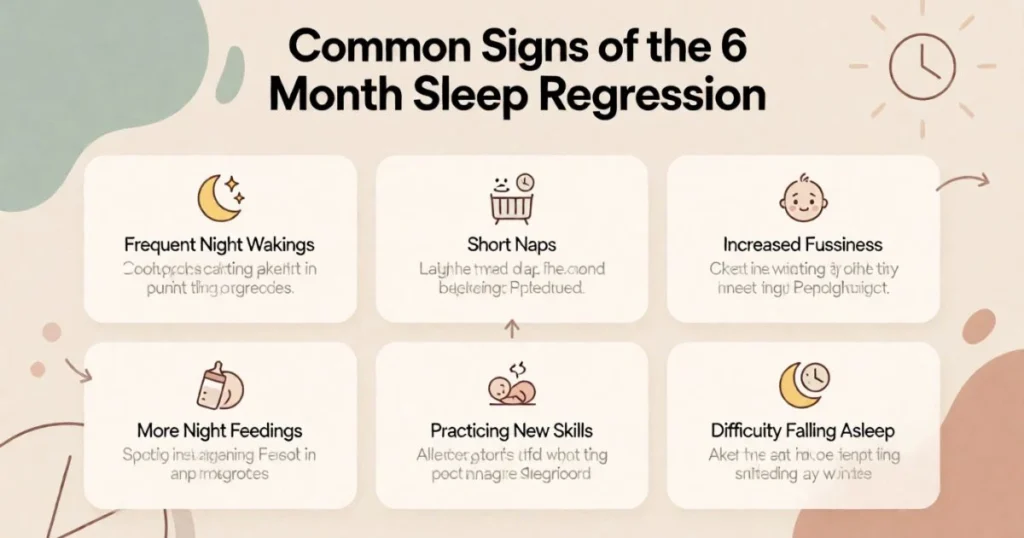
Every baby experiences the 6 month sleep regression differently.
Some babies wake only one extra time each night, while others suddenly resist naps, wake every couple of hours, or seem determined to practice new skills instead of sleeping. The 6 month sleep regression can look very different from one baby to another.
You may notice just one or two of these changes, or several happening at the same time. Common signs of the 6 month sleep regression include more frequent night wakings, shorter naps, bedtime resistance, and difficulty settling back to sleep.
The reassuring part is that these sleep disruptions are usually temporary and closely linked to your baby’s rapid physical, cognitive, and emotional development. Most babies gradually return to more predictable sleep as they move beyond the 6 month sleep regression.
Here are the most common signs to watch for.
1. Frequent Night Wakings

One of the first signs of the 6 month sleep regression is that your baby begins waking much more often during the night.
A baby who previously slept longer stretches may suddenly wake every two or three hours—or even more frequently. These frequent night wakings are among the most common symptoms of the 6 month sleep regression.
These wake-ups are often linked to:
- Practicing new developmental skills
- Increased awareness of the environment
- Growth spurts
- Temporary discomfort from teething
Because several changes can overlap at this age, there isn’t always a single reason for every waking. In many cases, the 6 month sleep regression is caused by a combination of rapid physical, cognitive, and emotional development rather than one specific factor.
What You Can Do
- Keep nighttime interactions calm and quiet.
- Avoid bright lights and stimulating play.
- Follow the same soothing routine each time your baby wakes.
- Give your baby a brief moment to settle before responding if they’re not distressed.
2. Fighting Naps

During the 6 month sleep regression, your baby may suddenly seem determined not to nap.
Instead of drifting off easily, they may:
- Cry when it’s time for a nap
- Stay awake much longer than usual
- Want to keep playing
- Become frustrated when you try to settle them
This often happens because the world has become much more interesting than sleep. As your baby’s curiosity and developmental skills grow, they may find it difficult to slow down and fall asleep during the day.
Even though your baby may resist naps, they still need plenty of daytime sleep to avoid becoming overtired. An overtired baby may have even more difficulty falling asleep and staying asleep, which can make the 6 month sleep regression feel even more challenging for the whole family.
3. Shorter Naps
Many six-month-olds begin waking after only one sleep cycle.
You might notice naps lasting:
- 30 minutes
- 40 minutes
- 45 minutes
Your baby may wake smiling and ready to play—or wake still tired and fussy.
Short naps often improve as babies become more comfortable balancing developmental milestones with healthy sleep.
4. Practicing New Skills in the Crib
This is one of the clearest signs that makes the 6-month sleep regression different from the 4-month regression.
Instead of sleeping, your baby may:
- Roll over repeatedly
- Sit up after waking
- Rock on hands and knees
- Bounce excitedly
- Reach for the crib rails
They’re not trying to avoid sleep.
They’re simply practicing exciting new skills whenever they have the opportunity—even in the middle of the night.
5. Increased Fussiness
Interrupted sleep can make babies more sensitive during the day.
You may notice your baby becomes:
- More clingy
- Easier to upset
- Harder to soothe
- Less patient during playtime
Keep in mind that fussiness can also be caused by teething, illness, or hunger, so consider your baby’s overall behavior rather than focusing on sleep alone.
6. More Night Feedings
Waking to Feed More Often
Around six months, parents often wonder whether every nighttime wake-up during the 6 month sleep regression means their baby is hungry.
The answer depends on the individual baby.
Some babies experience a growth spurt and genuinely need additional feeds. Others wake mainly because they’re adjusting to rapid developmental changes rather than because they’re hungry. During the 6 month sleep regression, it’s common for hunger and normal sleep disruptions to overlap.
If you’re unsure whether your baby still needs nighttime feeds, discuss their feeding needs with your pediatrician. They can help you determine whether your baby’s night wakings are related to hunger, growth, or the 6 month sleep regression.
7. Early Morning Wake-Ups
Has your baby started waking happily before sunrise?
Early rising can become more common during the 6-month sleep regression.
Possible reasons include:
- Light entering the room
- Overtiredness from poor naps
- Hunger
- Excitement to start the day
Blackout curtains, a consistent bedtime, and appropriate daytime sleep may help reduce very early mornings.
8. Bedtime Suddenly Takes Much Longer

During the 6 month sleep regression, a bedtime routine that once took 15 minutes may suddenly stretch to 45 minutes or more.
Your baby may seem:
- Wide awake
- Easily distracted
- Interested in everything around them
- Ready to practice rolling instead of sleeping
As your baby’s curiosity and developmental skills grow, settling down for sleep can become more challenging. During the 6 month sleep regression, many babies are simply more interested in exploring their surroundings than falling asleep.
Although longer bedtimes can be frustrating, maintaining a calm and consistent bedtime routine can help your baby gradually settle as they move through the 6 month sleep regression.
A predictable bedtime routine helps signal that it’s time to wind down, even when your baby seems determined to stay awake.
9. Restless Sleep
Many babies become noticeably more active while sleeping.
You may see:
- Rolling
- Leg kicking
- Turning frequently
- Soft babbling
- Brief crying
- Frequent movement
These behaviors are often normal parts of lighter sleep and active development.
Unless your baby is distressed or in an unsafe position, they don’t always need intervention.
10. Suddenly Refusing to Sleep Alone

Some babies who previously settled well in their crib begin wanting extra reassurance.
You may notice your baby:
- Wants to be held longer before bed
- Cries when placed in the crib
- Settles quickly when you return
- Sleeps better with your presence nearby
Around six months, babies become more socially aware and may seek additional comfort from familiar caregivers during times of rapid change.
Offering reassurance while maintaining a consistent bedtime routine can help your baby feel secure.
Quick Symptom Checklist
If you’re wondering whether your baby’s sleep changes are part of the 6-month sleep regression, this simple checklist can help you identify the signs.
| Symptom | Common During the 6-Month Sleep Regression? |
| Frequent night wakings | ✅ |
| Fighting naps | ✅ |
| Short naps | ✅ |
| Rolling or sitting in the crib | ✅ |
| Increased fussiness | ✅ |
| More night feeding | ✅ |
| Early morning waking | ✅ |
| Longer bedtime routine | ✅ |
| Restless sleep | ✅ |
| Wanting extra comfort | ✅ |
| Fever | ❌ |
| Difficulty breathing | ❌ |
| Persistent vomiting | ❌ |
If your baby develops fever, breathing difficulties, signs of dehydration, persistent vomiting, refuses several feeds, or seems unusually difficult to wake, don’t assume it’s simply the 6-month sleep regression. Contact your pediatrician for advice.
Could It Be Something Else?
Changes in your baby’s sleep at six months aren’t always caused by just one factor. In many cases, the 6 month sleep regression is influenced by several developmental and physical changes happening at the same time.
For example:
- A baby who is learning to sit may also be teething.
- A growth spurt may happen at the same time as starting solid foods.
- A mild cold can temporarily make sleep more restless.
When several of these factors overlap, the 6 month sleep regression may feel more intense or last a little longer than expected.
Rather than trying to identify one perfect cause, consider everything that’s happening in your baby’s life. Looking at the bigger picture—including your baby’s development, feeding, health, and daily routine—often provides the clearest understanding of what’s behind the 6 month sleep regression.
Key Takeaway
The 6-month sleep regression often brings frequent night wakings, nap resistance, shorter naps, and bedtime struggles. What makes this stage unique is that many babies are also learning exciting new physical skills, becoming more curious about the world, and seeking extra comfort from familiar caregivers.
Although these sleep disruptions can feel exhausting, they’re usually temporary and often improve as your baby becomes more confident with their new developmental milestones.
How Long Does the 6 Month Sleep Regression Usually Last?
If your baby’s sleep suddenly feels unpredictable again, it’s natural to wonder how long the 6 month sleep regression lasts.
The good news is that the 6 month sleep regression is usually temporary.
For many babies, the most noticeable sleep disruptions last between 2 and 6 weeks. As your baby becomes more confident with new developmental skills and settles into changing routines, sleep often starts to become more predictable again. Although every baby is different, most families find that the 6 month sleep regression gradually improves with time.
Unlike the 4-month sleep regression, which reflects a lasting change in how babies sleep, the 6 month sleep regression is usually driven by temporary developmental milestones rather than permanent changes in sleep patterns. Once those milestones become more familiar, many babies return to longer stretches of sleep and more consistent naps.
Remember that every baby’s timeline is unique. Some babies move through the 6 month sleep regression in just a couple of weeks, while others need a little longer before their sleep settles again.
Every Baby Adjusts at Their Own Pace
It’s important to remember that there isn’t a universal timeline for the 6 month sleep regression.
Some babies experience only a few restless nights, while others have several weeks of disrupted sleep. Every baby’s experience with the 6 month sleep regression is unique.
How long the 6 month sleep regression lasts depends on several factors, including:
- Your baby’s temperament
- New physical milestones
- Feeding patterns
- Nap quality
- Teething discomfort
- Daily routines
- Illness or travel
Because every baby develops at their own pace, there’s no exact end date for the 6 month sleep regression. With time, patience, and consistent sleep habits, most babies gradually return to more predictable sleep as they adjust to this stage of development.
One baby may adapt quickly after learning to roll confidently, while another may continue practicing new skills for several weeks.
Both experiences can be completely normal.
Typical Timeline
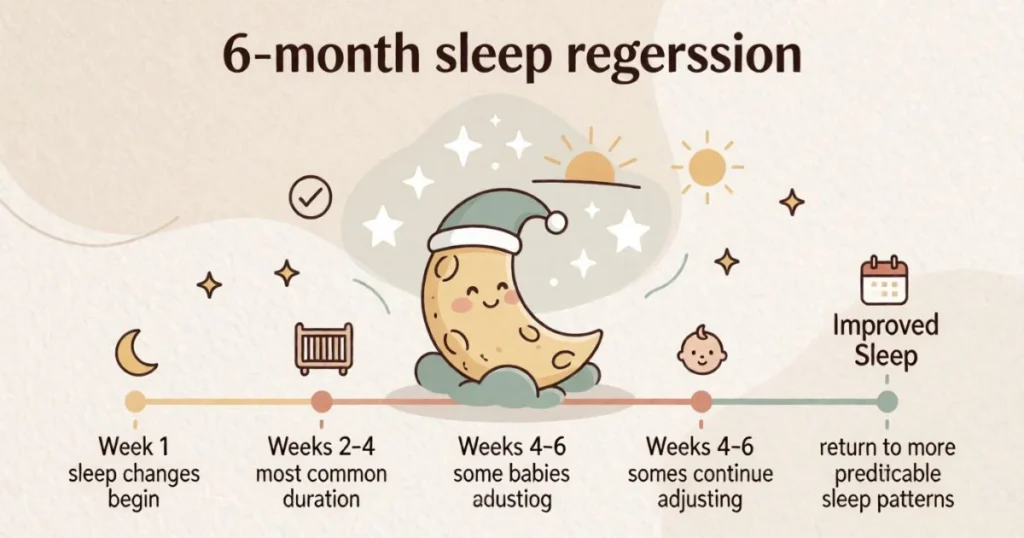
| Timeline | What You Might Notice |
| Week 1 | Sudden increase in night wakings or nap resistance |
| Weeks 2–3 | Baby continues practicing new physical and cognitive skills |
| Weeks 4–6 | Sleep gradually becomes more predictable as new skills improve |
| Beyond 6 Weeks | Ongoing sleep challenges may be related to another developmental change or another cause |
Think of this timeline as a general guide rather than a strict schedule.
Why Sleep Usually Improves
One of the most encouraging things about the 6 month sleep regression is that many babies begin sleeping more predictably once they become confident with their new abilities.
For example, a baby who spends several nights rolling over in the crib may gradually lose interest after mastering the skill. As these developmental milestones become familiar, the 6 month sleep regression often starts to improve.
The same is true for:
- Sitting independently
- Moving around more confidently
- Exploring new sounds
- Becoming familiar with solid-food routines
As these experiences become part of everyday life, they usually become less exciting at bedtime, making it easier for your baby to settle and stay asleep.
Many parents notice gradual improvements after the 6 month sleep regression, such as:
- Longer naps
- Fewer night wakings
- Easier bedtimes
- Better self-settling
- More predictable daily routines
These positive changes are reassuring signs that your baby is adapting to this stage of development and moving beyond the 6 month sleep regression.
Improvement usually happens gradually, with small steps adding up over time.
Can the 6 Month Sleep Regression Last Longer Than 6 Weeks?
Sometimes, yes.
If your baby’s sleep continues to be difficult beyond six weeks, it doesn’t necessarily mean the 6 month sleep regression is still happening. In many cases, the 6 month sleep regression has ended, but another factor may be affecting your baby’s sleep.
Common possibilities include:
- Ongoing teething discomfort
- A new developmental milestone
- Illness
- Travel or changes in routine
- An inconsistent sleep schedule
- A sleep environment that no longer supports healthy sleep
If sleep difficulties continue well beyond the typical timeframe for the 6 month sleep regression, or you’re concerned about your baby’s sleep, feeding, or overall health, it’s a good idea to speak with your pediatrician. They can help identify whether another issue may be contributing to your baby’s sleep disruptions.
Sometimes several of these factors overlap, making it seem as though the regression never ended.
If your baby continues struggling with sleep for an extended period or develops other concerning symptoms, it’s worth discussing the situation with your pediatrician.
Can Babies Skip the 6 Month Sleep Regression?
Yes.
Not all babies go through a noticeable 6 month sleep regression. Some babies move through this developmental stage with only minor sleep changes, while others may not experience a 6 month sleep regression at all.
Instead, they may simply:
- Wake once or twice more than usual
- Take a few shorter naps
- Need extra comfort for several days
This doesn’t mean they’re missing an important developmental milestone. Every baby develops at their own pace, and some adjust to new skills with only minor changes to their sleep.
If your baby seems to skip the 6 month sleep regression, that’s completely normal. Healthy sleep patterns vary from one child to another, and not every baby experiences noticeable sleep disruptions during this stage.
Can You Prevent the 6 Month Sleep Regression?
One of the most common questions parents ask is whether they can stop the 6 month sleep regression before it starts.
Unfortunately, the answer is no.
Because the 6 month sleep regression is linked to healthy growth and development, it isn’t something you can prevent. Developing skills such as rolling, sitting, exploring, communicating, and engaging with the world are all important parts of your baby’s progress.
Although your baby’s sleep may be unsettled for a while, these developmental milestones are healthy signs that they’re learning and growing. The 6 month sleep regression is usually a temporary phase that reflects these exciting changes.
What you can do is support healthy sleep habits that help your baby move through the 6 month sleep regression more comfortably.
Helpful habits include:
- Following a consistent bedtime routine
- Offering age-appropriate naps
- Encouraging plenty of daytime practice for new motor skills
- Providing regular breast milk or formula feeds and introducing solids when your baby is developmentally ready
- Creating a calm, sleep-friendly bedroom
- Responding consistently to nighttime wakings
These habits won’t prevent the 6 month sleep regression, but they can make it easier for your baby to adjust while supporting healthy sleep and development.
A Gentle Reminder for Parents
It can be discouraging when your baby’s sleep suddenly becomes less predictable after making progress during the 6 month sleep regression.
You may wonder:
- “Why is my baby’s sleep changing again after we finally settled into a good routine?”
- “Did I do something wrong?”
- “Will my baby eventually begin sleeping through the night more often?”
If you’re asking these questions, you’re not alone. The 6 month sleep regression can be challenging, but it’s usually a temporary part of healthy development rather than a reflection of your parenting.
As your little one masters new skills and reaches important physical, cognitive, and emotional milestones, their growing brain and body may temporarily make restful sleep more difficult. Although the 6 month sleep regression can feel exhausting, these changes are often reassuring signs that your baby is learning and growing.
With time, patience, and consistent sleep routines, most babies gradually move beyond the 6 month sleep regression and return to longer stretches of sleep. Until then, remember that every small step forward is part of your baby’s journey toward more mature and predictable sleep.
Key Takeaway
The 6-month sleep regression usually lasts 2 to 6 weeks, although every baby follows their own timeline.
As your baby becomes more confident with new physical and cognitive skills, sleep often becomes more predictable again.
The goal isn’t to rush your baby through this stage but to support them with consistent routines, plenty of daytime practice, and realistic expectations while they continue growing.
How to Help Your Baby Sleep During the 6 Month Sleep Regression
While you can’t prevent the 6-month sleep regression, there are plenty of gentle ways to support better sleep for both you and your baby during this stage.
Rather than searching for a quick fix, focus on supporting your baby’s rapidly changing developmental needs. At six months, sleep often improves when babies have plenty of opportunities to practice new skills, follow predictable routines, and feel safe and secure at bedtime.
Here are practical strategies that can help.
1. Let Your Baby Practice New Skills During the Day
One of the biggest reasons sleep becomes disrupted at six months is that babies are busy learning exciting new movements.
If your baby is trying to:
- Roll
- Sit independently
- Pivot during tummy time
- Rock on hands and knees
- Prepare for crawling
give them lots of supervised floor time during the day.
The more opportunities they have to practice these skills while awake, the less likely they are to spend bedtime practicing them in the crib.
Treat the day as a time for learning and practice, and the night as a time for rest and sleep.
2. Keep a Predictable Bedtime Routine
Your baby’s world feels much bigger now than it did just a few months ago.
A familiar bedtime routine helps signal that the busy day is ending and sleep is coming next.
Your routine doesn’t need to be complicated.
Example Bedtime Routine
| Step | Activity |
| 1 | Warm bath (optional) |
| 2 | Fresh diaper and pajamas |
| 3 | Dim the lights |
| 4 | Milk feed |
| 5 | Read a short book or sing quietly |
| 6 | Gentle cuddles |
| 7 | Place your baby in the crib while calm and sleepy |
Repeating the same sequence each evening creates consistency, even when sleep isn’t perfect.
3. Follow Age-Appropriate Wake Windows
Keeping your baby awake too long can make bedtime much harder.
Many six-month-olds do well with wake windows of approximately 2 to 3 hours, though every baby is different.
Example Wake Windows
| Time of Day | Suggested Wake Window |
| Morning | 2–2¼ hours |
| Midday | 2¼–2½ hours |
| Afternoon | 2½–3 hours |
| Before Bed | 2½–3 hours |
Instead of watching the clock alone, pay attention to your baby’s sleepy cues and adjust as needed.
4. Continue Prioritizing Milk Feeds
As your baby begins eating solid foods, you may wonder whether milk feeds are still as important as before.
The answer is no.
At around six months, breast milk or infant formula remains your baby’s main source of nutrition. Solid foods are introduced to complement milk, helping your baby explore new tastes and textures while gradually learning to eat.
To support healthy sleep:
- Continue offering breast milk or formula as recommended for your baby.
- Introduce solids as part of a balanced feeding routine, not as a strategy to make your baby sleep longer.
- Offer solids when your baby is alert and ready to explore new foods.
Meeting your baby’s nutritional needs during the day may help reduce hunger-related night waking, but there’s no guarantee that introducing solids will lead to sleeping through the night.
5. Create a Calm Sleep Environment

At six months, babies notice much more than they did as newborns.
A quiet, consistent sleep space helps reduce unnecessary stimulation.
Aim for:
- A dark room
- A comfortable temperature
- White noise if it’s helpful
- A firm mattress with a fitted sheet
- A crib free from pillows, blankets, bumpers, and toys
Following safe sleep recommendations remains important throughout your baby’s first year.
6. Give Your Baby a Moment to Resettle
It’s normal for babies to move, stretch, or make small noises between sleep cycles.
If your baby isn’t crying or distressed, pause briefly before stepping in.
Sometimes they’ll:
- Roll over
- Find a comfortable position
- Suck their fingers
- Settle back to sleep on their own
This isn’t about leaving your baby to cry. It’s simply giving them a chance to practice settling if they’re able.
7. Support Healthy Naps
Daytime sleep and nighttime sleep work together.
When naps are skipped or consistently too short, babies can become overtired, making bedtime more difficult.
If naps have been unpredictable:
- If your baby shows signs of tiredness, try offering the next nap a bit earlier than usual.
- Move bedtime earlier after a day of poor naps.
- Keep nap routines calm and consistent.
- Don’t expect every nap to be perfect.
Some days will naturally go more smoothly than others.
8. Stay Consistent Even on Difficult Nights
When you’re exhausted, it’s tempting to change your approach every evening.
One night you may rock your baby to sleep.
The next night you try a completely different strategy.
While flexibility is sometimes necessary, changing routines constantly can make it harder for your baby to know what to expect.
Choose a bedtime routine that works for your family and stick with it as consistently as possible.
Simple, consistent routines are often more effective than complicated sleep techniques.
Can Starting Solid Foods Affect Your Baby’s Sleep?
Around six months of age, it’s common for babies to begin eating solid foods at the same time their sleep patterns start to change.
Because these milestones overlap, it’s easy to assume they’re directly connected.
Many parents have heard that giving cereal before bed or increasing solid foods will help a baby sleep through the night.
Current evidence doesn’t consistently support that idea.
While some babies naturally begin sleeping for longer stretches around the same age they start solids, introducing complementary foods alone hasn’t been shown to reliably improve sleep for most infants.
Instead of using solids as a sleep strategy, focus on:
- Offering breast milk or formula as your baby’s primary nutrition.
- Introducing a variety of age-appropriate foods.
- Giving your baby the opportunity to discover new flavors and textures at a pace that feels comfortable for them.
- Allowing your baby to discover new flavors and textures at a pace that feels comfortable for them.
Healthy eating supports healthy development, but it isn’t a guaranteed solution for nighttime waking.
Common Mistakes Parents Make During the 6 Month Sleep Regression
When sleep suddenly becomes unpredictable, it’s understandable to look for anything that might help.
However, a few common misconceptions can sometimes make this stage more challenging.
Offering Extra Solids Hoping for Longer Sleep
Many parents are told that a fuller stomach means a better night’s sleep.
In reality, introducing more solid food than your baby needs isn’t a proven way to reduce night waking.
Feed your baby according to their hunger cues and your healthcare provider’s guidance rather than using solids as a sleep aid.
Forgetting Daytime Practice
A baby who spends very little time practicing rolling, sitting, or moving while awake may be more eager to practice these skills at bedtime.
Regular supervised floor play gives your baby opportunities to learn and explore during the day.
Assuming Every Wake-Up Is Teething
Teething can certainly disrupt sleep.
However, frequent waking at six months may also be related to developmental milestones, growth spurts, or changes in routine.
Looking at your baby’s overall behavior often gives a clearer picture than focusing on one possible cause.
Keeping Your Baby Awake Too Long
Some parents hope that skipping naps or extending wake windows will lead to better nighttime sleep.
More often, an overtired baby has greater difficulty settling and may wake more frequently overnight.
Protecting daytime sleep usually supports better nights.
Comparing Your Baby to Others
It’s easy to wonder why another baby seems to sleep through the night while yours doesn’t.
Every baby develops differently.
Temperament, feeding needs, health, and developmental timing all influence sleep.
Comparing your baby with others rarely tells the whole story.
Key Takeaway
The best way to support your baby during the 6-month sleep regression is to work with their development rather than against it.
Plenty of daytime practice, predictable routines, age-appropriate naps, and a calm sleep environment can help your baby adjust to this exciting stage while building healthy sleep habits that continue well beyond infancy.
Sample 6 Month-Old Sleep Schedule
By six months, many babies begin settling into a more predictable daily rhythm.
While every baby is different, many six-month-olds sleep 12 to 15 hours within a 24-hour period, including nighttime sleep and daytime naps. Most babies at this age take two to three naps, although some may still need a short late-afternoon catnap.
Remember that this is an example, not a strict schedule. Your baby’s sleep needs can change from one day to the next.
Example Daily Sleep Schedule
| Time | Activity |
| 7:00 a.m. | Wake up and milk feed |
| 8:45 a.m. | Breakfast (if solids have been introduced) |
| 9:15 a.m. | Morning nap |
| 10:30 a.m. | Milk feed and play |
| 12:30 p.m. | Lunch (if appropriate) |
| 1:00 p.m. | Afternoon nap |
| 2:30 p.m. | Milk feed and play |
| 4:45 p.m. | Optional short catnap (if needed) |
| 5:30 p.m. | Dinner (if appropriate) |
| 6:45 p.m. | Begin bedtime routine |
| 7:15–7:30 p.m. | Bedtime |
Some babies naturally transition to two naps around this age, while others continue needing a third short nap for several more weeks. Follow your baby’s cues rather than trying to match a specific schedule.
Can You Sleep Train During the 6 Month Sleep Regression?
Many parents wonder whether the 6-month sleep regression is a good time to begin sleep training.
There isn’t a one-size-fits-all answer.
Some babies may be developmentally ready for gentle sleep-learning approaches around six months, while others benefit from waiting a little longer. Readiness depends on your baby’s overall health, feeding needs, growth, and your family’s goals.
If you’re thinking about starting a formal sleep-training approach, speak with your pediatrician first to make sure it’s a good fit for your baby’s age, health, and development.
Whether or not you choose sleep training, you can continue building healthy sleep habits by:
- Keeping a consistent bedtime routine
- Following age-appropriate wake windows
- Encouraging daytime practice of new motor skills
- Providing opportunities for your baby to settle between sleep cycles when appropriate
- Responding to your baby’s needs with consistency and patience
Healthy sleep habits are valuable regardless of the sleep-training approach you choose.
When Should You Call Your Pediatrician?
Although the 6-month sleep regression is a normal developmental stage, not every sleep problem is caused by a sleep regression.
Contact your pediatrician if your baby:
- Has a fever or appears unusually ill.
- Has difficulty breathing or persistent coughing.
- Refuses several milk feeds in a row.
- Shows signs of dehydration, such as significantly fewer wet diapers.
- Is unusually difficult to wake.
- Isn’t gaining weight as expected.
- Cries inconsolably for long periods.
- Continues having significant sleep difficulties well beyond the expected adjustment period or develops other concerning symptoms.
Trust your instincts. If something about your baby’s behavior seems unusual or worries you, it’s always appropriate to seek medical advice.
If you’re concerned about your baby’s sleep or development, consult your pediatrician. You may also find practical information in the Raising Children Network’s baby sleep advice for parents.
F A Q
Yes. While not every baby experiences it, many babies go through a temporary period of disrupted sleep around six months as they reach important developmental milestones.
When does the 6-month sleep regression start?
It commonly begins between 5½ and 7 months, although the exact timing varies from one baby to another.
How long does the 6-month sleep regression last?
For many babies, the most noticeable sleep disruptions last 2 to 6 weeks, but the timeline varies depending on your baby’s development and overall routine.
Why is my 6-month-old waking every hour?
Frequent waking can happen for several reasons, including rapid developmental progress, growth spurts, teething, increased mobility, or temporary changes in feeding and sleep routines.
Does teething cause the 6-month sleep regression?
Teething can certainly affect sleep, but it’s usually only one piece of the puzzle. Many babies experience teething and developmental changes at the same time, making it difficult to identify a single cause.
Will Starting Solid Foods Help My Baby Sleep Longer at Night?
Not necessarily.
Although this is a common belief, research hasn’t consistently shown that introducing solid foods helps babies sleep longer. Breast milk or formula remains your baby’s primary source of nutrition throughout the first year, while solid foods support growth and development.
How many naps should a 6-month-old take?
Many six-month-olds take two or three naps each day. The exact number depends on your baby’s sleep needs and how long each nap lasts.
Can babies skip the 6-month sleep regression?
Yes.
Some babies experience only mild sleep changes, while others don’t show obvious signs of a regression at all. Both experiences are considered normal.
Should I let my baby practice rolling in the crib?
If your baby wakes and practices rolling or sitting for a few minutes without becoming upset, it’s generally fine to allow them a brief opportunity to settle on their own. Always place your baby on their back when putting them down to sleep, and ensure the sleep space follows safe sleep recommendations.
Is it okay to sleep train during the 6-month sleep regression?
Some families choose to begin gentle sleep training around six months, but readiness varies. Talk with your pediatrician before starting a formal sleep-training program, especially if you have concerns about feeding, growth, or your baby’s health.
Conclusion
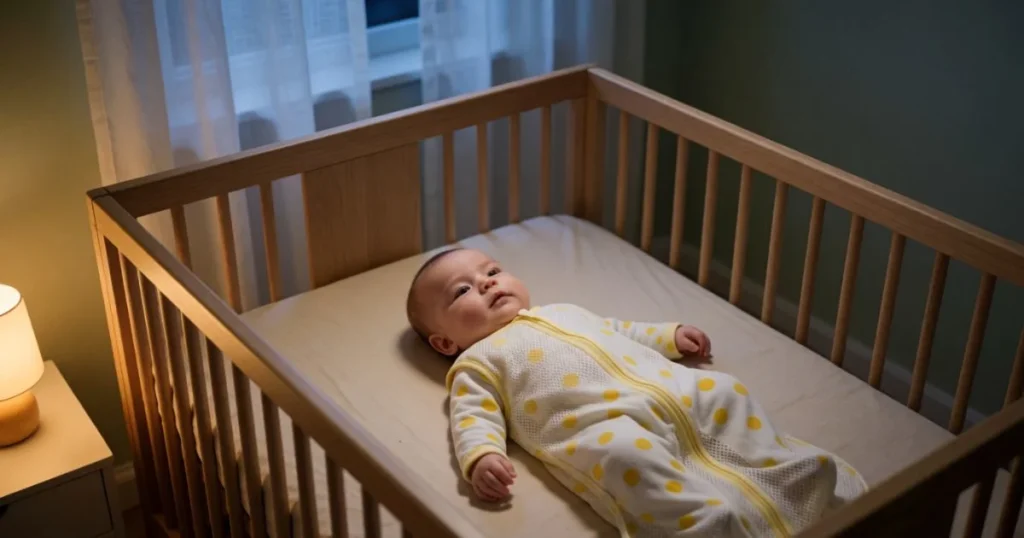
The 6-month sleep regression can feel frustrating, especially if your baby’s sleep had finally started improving. Frequent night wakings, nap resistance, and bedtime struggles may leave you wondering whether you’re moving backward.
In reality, your baby is moving forward in remarkable ways.
Learning to roll, sit, explore, communicate, and interact with the world requires enormous physical and mental energy. It’s no surprise that sleep sometimes becomes temporarily disrupted along the way.
Although you can’t prevent the 6-month sleep regression, you can support your baby by providing plenty of daytime opportunities to practice new skills, maintaining consistent sleep routines, and responding with patience as they adjust.
With time, these exciting milestones become part of everyday life—and many babies gradually return to longer, more predictable stretches of sleep.
Keep in mind that every baby grows and develops on their own unique timeline. Progress doesn’t always happen in a straight line, but each new skill is another step in your child’s incredible journey.
Continue Your Baby Sleep Journey
Sleep changes don’t stop at six months. As your baby grows, new developmental milestones can bring new sleep challenges—and new opportunities to build healthy sleep habits.
Continue exploring our complete sleep regression series:
- Sleep Regression Ages: Complete Guide from 4 Months to 2 Years
- 4 Month Sleep Regression: Signs, Causes, How Long It Lasts & How to Help Your Baby Sleep Again
- When Can Baby Sleep With a Blanket? Safe Age, Risks & Expert Tips
- When Can Babies Sleep on Their Stomach? Safe Sleep Guidelines for Parents
- Dream Feed: The Complete Guide to What It Is and How It Works
- Toddler Nap Schedule: Easy Complete Daily Sleep Plan by Age
At Parenting Whisper, we believe every stage of your baby’s development deserves compassionate, evidence-informed guidance. No matter where you are on your parenting journey, you’re not alone—and better nights are ahead.