

Feeling overwhelmed after having a baby does not mean you are a bad mother.
You may love your baby deeply and still feel exhausted, anxious, disconnected, sad, or unlike yourself. You may find yourself crying more than usual, worrying constantly, or wondering why motherhood feels so much harder than you expected.
Sometimes, what you need most is to know that someone else understands.
That is where Postpartum Depression Help Groups can become an important part of your support system. They can give you a place to talk with other parents, feel less isolated, learn about helpful resources, and discover that you are not the only one struggling.
A support group is not a replacement for professional treatment when you need it. But it can be one meaningful layer of support alongside your healthcare provider, therapist, family, friends, and other people you trust.
Important: If you have thoughts of suicide, are concerned you might hurt yourself or your baby, or experience hallucinations, extreme confusion, paranoia, or a loss of touch with reality, get emergency medical help right away. Postpartum psychosis is a life-threatening psychiatric condition that requires urgent medical assessment and treatment.

Baby Blues vs. Postpartum Depression
The first days after having a baby can bring dramatic emotional changes. Hormonal shifts, physical recovery, interrupted sleep, and the demands of caring for a newborn can leave you feeling tearful or overwhelmed.
These short-lived changes are often called the baby blues. If you need reassurance or connection during this adjustment, Postpartum Depression Help Groups may also help you learn about available support and understand when your feelings may require additional attention.
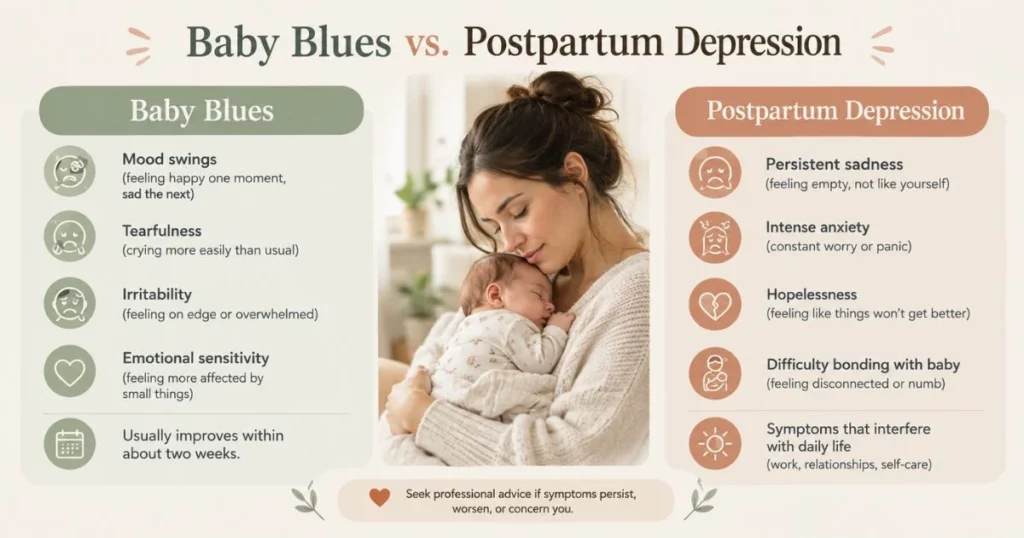
What Are the Baby Blues?
The baby blues commonly involve:
- Mood swings
- Crying spells
- Irritability
- Feeling emotionally sensitive
- Worry or feeling overwhelmed
- Difficulty sleeping
- Feeling exhausted
According to the National Institute of Mental Health, baby blues symptoms are generally mild and short-lived, occurring during the first two weeks after childbirth.
If these feelings intensify, persist for more than two weeks, or interfere with your daily activities, reach out to a healthcare professional for guidance and support. Postpartum Depression Help Groups can also offer connection and encouragement while you explore the support that feels right for you.
What Is Postpartum Depression?
Postpartum depression is a form of perinatal depression that occurs after childbirth. It is more than ordinary exhaustion or the temporary emotional changes associated with the baby blues.
Symptoms can include:
- Persistent sadness or emptiness
- Intense anxiety or irritability
- Feelings of guilt, worthlessness, or hopelessness
- Loss of interest or pleasure
- Extreme fatigue
- Difficulty concentrating or making decisions
- Significant changes in sleep or appetite
- Difficulty bonding with your baby
- Persistent worries about whether you can adequately care for your baby
- Thoughts involving death, suicide, or the possibility of harming yourself or your baby
NIMH notes that perinatal depression is treatable and that women experiencing symptoms should speak with a healthcare provider. Postpartum Depression Help Groups may also provide connection and peer encouragement alongside professional care.
Above all, experiencing postpartum depression does not mean you love your baby any less or that you are failing as a mother.
What Are Postpartum Depression Help Groups?
Postpartum Depression Help Groups connect parents experiencing depression after childbirth or facing other mental health challenges during pregnancy and the postpartum period.
These groups can take several forms.
Peer Support Groups
Peer groups bring together people who have experienced similar challenges and can relate to one another.
You may talk about:
- Feeling overwhelmed
- Anxiety after childbirth
- Loneliness
- Changes in your relationship
- Difficulty adjusting to parenthood
- Guilt or self-doubt
- Finding time for yourself
- Getting professional help
One of the main benefits of Postpartum Depression Help Groups is the opportunity to feel understood by others who have faced similar experiences.
Therapist-Led Groups
Some groups are led by therapists, psychologists, social workers, or other trained professionals.
Some Postpartum Depression Help Groups include guided discussions or therapeutic activities, while others focus on informal support and sharing experiences with peers.
Online Postpartum Depression Support Groups
Online groups can be particularly useful when leaving home feels difficult.
You may be able to participate from your:
- Bedroom
- Living room
- Baby’s nursery
- Workplace during an appropriate break
Online Postpartum Depression Help Groups can help you connect with a community that understands your particular circumstances, giving you more options than those available in your local area.
In-Person Support Groups
Meeting face-to-face can provide a stronger sense of community for some people.
Local Postpartum Depression Help Groups may also help you discover other services in your area, including therapists, maternal-health programs, childcare resources, and community organizations.
How Can Postpartum Depression Help Groups Help?
A support group cannot guarantee that your symptoms will disappear. Its value is often found in the connection, understanding, and encouragement it provides.
They Can Help You Feel Less Alone
Living with postpartum depression can leave you feeling as though no other mother understands how difficult this experience is.
Listening to another parent describe feelings that sound familiar can challenge that isolation.
Through Postpartum Depression Help Groups, you may realize:
- Other mothers have intrusive worries.
- Other parents struggle with guilt.
- Other people have difficulty adjusting after birth.
- You are not failing simply because motherhood feels difficult.
Research on peer-support interventions suggests that peer support may help reduce depressive and anxiety symptoms during the perinatal period, although the evidence varies across different interventions and programs.
They Give You Somewhere to Talk Without Pretending
You do not have to arrive at Postpartum Depression Help Groups feeling positive.
You can talk about the parts of motherhood that are difficult without pretending everything is fine.
A supportive group can give you space to say, “I’m struggling,” without turning that statement into a judgment about your parenting.
They Can Provide Emotional Validation
At times, Postpartum Depression Help Groups can offer understanding and compassion rather than advice or instructions from someone else.
You may need someone to listen.
Being heard can make it easier to recognize what you are feeling and decide what kind of help you need next.
They Can Connect You With Resources
Support groups may also introduce you to:
- Mental-health professionals
- Healthcare providers
- Local programs
- Parenting resources
- Community services
- Additional support groups
That can be especially useful when you are too overwhelmed to research every option yourself.
They Can Encourage Professional Support
A good Postpartum Depression Help Group should not tell you that you do not need medical or psychological care.
Instead, it can help you feel more comfortable taking that next step.
What Happens in a Postpartum Depression Support Group?
If you have never attended Postpartum Depression Help Groups, you may imagine that you will have to sit in front of strangers and tell them everything about your life.
That is not necessarily how groups work.
A typical meeting may include:
- A welcome or brief introduction
- A discussion about a specific postpartum topic
- Members sharing experiences
- Questions or reflections
- Practical coping ideas
- Information about additional resources
Some groups are highly structured. Others are more conversational.
Do You Have to Share Your Story?
Not necessarily.
Because each group has its own guidelines, contact the organizer beforehand to learn what to expect and how members participate.
If you feel nervous, you can start by listening.
You can share your story at your own pace without feeling pressured to discuss everything during your first session.
How to Choose a Postpartum Depression Support Group
Different Postpartum Depression Help Groups offer different experiences, so it’s important to find one that feels comfortable and suitable for your needs.
Before joining, consider the following.
Check Who Leads the Group
When choosing Postpartum Depression Help Groups, find out whether the group is:
- Peer-led
- Professionally facilitated
- Hosted by a hospital
- Organized by a nonprofit
- Moderated by trained volunteers
If the group offers therapy rather than peer support, check the qualifications of the professional providing it.
Understand What the Group Provides
Postpartum Depression Help Groups may offer:
- Peer support
- Education
- Group therapy
- Practical parenting support
- Crisis information
- Referrals to healthcare professionals
Knowing what you are joining can help you choose a group that matches your needs.
Consider Privacy and Confidentiality
For online Postpartum Depression Help Groups, find out:
- Who can see your posts
- Whether the group is private
- Whether conversations are moderated
- What personal information you are expected to provide
Do not assume that an online community offers the same confidentiality protections as professional healthcare.
Consider Accessibility
When choosing Postpartum Depression Help Groups, think about:
- Cost
- Location
- Meeting times
- Transportation
- Childcare
- Language
- Online availability
The best group is often the one you can realistically attend.
Pay Attention to the Environment
When choosing Postpartum Depression Help Groups, be cautious of groups that:
- Shame you
- Dismiss your symptoms
- Pressure you to share private information
- Discourage professional treatment
- Tell you to stop prescribed medication
- Promote unsafe medical advice
You deserve support that makes you feel respected rather than judged.
Where to Find Postpartum Depression Help Groups
You do not have to search randomly.
Start With Your Healthcare Provider
To find Postpartum Depression Help Groups, ask your:
- OB-GYN
- Midwife
- Primary care provider
- Pediatrician
- Therapist
- Psychiatrist
Your healthcare team may know about local maternal mental-health services or support groups.
NIMH recommends speaking with a healthcare provider or mental-health professional if you think you may have perinatal depression.
Check Hospitals and Medical Centers
Hospitals may offer maternal mental-health programs, group therapy, social-work services, or referrals to community resources.
Look for Community Programs
Community organizations may offer:
- Peer support
- Parenting programs
- Home-visiting services
- Maternal wellness programs
- Mental-health referrals
Availability varies considerably by location.
Consider Online Support
If getting to an in-person meeting is challenging because of travel, childcare responsibilities, distance, or fatigue, joining an online support group may be a more convenient option.
Postpartum Support International: A Place to Start
Postpartum Support International is one of the most useful starting points for parents looking for perinatal mental-health support.
PSI provides peer support, education, and referrals to resources. Its services include a HelpLine, local resource connections, peer mentoring, and online support groups. PSI currently lists more than 50 online support groups led by trained facilitators.
You can contact the PSI HelpLine at 1-800-944-4773. English support is available by calling or texting 800-944-4773, while Spanish support is available by calling the same number or texting 971-203-7773. PSI explains that its HelpLine provides information, encouragement, and resource connections but is not a crisis service.
PSI also provides regional resources for families in the United States and Canada, Europe and Central Asia, East Asia, South Asia and the Pacific, Latin America and the Caribbean, the Middle East and North Africa, and other regions.
Find support through Postpartum Support International
Postpartum Depression Help Groups in Philadelphia
If you live in Philadelphia, you have additional options through local hospitals, behavioral-health programs, maternal wellness organizations, and community services.
Before publishing a local resource list, check each organization’s current:
- Phone number
- Address
- Eligibility requirements
- Cost
- Referral requirements
- Group schedule
- Virtual availability
Local programs can change, so a resource should not be included simply because an older article or directory lists it.
A useful way to organize your local resources is:
| Type of resource | What to look for | Questions to ask |
| Hospital program | Maternal mental-health services | Do you offer postpartum support groups? |
| Community program | Peer or family support | Is the service free? |
| Therapy center | Individual or group therapy | Does insurance cover it? |
| Nonprofit | Peer support and referrals | Can you help me find a local group? |
| Online program | Virtual support groups | Who facilitates the meetings? |
This approach keeps the information useful even when individual programs change.
Support for Special Circumstances
Your experience may not fit neatly into a general postpartum depression group.
You may want a community that understands a particular part of your story.
Pregnancy and Infant Loss
Losing a pregnancy, experiencing a stillbirth, or losing an infant can cause deep emotional pain and leave parents feeling alone and disconnected from others.
PSI provides specialized resources for pregnancy and postpartum loss, including peer support and connections to additional resources.
NICU Parents
Parents whose babies spend time in neonatal intensive care may benefit from connecting with others who understand the uncertainty, fear, and exhaustion associated with a NICU experience.
Perinatal OCD and Intrusive Thoughts
If you are distressed by unwanted or frightening thoughts, consider seeking support from a group or mental health professional with experience in perinatal OCD and intrusive thoughts.
Having an intrusive thought does not automatically mean you intend to act on it, but distressing symptoms deserve appropriate professional assessment.
Partners and Dads
Postpartum mental-health support is not limited to mothers.
Partners and other parents can also experience emotional difficulties during the perinatal period, and specialized support may be available for them.
When a Support Group Isn’t Enough
A support group can be valuable, but you may need more individualized care.
Talk with a healthcare or mental-health professional if:
- Your symptoms persist.
- You feel increasingly hopeless.
- Anxiety is interfering with daily life.
- You are struggling to care for yourself.
- You are struggling to care for your baby.
- You cannot enjoy activities you previously enjoyed.
- You are having thoughts of death or self-harm.
- You are worried about thoughts of harming your baby.
Treatment for perinatal depression may include psychotherapy, medication, or a combination of treatments. A healthcare professional can help you decide what approach is appropriate for your symptoms and circumstances.
You do not have to choose between a support group and professional treatment. For many people, they can serve different purposes within the same support plan.
Build a Support Plan While You Recover
You do not need to handle everything yourself while you are trying to feel better.
Ask for Specific Help
Instead of saying, “I need help,” try asking someone to:
- Prepare dinner
- Pick up groceries
- Watch the baby while you shower
- Drive you to an appointment
- Handle laundry
- Take an older child to school
- Stay beside you while you make a call for support
Specific requests are often easier for other people to respond to.
Keep Someone Informed
Choose one trusted person who knows how you have been feeling.
Tell them what signs might indicate that you are getting worse.
Stay Connected With Your Healthcare Team
If your symptoms change or become more difficult to manage, contact your healthcare provider rather than waiting for your next scheduled appointment.
Your emotional well-being is just as important as your physical healing after childbirth.
When Postpartum Depression Requires Immediate Help
Some symptoms require urgent action rather than a support-group meeting.
Get Immediate Help If You Are Experiencing:
- Thoughts of suicide
- Thoughts of seriously harming yourself
- Thoughts of harming your baby
- Hallucinations
- Delusions
- Severe paranoia
- Extreme confusion
- A loss of contact with reality
- Severe or unusual behavior that makes you feel unsafe
Postpartum psychosis is a psychiatric emergency. According to the NIMH, symptoms such as hallucinations, delusions, mania, paranoia, or severe confusion require immediate medical attention. If these symptoms occur, go to the nearest emergency department or contact emergency services.
If you are in the United States and need immediate mental health crisis support, you can call or text 988 to reach the Suicide & Crisis Lifeline. The National Maternal Mental Health Hotline is also available at 1-833-852-6262 for pregnant and postpartum women in the United States; PSI notes that this service is free, confidential, and available 24/7.
If you are outside the United States, use your local emergency number or nearest emergency department.
A support group is not an emergency service.
Frequently Asked Questions About Postpartum Depression Help Groups
What are postpartum depression help groups?
Postpartum depression help groups are peer-support or professionally facilitated communities where parents can receive emotional support, share experiences, learn about resources, and connect with people who understand postpartum mental-health challenges.
Do postpartum depression help groups really help?
Studies indicate that peer-support programs may help ease symptoms of depression and anxiety in some mothers, although their effectiveness differs across interventions. A support group should be viewed as one part of your support system rather than a guaranteed cure or replacement for professional treatment.
Where can I find postpartum depression help groups?
Start with your healthcare provider, local hospitals, community organizations, mental-health professionals, and reputable perinatal mental-health organizations such as Postpartum Support International.
Are postpartum depression help groups free?
Some are free, particularly peer-support groups offered by nonprofits or community organizations. Others may charge a fee, especially when the group is part of professional therapy.
Can I join postpartum depression help groups online?
Yes. Online groups can be useful if leaving home is difficult or if you cannot find an appropriate local group. Check who runs the group, how it is moderated, and how your personal information is handled.
Are postpartum depression support groups confidential?
Confidentiality depends on the group. Professional groups may have formal confidentiality requirements, while online communities may have different privacy protections. Always check the rules before sharing personal information.
Can postpartum depression help groups replace therapy?
Not necessarily. Peer support and therapy serve different purposes. If your symptoms are persistent, severe, or interfering with your ability to function, speak with a qualified healthcare or mental-health professional.
What if I don’t feel comfortable talking in a group?
You can ask the organizer whether you can attend without sharing much during your first meeting. Listening can be a reasonable first step while you decide whether the group feels right for you.
What should I do if I think I might hurt myself or my baby?
Do not wait for a support-group meeting. Seek immediate emergency help, contact your local emergency service, or go to the nearest emergency department. If you’re in the United States and need immediate emotional support during a mental health crisis, you can call or text 988 to reach the Suicide & Crisis Lifeline.
Conclusion: You Deserve Support, Too
While recovering physically and adjusting emotionally after childbirth, you may also experience postpartum depression that makes you feel isolated and cut off from others.
You may question yourself. You may wonder why you are struggling when you thought you would feel happier. You may even feel guilty for needing help.
You deserve support and care simply because you need them, not because you have to prove yourself worthy of receiving them.
Postpartum depression help groups can give you a place to connect, listen, talk, and learn from people who understand some of what you are experiencing. For some parents, that first conversation is the beginning of reaching out for the professional care they need.
Start with one step.
Tell someone you trust how you are feeling. Ask your healthcare provider about local resources. Explore an online support group. Contact a reputable perinatal mental-health organization.
And if your symptoms are severe or you are worried about your safety or your baby’s safety, seek urgent help rather than trying to manage the situation alone.
You deserve support, too. And asking for it is not a sign that you are failing at motherhood—it is one way of taking care of yourself and your family.