
Parenting can put you in some surprisingly difficult situations. Your toddler refuses to get dressed. Your preschooler screams because you said no. Your child hits when frustrated, throws a toy, or melts down in the middle of the grocery store.
In those situations, you might wonder: How can you honor your child’s feelings while still keeping firm boundaries?
Respectful parenting gives you a practical answer. It does not ask you to let your child do whatever they want, avoid boundaries, or stay perfectly calm every minute of the day. Instead, it encourages you to treat your child with dignity while still providing the structure, limits, and guidance they need.
Current UNICEF guidance describes positive parenting in much the same way: building a secure relationship, listening to children’s feelings, setting clear age-appropriate limits, and guiding behavior without shouting, frightening, or hurting children.
The goal isn’t perfect parenting. It’s learning how to handle everyday challenges in a way that protects both your child’s dignity and your role as the parent.

What Is Respectful Parenting?
Respectful parenting is an approach that recognizes your child as a developing person with their own feelings, needs, preferences, and abilities.
You still make the important decisions. You still say no. You still stop unsafe behavior. But instead of relying primarily on fear, shame, threats, or punishment, you guide your child through connection, communication, clear expectations, and appropriate consequences.
A simple way to remember it is:
Respect the feeling. Set the boundary. Teach the behavior.
For example, if your toddler hits because they are angry, respectful parenting doesn’t mean saying, “It’s okay to hit because you’re upset.”
Instead, you might say:
“You’re really angry. I won’t let you hit me. You can tell me you’re mad.”
Your child’s anger is accepted. The hitting is stopped. Your child is given another way to express the feeling.

What Respectful Parenting Is Not
Respectful parenting is sometimes misunderstood as letting children control the household. That’s not the goal.
It does not mean:
- Letting your child make every decision
- Saying yes to avoid tantrums
- Ignoring aggressive behavior
- Avoiding consequences
- Never correcting your child
- Allowing unsafe choices
- Expecting yourself to be calm every second
- Giving children adult-level responsibility
Children need boundaries. UNICEF specifically emphasizes that positive parenting combines warmth and listening with clear rules, calm discipline, and realistic expectations.
Respectful Parenting vs. Gentle Parenting vs. Permissive Parenting
These parenting terms often overlap, which can make them confusing.
Respectful Parenting vs. Gentle Parenting
Respectful and gentle parenting both emphasize connection, empathy, non-violent discipline, emotional support, and understanding child development.
The terminology can vary between parenting educators, so there isn’t one universally accepted definition that separates the two completely.
The important practical idea is the same: you can be compassionate without abandoning boundaries.
Respectful Parenting vs. Permissive Parenting
This distinction is much clearer.
A respectful parent might say:
“I know you want another cookie. You’re disappointed. We’re finished with cookies for today.”
A permissive response might be:
“Okay, have another one. I don’t want you to cry.”
The first response acknowledges the child’s feelings while keeping the limit.
Respectful Parenting vs. Authoritarian Parenting
| Parenting approach | Emotional connection | Boundaries | Main emphasis |
| Respectful/positive | High | Clear | Guidance and teaching |
| Authoritarian | Lower | Very strict | Obedience and control |
| Permissive | High | Few | Freedom with limited structure |
| Neglectful | Low | Few | Limited guidance |
Respectful parenting therefore isn’t about choosing between kindness and firmness. It is about combining them.
Understanding the four main parenting styles can help you see how respectful parenting differs from more traditional approaches to discipline.
The Core Principles of Respectful Parenting
Once you understand the basic idea, the next step is turning it into everyday behavior.
1. See Your Child as a Whole Person
Try to look beyond the behavior.
A toddler who throws their cup isn’t simply “a difficult child.” They may be tired, frustrated, hungry, overstimulated, or still learning how to communicate.
Knowing why your child is acting that way doesn’t mean you have to allow the behavior. It helps you choose a more useful response.
2. Validate Feelings Without Approving Every Behavior
This is one of the most important principles of respectful parenting.
You can say:
“You’re angry.”
without saying:
“It’s okay to hit.”
You can say:
“You’re disappointed.”
while still saying:
“We’re not buying the toy.”
Your child needs to learn that emotions are safe to experience, while some behaviors have limits.
3. Set Clear and Age-Appropriate Boundaries

Children don’t automatically know what is safe, appropriate, or expected.
You may need to say:
- “I won’t let you hit.”
- “The tablet is finished for today.”
- “We hold hands in the parking lot.”
- “Food stays on the table.”
- “It’s time to leave the playground.”
Clear boundaries help your child understand what comes next.
4. Listen Before You Correct
When something goes wrong, pause long enough to understand what happened.
Ask yourself:
- What was my child trying to do?
- What happened immediately before the behavior?
- Is my expectation realistic for their age?
- Are they hungry, tired, overwhelmed, or frustrated?
Listening doesn’t remove your authority. It helps you respond in a more effective way.
5. Offer Choices When They Make Sense
Toddlers often want some control over their lives.
You can offer two acceptable choices:
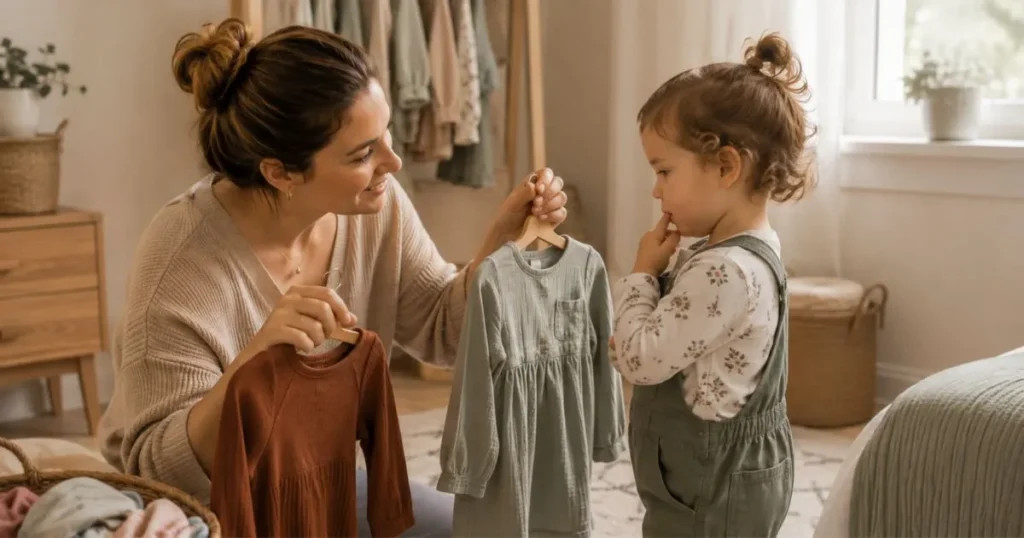
- “Red pajamas or blue pajamas?”
- “Would you prefer to brush your teeth before putting on your pajamas, or get dressed first?”
- “Walk to the car or hold my hand?”
You remain in charge of the larger boundary while giving your child a small amount of autonomy.
UNICEF notes that offering young children simple choices can support their growing independence as they learn to make decisions and test limits.
6. Encourage Independence
Let your child try things they can reasonably manage.
Depending on age, that could include:
- Putting toys away
- Choosing clothes
- Helping prepare food
- Washing hands
- Carrying a small item
- Helping set the table
You may need more patience when your child does something slowly or makes a mess, but these small opportunities help them develop confidence.
7. Model Respectful Behavior
Your child watches how you handle frustration.
If you want your child to speak calmly, listen, apologize, and solve problems, let them see you doing those things.
You might say:
“I’m feeling frustrated, so I’ll take a breath before I respond.”
You’re not only telling your child how to regulate emotions. You’re showing your child how to manage emotions in a healthy way.
8. Repair After Difficult Moments
Respectful parenting doesn’t mean you have to be perfect.
You may yell. You may respond too quickly. You may realize afterward that you handled a situation poorly.
Repair matters.
You can say:
“I was frustrated and I raised my voice. I should have spoken to you more calmly.I’m sorry. Let’s try again.”
That teaches your child that mistakes can be acknowledged and relationships can be repaired.
Using positive parenting tips can help you respond to your child’s needs while setting appropriate boundaries.
How to Practice Respectful Parenting Every Day
Respectful parenting becomes easier when you focus on small changes rather than trying to transform every interaction at once.
Pause Before You React
When your child’s behavior triggers you, take a breath before responding.
Even a few seconds can help you move from an automatic reaction to a deliberate response.
Get Down to Your Child’s Level
For a young child, kneeling or sitting nearby can make communication feel less intimidating.
Use a calm, clear voice and keep your instructions short.
Say What You Want Your Child to Do
Instead of:
“Don’t make a mess.”
try:
“Please put the blocks in the basket.”
Clear instructions tell your child exactly what you expect.
UNICEF recommends specific, realistic instructions rather than vague commands such as “be good.”
Notice Positive Behavior
Parents naturally notice problems because problems demand attention. Try deliberately noticing cooperation, patience, kindness, and effort too.
Instead of a general “Good job,” try:
“You waited for your turn. That was patient.”
Specific praise tells your child exactly which behavior you want to encourage.
Make Connection Part of Ordinary Life
Connection doesn’t require elaborate activities.
You can:
- Read together
- Talk while preparing dinner
- Play for ten minutes
- Cuddle before bedtime
- Let your child help with simple chores
- Spend a few minutes giving your child your undivided attention.
UNICEF recommends focused one-on-one time, even when parents have only a small amount of time available.
Understanding age-appropriate expectations can help you choose responsibilities and instructions that match your child’s stage of development.
How to Discipline With Respect
If you’re wondering how respectful parenting handles discipline, start by changing the purpose of discipline.
The goal isn’t simply to make your child regret what they did.
The goal is to help your child learn:
- What happened
- Why it wasn’t safe or appropriate
- What they can do differently
- How to repair the situation
Respectful Discipline Can Include
- Clear limits
- Redirection
- Positive reinforcement
- Natural consequences
- Logical consequences
- Problem-solving
- Teaching replacement behaviors
- Calm follow-through
For example, if your child throws a toy at someone, you can stop the behavior and say:
“I won’t let you throw the toy at people. Someone could get hurt. The toy is going away for now. You can play with it safely later.”
That’s a boundary and a consequence without humiliation.
What Respectful Parenting Avoids
You should not need to rely on:
- Hitting
- Spanking
- Slapping
- Shaming
- Name-calling
- Humiliation
- Threats
- Fear
- Verbal abuse
UNICEF advises parents to choose guidance rather than threats and explicitly recommends non-violent discipline.
How to Set Boundaries Without Punishment
Some parents worry that validating emotions will make boundaries weaker. In practice, you can do both.
A useful framework is:
Connect → Limit → Guide
For example:
“You really want to keep playing. It’s hard to stop when you’re having fun. It’s time to leave now. “You can walk to the car, or I can carry you.”
You’ve acknowledged the feeling, maintained the boundary, and offered a practical choice.
Examples of Respectful Boundaries
| Situation | What you can say | What you’re teaching |
| Hitting | “I won’t let you hit.” | Safety |
| Throwing food | “Food stays on the table.” | Mealtime expectations |
| Leaving the park | “You’re disappointed. It’s time to go.” | Handling transitions |
| Screen time | “Screen time is finished for today.” | Limits |
| Unsafe climbing | “I won’t let you climb there. It’s not safe.” | Safety |
| Taking a toy | “You want the toy. Let’s ask for a turn.” | Social skills |
A boundary becomes more effective when you can actually follow through calmly and consistently. UNICEF also emphasizes realistic expectations and consistent consequences.
Respectful Parenting During Toddler Tantrums

Tantrums are one of the hardest tests of respectful parenting.
Your toddler may be crying because they can’t have something, can’t express what they want, or simply can’t manage the size of their feelings yet.
That doesn’t mean you have to give in.
What to Do During a Tantrum
- Keep your child and others safe.
- Stay nearby if your child wants or tolerates your presence.
- Name what you see.
- Hold the boundary.
- Keep your words short.
- Avoid trying to teach a long lesson while your child is overwhelmed.
- Reconnect once your child is calmer.
You might say:
“You really wanted the cookie. You’re upset. I won’t change my answer. I’m here with you.”
If your child is screaming, you don’t have to win an argument. Your job is to provide safety and hold the limit.
UNICEF notes that young children are still learning to communicate and regulate their feelings, and recommends calm, firm, kind responses rather than harsh discipline.
Understanding toddler emotions and zero to three can help you respond to big feelings with more patience and confidence.
How to Handle Toddler Hitting With Respectful Parenting

Hitting requires a clear response because safety comes first.
You don’t need to shame your child to take the behavior seriously.
When Your Toddler Hits
Move close enough to stop the hitting if necessary and say:
“I won’t let you hit.”
Then identify the emotion:
“You’re angry because I took the toy.”
Then teach an alternative:
“You can say, ‘Mine!’ or ask me for help.”
Your response can be firm without calling your child “bad.”
What to Do Afterward
Once your toddler is calm:
- Talk briefly about what happened.
- Name the feeling.
- Explain the boundary.
- Practice an alternative response.
- Help repair the situation when appropriate.
The aim is not simply to stop one incident. You’re helping your child build a skill they will need again.
The same calm, non-shaming approach can also help when you’re dealing with toddler biting.
Respectful Parenting and Big Emotions

Your child’s emotional development doesn’t happen overnight.
You can help by giving feelings names:
- Angry
- Sad
- Worried
- Frustrated
- Excited
- Scared
- Disappointed
You can then teach safe ways to respond.
For example:
“You’re angry. You can tell me you’re mad. You can stomp your feet, but you can’t hit me.”
The message is simple:
Every feeling is allowed. Every behavior is not.
UNICEF recommends helping children talk about emotions and modeling healthy emotional regulation yourself.
Helping your child understand toddler emotions is an important step toward developing healthier ways to express big feelings.
Respectful Parenting Communication: What to Say Instead
The words you use can change the tone of a difficult interaction.
When Your Child Is Crying
Instead of:
“Stop crying.”
Try:
“You’re really upset. I’m here.”
When Your Child Says No
Instead of:
“Stop arguing.”
Try:
“You don’t want to get dressed. It’s still time to get dressed. Would you like the red shirt or the blue one?”
When Your Child Hits
Instead of:
“You’re naughty.”
Try:
“I won’t let you hit. You’re angry. Let’s find another way.”
When Your Child Makes a Mistake
Instead of:
“Look what you did!”
Try:
“Something went wrong. Let’s clean it up together.”
When Your Child Refuses to Cooperate
Instead of:
“You never listen.”
Try:
“You’re having a hard time stopping. I’ll help you.”
UNICEF recommends age-appropriate, clear communication and avoiding derogatory language when speaking with young children.
Respectful Parenting in Everyday Situations
Respectful parenting isn’t only useful during dramatic tantrums. It applies to ordinary moments throughout your day.
| Parenting moment | Respectful response |
| Your toddler refuses pajamas | 1. “Would you like the dinosaur pajamas or the striped ones?” |
| Your child throws a toy | “I won’t let you throw it at people. Let’s put it away.” |
| Your child won’t leave the park | “You wish you could stay. It’s time to go.” |
| Your child refuses dinner | “You don’t have to eat, but this is the meal we’re serving.” |
| Your child screams | “I hear you’re upset. I’ll listen when you can talk safely.” |
| Your child grabs a toy | “You want it. Let’s ask for a turn.” |
| Your child makes a mess | “Let’s clean it up together.” |
You won’t always get cooperation immediately. Respectful parenting isn’t a collection of magic phrases that makes children obey.
It is a consistent approach to how you respond when cooperation is difficult.
Respectful Parenting by Age
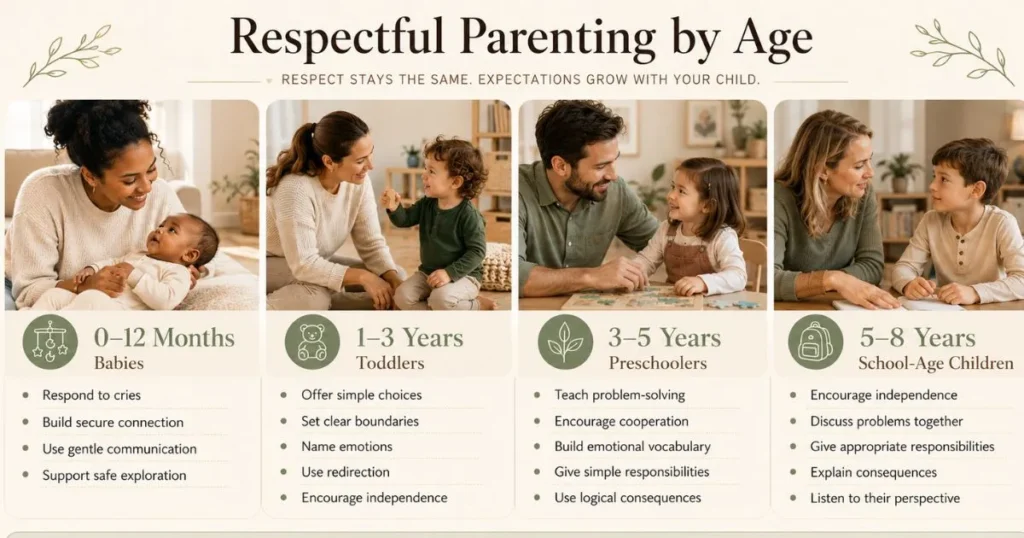
Your expectations should change as your child develops.
Respectful Parenting for Toddlers
Toddlers benefit from:
- Short instructions
- Simple choices
- Predictable routines
- Redirection
- Clear boundaries
- Emotional labeling
- Opportunities for independence
A toddler who cannot yet control an impulse should not be expected to behave like a school-age child.
Respectful Parenting for Preschoolers
You can gradually introduce:
- Problem-solving
- Responsibility
- More detailed explanations
- Simple consequences
- Cooperation
- Emotional vocabulary
Respectful Parenting for School-Age Children
As your child’s abilities grow, you can give them more involvement in:
- Family decisions
- Problem-solving
- Responsibilities
- Planning
- Understanding consequences
UNICEF’s age-specific guidance similarly emphasizes increasing independence while continuing to provide support, encouragement, and guidance.
Common Respectful Parenting Mistakes
Even when you understand the approach, a few mistakes can make it harder to apply.
Confusing Respect With Permissiveness
Your child’s feelings don’t automatically change your decision.
Explaining Too Much
When your toddler is overwhelmed, a long lecture usually isn’t helpful. Keep the message short and return to the conversation later.
Giving Too Many Choices
Two choices are often enough. You don’t need to turn every decision into a negotiation.
Expecting Adult-Level Self-Control
Your child is still developing impulse control and emotional regulation.
Trying to Prevent Every Negative Emotion
You don’t need to keep your child happy all the time. Disappointment is part of childhood.
Expecting Immediate Results
A child may understand a boundary and still test it tomorrow. Learning takes repetition.
What If You Yell or Lose Your Temper?
You may have a day when you are exhausted, your child is screaming, and you lose your patience.
That doesn’t make you a failure.
The important question is what you do next.
How to Repair After Yelling
- Take a moment to calm down.
- Return to your child.
- Acknowledge what happened.
- Take responsibility.
- Don’t blame your child for your reaction.
- Reconnect.
- Try the interaction again.
You might say:
“I yelled, and I shouldn’t have. I was frustrated, but it was my responsibility to handle that better. I’m sorry. Let’s try again.”
UNICEF’s current positive-parenting guidance also emphasizes that parents don’t need to be perfect and can make gradual changes over time.
Does Respectful Parenting Actually Work?
Respectful parenting isn’t designed to eliminate tantrums, defiance, crying, or frustration.
Children will still test boundaries.
They will still say no.
They will still have difficult days.
The goal is different. You’re helping your child gradually learn skills such as:
- Emotional awareness
- Self-regulation
- Communication
- Problem-solving
- Cooperation
- Responsibility
- Respect for others
Positive discipline guidance from UNICEF focuses on building healthy relationships while teaching responsibility, cooperation, and self-discipline rather than relying on punishment.
Benefits of Respectful Parenting
When you consistently combine warmth with clear expectations, you create an environment where your child knows that they are loved while also understanding that boundaries matter.
Potential benefits include:
- Better opportunities to practice emotional regulation
- Stronger communication
- Greater independence
- Clearer expectations
- More constructive parent-child interactions
- More opportunities to learn problem-solving
For you, the biggest benefit may simply be having a clearer framework for difficult moments. Instead of wondering, “Should I punish this?” you can ask:
“What can my child learn from this situation, and how can I teach that lesson while keeping everyone safe?”
How to Start Practicing Respectful Parenting Today
You don’t have to change everything all at once.
Start with these seven habits:
- Pause before reacting.
- Name your child’s feeling.
- State the boundary clearly.
- Use fewer words during emotional moments.
- Offer two choices when appropriate.
- Teach what your child can do instead.
- Repair when you make a mistake.
For example, if your toddler hits today, don’t worry about finding the perfect parenting response.
Start with:
“You’re angry. I won’t let you hit. I’m here to help.”
Then repeat the same basic message tomorrow.
Being consistent matters more than finding the perfect words every time.
Respectful Parenting Examples: Quick Reference
Keep this simple framework in mind:
Feelings → Boundary → Alternative
- “You’re angry → I won’t let you hit → You can tell me you’re mad.”
- “You’re disappointed → We’re not buying it → You can choose something from your toy box.”
- “You want to keep playing → It’s time to leave → You can walk or I can carry you.”
- “You don’t want dinner → You don’t have to eat → The next food opportunity will be later.”
This gives your child three things at once: emotional recognition, a clear limit, and a path forward.
Frequently Asked Questions About Respectful Parenting
What Is Respectful Parenting?
Respectful parenting means treating your child with dignity while providing appropriate guidance, boundaries, and expectations. It acknowledges your child’s feelings while still setting limits around unsafe or harmful behavior.
Is Respectful Parenting the Same as Gentle Parenting?
The approaches overlap considerably. Both generally emphasize connection, empathy, non-violent discipline, and age-appropriate expectations. The exact meaning of each term can vary among parenting educators.
Is Respectful Parenting Permissive?
No. Respectful parenting can include firm and consistent boundaries. You can acknowledge your child’s feelings while still saying no.
How Do You Discipline With Respectful Parenting?
You focus on teaching rather than humiliating or frightening your child. You can use clear limits, redirection, positive reinforcement, and appropriate natural or logical consequences.
How Do You Set Boundaries With Respectful Parenting?
Try the connect → limit → guide approach. Acknowledge your child’s feelings, state what you will or won’t allow, and show them what they can do instead.
How Does Respectful Parenting Handle Tantrums?
Keep your child safe, acknowledge the emotion, hold the boundary, and avoid lengthy explanations while your child is overwhelmed. Talk more once they are calm.
How Does Respectful Parenting Handle Toddler Hitting?
Stop the hitting, protect everyone involved, clearly state that hitting isn’t allowed, acknowledge the emotion behind it, and teach an alternative way to communicate anger or frustration.
Can You Say No With Respectful Parenting?
Absolutely. “No” is sometimes the most respectful answer when a request is unsafe, inappropriate, or outside your family’s boundaries. You can say no without shaming your child.
What If Respectful Parenting Isn’t Working?
First, check your expectations. Is your child developmentally capable of doing what you’re asking? Then consider whether the boundary is clear and whether you’re following through consistently. Look for patterns involving hunger, tiredness, transitions, or overstimulation.
How Do You Start Respectful Parenting?
Start small. Choose one habit, such as pausing before reacting or using specific praise. Once that feels natural, add another. You don’t need to become a completely different parent overnight.
Conclusion: Respectful Parenting Is About Guidance, Not Perfection

Respectful parenting doesn’t ask you to choose between being kind and being firm.
You can listen to your child’s feelings and say no.
You can comfort your toddler and stop hitting.
You can acknowledge disappointment and keep the boundary.
You can apologize when you lose your temper and remain the parent your child needs.
The heart of respectful parenting is not finding the perfect words every time. It’s building a relationship in which your child feels valued while learning that boundaries, safety, responsibility, and consideration for others matter.
Start with one small change today. Pause before reacting. Name the feeling. Hold the boundary. Then give your child another chance to practice.
If this approach resonates with you, save this guide for the next difficult parenting moment and share it with another parent who may need the reminder: you can be both compassionate and firm.