

Feeding a toddler can bring with it a unique kind of worry.
You prepare a balanced meal, and your child eats two bites. The vegetables are pushed aside. The chicken is ignored. Maybe today the only foods they want are crackers, yogurt, and bananas.
Then you start wondering: Is my toddler getting enough vitamins and minerals? Should I give a multivitamin?
If you’ve had this thought, you’re not alone. Toddlers commonly go through periods of picky eating, changing appetites, and strong food preferences. The good news is that you don’t need to create a perfect plate at every meal to support healthy growth.
For most healthy toddlers who eat a reasonably varied diet, toddler vitamins aren’t automatically necessary every day. The American Academy of Pediatrics (AAP) explains that healthy children who receive a balanced diet generally don’t need vitamin supplementation. Supplements may be helpful when a child eats a highly restricted diet, has a confirmed nutrient deficiency, or has a medical condition that makes deficiency more likely.
Instead of asking, “Which toddler vitamin is the best?” it is more helpful to begin with a different question:
Does your toddler actually need a supplement, and if so, what should you look for in toddler vitamins?
This guide will walk you through the nutrients that matter, when supplementation may be appropriate, how to read a supplement label, and how to choose toddler vitamins safely.
Do Toddlers Need Vitamins?
Not necessarily.

Your toddler’s nutritional needs can often be met through a varied diet that includes foods from several food groups. That doesn’t mean your child needs to eat vegetables at every meal or finish everything you serve.
Toddlers often eat unpredictably. Their appetite may be strong one day and surprisingly small the next. The AAP notes that picky eating is common during toddlerhood, particularly as children develop stronger food preferences and their growth rate slows after infancy.
Instead of judging your toddler’s nutrition from one meal, look at the overall eating pattern. Toddler vitamins may not be necessary when your child regularly gets a variety of nutrients from food.
A typical toddler diet can include:
- Fruits and vegetables
- Whole grains and other grains
- Eggs, meat, poultry, fish, beans, and other protein-rich foods
- Milk, yogurt, cheese, or appropriate fortified alternatives
- Healthy fats
- Water and other appropriate beverages
The goal isn’t perfection. It’s variety over time—and toddler vitamins should complement a healthy diet when they are actually needed, not replace it.
Why Most Healthy Toddlers Don’t Automatically Need a Multivitamin
A multivitamin doesn’t turn an unbalanced diet into a balanced one, and it shouldn’t replace regular meals.
Whole foods provide much more than individual vitamins and minerals. Depending on the food, they can also provide protein, carbohydrates, healthy fats, fiber, and other nutrients that support overall nutrition.
That’s why a food-first approach is generally preferred, with toddler vitamins used only when there is a genuine nutritional need.
There are, however, situations in which your toddler may benefit from supplementation.
When Does Your Toddler Actually Need a Vitamin Supplement?
A toddler vitamin supplement may be helpful when your child’s diet or health condition makes it difficult to get enough nutrients from food alone.
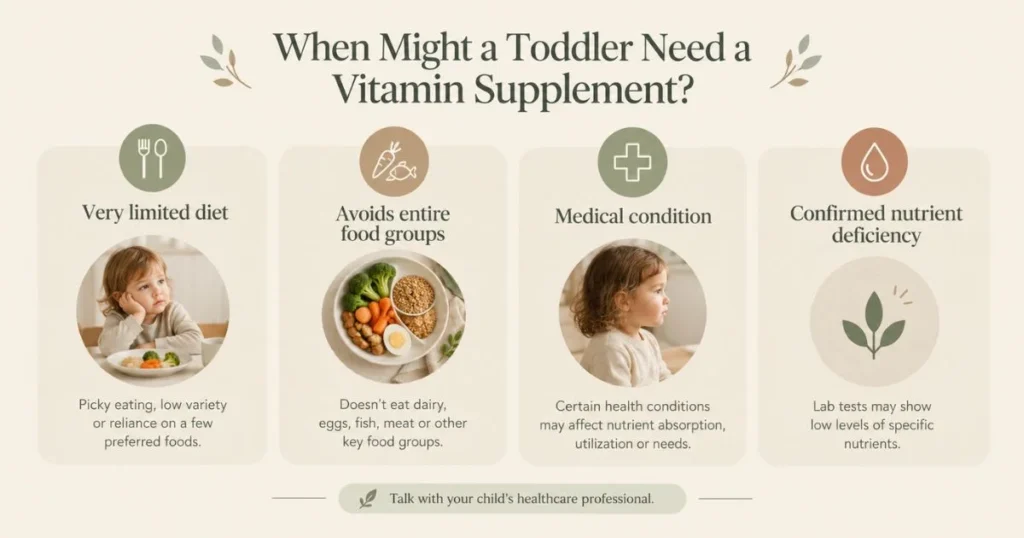
Your Toddler Has a Very Limited Diet
Some picky eating is completely normal. But If your toddler eats only a small selection of foods, offering simple, nutritious meals can make it easier to build variety over time.
Pay attention if your child consistently:
- Avoids several entire food groups
- Eats only a handful of foods
- Refuses most sources of protein
- Avoids foods containing iron
- Has a very limited variety of fruits and vegetables
- Has difficulty maintaining an adequate diet
That doesn’t automatically mean your toddler needs toddler vitamins. Instead, it may be a sign that you should take a closer look at your child’s overall diet and discuss any concerns with your pediatrician.
For children who prefer familiar foods, having several easy meal options can help parents keep offering balanced choices without pressure.
Your Toddler Avoids Entire Food Groups
Eliminating an entire food group can make certain nutrients harder to obtain.
For example, children following a vegan diet may need careful planning around nutrients such as vitamin B12, vitamin D, iron, calcium, zinc, vitamin A, and riboflavin. The AAP recommends that restrictive diets in children be planned carefully with appropriate professional guidance.
A vegetarian or vegan diet can be nutritious, but simply removing animal foods without replacing their nutrients isn’t enough. In some cases, toddler vitamins may be considered to help address specific nutritional gaps, but this should be based on your child’s individual needs.
Your Toddler Has a Medical Condition
Some medical conditions can affect nutrient absorption, nutritional needs, or your child’s ability to eat a sufficiently varied diet.
In these situations, toddler vitamins or specific supplements should be considered on an individual basis.
Your child’s pediatrician or registered dietitian may recommend a particular nutrient rather than a general multivitamin.
Your Toddler Has a Nutrient Deficiency
If your child has a confirmed nutrient deficiency, the right supplement and dosage will depend on the specific nutrient and your child’s individual needs.
This is one reason you shouldn’t guess when choosing high-dose toddler vitamins.
For example, iron is essential for growth and development, but giving extra iron without proper guidance is not a harmless precaution. The CDC explains that iron supports brain development, oxygen transport, immune function, and normal growth, while too little iron can contribute to iron-deficiency anemia.
Your Pediatrician Recommends Supplementation
Sometimes the simplest answer is the right one: your child’s healthcare professional understands your toddler’s diet, growth, medical history, and laboratory results in ways that a supplement label cannot.
If you’re unsure whether your toddler needs toddler vitamins, talk with your healthcare professional before starting a new supplement.
Which Vitamins and Minerals Do Toddlers Need?
No single nutrient is more important than all the others. Toddlers need a variety of vitamins and minerals to support healthy growth and development.
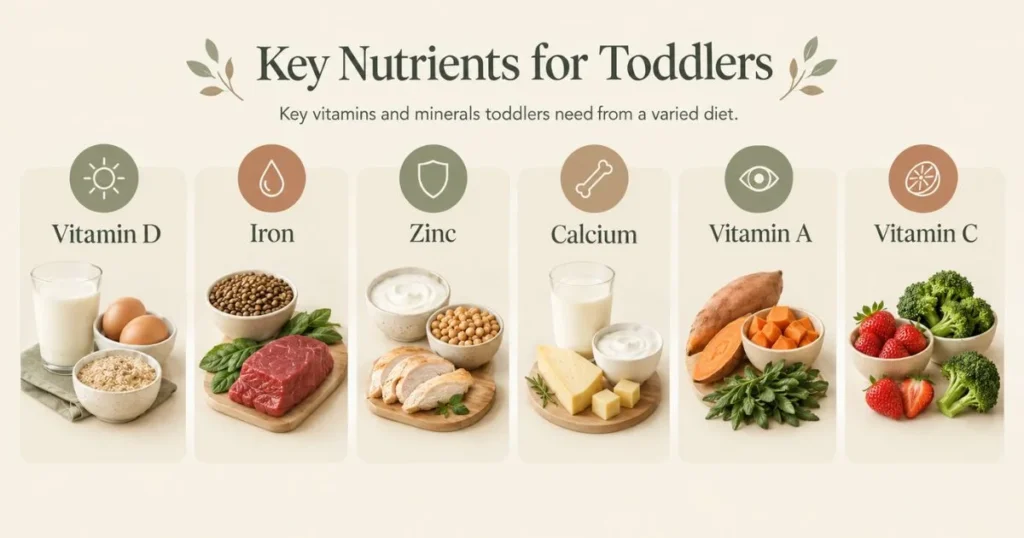
The CDC highlights vitamin D, iron, and zinc as especially important nutrients during early childhood, which is why these nutrients are worth considering when evaluating toddler vitamins.
Vitamin D
Vitamin D helps the body absorb calcium and plays an important role in maintaining healthy bones.
For children ages 12–24 months, the CDC recommends 600 IU (15 mcg) of vitamin D per day. This amount can come from food and, when necessary, an appropriate supplement.
Fortified foods such as :
- Fortified whole milk
- Fortified yogurt
- Fortified cereals
- Eggs
- Certain fish
If your toddler isn’t getting enough vitamin D from food, talk with your child’s healthcare professional about whether toddler vitamins or a vitamin D supplement may be appropriate.
Iron
Iron deserves special attention during toddlerhood because it supports oxygen transport, brain development, immune function, and normal growth.
Toddler breakfasts can include iron-rich foods such as .:
- Beef
- Chicken
- Fish
- Eggs
- Lentils
- Beans
- Iron-fortified cereals
Pairing iron-rich foods with fruits and vegetables can help you create balanced toddler meals.
Pairing plant sources of iron with vitamin C-rich foods can also help support iron absorption. If your toddler has limited sources of iron in their diet, toddler vitamins may sometimes be considered with guidance from a healthcare professional.
For example, you could serve lentils with tomatoes or strawberries alongside an iron-fortified cereal.
Zinc
Zinc supports healthy growth and development and also plays an important role in immune function.
Good food sources include:
- Meat
- Poultry
- Eggs
- Dairy
- Beans
- Nuts and seeds in safe, age-appropriate forms
The CDC identifies zinc, along with iron and vitamin D, as an important nutrient for young children. These nutrients are also worth considering when evaluating toddler vitamins.
Calcium
Calcium is important for supporting healthy bones and teeth as your toddler grows.
Common food sources include:
- Milk
- Yogurt
- Cheese
- Calcium-fortified soy beverages
- Certain fortified foods
A supplement isn’t necessarily the best way to provide calcium when your toddler can get enough from food. If you’re considering toddler vitamins, focus on your child’s overall diet and discuss any potential nutrient gaps with their healthcare professional.calcium. If your toddler regularly eats calcium-rich foods, that dietary intake should be considered before adding another product.
Vitamin A
Vitamin A supports healthy vision, immune function, and normal growth.
Food sources include:
- Sweet potatoes
- Carrots
- Eggs
- Dairy foods
- Orange and dark-green vegetables
These foods can provide important nutrients naturally, which is why toddler vitamins are not always necessary when your child eats a varied diet.
Vitamin C
Vitamin C supports immune function and helps the body absorb non-heme iron.
Good food sources include:
- Strawberries
- Oranges
- Kiwi
- Bell peppers
- Tomatoes
- Broccoli
Offering these foods regularly can help your toddler get vitamin C through their diet before considering toddler vitamins.
B Vitamins
B vitamins support energy metabolism and other important functions throughout the body.
A varied diet that includes grains, eggs, meat, dairy, legumes, fruits, and vegetables can provide several B vitamins.
Children following restrictive diets may have different nutritional needs, so their overall diet should be considered when deciding whether toddler vitamins are appropriate.
Toddler Vitamins for Picky Eaters
If your toddler eats only a few foods, it can be tempting to assume that toddler vitamins are the answer.
Sometimes a supplement may be appropriate. But picky eating alone doesn’t automatically mean your child has a vitamin deficiency.
Picky eating may look different from day to day, so having several familiar and nutritious foods available can help.
The AAP describes picky eating as common during toddlerhood and recommends a calm, supportive approach rather than turning meals into battles.
Normal Toddler Picky Eating
You may notice that your toddler:
- Loves a food one week and refuses it the next
- Eats more at one meal and very little at another
- Rejects unfamiliar textures
- Prefers a small group of familiar foods
- Gradually becomes more willing to try new foods
These behaviors can be part of normal development and don’t necessarily mean your child needs toddler vitamins.
When Picky Eating May Cause Nutritional Gaps
More concern is warranted when your child’s diet becomes extremely narrow.
If your child regularly avoids certain foods, you can explore age-appropriate meal ideas that provide a wider variety of nutrients.
For example, if your toddler consistently eats very few foods or avoids entire food groups, talk with your pediatrician about whether a nutritional assessment or toddler vitamins may be appropriate.
How to Support a Picky Eater Without Pressure
You don’t need to force your toddler to finish vegetables or clean the plate.
Instead:
- Serve at least one familiar food with meals.
- Continue offering new foods without pressure.
- Keep portions small.
- Eat together when possible.
- Show your child that you enjoy eating a variety of foods.
- Give your toddler appropriate choices.
- Look at your child’s eating habits over several days rather than focusing on a single meal.
- Offering a familiar food alongside something new can make mealtimes easier for picky eaters.
- Small, nutritious snacks can also help fill the gaps between meals when your toddler eats very little at one sitting.
The AAP recommends continuing to offer healthy foods while allowing children some control over whether and how much they eat. If you’re considering toddler vitamins, this food-first approach can help you determine whether a supplement is actually needed.
How to Choose the Right Toddler Vitamins
If you’ve decided that a supplement deserves consideration, don’t start by choosing the prettiest bottle or the product with the longest ingredient list.

Start with the label.
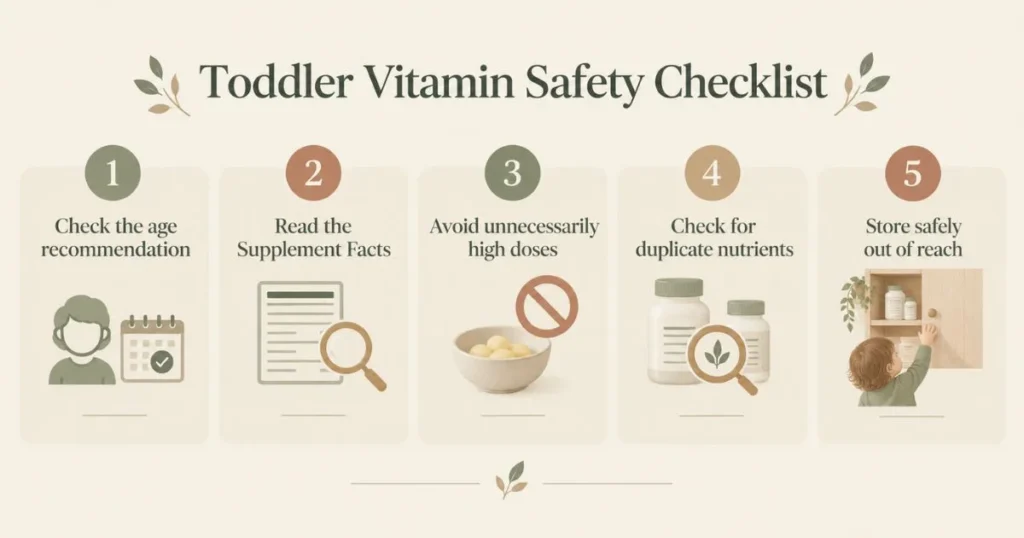
1. Check the Age Recommendation
Choose a product specifically intended for your child’s age.
A supplement designed for older children or adults may contain amounts that aren’t appropriate for a toddler.
2. Read the Supplement Facts Label
Look at:
- Serving size
- Amount of each nutrient
- Units such as mcg or mg
- Percentage of Daily Value
- Other ingredients
- Suggested use
- Age recommendations
Don’t rely solely on statements on the front of the package.
3. Look at the Amount of Each Nutrient
More isn’t automatically better.
Some nutrients can become harmful when consumed in excessive amounts. The AAP specifically warns that megadoses of vitamins such as A and D can cause toxic effects.
When choosing toddler vitamins, the goal is to find a supplement that fits your child’s actual nutritional needs rather than simply providing the largest possible dose.
4. Avoid Unnecessarily High Doses
Pay particular attention when a product contains high amounts of:
- Vitamin A
- Vitamin D
- Iron
- Zinc
Your toddler may also receive these nutrients from fortified foods or another supplement, so consider the total intake rather than looking at one bottle in isolation.
5. Consider Added Sugar and Sweeteners
Some toddler vitamins are designed to taste like candy.
Check the label for:
- Added sugars
- Sugar alcohols
- Artificial flavors
- Coloring agents
- Other ingredients your family prefers to avoid
A small amount of sugar doesn’t automatically make a supplement inappropriate, but it is reasonable to compare products.
6. Check the Other Ingredients
The active vitamins and minerals aren’t the whole story.
If your toddler has allergies or sensitivities, carefully review inactive ingredients as well.
If you’re considering a product containing herbs or other specialty ingredients, discuss it with your child’s healthcare professional rather than assuming “natural” means appropriate for toddlers.
7. Look for Appropriate Quality Verification
Dietary supplements aren’t regulated in exactly the same way as prescription medicines. The AAP notes that supplements don’t go through the same premarket approval process for safety and effectiveness as prescription drugs.
Some toddler vitamins may carry independent quality certifications or testing marks. Depending on the specific program, these may provide additional information about manufacturing practices or whether the product’s contents match the label.
However, third-party testing doesn’t mean a supplement is automatically necessary or appropriate for your child.
8. Choose an Age-Appropriate Form
The best form is one your child can take safely and according to the product’s instructions.
Toddler Multivitamins vs. Single-Nutrient Supplements
A multivitamin provides several vitamins, and in some cases minerals, in a single product.
A single-nutrient supplement focuses on one nutrient.
| Supplement Type | Main Purpose | Important Consideration |
| Multivitamin | Provides several nutrients | May not be necessary for every toddler |
| Vitamin D | Provides vitamin D | Total dietary and supplemental intake matters |
| Iron | Provides iron | Should be used carefully and appropriately |
| B12 | Provides vitamin B12 | Particularly relevant to some restrictive diets |
| Calcium | Provides calcium | Food is often an important source |
There is no universal “best toddler vitamin.”
The right choice depends on your child’s age, diet, nutritional gaps, health history, and professional recommendations.
Liquid, Chewable, Powder, or Gummy: Which Is Best?
The format matters, but it isn’t more important than the nutrient content and safety of the product.
Liquid Toddler Vitamins
Liquid supplements can be useful for children who cannot comfortably chew a tablet.
Measure liquid supplements carefully and follow the product’s dosing instructions exactly.
Powdered Supplements
Powders may be convenient when designed to be mixed into an appropriate food or drink.
Always follow the manufacturer’s directions rather than assuming you can add the product to any meal or beverage.
Chewable Vitamins
Chewables may work for children who can safely chew them and follow instructions.
Check the age recommendation carefully.
Gummy Vitamins
Gummies may be appealing to toddlers because they look and taste like candy.
That creates an important safety concern: your child may want more than the recommended serving.
Gummies can also contain added sugar and may have a sticky texture that isn’t ideal for teeth.
Most importantly, follow the individual product’s age recommendation and choking-safety instructions rather than assuming every gummy is appropriate for every toddler.
Are Toddler Vitamins Safe?
They can be appropriate when they’re actually needed and used correctly, but supplements aren’t risk-free.

Can Toddlers Get Too Many Vitamins?
Yes.
Excessive amounts of certain vitamins and minerals may lead to harmful effects.
The AAP specifically warns about high doses of vitamins A, C, and D, among others.
Fat-Soluble Vitamin Toxicity
Vitamins A, D, E, and K are fat-soluble vitamins, so the body processes and stores them differently from water-soluble vitamins.
Excessive intake can become a concern because some of these vitamins can accumulate in the body.
That’s why you should avoid giving your toddler several vitamin products without first checking their combined ingredients.
Why Iron Requires Special Care
Iron is an important nutrient, but excessive amounts can be harmful.
Never treat an iron-containing supplement like candy or assume that giving extra iron will make up for a poor meal.
If you think your toddler may not be getting enough iron, talk with your pediatrician.
Keep Vitamins Out of Reach
Keeping supplements safely out of reach is one of the simplest and most important steps you can take.
Store supplements somewhere your toddler cannot access them, even if the bottle has a child-resistant closure.
Teach your child that vitamins are medicine or supplements—not candy.
If your child accidentally takes more than the recommended amount, seek appropriate poison-control or emergency medical guidance promptly rather than waiting for symptoms.
Can Toddlers Get Enough Vitamins From Food?
For many healthy toddlers, food remains the foundation of nutrition.
You don’t need complicated recipes to provide nutritious meals.
A simple formula can help:
Protein + grain or starch + fruit or vegetable + healthy fat
For example:
- Egg + whole-grain toast + strawberries + avocado
- Lentils + rice + tomatoes + olive oil
- Yogurt + oats + berries + nut or seed butter in an age-appropriate form
- Chicken + sweet potato + broccoli + olive oil
Iron-Rich Toddler Breakfast
| Ingredient | Example Amount | Nutritional Contribution |
| Iron-fortified oats | ¼ cup | Iron and carbohydrates |
| Plain yogurt | ¼ cup | Calcium and protein |
| Mashed strawberries | 2 tbsp | Vitamin C |
| Smooth nut or seed butter | 1 tsp | Protein and healthy fats |
Simple Nutrient-Dense Toddler Lunch
| Ingredient | Example Amount | Nutritional Contribution |
| Cooked lentils | ¼ cup | Iron and protein |
| Soft rice | ¼ cup | Carbohydrates |
| Cooked vegetables | 2 tbsp | Vitamins and fiber |
| Olive oil | 1 tsp | Healthy fat |
Easy Toddler Snack
| Ingredient | Example Amount | Nutritional Contribution |
| Plain yogurt | ½ cup | Calcium and protein |
| Mashed banana | ½ | Carbohydrates and nutrients |
| Soft berries | 2–3 tbsp | Vitamin C |
| Ground chia seeds | Small amount | Fiber and healthy fats |
These are food ideas, not treatment plans. Portion sizes and food textures should be adapted to your child’s age, eating skills, and choking-safety needs.
When Should You Talk to Your Toddler’s Pediatrician?
Talk with your child’s healthcare professional if:
- Your toddler eats an extremely limited diet.
- Your child avoids entire food groups.
- You suspect a nutritional deficiency.
- Your child has a medical condition affecting nutrition.
- Your toddler follows a restrictive diet.
- You’re considering an iron supplement.
- You’re unsure whether your child needs vitamin D.
- You’re considering combining multiple supplements.
- You’re concerned about your child’s growth or development.
Your pediatrician may recommend dietary changes, a specific supplement, or further evaluation depending on your child’s situation.
Common Mistakes Parents Make With Toddler Vitamins
Assuming Every Toddler Needs a Multivitamin
Picky eating is common, but it doesn’t automatically mean your child has a deficiency.
Choosing Based on Marketing
Claims like “complete,” “immune boosting,” or “supercharged” do not tell you whether a product is suitable for your child.
Look at the actual Supplement Facts label instead.
Giving Too Much
More of a vitamin or mineral does not necessarily mean more benefit for your child.
With some nutrients, excess intake can be harmful.
Combining Multiple Supplements
Your toddler may receive the same nutrient from several sources.
Check the labels before combining supplements, and consult your healthcare professional if you are unsure.
Treating Gummies Like Candy
Even if a gummy tastes like a treat, it is still a supplement.
Keep it securely stored and follow the recommended serving.
Frequently Asked Questions About Toddler Vitamins
Do toddlers need vitamins every day?
Not every toddler needs a daily multivitamin. Toddlers who eat a varied, balanced diet can often get the nutrients they need from food alone. Supplements may be appropriate when dietary intake is restricted, a deficiency is identified, or a medical condition increases nutritional needs.
What are the best toddler vitamins?
There isn’t one best toddler vitamin for every child. The appropriate supplement depends on your toddler’s age, diet, nutritional needs, and health history. Instead of choosing based only on brand or marketing, look at the nutrient amounts, age recommendation, ingredients, and serving instructions.
What vitamins do toddlers need?
Toddlers need a variety of vitamins and minerals. Vitamin D, iron, and zinc are among the nutrients highlighted by the CDC for young children. Calcium, vitamin A, vitamin C, and B vitamins are also important parts of a varied diet.
Should picky eaters take toddler vitamins?
Not necessarily. Picky eating is common in toddlerhood. However, if your child’s diet is extremely limited or excludes entire food groups, speak with a pediatrician about whether nutritional assessment or supplementation is appropriate.
Can toddlers take adult vitamins?
You shouldn’t assume an adult vitamin is appropriate for a toddler. Adult products may contain different nutrient amounts or doses. Choose products specifically labeled for your child’s age and discuss supplementation with your child’s healthcare professional.
Are gummy vitamins safe for toddlers?
Some gummy products may be appropriate for young children when they are specifically labeled for that age and used as directed. However, gummies can pose concerns related to chewing, choking, added sugar, and accidental overconsumption. Always follow the individual product’s age and safety instructions.
Should toddlers take iron supplements?
Iron is an essential nutrient, but your toddler shouldn’t automatically receive an iron supplement. Iron supplementation should be based on your child’s nutritional situation and professional guidance, particularly because excessive iron can be harmful.
Can toddler vitamins replace healthy food?
No. Supplements can provide specific nutrients, but they don’t replace the broad nutritional value of a varied diet. Continue offering balanced meals and snacks even when your child takes a supplement.
How do I choose the right toddler vitamins?
Start with your child’s needs rather than the product. Check the recommended age, review the Supplement Facts label, compare nutrient amounts, avoid unnecessarily high doses, consider the added ingredients, and make sure you are not accidentally getting the same nutrient from multiple sources.
Conclusion: Choosing Toddler Vitamins With Confidence
Choosing toddler vitamins doesn’t have to become another source of anxiety.
Your child doesn’t need to eat perfectly every single day. Toddlers naturally have changing appetites, strong preferences, and periods when their favorite food seems to be the only food worth eating.
Start with the bigger picture.
Offer a variety of nutritious foods. Keep meals relaxed. Continue exposing your toddler to different tastes and textures. Pay attention to the overall eating pattern rather than one difficult dinner.
If your toddler has a very limited diet, avoids entire food groups, has a medical condition, or may have a nutritional deficiency, that’s when toddler vitamins may become useful.
And when you do choose toddler vitamins, look beyond the colorful packaging. Check the age recommendation, nutrient amounts, serving size, and ingredients. Avoid assuming that a higher dose is better, and keep supplements safely out of your child’s reach.
Most importantly, you don’t have to figure it out alone.
If you’re unsure whether your toddler needs a vitamin or which nutrient deserves attention, bring your questions to your pediatrician or a qualified dietitian. A personalized recommendation is far more useful than choosing toddler vitamins simply because another child takes them.
Your goal isn’t to create a perfect eater. It’s to give your toddler a strong nutritional foundation and use supplements thoughtfully when they are genuinely needed.